SUMMER TRAINING
  PRESENTATION


                  1
Summer Training
The Summer Training is an integral part of
MBA/BBA programme and aims at achieving the
following objectives:
   Application of knowledge and techniques learnt in the first
    year to real business problems and to test out and enrich
    one’s understanding, knowledge and skills.
   Gives an insight into the working of the real organizations.
   Gaining deeper understanding in specific functional areas.
   Appreciating the linkages among different functions and
    developing a realistic managerial perspective about
    organizations in their totality.
   Helps in exploring career opportunities in their areas of
    interest.


                                                               2
Do’s and Don’ts in the Organization

   Do’s-
       Punctuality (timeliness),
       Maintaining healthy and cordial relationship with
        the people in organization.
       Understanding the work culture.
       Obeying direct orders from the seniors.
       Showing a sense of belonging with the
        organization.
       Maintaining proper Line and Staff Relationship
        with the seniors and subordinates (If Any).

                                                        3
Do’s and Don’ts in the Organization

   Don’ts
       Do not take the training lightly and casually.
       Do not give an impression that you are doing the training
        just for the sake of it. Put your heart and soul.
       Do not involve in internal politics.
       Do not reveal you weaknesses.
       Do not lie to your seniors.
       Do not waste your time.
       Do not copy any material. Be original.
       Do not go for leave unless it is indispensable.
       Do not ask for favours.

                                                                4
   Each Student would be having 2 guides:
    Faculty Guide
    Industry Guide
   Should be in touch continuously with faculty guide.
   A letter must be produced by student to Faculty Guide with in
    one week of joining the company.


                                                                    5
 As a part of training, the students are required to submit a
Project Report and give a presentation to the organization, if
necessary. Also, they may be required to submit a project report to
the organization.

 The Report, Presentation on project report and Viva on Project
Report are the basis for evaluation of the Summer Internship.


The project must provide sufficient indication that the student is
competent in successful application of acquired management tools
and skills to practical problems of industry.


                                                                      6
Guidelines for Summer Training
       Each student will make three copies of project report in the
        recommended format. One copy is to be submitted to the faculty
        guide individually. The students will keep one copy of the project
        for their further reference in future and one copy to the
        organization where they have done their summer training (if
        required).
       All the students are required to follow the following instruction.
          There should not be any deviation from requirement of
           reproducing the cover page of the report from the format
           prescribed below.
          Students should prepare an outline – “framework on which long
           written works are constructed.”
          Preparation of the rough draft.
          Rewriting and Polishing the rough draft.
          Bibliography


                                                                         7
Prescribed Cover Page and Guidelines
   The cover page must be spiral bound.
   All the students are required to use the uniform font
    and format (except in heading and subheadings)
    through out the text of the report. For example, if
    anybody uses “Times New Roman” of font size 12 in
    the text, then he/she will be using the same through
    out the report.
   The project report must accompany a certificate
    authenticating the originality of the work done in the
    prescribed format, as indicated below.


                                                         8
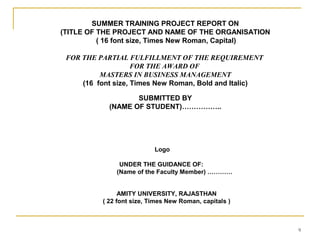
SUMMER TRAINING PROJECT REPORT ON
(TITLE OF THE PROJECT AND NAME OF THE ORGANISATION
          ( 16 font size, Times New Roman, Capital)

 FOR THE PARTIAL FULFILLMENT OF THE REQUIREMENT
                    FOR THE AWARD OF
          MASTERS IN BUSINESS MANAGEMENT
     (16 font size, Times New Roman, Bold and Italic)

                   SUBMITTED BY
            (NAME OF STUDENT)……………..


                           Logo

               UNDER THE GUIDANCE OF:
              (Name of the Faculty Member) …………


                AMITY UNIVERSITY, RAJASTHAN
          ( 22 font size, Times New Roman, capitals )


                                                        9
Certificate by Industry Guide

This is to certify that the project work done on (Title) is a
bonafide work carried out by Mr./Ms.--------------- under my
supervision and guidance. The project report is submitted
towards the partial fulfillment of 2 – year, full time Masters of
Business Administration Programme.

This work has not been submitted anywhere else for any other
degree/diploma. The original work was carried during --------to
----- in (Name of the organization).


Name & Sign of Industry Guide

Date:                                  Name & Sign of Faculty


                                                                10
REPORT STRUCTURE
   Cover and Title page
   Company’s Certificate of Completion of Project should bear
    signature and the stamp of the officer concerned in the
    organization where the student has under gone training.
   Certificate by faculty guide that the work is unique.
   Acknowledgement
   Declaration given by the student
   Abstract
   Table of contents (with consecutive numbering)
   Introduction
   Literature review
   Research Methodology
   Results and Discussion
   Conclusion & Recommendations
   Implications for future research
                                                            11
   Appendices
   References


                 12
Introduction
1.1 Introduction of the organization
       a) Aim & Establishment of the company
        1.   When was it established and by whom?
        2.   Vision, mission, goals, aims and the policies developed
        3.   Its position/stage in the life cycle.
        4.   Types of services/products given/produced
      b) Departments of the Company
        1.   Organizational chart showing the different departments
        2.   One paragraph about each of the departments explaining
             their functions within the company.
1.2 Objective of the study


                                                                       13
Industry review
This section for the summer training report would mean writing about
the ways in which the organizational realities are similar or different
from theory. The management theory dealt with in the report must be
written in detail. The review may be of the following:
 1. The Background
 2. The Promoters
 3. The Company and its Product line
 4. Features of the Product
 5. Marketing strategies
 6. Competitors
 7. Govt. Policies
 8. Taxation aspects
 9. Major problems
 10. Achievements
 11. Share Market Position
 12. National and International Image
 13. Future Prospects


                                                                     14
Research Methodology


I. Research Design.
II. Sampling Design, (Simple Random Sampling, Cluster
     Sampling, Systematic Sampling, Stratified Sampling,
     Convenience Sampling, Judgmental Sampling)
III. Sources of data (Primary or/and Secondary data).
IV. Data Collection tools/instruments.
V. Methods of data collection.


                                                           15
Appendix / Annexure
If the student uses any table/graph/ Figure, then it is to be numbered
and source of information from which it is collected, is to be
mentioned under each.

Bibliography:

Books:
Author (S) e.g. If Author name is Stephen Robbins, then it will be
written as Robbins Stephen.
Title, Place of Publication, Publisher, Date (year) of publication,
Number of pages referred from “------- to -------“.
Magazine & Journals/ Newspaper
Author(S), Title, Volume Number, Serial Number, Date of issue,
Page number
Internet:
Name of the site, Article Name, Name of the Author, date of the site
visited.

                                                                       16
ANNEXURE/ APPENDICES
     Original data
     Long Tables
     Questionnaires & Letters
     Schedules or forms used in collecting data
     Internet Printout
     Industry Printout

Typing Instructions:
       Paper A4 Size
       Margins Left = 1.5 inch, Right = 1 inch
       Spacing within a sentence: Double
       Between words: 1 space
       After a colon:     2 spaces
       After a semi colon: 2 spaces
       After a comma: 1 space
       After a full stop: 2 spaces


                                                  17
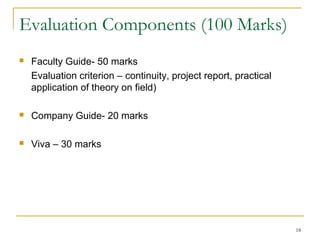
Evaluation Components (100 Marks)
   Faculty Guide- 50 marks
    Evaluation criterion – continuity, project report, practical
    application of theory on field)

   Company Guide- 20 marks

   Viva – 30 marks


                                                                   18
Thank You


            19

Summer training guidelines ppt

  • 1.
    SUMMER TRAINING PRESENTATION 1
  • 2.
    Summer Training The SummerTraining is an integral part of MBA/BBA programme and aims at achieving the following objectives:  Application of knowledge and techniques learnt in the first year to real business problems and to test out and enrich one’s understanding, knowledge and skills.  Gives an insight into the working of the real organizations.  Gaining deeper understanding in specific functional areas.  Appreciating the linkages among different functions and developing a realistic managerial perspective about organizations in their totality.  Helps in exploring career opportunities in their areas of interest. 2
  • 3.
    Do’s and Don’tsin the Organization  Do’s-  Punctuality (timeliness),  Maintaining healthy and cordial relationship with the people in organization.  Understanding the work culture.  Obeying direct orders from the seniors.  Showing a sense of belonging with the organization.  Maintaining proper Line and Staff Relationship with the seniors and subordinates (If Any). 3
  • 4.
    Do’s and Don’tsin the Organization  Don’ts  Do not take the training lightly and casually.  Do not give an impression that you are doing the training just for the sake of it. Put your heart and soul.  Do not involve in internal politics.  Do not reveal you weaknesses.  Do not lie to your seniors.  Do not waste your time.  Do not copy any material. Be original.  Do not go for leave unless it is indispensable.  Do not ask for favours. 4
  • 5.
    Each Student would be having 2 guides: Faculty Guide Industry Guide  Should be in touch continuously with faculty guide.  A letter must be produced by student to Faculty Guide with in one week of joining the company. 5
  • 6.
     As apart of training, the students are required to submit a Project Report and give a presentation to the organization, if necessary. Also, they may be required to submit a project report to the organization.  The Report, Presentation on project report and Viva on Project Report are the basis for evaluation of the Summer Internship. The project must provide sufficient indication that the student is competent in successful application of acquired management tools and skills to practical problems of industry. 6
  • 7.
    Guidelines for SummerTraining  Each student will make three copies of project report in the recommended format. One copy is to be submitted to the faculty guide individually. The students will keep one copy of the project for their further reference in future and one copy to the organization where they have done their summer training (if required).  All the students are required to follow the following instruction.  There should not be any deviation from requirement of reproducing the cover page of the report from the format prescribed below.  Students should prepare an outline – “framework on which long written works are constructed.”  Preparation of the rough draft.  Rewriting and Polishing the rough draft.  Bibliography 7
  • 8.
    Prescribed Cover Pageand Guidelines  The cover page must be spiral bound.  All the students are required to use the uniform font and format (except in heading and subheadings) through out the text of the report. For example, if anybody uses “Times New Roman” of font size 12 in the text, then he/she will be using the same through out the report.  The project report must accompany a certificate authenticating the originality of the work done in the prescribed format, as indicated below. 8
  • 9.
    SUMMER TRAINING PROJECTREPORT ON (TITLE OF THE PROJECT AND NAME OF THE ORGANISATION ( 16 font size, Times New Roman, Capital) FOR THE PARTIAL FULFILLMENT OF THE REQUIREMENT FOR THE AWARD OF MASTERS IN BUSINESS MANAGEMENT (16 font size, Times New Roman, Bold and Italic) SUBMITTED BY (NAME OF STUDENT)…………….. Logo UNDER THE GUIDANCE OF: (Name of the Faculty Member) ………… AMITY UNIVERSITY, RAJASTHAN ( 22 font size, Times New Roman, capitals ) 9
  • 10.
    Certificate by IndustryGuide This is to certify that the project work done on (Title) is a bonafide work carried out by Mr./Ms.--------------- under my supervision and guidance. The project report is submitted towards the partial fulfillment of 2 – year, full time Masters of Business Administration Programme. This work has not been submitted anywhere else for any other degree/diploma. The original work was carried during --------to ----- in (Name of the organization). Name & Sign of Industry Guide Date: Name & Sign of Faculty 10
  • 11.
    REPORT STRUCTURE  Cover and Title page  Company’s Certificate of Completion of Project should bear signature and the stamp of the officer concerned in the organization where the student has under gone training.  Certificate by faculty guide that the work is unique.  Acknowledgement  Declaration given by the student  Abstract  Table of contents (with consecutive numbering)  Introduction  Literature review  Research Methodology  Results and Discussion  Conclusion & Recommendations  Implications for future research 11
  • 12.
    Appendices  References 12
  • 13.
    Introduction 1.1 Introduction ofthe organization a) Aim & Establishment of the company 1. When was it established and by whom? 2. Vision, mission, goals, aims and the policies developed 3. Its position/stage in the life cycle. 4. Types of services/products given/produced b) Departments of the Company 1. Organizational chart showing the different departments 2. One paragraph about each of the departments explaining their functions within the company. 1.2 Objective of the study 13
  • 14.
    Industry review This sectionfor the summer training report would mean writing about the ways in which the organizational realities are similar or different from theory. The management theory dealt with in the report must be written in detail. The review may be of the following: 1. The Background 2. The Promoters 3. The Company and its Product line 4. Features of the Product 5. Marketing strategies 6. Competitors 7. Govt. Policies 8. Taxation aspects 9. Major problems 10. Achievements 11. Share Market Position 12. National and International Image 13. Future Prospects 14
  • 15.
    Research Methodology I. ResearchDesign. II. Sampling Design, (Simple Random Sampling, Cluster Sampling, Systematic Sampling, Stratified Sampling, Convenience Sampling, Judgmental Sampling) III. Sources of data (Primary or/and Secondary data). IV. Data Collection tools/instruments. V. Methods of data collection. 15
  • 16.
    Appendix / Annexure Ifthe student uses any table/graph/ Figure, then it is to be numbered and source of information from which it is collected, is to be mentioned under each. Bibliography: Books: Author (S) e.g. If Author name is Stephen Robbins, then it will be written as Robbins Stephen. Title, Place of Publication, Publisher, Date (year) of publication, Number of pages referred from “------- to -------“. Magazine & Journals/ Newspaper Author(S), Title, Volume Number, Serial Number, Date of issue, Page number Internet: Name of the site, Article Name, Name of the Author, date of the site visited. 16
  • 17.
    ANNEXURE/ APPENDICES Original data Long Tables Questionnaires & Letters Schedules or forms used in collecting data Internet Printout Industry Printout Typing Instructions: Paper A4 Size Margins Left = 1.5 inch, Right = 1 inch Spacing within a sentence: Double Between words: 1 space After a colon: 2 spaces After a semi colon: 2 spaces After a comma: 1 space After a full stop: 2 spaces 17
  • 18.
    Evaluation Components (100Marks)  Faculty Guide- 50 marks Evaluation criterion – continuity, project report, practical application of theory on field)  Company Guide- 20 marks  Viva – 30 marks 18
  • 19.