Summer Skin CareDr. Heidi LaForge
Program Overview1. Prevention of sun damage— a look into 	the newest products for protecting 	yourself against the suns damaging rays2. Skin cancers — What do they look like 	and how are they treated. 3. Improving the look of your skin — 	products that enhance your natural 	beauty
SunglassesLook for UV-protection details on product labelsChoose Sunglasses that block 99 to 100 percent of both UVA and UVB raysSkip sunglasses that are labeled cosmetic or those that don’t offer details on UV protectionOpt for larger lenses as the suns rays are reflected from all around you
Other considerations in sunglassesBlue blocking lenses — generally tinted amber and make objects in the distance easier to see but can make it difficult to distinguish the colors of traffic lightsPolarized lenses — reduce glare Photocromiclenses — adjust the level of protection based on the amount of light available (transition lenses) caution…these take time to adjustPolycarbonate lenses — are more resistant to impact or falls
CautionRemember - unless they specifically state that they are UV  protective…fancy lenses are just fancy lenses but the goal of sunglasses is SUN PROTECTION.
SunscreenSunscreens help shield you from the sun’s dangerous ultraviolet (UV) rays in two ways.  Some work by scattering the light, reflecting it away from your body.  Others absorb the UV rays before they reach your skin.
SunscreenRemember that picking the right sunscreen is only half of the battle.  Using it correctly is even more important.  Apply often and after swimming, sweating or strenuous activity.  For most people picking an SPF 30 or above is best…but as we will learn…ingredients do make a difference.
Sunscreen (continued)A few years ago, choosing a good sunscreen meant you just looked for a high sun protection factor (SPF)— which rates how well the sunscreen protects against one type of skin cancer causing UV rays (ultraviolet B) or UVB rays.  SPF refers to blockage of UVB rays only…the bad part is that research is showing that UVA rays also increase skin cancers.
Sunscreen and UVA raysWhile UVA rays do not cause sunburns, they do penetrate deeply into the skin and cause wrinkles, pigment changes and alter cellular structure and development leading to certain types of skin cancer.   The Environmental Protection Agency estimates that up to 90% of skin changes associated with aging are really caused by a lifetimes exposure to UVA rays.
So what sunscreen is right for you?A sunscreen with broad spectrum protection for both UVA and UVB.The SPF factor rates how effective the sunscreen is in preventing sunburn caused by UVB rays.  If you would normally burn in 15 minutes then SPF 15 multiplies that by a factor of 15.  This means you could go 150 minutes before burning.
Sunscreen confusion Contrary to what you might think…SPF 30 is not twice as strong as SPF 15.  While SPF 15 filters out 93% of UVB, SPF 30 only filters 97%, only a slight improvement.  There is no rating for how well a sunscreen is blocking UVA rays…so pay attention to the ingredients
Best Sunscreen ingredientsEcamsuleAvobenzone (helioplex)Titanium dioxide Zinc oxideMexoryl“Driving my Benz to Mexico before I  dioxide”
Sunscreen The next generation of sunscreens are just hitting the market— including L’Oreal’s Anthelios SX containing mexoryl and products containing Helioplex (avobenzone).  These sunscreens are designed to protect you against both UVA and UVB rays.  Currently in the US there are 100 types of sunscreen available for consumers to buy.  Given all of these options…how do you know which is the best sunscreen for you?
EcamsuleNew ingredient to block UVA rays.  It has been available in Europe and Canada since 1993 as Mexoryl SX.  In the US it is sold in L’Oreal’s Anthelios SX products.  It is not cheap.  A 3.4 oz tube (enough for four full body applications) will run $30!
AvobenzoneAvailable in Neutrogena’s Helioplex but in this sunscreen the product is not water or sweat-resistant…so it washes off…not bad but you need to apply often. This reminds you to look at all of the benefits…you want high SPF, UVA protection and it needs to be sweat proof…after all the sun is usually warm.
Titanium dioxide and zinc oxideLess expensive options for UVA protection and have been available for a long time.  These have a tendency to make skin appear more white.  Cost vs. Aesthetics on this one. Also do not use these products in spray or powder form…zinc and titanium cause lung inflammation.
Hall of ShameAnything that states it is waterproof instead of water resistant…says a lot about the other claims it makes.  Most things are water soluble and thus apply often.Oxybenzone— high doses can get into the blood stream and resemble estrogen molecules…no great data out there for what this does but there are safer products without this concern. RetinylPalmitate— Speeds up the growth of skin tumors in one study done on rats…no great data yet.  Was initially put in sun screen because it has been shown to smooth fine lines and wrinkles…the jury is out …but I am avoiding it like the plague.
Buyer BewareSunscreen makers are not required to verify that their sunscreens work, test for SPF protection, check waterproof claims or provide UVA protection. This year six in 10 high SPF sunscreens do not have enough UVA protection to be sold in Europe.
Best Products for the Moneyon Amazon.com1. 	L’OrealOmbrelle Sunscreen with Mexoryl SPF 45.  $24-$302. AveenoBaby Natural Protection Mineral Block Face 	Stick, SPF 50 contains Titanium Dioxide&  Zinc Oxide. $63. 	Blue Lizard Australian suncream SPF 30 contains zinc oxide. 	$10.4. 	California Baby (have 7 products with protection at 	various SPF’s) contains Titanium dioxide. $175. 	Badger Unscented SPF 30 contains zinc oxide. $136. 	Neutrogena Age Shield  with avobenzone. $107. Skinceuticals(contains both avobeznone and ecamsule). 	$21
What would I BuyIf I was going on a vacation to the Caribbean: Skinceuticals— great stuff but pricey (best price on Amazon).  You can only travel with 3 oz. anyway. If I needed a sunscreen to use frequently —Neutrogena  Age Shield.  It is easy to find and in most pharmacies and grocery stores.
Other Sun Products to RememberMakeup — most makeup lines have an SPF formula.  I love Revlon Color stay SPF 15. Contains titanium dioxide for added UVA protection as well.  Zinc oxide is a major ingredient however in most mineral makeupsLip Balm — The higher the SPF the better…this skin is thinner and more fragile.  I love Clinique Long Last Glosswear with SPF 15. The best ones have zinc oxide or titanium oxide. Shower Gels — Soliceis a new product designed to add SPF (UVB protection only) to your daily routine.   Can be found on Amazon.com.
Sunless TanningHow they work — Theactive ingredient is typically dihydroxyacetone (DHA), which reacts with amino acids on the outermost top layer of the skin to produce a tan color without the sun.  Look for DHA on the label.Is it Safe — Yes, studies states that it is not linked to skin cancer in lotions and gel forms (inhalation of spray tanning has not been studied)
Sunless Tanners Remember sunless tanners to do not protect against the sun unless they have SPF on the outside of the bottle and then only protect you the day that you applied the lotion.  If DHA only works through a chemical reaction with surface amino acids…it is important to exfoliate before application to remove dead skin cells that will likely slough by themselves soon to prevent too much streaking.
Sunless TanningBest products:Clinique Sunless Tanning (for light and dark skin tones)L’Oreal Soleil Tanning Gel (natural color but gels are more drying than lotions)Coppertone gradual tan (slight tanning smell but gradual color prevents mistakes or streaking)Tan Perfect (the darkest color but will rub off on your clothes)
Skin Cancer FactsSkin cancer is the most common form of cancer in the United States. More than two million people are diagnosed annually.Each year there are more new cases of skin cancer than the incidence of cancers of the breast, prostate, lung and colon combined!One in five Americans will develop skin cancer in the course of a lifetime.
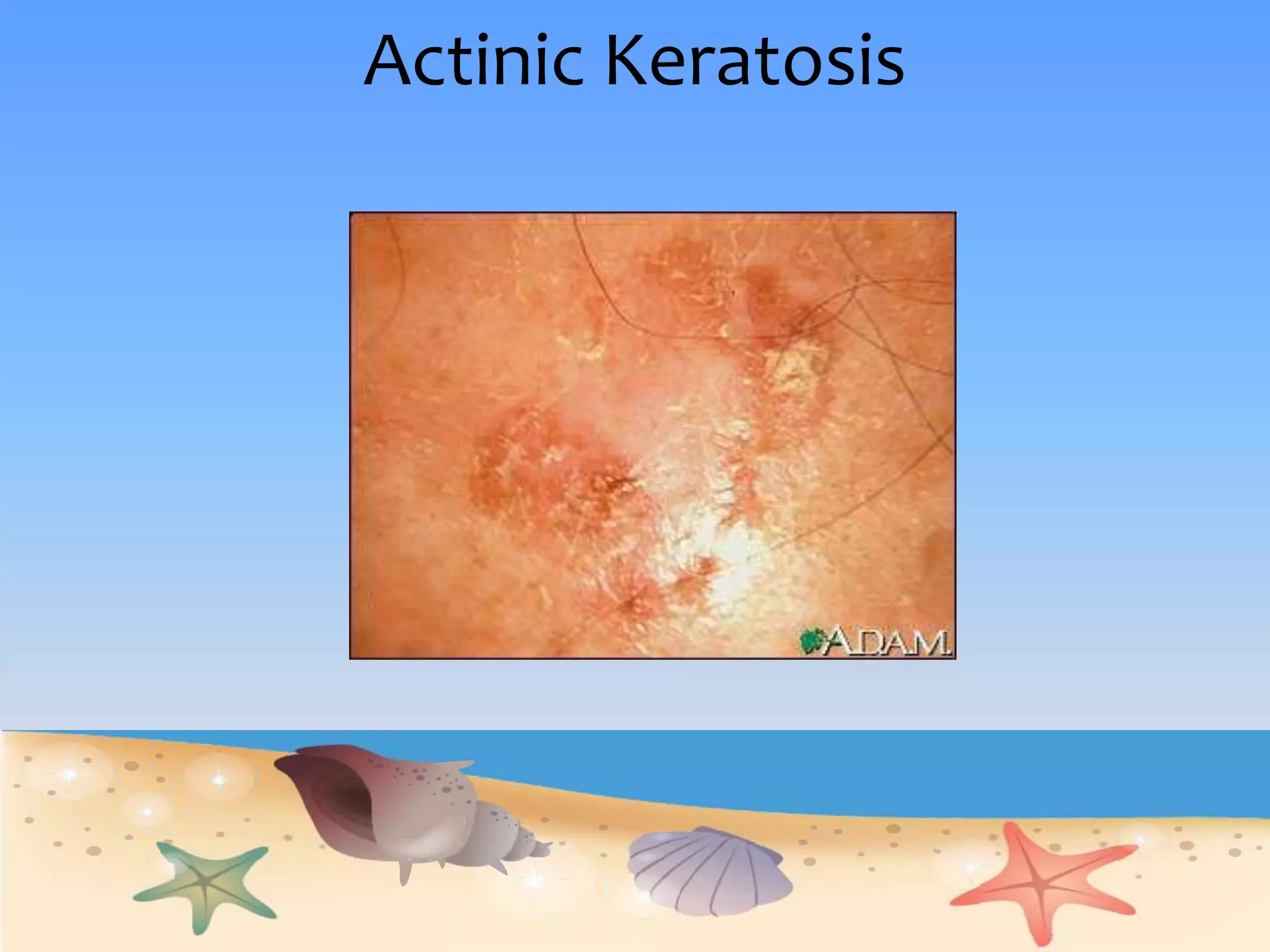
Pre-cancerActinic keratosis is the most common precancer; it affects more than 58 million Americans.Approximately 65 percent of all squamous cell carcinomas arise in lesions that previously were diagnosed as actinic Keratosis. In patients with a history of two or more skin cancers, 36 percent of basal cell carcinomas arise in lesions previously diagnosed as actinic Keratosis.
Actinic Keratosis
Basal Cell CarcinomaBasal cell carcinoma (BCC) is the most common form of skin cancer, affecting approximately two million Americans each year
More than one out of every three new cancers are skin cancers, and the vast majority are basal cell carcinomas.
These cancers arise in the basal cells, which line the deepest layer of the epidermis (top skin layer).Basal CellAn open sore that bleeds, oozes, or crusts and remains open for a few weeks only to heal up and then bleed again. A persistent, non–healing sore is a very common sign of an early basal cell carcinoma.
Basal CellA Pink Growth with a slightly elevated rolled border and a crusted indentation in the center. As the growth slowly enlarges, tiny blood vessels may develop on the surface.
Squamous Cell Carcinoma More than 700,000 new cases of squamous cell carcinoma (SCC) are diagnosed every year. That makes it the second most common skin cancer (after basal cell carcinoma).
 This form of skin cancer arises in the squamous cells that make up most of the skin’s upper layers (epidermis).
  Squamous cell carcinomas occur in areas frequently exposed to the sun, such as the rim of the ear, lower lip, face, bald scalp, neck, hands, arms and legs. Squamous Cell CancerA persistent, scaly red patch with irregular borders that sometimes crusts or bleeds.
MelanomaOne person dies of melanoma every 62 minutes.One in 55 people will be diagnosed with melanoma during their lifetime.Melanoma is the most common form of cancer for young adults 25-29 years old and the second most common form of cancer for young people 15-29 years old.The survival rate for patients whose melanoma is detected early, before the tumor has penetrated the skin, is about 99 percent.
Melanoma Pictures
The Warning SignsA skin growth that increases in size and appears pearly, translucent, tan, brown, black, or multicolored
A mole, birthmark, beauty mark, or any brown spot that: changes color increases in size or thickness changes in texture is irregular in outline is bigger than 6mm or 1/4”, the size of a pencil eraser 	appears after age 21 A spot or sore that continues to itch, hurt, crust, scab, erode, or bleed
An open sore that does not heal within three weeks Aging and Sun DamageUp to 90 percent of the visible changes commonly attributed to aging are caused by the sun.Contrary to popular belief, 80 percent of a person’s lifetime sun exposure is not acquired before age 18; only about 23 percent of lifetime exposure occurs by age 18.There Is Still Hope
How Do I look Better NowEmbrace your Inner beauty, protect your skin from this point on.Self Tan (wash your hands and feet)Wear Makeup— at home, in the grocery store…everyday is a day to be beautifulExplore your options for improved appearance…Botox, dermal fillers and laser treatments.
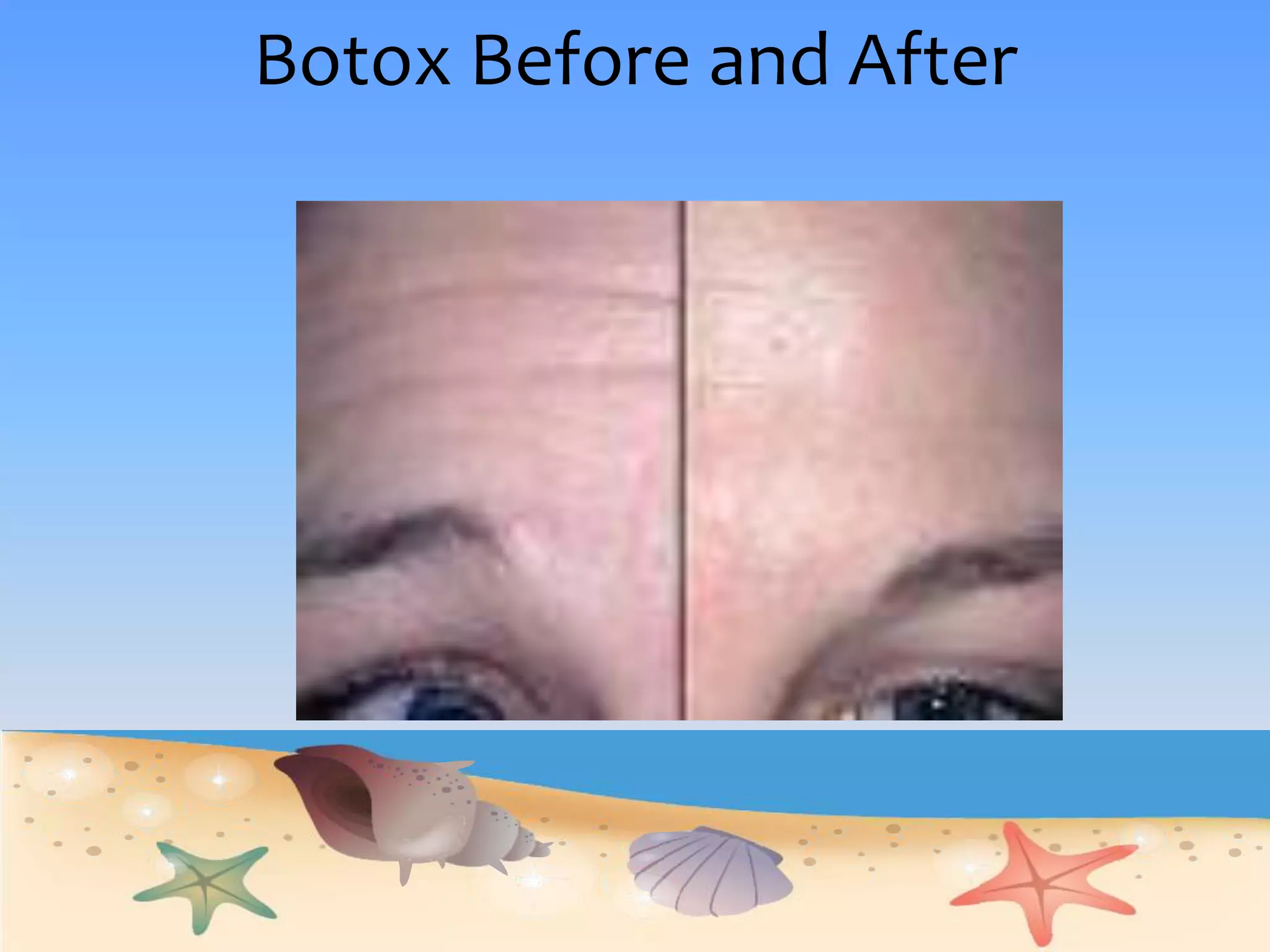
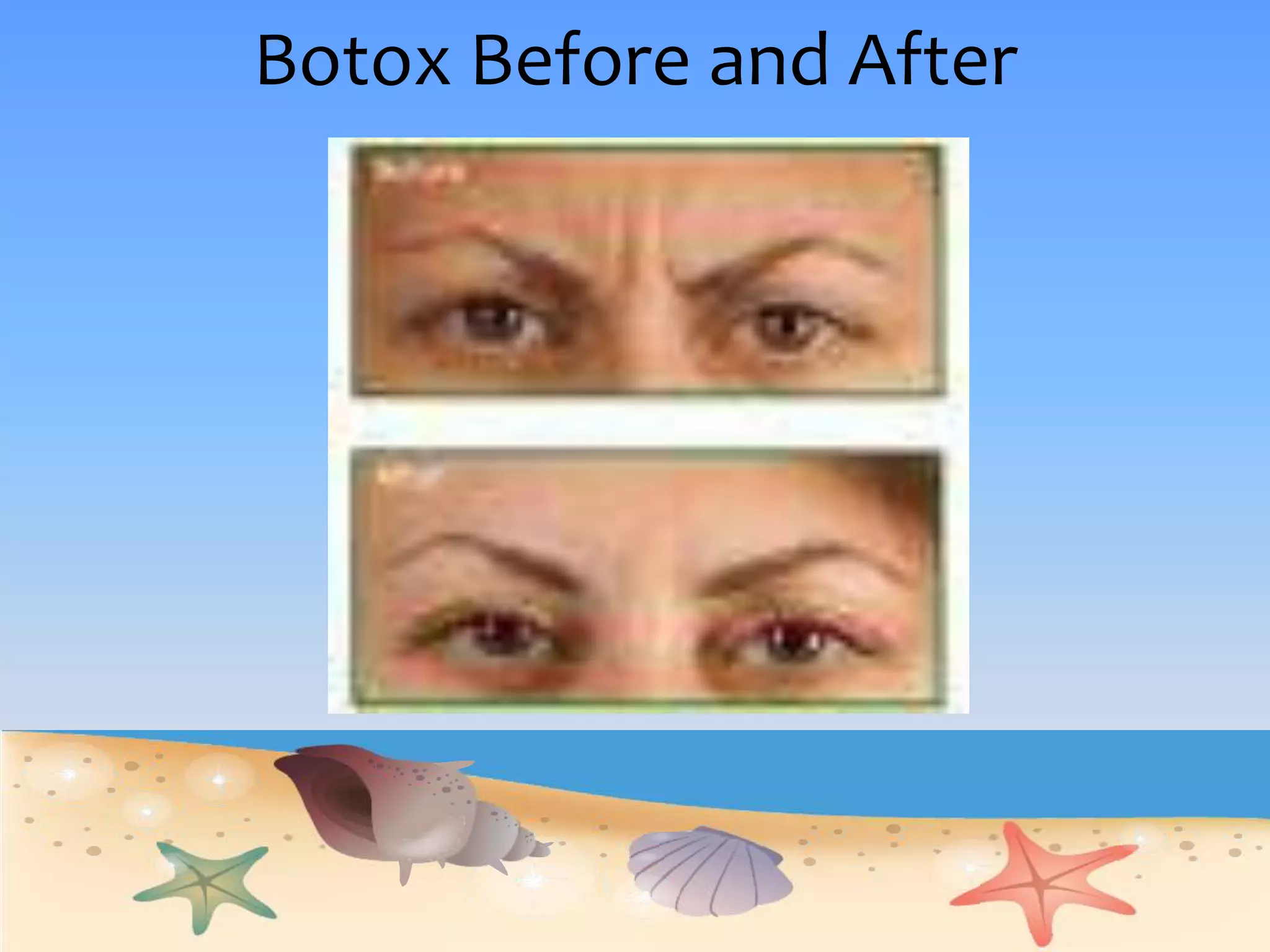
BOTOXBotulism toxin (BOTOX®) is a material that has been known for over a century and used for medical purposes for more than 50 years. In 2002, it was approved for improving and relaxing frown lines in the area between the eyes on the forehead.  Since 2002, BOTOX  has been used successfully in more than half a million patients.
How Does Botox WorkBotox works by blocking a chemical that aids in muscle contraction called acetylcholine When the nerve sends a signal to the muscle to contract, acetylcholine is released as before, but it can't bind anywhere on the muscle due to the BotoxThe muscle has no idea it is supposed to contract. It is essentially paralyzed, but not because the muscle  or the nerve have been damaged.Reminder…Botox takes 72 hours to reach maximum effect….be patient because beauty takes time.
Benefits of BOTOXLong-LastingVisible results have been shown to last up to 4 months (most 3 months) Your own results may vary.Non-Surgical with No DowntimeIt’s a simple, nonsurgical, 10-minute procedure with no downtime. Often called a “lunchtime procedure”, treatment requires no recovery.
Botox Before and After

Summer Skin Care

  • 1.
    Summer Skin CareDr.Heidi LaForge
  • 2.
    Program Overview1. Preventionof sun damage— a look into the newest products for protecting yourself against the suns damaging rays2. Skin cancers — What do they look like and how are they treated. 3. Improving the look of your skin — products that enhance your natural beauty
  • 3.
    SunglassesLook for UV-protectiondetails on product labelsChoose Sunglasses that block 99 to 100 percent of both UVA and UVB raysSkip sunglasses that are labeled cosmetic or those that don’t offer details on UV protectionOpt for larger lenses as the suns rays are reflected from all around you
  • 4.
    Other considerations insunglassesBlue blocking lenses — generally tinted amber and make objects in the distance easier to see but can make it difficult to distinguish the colors of traffic lightsPolarized lenses — reduce glare Photocromiclenses — adjust the level of protection based on the amount of light available (transition lenses) caution…these take time to adjustPolycarbonate lenses — are more resistant to impact or falls
  • 5.
    CautionRemember - unlessthey specifically state that they are UV protective…fancy lenses are just fancy lenses but the goal of sunglasses is SUN PROTECTION.
  • 6.
    SunscreenSunscreens help shieldyou from the sun’s dangerous ultraviolet (UV) rays in two ways. Some work by scattering the light, reflecting it away from your body. Others absorb the UV rays before they reach your skin.
  • 7.
    SunscreenRemember that pickingthe right sunscreen is only half of the battle. Using it correctly is even more important. Apply often and after swimming, sweating or strenuous activity. For most people picking an SPF 30 or above is best…but as we will learn…ingredients do make a difference.
  • 8.
    Sunscreen (continued)A fewyears ago, choosing a good sunscreen meant you just looked for a high sun protection factor (SPF)— which rates how well the sunscreen protects against one type of skin cancer causing UV rays (ultraviolet B) or UVB rays. SPF refers to blockage of UVB rays only…the bad part is that research is showing that UVA rays also increase skin cancers.
  • 9.
    Sunscreen and UVAraysWhile UVA rays do not cause sunburns, they do penetrate deeply into the skin and cause wrinkles, pigment changes and alter cellular structure and development leading to certain types of skin cancer. The Environmental Protection Agency estimates that up to 90% of skin changes associated with aging are really caused by a lifetimes exposure to UVA rays.
  • 10.
    So what sunscreenis right for you?A sunscreen with broad spectrum protection for both UVA and UVB.The SPF factor rates how effective the sunscreen is in preventing sunburn caused by UVB rays. If you would normally burn in 15 minutes then SPF 15 multiplies that by a factor of 15. This means you could go 150 minutes before burning.
  • 11.
    Sunscreen confusion Contraryto what you might think…SPF 30 is not twice as strong as SPF 15. While SPF 15 filters out 93% of UVB, SPF 30 only filters 97%, only a slight improvement. There is no rating for how well a sunscreen is blocking UVA rays…so pay attention to the ingredients
  • 12.
    Best Sunscreen ingredientsEcamsuleAvobenzone(helioplex)Titanium dioxide Zinc oxideMexoryl“Driving my Benz to Mexico before I dioxide”
  • 13.
    Sunscreen The nextgeneration of sunscreens are just hitting the market— including L’Oreal’s Anthelios SX containing mexoryl and products containing Helioplex (avobenzone). These sunscreens are designed to protect you against both UVA and UVB rays. Currently in the US there are 100 types of sunscreen available for consumers to buy. Given all of these options…how do you know which is the best sunscreen for you?
  • 14.
    EcamsuleNew ingredient toblock UVA rays. It has been available in Europe and Canada since 1993 as Mexoryl SX. In the US it is sold in L’Oreal’s Anthelios SX products. It is not cheap. A 3.4 oz tube (enough for four full body applications) will run $30!
  • 15.
    AvobenzoneAvailable in Neutrogena’sHelioplex but in this sunscreen the product is not water or sweat-resistant…so it washes off…not bad but you need to apply often. This reminds you to look at all of the benefits…you want high SPF, UVA protection and it needs to be sweat proof…after all the sun is usually warm.
  • 16.
    Titanium dioxide andzinc oxideLess expensive options for UVA protection and have been available for a long time. These have a tendency to make skin appear more white. Cost vs. Aesthetics on this one. Also do not use these products in spray or powder form…zinc and titanium cause lung inflammation.
  • 17.
    Hall of ShameAnythingthat states it is waterproof instead of water resistant…says a lot about the other claims it makes. Most things are water soluble and thus apply often.Oxybenzone— high doses can get into the blood stream and resemble estrogen molecules…no great data out there for what this does but there are safer products without this concern. RetinylPalmitate— Speeds up the growth of skin tumors in one study done on rats…no great data yet. Was initially put in sun screen because it has been shown to smooth fine lines and wrinkles…the jury is out …but I am avoiding it like the plague.
  • 18.
    Buyer BewareSunscreen makersare not required to verify that their sunscreens work, test for SPF protection, check waterproof claims or provide UVA protection. This year six in 10 high SPF sunscreens do not have enough UVA protection to be sold in Europe.
  • 19.
    Best Products forthe Moneyon Amazon.com1. L’OrealOmbrelle Sunscreen with Mexoryl SPF 45. $24-$302. AveenoBaby Natural Protection Mineral Block Face Stick, SPF 50 contains Titanium Dioxide& Zinc Oxide. $63. Blue Lizard Australian suncream SPF 30 contains zinc oxide. $10.4. California Baby (have 7 products with protection at various SPF’s) contains Titanium dioxide. $175. Badger Unscented SPF 30 contains zinc oxide. $136. Neutrogena Age Shield with avobenzone. $107. Skinceuticals(contains both avobeznone and ecamsule). $21
  • 20.
    What would IBuyIf I was going on a vacation to the Caribbean: Skinceuticals— great stuff but pricey (best price on Amazon). You can only travel with 3 oz. anyway. If I needed a sunscreen to use frequently —Neutrogena Age Shield. It is easy to find and in most pharmacies and grocery stores.
  • 21.
    Other Sun Productsto RememberMakeup — most makeup lines have an SPF formula. I love Revlon Color stay SPF 15. Contains titanium dioxide for added UVA protection as well. Zinc oxide is a major ingredient however in most mineral makeupsLip Balm — The higher the SPF the better…this skin is thinner and more fragile. I love Clinique Long Last Glosswear with SPF 15. The best ones have zinc oxide or titanium oxide. Shower Gels — Soliceis a new product designed to add SPF (UVB protection only) to your daily routine. Can be found on Amazon.com.
  • 22.
    Sunless TanningHow theywork — Theactive ingredient is typically dihydroxyacetone (DHA), which reacts with amino acids on the outermost top layer of the skin to produce a tan color without the sun. Look for DHA on the label.Is it Safe — Yes, studies states that it is not linked to skin cancer in lotions and gel forms (inhalation of spray tanning has not been studied)
  • 23.
    Sunless Tanners Remembersunless tanners to do not protect against the sun unless they have SPF on the outside of the bottle and then only protect you the day that you applied the lotion. If DHA only works through a chemical reaction with surface amino acids…it is important to exfoliate before application to remove dead skin cells that will likely slough by themselves soon to prevent too much streaking.
  • 24.
    Sunless TanningBest products:CliniqueSunless Tanning (for light and dark skin tones)L’Oreal Soleil Tanning Gel (natural color but gels are more drying than lotions)Coppertone gradual tan (slight tanning smell but gradual color prevents mistakes or streaking)Tan Perfect (the darkest color but will rub off on your clothes)
  • 25.
    Skin Cancer FactsSkincancer is the most common form of cancer in the United States. More than two million people are diagnosed annually.Each year there are more new cases of skin cancer than the incidence of cancers of the breast, prostate, lung and colon combined!One in five Americans will develop skin cancer in the course of a lifetime.
  • 26.
    Pre-cancerActinic keratosis isthe most common precancer; it affects more than 58 million Americans.Approximately 65 percent of all squamous cell carcinomas arise in lesions that previously were diagnosed as actinic Keratosis. In patients with a history of two or more skin cancers, 36 percent of basal cell carcinomas arise in lesions previously diagnosed as actinic Keratosis.
  • 27.
  • 28.
    Basal Cell CarcinomaBasalcell carcinoma (BCC) is the most common form of skin cancer, affecting approximately two million Americans each year
  • 29.
    More than oneout of every three new cancers are skin cancers, and the vast majority are basal cell carcinomas.
  • 30.
    These cancers arisein the basal cells, which line the deepest layer of the epidermis (top skin layer).Basal CellAn open sore that bleeds, oozes, or crusts and remains open for a few weeks only to heal up and then bleed again. A persistent, non–healing sore is a very common sign of an early basal cell carcinoma.
  • 31.
    Basal CellA PinkGrowth with a slightly elevated rolled border and a crusted indentation in the center. As the growth slowly enlarges, tiny blood vessels may develop on the surface.
  • 32.
    Squamous Cell CarcinomaMore than 700,000 new cases of squamous cell carcinoma (SCC) are diagnosed every year. That makes it the second most common skin cancer (after basal cell carcinoma).
  • 33.
    This formof skin cancer arises in the squamous cells that make up most of the skin’s upper layers (epidermis).
  • 34.
    Squamouscell carcinomas occur in areas frequently exposed to the sun, such as the rim of the ear, lower lip, face, bald scalp, neck, hands, arms and legs. Squamous Cell CancerA persistent, scaly red patch with irregular borders that sometimes crusts or bleeds.
  • 35.
    MelanomaOne person diesof melanoma every 62 minutes.One in 55 people will be diagnosed with melanoma during their lifetime.Melanoma is the most common form of cancer for young adults 25-29 years old and the second most common form of cancer for young people 15-29 years old.The survival rate for patients whose melanoma is detected early, before the tumor has penetrated the skin, is about 99 percent.
  • 36.
  • 37.
    The Warning SignsAskin growth that increases in size and appears pearly, translucent, tan, brown, black, or multicolored
  • 38.
    A mole, birthmark,beauty mark, or any brown spot that: changes color increases in size or thickness changes in texture is irregular in outline is bigger than 6mm or 1/4”, the size of a pencil eraser appears after age 21 A spot or sore that continues to itch, hurt, crust, scab, erode, or bleed
  • 39.
    An open sorethat does not heal within three weeks Aging and Sun DamageUp to 90 percent of the visible changes commonly attributed to aging are caused by the sun.Contrary to popular belief, 80 percent of a person’s lifetime sun exposure is not acquired before age 18; only about 23 percent of lifetime exposure occurs by age 18.There Is Still Hope
  • 40.
    How Do Ilook Better NowEmbrace your Inner beauty, protect your skin from this point on.Self Tan (wash your hands and feet)Wear Makeup— at home, in the grocery store…everyday is a day to be beautifulExplore your options for improved appearance…Botox, dermal fillers and laser treatments.
  • 41.
    BOTOXBotulism toxin (BOTOX®)is a material that has been known for over a century and used for medical purposes for more than 50 years. In 2002, it was approved for improving and relaxing frown lines in the area between the eyes on the forehead. Since 2002, BOTOX has been used successfully in more than half a million patients.
  • 42.
    How Does BotoxWorkBotox works by blocking a chemical that aids in muscle contraction called acetylcholine When the nerve sends a signal to the muscle to contract, acetylcholine is released as before, but it can't bind anywhere on the muscle due to the BotoxThe muscle has no idea it is supposed to contract. It is essentially paralyzed, but not because the muscle or the nerve have been damaged.Reminder…Botox takes 72 hours to reach maximum effect….be patient because beauty takes time.
  • 43.
    Benefits of BOTOXLong-LastingVisibleresults have been shown to last up to 4 months (most 3 months) Your own results may vary.Non-Surgical with No DowntimeIt’s a simple, nonsurgical, 10-minute procedure with no downtime. Often called a “lunchtime procedure”, treatment requires no recovery.
  • 44.
  • 45.
  • 46.
    How Do IPick a Doctor for CosmeticsPick a location where actual doctors are injecting products (not office or spa staff)Look for board certified physicians with good reviews and a company reputationEvaluate cost…are you paying for the fancy building, robes or lemon water or actual products that enhance your life.
  • 47.
    Program OverviewProtect yourselffrom the sun— Wear hats, sunglasses and pick the best sunscreen products to enhance and improve your skin.See your doctor regularly for skin checks Enhance your inner beauty