Skin Cancer and
Sun Protection
Jonathan Gerber, PharmD, BCPS, BCOP
REX Hospital
October 21st, 2014
Objectives
• Discuss skin cancer types,
epidemiology, and risk factors
• Explain options for sun protection
• Describe FDA labeling
requirements for sunscreen
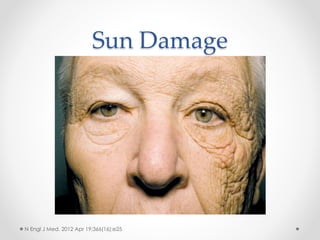
Sun Damage
N Engl J Med. 2012 Apr 19;366(16):e25
Skin Cancer Types
• Basal Cell Carcinoma (BCC)
o Most common type
o Typically appears on the face
o Rarely spreads
o Caused by sun exposure
• Squamous Cell Carcinoma (SCC)
o Typically appears on the face
o Can spread
o Caused by sun exposure
• Melanoma
o Arises from moles on the skin
o Most deadly
o Caused by intense intermittent sun exposure?
www.aad.org
Epidemiology
• Most common form of cancer
o Accounts for 75% of all diagnoses
• Approximately 3.5 million new cases per year in the
United States
o Squamous cell and basal cell are NOT reported
• Approximately 76,100 cases of melanoma will be
diagnosed in 2014
o Accounts for <2% of skin cancer cases, but most deaths
• Incidence has been increasing for at least 30 years
Arch Dermatol. 2010 Mar;146(3):283-7
www.cancer.org
Risk Factors
• Sun sensitivity
o Sunburn easily
o Difficulty tanning
o Natural blonde or red hair color
o Fair skin
• Excessive sun exposure
• Ethnicity
• Use of tanning booths
• Immune suppression
• History of skin cancer
www.aad.org
Prevention & Screening
• Never use tanning bed or lamp
• Wear an SPF 15 sunscreen every day
• Wear clothes that provide sun protection
• Wear sunglasses
• Avoid the sun between 10AM and 2PM
• Screening recommendations vary and are only
available for melanoma
o Monitor moles for melanoma
www.aad.org
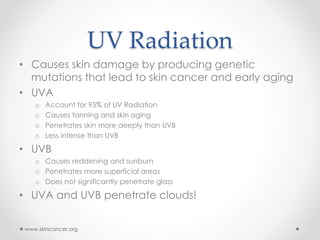
UV Radiation
• Causes skin damage by producing genetic
mutations that lead to skin cancer and early aging
• UVA
o Account for 95% of UV Radiation
o Causes tanning and skin aging
o Penetrates skin more deeply than UVB
o Less intense than UVB
• UVB
o Causes reddening and sunburn
o Penetrates more superficial areas
o Does not significantly penetrate glass
• UVA and UVB penetrate clouds!
www.skincancer.org
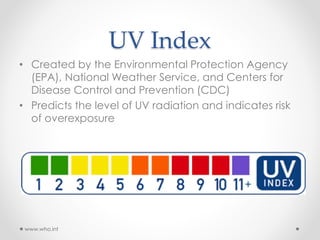
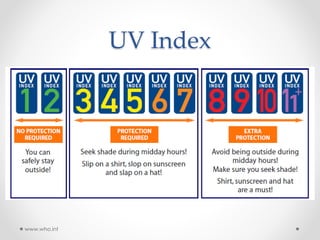
UV Index
• Created by the Environmental Protection Agency
(EPA), National Weather Service, and Centers for
Disease Control and Prevention (CDC)
• Predicts the level of UV radiation and indicates risk
of overexposure
www.who.int
UV Index
www.who.int
Clothing UPF
• Ultraviolet protection factor (UPF) is a measure of
UVA and UVB protection
• UPF compares the UV light measured without the
protection of the fabric to with protection of the
fabric
• Regulated by the Fair Trade Commission (FTC)
• Maximum allowed UPF is 50+
www.sun-protection-and-products-guide.com
Sunscreen SPF
• Sun protection factor (SPF) is primarily a measure of
UVB protection
• SPF compares the time of ultraviolet (UV) radiation
exposure it takes to cause redness when a person is
using a sunscreen in comparison to how much UV
exposure it takes to cause redness when they do
not use a sunscreen
• Absorbs or reflects UV radiation
• Regulated by the FDA
www.fda.gov
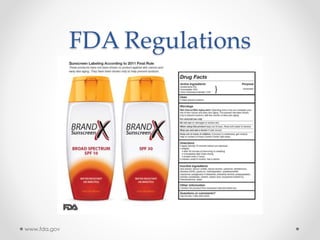
FDA Regulations
• Regulations passed June 2012 and became
effective December 2012
• Broad spectrum sunscreen protects against UVA
and UVB
• “Waterproof”, “Sweatproof”, and “Sunblock” terms
are not allowed
• Cannot claim more than 2 hours of protection
without reapplication unless data is submitted
o No “instant” or “all day” protection
• Water resistance is limited to 40 and 80 minutes
• Apply 15 minutes before sun exposure
www.fda.gov
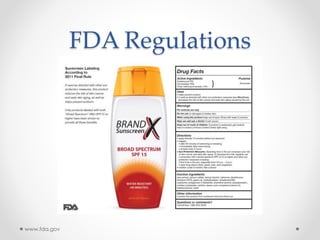
FDA Regulations
• Not all sunscreens are created equal!
• Some sunscreens are only labeled to prevent
sunburn...
• Non-broad spectrum OR broad spectrum + SPF <15
o “This product has been shown only to help prevent sunburn, not skin
cancer or early skin aging.”
• Some sunscreens are labeled to prevent sunburn,
skin cancer, and skin aging…
• Broad spectrum + SPF >=15
o “Helps prevent sunburn”
o “Decreases the risk of skin cancer and early skin aging caused by the sun”
www.fda.gov
FDA Regulations
www.fda.gov
FDA Regulations
www.fda.gov
How to Apply
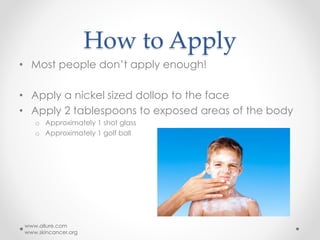
• Most people don’t apply enough!
• Apply a nickel sized dollop to the face
• Apply 2 tablespoons to exposed areas of the body
o Approximately 1 shot glass
o Approximately 1 golf ball
www.allure.com
www.skincancer.org
References
• Gordon, JR, Brieva, JC. Unilateral Dermatoheliosis,
2012. N Engl J Med; 366e25
• www.aad.org. Accessed October 2014
• Rogers, HW, Weinstock, MA, Harris, AR, et al.
Incidence estimate of nonmelanoma skin cancer in
the United States, 2006. Arch Dermatol 2010;
146(3):283-287
• American Cancer Society. Cancer Facts and
Figures 2014. http://www.cancer.org. Accessed
October 2014.
References
• www.skincancer.org. Accessed October 2014
• www.who.itn. Accessed October 2014
• www.sun-protection-and-products-guide.com.
Accessed October 2014
• www.fda.gov. Accessed October 2014
• www.allure.com. Accessed October 2014

Sun protectionv

  • 1.
    Skin Cancer and SunProtection Jonathan Gerber, PharmD, BCPS, BCOP REX Hospital October 21st, 2014
  • 2.
    Objectives • Discuss skincancer types, epidemiology, and risk factors • Explain options for sun protection • Describe FDA labeling requirements for sunscreen
  • 3.
    Sun Damage N EnglJ Med. 2012 Apr 19;366(16):e25
  • 4.
    Skin Cancer Types •Basal Cell Carcinoma (BCC) o Most common type o Typically appears on the face o Rarely spreads o Caused by sun exposure • Squamous Cell Carcinoma (SCC) o Typically appears on the face o Can spread o Caused by sun exposure • Melanoma o Arises from moles on the skin o Most deadly o Caused by intense intermittent sun exposure? www.aad.org
  • 5.
    Epidemiology • Most commonform of cancer o Accounts for 75% of all diagnoses • Approximately 3.5 million new cases per year in the United States o Squamous cell and basal cell are NOT reported • Approximately 76,100 cases of melanoma will be diagnosed in 2014 o Accounts for <2% of skin cancer cases, but most deaths • Incidence has been increasing for at least 30 years Arch Dermatol. 2010 Mar;146(3):283-7 www.cancer.org
  • 6.
    Risk Factors • Sunsensitivity o Sunburn easily o Difficulty tanning o Natural blonde or red hair color o Fair skin • Excessive sun exposure • Ethnicity • Use of tanning booths • Immune suppression • History of skin cancer www.aad.org
  • 7.
    Prevention & Screening •Never use tanning bed or lamp • Wear an SPF 15 sunscreen every day • Wear clothes that provide sun protection • Wear sunglasses • Avoid the sun between 10AM and 2PM • Screening recommendations vary and are only available for melanoma o Monitor moles for melanoma www.aad.org
  • 8.
    UV Radiation • Causesskin damage by producing genetic mutations that lead to skin cancer and early aging • UVA o Account for 95% of UV Radiation o Causes tanning and skin aging o Penetrates skin more deeply than UVB o Less intense than UVB • UVB o Causes reddening and sunburn o Penetrates more superficial areas o Does not significantly penetrate glass • UVA and UVB penetrate clouds! www.skincancer.org
  • 9.
    UV Index • Createdby the Environmental Protection Agency (EPA), National Weather Service, and Centers for Disease Control and Prevention (CDC) • Predicts the level of UV radiation and indicates risk of overexposure www.who.int
  • 10.
  • 11.
    Clothing UPF • Ultravioletprotection factor (UPF) is a measure of UVA and UVB protection • UPF compares the UV light measured without the protection of the fabric to with protection of the fabric • Regulated by the Fair Trade Commission (FTC) • Maximum allowed UPF is 50+ www.sun-protection-and-products-guide.com
  • 12.
    Sunscreen SPF • Sunprotection factor (SPF) is primarily a measure of UVB protection • SPF compares the time of ultraviolet (UV) radiation exposure it takes to cause redness when a person is using a sunscreen in comparison to how much UV exposure it takes to cause redness when they do not use a sunscreen • Absorbs or reflects UV radiation • Regulated by the FDA www.fda.gov
  • 13.
    FDA Regulations • Regulationspassed June 2012 and became effective December 2012 • Broad spectrum sunscreen protects against UVA and UVB • “Waterproof”, “Sweatproof”, and “Sunblock” terms are not allowed • Cannot claim more than 2 hours of protection without reapplication unless data is submitted o No “instant” or “all day” protection • Water resistance is limited to 40 and 80 minutes • Apply 15 minutes before sun exposure www.fda.gov
  • 14.
    FDA Regulations • Notall sunscreens are created equal! • Some sunscreens are only labeled to prevent sunburn... • Non-broad spectrum OR broad spectrum + SPF <15 o “This product has been shown only to help prevent sunburn, not skin cancer or early skin aging.” • Some sunscreens are labeled to prevent sunburn, skin cancer, and skin aging… • Broad spectrum + SPF >=15 o “Helps prevent sunburn” o “Decreases the risk of skin cancer and early skin aging caused by the sun” www.fda.gov
  • 15.
  • 16.
  • 17.
    How to Apply •Most people don’t apply enough! • Apply a nickel sized dollop to the face • Apply 2 tablespoons to exposed areas of the body o Approximately 1 shot glass o Approximately 1 golf ball www.allure.com www.skincancer.org
  • 19.
    References • Gordon, JR,Brieva, JC. Unilateral Dermatoheliosis, 2012. N Engl J Med; 366e25 • www.aad.org. Accessed October 2014 • Rogers, HW, Weinstock, MA, Harris, AR, et al. Incidence estimate of nonmelanoma skin cancer in the United States, 2006. Arch Dermatol 2010; 146(3):283-287 • American Cancer Society. Cancer Facts and Figures 2014. http://www.cancer.org. Accessed October 2014.
  • 20.
    References • www.skincancer.org. AccessedOctober 2014 • www.who.itn. Accessed October 2014 • www.sun-protection-and-products-guide.com. Accessed October 2014 • www.fda.gov. Accessed October 2014 • www.allure.com. Accessed October 2014