1) Risk for Melanoma
Doubles if you’ve had five sunburns
Only takes ONE blistering sunburn in childhood to double
your risk of melanoma later in life!
As opposed to other more common types of skin cancer
(basal cell cancer [BCC] or squamous cell cancer [SCC])
risk for melanoma increases with even ONE bad sunburn
SCC and BCC are related to chronic sun accumulation
Other risks for melanoma
Skin type (think fair, blond, blue-eyed, freckled)
Number of moles
Family history (NOT a factor in other skin cancers)
2) Sunburn tips: prevention
Before…
Stay out of the sun during peak hours (10-4)
Seek shade
Cover up with hats, long sleeves, etc
Apply sunscreen every 2 hours and liberally—estimate an
entire shot glass full to cover your body
Reapply after being in the water or sweating
Symptoms may take 4-6 hours to develop so a tinge of pink
may be … a world of hurt later
2) Sunburn tips: treatment
After…
Cool bath
Moisturize with light lotion
Don’t rub, scrub, scratch, or burst blisters
Nsaids (Non-Steroidal Anti-Inflammatory Drugs) i.e.
ibuprofen or naprosyn)
3) What about sunscreen?
What is SPF? The Sun Protection Factor means
how much longer can you stay in the sun without
burning. I.e., if you can stay in the sun for 20
minutes without burning, with SPF 15 sunscreen you
could be in the sun for close to 5 hours – in theory,
but in reality it’s far, far less in practice
Sunscreen: new law
Can no longer claim to be “water proof” or “sweat
proof”
Can only claim to be “water-resistant,” but must
specify whether they protect the skin for 40 or 80
minutes of swimming or sweating, based on standard
testing
Sunscreen cont’d
SPF refers mainly to the type of UVB protection a
sunscreen offers
In reality, people don’t use nearly enough sunscreen
and so the ACTUAL SPF is only about 1/3 of what
the bottle says so it’s safest to use a higher SPF (i.e.
SPF 15 is probably really only about SPF 5 with
normal usage)
Sunscreen cont’d
Some experts express concern about the very high
SPF because it may give a false sense of security:
generally between 30-50 is best
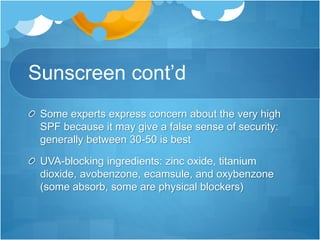
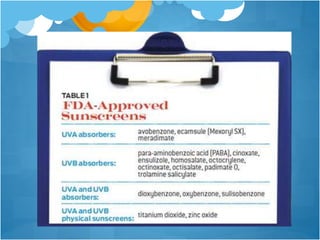
UVA-blocking ingredients: zinc oxide, titanium
dioxide, avobenzone, ecamsule, and oxybenzone
(some absorb, some are physical blockers)
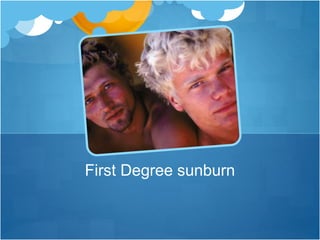
First Degree sunburn
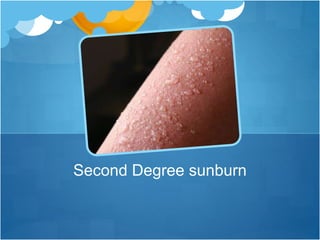
Second Degree sunburn
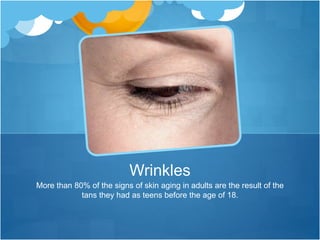
More than 80% of the signs of skin aging in adults are the result of the
tans they had as teens before the age of 18.
Wrinkles
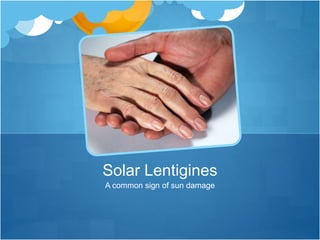
A common sign of sun damage
Solar Lentigines
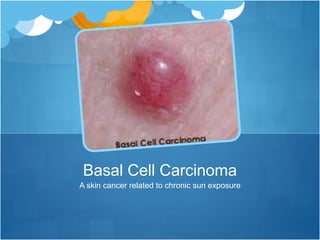
A skin cancer related to chronic sun exposure
Basal Cell Carcinoma
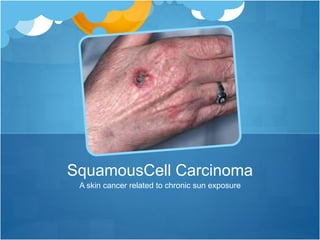
A skin cancer related to chronic sun exposure
SquamousCell Carcinoma
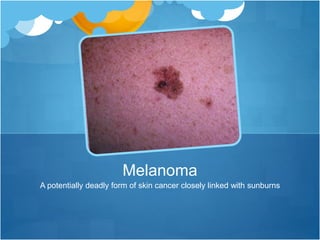
A potentially deadly form of skin cancer closely linked with sunburns
Melanoma

Sunburn: The Heat Is On!

  • 2.
    1) Risk forMelanoma Doubles if you’ve had five sunburns Only takes ONE blistering sunburn in childhood to double your risk of melanoma later in life! As opposed to other more common types of skin cancer (basal cell cancer [BCC] or squamous cell cancer [SCC]) risk for melanoma increases with even ONE bad sunburn SCC and BCC are related to chronic sun accumulation
  • 3.
    Other risks formelanoma Skin type (think fair, blond, blue-eyed, freckled) Number of moles Family history (NOT a factor in other skin cancers)
  • 4.
    2) Sunburn tips:prevention Before… Stay out of the sun during peak hours (10-4) Seek shade Cover up with hats, long sleeves, etc Apply sunscreen every 2 hours and liberally—estimate an entire shot glass full to cover your body Reapply after being in the water or sweating Symptoms may take 4-6 hours to develop so a tinge of pink may be … a world of hurt later
  • 5.
    2) Sunburn tips:treatment After… Cool bath Moisturize with light lotion Don’t rub, scrub, scratch, or burst blisters Nsaids (Non-Steroidal Anti-Inflammatory Drugs) i.e. ibuprofen or naprosyn)
  • 6.
    3) What aboutsunscreen? What is SPF? The Sun Protection Factor means how much longer can you stay in the sun without burning. I.e., if you can stay in the sun for 20 minutes without burning, with SPF 15 sunscreen you could be in the sun for close to 5 hours – in theory, but in reality it’s far, far less in practice
  • 7.
    Sunscreen: new law Canno longer claim to be “water proof” or “sweat proof” Can only claim to be “water-resistant,” but must specify whether they protect the skin for 40 or 80 minutes of swimming or sweating, based on standard testing
  • 8.
    Sunscreen cont’d SPF refersmainly to the type of UVB protection a sunscreen offers In reality, people don’t use nearly enough sunscreen and so the ACTUAL SPF is only about 1/3 of what the bottle says so it’s safest to use a higher SPF (i.e. SPF 15 is probably really only about SPF 5 with normal usage)
  • 9.
    Sunscreen cont’d Some expertsexpress concern about the very high SPF because it may give a false sense of security: generally between 30-50 is best UVA-blocking ingredients: zinc oxide, titanium dioxide, avobenzone, ecamsule, and oxybenzone (some absorb, some are physical blockers)
  • 11.
  • 12.
  • 13.
    More than 80%of the signs of skin aging in adults are the result of the tans they had as teens before the age of 18. Wrinkles
  • 14.
    A common signof sun damage Solar Lentigines
  • 15.
    A skin cancerrelated to chronic sun exposure Basal Cell Carcinoma
  • 16.
    A skin cancerrelated to chronic sun exposure SquamousCell Carcinoma
  • 17.
    A potentially deadlyform of skin cancer closely linked with sunburns Melanoma