Trends and Risk Factors
associated with Suicide in Ireland
18th March 2014
GROW Information Evening
Prof Ella Arensman
National Suicide Research Foundation
Department of Epidemiology and Public Health, University College Cork
National Suicide Research Foundation
 Main objective:
 To produce a nationally and internationally recognised body of reliable
knowledge from a multidisciplinary perspective on the risk and
protective factors associated with suicidal behaviour.
 Extent of the problem of self-harm and suicide as well as risk and
protective factors
 Effectiveness of intervention and prevention programmes for deliberate
self harm and suicide, and attitudes towards suicidal behaviour and its
prevention
 Research related tasks:
- Advisory role
- Training / education
- Supervision of students and trainees
Overview
 The extent of suicide in Ireland
 Attitudes towards suicidal behaviour
 The Suicide Support and Information System
 Risk factors associated with suicide
 Engaging with people at risk of suicide: Listening - Understanding -
Responding
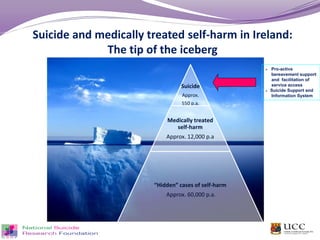
Suicide
Approx.
550 p.a.
Medically treated
self-harm
Approx. 12,000 p.a
“Hidden” cases of self-harm
Approx. 60,000 p.a.
Suicide and medically treated self-harm in Ireland:
The tip of the iceberg
 Pro-active
bereavement support
and facilitation of
service access
 Suicide Support and
Information System
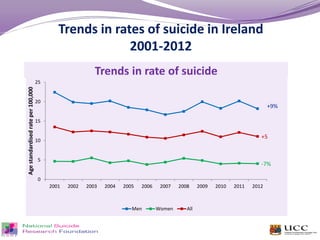
Trends in rates of suicide in Ireland
2001-2012
Trends in rate of suicide
-7%
+5
0
5
10
15
20
25
2001 2002 2003 2004 2005 2006 2007 2008 2009 2010 2011 2012
Agestandardisedrateper100,000
Men Women All
+9%
Attitudes towards suicidal behaviour
“There is a risk of evoking suicidal thoughts in
a persons mind if you ask about it”
Agree - Disagree
“Once a person has had suicidal thoughts,
he/she will never let them go”
Agree - Disagree
Attitudes towards suicidal behaviour
“Suicides among young people are particularly puzzling since
they have everything to live for”
Agree - Disagree
Attitudes towards suicidal behaviour
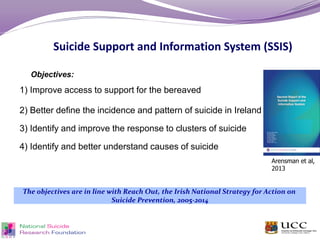
Suicide Support and Information System (SSIS)
Objectives:
1) Improve access to support for the bereaved
2) Better define the incidence and pattern of suicide in Ireland
3) Identify and improve the response to clusters of suicide
4) Identify and better understand causes of suicide
The objectives are in line with Reach Out, the Irish National Strategy for Action on
Suicide Prevention, 2005-2014
Arensman et al,
2013
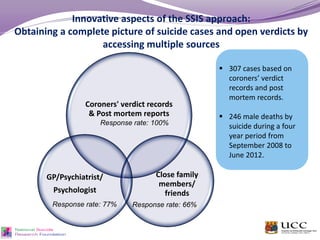
Innovative aspects of the SSIS approach:
Obtaining a complete picture of suicide cases and open verdicts by
accessing multiple sources
Coroners' verdict records
& Post mortem reports
Close family
members/
friends
GP/Psychiatrist/
Psychologist
 307 cases based on
coroners’ verdict
records and post
mortem records.
 246 male deaths by
suicide during a four
year period from
September 2008 to
June 2012.
Response rate: 100%
Response rate: 66%Response rate: 77%
Previous suicidal behaviour
 45% had a history of self harm. Of those, 52% had engaged in self harm 12
months prior to suicide, 24% less than a week, and 12% less than a day.
Psychiatric diagnosis
 Among those who had received a psychiatric assessment (31.4%), 61.1% were
diagnosed with mood disorder followed by anxiety disorder (12.9%)
Drug and alcohol use
 51.7% had abused alcohol and/or drugs in the year prior to death, the majority
abusing alcohol (78.1%)
Key findings from an examination of consecutive
suicide cases Sept 2008-March 2012
Employment & Occupation
 40.6% were in paid employment, 33.1 % were unemployed, 11.4% were retired,
6.8% were fulltime students, 5.0% had a long term disability and 3.1% were
homemakers.
 More than two fifths (41.6%) had worked in the construction/production sector,
followed by the agricultural sector (13.2%), sales/business development (8.9%),
students (8.2%), healthcare sector (6.6%) and education sector (3.9%).
Contact with health services
 In the year prior to death, 81% had been in contact with their GP or a mental
health service. Among those who had been in contact with the GP, the majority
(67.4%) had done so 4 times or more during the year prior to death.
Key findings from an examination of consecutive
suicide cases Sept 2008-March 2012
Key findings from an examination of consecutive
suicide cases Sept 2008-March 2012
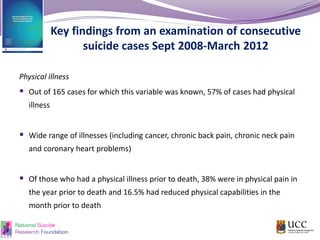
Physical illness
 Out of 165 cases for which this variable was known, 57% of cases had physical
illness
 Wide range of illnesses (including cancer, chronic back pain, chronic neck pain
and coronary heart problems)
 Of those who had a physical illness prior to death, 38% were in physical pain in
the year prior to death and 16.5% had reduced physical capabilities in the
month prior to death
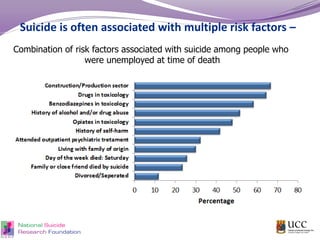
Suicide is often associated with multiple risk factors –
Combination of risk factors associated with suicide among people who
were unemployed at time of death
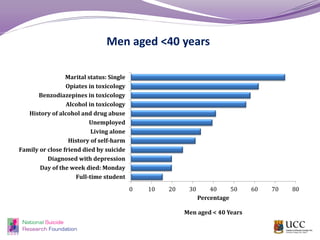
Men aged <40 years
0 10 20 30 40 50 60 70 80
Full-time student
Day of the week died: Monday
Diagnosed with depression
Family or close friend died by suicide
History of self-harm
Living alone
Unemployed
History of alcohol and drug abuse
Alcohol in toxicology
Benzodiazepines in toxicology
Opiates in toxicology
Marital status: Single
Percentage
Men aged < 40 Years
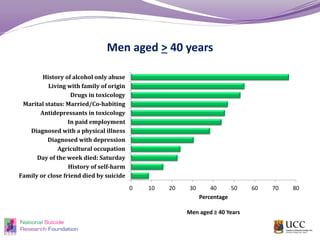
Men aged > 40 years
0 10 20 30 40 50 60 70 80
Family or close friend died by suicide
History of self-harm
Day of the week died: Saturday
Agricultural occupation
Diagnosed with depression
Diagnosed with a physical illness
In paid employment
Antidepressants in toxicology
Marital status: Married/Co-habiting
Drugs in toxicology
Living with family of origin
History of alcohol only abuse
Percentage
Men aged ≥ 40 Years
Direct effects:
 Intoxication impairs problem-solving ability
 Disinhibiting effect (impulsivity, lack of control)
Long term and indirect effects:
 Isolation (loss of work, relationships, etc.)
 Neurobiological deficits
The influence of alcohol & drugs
Engaging with people at risk of suicide –
Listening, Understanding, Responding
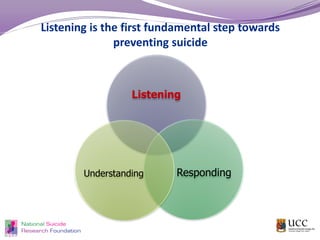
Listening is the first fundamental step towards
preventing suicide
Listening
RespondingUnderstanding
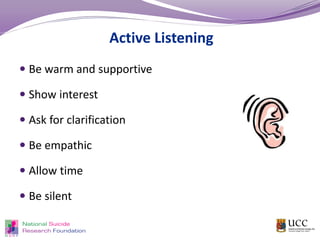
Active Listening
 Be warm and supportive
 Show interest
 Ask for clarification
 Be empathic
 Allow time
 Be silent
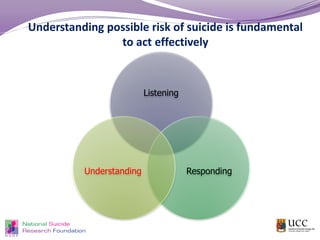
Understanding possible risk of suicide is fundamental
to act effectively
Listening
RespondingUnderstanding
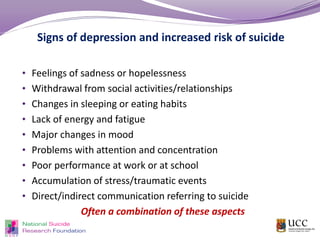
Signs of depression and increased risk of suicide
• Feelings of sadness or hopelessness
• Withdrawal from social activities/relationships
• Changes in sleeping or eating habits
• Lack of energy and fatigue
• Major changes in mood
• Problems with attention and concentration
• Poor performance at work or at school
• Accumulation of stress/traumatic events
• Direct/indirect communication referring to suicide
Often a combination of these aspects
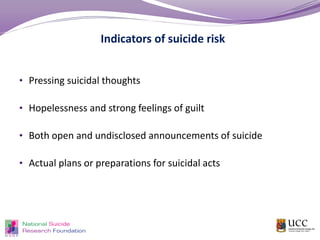
Indicators of suicide risk
• Pressing suicidal thoughts
• Hopelessness and strong feelings of guilt
• Both open and undisclosed announcements of suicide
• Actual plans or preparations for suicidal acts
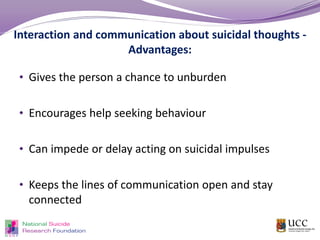
Interaction and communication about suicidal thoughts -
Advantages:
• Gives the person a chance to unburden
• Encourages help seeking behaviour
• Can impede or delay acting on suicidal impulses
• Keeps the lines of communication open and stay
connected
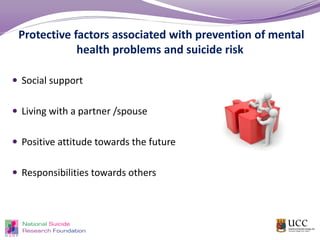
 Social support
 Living with a partner /spouse
 Positive attitude towards the future
 Responsibilities towards others
Protective factors associated with prevention of mental
health problems and suicide risk
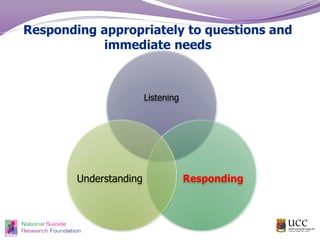
Responding appropriately to questions and
immediate needs
Listening
RespondingUnderstanding
Short-term responses in dealing with risk of
suicide and self-harm
 Involve the suicidal person where possible
 Elicit the extent of distress and intention using ordinary,
everyday, sensitive conversation
 Do not be judgmental or display shock
 Listen empathically
 Motivate and support help seeking behaviour (provide
information on relevant services)
Where to find help?
• Local GP or family doctor
• South-Doc:1890 335 999
• Samaritans: 1850 60 90 90
• Aware: 1890 303 302
• HSE Information Line: 1850 24 1850
 Pieta House: 021-4341400
www.yourmentalhealth.ie www.mabs.ie
www.samaritans.org www.aware.com
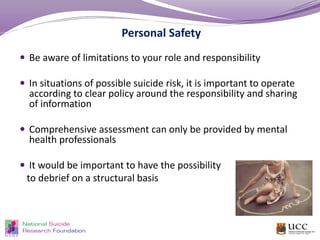
Personal Safety
 Be aware of limitations to your role and responsibility
 In situations of possible suicide risk, it is important to operate
according to clear policy around the responsibility and sharing
of information
 Comprehensive assessment can only be provided by mental
health professionals
 It would be important to have the possibility
to debrief on a structural basis
“People who attempt suicide never want to die,
what they want is a different life”
(R. Wieg, 2003)
“
Thank you!
Prof. Ella Arensman
National Suicide Research Foundation
University College Cork
Ireland
T: 00353 214205551
E-mail: earensman@ucc.ie
www.nsrf.ie
The National Suicide Research Foundation is in receipt of funding from the
National Office for Suicide Prevention

Trends and Risk Factors associated with Suicide in Ireland: Professor Ella Arensman

  • 1.
    Trends and RiskFactors associated with Suicide in Ireland 18th March 2014 GROW Information Evening Prof Ella Arensman National Suicide Research Foundation Department of Epidemiology and Public Health, University College Cork
  • 2.
    National Suicide ResearchFoundation  Main objective:  To produce a nationally and internationally recognised body of reliable knowledge from a multidisciplinary perspective on the risk and protective factors associated with suicidal behaviour.  Extent of the problem of self-harm and suicide as well as risk and protective factors  Effectiveness of intervention and prevention programmes for deliberate self harm and suicide, and attitudes towards suicidal behaviour and its prevention  Research related tasks: - Advisory role - Training / education - Supervision of students and trainees
  • 3.
    Overview  The extentof suicide in Ireland  Attitudes towards suicidal behaviour  The Suicide Support and Information System  Risk factors associated with suicide  Engaging with people at risk of suicide: Listening - Understanding - Responding
  • 4.
    Suicide Approx. 550 p.a. Medically treated self-harm Approx.12,000 p.a “Hidden” cases of self-harm Approx. 60,000 p.a. Suicide and medically treated self-harm in Ireland: The tip of the iceberg  Pro-active bereavement support and facilitation of service access  Suicide Support and Information System
  • 5.
    Trends in ratesof suicide in Ireland 2001-2012 Trends in rate of suicide -7% +5 0 5 10 15 20 25 2001 2002 2003 2004 2005 2006 2007 2008 2009 2010 2011 2012 Agestandardisedrateper100,000 Men Women All +9%
  • 6.
    Attitudes towards suicidalbehaviour “There is a risk of evoking suicidal thoughts in a persons mind if you ask about it” Agree - Disagree
  • 7.
    “Once a personhas had suicidal thoughts, he/she will never let them go” Agree - Disagree Attitudes towards suicidal behaviour
  • 8.
    “Suicides among youngpeople are particularly puzzling since they have everything to live for” Agree - Disagree Attitudes towards suicidal behaviour
  • 9.
    Suicide Support andInformation System (SSIS) Objectives: 1) Improve access to support for the bereaved 2) Better define the incidence and pattern of suicide in Ireland 3) Identify and improve the response to clusters of suicide 4) Identify and better understand causes of suicide The objectives are in line with Reach Out, the Irish National Strategy for Action on Suicide Prevention, 2005-2014 Arensman et al, 2013
  • 10.
    Innovative aspects ofthe SSIS approach: Obtaining a complete picture of suicide cases and open verdicts by accessing multiple sources Coroners' verdict records & Post mortem reports Close family members/ friends GP/Psychiatrist/ Psychologist  307 cases based on coroners’ verdict records and post mortem records.  246 male deaths by suicide during a four year period from September 2008 to June 2012. Response rate: 100% Response rate: 66%Response rate: 77%
  • 11.
    Previous suicidal behaviour 45% had a history of self harm. Of those, 52% had engaged in self harm 12 months prior to suicide, 24% less than a week, and 12% less than a day. Psychiatric diagnosis  Among those who had received a psychiatric assessment (31.4%), 61.1% were diagnosed with mood disorder followed by anxiety disorder (12.9%) Drug and alcohol use  51.7% had abused alcohol and/or drugs in the year prior to death, the majority abusing alcohol (78.1%) Key findings from an examination of consecutive suicide cases Sept 2008-March 2012
  • 12.
    Employment & Occupation 40.6% were in paid employment, 33.1 % were unemployed, 11.4% were retired, 6.8% were fulltime students, 5.0% had a long term disability and 3.1% were homemakers.  More than two fifths (41.6%) had worked in the construction/production sector, followed by the agricultural sector (13.2%), sales/business development (8.9%), students (8.2%), healthcare sector (6.6%) and education sector (3.9%). Contact with health services  In the year prior to death, 81% had been in contact with their GP or a mental health service. Among those who had been in contact with the GP, the majority (67.4%) had done so 4 times or more during the year prior to death. Key findings from an examination of consecutive suicide cases Sept 2008-March 2012
  • 13.
    Key findings froman examination of consecutive suicide cases Sept 2008-March 2012 Physical illness  Out of 165 cases for which this variable was known, 57% of cases had physical illness  Wide range of illnesses (including cancer, chronic back pain, chronic neck pain and coronary heart problems)  Of those who had a physical illness prior to death, 38% were in physical pain in the year prior to death and 16.5% had reduced physical capabilities in the month prior to death
  • 14.
    Suicide is oftenassociated with multiple risk factors – Combination of risk factors associated with suicide among people who were unemployed at time of death
  • 15.
    Men aged <40years 0 10 20 30 40 50 60 70 80 Full-time student Day of the week died: Monday Diagnosed with depression Family or close friend died by suicide History of self-harm Living alone Unemployed History of alcohol and drug abuse Alcohol in toxicology Benzodiazepines in toxicology Opiates in toxicology Marital status: Single Percentage Men aged < 40 Years
  • 16.
    Men aged >40 years 0 10 20 30 40 50 60 70 80 Family or close friend died by suicide History of self-harm Day of the week died: Saturday Agricultural occupation Diagnosed with depression Diagnosed with a physical illness In paid employment Antidepressants in toxicology Marital status: Married/Co-habiting Drugs in toxicology Living with family of origin History of alcohol only abuse Percentage Men aged ≥ 40 Years
  • 17.
    Direct effects:  Intoxicationimpairs problem-solving ability  Disinhibiting effect (impulsivity, lack of control) Long term and indirect effects:  Isolation (loss of work, relationships, etc.)  Neurobiological deficits The influence of alcohol & drugs
  • 18.
    Engaging with peopleat risk of suicide – Listening, Understanding, Responding
  • 19.
    Listening is thefirst fundamental step towards preventing suicide Listening RespondingUnderstanding
  • 20.
    Active Listening  Bewarm and supportive  Show interest  Ask for clarification  Be empathic  Allow time  Be silent
  • 21.
    Understanding possible riskof suicide is fundamental to act effectively Listening RespondingUnderstanding
  • 22.
    Signs of depressionand increased risk of suicide • Feelings of sadness or hopelessness • Withdrawal from social activities/relationships • Changes in sleeping or eating habits • Lack of energy and fatigue • Major changes in mood • Problems with attention and concentration • Poor performance at work or at school • Accumulation of stress/traumatic events • Direct/indirect communication referring to suicide Often a combination of these aspects
  • 23.
    Indicators of suiciderisk • Pressing suicidal thoughts • Hopelessness and strong feelings of guilt • Both open and undisclosed announcements of suicide • Actual plans or preparations for suicidal acts
  • 24.
    Interaction and communicationabout suicidal thoughts - Advantages: • Gives the person a chance to unburden • Encourages help seeking behaviour • Can impede or delay acting on suicidal impulses • Keeps the lines of communication open and stay connected
  • 25.
     Social support Living with a partner /spouse  Positive attitude towards the future  Responsibilities towards others Protective factors associated with prevention of mental health problems and suicide risk
  • 26.
    Responding appropriately toquestions and immediate needs Listening RespondingUnderstanding
  • 27.
    Short-term responses indealing with risk of suicide and self-harm  Involve the suicidal person where possible  Elicit the extent of distress and intention using ordinary, everyday, sensitive conversation  Do not be judgmental or display shock  Listen empathically  Motivate and support help seeking behaviour (provide information on relevant services)
  • 28.
    Where to findhelp? • Local GP or family doctor • South-Doc:1890 335 999 • Samaritans: 1850 60 90 90 • Aware: 1890 303 302 • HSE Information Line: 1850 24 1850  Pieta House: 021-4341400 www.yourmentalhealth.ie www.mabs.ie www.samaritans.org www.aware.com
  • 29.
    Personal Safety  Beaware of limitations to your role and responsibility  In situations of possible suicide risk, it is important to operate according to clear policy around the responsibility and sharing of information  Comprehensive assessment can only be provided by mental health professionals  It would be important to have the possibility to debrief on a structural basis
  • 30.
    “People who attemptsuicide never want to die, what they want is a different life” (R. Wieg, 2003) “
  • 31.
    Thank you! Prof. EllaArensman National Suicide Research Foundation University College Cork Ireland T: 00353 214205551 E-mail: earensman@ucc.ie www.nsrf.ie The National Suicide Research Foundation is in receipt of funding from the National Office for Suicide Prevention