Abortion The expulsion or removal of an embryo or a fetus from the uterus The most common method of abortion  suction or  vacuum  curettage This abortion can be done between 6 and 12 weeks  from the first day of  the last period
12 weeks/3 months
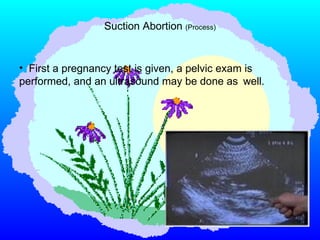
First a pregnancy test is given, a pelvic exam is  performed, and an ultrasound may be done as  well.   Suction Abortion  (Process)
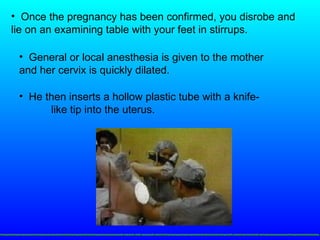
General or local anesthesia is given to the mother  and her cervix is quickly dilated.  He then inserts a hollow plastic tube with a knife-  like tip into the uterus.  Once the pregnancy has been confirmed, you disrobe and  lie on an examining table with your feet in stirrups. 
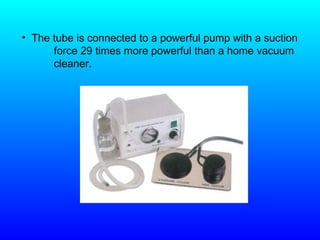
The tube is connected to a powerful pump with a suction  force 29 times more powerful than a home vacuum  cleaner.  
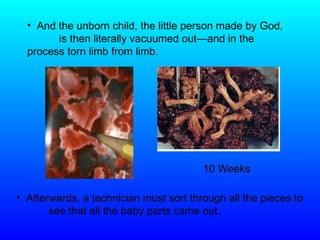
And the unborn child, the little person made by God,  is then literally vacuumed out — and in the  process torn limb from limb.  10 Weeks Afterwards, a technician must sort through all the pieces to  see that all the baby parts came out.
Possible Bad Effects Possible immediate problems following an abortion include: Abdominal cramping, pain, nausea, sweating, and  feeling faint during the procedure, cramping and  pain for 2-3 days following the procedure, as  well  as bleeding for up to 2 weeks.   Infection, bleeding, trauma to the cervix or uterus, and  incomplete abortion requiring repeat curettage
Abortionist Martin Haskell THE WITNESS: I've performed approximately or greater than 40,000 suction curettage abortions. Roughly, you know, 10,000 D&E abortions. After the 20th week I've performed approximately 5,000 abortions, about 3,000 of them being D&E and about 2,000 of them being the intact variety of D&E. Q. When you perform an abortion by the suction curettage method does it ever happen that a portion of the fetus is extracted from the uterus while the fetus is still alive? A. Yes.
Q. And how does that happen? A. Well, when we do a suction curettage abortion, you know, roughly one of three things is going to happen during the abortion: One would be is that the catheter as it approaches the fetus, you know, tears it and kills it at that instant inside the uterus.  Second would be that the fetus is small enough and the catheter is large enough that the fetus passes through the catheter.
Now on any given procedure does a surgeon know precisely which of those three possibilities is going to occur, the answer is no. But is it my intent that one of these three possibilities will happen with each given patient, then the answer is yes. Q. And when you perform an abortion provability are you concerned with the point in the process when the fetus dies? A: Generally no, because it doesn't add anything medically to the safety or care of the woman that's being taken care of. Third Dies in transit as it's passing through the catheter or dies in the suction bottle after it's actually all the way out.
References: http://www.youtube.com/watch?v=QBOAPleF1t0 http://www.pathlights.com/abortion/abort04.htm#The%20Suction%20Method http://images.search.yahoo.com/images/view?back=http%3A%2F%2Fimages.search.yahoo.com%2Fsearch%2Fimages%3Fp%3DSuction%2Babortion%26ei%3DUTF-8%26y%3DSearch%26fr%3Dmy-myy%26fr2%3Dtab-web%26xargs%3D0%26pstart%3D1%26b%3D21%26ni%3D20&w=300&h=209&imgurl=www.choicetolivewith.com%2FPictures%2Fsuctionmachine.JPG&rurl=http%3A%2F%2Fwww.choicetolivewith.com%2Fvacuumabortionpc.html&size=7.6kB&name=suctionmachine.JPG&p=Suction+abortion&type=JPG&oid=a43b32ea2f6f7378&no=26&tt=72&sigr=11l8934am&sigi=11kv70pv4&sigb=143b09dse

Abortion-Suction

  • 1.
    Abortion The expulsionor removal of an embryo or a fetus from the uterus The most common method of abortion suction or vacuum curettage This abortion can be done between 6 and 12 weeks from the first day of the last period
  • 2.
  • 3.
    First a pregnancytest is given, a pelvic exam is performed, and an ultrasound may be done as well.  Suction Abortion (Process)
  • 4.
    General or localanesthesia is given to the mother and her cervix is quickly dilated. He then inserts a hollow plastic tube with a knife- like tip into the uterus. Once the pregnancy has been confirmed, you disrobe and lie on an examining table with your feet in stirrups. 
  • 5.
    The tube isconnected to a powerful pump with a suction force 29 times more powerful than a home vacuum cleaner.  
  • 6.
    And the unbornchild, the little person made by God, is then literally vacuumed out — and in the process torn limb from limb. 10 Weeks Afterwards, a technician must sort through all the pieces to see that all the baby parts came out.
  • 7.
    Possible Bad EffectsPossible immediate problems following an abortion include: Abdominal cramping, pain, nausea, sweating, and feeling faint during the procedure, cramping and pain for 2-3 days following the procedure, as well as bleeding for up to 2 weeks.  Infection, bleeding, trauma to the cervix or uterus, and incomplete abortion requiring repeat curettage
  • 8.
    Abortionist Martin HaskellTHE WITNESS: I've performed approximately or greater than 40,000 suction curettage abortions. Roughly, you know, 10,000 D&E abortions. After the 20th week I've performed approximately 5,000 abortions, about 3,000 of them being D&E and about 2,000 of them being the intact variety of D&E. Q. When you perform an abortion by the suction curettage method does it ever happen that a portion of the fetus is extracted from the uterus while the fetus is still alive? A. Yes.
  • 9.
    Q. And howdoes that happen? A. Well, when we do a suction curettage abortion, you know, roughly one of three things is going to happen during the abortion: One would be is that the catheter as it approaches the fetus, you know, tears it and kills it at that instant inside the uterus. Second would be that the fetus is small enough and the catheter is large enough that the fetus passes through the catheter.
  • 10.
    Now on anygiven procedure does a surgeon know precisely which of those three possibilities is going to occur, the answer is no. But is it my intent that one of these three possibilities will happen with each given patient, then the answer is yes. Q. And when you perform an abortion provability are you concerned with the point in the process when the fetus dies? A: Generally no, because it doesn't add anything medically to the safety or care of the woman that's being taken care of. Third Dies in transit as it's passing through the catheter or dies in the suction bottle after it's actually all the way out.
  • 11.
    References: http://www.youtube.com/watch?v=QBOAPleF1t0 http://www.pathlights.com/abortion/abort04.htm#The%20Suction%20Methodhttp://images.search.yahoo.com/images/view?back=http%3A%2F%2Fimages.search.yahoo.com%2Fsearch%2Fimages%3Fp%3DSuction%2Babortion%26ei%3DUTF-8%26y%3DSearch%26fr%3Dmy-myy%26fr2%3Dtab-web%26xargs%3D0%26pstart%3D1%26b%3D21%26ni%3D20&w=300&h=209&imgurl=www.choicetolivewith.com%2FPictures%2Fsuctionmachine.JPG&rurl=http%3A%2F%2Fwww.choicetolivewith.com%2Fvacuumabortionpc.html&size=7.6kB&name=suctionmachine.JPG&p=Suction+abortion&type=JPG&oid=a43b32ea2f6f7378&no=26&tt=72&sigr=11l8934am&sigi=11kv70pv4&sigb=143b09dse