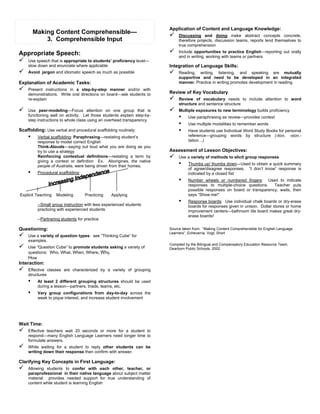
Application of Content and Language Knowledge:
        Making Content Comprehensible—                                  "    Discussing and doing make abstract concepts concrete,
            3. Comprehensible Input                                          therefore projects, discussion teams, reports lend themselves to
                                                                             true comprehension

Appropriate Speech:                                                     "    Include opportunities to practice English—reporting out orally
                                                                             and in writing, working with teams or partners
" Use speech that is appropriate to students’ proficiency level—
    slow down and enunciate where applicable                            Integration of Language Skills:
"   Avoid jargon and idiomatic speech as much as possible               "    Reading, writing, listening, and speaking are mutually
                                                                             supportive and need to be developed in an integrated
Explanation of Academic Tasks:                                               manner. Practice in writing promotes development in reading.
"   Present instructions in a step-by-step manner and/or with
                                                                        Review of Key Vocabulary
    demonstrations. Write oral directions on board—ask students to
    re-explain                                                          "    Review of vocabulary needs to include attention to word
                                                                             structure and sentence structure
"   Use peer-modeling—Focus attention on one group that is              "    Multiple exposures to new terminology builds proficiency
    functioning well on activity. Let those students explain step-by-
    step instructions to whole class using an overhead transparency
                                                                             !    Use paraphrasing as review—provides context
                                                                             !    Use multiple modalities to remember words
Scaffolding: Use verbal and procedural scaffolding routinely:                !    Have students use Individual Word Study Books for personal
    !    Verbal scaffolding: Paraphrasing—restating student’s                     reference—grouping words by structure (-tion, -sion,-
         response to model correct English                                        tation…)
         Think-Alouds—saying out loud what you are doing as you
         try to use a strategy                                          Assessment of Lesson Objectives:
         Reinforcing contextual definitions—restating a term by         "    Use a variety of methods to elicit group responses
         giving a context or definition Ex. Aborigines, the native
         people of Australia, were being driven from their homes.
                                                                             !    Thumbs up/ thumbs down—Used to obtain a quick summary
                                                                                  of agree/disagree responses. “I don’t know” response is
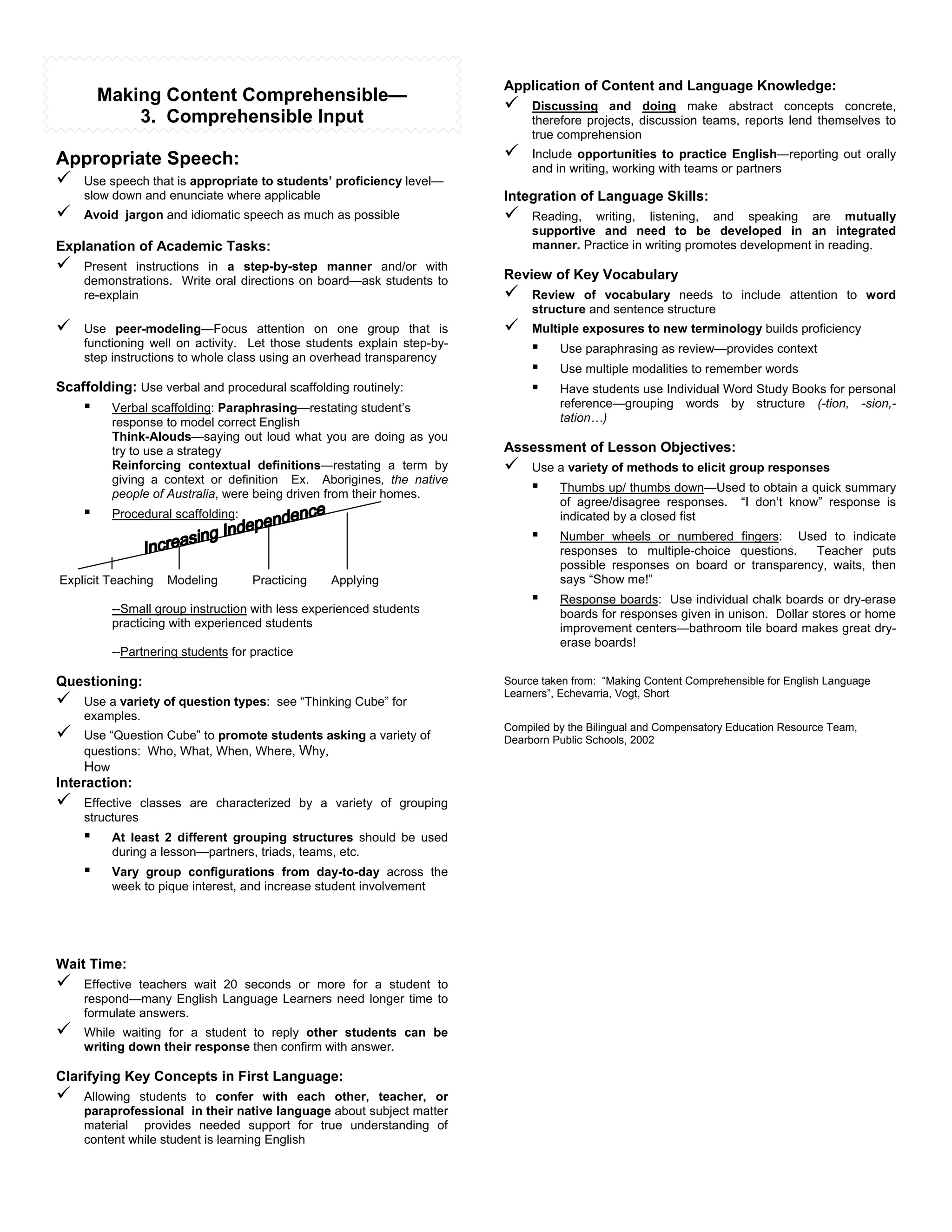
    !    Procedural scaffolding:                                                  indicated by a closed fist
                                                                             !    Number wheels or numbered fingers: Used to indicate
                                                                                  responses to multiple-choice questions.   Teacher puts
                                                                                  possible responses on board or transparency, waits, then
Explicit Teaching   Modeling       Practicing   Applying                          says “Show me!”
                                                                             !    Response boards: Use individual chalk boards or dry-erase
         --Small group instruction with less experienced students                 boards for responses given in unison. Dollar stores or home
         practicing with experienced students                                     improvement centers—bathroom tile board makes great dry-
                                                                                  erase boards!
         --Partnering students for practice

Questioning:                                                            Source taken from: “Making Content Comprehensible for English Language
                                                                        Learners”, Echevarria, Vogt, Short
"   Use a variety of question types: see “Thinking Cube” for
    examples.
                                                                        Compiled by the Bilingual and Compensatory Education Resource Team,
"   Use “Question Cube” to promote students asking a variety of         Dearborn Public Schools, 2002
    questions: Who, What, When, Where, Why,
    How
Interaction:
"   Effective classes are characterized by a variety of grouping
    structures
    !    At least 2 different grouping structures should be used
         during a lesson—partners, triads, teams, etc.
    !    Vary group configurations from day-to-day across the
         week to pique interest, and increase student involvement


Wait Time:
"   Effective teachers wait 20 seconds or more for a student to
    respond—many English Language Learners need longer time to
    formulate answers.
"   While waiting for a student to reply other students can be
    writing down their response then confirm with answer.

Clarifying Key Concepts in First Language:
"   Allowing students to confer with each other, teacher, or
    paraprofessional in their native language about subject matter
    material provides needed support for true understanding of
    content while student is learning English

SIOP Comprehensible Input

  • 1.
    Application of Contentand Language Knowledge: Making Content Comprehensible— " Discussing and doing make abstract concepts concrete, 3. Comprehensible Input therefore projects, discussion teams, reports lend themselves to true comprehension Appropriate Speech: " Include opportunities to practice English—reporting out orally and in writing, working with teams or partners " Use speech that is appropriate to students’ proficiency level— slow down and enunciate where applicable Integration of Language Skills: " Avoid jargon and idiomatic speech as much as possible " Reading, writing, listening, and speaking are mutually supportive and need to be developed in an integrated Explanation of Academic Tasks: manner. Practice in writing promotes development in reading. " Present instructions in a step-by-step manner and/or with Review of Key Vocabulary demonstrations. Write oral directions on board—ask students to re-explain " Review of vocabulary needs to include attention to word structure and sentence structure " Use peer-modeling—Focus attention on one group that is " Multiple exposures to new terminology builds proficiency functioning well on activity. Let those students explain step-by- step instructions to whole class using an overhead transparency ! Use paraphrasing as review—provides context ! Use multiple modalities to remember words Scaffolding: Use verbal and procedural scaffolding routinely: ! Have students use Individual Word Study Books for personal ! Verbal scaffolding: Paraphrasing—restating student’s reference—grouping words by structure (-tion, -sion,- response to model correct English tation…) Think-Alouds—saying out loud what you are doing as you try to use a strategy Assessment of Lesson Objectives: Reinforcing contextual definitions—restating a term by " Use a variety of methods to elicit group responses giving a context or definition Ex. Aborigines, the native people of Australia, were being driven from their homes. ! Thumbs up/ thumbs down—Used to obtain a quick summary of agree/disagree responses. “I don’t know” response is ! Procedural scaffolding: indicated by a closed fist ! Number wheels or numbered fingers: Used to indicate responses to multiple-choice questions. Teacher puts possible responses on board or transparency, waits, then Explicit Teaching Modeling Practicing Applying says “Show me!” ! Response boards: Use individual chalk boards or dry-erase --Small group instruction with less experienced students boards for responses given in unison. Dollar stores or home practicing with experienced students improvement centers—bathroom tile board makes great dry- erase boards! --Partnering students for practice Questioning: Source taken from: “Making Content Comprehensible for English Language Learners”, Echevarria, Vogt, Short " Use a variety of question types: see “Thinking Cube” for examples. Compiled by the Bilingual and Compensatory Education Resource Team, " Use “Question Cube” to promote students asking a variety of Dearborn Public Schools, 2002 questions: Who, What, When, Where, Why, How Interaction: " Effective classes are characterized by a variety of grouping structures ! At least 2 different grouping structures should be used during a lesson—partners, triads, teams, etc. ! Vary group configurations from day-to-day across the week to pique interest, and increase student involvement Wait Time: " Effective teachers wait 20 seconds or more for a student to respond—many English Language Learners need longer time to formulate answers. " While waiting for a student to reply other students can be writing down their response then confirm with answer. Clarifying Key Concepts in First Language: " Allowing students to confer with each other, teacher, or paraprofessional in their native language about subject matter material provides needed support for true understanding of content while student is learning English