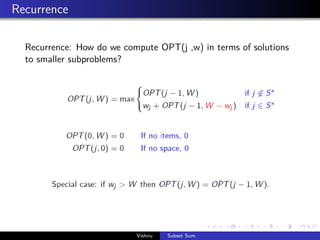
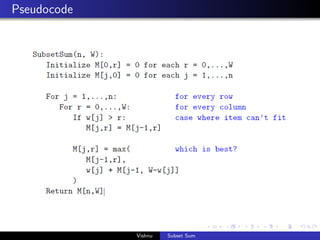
This document discusses the subset sum problem and how to solve it using dynamic programming. It introduces the problem of finding a subset of items that maximizes the total weight without exceeding a given bound. It describes using dynamic programming to build a solution by solving smaller subproblems and storing their results in a table. The dynamic programming algorithm runs in pseudo-polynomial time O(nW) where n is the number of items and W is the weight bound.
Dynamic Programming: SubsetSum
Vishnu Pratap Singh(2018IS08)
Advance Algorithm(CS-22121)
Department of Computer Science and Engineering
MNNIT ALLAHABAD, Prayagraj
April 27, 2019
Vishnu Subset Sum
2.
Dynamic Programming
Extremely generalalgorithm design technique
Similar to divide & conquer:
Build up the answer from smaller subproblems
More general than “simple” divide & conquer
Also more powerful
Generally applies to algorithms where the brute force
algorithm would be exponential.
Vishnu Subset Sum
3.
Subset Sum
Problem (SubsetSum).
Given:
An integer bound W, and
A collection of n items, each with a positive, integer weight wi
, find a subset S of items that:
maximizes i∈S wi while keeping i∈S wi ≤W.
We assume W and each wi is an integer.
Vishnu Subset Sum
4.
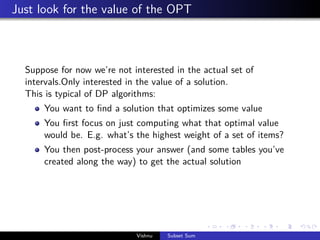
Just look forthe value of the OPT
Suppose for now we’re not interested in the actual set of
intervals.Only interested in the value of a solution.
This is typical of DP algorithms:
You want to find a solution that optimizes some value
You first focus on just computing what that optimal value
would be. E.g. what’s the highest weight of a set of items?
You then post-process your answer (and some tables you’ve
created along the way) to get the actual solution
Vishnu Subset Sum
5.
Optimal Notation
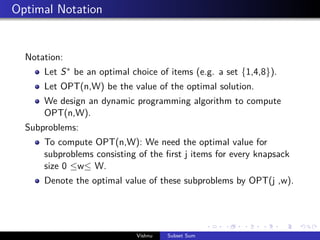
Notation:
Let S∗be an optimal choice of items (e.g. a set {1,4,8}).
Let OPT(n,W) be the value of the optimal solution.
We design an dynamic programming algorithm to compute
OPT(n,W).
Subproblems:
To compute OPT(n,W): We need the optimal value for
subproblems consisting of the first j items for every knapsack
size 0 ≤w≤ W.
Denote the optimal value of these subproblems by OPT(j ,w).
Vishnu Subset Sum
Runtime
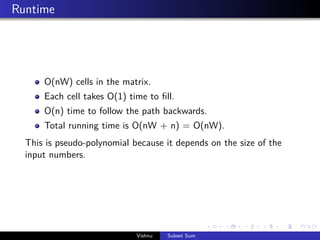
O(nW) cells inthe matrix.
Each cell takes O(1) time to fill.
O(n) time to follow the path backwards.
Total running time is O(nW + n) = O(nW).
This is pseudo-polynomial because it depends on the size of the
input numbers.
Vishnu Subset Sum