Collapsed (Individuals + Corporate + Banks) = Collapsed System Sub-Prime Crisis  An Economic Perspective PaisaMatters.com
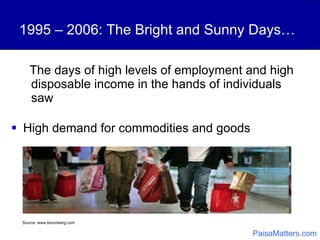
The days of high levels of employment and high disposable income in the hands of individuals saw 1995 – 2006: The Bright and Sunny Days… High demand for commodities and goods Source: www.bloomberg.com   PaisaMatters.com
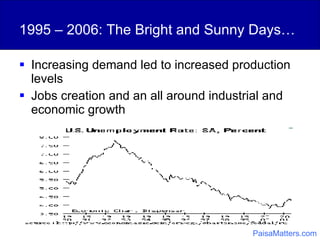
1995 – 2006: The Bright and Sunny Days… Increasing demand led to increased production levels Jobs creation and an all around industrial and economic growth  PaisaMatters.com
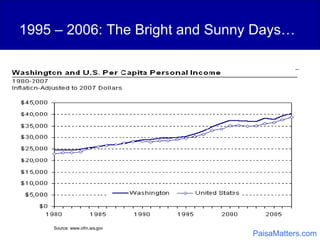
1995 – 2006: The Bright and Sunny Days… Source: www.ofm.wa.gov PaisaMatters.com
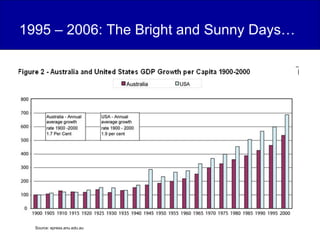
Source: epress.anu.edu.au  1995 – 2006: The Bright and Sunny Days…
1995 – 2006: The Bright and Sunny Days… The consumer generated organic infusion of money generated strong liquidity in the economy  The increasing aspirations and risk taking ability coupled with low interest rates fuelled strong credit growth Banking system flushed with liquidity felt a need to accelerate the credit growth PaisaMatters.com
High   income levels and desire to own a dream home had already created a good mortgage loan portfolio 1995 – 2006: The Bright and Sunny Days… Low interest rates made the housing more affordable and allowed to borrow more The prime mortgage loan market was falling short of propelling the desired exponential credit growth There was a huge population with ‘ less than perfect credit ’ to be tapped PaisaMatters.com
Borrowers   with  less than perfect credit  - the Subprime borrowers, presented a mouthwatering opportunity for bankers in the mortgages market 1995 – 2006: The Bright and Sunny Days… Banks started chasing the subprime borrowers with easy loans People who otherwise could not have afforded a home, bought homes with the high interest rate loans PaisaMatters.com
1995 – 2006: The Bright and Sunny Days… Welcome  to the world of   Sub-Prime Mortgages PaisaMatters.com
1995 – 2006: The Bright and Sunny Days… Subprime loans are mortgages given to borrowers with ‘ less than perfect ’ credit or poor credit history Most subprime borrowers are ones with low and inconsistent income Because subprime loans are riskier, they carry a higher rate of interest Not all subprime mortgage loans were used for buying houses but to refinance other obligations like credit card debts, making them even more risky PaisaMatters.com
1995 – 2006: The Bright and Sunny Days… Borrowers were happy to get loans without worrying about credit worthiness Mortgage brokers were happy as they were paid to underwrite these easy selling subprime loans without a responsibility to recover Bankers were happy with the credit growth and higher returns from subprime loans A Win-Win for all, but not for long. PaisaMatters.com
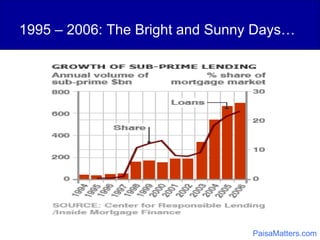
1995 – 2006: The Bright and Sunny Days… PaisaMatters.com
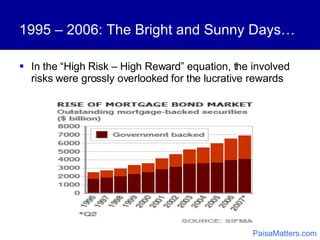
1995 – 2006: The Bright and Sunny Days… The bankers who originated subprime loans converted them to bundles of securities and sold the packaged Mortgage Backed Securities (MBS) in financial markets This allowed banks to pass on the risk of default to investors of MBS  This allowed banks to get these loans off their balance sheet and borrow more, only to originate more subprime loans The buyers of these subprime MBS thought they were taking a calculated risk of default in lieu of higher returns PaisaMatters.com
1995 – 2006: The Bright and Sunny Days… In the “High Risk – High Reward” equation, the involved risks were grossly overlooked for the lucrative rewards PaisaMatters.com
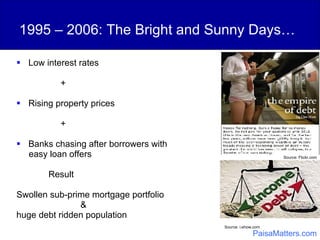
1995 – 2006: The Bright and Sunny Days… Low interest rates + Rising property prices + Banks chasing after borrowers with  easy loan offers Result Swollen sub-prime mortgage portfolio  &  huge debt ridden population Source: i.ehow.com   Source: Flickr.com PaisaMatters.com
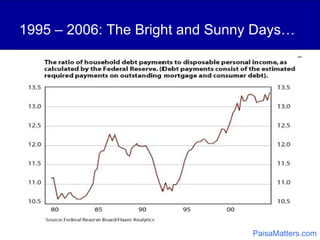
1995 – 2006: The Bright and Sunny Days… PaisaMatters.com
Q4 2006 – Q2 2007: The Gloomy Evenings Too much money chasing too few goods resulted in increase in commodity prices and rising inflation rate The interest rates started moving northwards Because most of these loans were Adjustable Rate Mortgages (ARMs), the loan installment amount increased Pressure started to mount on borrowers monthly cash outflows to meet the fixed obligations PaisaMatters.com
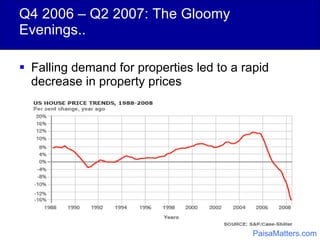
Q4 2006 – Q2 2007: The Gloomy Evenings.. Falling demand for properties led to a rapid decrease in property prices PaisaMatters.com
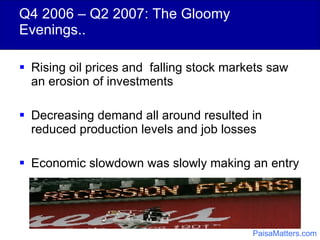
Q4 2006 – Q2 2007: The Gloomy Evenings.. Rising oil prices and  falling stock markets saw an erosion of investments Decreasing demand all around resulted in reduced production levels and job losses Economic slowdown was slowly making an entry PaisaMatters.com
Q3 2007 Onwards: The Scary Nights… The subprime borrowers with inconsistent and low incomes could not pay the increased loan installments Banks started to tighten the credit norms preventing subprime borrowers to refinance existing debts to lower payments Borrowers could not sell the property to repay debts as the house was worth less that what they bought for This left borrowers with an option to bring in more money or miss the loan payments PaisaMatters.com
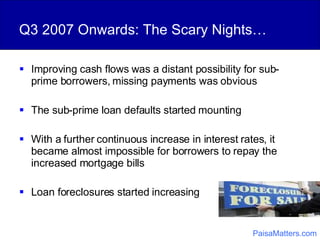
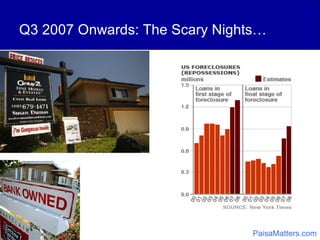
Q3 2007 Onwards: The Scary Nights… Improving cash flows was a distant possibility for sub-prime borrowers, missing payments was obvious The sub-prime loan defaults started mounting With a further continuous increase in interest rates, it became almost impossible for borrowers to repay the increased mortgage bills Loan foreclosures started increasing PaisaMatters.com
Q3 2007 Onwards: The Scary Nights… PaisaMatters.com
Q3 2007 Onwards: The Scary Nights… Because there were not many buyers for foreclosed properties, banks could not recover their outstanding loans by selling the foreclosed properties With tightened credit norms, fewer borrowers qualified for new loans leading to more homes to sell to fewer buyers Banks left with no other option but to write off the outstanding defaulted loans  Once considered  cash cows, the high return fetching mortgage backed securities (MBS) became worthless PaisaMatters.com
Q3 2007 Onwards: The Scary Nights… In deteriorating economic conditions, sub-prime loan defaults were followed by defaults in  prime mortgages home equity loans unsecured consumer loans (car loans, student loans, credit cards) and  commercial loans PaisaMatters.com
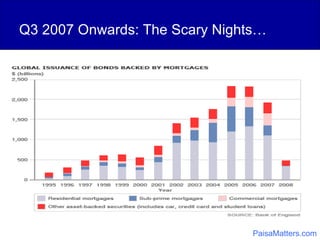
PaisaMatters.com Q3 2007 Onwards: The Scary Nights…
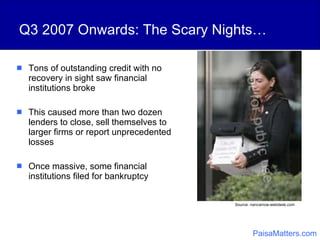
Q3 2007 Onwards: The Scary Nights… Tons of outstanding credit with no recovery in sight saw financial institutions broke This caused more than two dozen lenders to close, sell themselves to larger firms or report unprecedented losses  Once massive, some financial institutions filed for bankruptcy Source: nancarrow-webdesk.com  PaisaMatters.com
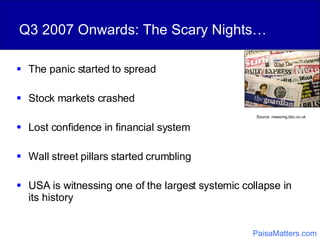
Q3 2007 Onwards: The Scary Nights… The panic started to spread Stock markets crashed Lost confidence in financial system Wall street pillars started crumbling USA is witnessing one of the largest systemic collapse in its history Source: newsimg.bbc.co.uk   PaisaMatters.com
Q3 2007 Onwards: The Scary Nights… Financial Times – 20 September 2008 “… bank boards and bank executives have failed to understand complex mortgage-backed banking products, as have central bankers, regulators and credit rating agencies.” PaisaMatters.com
?: The Dawn Ahead… Costly though, surely, a lesson for the economy Is the worst over yet?  …  Probably not ! How long before the economy starts looking-up again?  … Nobody knows! Hopefully Sooner, is the Dawn Ahead… PaisaMatters.com

Sub-Prime Crisis: An Economic Perspective

  • 1.
    Collapsed (Individuals +Corporate + Banks) = Collapsed System Sub-Prime Crisis An Economic Perspective PaisaMatters.com
  • 2.
    The days ofhigh levels of employment and high disposable income in the hands of individuals saw 1995 – 2006: The Bright and Sunny Days… High demand for commodities and goods Source: www.bloomberg.com PaisaMatters.com
  • 3.
    1995 – 2006:The Bright and Sunny Days… Increasing demand led to increased production levels Jobs creation and an all around industrial and economic growth PaisaMatters.com
  • 4.
    1995 – 2006:The Bright and Sunny Days… Source: www.ofm.wa.gov PaisaMatters.com
  • 5.
    Source: epress.anu.edu.au 1995 – 2006: The Bright and Sunny Days…
  • 6.
    1995 – 2006:The Bright and Sunny Days… The consumer generated organic infusion of money generated strong liquidity in the economy The increasing aspirations and risk taking ability coupled with low interest rates fuelled strong credit growth Banking system flushed with liquidity felt a need to accelerate the credit growth PaisaMatters.com
  • 7.
    High income levels and desire to own a dream home had already created a good mortgage loan portfolio 1995 – 2006: The Bright and Sunny Days… Low interest rates made the housing more affordable and allowed to borrow more The prime mortgage loan market was falling short of propelling the desired exponential credit growth There was a huge population with ‘ less than perfect credit ’ to be tapped PaisaMatters.com
  • 8.
    Borrowers with less than perfect credit - the Subprime borrowers, presented a mouthwatering opportunity for bankers in the mortgages market 1995 – 2006: The Bright and Sunny Days… Banks started chasing the subprime borrowers with easy loans People who otherwise could not have afforded a home, bought homes with the high interest rate loans PaisaMatters.com
  • 9.
    1995 – 2006:The Bright and Sunny Days… Welcome to the world of Sub-Prime Mortgages PaisaMatters.com
  • 10.
    1995 – 2006:The Bright and Sunny Days… Subprime loans are mortgages given to borrowers with ‘ less than perfect ’ credit or poor credit history Most subprime borrowers are ones with low and inconsistent income Because subprime loans are riskier, they carry a higher rate of interest Not all subprime mortgage loans were used for buying houses but to refinance other obligations like credit card debts, making them even more risky PaisaMatters.com
  • 11.
    1995 – 2006:The Bright and Sunny Days… Borrowers were happy to get loans without worrying about credit worthiness Mortgage brokers were happy as they were paid to underwrite these easy selling subprime loans without a responsibility to recover Bankers were happy with the credit growth and higher returns from subprime loans A Win-Win for all, but not for long. PaisaMatters.com
  • 12.
    1995 – 2006:The Bright and Sunny Days… PaisaMatters.com
  • 13.
    1995 – 2006:The Bright and Sunny Days… The bankers who originated subprime loans converted them to bundles of securities and sold the packaged Mortgage Backed Securities (MBS) in financial markets This allowed banks to pass on the risk of default to investors of MBS This allowed banks to get these loans off their balance sheet and borrow more, only to originate more subprime loans The buyers of these subprime MBS thought they were taking a calculated risk of default in lieu of higher returns PaisaMatters.com
  • 14.
    1995 – 2006:The Bright and Sunny Days… In the “High Risk – High Reward” equation, the involved risks were grossly overlooked for the lucrative rewards PaisaMatters.com
  • 15.
    1995 – 2006:The Bright and Sunny Days… Low interest rates + Rising property prices + Banks chasing after borrowers with easy loan offers Result Swollen sub-prime mortgage portfolio & huge debt ridden population Source: i.ehow.com Source: Flickr.com PaisaMatters.com
  • 16.
    1995 – 2006:The Bright and Sunny Days… PaisaMatters.com
  • 17.
    Q4 2006 –Q2 2007: The Gloomy Evenings Too much money chasing too few goods resulted in increase in commodity prices and rising inflation rate The interest rates started moving northwards Because most of these loans were Adjustable Rate Mortgages (ARMs), the loan installment amount increased Pressure started to mount on borrowers monthly cash outflows to meet the fixed obligations PaisaMatters.com
  • 18.
    Q4 2006 –Q2 2007: The Gloomy Evenings.. Falling demand for properties led to a rapid decrease in property prices PaisaMatters.com
  • 19.
    Q4 2006 –Q2 2007: The Gloomy Evenings.. Rising oil prices and falling stock markets saw an erosion of investments Decreasing demand all around resulted in reduced production levels and job losses Economic slowdown was slowly making an entry PaisaMatters.com
  • 20.
    Q3 2007 Onwards:The Scary Nights… The subprime borrowers with inconsistent and low incomes could not pay the increased loan installments Banks started to tighten the credit norms preventing subprime borrowers to refinance existing debts to lower payments Borrowers could not sell the property to repay debts as the house was worth less that what they bought for This left borrowers with an option to bring in more money or miss the loan payments PaisaMatters.com
  • 21.
    Q3 2007 Onwards:The Scary Nights… Improving cash flows was a distant possibility for sub-prime borrowers, missing payments was obvious The sub-prime loan defaults started mounting With a further continuous increase in interest rates, it became almost impossible for borrowers to repay the increased mortgage bills Loan foreclosures started increasing PaisaMatters.com
  • 22.
    Q3 2007 Onwards:The Scary Nights… PaisaMatters.com
  • 23.
    Q3 2007 Onwards:The Scary Nights… Because there were not many buyers for foreclosed properties, banks could not recover their outstanding loans by selling the foreclosed properties With tightened credit norms, fewer borrowers qualified for new loans leading to more homes to sell to fewer buyers Banks left with no other option but to write off the outstanding defaulted loans Once considered cash cows, the high return fetching mortgage backed securities (MBS) became worthless PaisaMatters.com
  • 24.
    Q3 2007 Onwards:The Scary Nights… In deteriorating economic conditions, sub-prime loan defaults were followed by defaults in prime mortgages home equity loans unsecured consumer loans (car loans, student loans, credit cards) and commercial loans PaisaMatters.com
  • 25.
    PaisaMatters.com Q3 2007Onwards: The Scary Nights…
  • 26.
    Q3 2007 Onwards:The Scary Nights… Tons of outstanding credit with no recovery in sight saw financial institutions broke This caused more than two dozen lenders to close, sell themselves to larger firms or report unprecedented losses Once massive, some financial institutions filed for bankruptcy Source: nancarrow-webdesk.com PaisaMatters.com
  • 27.
    Q3 2007 Onwards:The Scary Nights… The panic started to spread Stock markets crashed Lost confidence in financial system Wall street pillars started crumbling USA is witnessing one of the largest systemic collapse in its history Source: newsimg.bbc.co.uk PaisaMatters.com
  • 28.
    Q3 2007 Onwards:The Scary Nights… Financial Times – 20 September 2008 “… bank boards and bank executives have failed to understand complex mortgage-backed banking products, as have central bankers, regulators and credit rating agencies.” PaisaMatters.com
  • 29.
    ?: The DawnAhead… Costly though, surely, a lesson for the economy Is the worst over yet? … Probably not ! How long before the economy starts looking-up again? … Nobody knows! Hopefully Sooner, is the Dawn Ahead… PaisaMatters.com