Corporate Accounting Frauds:
Satyam Computers Limited
BY – SAHIL MATHEW
INTRODUCTION
• Satyam means “truth”
• Satyam Computers was founded in 1987.
• Satyam was as an example of “India’s growing success.” Satyam won
numerous awards for innovation, governance, and corporate
accountability.
• From 2003-2008, the company grew measurably, an annual
compound growth rate of 35%.
• The company was a leading star and a recognizable name–in a global
IT marketplace
THE SCAM
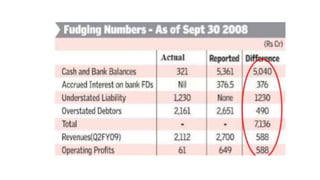
On January 7, 2009, Mr. Ramalinga Raju disclosed in a letter to Board
of Directors
1. He had been manipulating the company’s accounting numbers for
years.
2. Mr. Raju claimed that he overstated assets on Satyam’s balance
sheet by $1.47 billion.
3. Nearly $1.04 billion in bank loans and cash that the company
claimed to own was non-existent.
People Behind the Scam
• Ramalinga Raju : Satyam former chairman
• B Rama Raju : Brother of Ramalinga Raju Former Managing
Director
• V Srinivas : Ex-Chief financial officer
• S Gopalakrishnan: Price Waterhouse Auditor
• Talluri Srinivas :Price Waterhouse Auditor
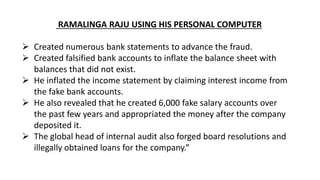
RAMALINGA RAJU USING HIS PERSONAL COMPUTER
 Created numerous bank statements to advance the fraud.
 Created falsified bank accounts to inflate the balance sheet with
balances that did not exist.
 He inflated the income statement by claiming interest income from
the fake bank accounts.
 He also revealed that he created 6,000 fake salary accounts over
the past few years and appropriated the money after the company
deposited it.
 The global head of internal audit also forged board resolutions and
illegally obtained loans for the company.”
Floated 2 other companies for their own purpose
Without taking permission of the shareholders
Failed to repay the loans
Transfer the funds
CONFESSION
JANUARY 7th 2009
RAJU CONFESSED THAT
IT WAS LIKE RIDING A TIGER NOT KNOWING HOW TO GET DOWN
WITHOUT BEING EATEN.
T h e gap in the balance sheet reached unmanageable
proportions and could not be filled anyhow in future.
• Maytas acquisition deal was the last attempt to fill the fictitious
assets with real ones.
• Maytas infra and Maytas properties : firms owned by the sons of
Raju.
• Planned to buy the Maytas to fill the gap in the balance sheet.
• Satyam was brought to its knee due to tunneling- The Satyam
promoters had substantially reduced their holdings in company from
25.6% in March 2001 to 8.74% in March 2008.
THE AUDITORS ROLE AND FACTORS
CONTRIBUTING TO FRAUD
• PricewaterhouseCoopers (PwC), audited Satyam’s books from June
2000 until the discovery of the fraud in 2009
• PwC audited the company for nearly 9 years and did not uncover the
fraud, whereas Merrill Lynch discovered the fraud as part of its due
diligence in merely 10 days
• Investors became wary of those companies who were clients of PwC
• Indian authorities also arrested and charged several of the company’s
auditors (PwC) of fraud.
• PwC came under intense scrutiny and its license to operate was
revoked.
AFTERMATH OF SATYAM SCANDAL
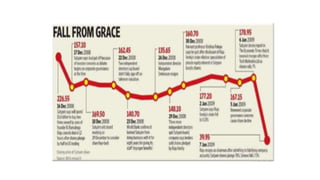
• After the news of the fraud
• Satyam’s shares fell to 11.50 rupees
• Criminal charges were brought against Mr. Raju, including: criminal
conspiracy, breach of trust, and forgery
• New board members were appointed- The Board’s goal was “to sell
the company within 100 days.”
• Tech Mahindra, bought Satyam for $1.13 per share-less than a third
of its stock market value
IMPACT OF THE SCAM
Jobs of over 50,000 technocrats were at risk.
Country`s booming economy was at risk.
The GDP fell by 0.4%.
I.T sector suffered a downturn. India`s global image was
tarnished. Indian stock market fell dramatically.
VICTIMS
1. Employees - Non‐payment of salaries, project cancellations, layoffs stranded
in many ways: morally, financially, legally, and socially.
2. Clients- Expressed loss of trust and reviewed their contracts
3. Shareholders- Lost their valuable investments and there was doubt about
revival of India
4. Bankers- Were concerned about recovery of financial and non-financial
exposure and recalled facilities
5. Indian Government- Worried about its image of the nation and IT-sector
affecting faith to invest, or to do business in the county.
FACTORS THAT CONTRIBUTE TO THE FRAUD
1. Greed
2. Ambitious corporate growth
3. Lack of transparency
4. Excessive interest in
maintaining stock prices
5. Executive incentives
6. Stock market expectations
7. Nature of accounting rules,
8. ESOPs issued to those who
prepared fake bills
9. High risk deals that went sour
10. Audit failures (internal and
external)
11. Rating agencies and investors
12. Weak independent directors
and audit committee
13. Whistle-blower policy not
being effective.
CORPORATE GOVERNANCE ISSUES AT SATYAM
• Failed to show good relation with the shareholders and employees
• CG issue - arose because of non-fulfillment of obligation of the
company towards the various stakeholders
• Shareholders never had the opportunity to give their consent
• Shareholders were at a loss and felt cheated
LESSONS LEARNED FROM SATYAM SCAM
• Investigate All Inaccuracies: If something seems inaccurate, it is
worth investigating. Dividing responsibilities across a team of people
makes it easier to detect irregularities or misappropriated funds
• Ruined reputations: threatens future foreign investment flows into
Asia’s third-largest economy and casts a cloud over growth in its once-
booming outsourcing sector.
• Corporate Governance needs to be stronger: Splitting up the roles,
careful selection of executives and top-level managers.
HOW THESE FRAUDS CAN BE CONTROLLED
• I n addition to the present statutory requirement, companies
should be required to institute sufficient internal management
controls.
• Management should ensure that the internal audit staffs areable
to prevent and detect financial statement fraud.
• Companies whose shares are publicly traded should be
required to have audit committees to monitor the internal
control system.
SATYAM NOW
• Ramalingam Raju along with 2 other accused of the scandal,
had been granted bail from Supreme court on 4 November 2011
as the investigation agency, CBI failed to file the charge sheet
even after more than 33 months of Raju been arrested
THANK YOU

Satyam Scam

  • 1.
    Corporate Accounting Frauds: SatyamComputers Limited BY – SAHIL MATHEW
  • 2.
    INTRODUCTION • Satyam means“truth” • Satyam Computers was founded in 1987. • Satyam was as an example of “India’s growing success.” Satyam won numerous awards for innovation, governance, and corporate accountability. • From 2003-2008, the company grew measurably, an annual compound growth rate of 35%. • The company was a leading star and a recognizable name–in a global IT marketplace
  • 3.
    THE SCAM On January7, 2009, Mr. Ramalinga Raju disclosed in a letter to Board of Directors 1. He had been manipulating the company’s accounting numbers for years. 2. Mr. Raju claimed that he overstated assets on Satyam’s balance sheet by $1.47 billion. 3. Nearly $1.04 billion in bank loans and cash that the company claimed to own was non-existent.
  • 4.
    People Behind theScam • Ramalinga Raju : Satyam former chairman • B Rama Raju : Brother of Ramalinga Raju Former Managing Director • V Srinivas : Ex-Chief financial officer • S Gopalakrishnan: Price Waterhouse Auditor • Talluri Srinivas :Price Waterhouse Auditor
  • 6.
    RAMALINGA RAJU USINGHIS PERSONAL COMPUTER  Created numerous bank statements to advance the fraud.  Created falsified bank accounts to inflate the balance sheet with balances that did not exist.  He inflated the income statement by claiming interest income from the fake bank accounts.  He also revealed that he created 6,000 fake salary accounts over the past few years and appropriated the money after the company deposited it.  The global head of internal audit also forged board resolutions and illegally obtained loans for the company.”
  • 7.
    Floated 2 othercompanies for their own purpose Without taking permission of the shareholders Failed to repay the loans Transfer the funds
  • 8.
    CONFESSION JANUARY 7th 2009 RAJUCONFESSED THAT IT WAS LIKE RIDING A TIGER NOT KNOWING HOW TO GET DOWN WITHOUT BEING EATEN. T h e gap in the balance sheet reached unmanageable proportions and could not be filled anyhow in future.
  • 9.
    • Maytas acquisitiondeal was the last attempt to fill the fictitious assets with real ones. • Maytas infra and Maytas properties : firms owned by the sons of Raju. • Planned to buy the Maytas to fill the gap in the balance sheet. • Satyam was brought to its knee due to tunneling- The Satyam promoters had substantially reduced their holdings in company from 25.6% in March 2001 to 8.74% in March 2008.
  • 10.
    THE AUDITORS ROLEAND FACTORS CONTRIBUTING TO FRAUD • PricewaterhouseCoopers (PwC), audited Satyam’s books from June 2000 until the discovery of the fraud in 2009 • PwC audited the company for nearly 9 years and did not uncover the fraud, whereas Merrill Lynch discovered the fraud as part of its due diligence in merely 10 days • Investors became wary of those companies who were clients of PwC • Indian authorities also arrested and charged several of the company’s auditors (PwC) of fraud. • PwC came under intense scrutiny and its license to operate was revoked.
  • 11.
    AFTERMATH OF SATYAMSCANDAL • After the news of the fraud • Satyam’s shares fell to 11.50 rupees • Criminal charges were brought against Mr. Raju, including: criminal conspiracy, breach of trust, and forgery • New board members were appointed- The Board’s goal was “to sell the company within 100 days.” • Tech Mahindra, bought Satyam for $1.13 per share-less than a third of its stock market value
  • 13.
    IMPACT OF THESCAM Jobs of over 50,000 technocrats were at risk. Country`s booming economy was at risk. The GDP fell by 0.4%. I.T sector suffered a downturn. India`s global image was tarnished. Indian stock market fell dramatically.
  • 14.
    VICTIMS 1. Employees -Non‐payment of salaries, project cancellations, layoffs stranded in many ways: morally, financially, legally, and socially. 2. Clients- Expressed loss of trust and reviewed their contracts 3. Shareholders- Lost their valuable investments and there was doubt about revival of India 4. Bankers- Were concerned about recovery of financial and non-financial exposure and recalled facilities 5. Indian Government- Worried about its image of the nation and IT-sector affecting faith to invest, or to do business in the county.
  • 15.
    FACTORS THAT CONTRIBUTETO THE FRAUD 1. Greed 2. Ambitious corporate growth 3. Lack of transparency 4. Excessive interest in maintaining stock prices 5. Executive incentives 6. Stock market expectations 7. Nature of accounting rules, 8. ESOPs issued to those who prepared fake bills 9. High risk deals that went sour 10. Audit failures (internal and external) 11. Rating agencies and investors 12. Weak independent directors and audit committee 13. Whistle-blower policy not being effective.
  • 16.
    CORPORATE GOVERNANCE ISSUESAT SATYAM • Failed to show good relation with the shareholders and employees • CG issue - arose because of non-fulfillment of obligation of the company towards the various stakeholders • Shareholders never had the opportunity to give their consent • Shareholders were at a loss and felt cheated
  • 17.
    LESSONS LEARNED FROMSATYAM SCAM • Investigate All Inaccuracies: If something seems inaccurate, it is worth investigating. Dividing responsibilities across a team of people makes it easier to detect irregularities or misappropriated funds • Ruined reputations: threatens future foreign investment flows into Asia’s third-largest economy and casts a cloud over growth in its once- booming outsourcing sector. • Corporate Governance needs to be stronger: Splitting up the roles, careful selection of executives and top-level managers.
  • 18.
    HOW THESE FRAUDSCAN BE CONTROLLED • I n addition to the present statutory requirement, companies should be required to institute sufficient internal management controls. • Management should ensure that the internal audit staffs areable to prevent and detect financial statement fraud. • Companies whose shares are publicly traded should be required to have audit committees to monitor the internal control system.
  • 19.
    SATYAM NOW • RamalingamRaju along with 2 other accused of the scandal, had been granted bail from Supreme court on 4 November 2011 as the investigation agency, CBI failed to file the charge sheet even after more than 33 months of Raju been arrested
  • 20.