
Now we are ready to look into the mess !
Evolution of home mortgage  Source : http://www.imf.org/external/pubs/ft/fandd/2007/12/dodd.htm  ,Subprime Mortgage Market Turmoil, Christopher L. Peterson, Asst Prof of Law, Univ of Florida  1930s Lender-Banks Borrower-Individuals Home loan funding Principal + interest payable over long term  Owning a house was not affordable to many  Great Depression brought industry to a halt. Large scale defaulters and lenders could not recover by reselling To simulate the industry again Government as part of New Deal policy created the Federal National Mortgage Association (Fannie Mae) in 1938. This created a secondary market for mortgages Lender-Banks Borrower-Individuals Home loan funding Principal + interest payable over long term  Bought loan Cash Transfer of credit risk, market risk  Had Access to long term borrowing Bought only those which conformed to certain underwriting standard ( called Prime Mortgages)
Evolution continued… Fannie Mae proved very successful . But by 1960s , borrowing done by it constituted a significant share of the debt owed by US government. 1968- Government National Mortgage Association (Ginnie Mae) was created to handle government guaranteed mortgages. Fannie Mae became federally chartered, privately held 1970- Ginnie Mae developed  MBS  -- shifted the market risk to investors -- eliminated debt incurred to fund government housing program 1970-Federal National Mortgage Corporation (Freddie Mac) created  To securitize conventional mortgages Provide competition to Fannie Mae Over time Fannie Mae and Freddie Mac together provided enormous amount of funding for US mortgage Since Fannie Mae and Freddie Mac  guaranteed loans, much of credit risk stayed with them. Size and diversification allowed them to handle it. Source : http://www.imf.org/external/pubs/ft/fandd/2007/12/dodd.htm  ,
New Model of mortgage lending Lender-Banks Home loan funding Principal + interest payable over long term  Bought loan Cash Transfer of credit & market risk MBS Cash Transfer of market risk   Advantages More liquidity in market Risk spread out  Long term funding for mortgage lending MBS- allows originators to earn fee income from underwriting activities without exposure to credit, market or liquidity risks as they see the loans they make SPV Securitization fees
Further evolution.. 1977- Private label securitization started first done by BOA and Salomon Brothers 1980s- pricing, liquidity and  tax hurdles were resolved in same Unlike 2-3 party , private label securitization has 10 or more different parties playing independent role Big private players in this field were Wells Frago Lehman Brothers Bear Stearns JP Morgan Goldman Sachs Bank Of America Indymac Washington Mutual Countrywide
Structured finance:  The players in securitization Originator End borrowers Conduit/trust/  SPV/SPE/SIV Investment bank  (underwriter) Rating agency Institutional  investor End lenders Insurance  company Broker Servicer $ $ $ $ $ Mortgages Mortgages MBS I&P ($) I&P ($) MBS, I&P ($) Financial  returns ($) LEGEND KEY O&G – interest and principal SPV – special purpose vehicle SPE – special purpose enterprise SIV – special investment vehicle MBS – mortgage backed securities Founder: loan originator or investment bank Purpose: transfering ownerhship of claims (loans) and collateral (mortgages) in order to issue mortgage backed securities (bonds). Exposure of founder: implicit guarantee in case of large losses. Assigns credit rating to issued MBSs. Organizes issuing of MBSs and places MBSs  to investors in financial markets. Broker places mortgage loans to borrowers for fee Manages the flow of interests and principal (I&P); usually, but not necessarilly the Originator  Typically a specialized mortgage bank Mutual funds, pension funds, hedge funds… Can assume part of risks (insurance of mortgage loans, insurance of MBS returns).
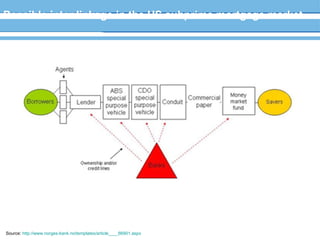
Possible inter linkage in the US subprime mortgage market Source:  http://www.norges-bank.no/templates/article____66901.aspx
Reasons for forming of Subprime mess Giant pool of money  available for investment through savings of Oil exporters , economic development in BRIC countries.  Private share in mortgage market   growth in large part through origination and securitization of high risk sub-prime  and Alt-A mortgages. Building up of the housing bubble Private Banks made use of  CDOs  to sell to investors Lax regulations which did not keep pace with the innovations happening in financial engineering US  kept interest rates  too low for too long  in post dotcom bust period  Hedge funds, Wall street firms and instructional investors found lower tranches in MBS and CDO attractive which were highly risky Hedge funds leverage ratio of the order of 500%.  To sum up in 3 words as noted by Harvard dean:  Leverage(high) , Transparency (low) and Liquidity (abundant)
Big assumptions Belief that modern  capital markets  had become so  much more advanced  than their predecessors that banks would always be able to trade debt securities. This encouraged banks to keep  lowering lending standards , since they assumed they could sell the risk on.  Many investors assumed that the  credit rating agencies  offered an  easy and cost-effective compass  with which to navigate this ever more complex world. Thus many continued to purchase complex securities throughout the first half of 2007 – even though most investors barely understood these products. Most crucially, there was a widespread assumption that the  process of “slicing and dicing” debt had made the financial system more stable . Policymakers thought that because the pain of any potential credit defaults was spread among millions of investors, rather than concentrated in particular banks, it would be much easier for the system to absorb shocks than in the past. Housing prices  will keep going up all time  Source :http://www.ft.com/cms/s/0/a09f751e-6187-11dd-af94-000077b07658,dwp_uuid=698e638e-e39a-11dc-8799-0000779fd2ac.html
Misaligned incentives & pitfalls “ churning” of capital “allows even an institution without a great amount of fixed capital to make a huge amount of loans, lending in a year much more money than it has If an individual or class of victims obtains a large judgment, the lender’s management can simply declare bankruptcy, liquidate whatever limited assets are left, and possibly reform a new company a short time later.  Securitization conduit divides various lending tasks into multiple corporate entities—a broker, an originator, a servicer, a document custodian, etc.—the conduit tends to prevent the accumulation of a large enough pool of at risk assets to attract the attention of class action attorneys, which tend to be the only actors capable of obtaining system-impacting judgments. Source : Subprime Mortgage Market Turmoil , testimony by Christopher L. Peterson
Good days turn bad. Crisis at the door (mid 2006 onwards): Through financial innovations loans issued to borrowers at minimal rate, adjusted rate. By mid 2006 time to pay bigger amounts comes Household income did not increase in  same  proportion as house prices Subprime mortgage owners start defaulting Rating agencies revise ratings of MBS/CDO as expected number of defaults turn out higher. Many ratings are lowered Bewildered investors lost faith in ratings, many stop buying MBS/CDO altogether Alarm bell at SIV/SPVs Banks find themselves in non-comfortable position , stop making loans Housing prices plummet  owing to increase in  foreclosure , delinquency and stoppage of loans
what a mess…. More frenzy in market and more defaults, again revised ratings, again further stoppage of funding and further stoppage of loans, further fall in house prices as demand and supply mismatch....problem feeding itself in circular fashion. As MBS/CDO market is shaken….investors start debating other derivatives true worth…panic spreads across and people start getting out….further hurting the banks The crisis unfolded as silent Tsunami on Wall Street where by the time people realized the graveness of the mess they were in , it had gone beyond control. Since, most of the player in the market, mortgage brokers, investment banks were running in debts. They are suddenly caught unaware and are in insolvency and start tumbling down….many are saved by nationalization as their fall would spread the contagion way far . Central government start pumping in money as last resort but one thing is surely not returning soon and which is very vital in financial industry -FAITH.
In Short Source : http://www.imf.org/external/pubs/ft/fandd/2007/12/dodd.htm  ,
Those good old days were gone now!!
How Subprime became Global Financial Crisis? Source: Financial Times ,  http://www.ft.com/cms/s/0/a09f751e-6187-11dd-af94-000077b07658,dwp_uuid=698e638e-e39a-11dc-8799-0000779fd2ac.html   In billion US $ How could problems with subprime mortgages, being such a small sector of global financial markets, provoke such dislocation?
Build up into a financial crisis… In 2003, Bank of International Settlements(BIS) repeatedly warned that risk dispersion might not always be benign. But US Federal Reserve was convinced that financial innovation had changed the system in a fundamentally beneficial way. No efforts made to correct debt to equity ratios of bank Huge trust in the intellectual capital of Wall Street –supported by the fact that banks were making big money.  When high rates of subprime default emerged in late 2006, market players assumed that the system would absorb the pain.  Initial estimate of subprime loss put to $50bn-$100bn by US FED  Subprime losses started to hit the financial system in the early summer of 2007 in unexpected ways. As the surprise spread, the  pillars of faith  that had supported the credit boom started to crumble. Investors woke up to the fact that it was dangerous to use the ratings agencies as a guide for complex debt securities.  In the summer of 2007, the  agencies started downgrading  billions of dollars of supposedly “ultra-safe” debt – causing prices to crumble. Source: Financial Times ,  http://www.ft.com/cms/s/0/a09f751e-6187-11dd-af94-000077b07658,dwp_uuid=698e638e-e39a-11dc-8799-0000779fd2ac.html
Poor Investors….  Shocked investors (sitting in all parts of the world) lost faith in ratings, many stopped buying complex instruments altogether That created an immediate funding crisis at many investment vehicles ( remember SIV), since most had funded themselves by issuing notes in the asset-backed commercial paper market.  Many banks had not yet passed on the risk to others. Many were holding asset-backed securities in “warehouses” and were working on splicing them up into CDOs, getting them rated by a credit agency such as Moody’s or Standard & Poor’s. Several banks were caught out not only because it took time to structure the securities but because they deliberately held on to what they regarded as “safe” tranches of loans. Ex. UBS was badly damaged by retaining “super-senior” CDO debt. It also meant that banks were no longer able to turn assets such as mortgages into subprime bonds and sell these on. That in turn meant the key assumption that the capital markets would always stay liquid – was overturned.  Assumption that banks would be better protected from a crisis because of risk dispersion – also cracked.  As investment vehicles lost their ability to raise finance, they turned to their banks for help. That squeezed the banks’ balance sheets at the very moment that they were facing their own losses on debt securities and finding it impossible to sell on loans.  Source: Financial Times ,  http://www.ft.com/cms/s/0/a09f751e-6187-11dd-af94-000077b07658,dwp_uuid=698e638e-e39a-11dc-8799-0000779fd2ac.html
Desperate banks…. As a result, western banks found themselves running out of capital Banks started hoarding cash and stopped lending to each other as financiers lost faith in their ability to judge the health of other institutions – or even their own. The  London interbank offered rate(LIBOR) , the main measure of interbank lending rates, rose sharply Firms became reluctant to participate in money markets ... as a result subprime credit problems turned into a systemic liquidity crunch. Vicious deleveraging spiral got under way. As banks scurried to improve their balance sheets, they began selling assets and cutting loans to hedge funds. But that hit asset prices, hurting those balance sheets once again.  Mark-to-market accounting forced banks to readjust their books after every panicky price drop  Source: Financial Times ,  http://www.ft.com/cms/s/0/a09f751e-6187-11dd-af94-000077b07658,dwp_uuid=698e638e-e39a-11dc-8799-0000779fd2ac.html
Lessons learned & Action plans …. lesson of the CDO collapse is that technology does not obviate the need to assess a borrower carefully. Neither banks nor credit agencies did this well enough on behalf of investors and it proved a painful experience for everyone In the medium term, regulators are preparing reforms that aim to make the system look credible These would force banks to hold more capital and ensure that the securitization process is more transparent Separately, groups such as the IIF are trying to introduce measures that could rebuild confidence in complex financial instruments More immediately, the banks are trying to rekindle investor trust by replenishing their capital bases Source: Financial Times ,  http://www.ft.com/cms/s/0/a09f751e-6187-11dd-af94-000077b07658,dwp_uuid=698e638e-e39a-11dc-8799-0000779fd2ac.html
Subprime losses by Big Banks Worldwide :US$ 586.2 billion and still counting Source: Financial Times
Finance & Economy The collapse of an enormous financial institution stirs uncertainty, and uncertainty rattles Wall Street. Lenders are happiest when they are confident they will be repaid. If they think there's a chance that borrowers will default, they simply don't make loans. Their refusal, in turn, can shut down the economy and the financial system. Financial system is what provides the funding for all the other sectors of the economy, and if you have a broken financial system, you have a broken economy
Investments devalued across the Globe Source: BBC News,  http://news.bbc.co.uk/2/hi/talking_point/7644574.stm
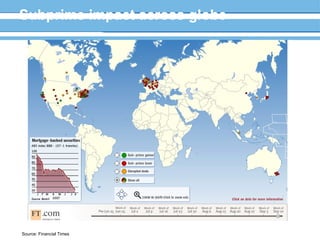
Subprime impact across globe Source: Financial Times
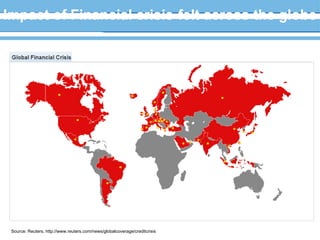
Impact of Financial crisis-felt across the globe Source: Reuters, http://www.reuters.com/news/globalcoverage/creditcrisis
Market share shifted from 2003 to mid 2006  Government share fell by  43%  where as private share rose sharply by  138%  over a period of 3 years Between sub-prime and prime Subprime lending increased by massive 205% over 3 years Alternative–A similarly expanded  by  384% Increase in Prime was mere 16.7%
Global pool of money Source: http://www.rbnz.govt.nz/speeches/2968727.html
Rise of Global Liquidity (1998 onwards) Source: http://www.rbnz.govt.nz/speeches/2968727.html
FED interest rate To catch up with dot com boom FED kept interest rate low for long This indirectly resulted in investors looking for other safe heavens They got attracted to housing market
High Banks leverage ratio’s to fund MBS/CDO
Building up of the housing bubble
Housing prices and Income Source: http://varbuzz.com/meltdown/  Housing prices were increasing Income slope was almost flat
Starting 2006 housing bubble busted
LIBOR rate
Credit rating of complex financial instruments Source: IMF and WSJ
Speedy Foreclosures
Top 10 Bankruptcies
The American way of debt Source:  http://www.nytimes.com/interactive/2008/07/20/business/20debt-trap.html?ei=5070
Average debt of American in 2004 Source:  http://www.nytimes.com/interactive/2008/07/20/business/20debt-trap.html?ei=5070
Thanks

financial-crisis-2008

  • 1.
    Now we areready to look into the mess !
  • 2.
    Evolution of homemortgage Source : http://www.imf.org/external/pubs/ft/fandd/2007/12/dodd.htm ,Subprime Mortgage Market Turmoil, Christopher L. Peterson, Asst Prof of Law, Univ of Florida 1930s Lender-Banks Borrower-Individuals Home loan funding Principal + interest payable over long term Owning a house was not affordable to many Great Depression brought industry to a halt. Large scale defaulters and lenders could not recover by reselling To simulate the industry again Government as part of New Deal policy created the Federal National Mortgage Association (Fannie Mae) in 1938. This created a secondary market for mortgages Lender-Banks Borrower-Individuals Home loan funding Principal + interest payable over long term Bought loan Cash Transfer of credit risk, market risk Had Access to long term borrowing Bought only those which conformed to certain underwriting standard ( called Prime Mortgages)
  • 3.
    Evolution continued… FannieMae proved very successful . But by 1960s , borrowing done by it constituted a significant share of the debt owed by US government. 1968- Government National Mortgage Association (Ginnie Mae) was created to handle government guaranteed mortgages. Fannie Mae became federally chartered, privately held 1970- Ginnie Mae developed MBS -- shifted the market risk to investors -- eliminated debt incurred to fund government housing program 1970-Federal National Mortgage Corporation (Freddie Mac) created To securitize conventional mortgages Provide competition to Fannie Mae Over time Fannie Mae and Freddie Mac together provided enormous amount of funding for US mortgage Since Fannie Mae and Freddie Mac guaranteed loans, much of credit risk stayed with them. Size and diversification allowed them to handle it. Source : http://www.imf.org/external/pubs/ft/fandd/2007/12/dodd.htm ,
  • 4.
    New Model ofmortgage lending Lender-Banks Home loan funding Principal + interest payable over long term Bought loan Cash Transfer of credit & market risk MBS Cash Transfer of market risk Advantages More liquidity in market Risk spread out Long term funding for mortgage lending MBS- allows originators to earn fee income from underwriting activities without exposure to credit, market or liquidity risks as they see the loans they make SPV Securitization fees
  • 5.
    Further evolution.. 1977-Private label securitization started first done by BOA and Salomon Brothers 1980s- pricing, liquidity and tax hurdles were resolved in same Unlike 2-3 party , private label securitization has 10 or more different parties playing independent role Big private players in this field were Wells Frago Lehman Brothers Bear Stearns JP Morgan Goldman Sachs Bank Of America Indymac Washington Mutual Countrywide
  • 6.
    Structured finance: The players in securitization Originator End borrowers Conduit/trust/ SPV/SPE/SIV Investment bank (underwriter) Rating agency Institutional investor End lenders Insurance company Broker Servicer $ $ $ $ $ Mortgages Mortgages MBS I&P ($) I&P ($) MBS, I&P ($) Financial returns ($) LEGEND KEY O&G – interest and principal SPV – special purpose vehicle SPE – special purpose enterprise SIV – special investment vehicle MBS – mortgage backed securities Founder: loan originator or investment bank Purpose: transfering ownerhship of claims (loans) and collateral (mortgages) in order to issue mortgage backed securities (bonds). Exposure of founder: implicit guarantee in case of large losses. Assigns credit rating to issued MBSs. Organizes issuing of MBSs and places MBSs to investors in financial markets. Broker places mortgage loans to borrowers for fee Manages the flow of interests and principal (I&P); usually, but not necessarilly the Originator Typically a specialized mortgage bank Mutual funds, pension funds, hedge funds… Can assume part of risks (insurance of mortgage loans, insurance of MBS returns).
  • 7.
    Possible inter linkagein the US subprime mortgage market Source: http://www.norges-bank.no/templates/article____66901.aspx
  • 8.
    Reasons for formingof Subprime mess Giant pool of money available for investment through savings of Oil exporters , economic development in BRIC countries. Private share in mortgage market growth in large part through origination and securitization of high risk sub-prime and Alt-A mortgages. Building up of the housing bubble Private Banks made use of CDOs to sell to investors Lax regulations which did not keep pace with the innovations happening in financial engineering US kept interest rates too low for too long in post dotcom bust period Hedge funds, Wall street firms and instructional investors found lower tranches in MBS and CDO attractive which were highly risky Hedge funds leverage ratio of the order of 500%. To sum up in 3 words as noted by Harvard dean: Leverage(high) , Transparency (low) and Liquidity (abundant)
  • 9.
    Big assumptions Beliefthat modern capital markets had become so much more advanced than their predecessors that banks would always be able to trade debt securities. This encouraged banks to keep lowering lending standards , since they assumed they could sell the risk on. Many investors assumed that the credit rating agencies offered an easy and cost-effective compass with which to navigate this ever more complex world. Thus many continued to purchase complex securities throughout the first half of 2007 – even though most investors barely understood these products. Most crucially, there was a widespread assumption that the process of “slicing and dicing” debt had made the financial system more stable . Policymakers thought that because the pain of any potential credit defaults was spread among millions of investors, rather than concentrated in particular banks, it would be much easier for the system to absorb shocks than in the past. Housing prices will keep going up all time Source :http://www.ft.com/cms/s/0/a09f751e-6187-11dd-af94-000077b07658,dwp_uuid=698e638e-e39a-11dc-8799-0000779fd2ac.html
  • 10.
    Misaligned incentives &pitfalls “ churning” of capital “allows even an institution without a great amount of fixed capital to make a huge amount of loans, lending in a year much more money than it has If an individual or class of victims obtains a large judgment, the lender’s management can simply declare bankruptcy, liquidate whatever limited assets are left, and possibly reform a new company a short time later. Securitization conduit divides various lending tasks into multiple corporate entities—a broker, an originator, a servicer, a document custodian, etc.—the conduit tends to prevent the accumulation of a large enough pool of at risk assets to attract the attention of class action attorneys, which tend to be the only actors capable of obtaining system-impacting judgments. Source : Subprime Mortgage Market Turmoil , testimony by Christopher L. Peterson
  • 11.
    Good days turnbad. Crisis at the door (mid 2006 onwards): Through financial innovations loans issued to borrowers at minimal rate, adjusted rate. By mid 2006 time to pay bigger amounts comes Household income did not increase in same proportion as house prices Subprime mortgage owners start defaulting Rating agencies revise ratings of MBS/CDO as expected number of defaults turn out higher. Many ratings are lowered Bewildered investors lost faith in ratings, many stop buying MBS/CDO altogether Alarm bell at SIV/SPVs Banks find themselves in non-comfortable position , stop making loans Housing prices plummet owing to increase in foreclosure , delinquency and stoppage of loans
  • 12.
    what a mess….More frenzy in market and more defaults, again revised ratings, again further stoppage of funding and further stoppage of loans, further fall in house prices as demand and supply mismatch....problem feeding itself in circular fashion. As MBS/CDO market is shaken….investors start debating other derivatives true worth…panic spreads across and people start getting out….further hurting the banks The crisis unfolded as silent Tsunami on Wall Street where by the time people realized the graveness of the mess they were in , it had gone beyond control. Since, most of the player in the market, mortgage brokers, investment banks were running in debts. They are suddenly caught unaware and are in insolvency and start tumbling down….many are saved by nationalization as their fall would spread the contagion way far . Central government start pumping in money as last resort but one thing is surely not returning soon and which is very vital in financial industry -FAITH.
  • 13.
    In Short Source: http://www.imf.org/external/pubs/ft/fandd/2007/12/dodd.htm ,
  • 14.
    Those good olddays were gone now!!
  • 15.
    How Subprime becameGlobal Financial Crisis? Source: Financial Times , http://www.ft.com/cms/s/0/a09f751e-6187-11dd-af94-000077b07658,dwp_uuid=698e638e-e39a-11dc-8799-0000779fd2ac.html In billion US $ How could problems with subprime mortgages, being such a small sector of global financial markets, provoke such dislocation?
  • 16.
    Build up intoa financial crisis… In 2003, Bank of International Settlements(BIS) repeatedly warned that risk dispersion might not always be benign. But US Federal Reserve was convinced that financial innovation had changed the system in a fundamentally beneficial way. No efforts made to correct debt to equity ratios of bank Huge trust in the intellectual capital of Wall Street –supported by the fact that banks were making big money. When high rates of subprime default emerged in late 2006, market players assumed that the system would absorb the pain. Initial estimate of subprime loss put to $50bn-$100bn by US FED  Subprime losses started to hit the financial system in the early summer of 2007 in unexpected ways. As the surprise spread, the pillars of faith that had supported the credit boom started to crumble. Investors woke up to the fact that it was dangerous to use the ratings agencies as a guide for complex debt securities. In the summer of 2007, the agencies started downgrading billions of dollars of supposedly “ultra-safe” debt – causing prices to crumble. Source: Financial Times , http://www.ft.com/cms/s/0/a09f751e-6187-11dd-af94-000077b07658,dwp_uuid=698e638e-e39a-11dc-8799-0000779fd2ac.html
  • 17.
    Poor Investors…. Shocked investors (sitting in all parts of the world) lost faith in ratings, many stopped buying complex instruments altogether That created an immediate funding crisis at many investment vehicles ( remember SIV), since most had funded themselves by issuing notes in the asset-backed commercial paper market.  Many banks had not yet passed on the risk to others. Many were holding asset-backed securities in “warehouses” and were working on splicing them up into CDOs, getting them rated by a credit agency such as Moody’s or Standard & Poor’s. Several banks were caught out not only because it took time to structure the securities but because they deliberately held on to what they regarded as “safe” tranches of loans. Ex. UBS was badly damaged by retaining “super-senior” CDO debt. It also meant that banks were no longer able to turn assets such as mortgages into subprime bonds and sell these on. That in turn meant the key assumption that the capital markets would always stay liquid – was overturned.  Assumption that banks would be better protected from a crisis because of risk dispersion – also cracked. As investment vehicles lost their ability to raise finance, they turned to their banks for help. That squeezed the banks’ balance sheets at the very moment that they were facing their own losses on debt securities and finding it impossible to sell on loans. Source: Financial Times , http://www.ft.com/cms/s/0/a09f751e-6187-11dd-af94-000077b07658,dwp_uuid=698e638e-e39a-11dc-8799-0000779fd2ac.html
  • 18.
    Desperate banks…. Asa result, western banks found themselves running out of capital Banks started hoarding cash and stopped lending to each other as financiers lost faith in their ability to judge the health of other institutions – or even their own. The London interbank offered rate(LIBOR) , the main measure of interbank lending rates, rose sharply Firms became reluctant to participate in money markets ... as a result subprime credit problems turned into a systemic liquidity crunch. Vicious deleveraging spiral got under way. As banks scurried to improve their balance sheets, they began selling assets and cutting loans to hedge funds. But that hit asset prices, hurting those balance sheets once again. Mark-to-market accounting forced banks to readjust their books after every panicky price drop  Source: Financial Times , http://www.ft.com/cms/s/0/a09f751e-6187-11dd-af94-000077b07658,dwp_uuid=698e638e-e39a-11dc-8799-0000779fd2ac.html
  • 19.
    Lessons learned &Action plans …. lesson of the CDO collapse is that technology does not obviate the need to assess a borrower carefully. Neither banks nor credit agencies did this well enough on behalf of investors and it proved a painful experience for everyone In the medium term, regulators are preparing reforms that aim to make the system look credible These would force banks to hold more capital and ensure that the securitization process is more transparent Separately, groups such as the IIF are trying to introduce measures that could rebuild confidence in complex financial instruments More immediately, the banks are trying to rekindle investor trust by replenishing their capital bases Source: Financial Times , http://www.ft.com/cms/s/0/a09f751e-6187-11dd-af94-000077b07658,dwp_uuid=698e638e-e39a-11dc-8799-0000779fd2ac.html
  • 20.
    Subprime losses byBig Banks Worldwide :US$ 586.2 billion and still counting Source: Financial Times
  • 21.
    Finance & EconomyThe collapse of an enormous financial institution stirs uncertainty, and uncertainty rattles Wall Street. Lenders are happiest when they are confident they will be repaid. If they think there's a chance that borrowers will default, they simply don't make loans. Their refusal, in turn, can shut down the economy and the financial system. Financial system is what provides the funding for all the other sectors of the economy, and if you have a broken financial system, you have a broken economy
  • 22.
    Investments devalued acrossthe Globe Source: BBC News, http://news.bbc.co.uk/2/hi/talking_point/7644574.stm
  • 23.
    Subprime impact acrossglobe Source: Financial Times
  • 24.
    Impact of Financialcrisis-felt across the globe Source: Reuters, http://www.reuters.com/news/globalcoverage/creditcrisis
  • 25.
    Market share shiftedfrom 2003 to mid 2006 Government share fell by 43% where as private share rose sharply by 138% over a period of 3 years Between sub-prime and prime Subprime lending increased by massive 205% over 3 years Alternative–A similarly expanded by 384% Increase in Prime was mere 16.7%
  • 26.
    Global pool ofmoney Source: http://www.rbnz.govt.nz/speeches/2968727.html
  • 27.
    Rise of GlobalLiquidity (1998 onwards) Source: http://www.rbnz.govt.nz/speeches/2968727.html
  • 28.
    FED interest rateTo catch up with dot com boom FED kept interest rate low for long This indirectly resulted in investors looking for other safe heavens They got attracted to housing market
  • 29.
    High Banks leverageratio’s to fund MBS/CDO
  • 30.
    Building up ofthe housing bubble
  • 31.
    Housing prices andIncome Source: http://varbuzz.com/meltdown/ Housing prices were increasing Income slope was almost flat
  • 32.
    Starting 2006 housingbubble busted
  • 33.
  • 34.
    Credit rating ofcomplex financial instruments Source: IMF and WSJ
  • 35.
  • 36.
  • 37.
    The American wayof debt Source: http://www.nytimes.com/interactive/2008/07/20/business/20debt-trap.html?ei=5070
  • 38.
    Average debt ofAmerican in 2004 Source: http://www.nytimes.com/interactive/2008/07/20/business/20debt-trap.html?ei=5070
  • 39.