SUBPRIME CRISIS AND THE WORLD Presented by: V.K.Malhotra
Introduction Little about the financial world - Its rise  Banking and non-banking institutions Different types of instruments Control of the central bank/s over financial institutions Debate grim in 1950s and 60s Keynes, Friedman, Radcliffe, Gurley, Shaw, etc.
What is liquidity? What is financial/credit market?
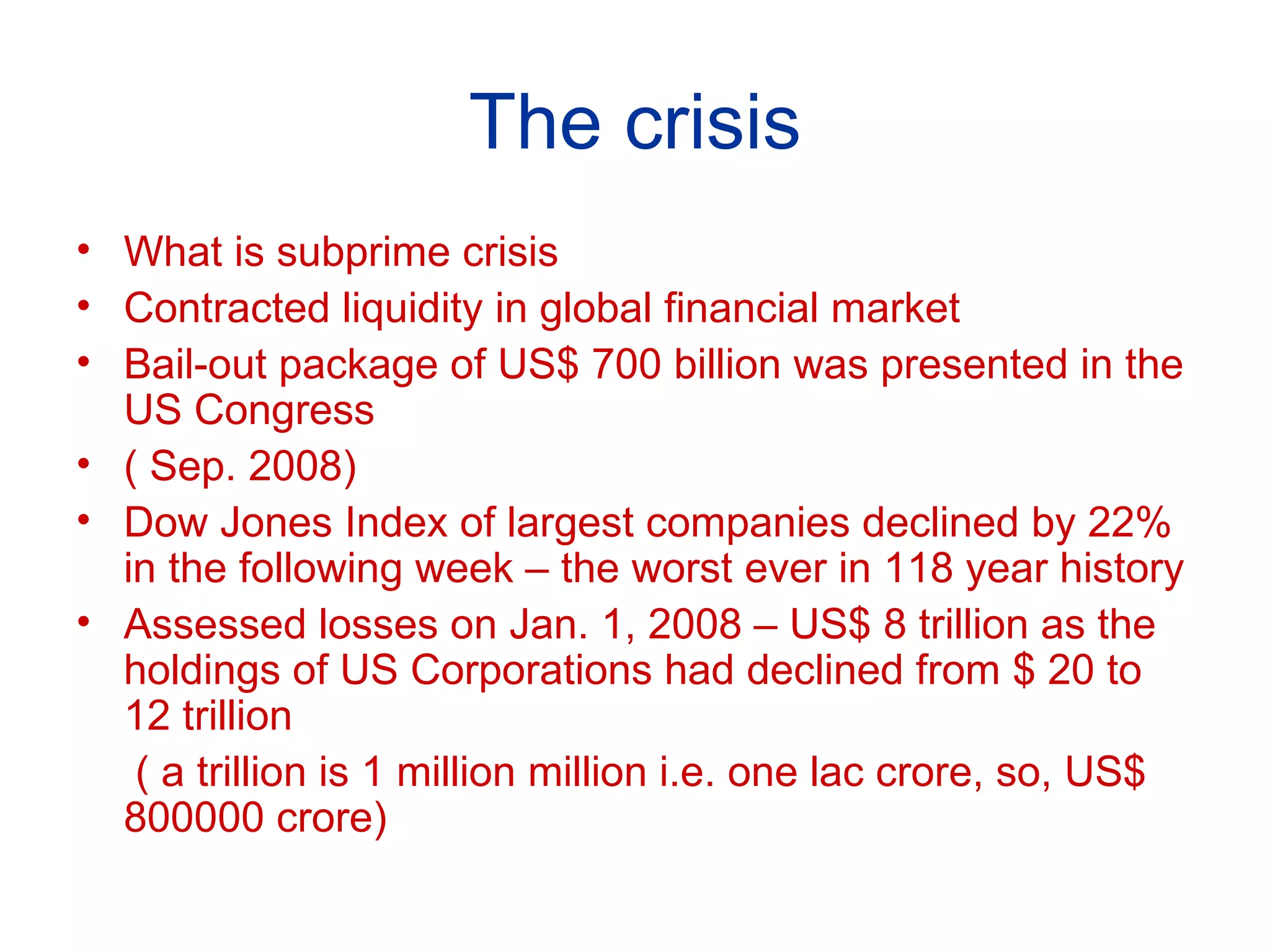
The crisis What is subprime crisis Contracted liquidity in global financial market Bail-out package of US$ 700 billion was presented in the US Congress  ( Sep. 2008)  Dow Jones Index of largest companies declined by 22% in the following week – the worst ever in 118 year history Assessed losses on Jan. 1, 2008 – US$ 8 trillion as the holdings of US Corporations had declined from $ 20 to 12 trillion ( a trillion is 1 million million i.e. one lac crore, so, US$ 800000 crore)
continued Liquidity concerns have driven central banks to take action to provide funds to worthy borrowers and restore confidence in financial market USA has even opted for bail-outs – In a capitalist economy Barrack Obama had made it a point in election campaign Cut in interest rates and economic packages
Who failed? Failure of mortgage companies,  investment firms  and government sponsored enterprises Some Corporates HSBC  New Century Financial Group Merrill Lynch JP Morgan Chase Goldman Sachs Citicorp AIG (America International Group)
The crisis has been fuelled by downturn in property (home) prices Subprime mortgages It had started to show in the middle of 2006 Housing bubble High default rate happening  High foreclosure rate due to delinquent accounts : up by 79% from 2006
Variable amount Foreclosure/ Delinquent accounts : 70 % of foreclosures are subprime loans though they account for only 12.5% of all mortgages More than 30% of subprime loans had become 90 days delinquent Prepayment Penalty
Adjustable Rate Mortgages (ARM) started in 2005 It come at Teaser Interest Rates Teaser Interest Rates : Initially only interest is charged with no principal repayment and the interest rates jump after some initial period of two-three years. These loans have high closing costs and pre-payment penalty. So, after sometime when the loan is reset, the monthly payment starts skyrocketing, may be by 50-60%. That forces a borrower to opt for refinance.  First Mortgage Second Mortgage
Keynesian economists Hyman Minsky described three types of speculative borrowing that can lead to collapse of asset value: Hedge borrowers – one who borrows with an intent of making debt payments from cash flows of other investments Speculative borrowers – one who borrows on the belief that they can service interest and they must roll over principal into new investments Ponzi borrowers – one who assumes that appreciation in asset value would refinance or pay-off the debt
What s credit risk?  The risk in case of default To protect against it, financial institutions can sell rights to the mortgage payments and related credit risk to the investors. This process is called securitization  The securities that investors purchase are called Mortgage Based Securities (MBS) Credit risk remains distributed in such manner There are no investors for MBS now as they have burnt fingers
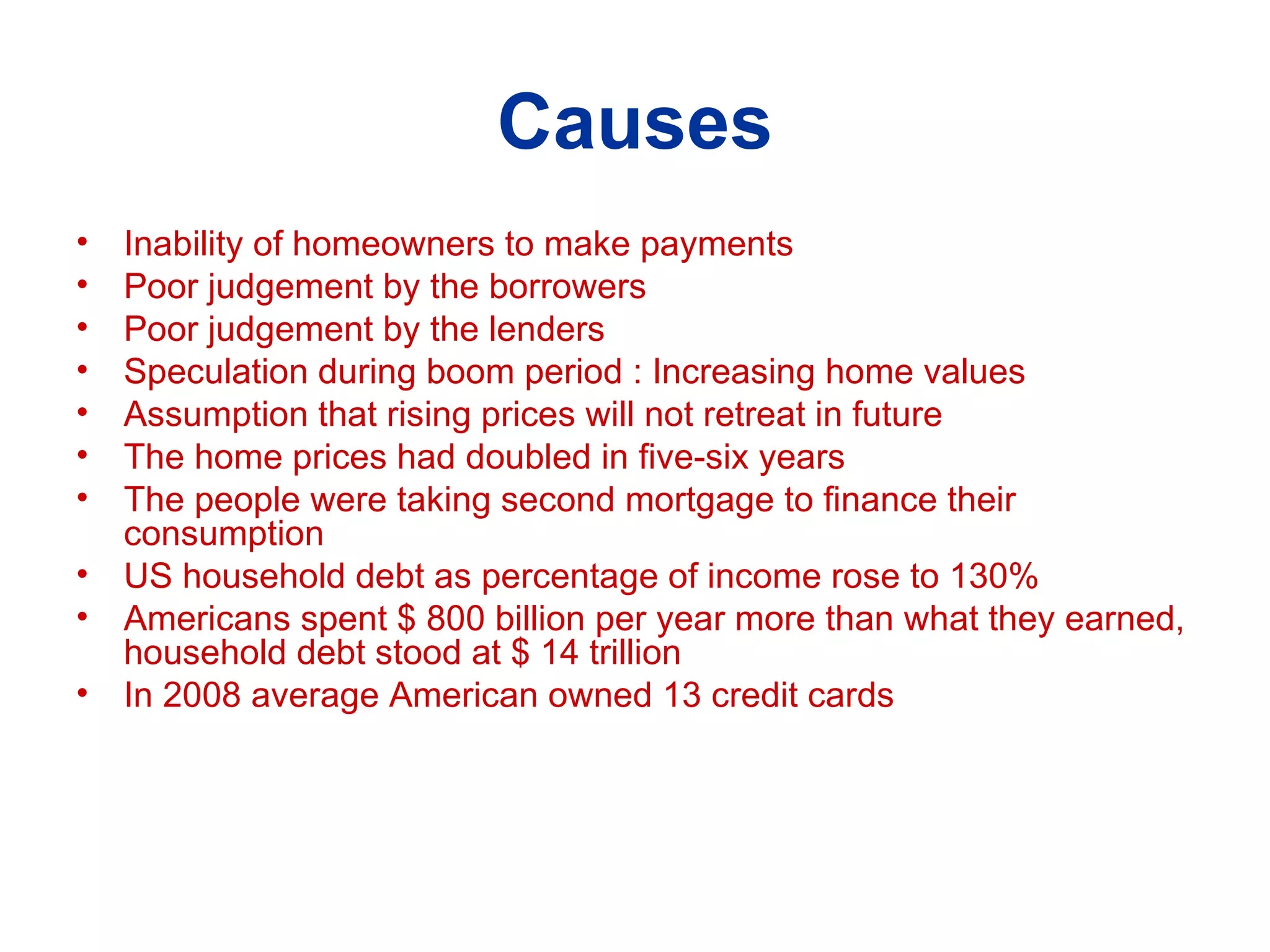
Causes Inability of homeowners to make payments Poor judgement by the borrowers Poor judgement by the lenders Speculation during boom period : Increasing home values Assumption that rising prices will not retreat in future The home prices had doubled in five-six years The people were taking second mortgage to finance their consumption US household debt as percentage of income rose to 130% Americans spent $ 800 billion per year more than what they earned, household debt stood at $ 14 trillion In 2008 average American owned 13 credit cards
Risky mortgage products High personal and corporate debt levels Financial innovation that concealed risk element Failure of central banks to regulate the economy Growing consumerism Erosion of asset value due to inventory of homes (over supply) Nearly 8.8 million homeowners i.e. 11% of homeowners had negative equity that is their homes are lesser in worth as compared to their mortgages and they started to walk away even ignoring credit rating impact Today inventory of homes stands at more than 10 months
Purchase of homes for investment and not for residence purpose (it is known as ‘flipping ’ or selling homes without ever living in  those) Ignoring credit rating : ignoring fundamentals The subprime markup or risk premium had declined from 2.8 to 1.3 percentage point. So, the risk premium required by lenders to offer a subprime loan had declined. Ninja loans – No income, no job, no assets and no down payments 49% of buyers offering no down payments Automated loan approvals – without subjecting approvals to appropriate reviews and documentation Where lenders lost their minds
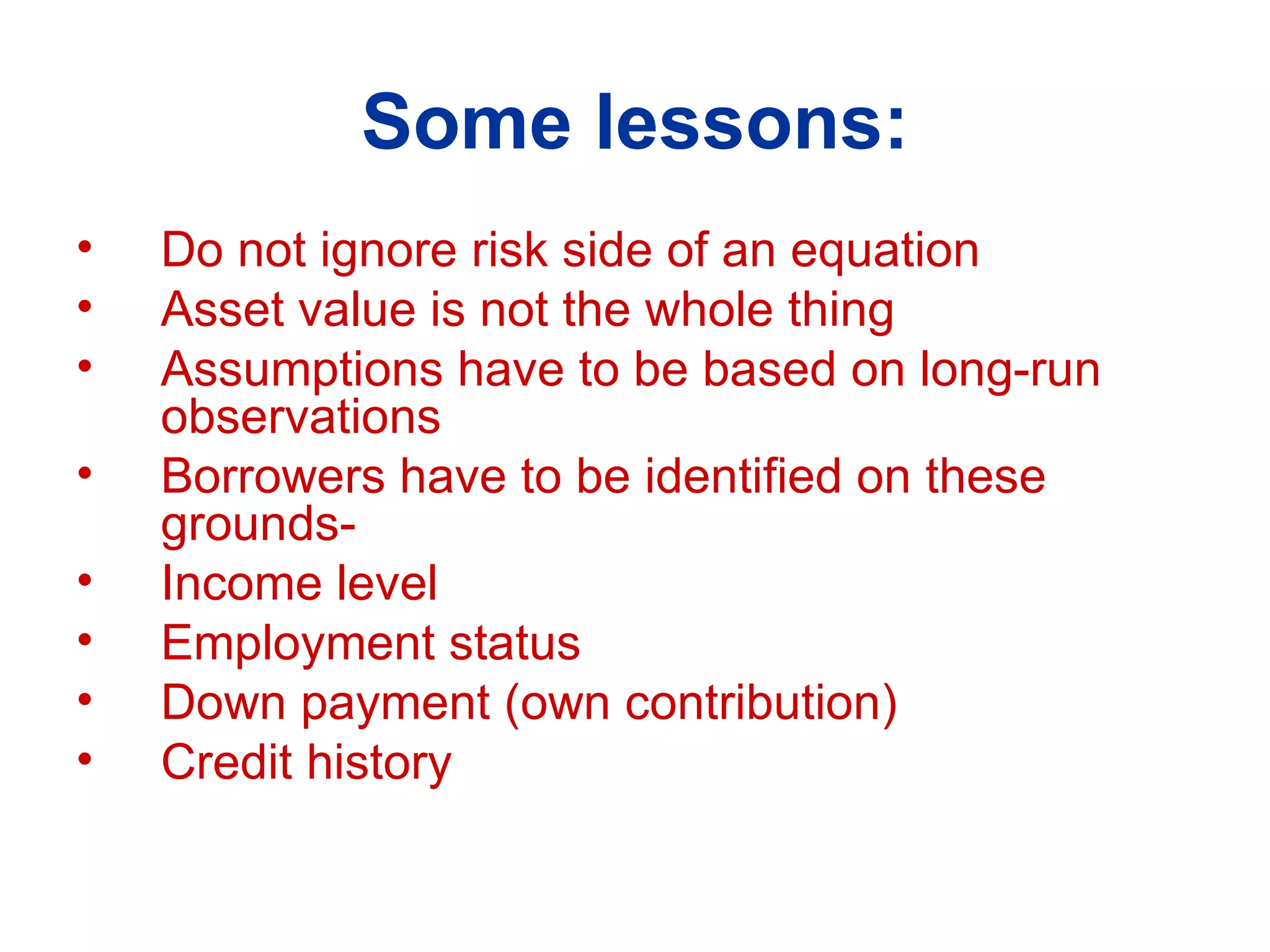
Some lessons: Do not ignore risk side of an equation Asset value is not the whole thing Assumptions have to be based on long-run observations Borrowers have to be identified on these grounds- Income level Employment status Down payment (own contribution) Credit history

Subprime

  • 1.
    SUBPRIME CRISIS ANDTHE WORLD Presented by: V.K.Malhotra
  • 2.
    Introduction Little aboutthe financial world - Its rise Banking and non-banking institutions Different types of instruments Control of the central bank/s over financial institutions Debate grim in 1950s and 60s Keynes, Friedman, Radcliffe, Gurley, Shaw, etc.
  • 3.
    What is liquidity?What is financial/credit market?
  • 4.
    The crisis Whatis subprime crisis Contracted liquidity in global financial market Bail-out package of US$ 700 billion was presented in the US Congress ( Sep. 2008) Dow Jones Index of largest companies declined by 22% in the following week – the worst ever in 118 year history Assessed losses on Jan. 1, 2008 – US$ 8 trillion as the holdings of US Corporations had declined from $ 20 to 12 trillion ( a trillion is 1 million million i.e. one lac crore, so, US$ 800000 crore)
  • 5.
    continued Liquidity concernshave driven central banks to take action to provide funds to worthy borrowers and restore confidence in financial market USA has even opted for bail-outs – In a capitalist economy Barrack Obama had made it a point in election campaign Cut in interest rates and economic packages
  • 6.
    Who failed? Failureof mortgage companies, investment firms and government sponsored enterprises Some Corporates HSBC New Century Financial Group Merrill Lynch JP Morgan Chase Goldman Sachs Citicorp AIG (America International Group)
  • 7.
    The crisis hasbeen fuelled by downturn in property (home) prices Subprime mortgages It had started to show in the middle of 2006 Housing bubble High default rate happening High foreclosure rate due to delinquent accounts : up by 79% from 2006
  • 8.
    Variable amount Foreclosure/Delinquent accounts : 70 % of foreclosures are subprime loans though they account for only 12.5% of all mortgages More than 30% of subprime loans had become 90 days delinquent Prepayment Penalty
  • 9.
    Adjustable Rate Mortgages(ARM) started in 2005 It come at Teaser Interest Rates Teaser Interest Rates : Initially only interest is charged with no principal repayment and the interest rates jump after some initial period of two-three years. These loans have high closing costs and pre-payment penalty. So, after sometime when the loan is reset, the monthly payment starts skyrocketing, may be by 50-60%. That forces a borrower to opt for refinance. First Mortgage Second Mortgage
  • 10.
    Keynesian economists HymanMinsky described three types of speculative borrowing that can lead to collapse of asset value: Hedge borrowers – one who borrows with an intent of making debt payments from cash flows of other investments Speculative borrowers – one who borrows on the belief that they can service interest and they must roll over principal into new investments Ponzi borrowers – one who assumes that appreciation in asset value would refinance or pay-off the debt
  • 11.
    What s creditrisk? The risk in case of default To protect against it, financial institutions can sell rights to the mortgage payments and related credit risk to the investors. This process is called securitization The securities that investors purchase are called Mortgage Based Securities (MBS) Credit risk remains distributed in such manner There are no investors for MBS now as they have burnt fingers
  • 12.
    Causes Inability ofhomeowners to make payments Poor judgement by the borrowers Poor judgement by the lenders Speculation during boom period : Increasing home values Assumption that rising prices will not retreat in future The home prices had doubled in five-six years The people were taking second mortgage to finance their consumption US household debt as percentage of income rose to 130% Americans spent $ 800 billion per year more than what they earned, household debt stood at $ 14 trillion In 2008 average American owned 13 credit cards
  • 13.
    Risky mortgage productsHigh personal and corporate debt levels Financial innovation that concealed risk element Failure of central banks to regulate the economy Growing consumerism Erosion of asset value due to inventory of homes (over supply) Nearly 8.8 million homeowners i.e. 11% of homeowners had negative equity that is their homes are lesser in worth as compared to their mortgages and they started to walk away even ignoring credit rating impact Today inventory of homes stands at more than 10 months
  • 14.
    Purchase of homesfor investment and not for residence purpose (it is known as ‘flipping ’ or selling homes without ever living in those) Ignoring credit rating : ignoring fundamentals The subprime markup or risk premium had declined from 2.8 to 1.3 percentage point. So, the risk premium required by lenders to offer a subprime loan had declined. Ninja loans – No income, no job, no assets and no down payments 49% of buyers offering no down payments Automated loan approvals – without subjecting approvals to appropriate reviews and documentation Where lenders lost their minds
  • 15.
    Some lessons: Donot ignore risk side of an equation Asset value is not the whole thing Assumptions have to be based on long-run observations Borrowers have to be identified on these grounds- Income level Employment status Down payment (own contribution) Credit history