PRESENTED BY
SAMIR
SHEKHAR
SUBPRIME CRISIS 2008
Housing Bubble: USA
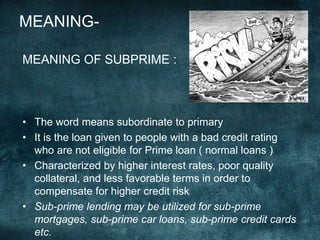
MEANING OF SUBPRIME :
• The word means subordinate to primary
• It is the loan given to people with a bad credit rating
who are not eligible for Prime loan ( normal loans )
• Characterized by higher interest rates, poor quality
collateral, and less favorable terms in order to
compensate for higher credit risk
• Sub-prime lending may be utilized for sub-prime
mortgages, sub-prime car loans, sub-prime credit cards
etc.
MEANING-
Why are Subprime loans issued ?
• For banks to earn more money by tapping the defaulting
customers
• For young people who do not have enough money for
down payment
• For people having financial problems
• For people who are discriminated
REASONS -
• The US subprime mortgage crisis was a set of events and conditions that led to a financial
crisis and subsequent recession that began in 2008
• Characterized by a rise in the inability to pay housing mortgages resulting in the decline of
securities backed by mortgages
• These mortgage-backed securities (MBS) initially offered attractive rates of return
• However, the lower credit quality ultimately caused massive defaults
• The money was sucked out of several banks, financial institutions and the economy as a
whole in September 2008
• Several European and developing countries had invested heavily in American banks
• The subsequent loss of funds resulted in the Global Recession of 2008
Subprime Crisis in Brief
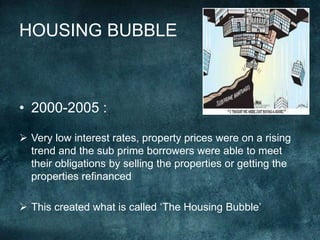
• 2000-2005 :
 Very low interest rates, property prices were on a rising
trend and the sub prime borrowers were able to meet
their obligations by selling the properties or getting the
properties refinanced
 This created what is called ‘The Housing Bubble’
HOUSING BUBBLE
• 2006-2008 :
 More subprime borrowers failed to pay their debts
 Securities held by mortgages lost value globally
 Global investors also drastically reduced purchases of
mortgage-backed debt and other securities
PROCEEDINGS
WHEN DID IT ALL
START?
• Owning a home is part of the 'American Dream'. It allows
people to take pride in a property and engage in a
community for the long term.
• However, homes are expensive and most people need to
borrow money to get one.
• The conditions were right for people to achieve that
dream. In the early 2000s, mortgage interest rates were
low, which allow you to borrow more money with a lower
monthly payment. In addition, home prices increased
dramatically, so buying a home seemed like a sure bet.
• Lenders understood that homes make good collateral so
they were willing to participate.
• The mortgage crisis was triggered as this situation built
momentum.
The American Dream
 DOT COM COLLAPSE – 2000
 SEPTEMBER 11 TERRORIST ATTACK
• Low interest rates
• Increase in loan incentives
• Easy credit conditions
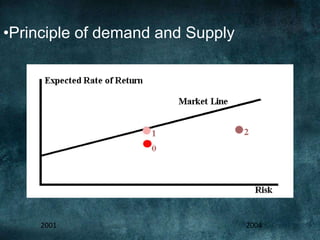
•Principle of demand and Supply
2001 2004
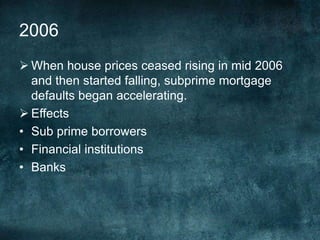
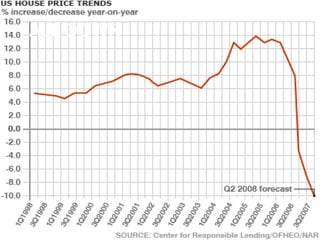
 When house prices ceased rising in mid 2006
and then started falling, subprime mortgage
defaults began accelerating.
 Effects
• Sub prime borrowers
• Financial institutions
• Banks
2006
• On December 1, 2008, the National Bureau of
Economic Research announced that the economy
had entered into a recession in December of 2007.
Real GDP increased by only 0.4 percent for the year
2008, and it decreased at annual rates of 5.4
percent in the 4th quarter of 2008 and 6.4 percent in
the 1st quarter of 2009. The unemployment rate
increased from 4.9 percent in December of 2007 to
9.5 percent in June of 2009.
• The total real estate equity in The United States was
valued at $13 trillion during the 2006 peak, had
fallen to $8.8 trillion by mid 2008.
2008
FALL DOWN
The Main
Players
The people who
contributed to the deadly
chain of events that sent
the entire world economy
into recession.
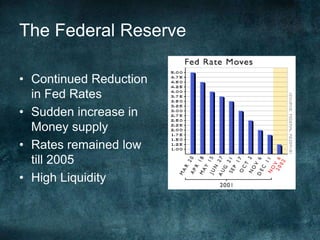
• Continued Reduction
in Fed Rates
• Sudden increase in
Money supply
• Rates remained low
till 2005
• High Liquidity
The Federal Reserve
• Lowered to lending rates to increase loan off
take
• As the prime market was nearing saturation,
began lending to subprime borrowers
• Aggressively sold MBS, CDO
• Additional funds raised by securitization was re-
deployed in the same manner
Commercial Banks
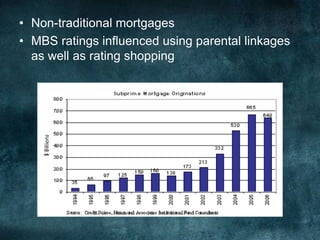
• Non-traditional mortgages
• MBS ratings influenced using parental linkages
as well as rating shopping
• Increased use of Secondary mortgage market
• Lenders sold their mortgages in the secondary
market
• Pooled mortgages into securities like CDOs and
MBS
Investment Banks
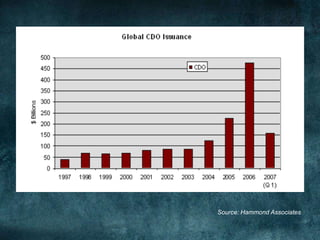
Investors:
• Investors were the ones willing to purchase
these CDOs at ridiculously low premiums over
Treasury bonds.
• These enticingly low rates are what ultimately
led to such huge demand for subprime loans.

INVESTORS-
Source: Hammond Associates
• Fuelled volatility through credit arbitrage
• Credit Default Swaps
• Influenced banks to bring out more MBS &
CDOs as it was a good avenue to invest in
Hedge Funds
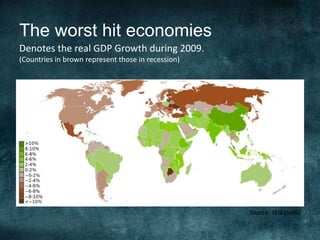
The worst hit economies
Source: Wikipedia
Denotes the real GDP Growth during 2009.
(Countries in brown represent those in recession)
SUBPRIME CRISIS
AND INDIA
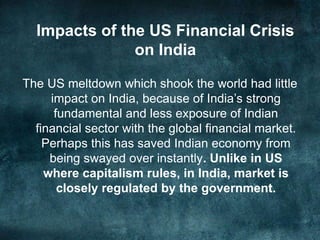
Impacts of the US Financial Crisis
on India
The US meltdown which shook the world had little
impact on India, because of India’s strong
fundamental and less exposure of Indian
financial sector with the global financial market.
Perhaps this has saved Indian economy from
being swayed over instantly. Unlike in US
where capitalism rules, in India, market is
closely regulated by the government.
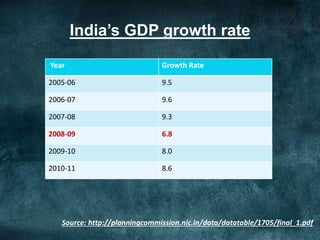
India’s GDP growth rate
Year Growth Rate
2005-06 9.5
2006-07 9.6
2007-08 9.3
2008-09 6.8
2009-10 8.0
2010-11 8.6
Source: http://planningcommission.nic.in/data/datatable/1705/final_1.pdf
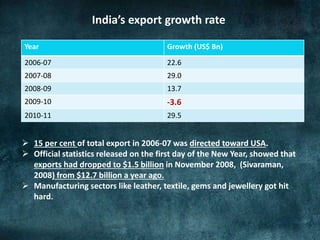
Year Growth (US$ Bn)
2006-07 22.6
2007-08 29.0
2008-09 13.7
2009-10 -3.6
2010-11 29.5
India’s export growth rate
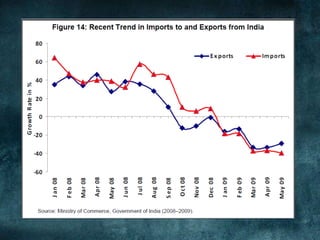
 15 per cent of total export in 2006-07 was directed toward USA.
 Official statistics released on the first day of the New Year, showed that
exports had dropped to $1.5 billion in November 2008, (Sivaraman,
2008) from $12.7 billion a year ago.
 Manufacturing sectors like leather, textile, gems and jewellery got hit
hard.
Impact on Indian Stock Market
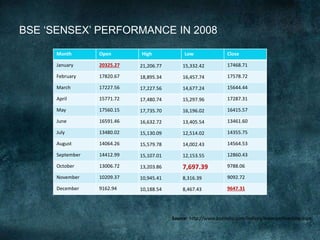
BSE ‘SENSEX’ PERFORMANCE IN 2008
Month Open High Low Close
January 20325.27 21,206.77 15,332.42 17468.71
February 17820.67 18,895.34 16,457.74 17578.72
March 17227.56 17,227.56 14,677.24 15644.44
April 15771.72 17,480.74 15,297.96 17287.31
May 17560.15 17,735.70 16,196.02 16415.57
June 16591.46 16,632.72 13,405.54 13461.60
July 13480.02 15,130.09 12,514.02 14355.75
August 14064.26 15,579.78 14,002.43 14564.53
September 14412.99 15,107.01 12,153.55 12860.43
October 13006.72 13,203.86 7,697.39 9788.06
November 10209.37 10,945.41 8,316.39 9092.72
December 9162.94 10,188.54 8,467.43 9647.31
Source: http://www.bseindia.com/indices/indexarchivedata.aspx
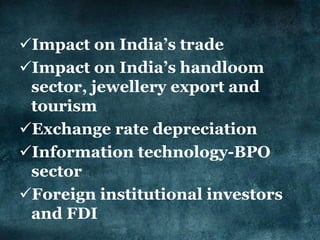
Impact on India’s trade
Impact on India’s handloom
sector, jewellery export and
tourism
Exchange rate depreciation
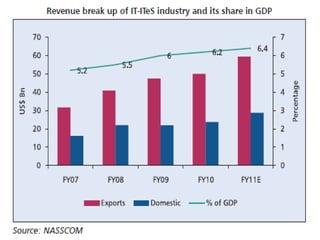
Information technology-BPO
sector
Foreign institutional investors
and FDI
This crisis also shows the failure of capitalist
market economy while the Indian economy
would be able to withstand the crisis without
any major difficulty
Why sub prime is not a
crisis in India ??
Role of Black Money
Lending based on ‘calls’
large portion of organised
lending is with public sector
banks
• He started sensing that real
estate, in particular, had entered
bubble territory before the crisis.
• One of the first moves he made
was to ban the use of bank loans
for the purchase of raw land.
• Only when the developer was
about to commence building
could the bank get involved —
and then only to make
construction loans.
ONE MAN ARMY of Dr. Y.V. Reddy!
• Reddy pushed interest rates up to more than 20
percent, which of course dampened the housing
frenzy.
• He made banks put aside extra capital for every
loan they made.
• In effect, Mr. Reddy was creating liquidity even
before there was a global liquidity crisis.
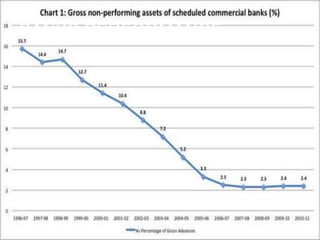
BANKS PERFORMANCE
THANK YOU

Subprime crisis

  • 1.
  • 2.
    MEANING OF SUBPRIME: • The word means subordinate to primary • It is the loan given to people with a bad credit rating who are not eligible for Prime loan ( normal loans ) • Characterized by higher interest rates, poor quality collateral, and less favorable terms in order to compensate for higher credit risk • Sub-prime lending may be utilized for sub-prime mortgages, sub-prime car loans, sub-prime credit cards etc. MEANING-
  • 3.
    Why are Subprimeloans issued ? • For banks to earn more money by tapping the defaulting customers • For young people who do not have enough money for down payment • For people having financial problems • For people who are discriminated REASONS -
  • 4.
    • The USsubprime mortgage crisis was a set of events and conditions that led to a financial crisis and subsequent recession that began in 2008 • Characterized by a rise in the inability to pay housing mortgages resulting in the decline of securities backed by mortgages • These mortgage-backed securities (MBS) initially offered attractive rates of return • However, the lower credit quality ultimately caused massive defaults • The money was sucked out of several banks, financial institutions and the economy as a whole in September 2008 • Several European and developing countries had invested heavily in American banks • The subsequent loss of funds resulted in the Global Recession of 2008 Subprime Crisis in Brief
  • 5.
    • 2000-2005 : Very low interest rates, property prices were on a rising trend and the sub prime borrowers were able to meet their obligations by selling the properties or getting the properties refinanced  This created what is called ‘The Housing Bubble’ HOUSING BUBBLE
  • 6.
    • 2006-2008 : More subprime borrowers failed to pay their debts  Securities held by mortgages lost value globally  Global investors also drastically reduced purchases of mortgage-backed debt and other securities PROCEEDINGS
  • 7.
    WHEN DID ITALL START?
  • 8.
    • Owning ahome is part of the 'American Dream'. It allows people to take pride in a property and engage in a community for the long term. • However, homes are expensive and most people need to borrow money to get one. • The conditions were right for people to achieve that dream. In the early 2000s, mortgage interest rates were low, which allow you to borrow more money with a lower monthly payment. In addition, home prices increased dramatically, so buying a home seemed like a sure bet. • Lenders understood that homes make good collateral so they were willing to participate. • The mortgage crisis was triggered as this situation built momentum. The American Dream
  • 9.
     DOT COMCOLLAPSE – 2000  SEPTEMBER 11 TERRORIST ATTACK
  • 10.
    • Low interestrates • Increase in loan incentives • Easy credit conditions
  • 11.
    •Principle of demandand Supply 2001 2004
  • 12.
     When houseprices ceased rising in mid 2006 and then started falling, subprime mortgage defaults began accelerating.  Effects • Sub prime borrowers • Financial institutions • Banks 2006
  • 13.
    • On December1, 2008, the National Bureau of Economic Research announced that the economy had entered into a recession in December of 2007. Real GDP increased by only 0.4 percent for the year 2008, and it decreased at annual rates of 5.4 percent in the 4th quarter of 2008 and 6.4 percent in the 1st quarter of 2009. The unemployment rate increased from 4.9 percent in December of 2007 to 9.5 percent in June of 2009. • The total real estate equity in The United States was valued at $13 trillion during the 2006 peak, had fallen to $8.8 trillion by mid 2008. 2008
  • 14.
  • 15.
    The Main Players The peoplewho contributed to the deadly chain of events that sent the entire world economy into recession.
  • 16.
    • Continued Reduction inFed Rates • Sudden increase in Money supply • Rates remained low till 2005 • High Liquidity The Federal Reserve
  • 17.
    • Lowered tolending rates to increase loan off take • As the prime market was nearing saturation, began lending to subprime borrowers • Aggressively sold MBS, CDO • Additional funds raised by securitization was re- deployed in the same manner Commercial Banks
  • 18.
    • Non-traditional mortgages •MBS ratings influenced using parental linkages as well as rating shopping
  • 19.
    • Increased useof Secondary mortgage market • Lenders sold their mortgages in the secondary market • Pooled mortgages into securities like CDOs and MBS Investment Banks
  • 20.
    Investors: • Investors werethe ones willing to purchase these CDOs at ridiculously low premiums over Treasury bonds. • These enticingly low rates are what ultimately led to such huge demand for subprime loans. INVESTORS-
  • 21.
  • 22.
    • Fuelled volatilitythrough credit arbitrage • Credit Default Swaps • Influenced banks to bring out more MBS & CDOs as it was a good avenue to invest in Hedge Funds
  • 23.
    The worst hiteconomies Source: Wikipedia Denotes the real GDP Growth during 2009. (Countries in brown represent those in recession)
  • 24.
  • 25.
    Impacts of theUS Financial Crisis on India The US meltdown which shook the world had little impact on India, because of India’s strong fundamental and less exposure of Indian financial sector with the global financial market. Perhaps this has saved Indian economy from being swayed over instantly. Unlike in US where capitalism rules, in India, market is closely regulated by the government.
  • 26.
    India’s GDP growthrate Year Growth Rate 2005-06 9.5 2006-07 9.6 2007-08 9.3 2008-09 6.8 2009-10 8.0 2010-11 8.6 Source: http://planningcommission.nic.in/data/datatable/1705/final_1.pdf
  • 27.
    Year Growth (US$Bn) 2006-07 22.6 2007-08 29.0 2008-09 13.7 2009-10 -3.6 2010-11 29.5 India’s export growth rate  15 per cent of total export in 2006-07 was directed toward USA.  Official statistics released on the first day of the New Year, showed that exports had dropped to $1.5 billion in November 2008, (Sivaraman, 2008) from $12.7 billion a year ago.  Manufacturing sectors like leather, textile, gems and jewellery got hit hard.
  • 29.
    Impact on IndianStock Market
  • 30.
    BSE ‘SENSEX’ PERFORMANCEIN 2008 Month Open High Low Close January 20325.27 21,206.77 15,332.42 17468.71 February 17820.67 18,895.34 16,457.74 17578.72 March 17227.56 17,227.56 14,677.24 15644.44 April 15771.72 17,480.74 15,297.96 17287.31 May 17560.15 17,735.70 16,196.02 16415.57 June 16591.46 16,632.72 13,405.54 13461.60 July 13480.02 15,130.09 12,514.02 14355.75 August 14064.26 15,579.78 14,002.43 14564.53 September 14412.99 15,107.01 12,153.55 12860.43 October 13006.72 13,203.86 7,697.39 9788.06 November 10209.37 10,945.41 8,316.39 9092.72 December 9162.94 10,188.54 8,467.43 9647.31 Source: http://www.bseindia.com/indices/indexarchivedata.aspx
  • 31.
    Impact on India’strade Impact on India’s handloom sector, jewellery export and tourism Exchange rate depreciation Information technology-BPO sector Foreign institutional investors and FDI
  • 32.
    This crisis alsoshows the failure of capitalist market economy while the Indian economy would be able to withstand the crisis without any major difficulty
  • 33.
    Why sub primeis not a crisis in India ??
  • 34.
    Role of BlackMoney Lending based on ‘calls’ large portion of organised lending is with public sector banks
  • 35.
    • He startedsensing that real estate, in particular, had entered bubble territory before the crisis. • One of the first moves he made was to ban the use of bank loans for the purchase of raw land. • Only when the developer was about to commence building could the bank get involved — and then only to make construction loans. ONE MAN ARMY of Dr. Y.V. Reddy!
  • 36.
    • Reddy pushedinterest rates up to more than 20 percent, which of course dampened the housing frenzy. • He made banks put aside extra capital for every loan they made. • In effect, Mr. Reddy was creating liquidity even before there was a global liquidity crisis.
  • 37.
  • 39.

Editor's Notes

  • #2 …to launch products,
  • #17 Asian Countries were also sending surplus funds into the US economy to help revive it
  • #18 JP Morgon Chase, Citigroup, Deutsche bank, Goldman Sachs, Lehman brothers, Bank of America, Merill Lynch, RBS Aggressively sold MBS, thus off loading such loans from their Balance Sheet MBS sold to banks, instituttions, hedge fund, investment banks, govts: japan, europe, russia (mainly) CDO-collateralized debt obligation MBS: mortgage backed security
  • #19 Non-traditional mortgages (such as 2/28 (section) and interest-only mortgages) that offered low introductory rates and minimal initial costs such as "no down payment” Some argue that the rating agencies should have foreseen the high default rates for subprime borrowers, and they should have given these CDOs much lower ratings than the 'AAA' rating given to the higher quality tranches. If the ratings had been more accurate, fewer investors would have bought into these securities, and the losses may not have been as bad.
  • #20 The increased use of the secondary mortgage market by lenders added to the number of subprime loans lenders could originate. Instead of holding the originated mortgages on their books, lenders were able to simply sell off the mortgages in the secondary market and collect the originating fees. This freed up more capital for even more lending, which increased liquidity even more. The snowball began to build momentum. A lot of the demand for these mortgages came from the creation of assets that pooled mortgages together into a security, such as a collateralized debt obligation (CDO). In this process, investment banks would buy the mortgages from lenders and securitize these mortgages into bonds, which were sold to investors through CDOs.
  • #22 Max : bought by japan,europe, russia
  • #23 They are out of regulatory control. Supposed to sell to knowledgeable investors, thus less paper work, less disclosures. Not their money. MBS, COD Promoted because they were issued at small premium over Gsec and assured high returns if and when the loans got serviced (refinanced by the borrower)
  • #28 With the US and several European countries slipping under the full blown recession, Indian exports have run into difficult times, since October. Manufacturing sectors like leather, textile, gems and jewellery have been hit hard because of the slump in the demand in the US and Europe. Further India enjoys trade surplus with USA and about 15 per cent of its total export in 2006-07 was directed toward USA. Indian exports fell by 9.9 per cent in November 2008, when the impact of declining consumer demand in the US and other major global market, with negative growth for the second month, running and widening monthly trade deficit over $10 billions. Official statistics released on the first day of the New Year, showed that exports had dropped to $1.5 billion in November this fiscal year, (Sivaraman, 2008) from $12.7 billion a year ago, while imports grew by $6.1billion to $21.5 billion.
  • #31 The global financial crisis has had a deep impact on Indian stock market: within one year (2008), there occurred a more than 50 percent fall in the SENSEX of Bombay stock exchange, the Bombay stock exchange benchmark index, which touched a high of 21,206 in January 2008, fell down to less than 10,000 during December 2008, shows the clear picture of the down fall off the stock market in India