Class -6
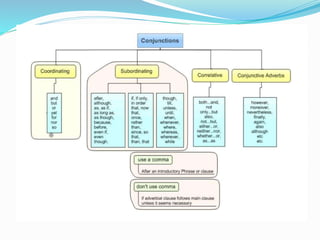
Three types of conjunctions
 Coordinating-connects words used in the same way.
 Correlative-pairs of words that connect word used in
the same way.
 Subordinating-used to begin subordinating clauses or
adverb clauses
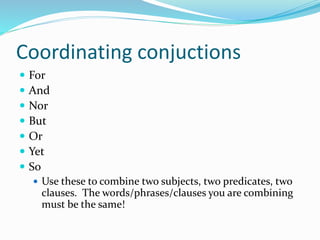
Coordinating conjuctions
 For
 And
 Nor
 But
 Or
 Yet
 So
 Use these to combine two subjects, two predicates, two
clauses. The words/phrases/clauses you are combining
must be the same!
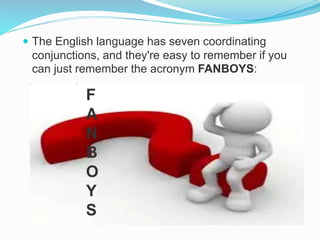
 The English language has seven coordinating
conjunctions, and they're easy to remember if you
can just remember the acronym FANBOYS:
F
A
N
B
O
Y
S
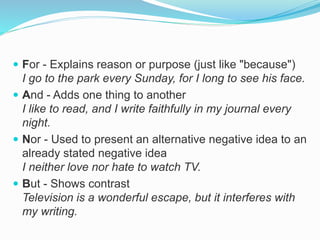
 For - Explains reason or purpose (just like "because")
I go to the park every Sunday, for I long to see his face.
 And - Adds one thing to another
I like to read, and I write faithfully in my journal every
night.
 Nor - Used to present an alternative negative idea to an
already stated negative idea
I neither love nor hate to watch TV.
 But - Shows contrast
Television is a wonderful escape, but it interferes with
my writing.
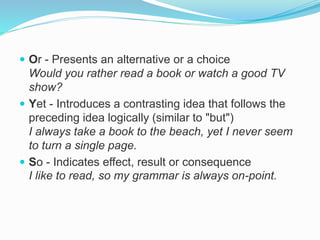
 Or - Presents an alternative or a choice
Would you rather read a book or watch a good TV
show?
 Yet - Introduces a contrasting idea that follows the
preceding idea logically (similar to "but")
I always take a book to the beach, yet I never seem
to turn a single page.
 So - Indicates effect, result or consequence
I like to read, so my grammar is always on-point.
Correlative conjunctions
 Used to join subjects, objects, predicates, and other
sentence parts.
 Common correlative conjunctions
 Both…and
 Either…or
 Neither…nor
 Whether…or
 Not only…but also
 Example: Their eye lenses are not only long but also
cylindrical.
 either/or - I want either the cheesecake or the
chocolate cake.
 both/and - We'll have both the cheesecake and the
chocolate cake.
 whether/or - I didn't know whether you'd want the
cheesecake or the chocolate cake, so I got both.
 neither/nor - Oh, you want neither the
cheesecake nor the chocolate cake? No problem.
 not only/but also - I'll eat them both - not only the
cheesecake but also the chocolate cake.
 not/but - I see you're in the mood not for
desserts but appetizers. I'll help you with those, too.
 as/as - Bowling isn't as fun as skeet shooting.
 such/that - Such is the beauty of nature that I keep
wondering/wandeering all the time.
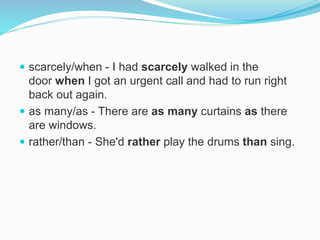
 scarcely/when - I had scarcely walked in the
door when I got an urgent call and had to run right
back out again.
 as many/as - There are as many curtains as there
are windows.
 rather/than - She'd rather play the drums than sing.
Subordinating Conjunctions
 Subordinating conjunctions that show the
significance of Time or Place
 Few subordinating conjunctions are used to show
the transition of place or time. Examples of this type
of conjunctions are where, wherever, as soon as, as
long as, once, when, till, until, while, whenever etc.
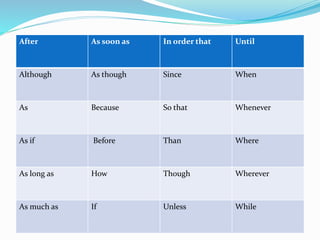
Some examples are given below
After As soon as In order that Until
Although As though Since When
As Because So that Whenever
As if Before Than Where
As long as How Though Wherever
As much as If Unless While
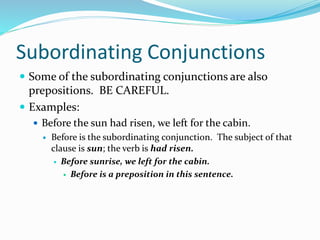
Subordinating Conjunctions
 Some of the subordinating conjunctions are also
prepositions. BE CAREFUL.
 Examples:
 Before the sun had risen, we left for the cabin.
 Before is the subordinating conjunction. The subject of that
clause is sun; the verb is had risen.
 Before sunrise, we left for the cabin.
 Before is a preposition in this sentence.
Conjunctions 6

Conjunctions 6

  • 1.
  • 3.
    Three types ofconjunctions  Coordinating-connects words used in the same way.  Correlative-pairs of words that connect word used in the same way.  Subordinating-used to begin subordinating clauses or adverb clauses
  • 4.
    Coordinating conjuctions  For And  Nor  But  Or  Yet  So  Use these to combine two subjects, two predicates, two clauses. The words/phrases/clauses you are combining must be the same!
  • 5.
     The Englishlanguage has seven coordinating conjunctions, and they're easy to remember if you can just remember the acronym FANBOYS: F A N B O Y S
  • 6.
     For -Explains reason or purpose (just like "because") I go to the park every Sunday, for I long to see his face.  And - Adds one thing to another I like to read, and I write faithfully in my journal every night.  Nor - Used to present an alternative negative idea to an already stated negative idea I neither love nor hate to watch TV.  But - Shows contrast Television is a wonderful escape, but it interferes with my writing.
  • 7.
     Or -Presents an alternative or a choice Would you rather read a book or watch a good TV show?  Yet - Introduces a contrasting idea that follows the preceding idea logically (similar to "but") I always take a book to the beach, yet I never seem to turn a single page.  So - Indicates effect, result or consequence I like to read, so my grammar is always on-point.
  • 9.
    Correlative conjunctions  Usedto join subjects, objects, predicates, and other sentence parts.  Common correlative conjunctions  Both…and  Either…or  Neither…nor  Whether…or  Not only…but also  Example: Their eye lenses are not only long but also cylindrical.
  • 10.
     either/or -I want either the cheesecake or the chocolate cake.  both/and - We'll have both the cheesecake and the chocolate cake.  whether/or - I didn't know whether you'd want the cheesecake or the chocolate cake, so I got both.  neither/nor - Oh, you want neither the cheesecake nor the chocolate cake? No problem.
  • 11.
     not only/butalso - I'll eat them both - not only the cheesecake but also the chocolate cake.  not/but - I see you're in the mood not for desserts but appetizers. I'll help you with those, too.  as/as - Bowling isn't as fun as skeet shooting.  such/that - Such is the beauty of nature that I keep wondering/wandeering all the time.
  • 12.
     scarcely/when -I had scarcely walked in the door when I got an urgent call and had to run right back out again.  as many/as - There are as many curtains as there are windows.  rather/than - She'd rather play the drums than sing.
  • 14.
    Subordinating Conjunctions  Subordinatingconjunctions that show the significance of Time or Place  Few subordinating conjunctions are used to show the transition of place or time. Examples of this type of conjunctions are where, wherever, as soon as, as long as, once, when, till, until, while, whenever etc. Some examples are given below
  • 15.
    After As soonas In order that Until Although As though Since When As Because So that Whenever As if Before Than Where As long as How Though Wherever As much as If Unless While
  • 16.
    Subordinating Conjunctions  Someof the subordinating conjunctions are also prepositions. BE CAREFUL.  Examples:  Before the sun had risen, we left for the cabin.  Before is the subordinating conjunction. The subject of that clause is sun; the verb is had risen.  Before sunrise, we left for the cabin.  Before is a preposition in this sentence.