Uses and Difference
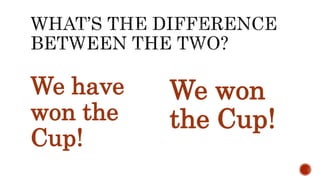
We have
won the
Cup!
We won
the Cup!
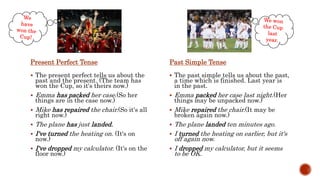
Present Perfect Tense
 The present perfect tells us about the
past and the present. (The team has
won the Cup, so it's theirs now.)
 Emma has packed her case.(So her
things are in the case now.)
 Mike has repaired the chair.(So it's all
right now.)
 The plane has just landed.
 I've turned the heating on. (It's on
now.)
 I've dropped my calculator. (It's on the
floor now.)
Past Simple Tense
 The past simple tells us about the past,
a time which is finished. Last year is
in the past.
 Emma packed her case last night.(Her
things may be unpacked now.)
 Mike repaired the chair.(It may be
broken again now.)
 The plane landed ten minutes ago.
 I turned the heating on earlier, but it's
off again now.
 I dropped my calculator, but it seems
to be OK.
We use the past simple (not the present perfect) to
talk about times in the past such as yesterday, last
week, in 1994, a hundred years ago.
• We watched United last week, NOT We have
watched United last week.
• Long ago dinosaurs lived here. NOT Long ago
dinosaurs have lived here.
 We often give a piece of news in the present perfect, e.g. We've
bought a new car. (The car is ours now.) We use the past
simple, e.g. We bought it last week, to give details or to ask for
details about things such as when and where it happened.
Here are some more examples.
 I've found my wallet. ~ Oh, good. Where did you find it?
 Your parcel has arrived. The postman brought it at eight
o'clock.
 They've closed the factory. ~ Really? When did they do that?
I have done or I did? (A)
Put in the correct verb form.
e.g. I've done (I / do) all the housework. The flat is really clean now.
A young couple bought (buy) the house next door. But they didn't live there long.
1 Our visitors……………………………. (arrive). They're sitting in the garden.
2 There's still a problem with the television. Someone ...................................... (repair) it, but then it broke down again.
3………………………… (I / lose) my bank card. I can't find it anywhere. 4 The match………………………… .. (start).
United are playing well.
5 My sister………………………….. (run) away from home. But she came back two days later.
6 Daniel………………………….. (earn) some money last week. But I'm afraid he's already spent it all. 7
………………………..(we / plant) an apple tree in the garden. Unfortunately it died.
8 Prices……………. .................. (go) up. Everything is more expensive this year.
9 Someone……………………. ......... (turn) on the hi-fi. What's that song called?
10 (I / phone) the office at eleven to speak to the manager, but he isn't there today. 11 (I / make) a cake. Would you like a
piece?
12 The runner Amos Temila…………………………… (break) the world record for the 1500 metres in Frankfurt. Then
two days later in Helsinki, Lee Williams ran it in an even faster time.
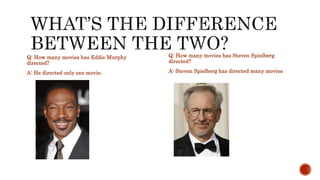
Q: How many movies has Eddie Murphy
directed?
A: He directed only one movie.
Q: How many movies has Steven Spielberg
directed?
A: Steven Spielberg has directed many movies
Have you (ever)...?
 We use the present perfect for actions
in a period of time up to the present.
 This young director has made four
films so far. He has made films means
that it is possible he will make more
films.
Here are some more examples.
 Have you ever played table tennis? ~
Yes, twice. I've played table tennis
before.
 We've never had any money.
Did you (ever)...?
 We use the past simple for actions in
the past, a period which is finished.
 The director made many films in his
long career. He made films means that
his career in films is over. He won't
make any more.
 Did Churchill ever go to America? ~
Yes, I think so.
 I played table tennis at college.
 We never had any money in those
days.
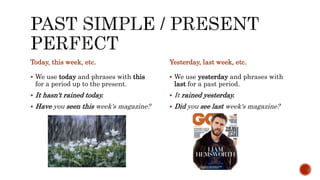
Today, this week, etc.
 We use today and phrases with this
for a period up to the present.
 It hasn't rained today.
 Have you seen this week's magazine?
Yesterday, last week, etc.
 We use yesterday and phrases with
last for a past period.
 It rained yesterday.
 Did you see last week's magazine?
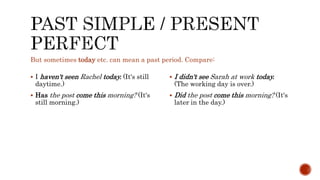
But sometimes today etc. can mean a past period. Compare:
 I haven't seen Rachel today. (It's still
daytime.)
 Has the post come this morning? (It's
still morning.)
 I didn't see Sarah at work today.
(The working day is over.)
 Did the post come this morning? (It's
later in the day.)
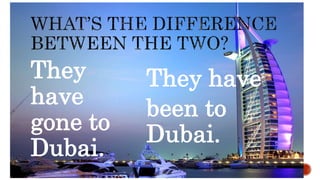
They
have
gone to
Dubai.
They have
been to
Dubai.
Past simple and Present Perfect Tense

Past simple and Present Perfect Tense

  • 1.
  • 2.
  • 3.
    Present Perfect Tense The present perfect tells us about the past and the present. (The team has won the Cup, so it's theirs now.)  Emma has packed her case.(So her things are in the case now.)  Mike has repaired the chair.(So it's all right now.)  The plane has just landed.  I've turned the heating on. (It's on now.)  I've dropped my calculator. (It's on the floor now.) Past Simple Tense  The past simple tells us about the past, a time which is finished. Last year is in the past.  Emma packed her case last night.(Her things may be unpacked now.)  Mike repaired the chair.(It may be broken again now.)  The plane landed ten minutes ago.  I turned the heating on earlier, but it's off again now.  I dropped my calculator, but it seems to be OK.
  • 4.
    We use thepast simple (not the present perfect) to talk about times in the past such as yesterday, last week, in 1994, a hundred years ago. • We watched United last week, NOT We have watched United last week. • Long ago dinosaurs lived here. NOT Long ago dinosaurs have lived here.
  • 5.
     We oftengive a piece of news in the present perfect, e.g. We've bought a new car. (The car is ours now.) We use the past simple, e.g. We bought it last week, to give details or to ask for details about things such as when and where it happened. Here are some more examples.  I've found my wallet. ~ Oh, good. Where did you find it?  Your parcel has arrived. The postman brought it at eight o'clock.  They've closed the factory. ~ Really? When did they do that?
  • 6.
    I have doneor I did? (A) Put in the correct verb form. e.g. I've done (I / do) all the housework. The flat is really clean now. A young couple bought (buy) the house next door. But they didn't live there long. 1 Our visitors……………………………. (arrive). They're sitting in the garden. 2 There's still a problem with the television. Someone ...................................... (repair) it, but then it broke down again. 3………………………… (I / lose) my bank card. I can't find it anywhere. 4 The match………………………… .. (start). United are playing well. 5 My sister………………………….. (run) away from home. But she came back two days later. 6 Daniel………………………….. (earn) some money last week. But I'm afraid he's already spent it all. 7 ………………………..(we / plant) an apple tree in the garden. Unfortunately it died. 8 Prices……………. .................. (go) up. Everything is more expensive this year. 9 Someone……………………. ......... (turn) on the hi-fi. What's that song called? 10 (I / phone) the office at eleven to speak to the manager, but he isn't there today. 11 (I / make) a cake. Would you like a piece? 12 The runner Amos Temila…………………………… (break) the world record for the 1500 metres in Frankfurt. Then two days later in Helsinki, Lee Williams ran it in an even faster time.
  • 7.
    Q: How manymovies has Eddie Murphy directed? A: He directed only one movie. Q: How many movies has Steven Spielberg directed? A: Steven Spielberg has directed many movies
  • 8.
    Have you (ever)...? We use the present perfect for actions in a period of time up to the present.  This young director has made four films so far. He has made films means that it is possible he will make more films. Here are some more examples.  Have you ever played table tennis? ~ Yes, twice. I've played table tennis before.  We've never had any money. Did you (ever)...?  We use the past simple for actions in the past, a period which is finished.  The director made many films in his long career. He made films means that his career in films is over. He won't make any more.  Did Churchill ever go to America? ~ Yes, I think so.  I played table tennis at college.  We never had any money in those days.
  • 9.
    Today, this week,etc.  We use today and phrases with this for a period up to the present.  It hasn't rained today.  Have you seen this week's magazine? Yesterday, last week, etc.  We use yesterday and phrases with last for a past period.  It rained yesterday.  Did you see last week's magazine?
  • 10.
    But sometimes todayetc. can mean a past period. Compare:  I haven't seen Rachel today. (It's still daytime.)  Has the post come this morning? (It's still morning.)  I didn't see Sarah at work today. (The working day is over.)  Did the post come this morning? (It's later in the day.)
  • 11.