By:
Ahmed Gamal Ahmed
Assistant lecturer of Internal
medicin
Diabetes and Endocrinology unit
๏‚จ Ms. D.W. is a 48-year-old premenopausal
woman who was found by her primary
care physician to have abnormal thyroid
function tests during routine screening
as part of her annual physical examination.
๏‚จ At that time, she was noted to have
a serum TSH of 0.17 mU/L.
๏‚จ She was referred to the endocrine clinic for
further evaluation.
๏‚จ She had no prior history of thyroid disease
๏‚จ No family history of thyroid disease.
She had no symptoms suggestive of
hyperthyroidism, and has felt completely well.
She had no compressive symptoms in the neck
including dysphagia, hoarseness, or neck pain.
Her past history was significant for mild
hypertension treated with hydrochlorothiazide.
๏‚จ The review of systems was normal, and the
patientโ€™s menses were regular.
๏‚จ The physical examination was entirely
normal except for mild obesity, with a body
mass index (BMI) of 30.
๏‚จ Her pulse was 84 beats per minute ,regular .
๏‚จ The thyroid gland was difficult to palpate,
but no nodules were identified.
๏‚จ Repeat thyroid function tests were as follows:
free T 4( 1.4 ng/dL), T 3 (135 ng/dL), and
๏‚จ TSH (0.11) mU/L.
๏‚จ Anti thyroid antibodies were negative.
๏‚จ A thyroid scan using iodine 123 showed a
mildly heterogeneous gland with several foci
of increased uptake bilaterally.
๏‚จ Thyroid ultrasound showed multiple
isoechoic and hyperechoic nodules
bilaterally, with overall normal thyroid size.
๏‚จ The largestnodules measured 1.5 cm in the
left lobe and 2.0 cm in the right lobe, and both
corresponded to areas of increased uptake on
the radionuclide scan.
๏‚จ IS it neccecssary to start treatment?
๏‚จ Subclinical hyperthyroidism (SCHyper) is a
biochemical diagnosis characterized by
normal serum thyroxine (T4) and tri-
iodothyronine (T3) levels in a setting of
decreased serum TSH concentrations
regardless of the presence or absence of
symptoms.
๏‚จ In contrast, overt hyperthyroidism is
characterized by an elevated serum T3 and/or
T4 with decreased TSH levels.
๏‚จ Subclinical hyperthyroidism is a common
finding in the general population.
๏‚จ In several large epidemiologic studies, the
frequency has been approximately 1%, without
a clear relationship to age .
๏‚จ This is in contrast to what is seen in subclinical
hypothyroidism, which has a much higher
prevalence of 8% to 10%, and an even
higher prevalence in older individuals,
approaching 15% to 20%.
๏‚จ In general, the causes of subclinical
hyperthyrodism are the same as the causes of
overt hyperthyroidism.
๏‚จ The most common cause of subclinical
hyperthyroidism is iatrogenic or inappro-
priate thyroid hormone use (exogenous
subclinical hyperthyroidism).
๏‚จ On the other hand, endogenous subclinical
hyperthyroidism is typically caused by mild
Gravesโ€™ disease, solitary toxic nodules, or
multinodular goiter.
๏‚จ Most of the time, subclinical hyperthyroidism
doesnโ€™t cause any symptoms (itโ€™s asymptomatic).
๏‚จ However, it can sometimes present with mild
symptoms of hyperthyroidism, which include:
๏‚จ Rapid heartbeat (palpitations).
๏‚จ Feeling shaky and/or nervous.
๏‚จ Weight loss.
๏‚จ Increased appetite.
๏‚จ Diarrhea and more frequent bowel movements.
๏‚จ Thin, warm and moist skin.
๏‚– Menstrual changes.
๏‚จ Subclinical hyperthyroidism has several
negative effects on cardiac function. These
effects are similar to, but milder and less
frequent than, those of overt
hyperthyroidism. .
๏‚จ Additional related complications included
tachycardia, atrial fibrillation, increased
cardiac contractility, impaired endothelial
function, reduced exercise tolerance, reduced
heart rate variability, and hypercoagulability.
๏‚จ Thyroid hormones directly stimulate bone resorption.
Changes induced by the thyroid hormones are mainly
observed in the cortical bone (wrist), to a significantly
low extent in the trabecular bone (spine), and to an
intermediate extent in the mixed corticalโ€“trabecular
bone (hip).
๏‚จ Whether subclinical hyperthyroidism increases the
fracture rate in the normal population is a matter of
intense debate. However, postmenopausal women
with subclinical hyperthyroidism may have high
fracture rates even though they show only mildly
suppressed serum TSH levels. Therefore, to rule out
osteoporosis, it is advisable to include a bone mineral
densityometric study in the assessment of these
patients.
๏‚จ Although the data are conflicting, some
authors have suggested that subclinical
hyperthyroidism may be associated with
dementia.
๏‚จ In contrast, a cross-sectional study in 295
English patients diagnosed with subclinical
thyroid dysfunction did not show any
association between subclinical
hyperthyroidism and depression, anxiety, or
cognitive function
๏‚จ The diagnosis of subclinical hyperthyroidism is
solely based on thyroid function testing (thyroid
blood tests).
๏‚จ The normal test range for thyroid-stimulating
hormone (TSH or thyrotropin) for a non-pregnant
adult is 0.4 to 4.5 mIU/L (milli-international units
per liter of blood).
๏‚จ If you had thyroid blood tests and the results
indicate that your TSH levels are low or
undetectable (0.1 to 0.4 mIU/L) and your
thyroxine (T4) and triiodothyronine (T3) levels
are in the normal range, it means you have
subclinical hyperthyroidism
๏‚จ Subclinical hyperthyroidism can be divided
into two categories:
๏‚จ Mild: Low but detectable TSH level โ€”
usually 0.1 to 0.4 mIU/L. This applies to 65%
to 75% of people with subclinical
hyperthyroidism.
๏‚จ Severe: TSH level is less than 0.1 mIU/L. This
applies to 25% to 35% of people with
subclinical hyperthyroidism.
๏‚จ It should also be noted that a low serum TSH is
not the sine qua non of thyroidal autonomy, and
may be present in patients with central
hypothyroidism and severe non thyroidal
illnesses (especially if dopamine or high doses of
glucocorticoids are used).
๏‚จ In addition, low serum TSH values are seen
physiologically at the end of the first trimester
pregnancy due to high circulating human
chorionic gonadotropin (HCG) levels, and may
also be observed in the elderly with normal
thyroid function due to a possible altered โ€œset
pointโ€ of the hypothalamic-pituitary-thyroid axis
.
๏‚จ In patients with true endogenous subclinical hyperthyroidism,
progression to overt hyperthyroidism may occur, with rates of
progression varying from 1% to 5% per year.
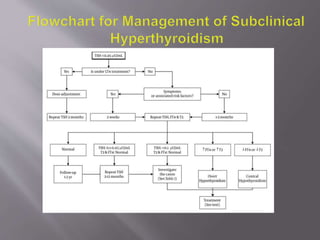
๏‚จ Finally, subclinical hyperthyroidism can be transient, so that
treatment should only be considered when thyroid function
abnormalities are clearly stable after repeated measurements
over 6 to 12 months.
๏‚จ For example, in one study, 38 of 50 untreated patients with
baseline serum TSH values between 0.05 and 0.5 mU/L had
normal serum TSH values 1 year later, whereas the majority of
patients with TSH levels <0.05 mU/L persisted in having
subnormal values.
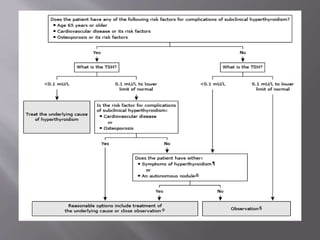
๏‚จ The principal issues surrounding the clinical
management of subclinical hyper- thyroidism are :
๏‚จ [1] possible symptoms of mild hyperthyroidism
๏‚จ (2)bone loss, especially in postmenopausal women.
๏‚จ (3) possible cardiovascular disease, especially atrial
fibrillation.
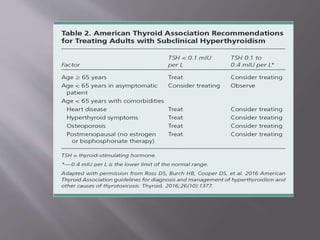
Indications of treatment:-
๏‚จ In pregnancy, SCHyper is relatively uncommon
and typically does not warrant treatment, in
contrast to overt hyperthyroidism. Studies
suggest that SCHyper occurs in 1.7% of singleton
pregnancies and may be more common in African
American and/or parous patients.
๏‚จ SCHyper does not appear to be associated with
increased risks of maternal, obstetric, or neonatal
morbidities, when compared to euthyroid
pregnant women, and instead may even have
decreased risks of gestational hypertension.
๏‚จ Finally, an increased risk of cardiac abnormalities
including increased hear rate, increased left
ventricular mass, diastolic dysfunction, and a
higher frequency of atrial fibrillation in the elderly
has been well documented .
๏‚จ Furthermore, an increase in all-cause mortality and
cardiovascular mortality has also been observed in
older individuals with subclinical hyperthyroidism
๏‚จ In another more recent prospective study of
individuals older than 60 years of age, an increased
risk of atrial fibrillation was noted even when the
serum TSH was 0.1 to 0.5 mU/L, but there was no
increase in cardiovascular mortality .
๏‚จ Options for the treatment of SCHyper follow
the same principles as overt hyperthyroidism
and include thionamides (ie, MMI or
propylthiouracil), I-radioactive therapy, and
thyroid surgery. Adrenergic symptoms can be
treated with cardioselective beta blockers,
such as propranolol, atenolol, or metoprolol,
and titrated to achieve the goal heart rate of
<90 beats/min. One should closely monitor
blood pressure in individuals managed with
beta blockers due to the side effect of
hypotension.
๏‚จ The etiology of our patientโ€™s subclinical
hyperthyroidism was established with the
radionuclide thyroid scan and thyroid
sonography, showing findings consistent
with a multinodular thyroid and areas of
autonomy within the gland.
๏‚จ The negative antithyroid antibodies are
evidence against autoimmune thyroid disease
as the etiology of her hyperthyroidism.
๏‚จ After performing a (DEXA) study, which was
normal, and discussing the pros and cons of
treatment with the patient, it was elected not to
treat her, based on the lack of clear evidence of
benefit.
๏‚จ The plan was as follows: thyroid function was to
be monitored every 6 months and consideration
of
radioactive iodine therapy would be more
seriously entertained when she become
postmenopausal, or if thyroid function
deteriorates further. After 2 years of follow-up,
thyroid function has remained stable and she still
has not received therapy.
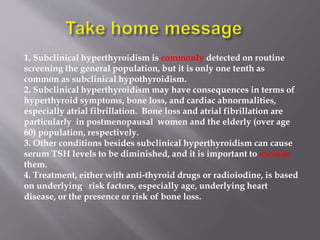
1. Subclinical hyperthyroidism is commonly detected on routine
screening the general population, but it is only one tenth as
common as subclinical hypothyroidism.
2. Subclinical hyperthyroidism may have consequences in terms of
hyperthyroid symptoms, bone loss, and cardiac abnormalities,
especially atrial fibrillation. Bone loss and atrial fibrillation are
particularly in postmenopausal women and the elderly (over age
60) population, respectively.
3. Other conditions besides subclinical hyperthyroidism can cause
serum TSH levels to be diminished, and it is important to exclude
them.
4. Treatment, either with anti-thyroid drugs or radioiodine, is based
on underlying risk factors, especially age, underlying heart
disease, or the presence or risk of bone loss.
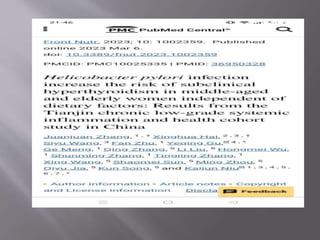
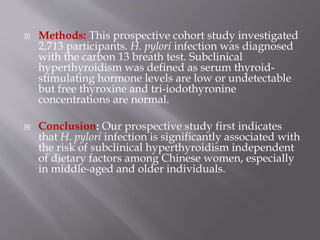
๏‚จ Methods: This prospective cohort study investigated
2,713 participants. H. pylori infection was diagnosed
with the carbon 13 breath test. Subclinical
hyperthyroidism was defined as serum thyroid-
stimulating hormone levels are low or undetectable
but free thyroxine and tri-iodothyronine
concentrations are normal.
๏‚จ Conclusion: Our prospective study first indicates
that H. pylori infection is significantly associated with
the risk of subclinical hyperthyroidism independent
of dietary factors among Chinese women, especially
in middle-aged and older individuals.

case presentationof the endocrine 3.pptx

  • 1.
    By: Ahmed Gamal Ahmed Assistantlecturer of Internal medicin Diabetes and Endocrinology unit
  • 2.
    ๏‚จ Ms. D.W.is a 48-year-old premenopausal woman who was found by her primary care physician to have abnormal thyroid function tests during routine screening as part of her annual physical examination.
  • 3.
    ๏‚จ At thattime, she was noted to have a serum TSH of 0.17 mU/L. ๏‚จ She was referred to the endocrine clinic for further evaluation. ๏‚จ She had no prior history of thyroid disease ๏‚จ No family history of thyroid disease.
  • 4.
    She had nosymptoms suggestive of hyperthyroidism, and has felt completely well. She had no compressive symptoms in the neck including dysphagia, hoarseness, or neck pain. Her past history was significant for mild hypertension treated with hydrochlorothiazide.
  • 5.
    ๏‚จ The reviewof systems was normal, and the patientโ€™s menses were regular. ๏‚จ The physical examination was entirely normal except for mild obesity, with a body mass index (BMI) of 30. ๏‚จ Her pulse was 84 beats per minute ,regular .
  • 6.
    ๏‚จ The thyroidgland was difficult to palpate, but no nodules were identified. ๏‚จ Repeat thyroid function tests were as follows: free T 4( 1.4 ng/dL), T 3 (135 ng/dL), and ๏‚จ TSH (0.11) mU/L. ๏‚จ Anti thyroid antibodies were negative.
  • 7.
    ๏‚จ A thyroidscan using iodine 123 showed a mildly heterogeneous gland with several foci of increased uptake bilaterally. ๏‚จ Thyroid ultrasound showed multiple isoechoic and hyperechoic nodules bilaterally, with overall normal thyroid size. ๏‚จ The largestnodules measured 1.5 cm in the left lobe and 2.0 cm in the right lobe, and both corresponded to areas of increased uptake on the radionuclide scan.
  • 8.
    ๏‚จ IS itneccecssary to start treatment?
  • 9.
    ๏‚จ Subclinical hyperthyroidism(SCHyper) is a biochemical diagnosis characterized by normal serum thyroxine (T4) and tri- iodothyronine (T3) levels in a setting of decreased serum TSH concentrations regardless of the presence or absence of symptoms. ๏‚จ In contrast, overt hyperthyroidism is characterized by an elevated serum T3 and/or T4 with decreased TSH levels.
  • 10.
    ๏‚จ Subclinical hyperthyroidismis a common finding in the general population. ๏‚จ In several large epidemiologic studies, the frequency has been approximately 1%, without a clear relationship to age . ๏‚จ This is in contrast to what is seen in subclinical hypothyroidism, which has a much higher prevalence of 8% to 10%, and an even higher prevalence in older individuals, approaching 15% to 20%.
  • 11.
    ๏‚จ In general,the causes of subclinical hyperthyrodism are the same as the causes of overt hyperthyroidism. ๏‚จ The most common cause of subclinical hyperthyroidism is iatrogenic or inappro- priate thyroid hormone use (exogenous subclinical hyperthyroidism). ๏‚จ On the other hand, endogenous subclinical hyperthyroidism is typically caused by mild Gravesโ€™ disease, solitary toxic nodules, or multinodular goiter.
  • 12.
    ๏‚จ Most ofthe time, subclinical hyperthyroidism doesnโ€™t cause any symptoms (itโ€™s asymptomatic). ๏‚จ However, it can sometimes present with mild symptoms of hyperthyroidism, which include: ๏‚จ Rapid heartbeat (palpitations). ๏‚จ Feeling shaky and/or nervous. ๏‚จ Weight loss. ๏‚จ Increased appetite. ๏‚จ Diarrhea and more frequent bowel movements. ๏‚จ Thin, warm and moist skin. ๏‚– Menstrual changes.
  • 13.
    ๏‚จ Subclinical hyperthyroidismhas several negative effects on cardiac function. These effects are similar to, but milder and less frequent than, those of overt hyperthyroidism. . ๏‚จ Additional related complications included tachycardia, atrial fibrillation, increased cardiac contractility, impaired endothelial function, reduced exercise tolerance, reduced heart rate variability, and hypercoagulability.
  • 14.
    ๏‚จ Thyroid hormonesdirectly stimulate bone resorption. Changes induced by the thyroid hormones are mainly observed in the cortical bone (wrist), to a significantly low extent in the trabecular bone (spine), and to an intermediate extent in the mixed corticalโ€“trabecular bone (hip). ๏‚จ Whether subclinical hyperthyroidism increases the fracture rate in the normal population is a matter of intense debate. However, postmenopausal women with subclinical hyperthyroidism may have high fracture rates even though they show only mildly suppressed serum TSH levels. Therefore, to rule out osteoporosis, it is advisable to include a bone mineral densityometric study in the assessment of these patients.
  • 15.
    ๏‚จ Although thedata are conflicting, some authors have suggested that subclinical hyperthyroidism may be associated with dementia. ๏‚จ In contrast, a cross-sectional study in 295 English patients diagnosed with subclinical thyroid dysfunction did not show any association between subclinical hyperthyroidism and depression, anxiety, or cognitive function
  • 16.
    ๏‚จ The diagnosisof subclinical hyperthyroidism is solely based on thyroid function testing (thyroid blood tests). ๏‚จ The normal test range for thyroid-stimulating hormone (TSH or thyrotropin) for a non-pregnant adult is 0.4 to 4.5 mIU/L (milli-international units per liter of blood). ๏‚จ If you had thyroid blood tests and the results indicate that your TSH levels are low or undetectable (0.1 to 0.4 mIU/L) and your thyroxine (T4) and triiodothyronine (T3) levels are in the normal range, it means you have subclinical hyperthyroidism
  • 17.
    ๏‚จ Subclinical hyperthyroidismcan be divided into two categories: ๏‚จ Mild: Low but detectable TSH level โ€” usually 0.1 to 0.4 mIU/L. This applies to 65% to 75% of people with subclinical hyperthyroidism. ๏‚จ Severe: TSH level is less than 0.1 mIU/L. This applies to 25% to 35% of people with subclinical hyperthyroidism.
  • 18.
    ๏‚จ It shouldalso be noted that a low serum TSH is not the sine qua non of thyroidal autonomy, and may be present in patients with central hypothyroidism and severe non thyroidal illnesses (especially if dopamine or high doses of glucocorticoids are used). ๏‚จ In addition, low serum TSH values are seen physiologically at the end of the first trimester pregnancy due to high circulating human chorionic gonadotropin (HCG) levels, and may also be observed in the elderly with normal thyroid function due to a possible altered โ€œset pointโ€ of the hypothalamic-pituitary-thyroid axis .
  • 19.
    ๏‚จ In patientswith true endogenous subclinical hyperthyroidism, progression to overt hyperthyroidism may occur, with rates of progression varying from 1% to 5% per year. ๏‚จ Finally, subclinical hyperthyroidism can be transient, so that treatment should only be considered when thyroid function abnormalities are clearly stable after repeated measurements over 6 to 12 months. ๏‚จ For example, in one study, 38 of 50 untreated patients with baseline serum TSH values between 0.05 and 0.5 mU/L had normal serum TSH values 1 year later, whereas the majority of patients with TSH levels <0.05 mU/L persisted in having subnormal values.
  • 20.
    ๏‚จ The principalissues surrounding the clinical management of subclinical hyper- thyroidism are : ๏‚จ [1] possible symptoms of mild hyperthyroidism ๏‚จ (2)bone loss, especially in postmenopausal women. ๏‚จ (3) possible cardiovascular disease, especially atrial fibrillation. Indications of treatment:-
  • 21.
    ๏‚จ In pregnancy,SCHyper is relatively uncommon and typically does not warrant treatment, in contrast to overt hyperthyroidism. Studies suggest that SCHyper occurs in 1.7% of singleton pregnancies and may be more common in African American and/or parous patients. ๏‚จ SCHyper does not appear to be associated with increased risks of maternal, obstetric, or neonatal morbidities, when compared to euthyroid pregnant women, and instead may even have decreased risks of gestational hypertension.
  • 22.
    ๏‚จ Finally, anincreased risk of cardiac abnormalities including increased hear rate, increased left ventricular mass, diastolic dysfunction, and a higher frequency of atrial fibrillation in the elderly has been well documented . ๏‚จ Furthermore, an increase in all-cause mortality and cardiovascular mortality has also been observed in older individuals with subclinical hyperthyroidism ๏‚จ In another more recent prospective study of individuals older than 60 years of age, an increased risk of atrial fibrillation was noted even when the serum TSH was 0.1 to 0.5 mU/L, but there was no increase in cardiovascular mortality .
  • 23.
    ๏‚จ Options forthe treatment of SCHyper follow the same principles as overt hyperthyroidism and include thionamides (ie, MMI or propylthiouracil), I-radioactive therapy, and thyroid surgery. Adrenergic symptoms can be treated with cardioselective beta blockers, such as propranolol, atenolol, or metoprolol, and titrated to achieve the goal heart rate of <90 beats/min. One should closely monitor blood pressure in individuals managed with beta blockers due to the side effect of hypotension.
  • 24.
    ๏‚จ The etiologyof our patientโ€™s subclinical hyperthyroidism was established with the radionuclide thyroid scan and thyroid sonography, showing findings consistent with a multinodular thyroid and areas of autonomy within the gland. ๏‚จ The negative antithyroid antibodies are evidence against autoimmune thyroid disease as the etiology of her hyperthyroidism.
  • 25.
    ๏‚จ After performinga (DEXA) study, which was normal, and discussing the pros and cons of treatment with the patient, it was elected not to treat her, based on the lack of clear evidence of benefit. ๏‚จ The plan was as follows: thyroid function was to be monitored every 6 months and consideration of radioactive iodine therapy would be more seriously entertained when she become postmenopausal, or if thyroid function deteriorates further. After 2 years of follow-up, thyroid function has remained stable and she still has not received therapy.
  • 29.
    1. Subclinical hyperthyroidismis commonly detected on routine screening the general population, but it is only one tenth as common as subclinical hypothyroidism. 2. Subclinical hyperthyroidism may have consequences in terms of hyperthyroid symptoms, bone loss, and cardiac abnormalities, especially atrial fibrillation. Bone loss and atrial fibrillation are particularly in postmenopausal women and the elderly (over age 60) population, respectively. 3. Other conditions besides subclinical hyperthyroidism can cause serum TSH levels to be diminished, and it is important to exclude them. 4. Treatment, either with anti-thyroid drugs or radioiodine, is based on underlying risk factors, especially age, underlying heart disease, or the presence or risk of bone loss.
  • 31.
    ๏‚จ Methods: Thisprospective cohort study investigated 2,713 participants. H. pylori infection was diagnosed with the carbon 13 breath test. Subclinical hyperthyroidism was defined as serum thyroid- stimulating hormone levels are low or undetectable but free thyroxine and tri-iodothyronine concentrations are normal. ๏‚จ Conclusion: Our prospective study first indicates that H. pylori infection is significantly associated with the risk of subclinical hyperthyroidism independent of dietary factors among Chinese women, especially in middle-aged and older individuals.