hypothyroidism
&
Diffuse toxic
goiter
(Graves' disease,
Basedow disease)
JSC “Astana medical university”
Astana
PLAN
1. Introduction
General means about
hypothyroidism & Diffuse toxic
goiter
2. Main body
Classification
Etiology
Pathogenesis
Clinical manifestations
Diagnostics
Differential diagnosis
Treatment
3. Conclusion - Recommendations
4. Bibliography
HYPOTHYROIDISM
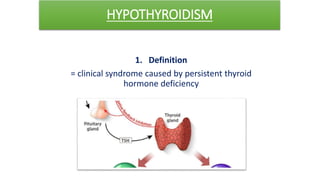
1. Definition
= clinical syndrome caused by persistent thyroid
hormone deficiency
A. Primary (thyroid) hypothyroidism
1. Destruction or lack of functionally
active tissue of the thyroid gland
- chronic autoimmune thyroiditis
- surgical removal of the thyroid
- radioactive therapy with 131I
- transient hypothyroidism with
subacute, postpartum and silent
("painless") thyroiditis
- agenesis and thyroid dysgenesis
2. Disturbance of thyroid hormone
synthesis
- congenital defects of thyroid
hormone biosynthesis
- severe iodine deficiency or excess
- drug or toxic effects (thyreostatic
drugs, lithium, perchlorate, etc.)
HYPOTHYROIDISM
CLASSIFICATION
B. Central (hypothalamic-pituitary,
secondary) hypothyroidism
1. Resolution or lack of cells
producing TSH or thyroliberin
- tumors
- traumatic or lumen injury (surgery,
proton therapy)
- vascular disorders (ischemic or
hemorrhagic damage)
- infectious or infiltrative processes
(abscess, tuberculosis, histiocytosis)
- chronic lymphocytic hypophysitis
- congenital disorders
- mutations
- drug and toxic effects
HYPOTHYROIDISM
PATHOGENESIS
HYPOTHYROIDISM
DIAGNOSTICS
LABORATORY INVESTIGATIONS
1. PRIMARY
HYPOTHYROI
DISM
TSH
INCREASE
T4 DECREASE
T3 DECREASE
2. SECONDARY
HYPOTHYROID
ISM
TSH DECREASE
T4 DECREASE
T3 DECREASE
INSTRUMENTAL INVESTIGATIONS
1. ULTRASOUND OF THYROID
thyroid reduction
there may be nodular cystic formations
2. ECG
sinus bradycardia
reduction of teeth voltage
INSTRUMENTAL INVESTIGATIONS
3. MRT
pituitary
adenoma
INSTRUMENTAL INVESTIGATIONS
1. Autoimmune thyroiditis
- if chronic AIT, then it is
irreversible and the patient
should receive replacement
therapy for life
- while hypothyroidism is usually
terminated by the restoration of
the thyroid gland
2. Primary and secondary
hypothyroidism
- secondary - uninsulated,
combined with the secondary
failure of other endocrine glands
(hypocritisism, hypogonadism).
- normal level of TSH can
sometimes be
HYPOTHYROIDISM
DIFFERENTIAL DIAGNOSIS
• Rheumatological:
polyarthritis, polysinovitis,
progressive osteoarthrosis (often
adjacent to neurological masks);
• Gynecological:
menstrual disorders
(amenorrhea, polymenorrhea,
hypermenorrhea, menorrhagia,
dysfunctional uterine bleeding),
infertility;
• Hematologic:
normochromic normocytic, iron
hypochromic or macrocytic B12
deficiency anemia;
• Psychiatric:
depression, dementia.
 Gastroenterological:
constipation, biliary tract
dyskinesia, cholelithiasis, chronic
hepatitis (jaundice combined
with elevated hepatic
transaminase);
 Cardiac:
diastolic hypertension,
dyslipidemia, hydropericardium;
 Respiratory:
sleep apnea syndrome, pleural
effusion of unknown origin,
chronic laryngitis;
 Neurological:
tunnel syndromes (carpal canal,
peroneal canal nerve);
HYPOTHYROIDISM
DIFFERENTIAL DIAGNOSIS
LEVOTIROXIN (L-T4)
Pharmacological action - compensating for the deficiency of thyroid hormones.
Inside, in the morning, on an empty stomach, washed down with a small amount of
liquid.
Tablets should be taken regularly.
FOR WOMAN = 100 MG/DAY
FOR MAN = 150 MG/DAY
HYPOTHYROIDISM
TREATMENT
CONCLUSION
Low-fat diet with plenty of fiber
Patients activation
Outdoor stay
Wearing warm clothes
DIFFUSE TOXIC GOITER
1. Definition
= systemic autoimmune disease, which develops as a
result of the production of stimulating antibodies to
the thyroid hormone receptor (AB – pTSH) , is clinically
manifested by the defeat of the thyroid gland with the
development of thyrotoxicosis syndrome in
combination with extrathyroid pathology
CAUSES
GRAVES’
DISEASE
Iodine deficiency
Autoimmune disease
Women over the age
of 40
Hyperthyroidism
Other causes
1. Smoking
2. Hormonal changes
3. Thyroiditis
4. Lithium
5. Overconsumption of iodine
6. Radiation therapy
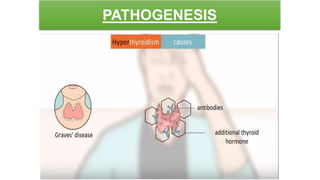
PATHOGENESIS
PATHOGENESIS
PATHOGENESIS
THYROID GLAND PALPATION
Goiter size classification
(WHO)
0 - no goiter
I - the size of the goiter is larger
than the distal phalanx of the
doctor’s thumb, the goiter is
palpable but not visible
II - goiter is palpable and
visible to the eye
Study of functional activity of the
thyroid gland
Thyroid hormones in the blood
TSH DECREASE (<0,1 mE/l)
T3 INCREASE
T4 INCREASE
Study of immunological markers
ANTIBODIES TO r-TSH - 99-100%
ANTIBODIES TO TPO (TYREOPEROXIDASE)
– 40-60%

INSTRUMENTAL INVESTIGATIONS
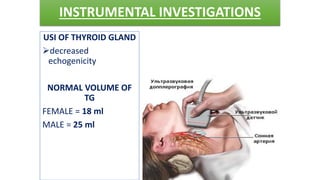
USI OF THYROID GLAND
decreased
echogenicity
NORMAL VOLUME OF
TG
FEMALE = 18 ml
MALE = 25 ml
THYROID SCINTIGRAPHY
Use technetium isotope (99mTc)
Disease = Equable isotope distribution
INSTRUMENTAL INVESTIGATIONS
CT
MRT
RETROSTERNAL GOITER
DISPLACEMENT AND RELEASE OF TRAHEA AND ESOPHAGUS
INSTRUMENTAL INVESTIGATIONS
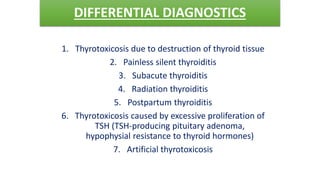
DIFFERENTIAL DIAGNOSTICS
1. Thyrotoxicosis due to destruction of thyroid tissue
2. Painless silent thyroiditis
3. Subacute thyroiditis
4. Radiation thyroiditis
5. Postpartum thyroiditis
6. Thyrotoxicosis caused by excessive proliferation of
TSH (TSH-producing pituitary adenoma,
hypophysial resistance to thyroid hormones)
7. Artificial thyrotoxicosis
NON-MEDICAL TREATMENT
 Limiting physical activity
To give up smoking
RECEPTION OF THYROESTATICS
THERAPY 12-18 MONTHS
Tiamazol (tyrosol, merkazolil)
Propylthiouracil
Beginning
+ relatively large doses: 30-40 mg (2 times)
or propylthiouracil 300-400 mg (3-4 times)/
Lasts 3-4 months
+ B – blockers – ANAPRILIN 120 mg/day 3-4
times; CONCOR 5 mg/day; ATENOLOL 100
mg/day 1 time.
+ GCS if severe prolonged thyrotoxicosis –
PREDNIZOLON (10-15 mg/day) or
HYDROCORTIZON (50-70 mg/day)
MEDICAL TREATMENT
SCHEME "BLOCK AND REPLACE"
If T4 = NORMAL we decrease dose
after 2-3 weeks – SUPPORTIVE
THERAPY
+ TIAMAZOL 10 mg/day/
+ LEVOTHYROXIN 25-50 mcg/day
THERAPY WITH 131 I
In case of recurrence of thyrotoxicosis
WAY = destruction of hyper functioning thyroid tissue
SURGICAL TREATMENT
• Indications:
lateral goiter, diffuse and nodular forms of goiter
1. FIRST: Achievement of euthyroid state
2. Surgery
hypothyroidism.pptx
hypothyroidism.pptx

hypothyroidism.pptx

  • 1.
    hypothyroidism & Diffuse toxic goiter (Graves' disease, Basedowdisease) JSC “Astana medical university” Astana
  • 2.
    PLAN 1. Introduction General meansabout hypothyroidism & Diffuse toxic goiter 2. Main body Classification Etiology Pathogenesis Clinical manifestations Diagnostics Differential diagnosis Treatment 3. Conclusion - Recommendations 4. Bibliography
  • 5.
    HYPOTHYROIDISM 1. Definition = clinicalsyndrome caused by persistent thyroid hormone deficiency
  • 6.
    A. Primary (thyroid)hypothyroidism 1. Destruction or lack of functionally active tissue of the thyroid gland - chronic autoimmune thyroiditis - surgical removal of the thyroid - radioactive therapy with 131I - transient hypothyroidism with subacute, postpartum and silent ("painless") thyroiditis - agenesis and thyroid dysgenesis 2. Disturbance of thyroid hormone synthesis - congenital defects of thyroid hormone biosynthesis - severe iodine deficiency or excess - drug or toxic effects (thyreostatic drugs, lithium, perchlorate, etc.) HYPOTHYROIDISM CLASSIFICATION B. Central (hypothalamic-pituitary, secondary) hypothyroidism 1. Resolution or lack of cells producing TSH or thyroliberin - tumors - traumatic or lumen injury (surgery, proton therapy) - vascular disorders (ischemic or hemorrhagic damage) - infectious or infiltrative processes (abscess, tuberculosis, histiocytosis) - chronic lymphocytic hypophysitis - congenital disorders - mutations - drug and toxic effects
  • 8.
  • 11.
  • 12.
    LABORATORY INVESTIGATIONS 1. PRIMARY HYPOTHYROI DISM TSH INCREASE T4DECREASE T3 DECREASE 2. SECONDARY HYPOTHYROID ISM TSH DECREASE T4 DECREASE T3 DECREASE
  • 13.
    INSTRUMENTAL INVESTIGATIONS 1. ULTRASOUNDOF THYROID thyroid reduction there may be nodular cystic formations
  • 14.
    2. ECG sinus bradycardia reductionof teeth voltage INSTRUMENTAL INVESTIGATIONS
  • 15.
  • 16.
    1. Autoimmune thyroiditis -if chronic AIT, then it is irreversible and the patient should receive replacement therapy for life - while hypothyroidism is usually terminated by the restoration of the thyroid gland 2. Primary and secondary hypothyroidism - secondary - uninsulated, combined with the secondary failure of other endocrine glands (hypocritisism, hypogonadism). - normal level of TSH can sometimes be HYPOTHYROIDISM DIFFERENTIAL DIAGNOSIS
  • 17.
    • Rheumatological: polyarthritis, polysinovitis, progressiveosteoarthrosis (often adjacent to neurological masks); • Gynecological: menstrual disorders (amenorrhea, polymenorrhea, hypermenorrhea, menorrhagia, dysfunctional uterine bleeding), infertility; • Hematologic: normochromic normocytic, iron hypochromic or macrocytic B12 deficiency anemia; • Psychiatric: depression, dementia.  Gastroenterological: constipation, biliary tract dyskinesia, cholelithiasis, chronic hepatitis (jaundice combined with elevated hepatic transaminase);  Cardiac: diastolic hypertension, dyslipidemia, hydropericardium;  Respiratory: sleep apnea syndrome, pleural effusion of unknown origin, chronic laryngitis;  Neurological: tunnel syndromes (carpal canal, peroneal canal nerve); HYPOTHYROIDISM DIFFERENTIAL DIAGNOSIS
  • 18.
    LEVOTIROXIN (L-T4) Pharmacological action- compensating for the deficiency of thyroid hormones. Inside, in the morning, on an empty stomach, washed down with a small amount of liquid. Tablets should be taken regularly. FOR WOMAN = 100 MG/DAY FOR MAN = 150 MG/DAY HYPOTHYROIDISM TREATMENT
  • 19.
    CONCLUSION Low-fat diet withplenty of fiber Patients activation Outdoor stay Wearing warm clothes
  • 21.
    DIFFUSE TOXIC GOITER 1.Definition = systemic autoimmune disease, which develops as a result of the production of stimulating antibodies to the thyroid hormone receptor (AB – pTSH) , is clinically manifested by the defeat of the thyroid gland with the development of thyrotoxicosis syndrome in combination with extrathyroid pathology
  • 22.
    CAUSES GRAVES’ DISEASE Iodine deficiency Autoimmune disease Womenover the age of 40 Hyperthyroidism Other causes 1. Smoking 2. Hormonal changes 3. Thyroiditis 4. Lithium 5. Overconsumption of iodine 6. Radiation therapy
  • 23.
  • 24.
  • 25.
  • 35.
    THYROID GLAND PALPATION Goitersize classification (WHO) 0 - no goiter I - the size of the goiter is larger than the distal phalanx of the doctor’s thumb, the goiter is palpable but not visible II - goiter is palpable and visible to the eye
  • 36.
    Study of functionalactivity of the thyroid gland Thyroid hormones in the blood TSH DECREASE (<0,1 mE/l) T3 INCREASE T4 INCREASE
  • 37.
    Study of immunologicalmarkers ANTIBODIES TO r-TSH - 99-100% ANTIBODIES TO TPO (TYREOPEROXIDASE) – 40-60% 
  • 38.
    INSTRUMENTAL INVESTIGATIONS USI OFTHYROID GLAND decreased echogenicity NORMAL VOLUME OF TG FEMALE = 18 ml MALE = 25 ml
  • 39.
    THYROID SCINTIGRAPHY Use technetiumisotope (99mTc) Disease = Equable isotope distribution INSTRUMENTAL INVESTIGATIONS
  • 40.
    CT MRT RETROSTERNAL GOITER DISPLACEMENT ANDRELEASE OF TRAHEA AND ESOPHAGUS INSTRUMENTAL INVESTIGATIONS
  • 41.
    DIFFERENTIAL DIAGNOSTICS 1. Thyrotoxicosisdue to destruction of thyroid tissue 2. Painless silent thyroiditis 3. Subacute thyroiditis 4. Radiation thyroiditis 5. Postpartum thyroiditis 6. Thyrotoxicosis caused by excessive proliferation of TSH (TSH-producing pituitary adenoma, hypophysial resistance to thyroid hormones) 7. Artificial thyrotoxicosis
  • 43.
    NON-MEDICAL TREATMENT  Limitingphysical activity To give up smoking
  • 44.
    RECEPTION OF THYROESTATICS THERAPY12-18 MONTHS Tiamazol (tyrosol, merkazolil) Propylthiouracil Beginning + relatively large doses: 30-40 mg (2 times) or propylthiouracil 300-400 mg (3-4 times)/ Lasts 3-4 months + B – blockers – ANAPRILIN 120 mg/day 3-4 times; CONCOR 5 mg/day; ATENOLOL 100 mg/day 1 time. + GCS if severe prolonged thyrotoxicosis – PREDNIZOLON (10-15 mg/day) or HYDROCORTIZON (50-70 mg/day) MEDICAL TREATMENT SCHEME "BLOCK AND REPLACE" If T4 = NORMAL we decrease dose after 2-3 weeks – SUPPORTIVE THERAPY + TIAMAZOL 10 mg/day/ + LEVOTHYROXIN 25-50 mcg/day
  • 45.
    THERAPY WITH 131I In case of recurrence of thyrotoxicosis WAY = destruction of hyper functioning thyroid tissue
  • 46.
    SURGICAL TREATMENT • Indications: lateralgoiter, diffuse and nodular forms of goiter 1. FIRST: Achievement of euthyroid state 2. Surgery