Biopotential electrodes
 Electrodes are employed to pick up
the electrical signals of the body.
1
Prepared by A.Devasena,
Associate Professor,
Dhanalakshmi College of Engg.
Chennai
the interface
metal electrolyte
M+
A-
e-
I
To sense a signal
a current I must flow !
2
Prepared by A.Devasena,
Associate Professor,
Dhanalakshmi College of Engg.
Chennai
the interface problem
metal electrolyte
M+
A-
e-
I
To sense a signal
a current I must flow !
But no electron e- is
passing the interface!
?
3
Prepared by A.Devasena,
Associate Professor,
Dhanalakshmi College of Engg.
Chennai
metal cation
leaving into the electrolyte
No current
What’s going on?
4
Prepared by A.Devasena,
Associate Professor,
Dhanalakshmi College of Engg.
Chennai
metal cation
 joining the metal
No current
What’s going on?
5
Prepared by A.Devasena,
Associate Professor,
Dhanalakshmi College of Engg.
Chennai
metal cation
 joining the metal
No current
One cation M+
out of the electrolyte
becomes one neutral atom M
taking off one free electron
from the metal.
6
Prepared by A.Devasena,
Associate Professor,
Dhanalakshmi College of Engg.
Chennai
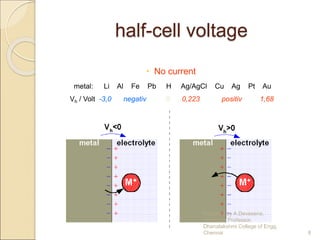
half-cell voltage
 No current
7
Prepared by A.Devasena,
Associate Professor,
Dhanalakshmi College of Engg.
Chennai
half-cell voltage
 No current
metal: Li Al Fe Pb H Ag/AgCl Cu Ag Pt Au
Vh / Volt -3,0 negativ 0 0,223 positiv 1,68
8
Prepared by A.Devasena,
Associate Professor,
Dhanalakshmi College of Engg.
Chennai
Half cell potential
 The voltage developed at an
electrode-electrolyte interface is
designated as the half cell- potential.
9
Prepared by A.Devasena,
Associate Professor,
Dhanalakshmi College of Engg.
Chennai
electrode double layer
 No current
10
Prepared by A.Devasena,
Associate Professor,
Dhanalakshmi College of Engg.
Chennai
electrode double layer
12
No current
Prepared by A.Devasena,
Associate Professor,
Dhanalakshmi College of Engg.
Chennai
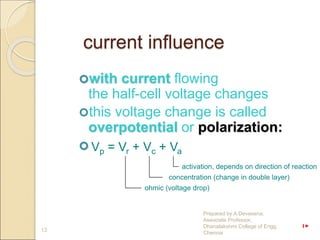
current influence
with current flowing
the half-cell voltage changes
this voltage change is called
overpotential or polarization:

13
Vp = Vr + Vc + Va
activation, depends on direction of reaction
concentration (change in double layer)
ohmic (voltage drop)
Prepared by A.Devasena,
Associate Professor,
Dhanalakshmi College of Engg.
Chennai
polarizable electrode
“perfectly” polarizable electrode:
- only displacement current,
electrode behave like a capacitor
example: noble metals like platinum
Pt.
Electrodes in which no net transfer of
charge occurs across the metal
electrode interface are called as
perfectly polarized electrodes.
14
Prepared by A.Devasena,
Associate Professor,
Dhanalakshmi College of Engg.
Chennai
nonpolarizable electrode
“perfectly” nonpolarizable electrode:
- current passes freely across
interface,
- no overpotential
examples:
- silver/silver chloride (Ag/AgCl),
- mercury/mercurous chloride
(Hg/Hg2Cl2) (calomel)
Electrodes in which unhindered
exchange of charge is possible
across the metal electrolyte interface
15
Prepared by A.Devasena,
Associate Professor,
Dhanalakshmi College of Engg.
Chennai
chemical reactions
16
silver / silver chloride
Prepared by A.Devasena,
Associate Professor,
Dhanalakshmi College of Engg.
Chennai
electrical behaviour
17
equivalent circuit
Prepared by A.Devasena,
Associate Professor,
Dhanalakshmi College of Engg.
Chennai
equivalent circuit
18
electrode-electrolyte
Prepared by A.Devasena,
Associate Professor,
Dhanalakshmi College of Engg.
Chennai
again el. behaviour
20
the skin: an additional interface!
Prepared by A.Devasena,
Associate Professor,
Dhanalakshmi College of Engg.
Chennai
total equivalent circuit
22
simplified
Cd
Rd
Rep||Rp
Vh* ZE
Vh*
Prepared by A.Devasena,
Associate Professor,
Dhanalakshmi College of Engg.
Chennai
high impedance
 interference with main power-lines
(!!)
 potential devider with Rinput
 frequency dependant. c
23
Prepared by A.Devasena,
Associate Professor,
Dhanalakshmi College of Engg.
Chennai
changing half-cell voltage
 influenced by local concentration
 saturation of amplifier
 motion artefacts by changing the
the gel-skin potential (Vep).
24
simulation:
Prepared by A.Devasena,
Associate Professor,
Dhanalakshmi College of Engg.
Chennai
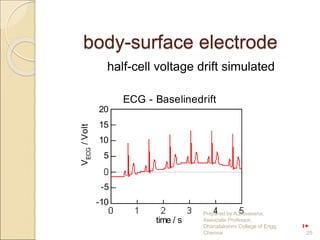
body-surface electrode
25
half-cell voltage drift simulated
time / s
ECG - Baselinedrift
20
15
10
5
-5
-10
V
ECG
/
Volt
Prepared by A.Devasena,
Associate Professor,
Dhanalakshmi College of Engg.
Chennai
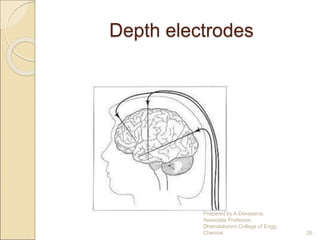
Depth electrodes
26
Prepared by A.Devasena,
Associate Professor,
Dhanalakshmi College of Engg.
Chennai
Depth electrode-
27
Prepared by A.Devasena,
Associate Professor,
Dhanalakshmi College of Engg.
Chennai
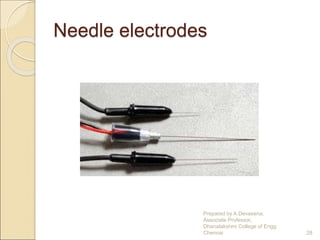
Needle electrodes
28
Prepared by A.Devasena,
Associate Professor,
Dhanalakshmi College of Engg.
Chennai
Needle electrodes – with pins
29
Prepared by A.Devasena,
Associate Professor,
Dhanalakshmi College of Engg.
Chennai
Inserting a Needle electrode
30
Prepared by A.Devasena,
Associate Professor,
Dhanalakshmi College of Engg.
Chennai
31
Prepared by A.Devasena,
Associate Professor,
Dhanalakshmi College of Engg.
Chennai
32
Prepared by A.Devasena,
Associate Professor,
Dhanalakshmi College of Engg.
Chennai
33
Prepared by A.Devasena,
Associate Professor,
Dhanalakshmi College of Engg.
Chennai
34
Prepared by A.Devasena,
Associate Professor,
Dhanalakshmi College of Engg.
Chennai
35
Prepared by A.Devasena,
Associate Professor,
Dhanalakshmi College of Engg.
Chennai
36
Prepared by A.Devasena,
Associate Professor,
Dhanalakshmi College of Engg.
Chennai
37
Prepared by A.Devasena,
Associate Professor,
Dhanalakshmi College of Engg.
Chennai
38
Prepared by A.Devasena,
Associate Professor,
Dhanalakshmi College of Engg.
Chennai
39
Prepared by A.Devasena,
Associate Professor,
Dhanalakshmi College of Engg.
Chennai

study_of_Bio_potential_Electrodes.ppt

Editor's Notes