EMC for Semiconductor Manufacturing
Facility, Equipment Electromagnetic
Compatibility and E33 Directions
EMI Issues in
Semiconductor
Environment
Vladimir Kraz
Credence Technologies
vladimir@credencetech.com
831-459-7488
July 11, 2006 STEP7
2
What is EMI?
• ElectroMagnetic Interference is electromagnetic emission that
causes equipment malfunction
• No matter how strong emission is, if it doesn’t cause problems,
it is not an interference, i.e. not EMI.
• Therefore, the impact of EMI is judged not only by how much
emission is generated, but also by how it gets from “here” to
“there” and by how immune the equipment is to EMI.
• For simplicity of this discussion we will call all electromagnetic
emission “EMI,” though it is technically incorrect
CREDENCE
TECHNOLOGIES
www.credencetech.com
©2002
July 11, 2006 STEP7
3
Electromagnetic Field is
Natural Phenomenon
• Electricity and magnetism were not invented –
they were discovered
• Earth has strong magnetic field
• Lightning and other atmospheric phenomena
create electric and magnetic fields
• Sun experiences electromagnetic storms
• There is no place in the Universe without
electromagnetic fields
July 11, 2006 STEP7
4
How EMI
Manifests Itself
• Outright equipment lock-up
• Tools do things they weren’t supposed to do
• Software errors
• Erratic response
• Parametric errors
• Sensor misreading
• Component damage
CREDENCE
TECHNOLOGIES
www.credencetech.com
©2002
July 11, 2006 STEP7
5
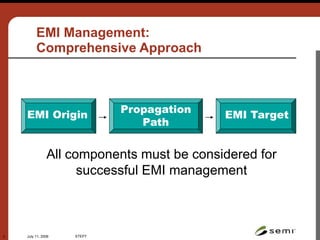
EMI Management:
Comprehensive Approach
All components must be considered for
successful EMI management
EMI Origin
Propagation
Path
EMI Target
CREDENCE
TECHNOLOGIES
www.credencetech.com
©2002
July 11, 2006 STEP7
6
EMI Sources in Cleanrooms
EMI Origin
Propagation
Path
EMI Target
CREDENCE
TECHNOLOGIES
www.credencetech.com
©2002
July 11, 2006 STEP7
7
Sources of EMI in Cleanrooms
• ESD Events
• Poorly-designed equipment
• Poorly installed equipment
• Poorly maintained equipment
• Mobile phones and walkie-talkies
CREDENCE
TECHNOLOGIES
www.credencetech.com
©2002
July 11, 2006 STEP7
8
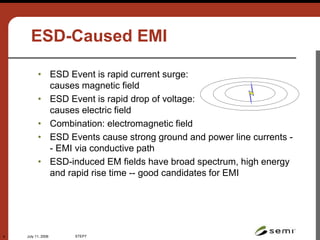
ESD-Caused EMI
• ESD Event is rapid current surge:
causes magnetic field
• ESD Event is rapid drop of voltage:
causes electric field
• Combination: electromagnetic field
• ESD Events cause strong ground and power line currents -
- EMI via conductive path
• ESD-induced EM fields have broad spectrum, high energy
and rapid rise time -- good candidates for EMI
CREDENCE
TECHNOLOGIES
www.credencetech.com
©2002
July 11, 2006 STEP7
9
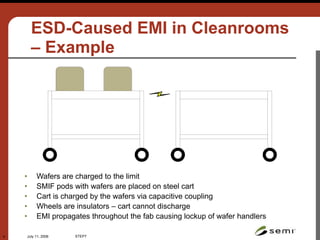
ESD-Caused EMI in Cleanrooms
– Example
• Wafers are charged to the limit
• SMIF pods with wafers are placed on steel cart
• Cart is charged by the wafers via capacitive coupling
• Wheels are insulators – cart cannot discharge
• EMI propagates throughout the fab causing lockup of wafer handlers
CREDENCE
TECHNOLOGIES
www.credencetech.com
©2002
July 11, 2006 STEP7
10
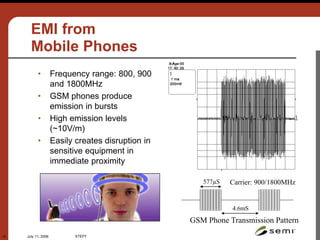
EMI from
Mobile Phones
• Frequency range: 800, 900
and 1800MHz
• GSM phones produce
emission in bursts
• High emission levels
(~10V/m)
• Easily creates disruption in
sensitive equipment in
immediate proximity
577µS
4.6mS
GSM Phone Transmission Pattern
CREDENCE
TECHNOLOGIES
www.credencetech.com
©2002
Carrier: 900/1800MHz
July 11, 2006 STEP7
11
EMI Caused by Equipment
• Every electric or electronics device generates
electromagnetic field
• If this field is too strong and has certain
properties, it is good candidate for EMI
• Poorly-maintained equipment is good source of
EMI (DC brush motors, bad grounding)
• EMI-generating equipment often causes
problems for itself
CREDENCE
TECHNOLOGIES
www.credencetech.com
©2002
July 11, 2006 STEP7
12
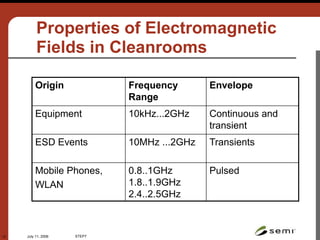
Properties of Electromagnetic
Fields in Cleanrooms
Origin Frequency
Range
Envelope
Equipment 10kHz...2GHz Continuous and
transient
ESD Events 10MHz ...2GHz Transients
Mobile Phones,
WLAN
0.8..1GHz
1.8..1.9GHz
2.4..2.5GHz
Pulsed
July 11, 2006 STEP7
13
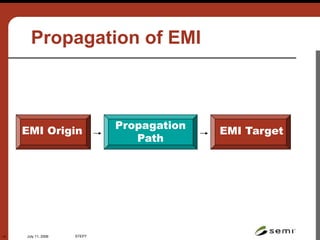
Propagation of EMI
EMI Origin Propagation
Path
EMI Target
July 11, 2006 STEP7
14
Propagation of
Electromagnetic Emission
• Radiated
– Electromagnetic field composed of electric and magnetic fields
propagates via air path just as emission from a mobile phone would
reach the base station
– This field would create voltages and currents in any metal object,
i.e. wire, PCB trace, etc.
• Conducted
– The most neglected type of propagation
– High-frequency currents move via power, ground and data cables
and inject undesirable signals into equipment
• Mixed
– Radiated emission generates signals in wires and cables. These
signals are then injected into equipment via conductive path
July 11, 2006 STEP7
15
Radiated Emission
Equipment Shielding
• Used for both reduction of emission and
improvement of immunity
• Tool panels (shielding) are often left open after
maintenance
• Sometimes panels are not connected to
ground (painted mounting, etc.)
• Anodized aluminum is not a conductor!
• Dissipative surfaces are not EMI-conductive!
July 11, 2006 STEP7
16
Conducted Emission:
Propagation via Wires and Cables
• Common conduits:
– Ground wires
– Power cables
– Network cables
• A signal originated in one spot can
propagate through the entire fab via
these conduits
July 11, 2006 STEP7
17
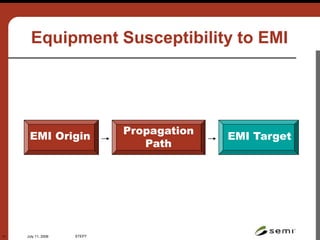
Equipment Susceptibility to EMI
EMI Origin
Propagation
Path
EMI Target
July 11, 2006 STEP7
18
EMI-Caused Equipment Failures
Three Basic Types of Failures
• Fatal failure due to overstress
– direct ESD discharge
– very high EMI-induced signals (EOS)
• Latch-Up
– induced voltages are outside of supply rails
– often recoverable after power-cycling
– sometimes causes overheating and failure
• Injection of false signals
– Induced signal is comparable to legitimate signals
July 11, 2006 STEP7
19
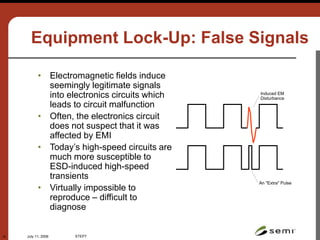
Equipment Lock-Up: False Signals
• Electromagnetic fields induce
seemingly legitimate signals
into electronics circuits which
leads to circuit malfunction
• Often, the electronics circuit
does not suspect that it was
affected by EMI
• Today’s high-speed circuits are
much more susceptible to
ESD-induced high-speed
transients
• Virtually impossible to
reproduce – difficult to
diagnose
Induced EM
Disturbance
An "Extra" Pulse
July 11, 2006 STEP7
20
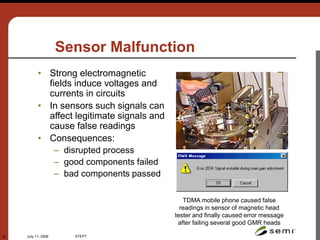
Sensor Malfunction
• Strong electromagnetic
fields induce voltages and
currents in circuits
• In sensors such signals can
affect legitimate signals and
cause false readings
• Consequences:
– disrupted process
– good components failed
– bad components passed
TDMA mobile phone caused false
readings in sensor of magnetic head
tester and finally caused error message
after failing several good GMR heads
Ground and EMI
July 11, 2006 STEP7
22
EMI Grounding:
What is Different?
• For static dissipation and for safety ground
should provide conductive path to “zero”
potential
In order for it to be good EMI ground, it also:
• Should be able to offer very low impedance at
high frequencies
• Should be able to conduct all the
high-frequency residual signals
• Should not channel EMI from one tool to
another
July 11, 2006 STEP7
23
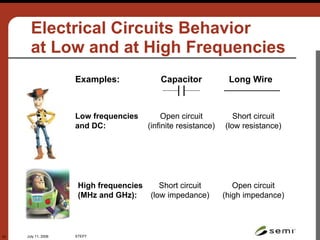
Electrical Circuits Behavior
at Low and at High Frequencies
Low frequencies
and DC:
Examples: Capacitor Long Wire
Open circuit
(infinite resistance)
Short circuit
(low resistance)
High frequencies
(MHz and GHz):
Short circuit
(low impedance)
Open circuit
(high impedance)
July 11, 2006 STEP7
24
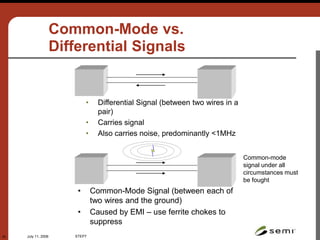
Common-Mode vs.
Differential Signals
• Differential Signal (between two wires in a
pair)
• Carries signal
• Also carries noise, predominantly <1MHz
• Common-Mode Signal (between each of
two wires and the ground)
• Caused by EMI – use ferrite chokes to
suppress
CREDENCE
TECHNOLOGIES
www.credencetech.com
©2002
Common-mode
signal under all
circumstances must
be fought
July 11, 2006 STEP7
25
Why Multimeter Reads Random
Resistance and Voltages on Ground?
• Quality of grounding is typically tested with an
ohmmeter
• Ohmmeter works from DC to up to ~3000Hz
(typically)
• For EMI (Megahertz and up), ohmmeter is useless
• High-frequency signals get rectified by multimeter
circuit and produce DC voltages that emulate “extra”
resistance, often “negative”
• Specially-designed instruments can ignore high-
frequency components and measure only the
required parameter
July 11, 2006 STEP7
26
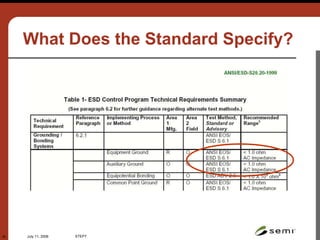
What Does the Standard Specify?
July 11, 2006 STEP7
27
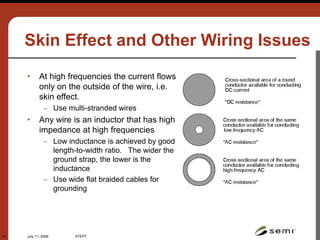
Skin Effect and Other Wiring Issues
• At high frequencies the current flows
only on the outside of the wire, i.e.
skin effect.
– Use multi-stranded wires
• Any wire is an inductor that has high
impedance at high frequencies
– Low inductance is achieved by good
length-to-width ratio. The wider the
ground strap, the lower is the
inductance
– Use wide flat braided cables for
grounding
DC HF
CREDENCE
TECHNOLOGIES
www.credencetech.com
©2002
July 11, 2006 STEP7
28
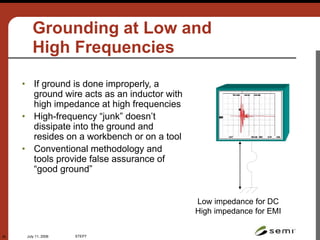
Grounding at Low and
High Frequencies
• If ground is done improperly, a
ground wire acts as an inductor with
high impedance at high frequencies
• High-frequency “junk” doesn’t
dissipate into the ground and
resides on a workbench or on a tool
• Conventional methodology and
tools provide false assurance of
“good ground”
Low impedance for DC
High impedance for EMI
CREDENCE
TECHNOLOGIES
www.credencetech.com
©2002
July 11, 2006 STEP7
29
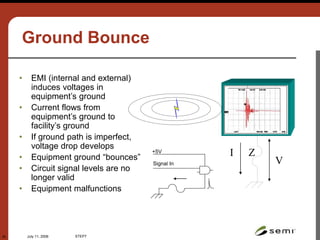
Ground Bounce
• EMI (internal and external)
induces voltages in
equipment’s ground
• Current flows from
equipment’s ground to
facility’s ground
• If ground path is imperfect,
voltage drop develops
• Equipment ground “bounces”
• Circuit signal levels are no
longer valid
• Equipment malfunctions
I
V
+5V
Signal In
CREDENCE
TECHNOLOGIES
www.credencetech.com
©2002
Z
July 11, 2006 STEP7
30
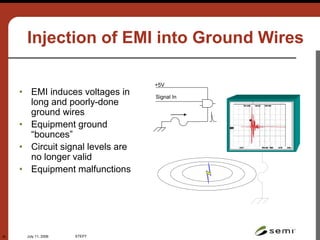
Injection of EMI into Ground Wires
• EMI induces voltages in
long and poorly-done
ground wires
• Equipment ground
“bounces”
• Circuit signal levels are
no longer valid
• Equipment malfunctions
+5V
Signal In
CREDENCE
TECHNOLOGIES
www.credencetech.com
©2002
July 11, 2006 STEP7
31
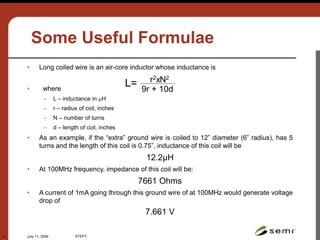
Some Useful Formulae
• Long coiled wire is an air-core inductor whose inductance is
• where
– L – inductance in H
– r – radius of coil, inches
– N – number of turns
– d – length of coil, inches
• As an example, if the “extra” ground wire is coiled to 12” diameter (6” radius), has 5
turns and the length of this coil is 0.75”, inductance of this coil will be
12.2μH
• At 100MHz frequency, impedance of this coil will be:
7661 Ohms
• A current of 1mA going through this ground wire of at 100MHz would generate voltage
drop of
7.661 V
L= r2xN2
9r + 10d
July 11, 2006 STEP7
32
Some Useful Formulae
• Inductance of a straight wire at high frequencies can be calculated
as:
• where
– L – inductance in H
– r – radius wire, cm
– d – length of wire, cm
• A common 10m (30 feet) ground run of 12 gage solid wire has self-
inductance at high frequencies of
17.36μH
• The same 1mA current at 100MHz would create a voltage on this
length of wire of
10.9V
L=0.002d*[ln -1]
2d
r
July 11, 2006 STEP7
33
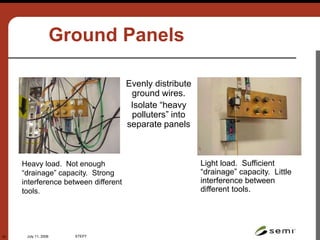
Ground Panels
Heavy load. Not enough
“drainage” capacity. Strong
interference between different
tools.
Light load. Sufficient
“drainage” capacity. Little
interference between
different tools.
Evenly distribute
ground wires.
Isolate “heavy
polluters” into
separate panels
CREDENCE
TECHNOLOGIES
www.credencetech.com
©2002
July 11, 2006 STEP7
34
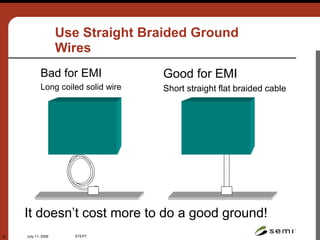
Use Straight Braided Ground
Wires
It doesn’t cost more to do a good ground!
Bad for EMI
Long coiled solid wire
Good for EMI
Short straight flat braided cable
July 11, 2006 STEP7
35
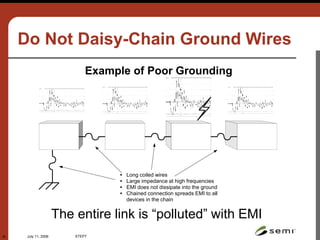
Do Not Daisy-Chain Ground Wires
The entire link is “polluted” with EMI
 Long coiled wires
 Large impedance at high frequencies
 EMI does not dissipate into the ground
 Chained connection spreads EMI to all
devices in the chain
Example of Poor Grounding
July 11, 2006 STEP7
36
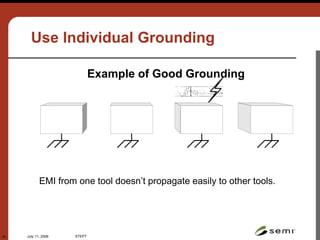
Use Individual Grounding
EMI from one tool doesn’t propagate easily to other tools.
Example of Good Grounding
July 11, 2006 STEP7
37
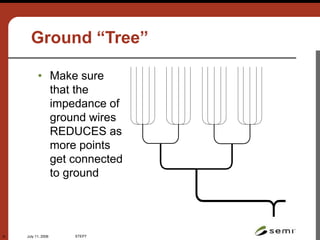
Ground “Tree”
• Make sure
that the
impedance of
ground wires
REDUCES as
more points
get connected
to ground
July 11, 2006 STEP7
38
Assuring Good EMI Ground
• Shorten your ground wires
• Straighten your ground wires
• Use large gauge flat braided cable
• Connect it to known good ground
• Do not chain-link many workstations
• Always verify ground quality for EMI
• Do it on a regular basis
• Continuously monitor ground activity
SEMI E.33
Work in Progress
July 11, 2006 STEP7
40
Summary of SEMI E.33
• This document describes requirements for
electromagnetic compliance for semiconductor
equipment in the FABs
• This document does not address emission
levels in the FAB itself
• This document relies mostly on existing
accepted industry standards for emission limits
and methodology
• This document also sets its own limits where
existing standards are not sufficient
July 11, 2006 STEP7
41
The Need for the Update of E.33
• The original E.33 document was issues
in 1994 – it has been 12 years since
• Not only regulatory requirements have
changed significantly, but also did the
fabrication technology
• Requirements for electromagnetic
performance have significantly risen in
the past years
July 11, 2006 STEP7
42
Fundamental Changes in E.33
• Updated references to existing EMC
standards and regulation
• More specifically, compliance with the
requirements of the EMC Directive
meets the minimum requirements for
conformance with SEMI E33
• Limits for such parameters as ELF are
updated in accordance with current
process requirements
July 11, 2006 STEP7
43
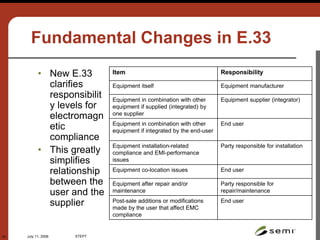
Fundamental Changes in E.33
• New E.33
clarifies
responsibilit
y levels for
electromagn
etic
compliance
• This greatly
simplifies
relationship
between the
user and the
supplier
Item Responsibility
Equipment itself Equipment manufacturer
Equipment in combination with other
equipment if supplied (integrated) by
one supplier
Equipment supplier (integrator)
Equipment in combination with other
equipment if integrated by the end-user
End user
Equipment installation-related
compliance and EMI-performance
issues
Party responsible for installation
Equipment co-location issues End user
Equipment after repair and/or
maintenance
Party responsible for
repair/maintenance
Post-sale additions or modifications
made by the user that affect EMC
compliance
End user
July 11, 2006 STEP7
44
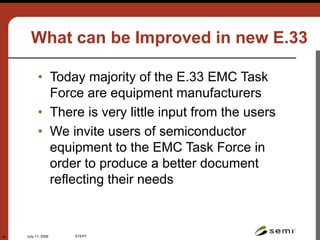
What can be Improved in new E.33
• Today majority of the E.33 EMC Task
Force are equipment manufacturers
• There is very little input from the users
• We invite users of semiconductor
equipment to the EMC Task Force in
order to produce a better document
reflecting their needs
July 11, 2006 STEP7
45
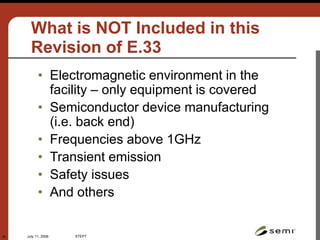
What is NOT Included in this
Revision of E.33
• Electromagnetic environment in the
facility – only equipment is covered
• Semiconductor device manufacturing
(i.e. back end)
• Frequencies above 1GHz
• Transient emission
• Safety issues
• And others

Kraz_Presentation.ppt

  • 1.
    EMC for SemiconductorManufacturing Facility, Equipment Electromagnetic Compatibility and E33 Directions EMI Issues in Semiconductor Environment Vladimir Kraz Credence Technologies vladimir@credencetech.com 831-459-7488
  • 2.
    July 11, 2006STEP7 2 What is EMI? • ElectroMagnetic Interference is electromagnetic emission that causes equipment malfunction • No matter how strong emission is, if it doesn’t cause problems, it is not an interference, i.e. not EMI. • Therefore, the impact of EMI is judged not only by how much emission is generated, but also by how it gets from “here” to “there” and by how immune the equipment is to EMI. • For simplicity of this discussion we will call all electromagnetic emission “EMI,” though it is technically incorrect CREDENCE TECHNOLOGIES www.credencetech.com ©2002
  • 3.
    July 11, 2006STEP7 3 Electromagnetic Field is Natural Phenomenon • Electricity and magnetism were not invented – they were discovered • Earth has strong magnetic field • Lightning and other atmospheric phenomena create electric and magnetic fields • Sun experiences electromagnetic storms • There is no place in the Universe without electromagnetic fields
  • 4.
    July 11, 2006STEP7 4 How EMI Manifests Itself • Outright equipment lock-up • Tools do things they weren’t supposed to do • Software errors • Erratic response • Parametric errors • Sensor misreading • Component damage CREDENCE TECHNOLOGIES www.credencetech.com ©2002
  • 5.
    July 11, 2006STEP7 5 EMI Management: Comprehensive Approach All components must be considered for successful EMI management EMI Origin Propagation Path EMI Target CREDENCE TECHNOLOGIES www.credencetech.com ©2002
  • 6.
    July 11, 2006STEP7 6 EMI Sources in Cleanrooms EMI Origin Propagation Path EMI Target CREDENCE TECHNOLOGIES www.credencetech.com ©2002
  • 7.
    July 11, 2006STEP7 7 Sources of EMI in Cleanrooms • ESD Events • Poorly-designed equipment • Poorly installed equipment • Poorly maintained equipment • Mobile phones and walkie-talkies CREDENCE TECHNOLOGIES www.credencetech.com ©2002
  • 8.
    July 11, 2006STEP7 8 ESD-Caused EMI • ESD Event is rapid current surge: causes magnetic field • ESD Event is rapid drop of voltage: causes electric field • Combination: electromagnetic field • ESD Events cause strong ground and power line currents - - EMI via conductive path • ESD-induced EM fields have broad spectrum, high energy and rapid rise time -- good candidates for EMI CREDENCE TECHNOLOGIES www.credencetech.com ©2002
  • 9.
    July 11, 2006STEP7 9 ESD-Caused EMI in Cleanrooms – Example • Wafers are charged to the limit • SMIF pods with wafers are placed on steel cart • Cart is charged by the wafers via capacitive coupling • Wheels are insulators – cart cannot discharge • EMI propagates throughout the fab causing lockup of wafer handlers CREDENCE TECHNOLOGIES www.credencetech.com ©2002
  • 10.
    July 11, 2006STEP7 10 EMI from Mobile Phones • Frequency range: 800, 900 and 1800MHz • GSM phones produce emission in bursts • High emission levels (~10V/m) • Easily creates disruption in sensitive equipment in immediate proximity 577µS 4.6mS GSM Phone Transmission Pattern CREDENCE TECHNOLOGIES www.credencetech.com ©2002 Carrier: 900/1800MHz
  • 11.
    July 11, 2006STEP7 11 EMI Caused by Equipment • Every electric or electronics device generates electromagnetic field • If this field is too strong and has certain properties, it is good candidate for EMI • Poorly-maintained equipment is good source of EMI (DC brush motors, bad grounding) • EMI-generating equipment often causes problems for itself CREDENCE TECHNOLOGIES www.credencetech.com ©2002
  • 12.
    July 11, 2006STEP7 12 Properties of Electromagnetic Fields in Cleanrooms Origin Frequency Range Envelope Equipment 10kHz...2GHz Continuous and transient ESD Events 10MHz ...2GHz Transients Mobile Phones, WLAN 0.8..1GHz 1.8..1.9GHz 2.4..2.5GHz Pulsed
  • 13.
    July 11, 2006STEP7 13 Propagation of EMI EMI Origin Propagation Path EMI Target
  • 14.
    July 11, 2006STEP7 14 Propagation of Electromagnetic Emission • Radiated – Electromagnetic field composed of electric and magnetic fields propagates via air path just as emission from a mobile phone would reach the base station – This field would create voltages and currents in any metal object, i.e. wire, PCB trace, etc. • Conducted – The most neglected type of propagation – High-frequency currents move via power, ground and data cables and inject undesirable signals into equipment • Mixed – Radiated emission generates signals in wires and cables. These signals are then injected into equipment via conductive path
  • 15.
    July 11, 2006STEP7 15 Radiated Emission Equipment Shielding • Used for both reduction of emission and improvement of immunity • Tool panels (shielding) are often left open after maintenance • Sometimes panels are not connected to ground (painted mounting, etc.) • Anodized aluminum is not a conductor! • Dissipative surfaces are not EMI-conductive!
  • 16.
    July 11, 2006STEP7 16 Conducted Emission: Propagation via Wires and Cables • Common conduits: – Ground wires – Power cables – Network cables • A signal originated in one spot can propagate through the entire fab via these conduits
  • 17.
    July 11, 2006STEP7 17 Equipment Susceptibility to EMI EMI Origin Propagation Path EMI Target
  • 18.
    July 11, 2006STEP7 18 EMI-Caused Equipment Failures Three Basic Types of Failures • Fatal failure due to overstress – direct ESD discharge – very high EMI-induced signals (EOS) • Latch-Up – induced voltages are outside of supply rails – often recoverable after power-cycling – sometimes causes overheating and failure • Injection of false signals – Induced signal is comparable to legitimate signals
  • 19.
    July 11, 2006STEP7 19 Equipment Lock-Up: False Signals • Electromagnetic fields induce seemingly legitimate signals into electronics circuits which leads to circuit malfunction • Often, the electronics circuit does not suspect that it was affected by EMI • Today’s high-speed circuits are much more susceptible to ESD-induced high-speed transients • Virtually impossible to reproduce – difficult to diagnose Induced EM Disturbance An "Extra" Pulse
  • 20.
    July 11, 2006STEP7 20 Sensor Malfunction • Strong electromagnetic fields induce voltages and currents in circuits • In sensors such signals can affect legitimate signals and cause false readings • Consequences: – disrupted process – good components failed – bad components passed TDMA mobile phone caused false readings in sensor of magnetic head tester and finally caused error message after failing several good GMR heads
  • 21.
  • 22.
    July 11, 2006STEP7 22 EMI Grounding: What is Different? • For static dissipation and for safety ground should provide conductive path to “zero” potential In order for it to be good EMI ground, it also: • Should be able to offer very low impedance at high frequencies • Should be able to conduct all the high-frequency residual signals • Should not channel EMI from one tool to another
  • 23.
    July 11, 2006STEP7 23 Electrical Circuits Behavior at Low and at High Frequencies Low frequencies and DC: Examples: Capacitor Long Wire Open circuit (infinite resistance) Short circuit (low resistance) High frequencies (MHz and GHz): Short circuit (low impedance) Open circuit (high impedance)
  • 24.
    July 11, 2006STEP7 24 Common-Mode vs. Differential Signals • Differential Signal (between two wires in a pair) • Carries signal • Also carries noise, predominantly <1MHz • Common-Mode Signal (between each of two wires and the ground) • Caused by EMI – use ferrite chokes to suppress CREDENCE TECHNOLOGIES www.credencetech.com ©2002 Common-mode signal under all circumstances must be fought
  • 25.
    July 11, 2006STEP7 25 Why Multimeter Reads Random Resistance and Voltages on Ground? • Quality of grounding is typically tested with an ohmmeter • Ohmmeter works from DC to up to ~3000Hz (typically) • For EMI (Megahertz and up), ohmmeter is useless • High-frequency signals get rectified by multimeter circuit and produce DC voltages that emulate “extra” resistance, often “negative” • Specially-designed instruments can ignore high- frequency components and measure only the required parameter
  • 26.
    July 11, 2006STEP7 26 What Does the Standard Specify?
  • 27.
    July 11, 2006STEP7 27 Skin Effect and Other Wiring Issues • At high frequencies the current flows only on the outside of the wire, i.e. skin effect. – Use multi-stranded wires • Any wire is an inductor that has high impedance at high frequencies – Low inductance is achieved by good length-to-width ratio. The wider the ground strap, the lower is the inductance – Use wide flat braided cables for grounding DC HF CREDENCE TECHNOLOGIES www.credencetech.com ©2002
  • 28.
    July 11, 2006STEP7 28 Grounding at Low and High Frequencies • If ground is done improperly, a ground wire acts as an inductor with high impedance at high frequencies • High-frequency “junk” doesn’t dissipate into the ground and resides on a workbench or on a tool • Conventional methodology and tools provide false assurance of “good ground” Low impedance for DC High impedance for EMI CREDENCE TECHNOLOGIES www.credencetech.com ©2002
  • 29.
    July 11, 2006STEP7 29 Ground Bounce • EMI (internal and external) induces voltages in equipment’s ground • Current flows from equipment’s ground to facility’s ground • If ground path is imperfect, voltage drop develops • Equipment ground “bounces” • Circuit signal levels are no longer valid • Equipment malfunctions I V +5V Signal In CREDENCE TECHNOLOGIES www.credencetech.com ©2002 Z
  • 30.
    July 11, 2006STEP7 30 Injection of EMI into Ground Wires • EMI induces voltages in long and poorly-done ground wires • Equipment ground “bounces” • Circuit signal levels are no longer valid • Equipment malfunctions +5V Signal In CREDENCE TECHNOLOGIES www.credencetech.com ©2002
  • 31.
    July 11, 2006STEP7 31 Some Useful Formulae • Long coiled wire is an air-core inductor whose inductance is • where – L – inductance in H – r – radius of coil, inches – N – number of turns – d – length of coil, inches • As an example, if the “extra” ground wire is coiled to 12” diameter (6” radius), has 5 turns and the length of this coil is 0.75”, inductance of this coil will be 12.2μH • At 100MHz frequency, impedance of this coil will be: 7661 Ohms • A current of 1mA going through this ground wire of at 100MHz would generate voltage drop of 7.661 V L= r2xN2 9r + 10d
  • 32.
    July 11, 2006STEP7 32 Some Useful Formulae • Inductance of a straight wire at high frequencies can be calculated as: • where – L – inductance in H – r – radius wire, cm – d – length of wire, cm • A common 10m (30 feet) ground run of 12 gage solid wire has self- inductance at high frequencies of 17.36μH • The same 1mA current at 100MHz would create a voltage on this length of wire of 10.9V L=0.002d*[ln -1] 2d r
  • 33.
    July 11, 2006STEP7 33 Ground Panels Heavy load. Not enough “drainage” capacity. Strong interference between different tools. Light load. Sufficient “drainage” capacity. Little interference between different tools. Evenly distribute ground wires. Isolate “heavy polluters” into separate panels CREDENCE TECHNOLOGIES www.credencetech.com ©2002
  • 34.
    July 11, 2006STEP7 34 Use Straight Braided Ground Wires It doesn’t cost more to do a good ground! Bad for EMI Long coiled solid wire Good for EMI Short straight flat braided cable
  • 35.
    July 11, 2006STEP7 35 Do Not Daisy-Chain Ground Wires The entire link is “polluted” with EMI  Long coiled wires  Large impedance at high frequencies  EMI does not dissipate into the ground  Chained connection spreads EMI to all devices in the chain Example of Poor Grounding
  • 36.
    July 11, 2006STEP7 36 Use Individual Grounding EMI from one tool doesn’t propagate easily to other tools. Example of Good Grounding
  • 37.
    July 11, 2006STEP7 37 Ground “Tree” • Make sure that the impedance of ground wires REDUCES as more points get connected to ground
  • 38.
    July 11, 2006STEP7 38 Assuring Good EMI Ground • Shorten your ground wires • Straighten your ground wires • Use large gauge flat braided cable • Connect it to known good ground • Do not chain-link many workstations • Always verify ground quality for EMI • Do it on a regular basis • Continuously monitor ground activity
  • 39.
  • 40.
    July 11, 2006STEP7 40 Summary of SEMI E.33 • This document describes requirements for electromagnetic compliance for semiconductor equipment in the FABs • This document does not address emission levels in the FAB itself • This document relies mostly on existing accepted industry standards for emission limits and methodology • This document also sets its own limits where existing standards are not sufficient
  • 41.
    July 11, 2006STEP7 41 The Need for the Update of E.33 • The original E.33 document was issues in 1994 – it has been 12 years since • Not only regulatory requirements have changed significantly, but also did the fabrication technology • Requirements for electromagnetic performance have significantly risen in the past years
  • 42.
    July 11, 2006STEP7 42 Fundamental Changes in E.33 • Updated references to existing EMC standards and regulation • More specifically, compliance with the requirements of the EMC Directive meets the minimum requirements for conformance with SEMI E33 • Limits for such parameters as ELF are updated in accordance with current process requirements
  • 43.
    July 11, 2006STEP7 43 Fundamental Changes in E.33 • New E.33 clarifies responsibilit y levels for electromagn etic compliance • This greatly simplifies relationship between the user and the supplier Item Responsibility Equipment itself Equipment manufacturer Equipment in combination with other equipment if supplied (integrated) by one supplier Equipment supplier (integrator) Equipment in combination with other equipment if integrated by the end-user End user Equipment installation-related compliance and EMI-performance issues Party responsible for installation Equipment co-location issues End user Equipment after repair and/or maintenance Party responsible for repair/maintenance Post-sale additions or modifications made by the user that affect EMC compliance End user
  • 44.
    July 11, 2006STEP7 44 What can be Improved in new E.33 • Today majority of the E.33 EMC Task Force are equipment manufacturers • There is very little input from the users • We invite users of semiconductor equipment to the EMC Task Force in order to produce a better document reflecting their needs
  • 45.
    July 11, 2006STEP7 45 What is NOT Included in this Revision of E.33 • Electromagnetic environment in the facility – only equipment is covered • Semiconductor device manufacturing (i.e. back end) • Frequencies above 1GHz • Transient emission • Safety issues • And others