

Study Satisfaction for Students in Universities   Natalia Ivanilova Vitaly Kobets Ludmila Konstants Vira Lyubchenko Vladimir Popov
Effective learning in the classroom depends on the teacher's ability…  to maintain the interest that brought students to the course in the first place. Literature Review Ericksen S.C. The Lecture // Memo to the Faculty, no. 60. Ann Arbor: Centre for Research on Teaching and Learning, University of Michigan, 1978
General Strategies Capitalize on students' existing needs  Make students active participants in learning  Ask students to analyze what makes their classes more or less "motivating"
Incorporating Instructional Behaviours that Motivate Students   Hold high but realistic expectations for your students.  Help students set achievable goals for themselves.  Tell students what they need to do to succeed in your course.  Strengthen students' self-motivation.  Avoid creating intense competition among students.  Be enthusiastic about your subject.
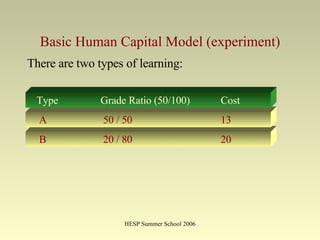
Basic Human Capital Model (experiment) There are two types of learning: B   20 / 80 20 A   50 / 50 13   Type   Grade Ratio (50/100) Cost
Basic Human Capital Model (experiment) Assumption 1.  During all year in the university a student can choice one of the two ways. Taking into account intellectual and physical abilities of each student, to them is accessible any from these ways: ineffective learning (A) effective learning (B) Working effectively, a student carries costs in size of 20 m.u. for all the learning time, during unproductive work – only 13 m.u. Assumption 2.   His or her future wages is the basic factor of student’s teaching efficiency at present.
Main Question What wages for graduating students must be at the receipt them on work after finishing of university, that during teaching their work was effective and corresponded to the way B or was ineffective and corresponded to the way A?
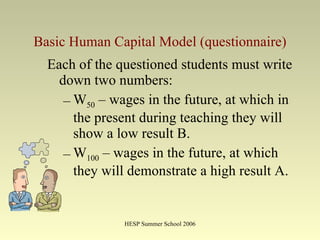
Basic Human Capital Model (questionnaire) Each of the questioned students must write down two numbers: W 50  – wages in the future, at which in the present during teaching they will show a low result B. W 100  – wages in the future, at which they will demonstrate a high result A.
Basic Human Capital Model (results) Nobody of students is going to be outlaid on teaching more than amount of the expected wages which each of them wrote down and chose independently. But half of students consider that for further work they need to adjust only minimum efforts A, although here they will lose in the future wages.
Incentives Structure There are 4 basic kinds of principal students incentives: Monetary incentives Research incentives Recognition incentives Teaching incentives
Incentives Structure (experiment) Formulate main question Formulate questionnaire Analyze results
Main Question Are there similarity between the preferred incentives of students and students perceptions of actual incentive structure?
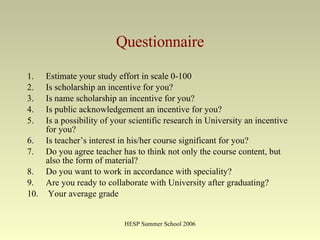
Questionnaire Estimate your study effort in scale  0-100  Is scholarship  an incentive for you ?  Is name scholarship  an incentive for you ?  Is  public acknowledgement  an incentive for you ?  Is  a possibility of your  scientific research in University an incentive for you ? Is teacher ’ s interest in his / her course significant for you? Do you agree teacher has to think not only the course content ,  but also the form of material?   Do you want to work in accordance with  speciality?  Are you ready to collaborate with University after  graduating?  Your average grade
Our Respondents (integration) DNU   64,00 87,47 ASU   76,28 85,50 AUCA   66,67 70,00   University   Effort Grade ONPU   82,00 90,00 KSU   64,75 87,47
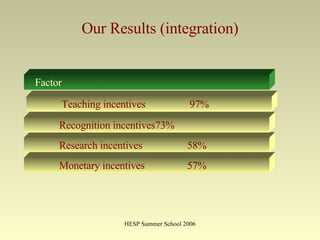
Our Results (integration) Research incentives 58%   Recognition incentives 73%   Monetary incentives 57%   Factor Teaching incentives   97%
Thanks for your attention!

Study Satisfaction for Students in Universities

  • 1.
    Study Satisfaction forStudents in Universities Natalia Ivanilova Vitaly Kobets Ludmila Konstants Vira Lyubchenko Vladimir Popov
  • 2.
    Effective learning inthe classroom depends on the teacher's ability… to maintain the interest that brought students to the course in the first place. Literature Review Ericksen S.C. The Lecture // Memo to the Faculty, no. 60. Ann Arbor: Centre for Research on Teaching and Learning, University of Michigan, 1978
  • 3.
    General Strategies Capitalizeon students' existing needs Make students active participants in learning Ask students to analyze what makes their classes more or less "motivating"
  • 4.
    Incorporating Instructional Behavioursthat Motivate Students Hold high but realistic expectations for your students. Help students set achievable goals for themselves. Tell students what they need to do to succeed in your course. Strengthen students' self-motivation. Avoid creating intense competition among students. Be enthusiastic about your subject.
  • 5.
    Basic Human CapitalModel (experiment) There are two types of learning: B 20 / 80 20 A 50 / 50 13 Type Grade Ratio (50/100) Cost
  • 6.
    Basic Human CapitalModel (experiment) Assumption 1. During all year in the university a student can choice one of the two ways. Taking into account intellectual and physical abilities of each student, to them is accessible any from these ways: ineffective learning (A) effective learning (B) Working effectively, a student carries costs in size of 20 m.u. for all the learning time, during unproductive work – only 13 m.u. Assumption 2. His or her future wages is the basic factor of student’s teaching efficiency at present.
  • 7.
    Main Question Whatwages for graduating students must be at the receipt them on work after finishing of university, that during teaching their work was effective and corresponded to the way B or was ineffective and corresponded to the way A?
  • 8.
    Basic Human CapitalModel (questionnaire) Each of the questioned students must write down two numbers: W 50 – wages in the future, at which in the present during teaching they will show a low result B. W 100 – wages in the future, at which they will demonstrate a high result A.
  • 9.
    Basic Human CapitalModel (results) Nobody of students is going to be outlaid on teaching more than amount of the expected wages which each of them wrote down and chose independently. But half of students consider that for further work they need to adjust only minimum efforts A, although here they will lose in the future wages.
  • 10.
    Incentives Structure Thereare 4 basic kinds of principal students incentives: Monetary incentives Research incentives Recognition incentives Teaching incentives
  • 11.
    Incentives Structure (experiment)Formulate main question Formulate questionnaire Analyze results
  • 12.
    Main Question Arethere similarity between the preferred incentives of students and students perceptions of actual incentive structure?
  • 13.
    Questionnaire Estimate yourstudy effort in scale 0-100 Is scholarship an incentive for you ? Is name scholarship an incentive for you ? Is public acknowledgement an incentive for you ? Is a possibility of your scientific research in University an incentive for you ? Is teacher ’ s interest in his / her course significant for you? Do you agree teacher has to think not only the course content , but also the form of material? Do you want to work in accordance with speciality? Are you ready to collaborate with University after graduating? Your average grade
  • 14.
    Our Respondents (integration)DNU 64,00 87,47 ASU 76,28 85,50 AUCA 66,67 70,00 University Effort Grade ONPU 82,00 90,00 KSU 64,75 87,47
  • 15.
    Our Results (integration)Research incentives 58% Recognition incentives 73% Monetary incentives 57% Factor Teaching incentives 97%
  • 16.
    Thanks for yourattention!