


CONTENTS:
History and Culture of China
Do and Don'ts in china
PreliminaryVisits
LanguageTraining
Practical assistance
Security Briefing
Introduction to
Cultural awarness of
China
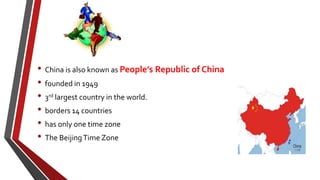
• China is also known as People’s Republic of China
• founded in 1949
• 3rd largest country in the world.
• borders 14 countries
• has only one time zone
• The BeijingTime Zone
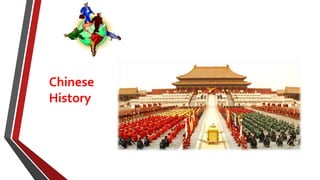
Chinese
History
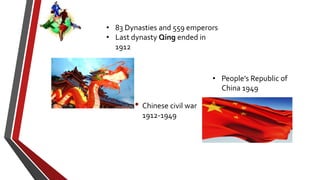
• Chinese civil war
1912-1949
• 83 Dynasties and 559 emperors
• Last dynasty Qing ended in
1912
• People’s Republic of
China 1949
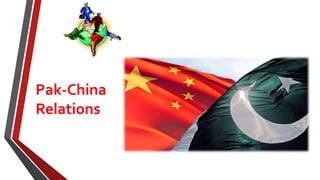
Pak-China
Relations
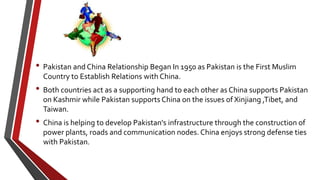
• Pakistan and China Relationship Began In 1950 as Pakistan is the First Muslim
Country to Establish Relations with China.
• Both countries act as a supporting hand to each other as China supports Pakistan
on Kashmir while Pakistan supports China on the issues of Xinjiang ,Tibet, and
Taiwan.
• China is helping to develop Pakistan's infrastructure through the construction of
power plants, roads and communication nodes. China enjoys strong defense ties
with Pakistan.
• In 2010, U.S questioned about Pak- China friendship, Pakistan's former President
Pervez Musharraf said china is "time- tested and all-weather friend, in return
Chinese president Hu Jintao referred Pakistan as "a good friend and partner
• On 8 November 2014, Pakistan and China signed 19 agreements particularly of
$42 billion relating China– Pakistan Economic Corridor (CPEC) 2015.
• Pak-China relation is not only on the political level but people of both the
countries share a deep and special bond.
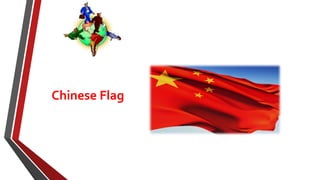
Chinese Flag
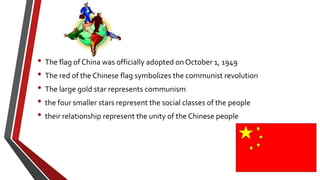
• The flag of China was officially adopted on October 1, 1949
• The red of the Chinese flag symbolizes the communist revolution
• The large gold star represents communism
• the four smaller stars represent the social classes of the people
• their relationship represent the unity of the Chinese people
Population
Facts
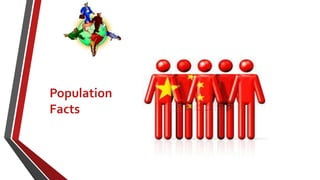
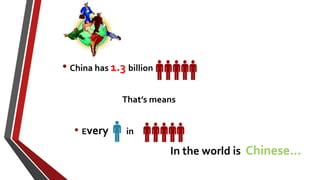
• China has 1.3 billion
That’s means
• Every in
In the world is Chinese…
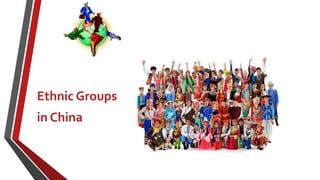
Ethnic Groups
in China
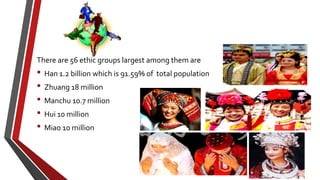
There are 56 ethic groups largest among them are
• Han 1.2 billion which is 91.59% of total population
• Zhuang 18 million
• Manchu 10.7 million
• Hui 10 million
• Miao 10 million
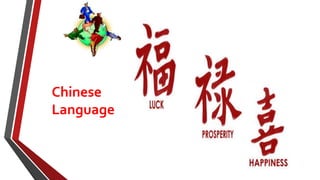
Chinese
Language
• There are seven major groups of dialects
• There are 50,000 Chinese characters
• The official national language of China is Pŭtōnghuà
• Mandarin is Chinese official spoken language
Chinese Food
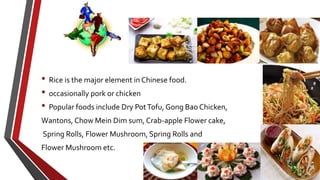
• Rice is the major element in Chinese food.
• occasionally pork or chicken
• Popular foods include Dry PotTofu, Gong Bao Chicken,
Wantons, Chow Mein Dim sum, Crab-apple Flower cake,
Spring Rolls, Flower Mushroom, Spring Rolls and
Flower Mushroom etc.
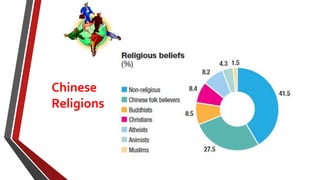
Chinese
Religions
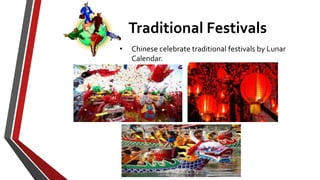
Traditional Festivals
• Chinese celebrate traditional festivals by Lunar
Calendar.
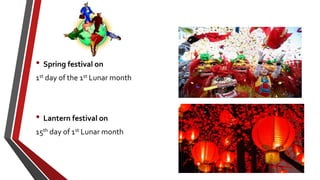
• Spring festival on
1st day of the 1st Lunar month
• Lantern festival on
15th day of 1st Lunar month
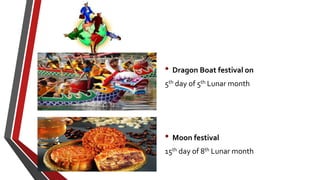
• Dragon Boat festival on
5th day of 5th Lunar month
• Moon festival
15th day of 8th Lunar month
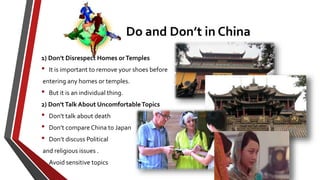
Do and Don’t in China
1) Don't Disrespect Homes orTemples
• It is important to remove your shoes before
entering any homes or temples.
• But it is an individual thing.
2) Don'tTalk About UncomfortableTopics
• Don't talk about death
• Don’t compare China to Japan
• Don’t discuss Political
and religious issues .
• Avoid sensitive topics
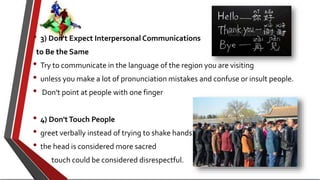
• 3) Don't Expect Interpersonal Communications
to Be the Same
• Try to communicate in the language of the region you are visiting
• unless you make a lot of pronunciation mistakes and confuse or insult people.
• Don't point at people with one finger
• 4) Don'tTouch People
• greet verbally instead of trying to shake hands.
• the head is considered more sacred
• touch could be considered disrespectful.
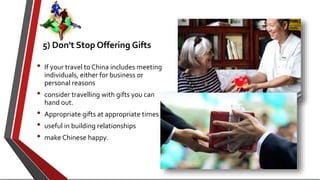
5) Don't Stop Offering Gifts
• If your travel to China includes meeting
individuals, either for business or
personal reasons
• consider travelling with gifts you can
hand out.
• Appropriate gifts at appropriate times
• useful in building relationships
• make Chinese happy.
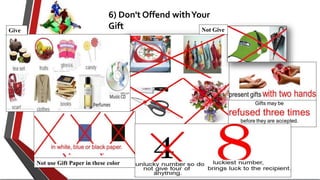
6) Don't Offend withYour
GiftGive Not Give
Not use Gift Paper in these color
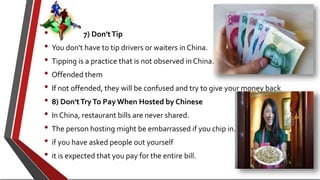
• 7) Don'tTip
• You don't have to tip drivers or waiters in China.
• Tipping is a practice that is not observed in China.
• Offended them
• If not offended, they will be confused and try to give your money back
• 8) Don'tTryTo Pay When Hosted by Chinese
• In China, restaurant bills are never shared.
• The person hosting might be embarrassed if you chip in.
• if you have asked people out yourself
• it is expected that you pay for the entire bill.
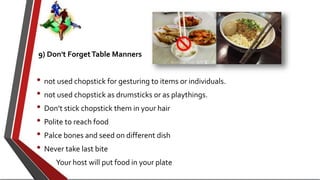
9) Don't ForgetTable Manners
• not used chopstick for gesturing to items or individuals.
• not used chopstick as drumsticks or as playthings.
• Don’t stick chopstick them in your hair
• Polite to reach food
• Palce bones and seed on different dish
• Never take last bite
• Your host will put food in your plate
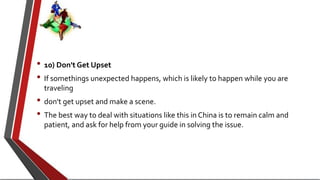
• 10) Don't Get Upset
• If somethings unexpected happens, which is likely to happen while you are
traveling
• don't get upset and make a scene.
• The best way to deal with situations like this in China is to remain calm and
patient, and ask for help from your guide in solving the issue.
• A well-planned trip for oversea candidate
and spouse that provide a preview and
allows them to assess their suitability for and
interest in the assignment.
• Experience host country business context.
• This trip is about a week and it was not a
'tourist' experience.
• Increase cultural awareness and decision
about housing and schooling.
PreliminaryVisit
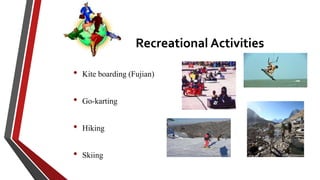
Recreational Activities
• Kite boarding (Fujian)
• Go-karting
• Hiking
• Skiing
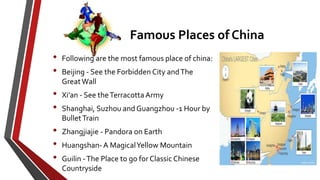
Famous Places of China
• Following are the most famous place of china:
• Beijing - See the Forbidden City andThe
GreatWall
• Xi’an - See theTerracotta Army
• Shanghai, Suzhou and Guangzhou -1 Hour by
BulletTrain
• Zhangjiajie - Pandora on Earth
• Huangshan- A MagicalYellow Mountain
• Guilin -The Place to go for Classic Chinese
Countryside
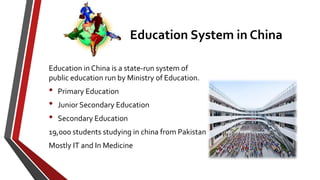
Education System in China
Education in China is a state-run system of
public education run by Ministry of Education.
• Primary Education
• Junior Secondary Education
• Secondary Education
19,000 students studying in china from Pakistan
Mostly IT and In Medicine
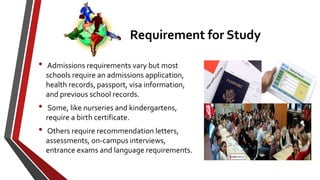
Requirement for Study
• Admissions requirements vary but most
schools require an admissions application,
health records, passport, visa information,
and previous school records.
• Some, like nurseries and kindergartens,
require a birth certificate.
• Others require recommendation letters,
assessments, on-campus interviews,
entrance exams and language requirements.
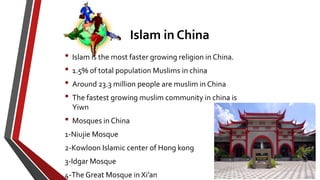
Islam in China
• Islam is the most faster growing religion in China.
• 1.5% of total population Muslims in china
• Around 23.3 million people are muslim in China
• The fastest growing muslim community in china is
Yiwn
• Mosques in China
1-Niujie Mosque
2-Kowloon Islamic center of Hong kong
3-Idgar Mosque
4-The Great Mosque in Xi’an
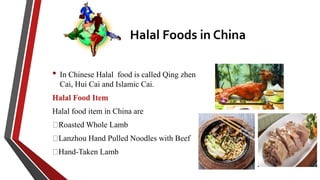
Halal Foods in China
• In Chinese Halal food is called Qing zhen
Cai, Hui Cai and Islamic Cai.
Halal Food Item
Halal food item in China are
Roasted Whole Lamb
Lanzhou Hand Pulled Noodles with Beef
Hand-Taken Lamb
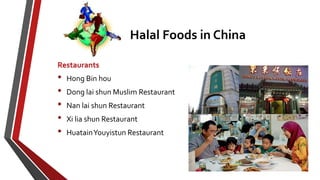
Halal Foods in China
Restaurants
• Hong Bin hou
• Dong lai shun Muslim Restaurant
• Nan lai shun Restaurant
• Xi lia shun Restaurant
• HuatainYouyistun Restaurant
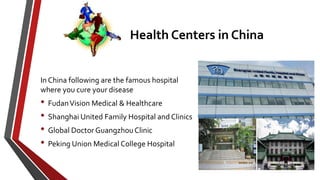
Health Centers in China
In China following are the famous hospital
where you cure your disease
• FudanVision Medical & Healthcare
• Shanghai United Family Hospital and Clinics
• Global Doctor GuangzhouClinic
• Peking Union Medical College Hospital
Expatriate should be accompanied by foreign language training because
knowledge of language of the host country is vital to successfully living and
working in that country. A language always carries an enormous amount of
culture it represents. If expatriate are proficient in the local language, the
potential for misunderstanding and misinterpretation is greatly reduce.
Language training conduct through offer different language courses. Different
instituations in Pakistan are offer to learn chinse language courses.
• TEVTA will train 15000 students in chinse language course
during the current year. 3 months duration course has been
started in the 5 cities of the province of the punjab.
Four-month executive course of chinese language is
also offered which is specially designed for the business
community
How to Conduct Language Training
• Pakistan Chinese institution
Two-month language course offer from this institutions.
OBJECTIVES
• To understand the construction of commonly used chinese characters and
learn to write them correctly
• To understand and used correctly basic chinese grammar and sentence
structures
How to Conduct Language Training
Online Chinese language course
• 1st level
Institution: Mandarin
Length of this course is 6 weeks and efforts 4 hours per week.
What you will learn from this course ?
• Basic spoken mandarin phrases and vocabulary for everyday life
• The importance of proper ‘tones’ in mandarin
• Greater insight into chinese culture and its influence on pop culture
How to Conduct Language Training
• 2nd level
Institution: Mandarin
Length of this course is 6 weeks and efforts 4 hours per week.
What you learn from this course ?
• Basic spoken mandarin phrases and vocabulary for everyday life
• Great insight into chinese culture
• The vocabulary differences between China &Tiwan
• Basic mandarin chinese grammar and sentence pattern.
How to Conduct Language Training
• National University of Modern Languages chinese
This institute offer the chinese short courses through
vedio based E-Learning program and also promoting
Education of chinese language and literature across Pakistan
How to Conduct Language Training
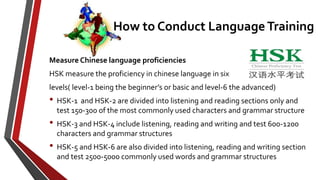
Measure Chinese language proficiencies
HSK measure the proficiency in chinese language in six
levels( level-1 being the beginner’s or basic and level-6 the advanced)
• HSK-1 and HSK-2 are divided into listening and reading sections only and
test 150-300 of the most commonly used characters and grammar structure
• HSK-3 and HSK-4 include listening, reading and writing and test 600-1200
characters and grammar structures
• HSK-5 and HSK-6 are also divided into listening, reading and writing section
and test 2500-5000 commonly used words and grammar structures
How to Conduct Language Training
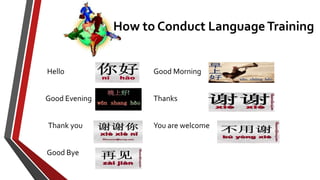
Hello Good Morning
Good Evening Thanks
Thank you You are welcome
Good Bye
How to Conduct Language Training
Expatriate face challenges in china due to language into internal versus
external corporate problems.
Internal problem
• communication upward with their local superiors and horizontally with local
peers
• communication downward with their local subordinates
Expatriate Challenges in China
External Problems
• Customers
• Suppliers
• Government agencies
• Distributers
Expatriate Challenges in China
• Take a language course as soon as you decide to relocate
• Find native speakers of that language in your current city and practice their
language with them
• Download online language applications to master the basics
• Try to watch a lot of local television programs, listen to the radio, and to the
native around you
• Try to speak as much as possible even if you are afraid of making mistake
Solutions of the Challenges
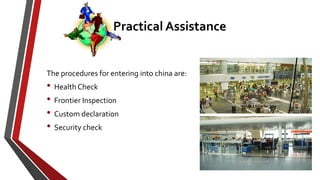
The procedures for entering into china are:
• Health Check
• Frontier Inspection
• Custom declaration
• Security check
Practical Assistance
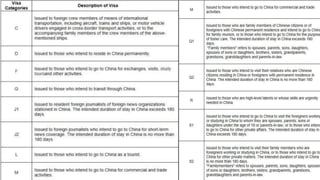
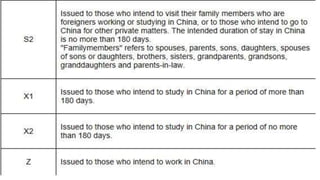
a visa is a permit granted before travelling to enter a country, usually for a fee.
There is considerable complexity as there are several types;
• It can be applied for in your own country, within mainland, or in a third
country;
• the rules vary according to your nationality,
• the regulations can be changed at any time.
Practical Assistance
Chinese Embassy Islamabad
Website: http://pk.chineseembassy.org
Email: chinaemb_pk@mfa.gov.cn
Ambassador: Mr. Liu Jian
Address: Ramina 4, Diplomatic Enclave, Islamabad, Pakistan
Office Hours: 8:30-12:00, 14:30-16:30 Monday-Friday
Consulate
1-Karachi
Website: http://karachi.china-consulate.org
Email: chinaconsul_khi_pk@mfa.gov.cn
Consul General: Mr. Zhang jianxin
Address: Plot No. ST.20, Block 4, Clifton Karachi, Pakistan
Office Hours: 09:00-12:30, 15:00-17:00, Monday-Friday
Chinese Consulate in Pakistan:
2-Lahore
Address: Canal Bank Rd, Lahore
Phone:0321 8647941
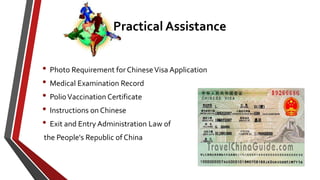
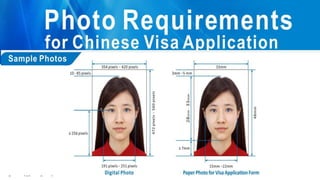
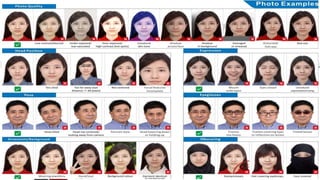
• Photo Requirement forChineseVisa Application
• Medical Examination Record
• PolioVaccination Certificate
• Instructions on Chinese
• Exit and Entry Administration Law of
the People's Republic of China
Practical Assistance
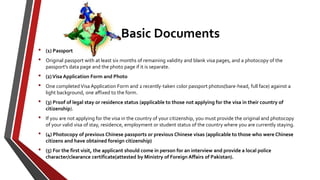
Basic Documents
• (1) Passport
• Original passport with at least six months of remaining validity and blank visa pages, and a photocopy of the
passport's data page and the photo page if it is separate.
• (2)Visa Application Form and Photo
• One completed Visa Application Form and 2 recently-taken color passport photos(bare-head, full face) against a
light background, one affixed to the form.
• (3) Proof of legal stay or residence status (applicable to those not applying for the visa in their country of
citizenship).
• If you are not applying for the visa in the country of your citizenship, you must provide the original and photocopy
of your valid visa of stay, residence, employment or student status of the country where you are currently staying.
• (4) Photocopy of previous Chinese passports or previous Chinese visas (applicable to those who were Chinese
citizens and have obtained foreign citizenship)
• (5) For the first visit, the applicant should come in person for an interview and provide a local police
character/clearance certificate(attested by Ministry of Foreign Affairs of Pakistan).
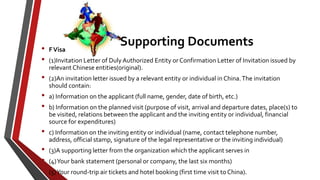
Supporting Documents• FVisa
• (1)Invitation Letter of Duly Authorized Entity or Confirmation Letter of Invitation issued by
relevant Chinese entities(original).
• (2)An invitation letter issued by a relevant entity or individual in China.The invitation
should contain:
• a) Information on the applicant (full name, gender, date of birth, etc.)
• b) Information on the planned visit (purpose of visit, arrival and departure dates, place(s) to
be visited, relations between the applicant and the inviting entity or individual, financial
source for expenditures)
• c) Information on the inviting entity or individual (name, contact telephone number,
address, official stamp, signature of the legal representative or the inviting individual)
• (3)A supporting letter from the organization which the applicant serves in
• (4)Your bank statement (personal or company, the last six months)
• (5)Your round-trip air tickets and hotel booking (first time visit to China).
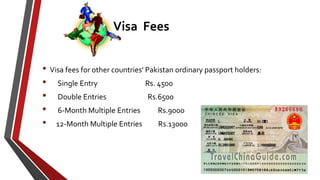
• Visa fees for other countries' Pakistan ordinary passport holders:
• Single Entry Rs. 4500
• Double Entries Rs.6500
• 6-Month Multiple Entries Rs.9000
• 12-Month Multiple Entries Rs.13000
Visa Fees
Travelers should follow certain security principles:
• Respect local police requirement
• may at times place foreign visitors under surveillance
• Foreign government officials, journalists, and business people with access to
advanced proprietary technology.
• it is illegal to exchange dollars for RNB except at banks, hotels, and official
exchange offices.
• Terrorism is rare in China.
Security Briefing
• Personal possessions in hotel rooms, including computers, used freely.
• Travellers are subject to host Nation laws.
• incidents of violence against foreigners, including sexual assaults,
have taken place.
• Taking photographs of anything without any security issue.
Security Briefing
To conclude we can say that sending expatriate to china:
• its opportunity for employees as china is growing to become highly industrialized
country.
• pre departure training is important for expatriate.
• Establishment of interaction between youth of both countries build good relationship.
• countries will continue to grow and will ensure strategic and economic development.
• This will be benefit our both countries and greatly contribute to the prosperity and
progress of the whole Asia.
Conclusion
Questions and answer session
Q1. what does Chinese flag represent?
Q2.Why to avoid giving white color gifts?
Q3.While eating where you should place
your chopsticks?
Q4.what are the study requirement in
china?
Q5.How to say “thank you” in Chinese?
Q6.Tell the procedures to enter into
china? Just name
Training expatriate for china

Training expatriate for china

  • 2.
    CONTENTS: History and Cultureof China Do and Don'ts in china PreliminaryVisits LanguageTraining Practical assistance Security Briefing
  • 3.
  • 4.
    • China isalso known as People’s Republic of China • founded in 1949 • 3rd largest country in the world. • borders 14 countries • has only one time zone • The BeijingTime Zone
  • 5.
  • 6.
    • Chinese civilwar 1912-1949 • 83 Dynasties and 559 emperors • Last dynasty Qing ended in 1912 • People’s Republic of China 1949
  • 7.
  • 8.
    • Pakistan andChina Relationship Began In 1950 as Pakistan is the First Muslim Country to Establish Relations with China. • Both countries act as a supporting hand to each other as China supports Pakistan on Kashmir while Pakistan supports China on the issues of Xinjiang ,Tibet, and Taiwan. • China is helping to develop Pakistan's infrastructure through the construction of power plants, roads and communication nodes. China enjoys strong defense ties with Pakistan.
  • 9.
    • In 2010,U.S questioned about Pak- China friendship, Pakistan's former President Pervez Musharraf said china is "time- tested and all-weather friend, in return Chinese president Hu Jintao referred Pakistan as "a good friend and partner • On 8 November 2014, Pakistan and China signed 19 agreements particularly of $42 billion relating China– Pakistan Economic Corridor (CPEC) 2015. • Pak-China relation is not only on the political level but people of both the countries share a deep and special bond.
  • 10.
  • 11.
    • The flagof China was officially adopted on October 1, 1949 • The red of the Chinese flag symbolizes the communist revolution • The large gold star represents communism • the four smaller stars represent the social classes of the people • their relationship represent the unity of the Chinese people
  • 12.
  • 13.
    • China has1.3 billion That’s means • Every in In the world is Chinese…
  • 14.
  • 15.
    There are 56ethic groups largest among them are • Han 1.2 billion which is 91.59% of total population • Zhuang 18 million • Manchu 10.7 million • Hui 10 million • Miao 10 million
  • 16.
  • 17.
    • There areseven major groups of dialects • There are 50,000 Chinese characters • The official national language of China is Pŭtōnghuà • Mandarin is Chinese official spoken language
  • 18.
  • 19.
    • Rice isthe major element in Chinese food. • occasionally pork or chicken • Popular foods include Dry PotTofu, Gong Bao Chicken, Wantons, Chow Mein Dim sum, Crab-apple Flower cake, Spring Rolls, Flower Mushroom, Spring Rolls and Flower Mushroom etc.
  • 20.
  • 21.
    Traditional Festivals • Chinesecelebrate traditional festivals by Lunar Calendar.
  • 22.
    • Spring festivalon 1st day of the 1st Lunar month • Lantern festival on 15th day of 1st Lunar month
  • 23.
    • Dragon Boatfestival on 5th day of 5th Lunar month • Moon festival 15th day of 8th Lunar month
  • 24.
    Do and Don’tin China 1) Don't Disrespect Homes orTemples • It is important to remove your shoes before entering any homes or temples. • But it is an individual thing. 2) Don'tTalk About UncomfortableTopics • Don't talk about death • Don’t compare China to Japan • Don’t discuss Political and religious issues . • Avoid sensitive topics
  • 25.
    • 3) Don'tExpect Interpersonal Communications to Be the Same • Try to communicate in the language of the region you are visiting • unless you make a lot of pronunciation mistakes and confuse or insult people. • Don't point at people with one finger • 4) Don'tTouch People • greet verbally instead of trying to shake hands. • the head is considered more sacred • touch could be considered disrespectful.
  • 26.
    5) Don't StopOffering Gifts • If your travel to China includes meeting individuals, either for business or personal reasons • consider travelling with gifts you can hand out. • Appropriate gifts at appropriate times • useful in building relationships • make Chinese happy.
  • 27.
    6) Don't OffendwithYour GiftGive Not Give Not use Gift Paper in these color
  • 28.
    • 7) Don'tTip •You don't have to tip drivers or waiters in China. • Tipping is a practice that is not observed in China. • Offended them • If not offended, they will be confused and try to give your money back • 8) Don'tTryTo Pay When Hosted by Chinese • In China, restaurant bills are never shared. • The person hosting might be embarrassed if you chip in. • if you have asked people out yourself • it is expected that you pay for the entire bill.
  • 29.
    9) Don't ForgetTableManners • not used chopstick for gesturing to items or individuals. • not used chopstick as drumsticks or as playthings. • Don’t stick chopstick them in your hair • Polite to reach food • Palce bones and seed on different dish • Never take last bite • Your host will put food in your plate
  • 30.
    • 10) Don'tGet Upset • If somethings unexpected happens, which is likely to happen while you are traveling • don't get upset and make a scene. • The best way to deal with situations like this in China is to remain calm and patient, and ask for help from your guide in solving the issue.
  • 31.
    • A well-plannedtrip for oversea candidate and spouse that provide a preview and allows them to assess their suitability for and interest in the assignment. • Experience host country business context. • This trip is about a week and it was not a 'tourist' experience. • Increase cultural awareness and decision about housing and schooling. PreliminaryVisit
  • 32.
    Recreational Activities • Kiteboarding (Fujian) • Go-karting • Hiking • Skiing
  • 33.
    Famous Places ofChina • Following are the most famous place of china: • Beijing - See the Forbidden City andThe GreatWall • Xi’an - See theTerracotta Army • Shanghai, Suzhou and Guangzhou -1 Hour by BulletTrain • Zhangjiajie - Pandora on Earth • Huangshan- A MagicalYellow Mountain • Guilin -The Place to go for Classic Chinese Countryside
  • 34.
    Education System inChina Education in China is a state-run system of public education run by Ministry of Education. • Primary Education • Junior Secondary Education • Secondary Education 19,000 students studying in china from Pakistan Mostly IT and In Medicine
  • 35.
    Requirement for Study •Admissions requirements vary but most schools require an admissions application, health records, passport, visa information, and previous school records. • Some, like nurseries and kindergartens, require a birth certificate. • Others require recommendation letters, assessments, on-campus interviews, entrance exams and language requirements.
  • 36.
    Islam in China •Islam is the most faster growing religion in China. • 1.5% of total population Muslims in china • Around 23.3 million people are muslim in China • The fastest growing muslim community in china is Yiwn • Mosques in China 1-Niujie Mosque 2-Kowloon Islamic center of Hong kong 3-Idgar Mosque 4-The Great Mosque in Xi’an
  • 37.
    Halal Foods inChina • In Chinese Halal food is called Qing zhen Cai, Hui Cai and Islamic Cai. Halal Food Item Halal food item in China are Roasted Whole Lamb Lanzhou Hand Pulled Noodles with Beef Hand-Taken Lamb
  • 38.
    Halal Foods inChina Restaurants • Hong Bin hou • Dong lai shun Muslim Restaurant • Nan lai shun Restaurant • Xi lia shun Restaurant • HuatainYouyistun Restaurant
  • 39.
    Health Centers inChina In China following are the famous hospital where you cure your disease • FudanVision Medical & Healthcare • Shanghai United Family Hospital and Clinics • Global Doctor GuangzhouClinic • Peking Union Medical College Hospital
  • 41.
    Expatriate should beaccompanied by foreign language training because knowledge of language of the host country is vital to successfully living and working in that country. A language always carries an enormous amount of culture it represents. If expatriate are proficient in the local language, the potential for misunderstanding and misinterpretation is greatly reduce.
  • 42.
    Language training conductthrough offer different language courses. Different instituations in Pakistan are offer to learn chinse language courses. • TEVTA will train 15000 students in chinse language course during the current year. 3 months duration course has been started in the 5 cities of the province of the punjab. Four-month executive course of chinese language is also offered which is specially designed for the business community How to Conduct Language Training
  • 43.
    • Pakistan Chineseinstitution Two-month language course offer from this institutions. OBJECTIVES • To understand the construction of commonly used chinese characters and learn to write them correctly • To understand and used correctly basic chinese grammar and sentence structures How to Conduct Language Training
  • 44.
    Online Chinese languagecourse • 1st level Institution: Mandarin Length of this course is 6 weeks and efforts 4 hours per week. What you will learn from this course ? • Basic spoken mandarin phrases and vocabulary for everyday life • The importance of proper ‘tones’ in mandarin • Greater insight into chinese culture and its influence on pop culture How to Conduct Language Training
  • 45.
    • 2nd level Institution:Mandarin Length of this course is 6 weeks and efforts 4 hours per week. What you learn from this course ? • Basic spoken mandarin phrases and vocabulary for everyday life • Great insight into chinese culture • The vocabulary differences between China &Tiwan • Basic mandarin chinese grammar and sentence pattern. How to Conduct Language Training
  • 46.
    • National Universityof Modern Languages chinese This institute offer the chinese short courses through vedio based E-Learning program and also promoting Education of chinese language and literature across Pakistan How to Conduct Language Training
  • 47.
    Measure Chinese languageproficiencies HSK measure the proficiency in chinese language in six levels( level-1 being the beginner’s or basic and level-6 the advanced) • HSK-1 and HSK-2 are divided into listening and reading sections only and test 150-300 of the most commonly used characters and grammar structure • HSK-3 and HSK-4 include listening, reading and writing and test 600-1200 characters and grammar structures • HSK-5 and HSK-6 are also divided into listening, reading and writing section and test 2500-5000 commonly used words and grammar structures How to Conduct Language Training
  • 48.
    Hello Good Morning GoodEvening Thanks Thank you You are welcome Good Bye How to Conduct Language Training
  • 49.
    Expatriate face challengesin china due to language into internal versus external corporate problems. Internal problem • communication upward with their local superiors and horizontally with local peers • communication downward with their local subordinates Expatriate Challenges in China
  • 50.
    External Problems • Customers •Suppliers • Government agencies • Distributers Expatriate Challenges in China
  • 51.
    • Take alanguage course as soon as you decide to relocate • Find native speakers of that language in your current city and practice their language with them • Download online language applications to master the basics • Try to watch a lot of local television programs, listen to the radio, and to the native around you • Try to speak as much as possible even if you are afraid of making mistake Solutions of the Challenges
  • 52.
    The procedures forentering into china are: • Health Check • Frontier Inspection • Custom declaration • Security check Practical Assistance
  • 53.
    a visa isa permit granted before travelling to enter a country, usually for a fee. There is considerable complexity as there are several types; • It can be applied for in your own country, within mainland, or in a third country; • the rules vary according to your nationality, • the regulations can be changed at any time. Practical Assistance
  • 54.
    Chinese Embassy Islamabad Website:http://pk.chineseembassy.org Email: chinaemb_pk@mfa.gov.cn Ambassador: Mr. Liu Jian Address: Ramina 4, Diplomatic Enclave, Islamabad, Pakistan Office Hours: 8:30-12:00, 14:30-16:30 Monday-Friday Consulate 1-Karachi Website: http://karachi.china-consulate.org Email: chinaconsul_khi_pk@mfa.gov.cn Consul General: Mr. Zhang jianxin Address: Plot No. ST.20, Block 4, Clifton Karachi, Pakistan Office Hours: 09:00-12:30, 15:00-17:00, Monday-Friday Chinese Consulate in Pakistan: 2-Lahore Address: Canal Bank Rd, Lahore Phone:0321 8647941
  • 55.
    • Photo RequirementforChineseVisa Application • Medical Examination Record • PolioVaccination Certificate • Instructions on Chinese • Exit and Entry Administration Law of the People's Republic of China Practical Assistance
  • 60.
    Basic Documents • (1)Passport • Original passport with at least six months of remaining validity and blank visa pages, and a photocopy of the passport's data page and the photo page if it is separate. • (2)Visa Application Form and Photo • One completed Visa Application Form and 2 recently-taken color passport photos(bare-head, full face) against a light background, one affixed to the form. • (3) Proof of legal stay or residence status (applicable to those not applying for the visa in their country of citizenship). • If you are not applying for the visa in the country of your citizenship, you must provide the original and photocopy of your valid visa of stay, residence, employment or student status of the country where you are currently staying. • (4) Photocopy of previous Chinese passports or previous Chinese visas (applicable to those who were Chinese citizens and have obtained foreign citizenship) • (5) For the first visit, the applicant should come in person for an interview and provide a local police character/clearance certificate(attested by Ministry of Foreign Affairs of Pakistan).
  • 61.
    Supporting Documents• FVisa •(1)Invitation Letter of Duly Authorized Entity or Confirmation Letter of Invitation issued by relevant Chinese entities(original). • (2)An invitation letter issued by a relevant entity or individual in China.The invitation should contain: • a) Information on the applicant (full name, gender, date of birth, etc.) • b) Information on the planned visit (purpose of visit, arrival and departure dates, place(s) to be visited, relations between the applicant and the inviting entity or individual, financial source for expenditures) • c) Information on the inviting entity or individual (name, contact telephone number, address, official stamp, signature of the legal representative or the inviting individual) • (3)A supporting letter from the organization which the applicant serves in • (4)Your bank statement (personal or company, the last six months) • (5)Your round-trip air tickets and hotel booking (first time visit to China).
  • 62.
    • Visa feesfor other countries' Pakistan ordinary passport holders: • Single Entry Rs. 4500 • Double Entries Rs.6500 • 6-Month Multiple Entries Rs.9000 • 12-Month Multiple Entries Rs.13000 Visa Fees
  • 63.
    Travelers should followcertain security principles: • Respect local police requirement • may at times place foreign visitors under surveillance • Foreign government officials, journalists, and business people with access to advanced proprietary technology. • it is illegal to exchange dollars for RNB except at banks, hotels, and official exchange offices. • Terrorism is rare in China. Security Briefing
  • 64.
    • Personal possessionsin hotel rooms, including computers, used freely. • Travellers are subject to host Nation laws. • incidents of violence against foreigners, including sexual assaults, have taken place. • Taking photographs of anything without any security issue. Security Briefing
  • 65.
    To conclude wecan say that sending expatriate to china: • its opportunity for employees as china is growing to become highly industrialized country. • pre departure training is important for expatriate. • Establishment of interaction between youth of both countries build good relationship. • countries will continue to grow and will ensure strategic and economic development. • This will be benefit our both countries and greatly contribute to the prosperity and progress of the whole Asia. Conclusion
  • 66.
    Questions and answersession Q1. what does Chinese flag represent? Q2.Why to avoid giving white color gifts? Q3.While eating where you should place your chopsticks? Q4.what are the study requirement in china? Q5.How to say “thank you” in Chinese? Q6.Tell the procedures to enter into china? Just name