International Journal of Managing Public Sector Information and Communication Technologies (IJMPICT)
Vol. 7, No. 2, June 2016
DOI : 10.5121/ijmpict.2016.7201 1
STUDENT VIEW ON WEB-BASED INTELLIGENT
TUTORING SYSTEMS ABOUT SUCCESS AND
RETENTION OF PHYSICS EDUCATION
Mustafa Erdemir1
, Şebnem İngeç Kandil2
, Abdulkadir Karacı3
1
Kastamonu University, Education Faculty, Kastamonu, Turkey
2
Gazi University, Education Faculty, Ankara, Turkey
3
Kastamonu University, Engineering and ArchitectureFaculty, Kastamonu, Turkey
ABSTRACT
Purpose of this research is to determine the students' point of view about web based intelligent tutoring
system's (WBITS) availability, effects on the success and contribution to learning about work, energy and
conservation of energy topics. The system will be evaluated on student's angle of view. Intelligence
tutoring system that used on the research is used only online by 21 Elementary School Math Teacher
candidate for 4 weeks on Physics I course. Public opinion poll that developed by the researchers have
used as a data gathering tool. Data gathered in this research has analyzed by descriptive statistical
method. Participant students have underlined that web based intelligent tutoring systems are effective on
physics courses. Mathematics teacher candidates have expressed their opinion that it is helpful to use the
WBITS because it is not depending on time and place, it has capability to serve lots of events and problem
solving possibility and it is helping to increase the education performance.
KEYWORDS
Web Based Intelligent Tutoring Systems, Physics Education, Remote Education and Student's Opinion
1. INTRODUCTION
Web based education defined as Internet based applications that aim to educate people in specific
purposes [1]. Internet have eliminated borders to get information and makes it possible to reach
any information on the earth by just a click [2]. Easy to use structure of the Internet makes it
easier to reach the information and also lets people to follow the news with different sources
easily. Ease of access to information have effects institutions structure and their functions, gives
opportunity to increase quality of education. Developments in Internet technologies provides
environment to develop new education environment. These developments make it necessary to
reconstruct existing education environment.
Web based learning mediums are attractive for education because of its advantages like ease of
information transfer, rich content,its independence to time and place, etc. For these reasons not
only educational institutions but also non-educational institutions are interested in web based
education methods.
1.2. Web Based Intelligence Tutoring Systems (WBITS)
Usage of web based courses by many people and its ability to provide flexible learning
environment are providing huge advantages [3]. Development of web and artificial neural
networks makes it easy to transfer information between student and teacher [4]. Web based
International Journal of Managing Public Sector Information and Communication Technologies (IJMPICT)
Vol. 7, No. 2, June 2016
2
intelligent tutoring system not only makes storage of the information environment friendly than
paper, it also provides ease of access and location free advantage to reach to it. While developing
web based intelligent tutoring systems, pedagogic data suitable for students and pedagogic
sequence of the courses are included. Web based courses adress both formal education and
informal education. WBITS provides individualized education. Individualized education
situations contribute to reaching of the educational goals. According to Wooddall, when
customized services and individualized approaches applied online, it increases the power of
tutoring [5].
1.3. Intelligence Tutoring Systems (ITS)
Purpose of the intelligent learning systems is to correct deficiencies and to provide easy,
permanent and quick learning. In order to make this, decision trees, neural networks, decision
networks etc techniques are being used. While computer supported learning systems provides
feedback as answers to the students, intelligent tutoring systems (ITS) provides answers related
to student's level of knowledge via interface with feedbacks [6]. ITS are seen as the education
systems of the future, and studies are being made in this area. In order to provide classroom-like
education, ITSs are succesfull compared to other systems [7]. Intelligent learning systems are
systems that try to act like teacher, adaptable to student's individual needs and teacher's behavior,
provides flexible teaching materials to student and also have one to one learning and feedback
properties [8]. Experiments on intelligent learning systems have positive outputs. Significant
effect magnitute in favor of intelligent learning systems has been found in researches which
compares classroom education and intelligent learning systems between 1997 and 2010 [9].
In intelligent learning systems, information are designed in knot pattern.Knots are connections
between simulators, articles, related links, pictures or videos. Hyper media bridge connections
makes it possible to link informations and different topics with different bridges, instead of
classic reading that uses articles as parts or knots [10].
1.4. Components of Intelligent Tutoring Systems
Intelligent learning systems consists four components [11].
1.4.1. Expert Module
Knowledge and behavior needs to be learned are in this component. Consist of construction of
knowledge forms with conceptual network and hierarchical structure. Units of information
consist of concepts and sectionsWhile developing information units, concepts and sections
should approved by experts [12].
1.4.2. Learning Module
Consist the best strategy about transfering information to students. Different strategies needed for
different subjects and different knowledge levels and education materials has to be considered
while developing this strategies.
1.4.3. User Interface Module
Provides control and communication between expert, student and learning modules.
Communication process between user and learning modules is provided by computers.
1.4.4. Student Model Module
[
Gathers information for pedagogic module while some student modules consist short term data
(only for a session) other modules stores and useslong term data. Short term data can be used for
momentary assistance. Long term data can be used for pedagogic actions and selecting best
International Journal of Managing Public Sector Information and Communication Technologies (IJMPICT)
Vol. 7, No. 2, June 2016
3
problems or topics for student. Short term data can be used for momentary assistance. Long term
data can be used for pedagogic actions and selecting best problems or topics for student [13].
1.5. Student Coating Module Used in Research
Coating student model consist differences between student and expert. It is the subject of
promise that two different knowledge is there. These are unknown subjects and minsunderstood
subjects. In this model, by comparing knowledge of the student with the knowledge of the
expert, student's knowledge is being tried to be taken under expert's knowledge. By this, what
student knows and what should student has to know is detected [14]. Purpose of this is to
eliminate missing or misunderstood information from students and helping them to reach the
expert knowledge.
2. METHOD
2.1. The Aim of the Study
The aim of the study is opinions of the mathematics teacher candidates' views on the WBITS
after they use the system in Physcs I course, with subjects work, energy and conservation of
energy. In the research, 21 students' views about the system has shown.
2.2. Limitations of Research
Research is limited to 21 students because it is not possible to reach all of the students who get
their lessons on WBITS. It is evaluated that it is better to rate answers with reasons why the
participants agree or not. But because of the conditions, only if they agree or not is taken into
evaluation. While developing the content of the research, links about shapes, events, examples,
problems, animations and hypermedia have used. Beside of these, rich mediums like course
videos and expert opinion videos could not prepared because of the limited facilities and lack of
workforce.
2.3. The Significance of the Study
Intelligent tutoring systems are seen as the education systems of the future. Researchers are being
made in the field, and usage of the ITS is increasing day by day. In this research, contributing to
physics education and in order to make physics education effective, it is underlined that
technology should be followed and its importance is also noticed. Contribution to the literate will
provide better physcs education usage.
2.4. Working Group
Working group of this research consist of 21 Elementary Mathematics Teacher Students who
took Physics I course in 2012-2013 academic year,
2.5. The Model of the Study
This research is a qualitive research, and it consist of 21 students and case study. In case study,
factors relating to a case (environment, individuals, processes, events etc.) are investigated and
reported with a holistic approach [15]. By using "TURKSOZ" developed by Karacı (2013) [16],
adaptable Intelligent Tutoring System and curriculum, work, energy and conservation of the
energy subjects have transferred to the system. Prepared content has been uploaded to
www.zekifizik.com. Id and passwords for students have created in order to let them login to the
system from this adress.In order to develop the content of the research, links about shapes,
events, examples, problems, animations and hypermedia have used.While creating the content,
the feedbacks of the remote education students in evaluating survey considered.
International Journal of Managing Public Sector Information and Communication Technologies (IJMPICT)
Vol. 7, No. 2, June 2016
4
2.6. Gathering Data
Opinions of the students who took Physics I course and studied work, energy and conservation of
energy subject have taken with the five Likert-type general opinion survey. Survey has prepared
as "Definitely Agree (5), Agree (4), Likely Agree (3), Disagree (2) and Definitely Disagree (1)".
In general opinion survey and experimental transaction process, effect on physics education of
ease of use of WBITS, remote tutoring and intelligence properties tried to be detected.
2.7. Analyzing the Data
Data gathered from general opinion survey have analyzed with descriptive analysis technique.
3. FINDINGS
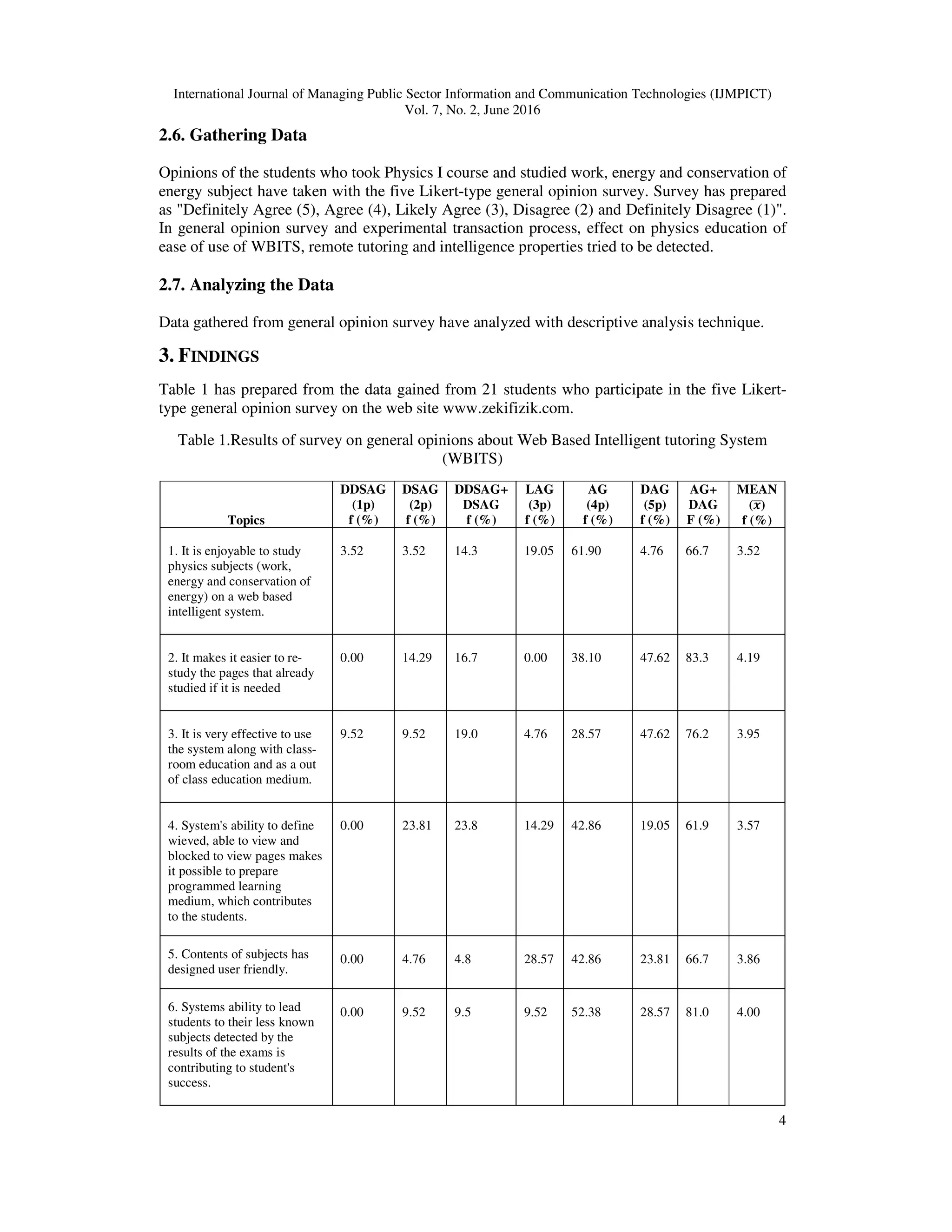
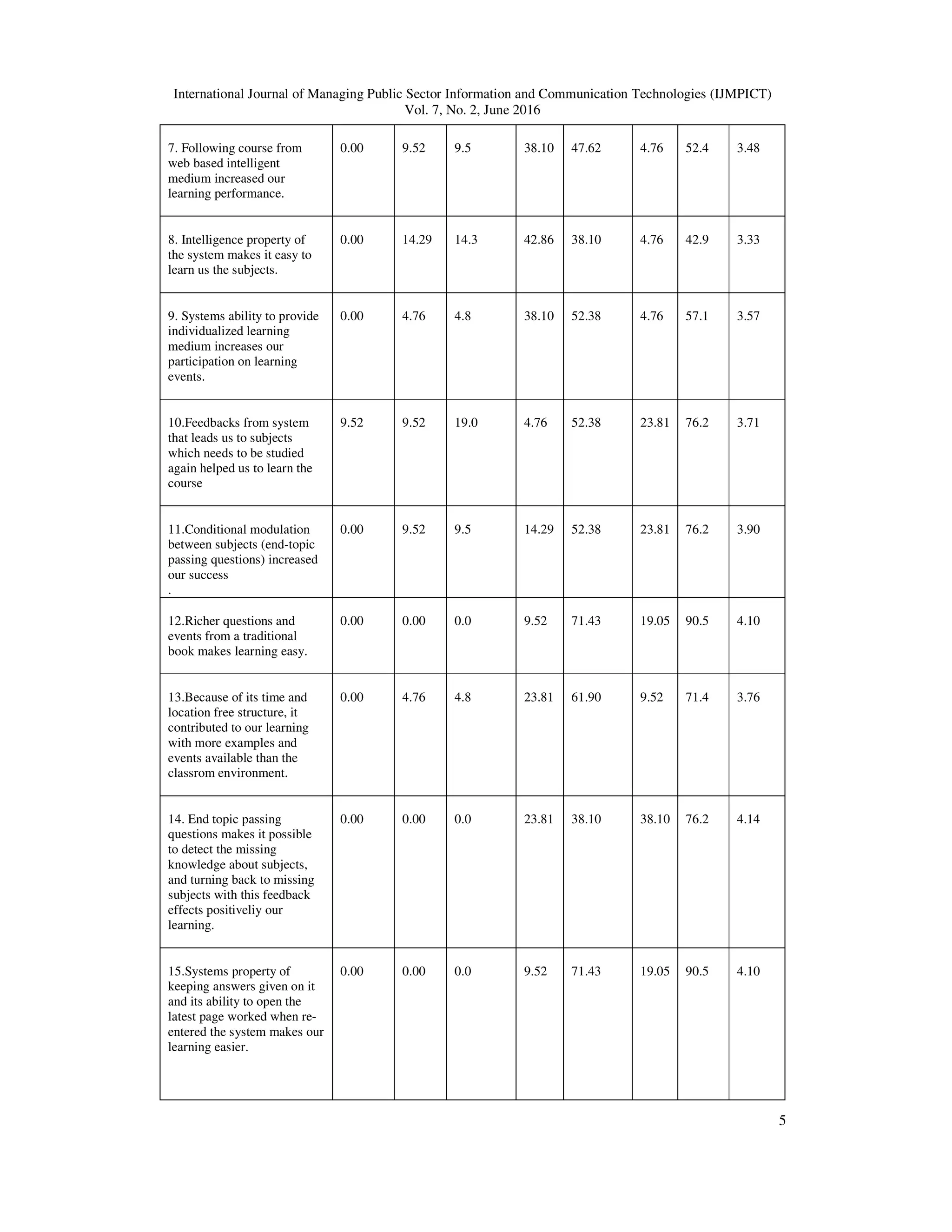
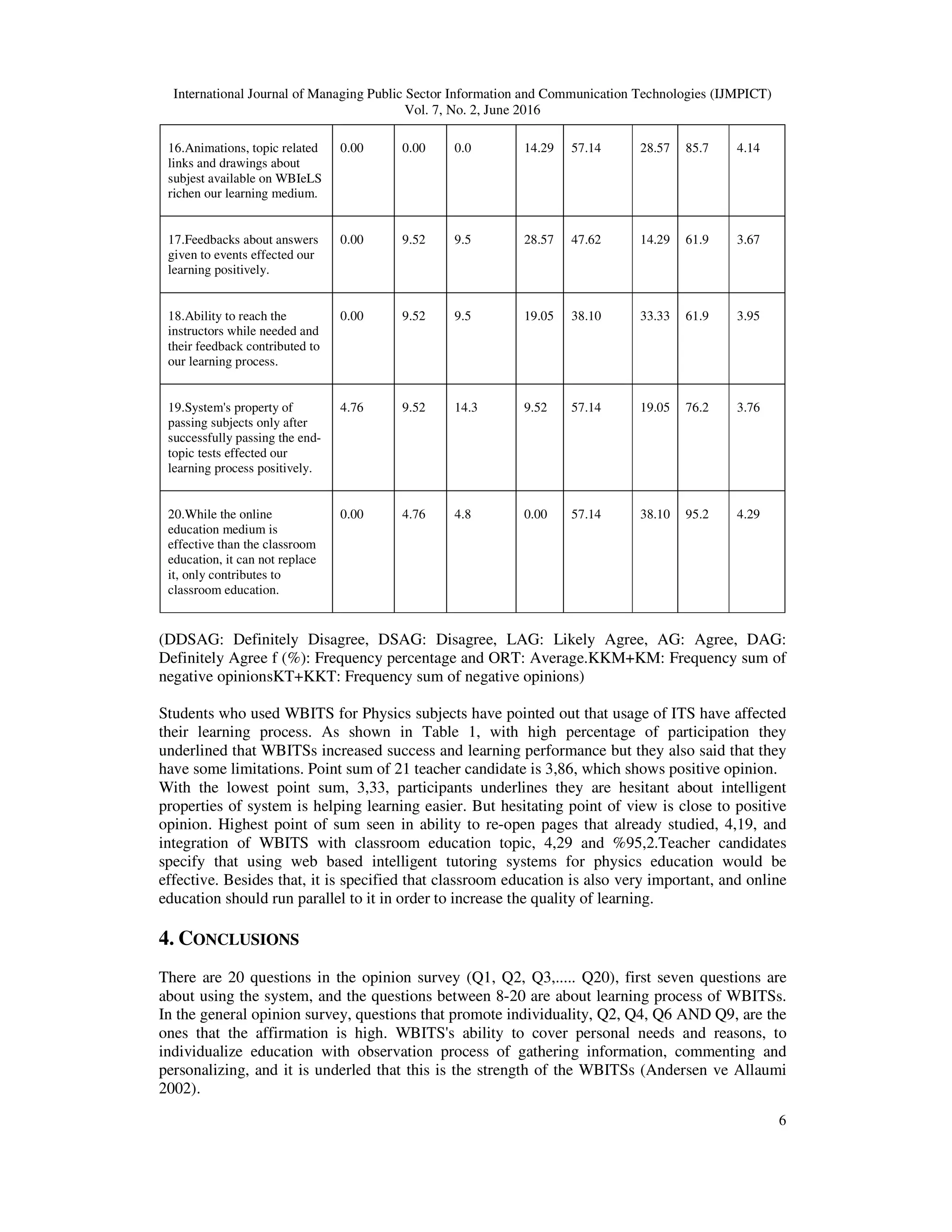
Table 1 has prepared from the data gained from 21 students who participate in the five Likert-
type general opinion survey on the web site www.zekifizik.com.
Table 1.Results of survey on general opinions about Web Based Intelligent tutoring System
(WBITS)
Topics
DDSAG
(1p)
f (%)
DSAG
(2p)
f (%)
DDSAG+
DSAG
f (%)
LAG
(3p)
f (%)
AG
(4p)
f (%)
DAG
(5p)
f (%)
AG+
DAG
F (%)
MEAN
(࢞ഥ)
f (%)
1. It is enjoyable to study
physics subjects (work,
energy and conservation of
energy) on a web based
intelligent system.
3.52 3.52 14.3 19.05 61.90 4.76 66.7 3.52
2. It makes it easier to re-
study the pages that already
studied if it is needed
0.00 14.29 16.7 0.00 38.10 47.62 83.3 4.19
3. It is very effective to use
the system along with class-
room education and as a out
of class education medium.
9.52 9.52 19.0 4.76 28.57 47.62 76.2 3.95
4. System's ability to define
wieved, able to view and
blocked to view pages makes
it possible to prepare
programmed learning
medium, which contributes
to the students.
0.00 23.81 23.8 14.29 42.86 19.05 61.9 3.57
5. Contents of subjects has
designed user friendly.
0.00 4.76 4.8 28.57 42.86 23.81 66.7 3.86
6. Systems ability to lead
students to their less known
subjects detected by the
results of the exams is
contributing to student's
success.
0.00 9.52 9.5 9.52 52.38 28.57 81.0 4.00
International Journal of Managing Public Sector Information and Communication Technologies (IJMPICT)
Vol. 7, No. 2, June 2016
5
7. Following course from
web based intelligent
medium increased our
learning performance.
0.00 9.52 9.5 38.10 47.62 4.76 52.4 3.48
8. Intelligence property of
the system makes it easy to
learn us the subjects.
0.00 14.29 14.3 42.86 38.10 4.76 42.9 3.33
9. Systems ability to provide
individualized learning
medium increases our
participation on learning
events.
0.00 4.76 4.8 38.10 52.38 4.76 57.1 3.57
10.Feedbacks from system
that leads us to subjects
which needs to be studied
again helped us to learn the
course
9.52 9.52 19.0 4.76 52.38 23.81 76.2 3.71
11.Conditional modulation
between subjects (end-topic
passing questions) increased
our success
.
0.00 9.52 9.5 14.29 52.38 23.81 76.2 3.90
12.Richer questions and
events from a traditional
book makes learning easy.
0.00 0.00 0.0 9.52 71.43 19.05 90.5 4.10
13.Because of its time and
location free structure, it
contributed to our learning
with more examples and
events available than the
classrom environment.
0.00 4.76 4.8 23.81 61.90 9.52 71.4 3.76
14. End topic passing
questions makes it possible
to detect the missing
knowledge about subjects,
and turning back to missing
subjects with this feedback
effects positiveliy our
learning.
0.00 0.00 0.0 23.81 38.10 38.10 76.2 4.14
15.Systems property of
keeping answers given on it
and its ability to open the
latest page worked when re-
entered the system makes our
learning easier.
0.00 0.00 0.0 9.52 71.43 19.05 90.5 4.10
International Journal of Managing Public Sector Information and Communication Technologies (IJMPICT)
Vol. 7, No. 2, June 2016
6
16.Animations, topic related
links and drawings about
subjest available on WBIeLS
richen our learning medium.
0.00 0.00 0.0 14.29 57.14 28.57 85.7 4.14
17.Feedbacks about answers
given to events effected our
learning positively.
0.00 9.52 9.5 28.57 47.62 14.29 61.9 3.67
18.Ability to reach the
instructors while needed and
their feedback contributed to
our learning process.
0.00 9.52 9.5 19.05 38.10 33.33 61.9 3.95
19.System's property of
passing subjects only after
successfully passing the end-
topic tests effected our
learning process positively.
4.76 9.52 14.3 9.52 57.14 19.05 76.2 3.76
20.While the online
education medium is
effective than the classroom
education, it can not replace
it, only contributes to
classroom education.
0.00 4.76 4.8 0.00 57.14 38.10 95.2 4.29
(DDSAG: Definitely Disagree, DSAG: Disagree, LAG: Likely Agree, AG: Agree, DAG:
Definitely Agree f (%): Frequency percentage and ORT: Average.KKM+KM: Frequency sum of
negative opinionsKT+KKT: Frequency sum of negative opinions)
Students who used WBITS for Physics subjects have pointed out that usage of ITS have affected
their learning process. As shown in Table 1, with high percentage of participation they
underlined that WBITSs increased success and learning performance but they also said that they
have some limitations. Point sum of 21 teacher candidate is 3,86, which shows positive opinion.
With the lowest point sum, 3,33, participants underlines they are hesitant about intelligent
properties of system is helping learning easier. But hesitating point of view is close to positive
opinion. Highest point of sum seen in ability to re-open pages that already studied, 4,19, and
integration of WBITS with classroom education topic, 4,29 and %95,2.Teacher candidates
specify that using web based intelligent tutoring systems for physics education would be
effective. Besides that, it is specified that classroom education is also very important, and online
education should run parallel to it in order to increase the quality of learning.
4. CONCLUSIONS
There are 20 questions in the opinion survey (Q1, Q2, Q3,..... Q20), first seven questions are
about using the system, and the questions between 8-20 are about learning process of WBITSs.
In the general opinion survey, questions that promote individuality, Q2, Q4, Q6 AND Q9, are the
ones that the affirmation is high. WBITS's ability to cover personal needs and reasons, to
individualize education with observation process of gathering information, commenting and
personalizing, and it is underled that this is the strength of the WBITSs (Andersen ve Allaumi
2002).
International Journal of Managing Public Sector Information and Communication Technologies (IJMPICT)
Vol. 7, No. 2, June 2016
7
Questions have positive results which underline the subject's visional aspects, Q7, Q8, Q16.
Concencus on the question Q17 with 4,14 sum shows that rich content is supporting learning and
WBITSs' visual substructure makes the learning process easier. This supports Jimoyiannis [17]
view on physics education is easier with animations and other visual objects in order to teach
concepts and correction of the misknowledge and also it makes easier to connect pre-existing
knowledge with the new ones.
Questions that contains basic features of the used WBITS, Q10, Q11, Q17, Q18 and Q19 got
positive answers from teacher candidates, which shows that WBITSs are seen as functional by
their basic featuresAlso, in Q1, Q3, Q5, Q12, Q15 and Q20, positive opinions have shown about
basic features. In Q3, teacher candidates shows that it is very effective to use the system along
with class-room education and as a out of class education medium with 3,95 average sum.
Candidates underlines that expanding learning process outside of the classroom to a wide aspect
is important. They emphasize that remote learning with web based courses may be used with a
lot of people and everybody can participate in learning processes where they want to, and this is
an advantage in educational processes [3].
Teacher candidates participated in general opinion survey have shown they have similar opinions
with the other researches from literature. It is important to integrate WBITS with classroom
education not only for students who could not participate in classroom lessons because of
different reasons, but also to support regular students follow and evaluate processes about the
course.
REFERENCES
[1] Devedzic. V. (2004). Education and the semantic web. International Journal of Artificial
Intelligence in Education 14, 39.
[2] Anderson, T., & Elloumi, F. (2002). Theory and practice of online learning. Athabasca University
Press.
[3] Brusilovsky, P., Eklund, J., & Schwarz, E. (1998). Web-based education for all: A tool for
developing adaptive courseware. Computer Networks and ISDN Systems, 30 (1-7), 291-300.
[4] Maria A. M. Souto, Regina Verdin, Karine Beschoren2, Renata Zanella3, Mariano Nicolao1,
Milton Madeira2, Rosa Maria Viccari1, José Palazzo M. de Oliveira. (2002). Web Adaptive
Training System based on Cognitive Student Style. IFIP World Computer Congress, 17th Edition,
2002, Montréal, Canada, August, 25-30.
[5] Woodall, D. (2001). Evaluating e-Learning Solutions Choosing the right e-Learning. solution for
your organization-NC:Smartforc. (http://www.internettime.com/itimegroup/woodall.htm)
[6] VanLehn, K. (2011). The relative effectiveness of human tutoring, Intelligent Tutoring Systems,
and other tutoring systems. Educational Psychologist,46, 197–221.
doi:10.1080/00461520.2011.611369.
[7] Doğan, N. & Kubat B. (2008). Akıllı öğretim sistemleri için yeni bir bileşen: düzenleyici modül
(A new component for intelligent tutoring systems: regulatory module). Journal of Information
Technology, 1(2), 5-9.
[8] Moungdridou, M., Virvou, M. (2003). Analysis and design of a web-based authoring tool
generating intelligent tutoring systems. Computer & Education, 40, p.158.
[9] Ma, W., Adesope, O. O., Nesbit, J. C., & Liu, Q. (2014). Intelligent Tutoring Systems and
Learning Outcomes: A Meta-Analysis. Journal of Educational Psychology. Advance online
publication. http://dx.doi.org/10.1037/a0037123.
[10] Mcknight, C., Dillon, A., ve Richardson, J. (1996). User-centered design of hypertext/hypermedia
for education. In David H. Jonassen (Ed.). Handbook of Research for Educational
Communications and Technology, p. 622-633.
[11] Woolf, B. (1992). AI in Education. Encyclopedia of Artificial Intelligence, (Ed. Shapiro, S.) New
York: John Wiley & Sons, Inc.
International Journal of Managing Public Sector Information and Communication Technologies (IJMPICT)
Vol. 7, No. 2, June 2016
8
[12] Yong, Z., Zhijing, L. (2003). A Model of web oriented intelligent tutoring system for distance
education. IEEE Proceedings of the Fifth International Conference on Computational Intelligence
and Multimedia Applications (ICCIMA’03), 78-83
[13] Suraweara, P. (2004). An intelligent teaching system for database modelling. MscThesis ,
Computer Science at the University of Canterbury, 9,10,15,16.
[14] Doğan, B. (2006). Zeki öğretim sistemlerinde veri madenciliği kullanılması (The use of data
mining in the intelligent teaching systems). Doctorial dissertation, Institute of Science and
Technology, Marmara University, İstanbul.
[15] Yıldırım, A., & Şimşek, H. (2008). Sosyal bilimlerde nitel araştırma yöntemleri (Qualitative
research methods in the social sciences), (6th Edition). Ankara: Seçkin.
[16] Karacı, A. (2013). Ses Sentezleme ve Tanıma Teknolojilerini Kullanarak Türkçenin Ana Dil
Olarak Öğretimi İçin Zeki Öğretim Sistemi Geliştirilmesi(Intelligent Tutoring Systems
Development for Sound Synthesis and Recognition Technologies using Turkish as the Native
Education). Doctorial dissertation, Institute of Informatics, Gazi University, Ankara.
[17] Jimoyiannis, A., Komis, V. (2001). Computer simulations in physic teaching and learning; a case
study on student understanding of trajectory motion. Computer and Education, 36, 185.

Student View on Web-Based Intelligent Tutoring Systems about Success and Retention of Physics Education

  • 1.
    International Journal ofManaging Public Sector Information and Communication Technologies (IJMPICT) Vol. 7, No. 2, June 2016 DOI : 10.5121/ijmpict.2016.7201 1 STUDENT VIEW ON WEB-BASED INTELLIGENT TUTORING SYSTEMS ABOUT SUCCESS AND RETENTION OF PHYSICS EDUCATION Mustafa Erdemir1 , Şebnem İngeç Kandil2 , Abdulkadir Karacı3 1 Kastamonu University, Education Faculty, Kastamonu, Turkey 2 Gazi University, Education Faculty, Ankara, Turkey 3 Kastamonu University, Engineering and ArchitectureFaculty, Kastamonu, Turkey ABSTRACT Purpose of this research is to determine the students' point of view about web based intelligent tutoring system's (WBITS) availability, effects on the success and contribution to learning about work, energy and conservation of energy topics. The system will be evaluated on student's angle of view. Intelligence tutoring system that used on the research is used only online by 21 Elementary School Math Teacher candidate for 4 weeks on Physics I course. Public opinion poll that developed by the researchers have used as a data gathering tool. Data gathered in this research has analyzed by descriptive statistical method. Participant students have underlined that web based intelligent tutoring systems are effective on physics courses. Mathematics teacher candidates have expressed their opinion that it is helpful to use the WBITS because it is not depending on time and place, it has capability to serve lots of events and problem solving possibility and it is helping to increase the education performance. KEYWORDS Web Based Intelligent Tutoring Systems, Physics Education, Remote Education and Student's Opinion 1. INTRODUCTION Web based education defined as Internet based applications that aim to educate people in specific purposes [1]. Internet have eliminated borders to get information and makes it possible to reach any information on the earth by just a click [2]. Easy to use structure of the Internet makes it easier to reach the information and also lets people to follow the news with different sources easily. Ease of access to information have effects institutions structure and their functions, gives opportunity to increase quality of education. Developments in Internet technologies provides environment to develop new education environment. These developments make it necessary to reconstruct existing education environment. Web based learning mediums are attractive for education because of its advantages like ease of information transfer, rich content,its independence to time and place, etc. For these reasons not only educational institutions but also non-educational institutions are interested in web based education methods. 1.2. Web Based Intelligence Tutoring Systems (WBITS) Usage of web based courses by many people and its ability to provide flexible learning environment are providing huge advantages [3]. Development of web and artificial neural networks makes it easy to transfer information between student and teacher [4]. Web based
  • 2.
    International Journal ofManaging Public Sector Information and Communication Technologies (IJMPICT) Vol. 7, No. 2, June 2016 2 intelligent tutoring system not only makes storage of the information environment friendly than paper, it also provides ease of access and location free advantage to reach to it. While developing web based intelligent tutoring systems, pedagogic data suitable for students and pedagogic sequence of the courses are included. Web based courses adress both formal education and informal education. WBITS provides individualized education. Individualized education situations contribute to reaching of the educational goals. According to Wooddall, when customized services and individualized approaches applied online, it increases the power of tutoring [5]. 1.3. Intelligence Tutoring Systems (ITS) Purpose of the intelligent learning systems is to correct deficiencies and to provide easy, permanent and quick learning. In order to make this, decision trees, neural networks, decision networks etc techniques are being used. While computer supported learning systems provides feedback as answers to the students, intelligent tutoring systems (ITS) provides answers related to student's level of knowledge via interface with feedbacks [6]. ITS are seen as the education systems of the future, and studies are being made in this area. In order to provide classroom-like education, ITSs are succesfull compared to other systems [7]. Intelligent learning systems are systems that try to act like teacher, adaptable to student's individual needs and teacher's behavior, provides flexible teaching materials to student and also have one to one learning and feedback properties [8]. Experiments on intelligent learning systems have positive outputs. Significant effect magnitute in favor of intelligent learning systems has been found in researches which compares classroom education and intelligent learning systems between 1997 and 2010 [9]. In intelligent learning systems, information are designed in knot pattern.Knots are connections between simulators, articles, related links, pictures or videos. Hyper media bridge connections makes it possible to link informations and different topics with different bridges, instead of classic reading that uses articles as parts or knots [10]. 1.4. Components of Intelligent Tutoring Systems Intelligent learning systems consists four components [11]. 1.4.1. Expert Module Knowledge and behavior needs to be learned are in this component. Consist of construction of knowledge forms with conceptual network and hierarchical structure. Units of information consist of concepts and sectionsWhile developing information units, concepts and sections should approved by experts [12]. 1.4.2. Learning Module Consist the best strategy about transfering information to students. Different strategies needed for different subjects and different knowledge levels and education materials has to be considered while developing this strategies. 1.4.3. User Interface Module Provides control and communication between expert, student and learning modules. Communication process between user and learning modules is provided by computers. 1.4.4. Student Model Module [ Gathers information for pedagogic module while some student modules consist short term data (only for a session) other modules stores and useslong term data. Short term data can be used for momentary assistance. Long term data can be used for pedagogic actions and selecting best
  • 3.
    International Journal ofManaging Public Sector Information and Communication Technologies (IJMPICT) Vol. 7, No. 2, June 2016 3 problems or topics for student. Short term data can be used for momentary assistance. Long term data can be used for pedagogic actions and selecting best problems or topics for student [13]. 1.5. Student Coating Module Used in Research Coating student model consist differences between student and expert. It is the subject of promise that two different knowledge is there. These are unknown subjects and minsunderstood subjects. In this model, by comparing knowledge of the student with the knowledge of the expert, student's knowledge is being tried to be taken under expert's knowledge. By this, what student knows and what should student has to know is detected [14]. Purpose of this is to eliminate missing or misunderstood information from students and helping them to reach the expert knowledge. 2. METHOD 2.1. The Aim of the Study The aim of the study is opinions of the mathematics teacher candidates' views on the WBITS after they use the system in Physcs I course, with subjects work, energy and conservation of energy. In the research, 21 students' views about the system has shown. 2.2. Limitations of Research Research is limited to 21 students because it is not possible to reach all of the students who get their lessons on WBITS. It is evaluated that it is better to rate answers with reasons why the participants agree or not. But because of the conditions, only if they agree or not is taken into evaluation. While developing the content of the research, links about shapes, events, examples, problems, animations and hypermedia have used. Beside of these, rich mediums like course videos and expert opinion videos could not prepared because of the limited facilities and lack of workforce. 2.3. The Significance of the Study Intelligent tutoring systems are seen as the education systems of the future. Researchers are being made in the field, and usage of the ITS is increasing day by day. In this research, contributing to physics education and in order to make physics education effective, it is underlined that technology should be followed and its importance is also noticed. Contribution to the literate will provide better physcs education usage. 2.4. Working Group Working group of this research consist of 21 Elementary Mathematics Teacher Students who took Physics I course in 2012-2013 academic year, 2.5. The Model of the Study This research is a qualitive research, and it consist of 21 students and case study. In case study, factors relating to a case (environment, individuals, processes, events etc.) are investigated and reported with a holistic approach [15]. By using "TURKSOZ" developed by Karacı (2013) [16], adaptable Intelligent Tutoring System and curriculum, work, energy and conservation of the energy subjects have transferred to the system. Prepared content has been uploaded to www.zekifizik.com. Id and passwords for students have created in order to let them login to the system from this adress.In order to develop the content of the research, links about shapes, events, examples, problems, animations and hypermedia have used.While creating the content, the feedbacks of the remote education students in evaluating survey considered.
  • 4.
    International Journal ofManaging Public Sector Information and Communication Technologies (IJMPICT) Vol. 7, No. 2, June 2016 4 2.6. Gathering Data Opinions of the students who took Physics I course and studied work, energy and conservation of energy subject have taken with the five Likert-type general opinion survey. Survey has prepared as "Definitely Agree (5), Agree (4), Likely Agree (3), Disagree (2) and Definitely Disagree (1)". In general opinion survey and experimental transaction process, effect on physics education of ease of use of WBITS, remote tutoring and intelligence properties tried to be detected. 2.7. Analyzing the Data Data gathered from general opinion survey have analyzed with descriptive analysis technique. 3. FINDINGS Table 1 has prepared from the data gained from 21 students who participate in the five Likert- type general opinion survey on the web site www.zekifizik.com. Table 1.Results of survey on general opinions about Web Based Intelligent tutoring System (WBITS) Topics DDSAG (1p) f (%) DSAG (2p) f (%) DDSAG+ DSAG f (%) LAG (3p) f (%) AG (4p) f (%) DAG (5p) f (%) AG+ DAG F (%) MEAN (࢞ഥ) f (%) 1. It is enjoyable to study physics subjects (work, energy and conservation of energy) on a web based intelligent system. 3.52 3.52 14.3 19.05 61.90 4.76 66.7 3.52 2. It makes it easier to re- study the pages that already studied if it is needed 0.00 14.29 16.7 0.00 38.10 47.62 83.3 4.19 3. It is very effective to use the system along with class- room education and as a out of class education medium. 9.52 9.52 19.0 4.76 28.57 47.62 76.2 3.95 4. System's ability to define wieved, able to view and blocked to view pages makes it possible to prepare programmed learning medium, which contributes to the students. 0.00 23.81 23.8 14.29 42.86 19.05 61.9 3.57 5. Contents of subjects has designed user friendly. 0.00 4.76 4.8 28.57 42.86 23.81 66.7 3.86 6. Systems ability to lead students to their less known subjects detected by the results of the exams is contributing to student's success. 0.00 9.52 9.5 9.52 52.38 28.57 81.0 4.00
  • 5.
    International Journal ofManaging Public Sector Information and Communication Technologies (IJMPICT) Vol. 7, No. 2, June 2016 5 7. Following course from web based intelligent medium increased our learning performance. 0.00 9.52 9.5 38.10 47.62 4.76 52.4 3.48 8. Intelligence property of the system makes it easy to learn us the subjects. 0.00 14.29 14.3 42.86 38.10 4.76 42.9 3.33 9. Systems ability to provide individualized learning medium increases our participation on learning events. 0.00 4.76 4.8 38.10 52.38 4.76 57.1 3.57 10.Feedbacks from system that leads us to subjects which needs to be studied again helped us to learn the course 9.52 9.52 19.0 4.76 52.38 23.81 76.2 3.71 11.Conditional modulation between subjects (end-topic passing questions) increased our success . 0.00 9.52 9.5 14.29 52.38 23.81 76.2 3.90 12.Richer questions and events from a traditional book makes learning easy. 0.00 0.00 0.0 9.52 71.43 19.05 90.5 4.10 13.Because of its time and location free structure, it contributed to our learning with more examples and events available than the classrom environment. 0.00 4.76 4.8 23.81 61.90 9.52 71.4 3.76 14. End topic passing questions makes it possible to detect the missing knowledge about subjects, and turning back to missing subjects with this feedback effects positiveliy our learning. 0.00 0.00 0.0 23.81 38.10 38.10 76.2 4.14 15.Systems property of keeping answers given on it and its ability to open the latest page worked when re- entered the system makes our learning easier. 0.00 0.00 0.0 9.52 71.43 19.05 90.5 4.10
  • 6.
    International Journal ofManaging Public Sector Information and Communication Technologies (IJMPICT) Vol. 7, No. 2, June 2016 6 16.Animations, topic related links and drawings about subjest available on WBIeLS richen our learning medium. 0.00 0.00 0.0 14.29 57.14 28.57 85.7 4.14 17.Feedbacks about answers given to events effected our learning positively. 0.00 9.52 9.5 28.57 47.62 14.29 61.9 3.67 18.Ability to reach the instructors while needed and their feedback contributed to our learning process. 0.00 9.52 9.5 19.05 38.10 33.33 61.9 3.95 19.System's property of passing subjects only after successfully passing the end- topic tests effected our learning process positively. 4.76 9.52 14.3 9.52 57.14 19.05 76.2 3.76 20.While the online education medium is effective than the classroom education, it can not replace it, only contributes to classroom education. 0.00 4.76 4.8 0.00 57.14 38.10 95.2 4.29 (DDSAG: Definitely Disagree, DSAG: Disagree, LAG: Likely Agree, AG: Agree, DAG: Definitely Agree f (%): Frequency percentage and ORT: Average.KKM+KM: Frequency sum of negative opinionsKT+KKT: Frequency sum of negative opinions) Students who used WBITS for Physics subjects have pointed out that usage of ITS have affected their learning process. As shown in Table 1, with high percentage of participation they underlined that WBITSs increased success and learning performance but they also said that they have some limitations. Point sum of 21 teacher candidate is 3,86, which shows positive opinion. With the lowest point sum, 3,33, participants underlines they are hesitant about intelligent properties of system is helping learning easier. But hesitating point of view is close to positive opinion. Highest point of sum seen in ability to re-open pages that already studied, 4,19, and integration of WBITS with classroom education topic, 4,29 and %95,2.Teacher candidates specify that using web based intelligent tutoring systems for physics education would be effective. Besides that, it is specified that classroom education is also very important, and online education should run parallel to it in order to increase the quality of learning. 4. CONCLUSIONS There are 20 questions in the opinion survey (Q1, Q2, Q3,..... Q20), first seven questions are about using the system, and the questions between 8-20 are about learning process of WBITSs. In the general opinion survey, questions that promote individuality, Q2, Q4, Q6 AND Q9, are the ones that the affirmation is high. WBITS's ability to cover personal needs and reasons, to individualize education with observation process of gathering information, commenting and personalizing, and it is underled that this is the strength of the WBITSs (Andersen ve Allaumi 2002).
  • 7.
    International Journal ofManaging Public Sector Information and Communication Technologies (IJMPICT) Vol. 7, No. 2, June 2016 7 Questions have positive results which underline the subject's visional aspects, Q7, Q8, Q16. Concencus on the question Q17 with 4,14 sum shows that rich content is supporting learning and WBITSs' visual substructure makes the learning process easier. This supports Jimoyiannis [17] view on physics education is easier with animations and other visual objects in order to teach concepts and correction of the misknowledge and also it makes easier to connect pre-existing knowledge with the new ones. Questions that contains basic features of the used WBITS, Q10, Q11, Q17, Q18 and Q19 got positive answers from teacher candidates, which shows that WBITSs are seen as functional by their basic featuresAlso, in Q1, Q3, Q5, Q12, Q15 and Q20, positive opinions have shown about basic features. In Q3, teacher candidates shows that it is very effective to use the system along with class-room education and as a out of class education medium with 3,95 average sum. Candidates underlines that expanding learning process outside of the classroom to a wide aspect is important. They emphasize that remote learning with web based courses may be used with a lot of people and everybody can participate in learning processes where they want to, and this is an advantage in educational processes [3]. Teacher candidates participated in general opinion survey have shown they have similar opinions with the other researches from literature. It is important to integrate WBITS with classroom education not only for students who could not participate in classroom lessons because of different reasons, but also to support regular students follow and evaluate processes about the course. REFERENCES [1] Devedzic. V. (2004). Education and the semantic web. International Journal of Artificial Intelligence in Education 14, 39. [2] Anderson, T., & Elloumi, F. (2002). Theory and practice of online learning. Athabasca University Press. [3] Brusilovsky, P., Eklund, J., & Schwarz, E. (1998). Web-based education for all: A tool for developing adaptive courseware. Computer Networks and ISDN Systems, 30 (1-7), 291-300. [4] Maria A. M. Souto, Regina Verdin, Karine Beschoren2, Renata Zanella3, Mariano Nicolao1, Milton Madeira2, Rosa Maria Viccari1, José Palazzo M. de Oliveira. (2002). Web Adaptive Training System based on Cognitive Student Style. IFIP World Computer Congress, 17th Edition, 2002, Montréal, Canada, August, 25-30. [5] Woodall, D. (2001). Evaluating e-Learning Solutions Choosing the right e-Learning. solution for your organization-NC:Smartforc. (http://www.internettime.com/itimegroup/woodall.htm) [6] VanLehn, K. (2011). The relative effectiveness of human tutoring, Intelligent Tutoring Systems, and other tutoring systems. Educational Psychologist,46, 197–221. doi:10.1080/00461520.2011.611369. [7] Doğan, N. & Kubat B. (2008). Akıllı öğretim sistemleri için yeni bir bileşen: düzenleyici modül (A new component for intelligent tutoring systems: regulatory module). Journal of Information Technology, 1(2), 5-9. [8] Moungdridou, M., Virvou, M. (2003). Analysis and design of a web-based authoring tool generating intelligent tutoring systems. Computer & Education, 40, p.158. [9] Ma, W., Adesope, O. O., Nesbit, J. C., & Liu, Q. (2014). Intelligent Tutoring Systems and Learning Outcomes: A Meta-Analysis. Journal of Educational Psychology. Advance online publication. http://dx.doi.org/10.1037/a0037123. [10] Mcknight, C., Dillon, A., ve Richardson, J. (1996). User-centered design of hypertext/hypermedia for education. In David H. Jonassen (Ed.). Handbook of Research for Educational Communications and Technology, p. 622-633. [11] Woolf, B. (1992). AI in Education. Encyclopedia of Artificial Intelligence, (Ed. Shapiro, S.) New York: John Wiley & Sons, Inc.
  • 8.
    International Journal ofManaging Public Sector Information and Communication Technologies (IJMPICT) Vol. 7, No. 2, June 2016 8 [12] Yong, Z., Zhijing, L. (2003). A Model of web oriented intelligent tutoring system for distance education. IEEE Proceedings of the Fifth International Conference on Computational Intelligence and Multimedia Applications (ICCIMA’03), 78-83 [13] Suraweara, P. (2004). An intelligent teaching system for database modelling. MscThesis , Computer Science at the University of Canterbury, 9,10,15,16. [14] Doğan, B. (2006). Zeki öğretim sistemlerinde veri madenciliği kullanılması (The use of data mining in the intelligent teaching systems). Doctorial dissertation, Institute of Science and Technology, Marmara University, İstanbul. [15] Yıldırım, A., & Şimşek, H. (2008). Sosyal bilimlerde nitel araştırma yöntemleri (Qualitative research methods in the social sciences), (6th Edition). Ankara: Seçkin. [16] Karacı, A. (2013). Ses Sentezleme ve Tanıma Teknolojilerini Kullanarak Türkçenin Ana Dil Olarak Öğretimi İçin Zeki Öğretim Sistemi Geliştirilmesi(Intelligent Tutoring Systems Development for Sound Synthesis and Recognition Technologies using Turkish as the Native Education). Doctorial dissertation, Institute of Informatics, Gazi University, Ankara. [17] Jimoyiannis, A., Komis, V. (2001). Computer simulations in physic teaching and learning; a case study on student understanding of trajectory motion. Computer and Education, 36, 185.