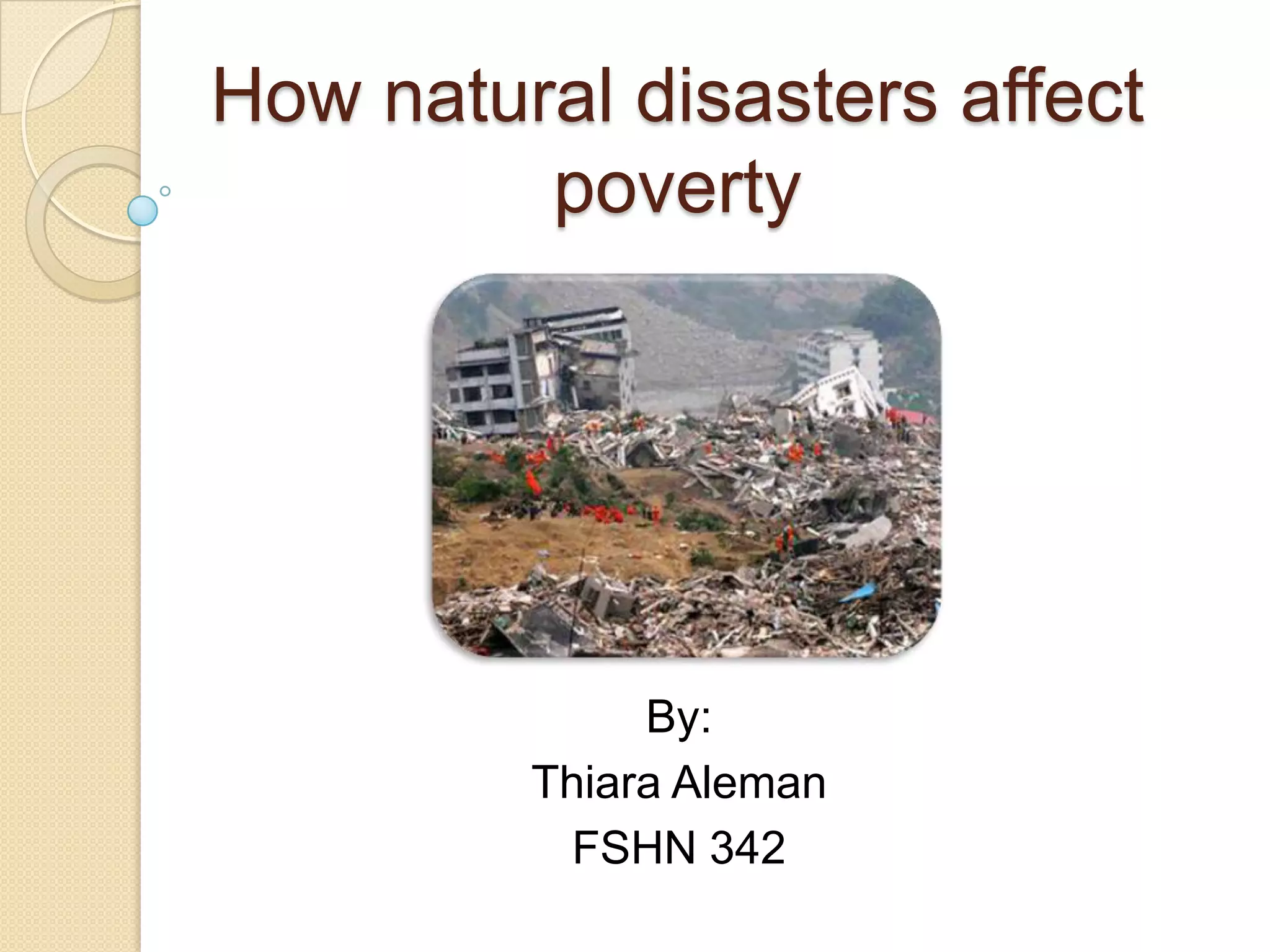
How natural disasters affect povertyBy:Thiara AlemanFSHN 342
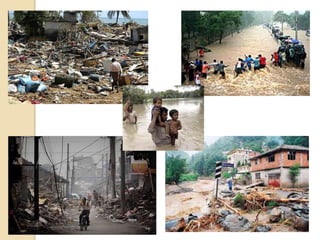
An overview of natural disasters…A natural disaster is the effect of a natural hazard that leads to financial, environmental and human losses.Types of natural disasters occurring worldwide:Earthquakes, tornadoes, volcanoes, droughts, floods, hurricanes, tsunamis, etc. The resulting losses depend on the vulnerability of the population, so “disasters occur when hazards meet vulnerability.”
Facts about disasters in developing countries…The poor are the most vulnerable to environmental disasters because:Live in areas with high risk to natural disasters and extreme weatherLive in poorly built shelter which is easily damagedLive in areas with few or no early warning programs for disastersHave few assets and a weak social safety net to help them battle with disasters and variable weather
Facts about disasters in developing countries…Over 90% of deaths caused by natural disasters are occurring in poor countries.More susceptible to diseasesThere are fewer doctors and health care programs near these areasAccess to clean water and toilet facilities is limited.The poor have more difficulty recoveringBecome vulnerable to diseasesCan’t afford to buy foodHave less money saved up if agriculture is destroyed
Facts about disasters in developing countries…From 1990 to 1998, 97 percent of deaths related to natural disasters were in developing countries.Millions have suffered from undernourishment or died of hunger during droughts and floodingAn average cost of natural disasters as a percentage of GDP is 20 percent higher in low-income countries than in rich industrialized countries.
Ethical Argument…Rights Theory:Protected privileges people deserveEvery person that has an opportunity to live has a right to benefit from the worlds resources; water, food and shelter.Developed countries should come together and provide aid for the affected countries that need it the most.
Ethical Argument…Justice:Fairness and equality of treatmentDeveloping countries deserve to be treated like other wealthy countries when they are going through a natural disaster. If its possible for a developed country to stand up from a disaster, developing countries deserve to be able to do the same.With equality of treatment, effects of poverty in developing countries can be reduced.
Ethical Argument…Beneficence:Do good and help othersBy helping the ones that most need it we can be able to reduce and improve the effects of natural disasters throughout the poorest countries.Undernourishment HungerDeaths
References…Scholarly ReferencesKreimer, A and Arnold, M. 2000. Managing Disaster Risk in Emerging Economies. Disaster Risk Management Series No. 2. pp. 55-61. Available at: http://www.google.com/books?hl=es&lr=&id=hLwtSetlKZYC&oi=fnd&pg=PA55&dq=natural+disasters+affect+poverty&ots=7_PJRlltNG&sig=2bsUi8D8YRshgpIdkS8KyeMbAxQ#v=onepage&q=natural%20disasters%20affect%20poverty&f=false. Accessed July 4, 2011.Anderson, M. Which costs more: prevention or recovery? pp. 1-11. Available at: http://desastres.unanleon.edu.ni/pdf/2002/agosto/pdf/eng/doc4715/doc4715-contenido.pdf. Accessed July 3, 2011. Other resourcesEPT (Environment and Poverty Times). Natural Disasters, “ at the whim of nature”. Retrieved July 5, 2011. http://www.grida.no/files/publications/environment-times/poverty%20No1%20-%20page12.pdf

Student presentation

  • 1.
    How natural disastersaffect povertyBy:Thiara AlemanFSHN 342
  • 2.
    An overview ofnatural disasters…A natural disaster is the effect of a natural hazard that leads to financial, environmental and human losses.Types of natural disasters occurring worldwide:Earthquakes, tornadoes, volcanoes, droughts, floods, hurricanes, tsunamis, etc. The resulting losses depend on the vulnerability of the population, so “disasters occur when hazards meet vulnerability.”
  • 4.
    Facts about disastersin developing countries…The poor are the most vulnerable to environmental disasters because:Live in areas with high risk to natural disasters and extreme weatherLive in poorly built shelter which is easily damagedLive in areas with few or no early warning programs for disastersHave few assets and a weak social safety net to help them battle with disasters and variable weather
  • 5.
    Facts about disastersin developing countries…Over 90% of deaths caused by natural disasters are occurring in poor countries.More susceptible to diseasesThere are fewer doctors and health care programs near these areasAccess to clean water and toilet facilities is limited.The poor have more difficulty recoveringBecome vulnerable to diseasesCan’t afford to buy foodHave less money saved up if agriculture is destroyed
  • 6.
    Facts about disastersin developing countries…From 1990 to 1998, 97 percent of deaths related to natural disasters were in developing countries.Millions have suffered from undernourishment or died of hunger during droughts and floodingAn average cost of natural disasters as a percentage of GDP is 20 percent higher in low-income countries than in rich industrialized countries.
  • 7.
    Ethical Argument…Rights Theory:Protectedprivileges people deserveEvery person that has an opportunity to live has a right to benefit from the worlds resources; water, food and shelter.Developed countries should come together and provide aid for the affected countries that need it the most.
  • 8.
    Ethical Argument…Justice:Fairness andequality of treatmentDeveloping countries deserve to be treated like other wealthy countries when they are going through a natural disaster. If its possible for a developed country to stand up from a disaster, developing countries deserve to be able to do the same.With equality of treatment, effects of poverty in developing countries can be reduced.
  • 9.
    Ethical Argument…Beneficence:Do goodand help othersBy helping the ones that most need it we can be able to reduce and improve the effects of natural disasters throughout the poorest countries.Undernourishment HungerDeaths
  • 10.
    References…Scholarly ReferencesKreimer, Aand Arnold, M. 2000. Managing Disaster Risk in Emerging Economies. Disaster Risk Management Series No. 2. pp. 55-61. Available at: http://www.google.com/books?hl=es&lr=&id=hLwtSetlKZYC&oi=fnd&pg=PA55&dq=natural+disasters+affect+poverty&ots=7_PJRlltNG&sig=2bsUi8D8YRshgpIdkS8KyeMbAxQ#v=onepage&q=natural%20disasters%20affect%20poverty&f=false. Accessed July 4, 2011.Anderson, M. Which costs more: prevention or recovery? pp. 1-11. Available at: http://desastres.unanleon.edu.ni/pdf/2002/agosto/pdf/eng/doc4715/doc4715-contenido.pdf. Accessed July 3, 2011. Other resourcesEPT (Environment and Poverty Times). Natural Disasters, “ at the whim of nature”. Retrieved July 5, 2011. http://www.grida.no/files/publications/environment-times/poverty%20No1%20-%20page12.pdf