Student Employment
Etiquette
Webster University Center Staff Online
Training
Introduction
If you practice proper etiquette, you are less likely to offend and/or annoy
people. While many people think etiquette is only about table manners in
fancy restaurants, it is simply the expected behavior that shows respect, which
is meant to make everyone feel comfortable.
In this training, you will be taught three proper etiquette skill sets:
1. Understanding your supervisor’s expectations
2. What to do and what not to do as a student employee
3. How to incorporate positive work habits
Section 1: Supervisor Expectations
Supervisor Expectations
1. Show up on time
Arriving early is on time, while being on time is late. You want to aim to be
in at least 5-10 minutes before your scheduled shift. That is to account for
going to the restroom and getting your things settled in and clocking in.
Always remember to clock in! You should be working once your shift begins.
2. Respect your work environment
It’s as simple as keeping your work area clean and respecting the office
resources (copier, printer, pens, etc.) This attention to cleanliness extends to
all the spaces in the building.
Supervisor Expectations
3. Attitude is everything
People who are energetic and interested are the most sought after in any
work environment. People who are like this sustain a positive, friendly
mindset while at work and leave personal matters at home. This allows the
work environment to flow smoothly and ensures that each team member is
ready for work.
4. Demonstrate initiative and willingness to work and learn
This may seem basic, but in actuality, it can be hard to exercise. Having
flexibility in your schedule, taking on extra tasks, and asking lots of questions
are all ways you could demonstrate any of these traits.
Supervisor Expectations
5. Perform assigned tasks
While at work, you are there to work. Which means completing all
assigned tasks to your best ability and in a timely manner. You want to do this
before working on personal work/activities. It is the standard that if/when you
complete any assigned tasks that you go to your supervisor for another task.
6. Talk with your supervisor
It is important to maintain an open and clear communication flow
between you and your supervisor, whether it be to discuss schedule
changes/concerns or any work issues. There are many available
communication platforms to utilize.
Supervisor Expectations
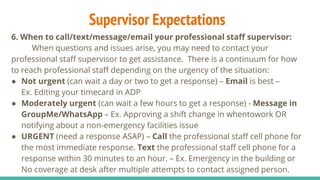
6. When to call/text/message/email your professional staff supervisor:
When questions and issues arise, you may need to contact your
professional staff supervisor to get assistance. There is a continuum for how
to reach professional staff depending on the urgency of the situation:
● Not urgent (can wait a day or two to get a response) – Email is best –
Ex. Editing your timecard in ADP
● Moderately urgent (can wait a few hours to get a response) - Message in
GroupMe/WhatsApp – Ex. Approving a shift change in whentowork OR
notifying about a non-emergency facilities issue
● URGENT (need a response ASAP) – Call the professional staff cell phone for
the most immediate response. Text the professional staff cell phone for a
response within 30 minutes to an hour. – Ex. Emergency in the building or
No coverage at desk after multiple attempts to contact assigned person.
Section 2: Workplace Dos and Don’ts
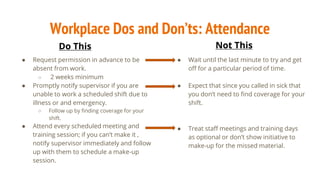
Workplace Dos and Don’ts: Attendance
● Request permission in advance to be
absent from work.
○ 2 weeks minimum
● Promptly notify supervisor if you are
unable to work a scheduled shift due to
illness or and emergency.
○ Follow up by finding coverage for your
shift.
● Attend every scheduled meeting and
training session; if you can’t make it ,
notify supervisor immediately and follow
up with them to schedule a make-up
session.
● Wait until the last minute to try and get
off for a particular period of time.
● Expect that since you called in sick that
you don’t need to find coverage for your
shift.
● Treat staff meetings and training days
as optional or don’t show initiative to
make-up for the missed material.
Do This Not This
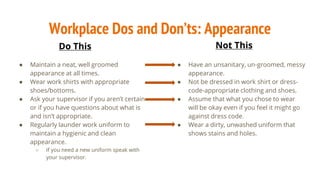
Workplace Dos and Don’ts: Appearance
● Maintain a neat, well groomed
appearance at all times.
● Wear work shirts with appropriate
shoes/bottoms.
● Ask your supervisor if you aren’t certain
or if you have questions about what is
and isn’t appropriate.
● Regularly launder work uniform to
maintain a hygienic and clean
appearance.
○ If you need a new uniform speak with
your supervisor.
● Have an unsanitary, un-groomed, messy
appearance.
● Not be dressed in work shirt or dress-
code-appropriate clothing and shoes.
● Assume that what you chose to wear
will be okay even if you feel it might go
against dress code.
● Wear a dirty, unwashed uniform that
shows stains and holes.
Do This Not This
Workplace Dos and Don’ts: Timeliness
● Arrive 5-10 minutes BEFORE your
scheduled shift to allow enough time to
get settled in and clocked in.
● Be prepared and ready to work the
minute your shift begins.
● Respect your colleagues time and
always plan for appropriate travel time
to work.
● Arrive late or at the time that your
schedule begins with no sense of
urgency to begin working promptly.
● Arrive to work without proper
attire/uniform making on-shift person
wait to leave past their scheduled time.
● Poor management of personal time
resulting in consistent tardiness to
scheduled shifts/ meetings.
Do This Not This
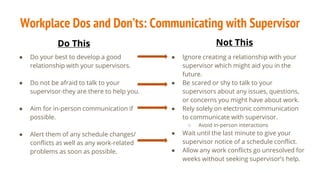
Workplace Dos and Don’ts: Communicating with Supervisor
● Do your best to develop a good
relationship with your supervisors.
● Do not be afraid to talk to your
supervisor-they are there to help you.
● Aim for in-person communication if
possible.
● Alert them of any schedule changes/
conflicts as well as any work-related
problems as soon as possible.
● Ignore creating a relationship with your
supervisor which might aid you in the
future.
● Be scared or shy to talk to your
supervisors about any issues, questions,
or concerns you might have about work.
● Rely solely on electronic communication
to communicate with supervisor.
○ Avoid in-person interactions
● Wait until the last minute to give your
supervisor notice of a schedule conflict.
● Allow any work conflicts go unresolved for
weeks without seeking supervisor’s help.
Do This Not This
Section 3: Development of Positive Work Habits
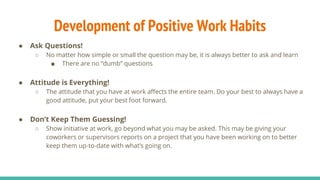
Development of Positive Work Habits
● Ask Questions!
○ No matter how simple or small the question may be, it is always better to ask and learn
■ There are no “dumb” questions
● Attitude is Everything!
○ The attitude that you have at work affects the entire team. Do your best to always have a
good attitude, put your best foot forward.
● Don’t Keep Them Guessing!
○ Show initiative at work, go beyond what you may be asked. This may be giving your
coworkers or supervisors reports on a project that you have been working on to better
keep them up-to-date with what’s going on.
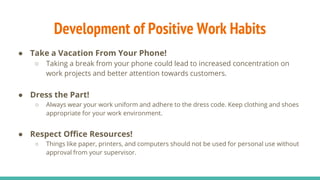
Development of Positive Work Habits
● Take a Vacation From Your Phone!
○ Taking a break from your phone could lead to increased concentration on
work projects and better attention towards customers.
● Dress the Part!
○ Always wear your work uniform and adhere to the dress code. Keep clothing and shoes
appropriate for your work environment.
● Respect Office Resources!
○ Things like paper, printers, and computers should not be used for personal use without
approval from your supervisor.

Student employment etiquette presentation

  • 1.
  • 2.
    Introduction If you practiceproper etiquette, you are less likely to offend and/or annoy people. While many people think etiquette is only about table manners in fancy restaurants, it is simply the expected behavior that shows respect, which is meant to make everyone feel comfortable. In this training, you will be taught three proper etiquette skill sets: 1. Understanding your supervisor’s expectations 2. What to do and what not to do as a student employee 3. How to incorporate positive work habits
  • 3.
  • 4.
    Supervisor Expectations 1. Showup on time Arriving early is on time, while being on time is late. You want to aim to be in at least 5-10 minutes before your scheduled shift. That is to account for going to the restroom and getting your things settled in and clocking in. Always remember to clock in! You should be working once your shift begins. 2. Respect your work environment It’s as simple as keeping your work area clean and respecting the office resources (copier, printer, pens, etc.) This attention to cleanliness extends to all the spaces in the building.
  • 5.
    Supervisor Expectations 3. Attitudeis everything People who are energetic and interested are the most sought after in any work environment. People who are like this sustain a positive, friendly mindset while at work and leave personal matters at home. This allows the work environment to flow smoothly and ensures that each team member is ready for work. 4. Demonstrate initiative and willingness to work and learn This may seem basic, but in actuality, it can be hard to exercise. Having flexibility in your schedule, taking on extra tasks, and asking lots of questions are all ways you could demonstrate any of these traits.
  • 6.
    Supervisor Expectations 5. Performassigned tasks While at work, you are there to work. Which means completing all assigned tasks to your best ability and in a timely manner. You want to do this before working on personal work/activities. It is the standard that if/when you complete any assigned tasks that you go to your supervisor for another task. 6. Talk with your supervisor It is important to maintain an open and clear communication flow between you and your supervisor, whether it be to discuss schedule changes/concerns or any work issues. There are many available communication platforms to utilize.
  • 7.
    Supervisor Expectations 6. Whento call/text/message/email your professional staff supervisor: When questions and issues arise, you may need to contact your professional staff supervisor to get assistance. There is a continuum for how to reach professional staff depending on the urgency of the situation: ● Not urgent (can wait a day or two to get a response) – Email is best – Ex. Editing your timecard in ADP ● Moderately urgent (can wait a few hours to get a response) - Message in GroupMe/WhatsApp – Ex. Approving a shift change in whentowork OR notifying about a non-emergency facilities issue ● URGENT (need a response ASAP) – Call the professional staff cell phone for the most immediate response. Text the professional staff cell phone for a response within 30 minutes to an hour. – Ex. Emergency in the building or No coverage at desk after multiple attempts to contact assigned person.
  • 8.
    Section 2: WorkplaceDos and Don’ts
  • 9.
    Workplace Dos andDon’ts: Attendance ● Request permission in advance to be absent from work. ○ 2 weeks minimum ● Promptly notify supervisor if you are unable to work a scheduled shift due to illness or and emergency. ○ Follow up by finding coverage for your shift. ● Attend every scheduled meeting and training session; if you can’t make it , notify supervisor immediately and follow up with them to schedule a make-up session. ● Wait until the last minute to try and get off for a particular period of time. ● Expect that since you called in sick that you don’t need to find coverage for your shift. ● Treat staff meetings and training days as optional or don’t show initiative to make-up for the missed material. Do This Not This
  • 10.
    Workplace Dos andDon’ts: Appearance ● Maintain a neat, well groomed appearance at all times. ● Wear work shirts with appropriate shoes/bottoms. ● Ask your supervisor if you aren’t certain or if you have questions about what is and isn’t appropriate. ● Regularly launder work uniform to maintain a hygienic and clean appearance. ○ If you need a new uniform speak with your supervisor. ● Have an unsanitary, un-groomed, messy appearance. ● Not be dressed in work shirt or dress- code-appropriate clothing and shoes. ● Assume that what you chose to wear will be okay even if you feel it might go against dress code. ● Wear a dirty, unwashed uniform that shows stains and holes. Do This Not This
  • 11.
    Workplace Dos andDon’ts: Timeliness ● Arrive 5-10 minutes BEFORE your scheduled shift to allow enough time to get settled in and clocked in. ● Be prepared and ready to work the minute your shift begins. ● Respect your colleagues time and always plan for appropriate travel time to work. ● Arrive late or at the time that your schedule begins with no sense of urgency to begin working promptly. ● Arrive to work without proper attire/uniform making on-shift person wait to leave past their scheduled time. ● Poor management of personal time resulting in consistent tardiness to scheduled shifts/ meetings. Do This Not This
  • 12.
    Workplace Dos andDon’ts: Communicating with Supervisor ● Do your best to develop a good relationship with your supervisors. ● Do not be afraid to talk to your supervisor-they are there to help you. ● Aim for in-person communication if possible. ● Alert them of any schedule changes/ conflicts as well as any work-related problems as soon as possible. ● Ignore creating a relationship with your supervisor which might aid you in the future. ● Be scared or shy to talk to your supervisors about any issues, questions, or concerns you might have about work. ● Rely solely on electronic communication to communicate with supervisor. ○ Avoid in-person interactions ● Wait until the last minute to give your supervisor notice of a schedule conflict. ● Allow any work conflicts go unresolved for weeks without seeking supervisor’s help. Do This Not This
  • 13.
    Section 3: Developmentof Positive Work Habits
  • 14.
    Development of PositiveWork Habits ● Ask Questions! ○ No matter how simple or small the question may be, it is always better to ask and learn ■ There are no “dumb” questions ● Attitude is Everything! ○ The attitude that you have at work affects the entire team. Do your best to always have a good attitude, put your best foot forward. ● Don’t Keep Them Guessing! ○ Show initiative at work, go beyond what you may be asked. This may be giving your coworkers or supervisors reports on a project that you have been working on to better keep them up-to-date with what’s going on.
  • 15.
    Development of PositiveWork Habits ● Take a Vacation From Your Phone! ○ Taking a break from your phone could lead to increased concentration on work projects and better attention towards customers. ● Dress the Part! ○ Always wear your work uniform and adhere to the dress code. Keep clothing and shoes appropriate for your work environment. ● Respect Office Resources! ○ Things like paper, printers, and computers should not be used for personal use without approval from your supervisor.