Northeastern Illinois University – Orientation Leader Training 2016
F. Tyler McLoughlin
Graduate Student Intern- New Student and Transition Programs
 What is the purpose of higher education?
 Learn the 3 developmental domains.
 Learn difference between change, growth and development.
 What are formal theories and informal theories?
 Baxter Magolda and Self Authorship in relation to Orientation.
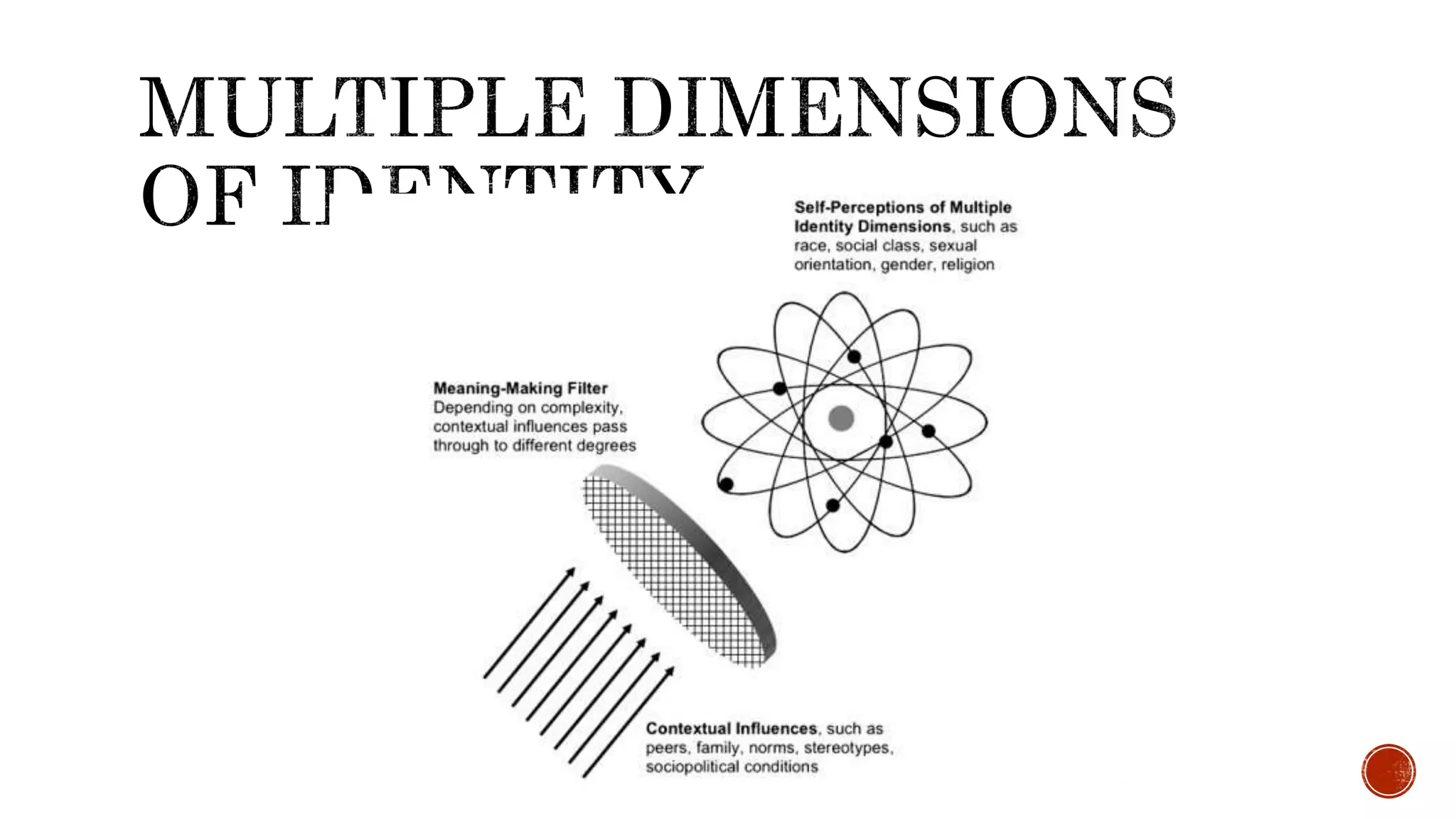
 Recap of Multiple Dimensions of Identity.
 Mike Posner Music Video – Be As You Are
Higher education has a responsibility to help young adults
transition from being shaped by society to shaping society
in their role as leaders in society’s future” (Magolda, 1999,
p. 630)
How do we do this?
Academia – Knowledge
Developing students as “a whole person”
What does “the whole person look like”?
 Biological – Bodies are in continuous growth.
 Cognitively – How we actively think through situations.
 Psychosocially – The development of personality and social
skills, how we interact within this environment.
 How has NEIU developed you as a whole person within these
domains?
 Student Development Defined – The organization of increasing
complexity. (Sanford, 1997, p. 47)
 E.g., Being able to construct identity as intersectional
 Change – “altered condition that may be positive or negative.”
(Evans, Forney, Guido, Patton, Renn, 2010, p. 6)
 E.g., Stop smoking because it is bad or start smoking because it is cool.
 Growth – “refers to expansion which may be favorable or
unfavorable” (Evans et al., 2010, p. 6).
 A tree can grow 5 inches, we can physically measure it.
 The process, the HOW and the WHY is development.
 Formal Theories – Theoretical concepts constructed within
research.
 E.g., Piaget cognitive development theory
 Informal Theories – Our lived experiences, previous
standpoints or body of common knowledge.
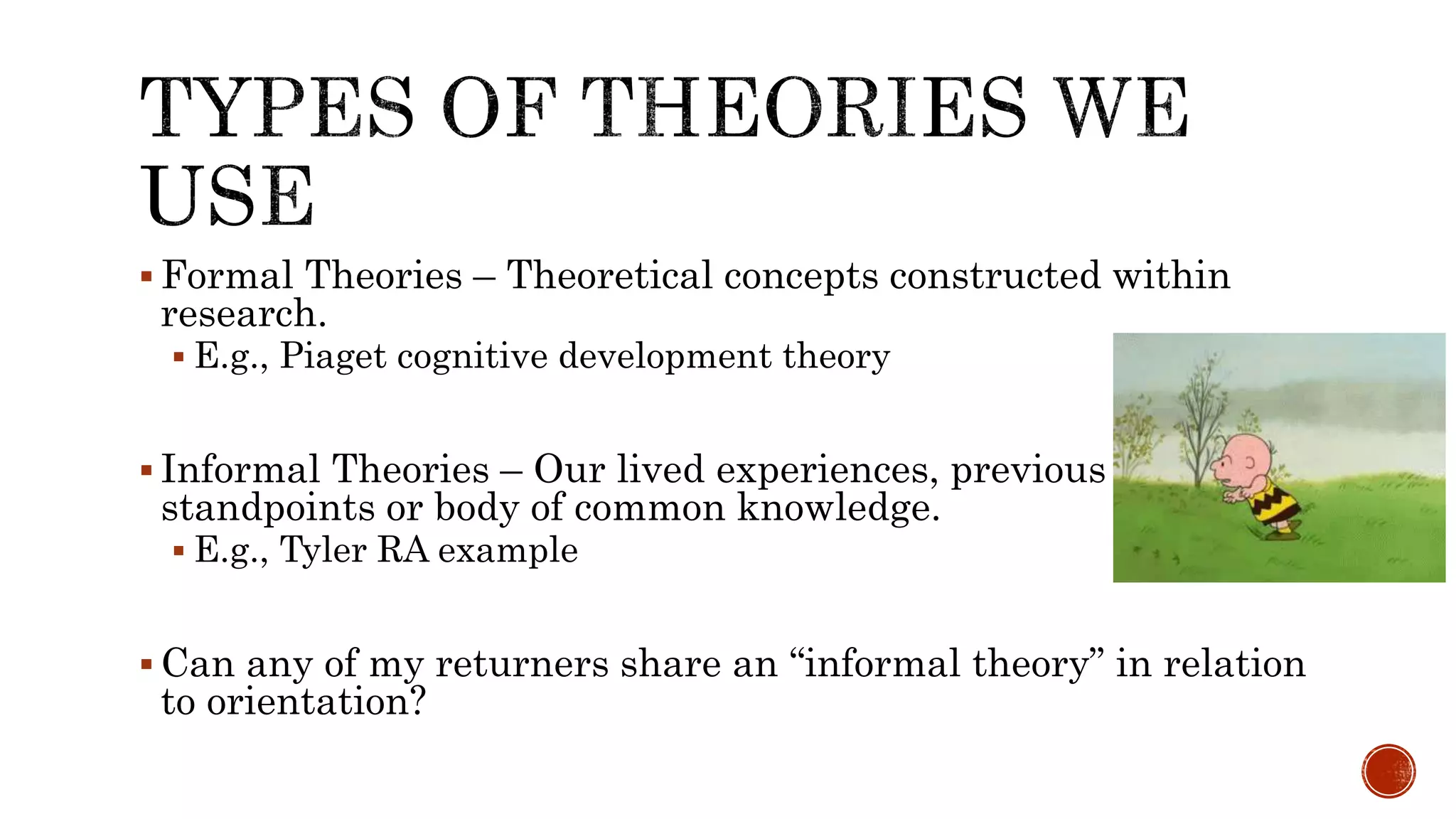
 E.g., Tyler RA example
 Can any of my returners share an “informal theory” in relation
to orientation?
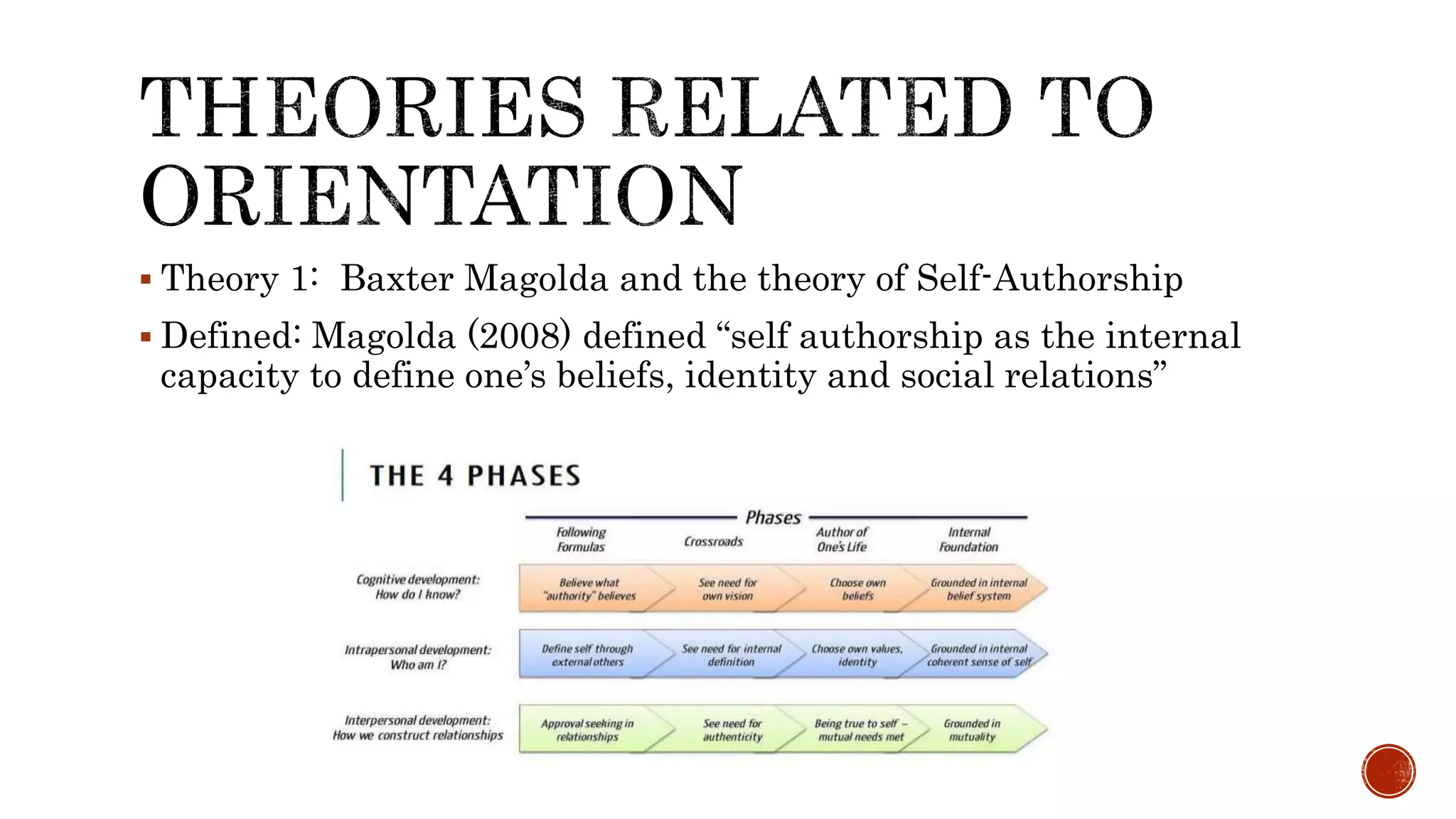
 Theory 1: Baxter Magolda and the theory of Self-Authorship
 Defined: Magolda (2008) defined “self authorship as the internal
capacity to define one’s beliefs, identity and social relations”
The idea simplified:
How do I know?
Who am I?
How do I want to construct relationships with
others?
4 Phases
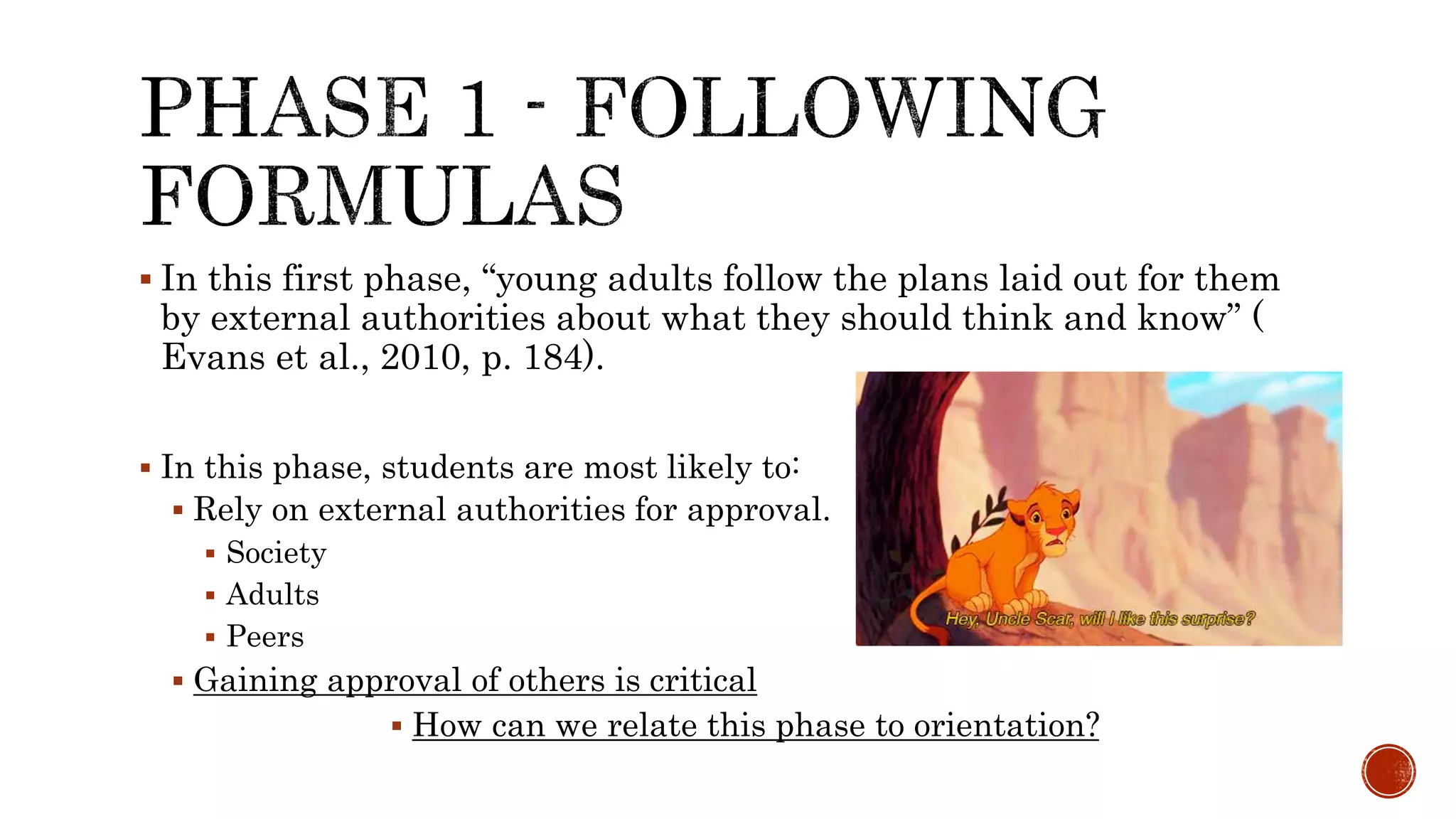
 In this first phase, “young adults follow the plans laid out for them
by external authorities about what they should think and know” (
Evans et al., 2010, p. 184).
 In this phase, students are most likely to:
 Rely on external authorities for approval.
 Society
 Adults
 Peers
 Gaining approval of others is critical
 How can we relate this phase to orientation?
In the second phase students “discover that the plans they
have followed do not necessarily work well and they needs
to establish new plans that better suit their needs and
interest” (Evans et al., 2010, p. 185).
 In this phase students are most likely to:
 Realize that the plan laid out by others is not necessarily in their best interest.
 They want to create their own sense of self.
 What type of incoming students might be in this phase?
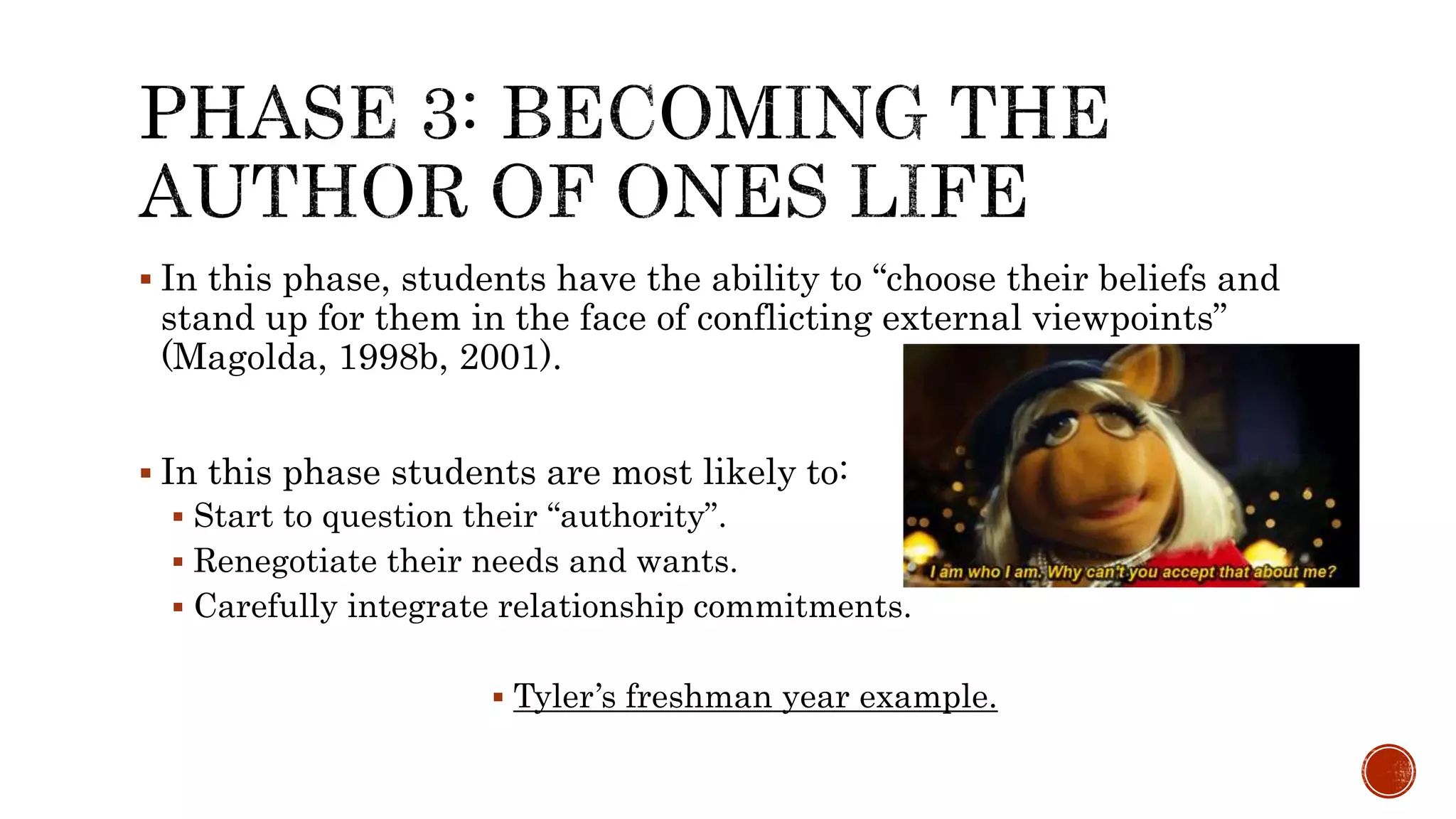
 In this phase, students have the ability to “choose their beliefs and
stand up for them in the face of conflicting external viewpoints”
(Magolda, 1998b, 2001).
 In this phase students are most likely to:
 Start to question their “authority”.
 Renegotiate their needs and wants.
 Carefully integrate relationship commitments.
 Tyler’s freshman year example.
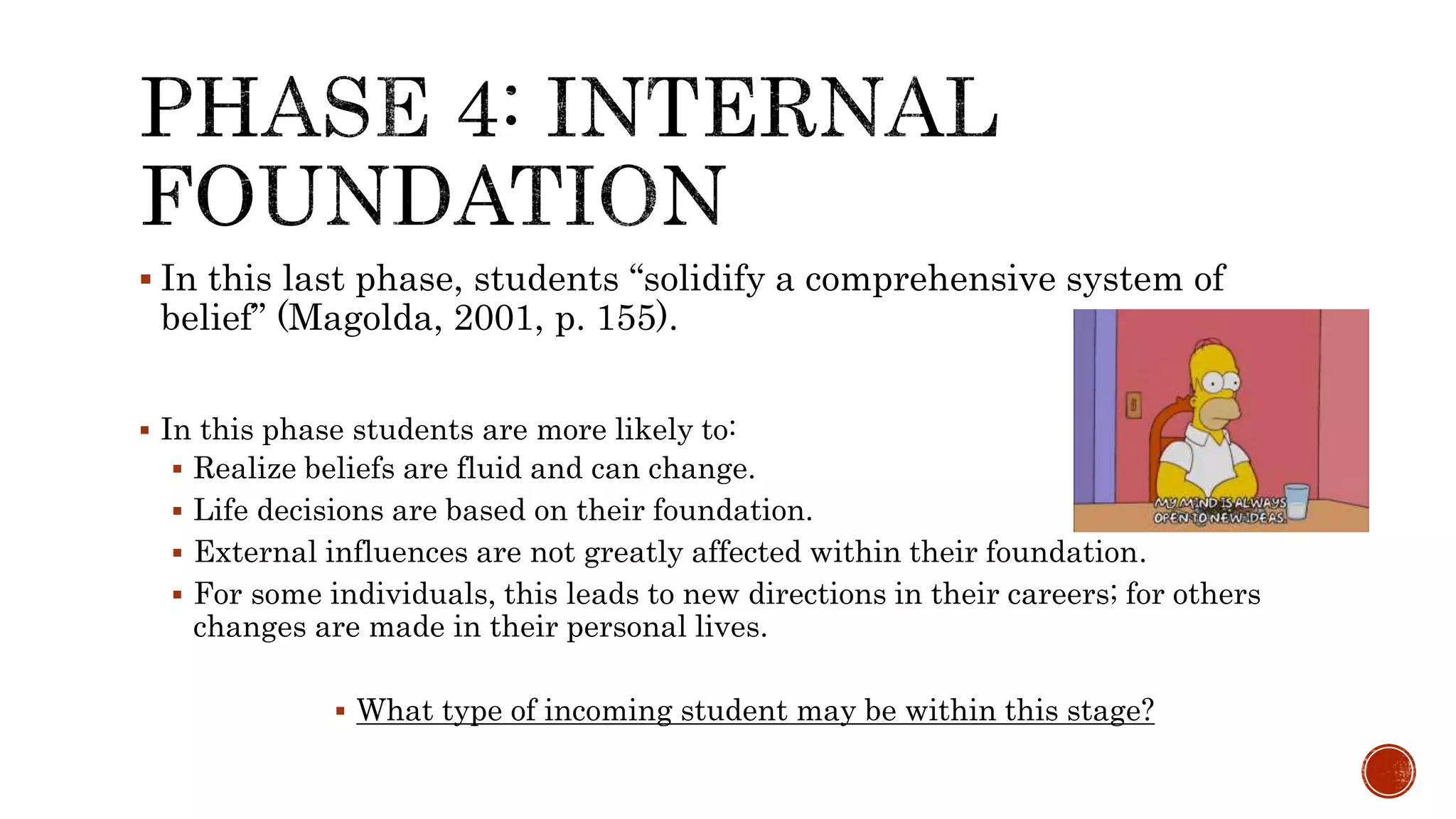
 In this last phase, students “solidify a comprehensive system of
belief” (Magolda, 2001, p. 155).
 In this phase students are more likely to:
 Realize beliefs are fluid and can change.
 Life decisions are based on their foundation.
 External influences are not greatly affected within their foundation.
 For some individuals, this leads to new directions in their careers; for others
changes are made in their personal lives.
 What type of incoming student may be within this stage?
Do any of these stages resonate with you? How so?
Can you provide an example of a time where you believe
you experiencing a specific stage?
How can we use these stages to better understand our
students?
Knowing the stages, how do you believe you could use this
in our work as the Orientation Team?
Environment plays an ENORMOUS role in ones
identity development and portrayal.
 All students think different and make meaning
different.
Theory is NOT something to categorize people.
Theory is to help US better serve our students.
“There are moments where you fall to the ground”
“But you are stronger then you feel you are now”
“Everybody plays the fool sometime”
 https://www.youtube.com/watch?v=_QmjmQjhDA8

Student Development 101 (1)

  • 1.
    Northeastern Illinois University– Orientation Leader Training 2016 F. Tyler McLoughlin Graduate Student Intern- New Student and Transition Programs
  • 2.
     What isthe purpose of higher education?  Learn the 3 developmental domains.  Learn difference between change, growth and development.  What are formal theories and informal theories?  Baxter Magolda and Self Authorship in relation to Orientation.  Recap of Multiple Dimensions of Identity.  Mike Posner Music Video – Be As You Are
  • 3.
    Higher education hasa responsibility to help young adults transition from being shaped by society to shaping society in their role as leaders in society’s future” (Magolda, 1999, p. 630) How do we do this? Academia – Knowledge Developing students as “a whole person”
  • 4.
    What does “thewhole person look like”?  Biological – Bodies are in continuous growth.  Cognitively – How we actively think through situations.  Psychosocially – The development of personality and social skills, how we interact within this environment.  How has NEIU developed you as a whole person within these domains?
  • 5.
     Student DevelopmentDefined – The organization of increasing complexity. (Sanford, 1997, p. 47)  E.g., Being able to construct identity as intersectional  Change – “altered condition that may be positive or negative.” (Evans, Forney, Guido, Patton, Renn, 2010, p. 6)  E.g., Stop smoking because it is bad or start smoking because it is cool.  Growth – “refers to expansion which may be favorable or unfavorable” (Evans et al., 2010, p. 6).  A tree can grow 5 inches, we can physically measure it.  The process, the HOW and the WHY is development.
  • 6.
     Formal Theories– Theoretical concepts constructed within research.  E.g., Piaget cognitive development theory  Informal Theories – Our lived experiences, previous standpoints or body of common knowledge.  E.g., Tyler RA example  Can any of my returners share an “informal theory” in relation to orientation?
  • 7.
     Theory 1:Baxter Magolda and the theory of Self-Authorship  Defined: Magolda (2008) defined “self authorship as the internal capacity to define one’s beliefs, identity and social relations”
  • 8.
    The idea simplified: Howdo I know? Who am I? How do I want to construct relationships with others? 4 Phases
  • 9.
     In thisfirst phase, “young adults follow the plans laid out for them by external authorities about what they should think and know” ( Evans et al., 2010, p. 184).  In this phase, students are most likely to:  Rely on external authorities for approval.  Society  Adults  Peers  Gaining approval of others is critical  How can we relate this phase to orientation?
  • 10.
    In the secondphase students “discover that the plans they have followed do not necessarily work well and they needs to establish new plans that better suit their needs and interest” (Evans et al., 2010, p. 185).  In this phase students are most likely to:  Realize that the plan laid out by others is not necessarily in their best interest.  They want to create their own sense of self.  What type of incoming students might be in this phase?
  • 11.
     In thisphase, students have the ability to “choose their beliefs and stand up for them in the face of conflicting external viewpoints” (Magolda, 1998b, 2001).  In this phase students are most likely to:  Start to question their “authority”.  Renegotiate their needs and wants.  Carefully integrate relationship commitments.  Tyler’s freshman year example.
  • 12.
     In thislast phase, students “solidify a comprehensive system of belief” (Magolda, 2001, p. 155).  In this phase students are more likely to:  Realize beliefs are fluid and can change.  Life decisions are based on their foundation.  External influences are not greatly affected within their foundation.  For some individuals, this leads to new directions in their careers; for others changes are made in their personal lives.  What type of incoming student may be within this stage?
  • 13.
    Do any ofthese stages resonate with you? How so? Can you provide an example of a time where you believe you experiencing a specific stage? How can we use these stages to better understand our students? Knowing the stages, how do you believe you could use this in our work as the Orientation Team?
  • 15.
    Environment plays anENORMOUS role in ones identity development and portrayal.  All students think different and make meaning different. Theory is NOT something to categorize people. Theory is to help US better serve our students.
  • 16.
    “There are momentswhere you fall to the ground” “But you are stronger then you feel you are now” “Everybody plays the fool sometime”  https://www.youtube.com/watch?v=_QmjmQjhDA8