C structures and unions
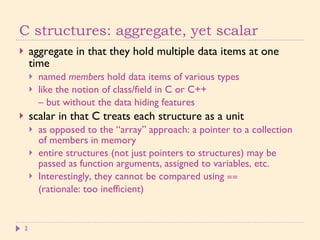
C structures: aggregate, yet scalar aggregate in that they hold multiple data items at one time named  members  hold data items of various types like the notion of class/field in C or C++ –  but without the data hiding features scalar in that C treats each structure as a unit as opposed to the “array” approach: a pointer to a collection of members in memory entire structures (not just pointers to structures) may be passed as function arguments, assigned to variables, etc. Interestingly, they cannot be compared using  == (rationale: too inefficient)
Structure declarations Combined variable and type declaration struct tag {member-list} variable-list; Any one of the three portions can be omitted struct {int a, b; char *p;} x, y;  /* omit tag */ variables  x, y  declared with members as described: int  members  a, b  and  char  pointer  p . x  and  y  have same type, but differ from all others – even if there is another declaration: struct {int a, b; char *p;} z; /* z has different type from x, y */
Structure declarations struct S {int a, b; char *p;};  /* omit variables */ No variables are declared, but there is now a type  struct S  that can be referred to later struct S z;  /* omit members */ Given an earlier declaration of  struct S , this declares a variable of that type typedef struct {int a, b; char *p;} S; /* omit both tag and variables */ This creates a simple type name  S (more convenient than  struct S )
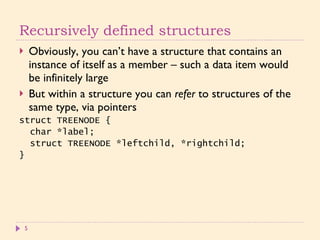
Recursively defined structures Obviously, you can’t have a structure that contains an instance of itself as a member – such a data item would be infinitely large But within a structure you can  refer  to structures of the same type, via pointers struct TREENODE { char *label; struct TREENODE *leftchild, *rightchild; }
Recursively defined structures When two structures refer to each other, one must be declared in incomplete (prototype) fashion struct HUMAN; struct PET { char name[NAME_LIMIT]; char species[NAME_LIMIT]; struct HUMAN *owner; } fido = {″Fido″, ″Canis lupus familiaris″}; struct HUMAN { char name[NAME_LIMIT]; struct PET pets[PET_LIMIT]; } sam = {″Sam″, {fido}}; We can’t initialize the  owner  member at this point, since it hasn’t been declared yet
Direct access operator  s.m subscript and dot operators have same precedence and associate left-to-right, so we don’t need parentheses for  sam.pets[0].species Indirect access  s->m : equivalent to  (*s).m Dereference a pointer to a structure, then return a member of that structure Dot operator has higher precedence than indirection operator , so parentheses are needed in (*s).m (*fido.owner).name or fido.owner->name Member access .  evaluated first: access  owner  member *  evaluated next: dereference pointer to  HUMAN .  and  ->  have equal precedence and associate left-to-right
struct COST { int amount; char currency_type[2]; } struct PART { char id[2]; struct COST cost; int num_avail; } layout of  struct PART : Here, the system uses 4-byte alignment of integers, so  amount  and  num_avail  must be aligned Four bytes wasted for each structure! Memory layout id amount num_avail cost currency_type
A better alternative (from a space perspective): struct COST { int amount; char currency_type; } struct PART { struct COST cost; char id[2]; int num_avail; } Memory layout id amount num_avail cost currency_type
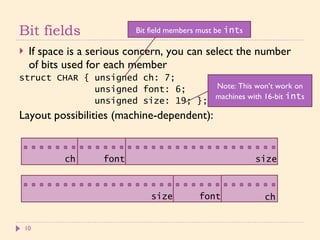
Bit fields If space is a serious concern, you can select the number of bits used for each member struct CHAR { unsigned ch: 7; unsigned font: 6; unsigned size: 19; }; Layout possibilities (machine-dependent): ch font size ch font size Note: This won’t work on machines with 16-bit  int s Bit field members must be  int s
Bit fields Portability is an issue: Do any bit field sizes exceed the machine’s  int  size? Is there any pointer manipulation in your code that assumes a particular layout? Bit fields are “syntactic sugar” for more complex shifting/masking e.g. to get  font  value, mask off the  ch  and  size  bits, then shift right by 19 This is what  actually happens  in the object code – bit fields just make it look simpler at the source level
Structures as function arguments Structures are scalars, so they can be returned and passed as arguments – just like  int s,  char s struct BIG changestruct(struct BIG s); Call by value: temporary copy of structure is created Caution: passing large structures is inefficient –  involves a lot of copying avoid by passing a pointer to the structure instead: void changestruct(struct BIG *s); What if the  struct  argument is read-only? Safe approach: use  const void changestruct(struct BIG const *s);
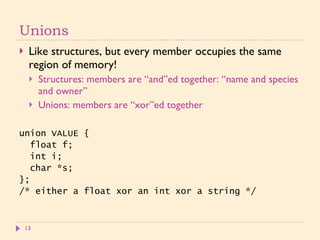
Unions Like structures, but every member occupies the same region of memory! Structures: members are “and”ed together: “name and species and owner” Unions: members are “xor”ed together union VALUE { float f; int i; char *s; }; /* either a float xor an int xor a string */
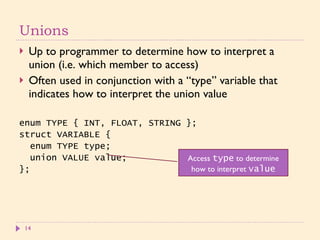
Unions Up to programmer to determine how to interpret a union (i.e. which member to access) Often used in conjunction with a “type” variable that indicates how to interpret the union value enum TYPE { INT, FLOAT, STRING }; struct VARIABLE { enum TYPE type; union VALUE value; }; Access  type  to determine how to interpret  value
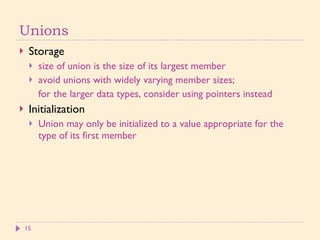
Unions Storage size of union is the size of its largest member avoid unions with widely varying member sizes; for the larger data types, consider using pointers instead Initialization Union may only be initialized to a value appropriate for the type of its first member

structures and unions in 'C'

  • 1.
  • 2.
    C structures: aggregate,yet scalar aggregate in that they hold multiple data items at one time named members hold data items of various types like the notion of class/field in C or C++ – but without the data hiding features scalar in that C treats each structure as a unit as opposed to the “array” approach: a pointer to a collection of members in memory entire structures (not just pointers to structures) may be passed as function arguments, assigned to variables, etc. Interestingly, they cannot be compared using == (rationale: too inefficient)
  • 3.
    Structure declarations Combinedvariable and type declaration struct tag {member-list} variable-list; Any one of the three portions can be omitted struct {int a, b; char *p;} x, y; /* omit tag */ variables x, y declared with members as described: int members a, b and char pointer p . x and y have same type, but differ from all others – even if there is another declaration: struct {int a, b; char *p;} z; /* z has different type from x, y */
  • 4.
    Structure declarations structS {int a, b; char *p;}; /* omit variables */ No variables are declared, but there is now a type struct S that can be referred to later struct S z; /* omit members */ Given an earlier declaration of struct S , this declares a variable of that type typedef struct {int a, b; char *p;} S; /* omit both tag and variables */ This creates a simple type name S (more convenient than struct S )
  • 5.
    Recursively defined structuresObviously, you can’t have a structure that contains an instance of itself as a member – such a data item would be infinitely large But within a structure you can refer to structures of the same type, via pointers struct TREENODE { char *label; struct TREENODE *leftchild, *rightchild; }
  • 6.
    Recursively defined structuresWhen two structures refer to each other, one must be declared in incomplete (prototype) fashion struct HUMAN; struct PET { char name[NAME_LIMIT]; char species[NAME_LIMIT]; struct HUMAN *owner; } fido = {″Fido″, ″Canis lupus familiaris″}; struct HUMAN { char name[NAME_LIMIT]; struct PET pets[PET_LIMIT]; } sam = {″Sam″, {fido}}; We can’t initialize the owner member at this point, since it hasn’t been declared yet
  • 7.
    Direct access operator s.m subscript and dot operators have same precedence and associate left-to-right, so we don’t need parentheses for sam.pets[0].species Indirect access s->m : equivalent to (*s).m Dereference a pointer to a structure, then return a member of that structure Dot operator has higher precedence than indirection operator , so parentheses are needed in (*s).m (*fido.owner).name or fido.owner->name Member access . evaluated first: access owner member * evaluated next: dereference pointer to HUMAN . and -> have equal precedence and associate left-to-right
  • 8.
    struct COST {int amount; char currency_type[2]; } struct PART { char id[2]; struct COST cost; int num_avail; } layout of struct PART : Here, the system uses 4-byte alignment of integers, so amount and num_avail must be aligned Four bytes wasted for each structure! Memory layout id amount num_avail cost currency_type
  • 9.
    A better alternative(from a space perspective): struct COST { int amount; char currency_type; } struct PART { struct COST cost; char id[2]; int num_avail; } Memory layout id amount num_avail cost currency_type
  • 10.
    Bit fields Ifspace is a serious concern, you can select the number of bits used for each member struct CHAR { unsigned ch: 7; unsigned font: 6; unsigned size: 19; }; Layout possibilities (machine-dependent): ch font size ch font size Note: This won’t work on machines with 16-bit int s Bit field members must be int s
  • 11.
    Bit fields Portabilityis an issue: Do any bit field sizes exceed the machine’s int size? Is there any pointer manipulation in your code that assumes a particular layout? Bit fields are “syntactic sugar” for more complex shifting/masking e.g. to get font value, mask off the ch and size bits, then shift right by 19 This is what actually happens in the object code – bit fields just make it look simpler at the source level
  • 12.
    Structures as functionarguments Structures are scalars, so they can be returned and passed as arguments – just like int s, char s struct BIG changestruct(struct BIG s); Call by value: temporary copy of structure is created Caution: passing large structures is inefficient – involves a lot of copying avoid by passing a pointer to the structure instead: void changestruct(struct BIG *s); What if the struct argument is read-only? Safe approach: use const void changestruct(struct BIG const *s);
  • 13.
    Unions Like structures,but every member occupies the same region of memory! Structures: members are “and”ed together: “name and species and owner” Unions: members are “xor”ed together union VALUE { float f; int i; char *s; }; /* either a float xor an int xor a string */
  • 14.
    Unions Up toprogrammer to determine how to interpret a union (i.e. which member to access) Often used in conjunction with a “type” variable that indicates how to interpret the union value enum TYPE { INT, FLOAT, STRING }; struct VARIABLE { enum TYPE type; union VALUE value; }; Access type to determine how to interpret value
  • 15.
    Unions Storage sizeof union is the size of its largest member avoid unions with widely varying member sizes; for the larger data types, consider using pointers instead Initialization Union may only be initialized to a value appropriate for the type of its first member