STRUCTURE-ACTIVITY
RELATIONSHIP
IN POLYMERS
CORRELATION OF STRUCTURE
WITH
➢ Chemical Properties
➢ Sutuctural, chemical reactivity etc.
➢ Electrical Properties
➢ Band gap, dielectric, polarization etc.
➢ Optical Properties
➢ Transmission, reflection, color etc.
➢ Mechanical Properties
➢ Stress-strain behavior, tensile strength etc.
1.Structure and Chemical Properties
A - SOLUBILITY AND SWELLING BEHAVIOUR
 The solution of a polymer in a solvent involves the
diffusion of solvent into the polymer, which swells and
finally disintegrates. A polymer is soluble in that
solvent which Is chemically similar to it
 Example- Unvulcanized natural rubber is isoprene (2-
methylbut-1,3-diene)(non polar polymer) soluble in
nonpolar solvent like CCl4, toluene but insoluble in
polar ethyl alcohol
 A crystalline non polar polymer such as PE or PP swell
in non polar solvent at room temperature
 A crystalline polar polymer like nylon 66 is soluble in
that solvent which is capable of hydrogen bond
formation like formic acid, glacial acetic acid, phenol
and cresol
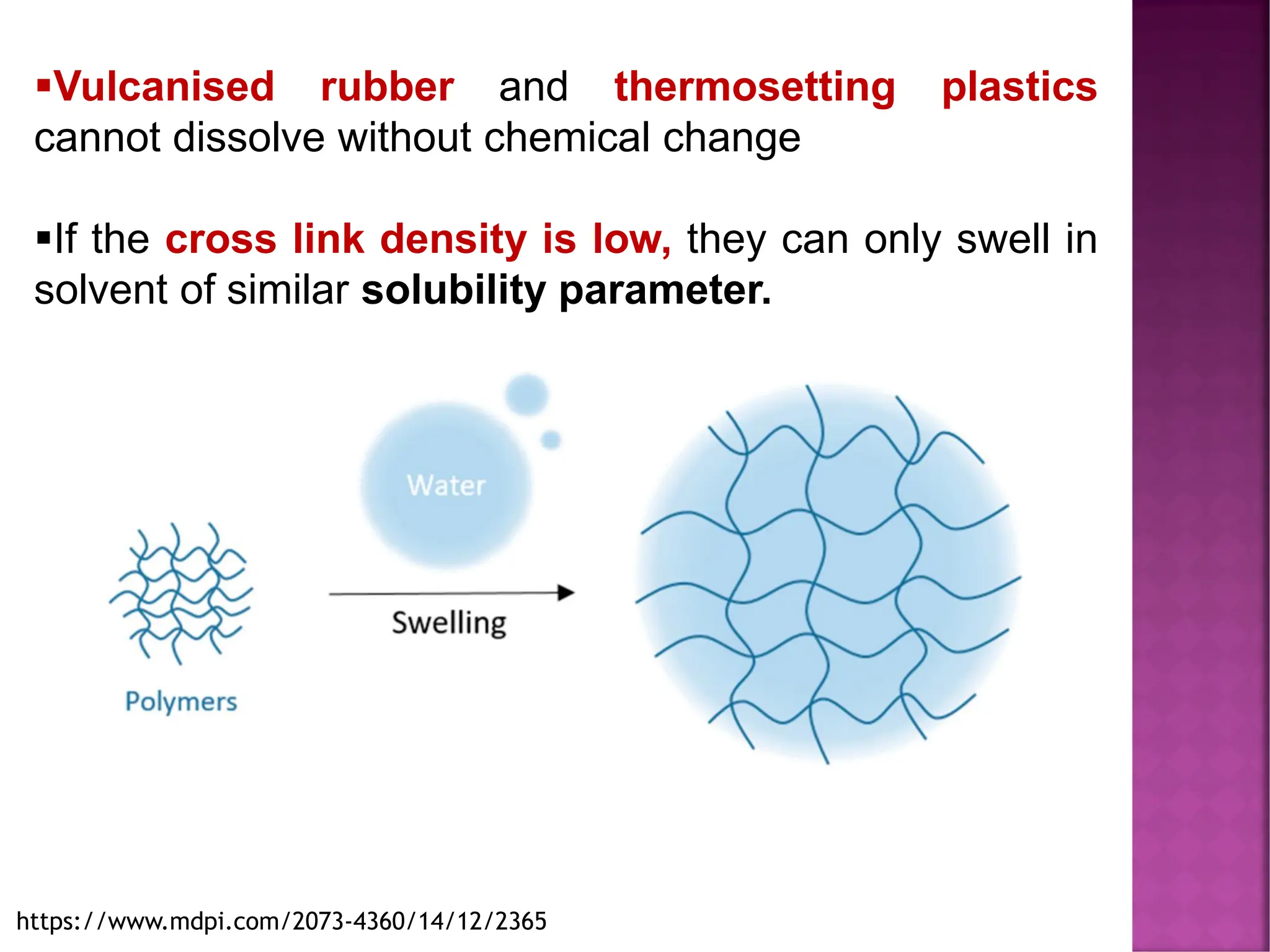
▪Vulcanised rubber and thermosetting plastics
cannot dissolve without chemical change
▪If the cross link density is low, they can only swell in
solvent of similar solubility parameter.
https://www.mdpi.com/2073-4360/14/12/2365
B – CHEMICAL REACTIVITY
Reactivity of a polymer is determined by the chemical groups
present on it.
For example:
• Polyolefin (such as PE) are inert as they contain only C-C and
C-H bonds. If they contain tertiary carbon atoms (like
branched PE, PP
. etc.) then they easily undergo oxidation
• PTFE (Polytetrafluoroethylene) is very stable and chemically
inert as it contains only C-C and C-F bonds
• Rubbers generally have double bonds in their structure and
allylic positions are potential sites for the attack by oxygen
and ozone. This will lead to scission of the main chain and
reduction in molecular mass.
• Nylon and Polyesters are susceptible to hydrolysis as they
contain amide and ester linkages.
C – DIFFUSION AND PERMEABILITY
 Diffusion tend to equal out the concentration of a given species in a
given environment
 In Polymers, it occurs through voids and other gaps
 It depends on the size of the gaps
 In amorphous polymers, above Tg, there is appreciable free volume in
the polymer mass because of segmental mobility
 Hence, diffusion rates are higher in rubbers compared to other types
of molecular packing.
 Crystalline polymers tend to resist diffusion because of much greater
degree of molecular packing
 If size of the molecule is small (e.g., tetrahydrofuran), then it diffuses
fast at room temperature to dissolve the polymer in a few hours.
 But large sized molecules of di-iso-octylphthalate, diffuse very slowly
and can only act as plasticizers.
 Permeability of crystalline polymers is less compared to rubbery
polymer.
D - Aging and Weathering
 Heat, ultra-violet light, high energy radiation and chemical
environments are the main factors which may cause a change in
the properties of a polymer
 PTFE has good light stability because the linkages present have
bond energies greater than light energy
 PE and PVC also have good light stability, because they do not
absorb light of the damaging wavelength's present on the earth's
surface
 But after processing, there may be introduction of certain
carbonyl or other groups which are potential sites for
photochemical action
 Heat stability of (PTFE > PP > PMMA > PVC) as it depends on
the bond energies of chemical linkages present in the polymer.
STRUCTURE AND ELECTRICAL
PROPERTIES OF POLYMERS
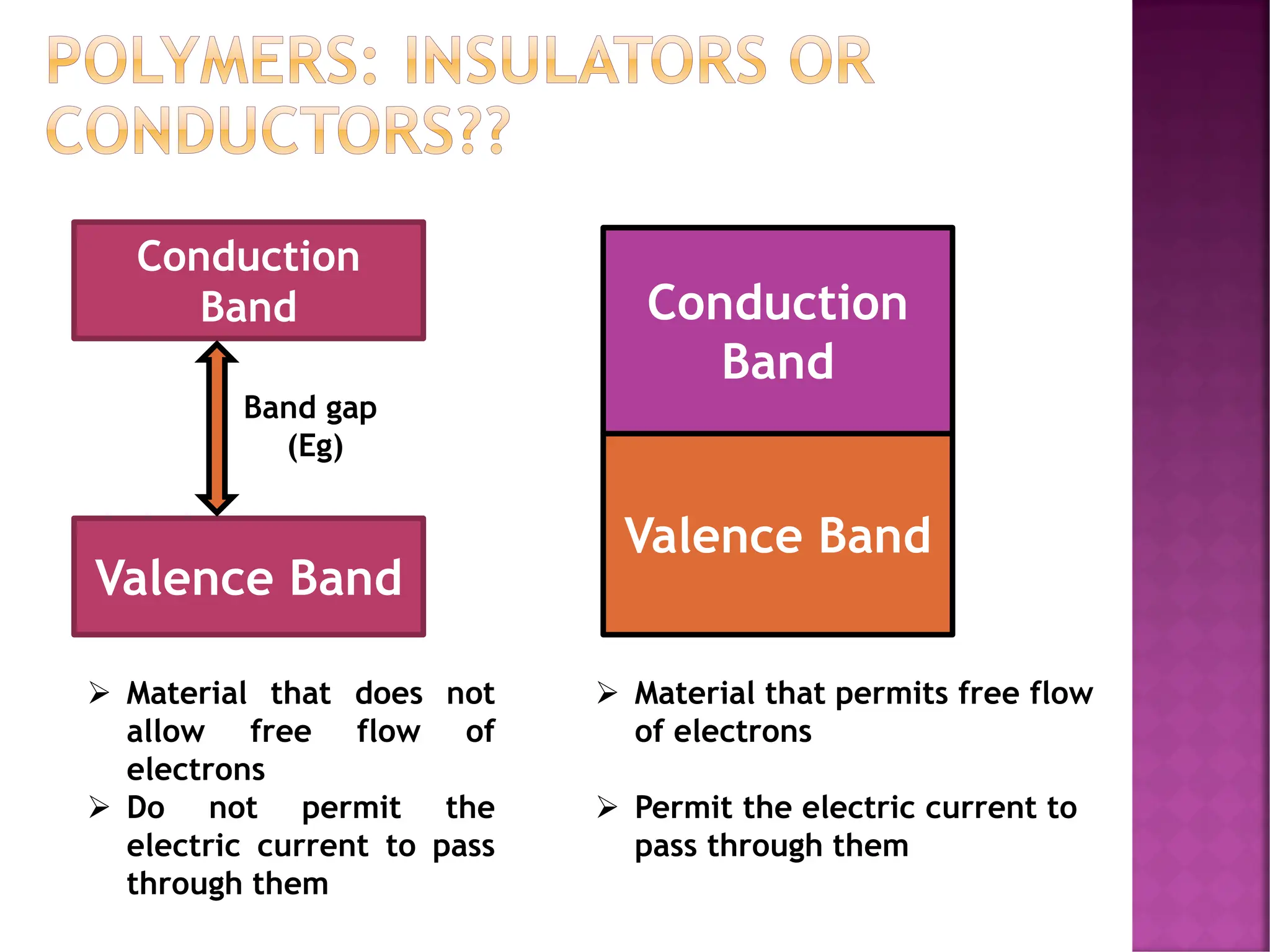
POLYMERS: INSULATORS OR
CONDUCTORS??
Conduction
Band
Valence Band
Band gap
(Eg)
Conduction
Band
Valence Band
➢ Material that does not
allow free flow of
electrons
➢ Do not permit the
electric current to pass
through them
➢ Material that permits free flow
of electrons
➢ Permit the electric current to
pass through them
DIELECTRIC CONSTANT
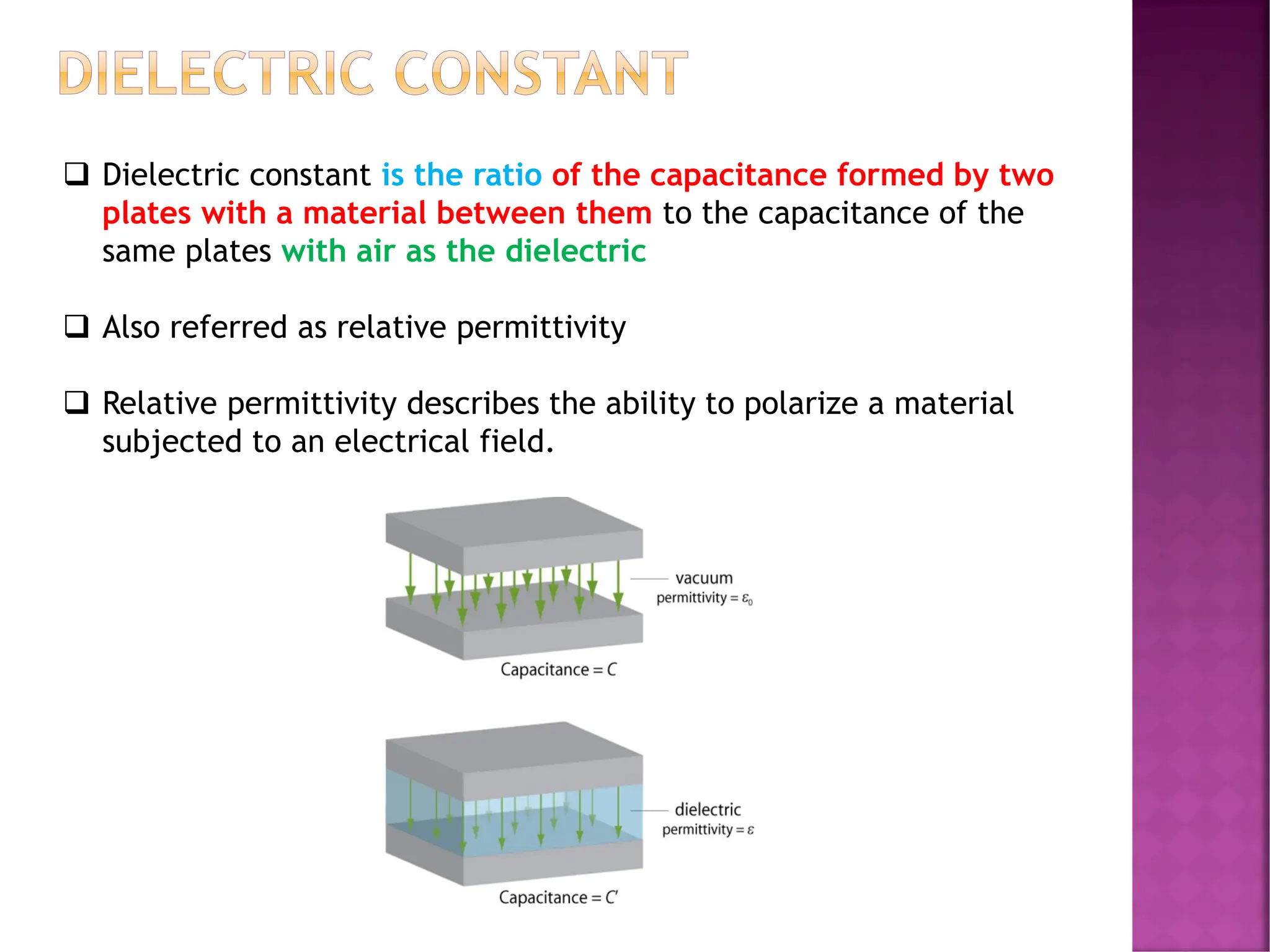
❑ Dielectric constant is the ratio of the capacitance formed by two
plates with a material between them to the capacitance of the
same plates with air as the dielectric
❑ Also referred as relative permittivity
❑ Relative permittivity describes the ability to polarize a material
subjected to an electrical field.
DIELECTRIC CONSTANT
❑Dielectric constant characterizes the ability of
plastics to store electrical energy.
❑The dielectric constant (𝜅𝑒) of a plastic or
insulating material can be defined as the ratio of
the charge stored in an insulating material placed
between two metallic plates to the charge that
can be stored when the insulating material is
replaced by vacuum or air.
❑If a material were to be used for strictly insulating
purposes, it would be better to have a lower
dielectric constant
WHY PLASTIC MATERIAL BEHAVE
AS AN INSULATOR??
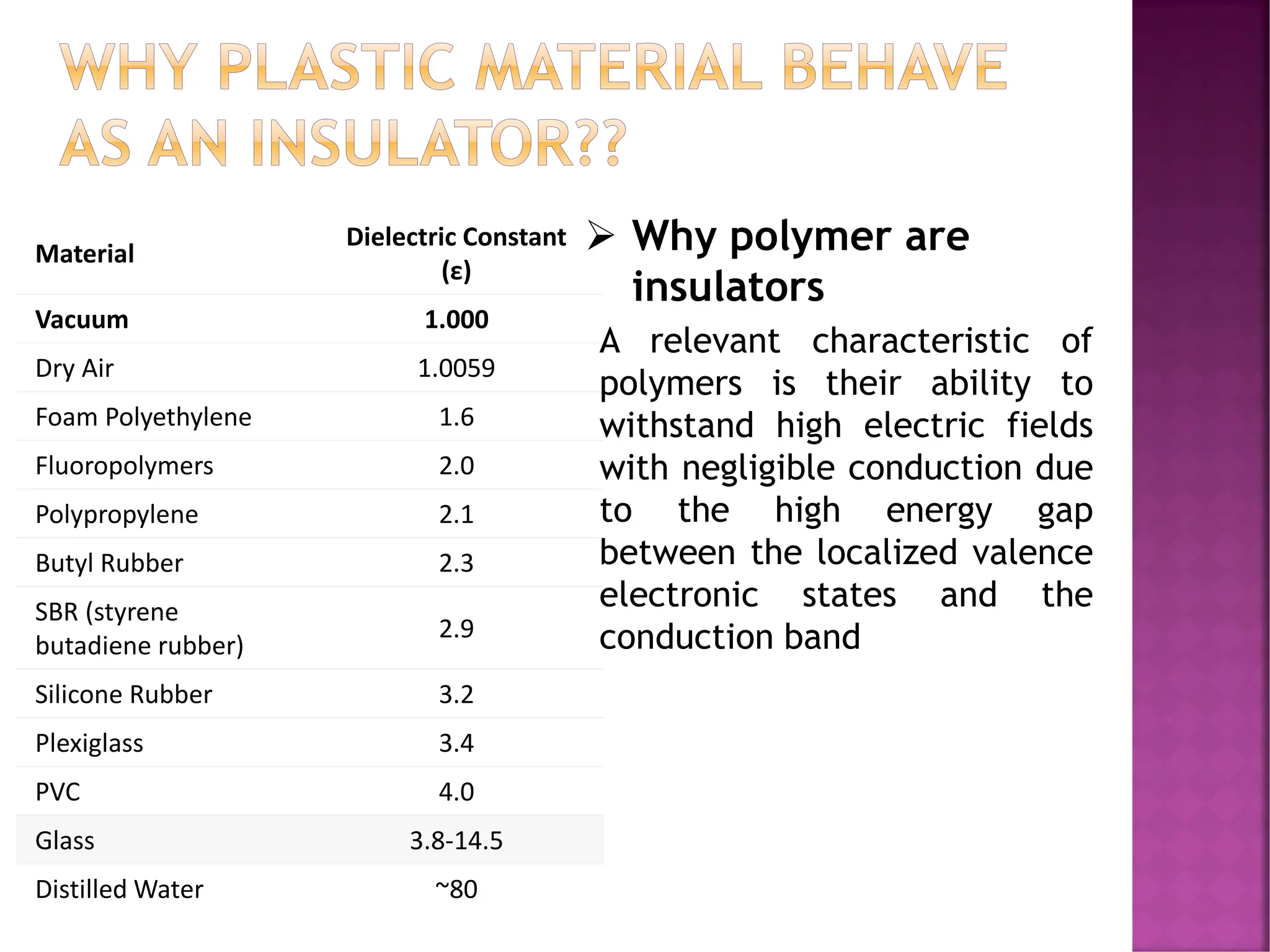
Material
Dielectric Constant
(ε)
Vacuum 1.000
Dry Air 1.0059
Foam Polyethylene 1.6
Fluoropolymers 2.0
Polypropylene 2.1
Butyl Rubber 2.3
SBR (styrene
butadiene rubber)
2.9
Silicone Rubber 3.2
Plexiglass 3.4
PVC 4.0
Glass 3.8-14.5
Distilled Water ~80
A relevant characteristic of
polymers is their ability to
withstand high electric fields
with negligible conduction due
to the high energy gap
between the localized valence
electronic states and the
conduction band
➢ Why polymer are
insulators
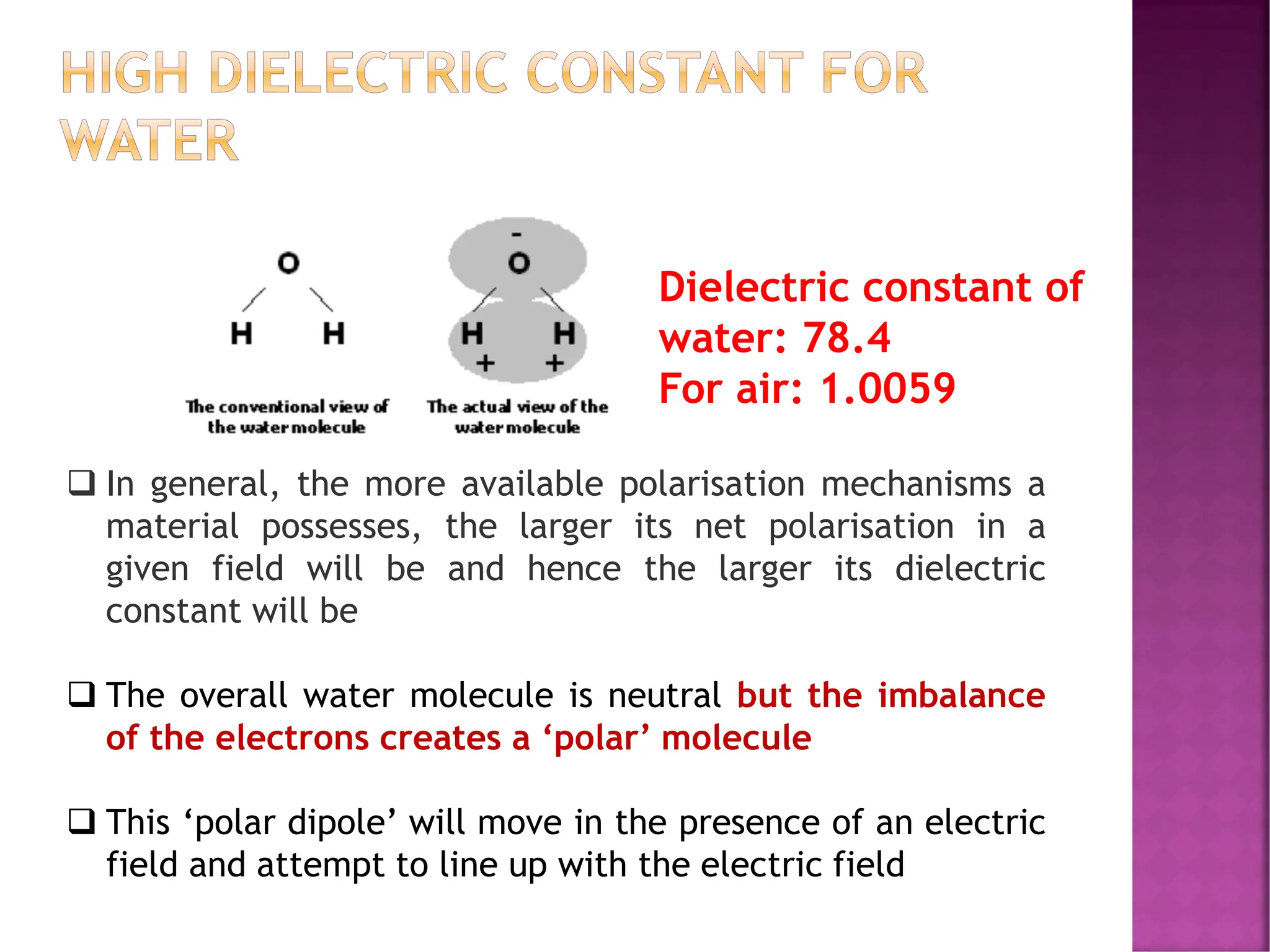
HIGH DIELECTRIC CONSTANT FOR
WATER
❑ In general, the more available polarisation mechanisms a
material possesses, the larger its net polarisation in a
given field will be and hence the larger its dielectric
constant will be
❑ The overall water molecule is neutral but the imbalance
of the electrons creates a ‘polar’ molecule
❑ This ‘polar dipole’ will move in the presence of an electric
field and attempt to line up with the electric field
Dielectric constant of
water: 78.4
For air: 1.0059
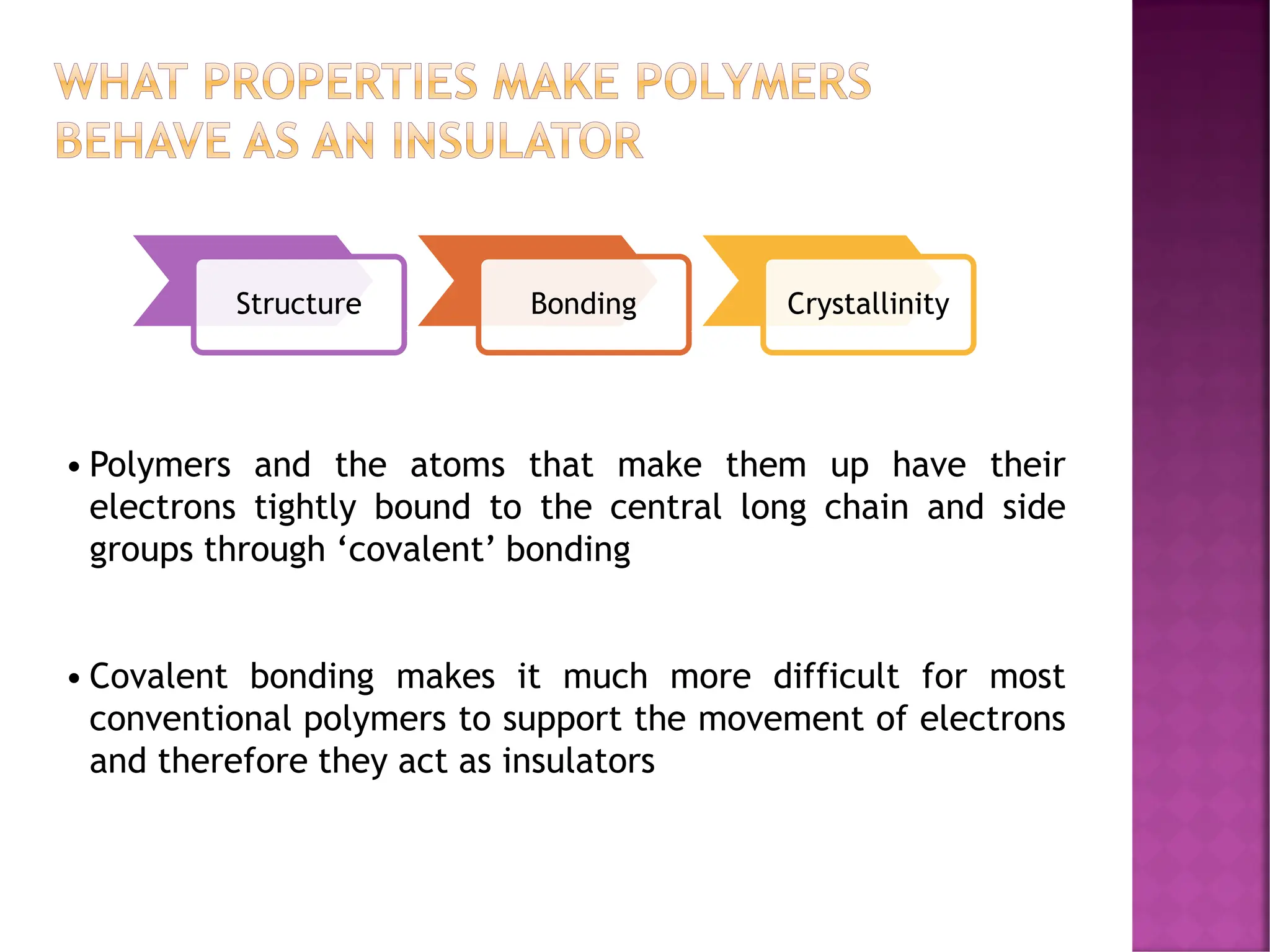
WHAT PROPERTIES MAKE POLYMERS
BEHAVE AS AN INSULATOR
Structure Bonding Crystallinity
• Polymers and the atoms that make them up have their
electrons tightly bound to the central long chain and side
groups through ‘covalent’ bonding
• Covalent bonding makes it much more difficult for most
conventional polymers to support the movement of electrons
and therefore they act as insulators
STRUCTURE AND ELECTRICAL
PROPERTIES
•Structure of plastics gives a better understanding of chemical
resistance and the electrical properties
•Structure determines properties at all levels
•Most plastics are dielectrics or insulators (poor conductors of
electricity) and resist the flow of a current. The doping can
transform them into conducting materials.
• The structure of the polymer determines whether it is polar or
non-polar and this determines many of the dielectric properties of
the plastic
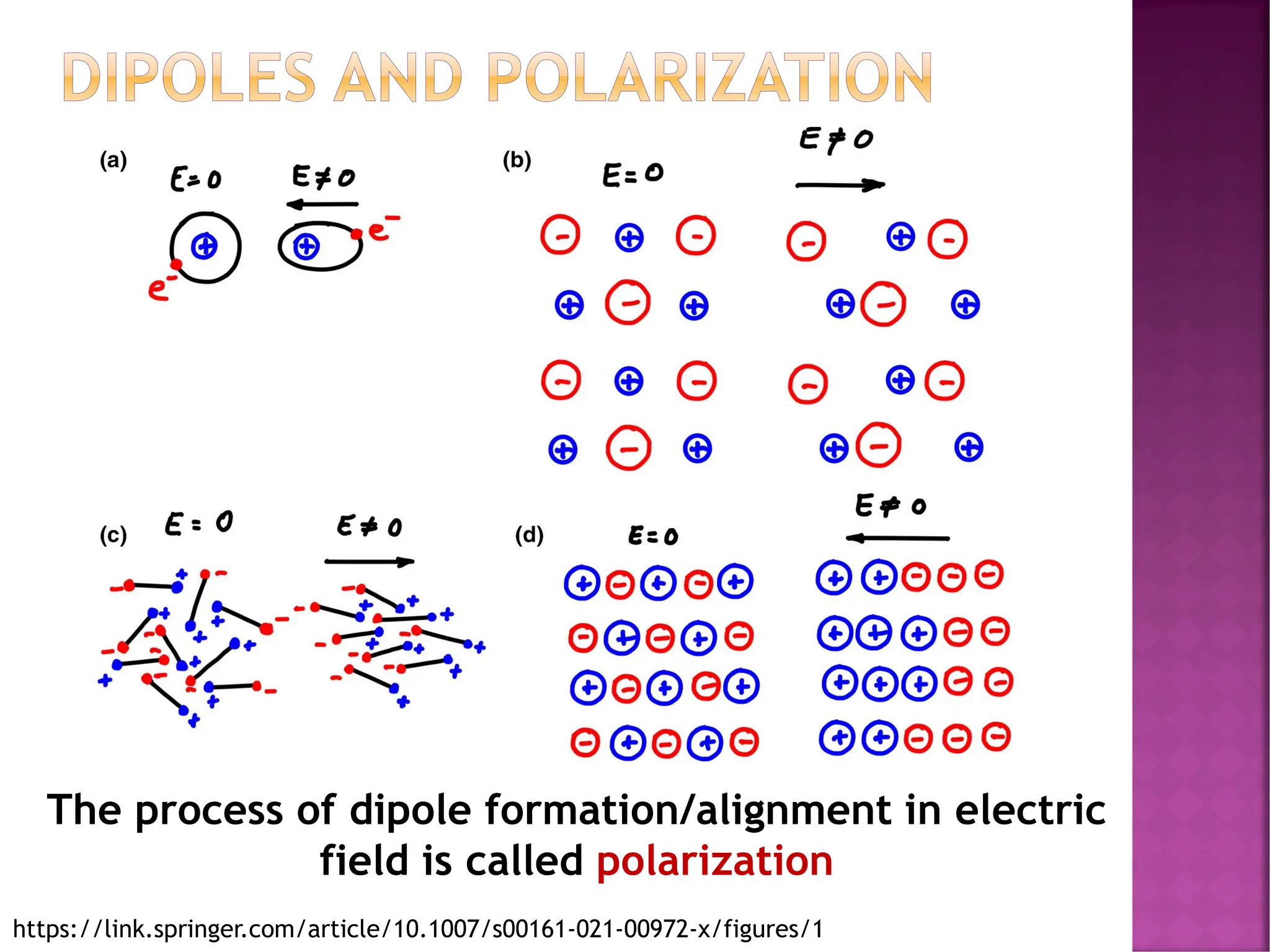
DIPOLES AND POLARIZATION
The process of dipole formation/alignment in electric
field is called polarization
https://link.springer.com/article/10.1007/s00161-021-00972-x/figures/1
POLARIZATION IN POLYMERS
•Polar plastics do not have a fully covalent bond and
there is a slight imbalance in the electronic
charge of the molecule
•In polar plastics, dipoles are created by an
imbalance in the distribution of electrons and in
the presence of an electric field the dipoles will
attempt to move to align with the field. This will
create ‘dipole polarization’ of the material
•Examples of polar plastics are PMMA, PVC, PC; these
materials tend to be moderately good as insulators
POLAR AND NON-POLAR PLASTICS
•In non-polar plastics there are no polar dipoles
present and the application of an electric field does
not try to align any dipoles
•The electric field does, however, move the electrons
slightly in the direction of the electric field to create
‘electron polarization’, in this case the only
movement is that of electrons and this is effectively
instantaneous
•Examples of non-polar plastics are PTFE (and many
other fluoropolymers), PE, PP and PS and these
materials tend to have high resistivity and low
dielectric constants
FACTORS INFLUENCING DIELECTRIC
CONSTANT
Dielectric constant decreases with increase in
alternating current frequency
Frequency Temperature
and moisture
Structure
Presence of
impurities
Weathering
and
deterioration
• Low frequencies (60 Hz): dielectric constants between 3 – 9
• High frequencies (106 Hz): dielectric constants between 3-5
DEPENDENCE OF DIELECTRIC CONSTANT ON
FREQUENCY
• For polar plastics the alternating current frequency is an
important factor because of the time taken to align dipoles
• At very low frequencies the dipoles have sufficient time to
align with the field before it changes direction
• At very high frequencies the dipoles do not have time to align
before the field changes direction and the dielectric lowers
• At intermediate frequencies the dipoles move but have not
completed their movement before the field changes direction
• For non-polar plastics the dielectric constant is independent
of the alternating current frequency because the electron
polarization is effectively instantaneous
DIELECTRIC CONSTANT (alternating current)
ENVIRONMENT AND ELECTRIC
PROPERTIES
•The electrical properties of plastics may also be
changed quite dramatically by the environmental
conditions, such as moisture and/or temperature
and this is true for polar plastics
•The polar plastics have a tendency to absorb
moisture from the atmosphere and can often
contain a significant amount of water at normal
room temperature
•For these materials, the presence of the water
generally raises the dielectric constant
EFFECT OF WATER ON THE
DIELECTRIC PROPERTIES
Water has the following deleterious effects
• Its higher dielectric constant raises the overall
dielectric constant of the polymer-water mixture
• the higher electrical conductivity, lowers the
resistivity of the compound
• On some polymers like Nylons, water exerts its
plasticizing effect which increases segmental
mobility and enhances the dielectric constant of
the polymer itself.
ENVIRONMENT AND ELECTRIC
PROPERTIES
•Raising the temperature of a polar plastic allows
faster movement of the polymer chains and faster
alignment of the dipoles
•This is particularly true if the temperature is raised
above Tg because above Tg much more molecular
movement is possible
•Raising the temperature inevitably raises the
dielectric constant of polar plastics.
FLUOROCARBONS
• The fluorocarbon plastics family is generally non-polar and as
such these plastics have very low dielectric constants (< 3)
• As electrical materials, the fluorocarbons are a preferred
solution to many high specification applications due to their
exceptional properties
• Non-polar plastics, such as the fluoropolymers, are not as
affected by the water
• This is because they tend not to absorb water
• And temperature effects are not generally as severe because
increased temperature does not affect the electronic
polarization
3.STRUCTURE AND OPTICAL PROPERTIES
 Amorphous polymers are generally transparent because of the
constancy in the refractive index throughout the sample
 Crystalline polymers may or may not be transparent
 If the wavelength of light is bigger than the crystalline
structures such as spherulites, the later do not interfere with
the passage of light and the polymer is transparent
 In most of crystalline polymers, refractive indices of
crystalline and amorphous regions are different and the
presence of interfaces between these regions will cause scatter
of light rays
 This property is dependent on the densities of two regions. If the
densities of crystalline and amorphous regions are similar (such
as in poly (4-methylpent-l-ene)), the polymer is transparent. In
other cases, the polymer may be opaque or translucent
OPTICAL PROPERTIES OF POLYMER
There are 3 key interactions between light and
polymers
 Transmission (clarity)
 Reflection (to enhance and minimize glare)
 Color fiber optics cables
 Transmission of light through the polymer for purpose
of clarity, good example would be, fiber optics
cables
 Fiber optics have to be clear to light in order to
transmit the light and data, that associated with that
light
 Sometimes we want low reflection for example in
computer screen (to minimize the glare), or high
reflections (such as packaging to make products look
shiny)
 Color production – we might want a polymer that
produces a particular color when it is illuminated
from behind example Tail lights
 Polymer clarity is important property of polymer
for transmission
 As a rule, amorphous polymers are transparent
 Increasing crystalline nature leads to translucency,
because polymer crystals are approximately the
same size as the wavelength of light, and therefore
scatter the light
 Most common, optically clear polymers are acrylic,
polycarbonates and polystyrene
 All of these have complex polymer structure and
therefore tend to form, amorphous polymer
4.STRUCTURE AND MECHANICAL PROPERTIES
(A)Toughness : Below Tg, amorphous polymers break with a brittle
fracture and they become tougher as the Tg is approached
 Large degree of crystallinity in crystalline polymers lead to
inflexible masses and only moderate impact strengths
 The size of the crystalline structures also determine toughness,
small spherulitic structures leading to masses with high impact
strengths
(B) Strength : Since the intermolecular forces of attraction
increases with the chain length of the polymer and presence of
polar groups hence the strength of the polymer also increases with
its molecular weight
 Low molecular weight polymers are soft and gum-like resins but
higher molecular weight polymers are tougher and more heat
resistant
 Polymer chains in linear polymers are held together by weak
intermolecular forces which can be easily overcome by the
application of heat and pressure hence they show highest
degree of plastic deformation
 In cross-linked polymers, the molecular slippage is completely
absent because of the presence of covalent cross-links
 Thus, softening does not occur on heating and the cross-linked
polymers are very hard, they have high strength and low
extensibilities
 Crystalline polymers are also stiff. But the polymers with low
degree of crystallinity, cross-linking and polarity have low strength
 The mechanical behavior of a polymer is characterized by its
stress-strain curve
STRESS STRAIN BEHAVIOR
 Any force applied on the material creates a
stress and strain on it
 Stress is measured by the force per unit area of
a plane
 It is expressed in pascals
Stress (σ) = Force (F)/Area (A)
 The change in the shape or dimensions of a
body resulting from stress is called strain or
deformation
STRESS STRAIN BEHAVIOR
 Strain is expressed in dimensionless units
such as in percentage
 The tensile strain is expressed as elongation
per unit length
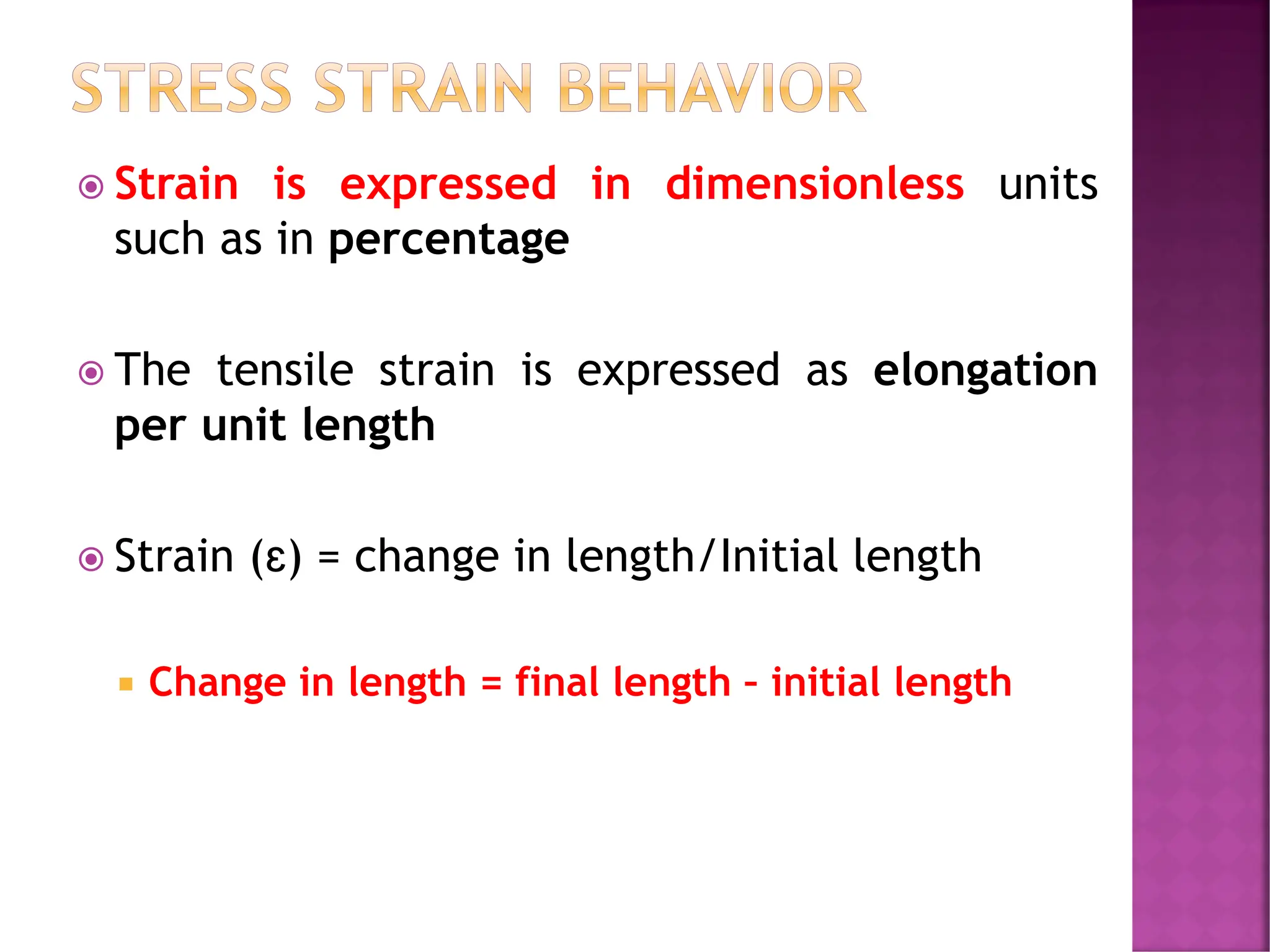
 Strain (ɛ) = change in length/Initial length
 Change in length = final length – initial length
METHOD OF TENSILE TESTING
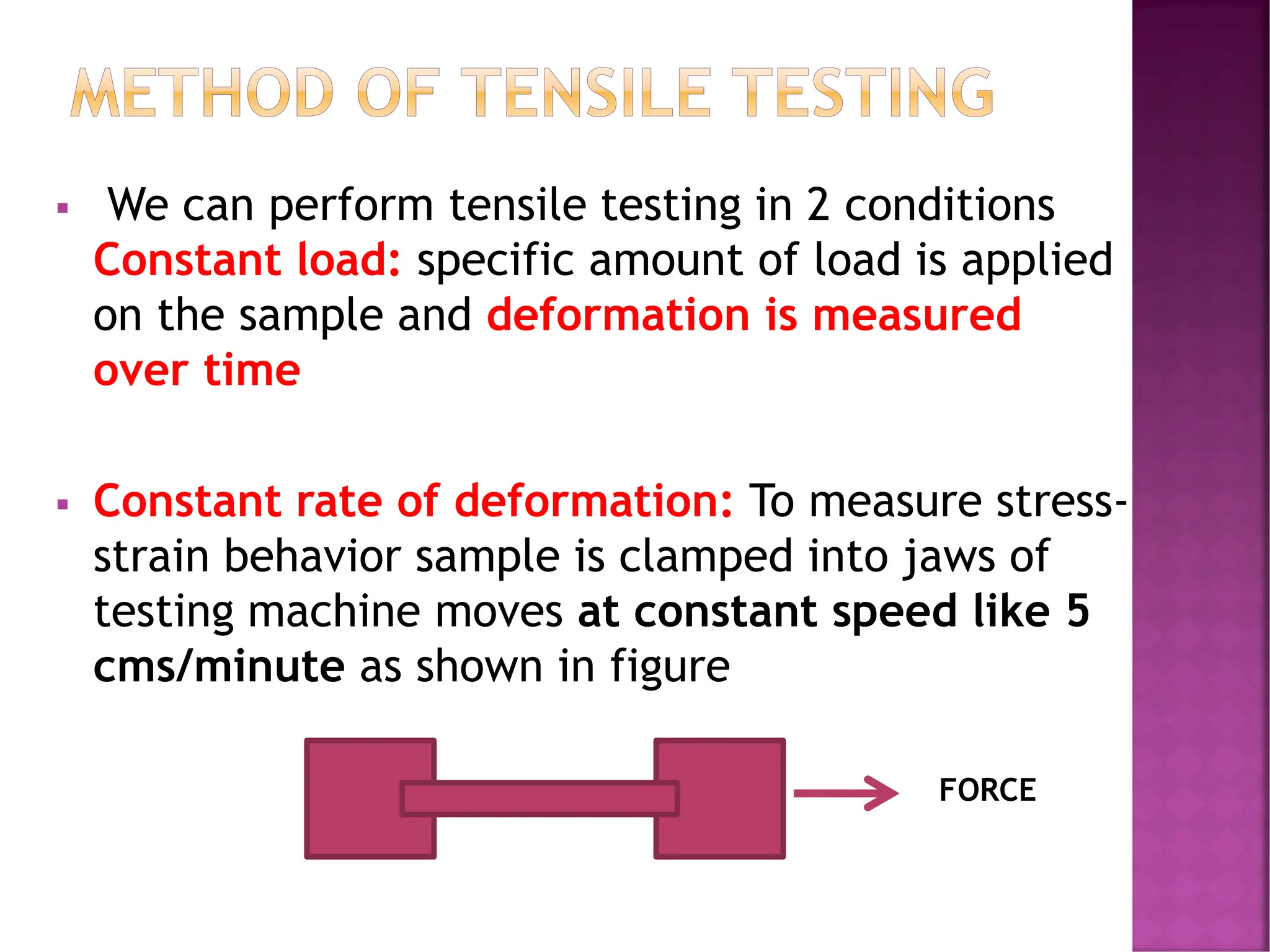
▪ We can perform tensile testing in 2 conditions
Constant load: specific amount of load is applied
on the sample and deformation is measured
over time
▪ Constant rate of deformation: To measure stress-
strain behavior sample is clamped into jaws of
testing machine moves at constant speed like 5
cms/minute as shown in figure
FORCE
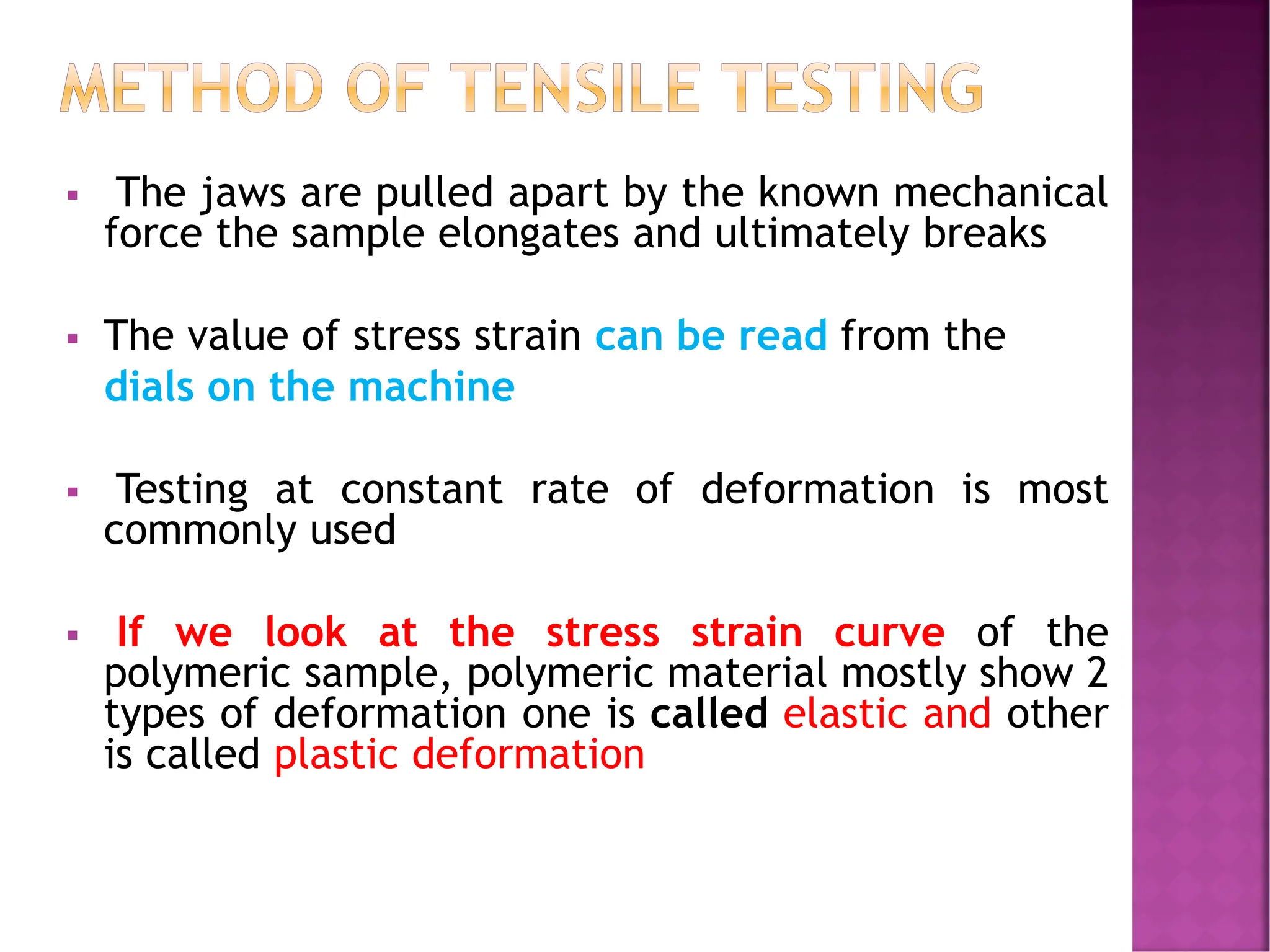
▪ The jaws are pulled apart by the known mechanical
force the sample elongates and ultimately breaks
▪ The value of stress strain can be read from the
dials on the machine
▪ Testing at constant rate of deformation is most
commonly used
▪ If we look at the stress strain curve of the
polymeric sample, polymeric material mostly show 2
types of deformation one is called elastic and other
is called plastic deformation
METHOD OF TENSILE TESTING
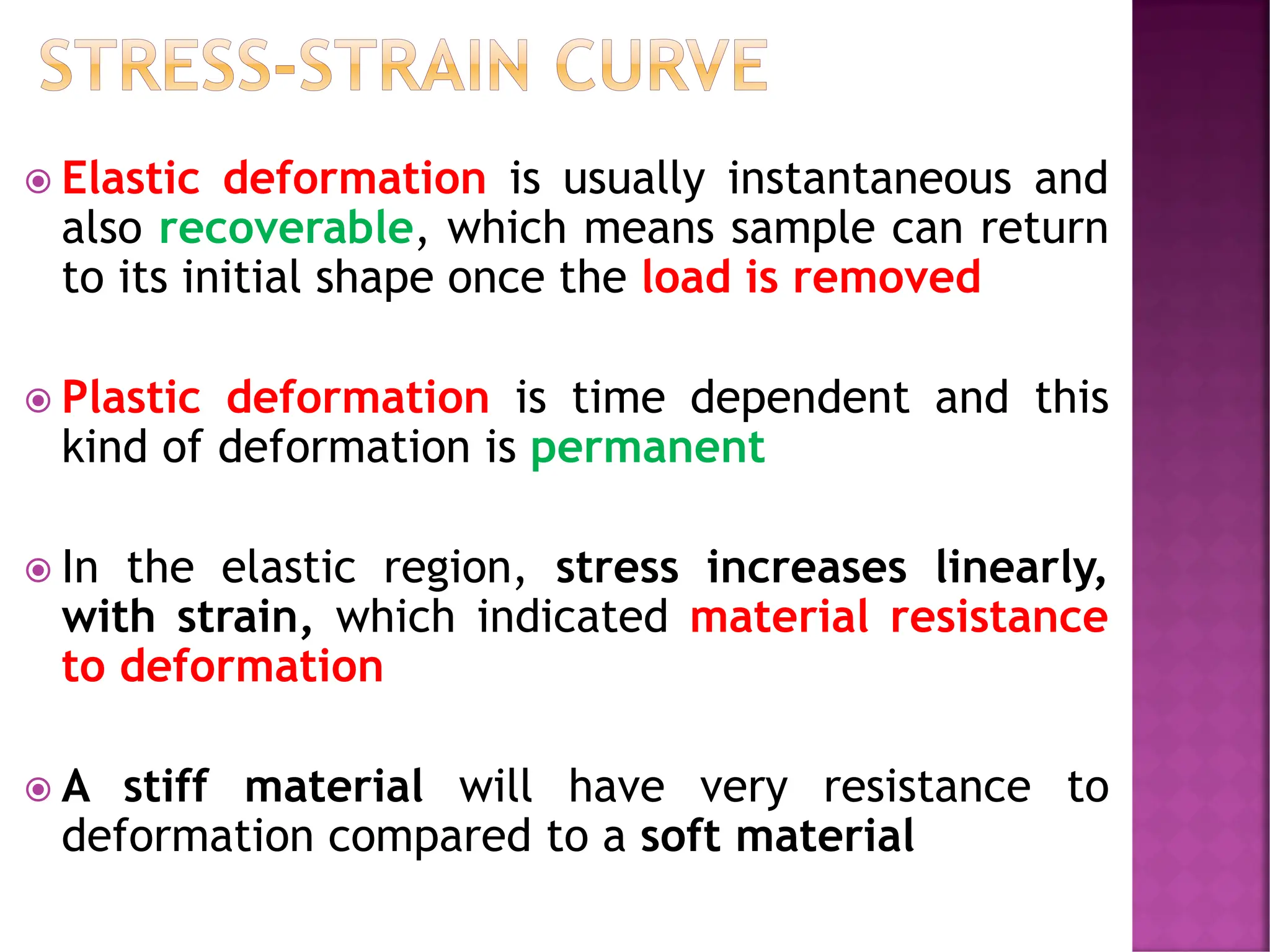
Stress-Strain curve for a typical Viscoelastic polymer
STRESS-STRAIN CURVE
STRESS-STRAIN CURVE
 Elastic deformation is usually instantaneous and
also recoverable, which means sample can return
to its initial shape once the load is removed
 Plastic deformation is time dependent and this
kind of deformation is permanent
 In the elastic region, stress increases linearly,
with strain, which indicated material resistance
to deformation
 A stiff material will have very resistance to
deformation compared to a soft material
 Therefore, the stiff material will have high ratio of
stress to strain at certain stress level – yield stress
 Resistance to deformation decreases as a result
material can be easily deformed
 In this phase, we can see that strain increases
without increasing stress
 Polymer resistance to deformation at higher strain
level, becomes harder to deform, so higher amount
of stress is required, this is called strain hardening
 Finally material breaks at stress value higher than
the yield stress
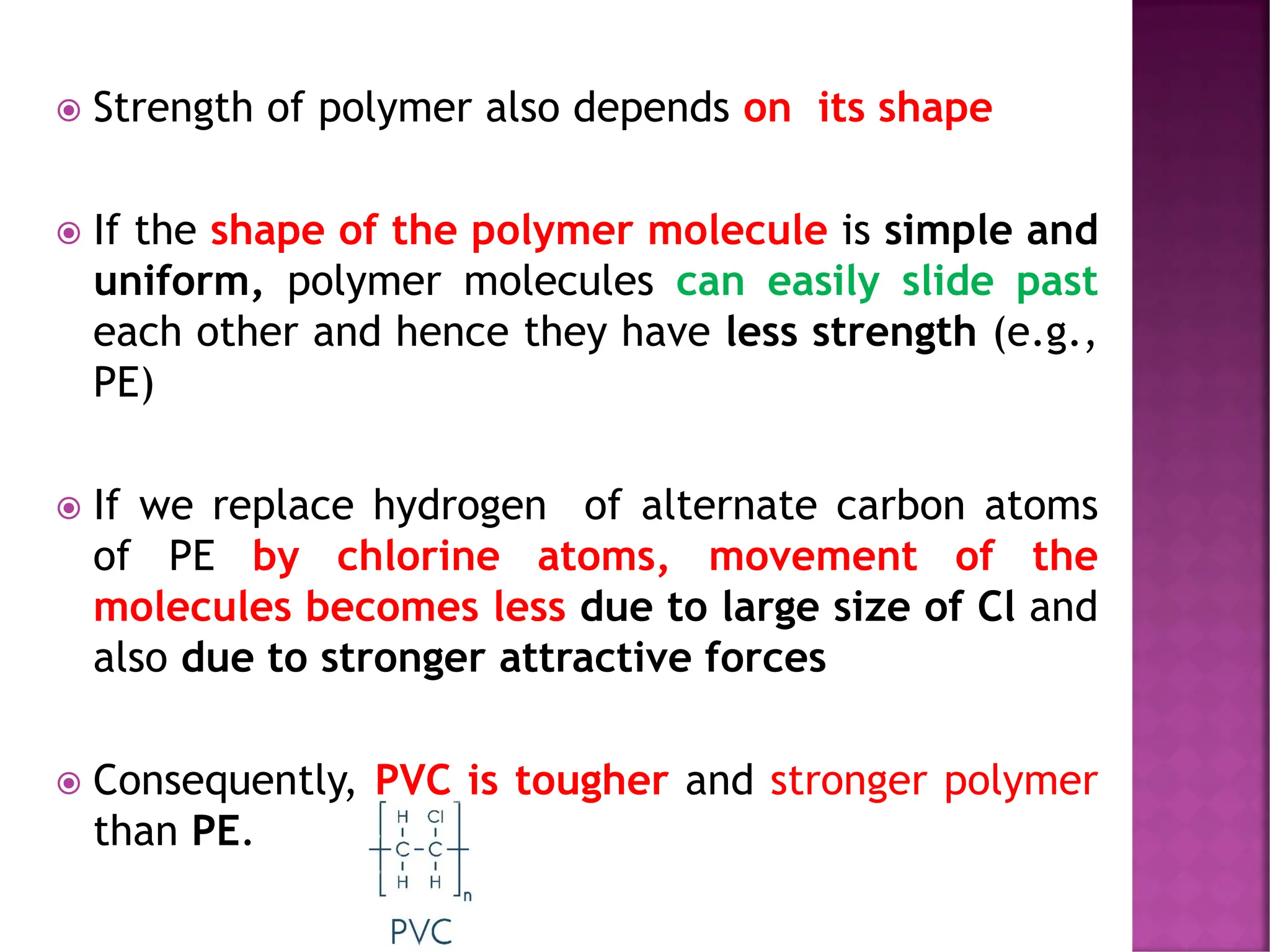
 Strength of polymer also depends on its shape
 If the shape of the polymer molecule is simple and
uniform, polymer molecules can easily slide past
each other and hence they have less strength (e.g.,
PE)
 If we replace hydrogen of alternate carbon atoms
of PE by chlorine atoms, movement of the
molecules becomes less due to large size of Cl and
also due to stronger attractive forces
 Consequently, PVC is tougher and stronger polymer
than PE.
MECHANICAL PROPERTIES
 Strength:
Stress at break or failure point. Strength is usually
maximum stress value.
 Toughness:
Toughness of a material = amount of energy
consumed by the material before it fails or
 Energy to break the sample
 Equal to the area under the stress-strain curve
METHOD OF TENSILE TESTING
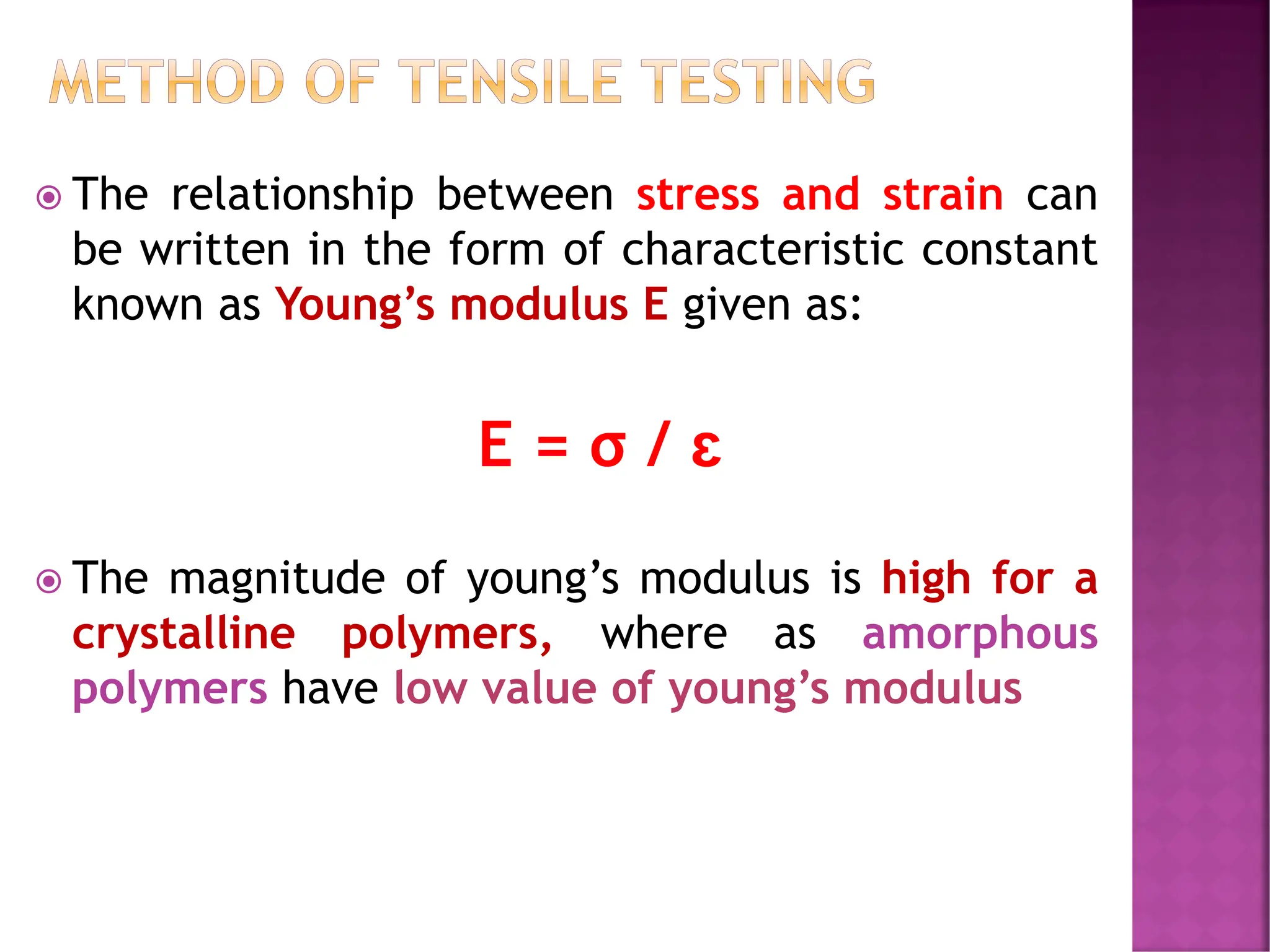
 The relationship between stress and strain can
be written in the form of characteristic constant
known as Young’s modulus E given as:
E = σ / ɛ
 The magnitude of young’s modulus is high for a
crystalline polymers, where as amorphous
polymers have low value of young’s modulus
(C) Elasticity : It is characterized by the recovery of
original shape after the removal of deforming
stress
 The flexible linear polymers or copolymers have low Tg's.
 They are only slightly cross-linked, amorphous and rubbery.
 The rubber chains are free to move or extend locally between
cross-links
 Cross links prevent permanent slipping of adjacent molecules
past each other
ELASTOMERS
Elastomers are loosely cross-linked polymers. They have the
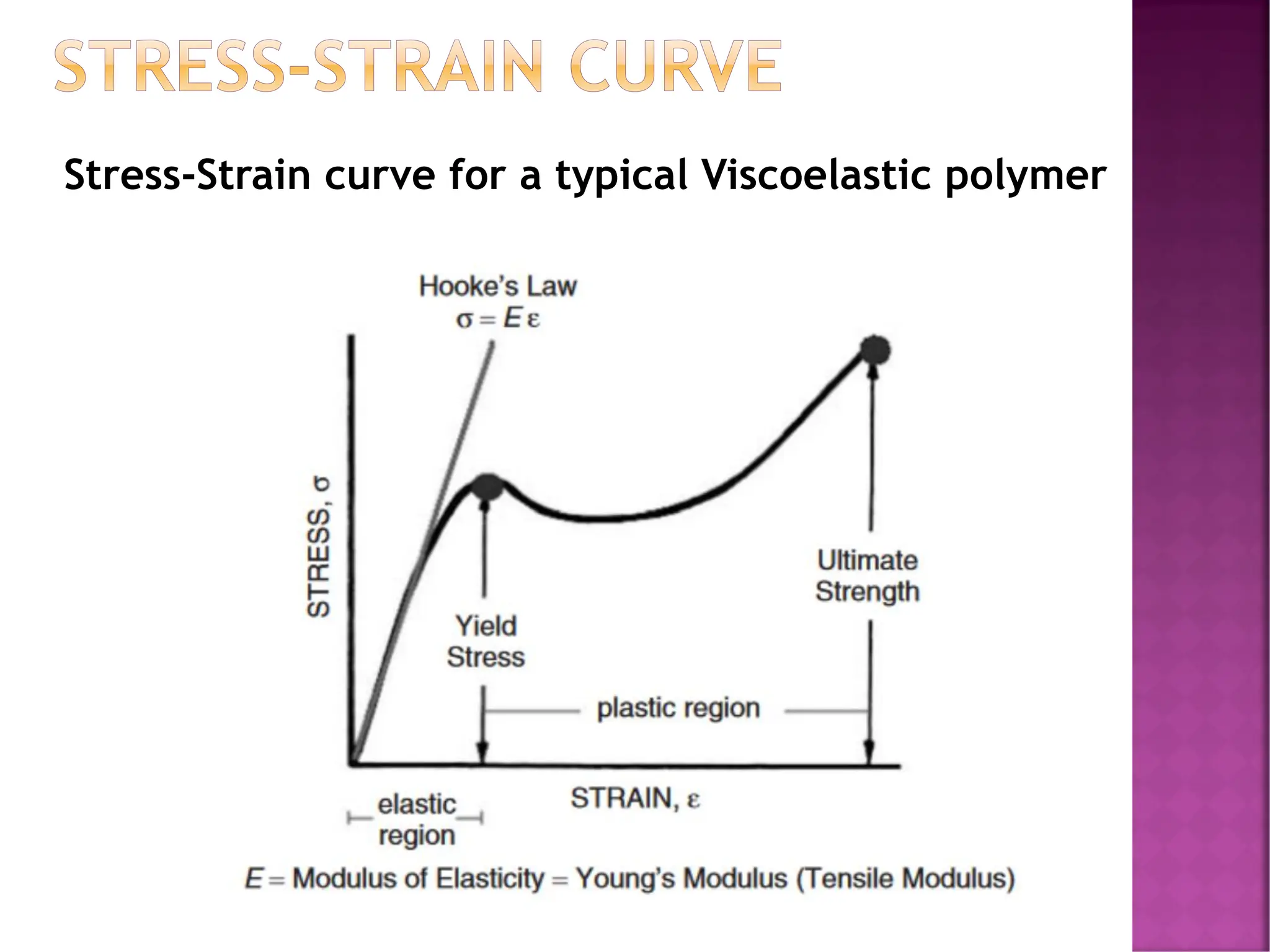
characteristics of rubber in terms of flexibility and elasticity.
The long randomly coiled, loosely cross-linked materials can be
stretched easily, but return to their original shapes when the
force or stress is removed. A large number of cross-links would
make the material rigid, hard, and closer in properties to a
thermoset
Examples of elastomers include natural rubbers, styrene-
butadiene block copolymers, polyisoprene, silicone elastomers,
and nitrile rubbers. Various copolymer technologies continue to
bring new elastomers to the market. Applications of elastomers
include soft touch overmolds, gaskets, seals, and rubber septums.
 In the absence of any deforming force, the polymeric chains in
elastomers between cross-links adopt irregularly coiled and
entangled conformation
 When they are stretched, chains between the cross-links dis-
entangle and straighten out
 Hence, they show high extensibilities. When the deforming stress
is removed, they re-adopt their original conformation hence they
also exhibit complete recovery of shape.
ELASTOMERS

Structure-Activity-Relationship.pdfStructure-Activity-Relationship.pdfStructure-Activity-Relationship.pdfStructure-Activity-Relationship.pdfStructure-Activity-Relationship.pdfStructure-Activity-Relationship.pdf

  • 1.
  • 2.
    CORRELATION OF STRUCTURE WITH ➢Chemical Properties ➢ Sutuctural, chemical reactivity etc. ➢ Electrical Properties ➢ Band gap, dielectric, polarization etc. ➢ Optical Properties ➢ Transmission, reflection, color etc. ➢ Mechanical Properties ➢ Stress-strain behavior, tensile strength etc.
  • 3.
    1.Structure and ChemicalProperties A - SOLUBILITY AND SWELLING BEHAVIOUR  The solution of a polymer in a solvent involves the diffusion of solvent into the polymer, which swells and finally disintegrates. A polymer is soluble in that solvent which Is chemically similar to it  Example- Unvulcanized natural rubber is isoprene (2- methylbut-1,3-diene)(non polar polymer) soluble in nonpolar solvent like CCl4, toluene but insoluble in polar ethyl alcohol  A crystalline non polar polymer such as PE or PP swell in non polar solvent at room temperature  A crystalline polar polymer like nylon 66 is soluble in that solvent which is capable of hydrogen bond formation like formic acid, glacial acetic acid, phenol and cresol
  • 4.
    ▪Vulcanised rubber andthermosetting plastics cannot dissolve without chemical change ▪If the cross link density is low, they can only swell in solvent of similar solubility parameter. https://www.mdpi.com/2073-4360/14/12/2365
  • 5.
    B – CHEMICALREACTIVITY Reactivity of a polymer is determined by the chemical groups present on it. For example: • Polyolefin (such as PE) are inert as they contain only C-C and C-H bonds. If they contain tertiary carbon atoms (like branched PE, PP . etc.) then they easily undergo oxidation • PTFE (Polytetrafluoroethylene) is very stable and chemically inert as it contains only C-C and C-F bonds • Rubbers generally have double bonds in their structure and allylic positions are potential sites for the attack by oxygen and ozone. This will lead to scission of the main chain and reduction in molecular mass. • Nylon and Polyesters are susceptible to hydrolysis as they contain amide and ester linkages.
  • 6.
    C – DIFFUSIONAND PERMEABILITY  Diffusion tend to equal out the concentration of a given species in a given environment  In Polymers, it occurs through voids and other gaps  It depends on the size of the gaps  In amorphous polymers, above Tg, there is appreciable free volume in the polymer mass because of segmental mobility  Hence, diffusion rates are higher in rubbers compared to other types of molecular packing.  Crystalline polymers tend to resist diffusion because of much greater degree of molecular packing  If size of the molecule is small (e.g., tetrahydrofuran), then it diffuses fast at room temperature to dissolve the polymer in a few hours.  But large sized molecules of di-iso-octylphthalate, diffuse very slowly and can only act as plasticizers.  Permeability of crystalline polymers is less compared to rubbery polymer.
  • 7.
    D - Agingand Weathering  Heat, ultra-violet light, high energy radiation and chemical environments are the main factors which may cause a change in the properties of a polymer  PTFE has good light stability because the linkages present have bond energies greater than light energy  PE and PVC also have good light stability, because they do not absorb light of the damaging wavelength's present on the earth's surface  But after processing, there may be introduction of certain carbonyl or other groups which are potential sites for photochemical action  Heat stability of (PTFE > PP > PMMA > PVC) as it depends on the bond energies of chemical linkages present in the polymer.
  • 8.
  • 9.
    POLYMERS: INSULATORS OR CONDUCTORS?? Conduction Band ValenceBand Band gap (Eg) Conduction Band Valence Band ➢ Material that does not allow free flow of electrons ➢ Do not permit the electric current to pass through them ➢ Material that permits free flow of electrons ➢ Permit the electric current to pass through them
  • 10.
    DIELECTRIC CONSTANT ❑ Dielectricconstant is the ratio of the capacitance formed by two plates with a material between them to the capacitance of the same plates with air as the dielectric ❑ Also referred as relative permittivity ❑ Relative permittivity describes the ability to polarize a material subjected to an electrical field.
  • 11.
    DIELECTRIC CONSTANT ❑Dielectric constantcharacterizes the ability of plastics to store electrical energy. ❑The dielectric constant (𝜅𝑒) of a plastic or insulating material can be defined as the ratio of the charge stored in an insulating material placed between two metallic plates to the charge that can be stored when the insulating material is replaced by vacuum or air. ❑If a material were to be used for strictly insulating purposes, it would be better to have a lower dielectric constant
  • 12.
    WHY PLASTIC MATERIALBEHAVE AS AN INSULATOR?? Material Dielectric Constant (ε) Vacuum 1.000 Dry Air 1.0059 Foam Polyethylene 1.6 Fluoropolymers 2.0 Polypropylene 2.1 Butyl Rubber 2.3 SBR (styrene butadiene rubber) 2.9 Silicone Rubber 3.2 Plexiglass 3.4 PVC 4.0 Glass 3.8-14.5 Distilled Water ~80 A relevant characteristic of polymers is their ability to withstand high electric fields with negligible conduction due to the high energy gap between the localized valence electronic states and the conduction band ➢ Why polymer are insulators
  • 13.
    HIGH DIELECTRIC CONSTANTFOR WATER ❑ In general, the more available polarisation mechanisms a material possesses, the larger its net polarisation in a given field will be and hence the larger its dielectric constant will be ❑ The overall water molecule is neutral but the imbalance of the electrons creates a ‘polar’ molecule ❑ This ‘polar dipole’ will move in the presence of an electric field and attempt to line up with the electric field Dielectric constant of water: 78.4 For air: 1.0059
  • 14.
    WHAT PROPERTIES MAKEPOLYMERS BEHAVE AS AN INSULATOR Structure Bonding Crystallinity • Polymers and the atoms that make them up have their electrons tightly bound to the central long chain and side groups through ‘covalent’ bonding • Covalent bonding makes it much more difficult for most conventional polymers to support the movement of electrons and therefore they act as insulators
  • 15.
    STRUCTURE AND ELECTRICAL PROPERTIES •Structureof plastics gives a better understanding of chemical resistance and the electrical properties •Structure determines properties at all levels •Most plastics are dielectrics or insulators (poor conductors of electricity) and resist the flow of a current. The doping can transform them into conducting materials. • The structure of the polymer determines whether it is polar or non-polar and this determines many of the dielectric properties of the plastic
  • 16.
    DIPOLES AND POLARIZATION Theprocess of dipole formation/alignment in electric field is called polarization https://link.springer.com/article/10.1007/s00161-021-00972-x/figures/1
  • 17.
    POLARIZATION IN POLYMERS •Polarplastics do not have a fully covalent bond and there is a slight imbalance in the electronic charge of the molecule •In polar plastics, dipoles are created by an imbalance in the distribution of electrons and in the presence of an electric field the dipoles will attempt to move to align with the field. This will create ‘dipole polarization’ of the material •Examples of polar plastics are PMMA, PVC, PC; these materials tend to be moderately good as insulators
  • 18.
    POLAR AND NON-POLARPLASTICS •In non-polar plastics there are no polar dipoles present and the application of an electric field does not try to align any dipoles •The electric field does, however, move the electrons slightly in the direction of the electric field to create ‘electron polarization’, in this case the only movement is that of electrons and this is effectively instantaneous •Examples of non-polar plastics are PTFE (and many other fluoropolymers), PE, PP and PS and these materials tend to have high resistivity and low dielectric constants
  • 19.
    FACTORS INFLUENCING DIELECTRIC CONSTANT Dielectricconstant decreases with increase in alternating current frequency Frequency Temperature and moisture Structure Presence of impurities Weathering and deterioration • Low frequencies (60 Hz): dielectric constants between 3 – 9 • High frequencies (106 Hz): dielectric constants between 3-5
  • 20.
    DEPENDENCE OF DIELECTRICCONSTANT ON FREQUENCY • For polar plastics the alternating current frequency is an important factor because of the time taken to align dipoles • At very low frequencies the dipoles have sufficient time to align with the field before it changes direction • At very high frequencies the dipoles do not have time to align before the field changes direction and the dielectric lowers • At intermediate frequencies the dipoles move but have not completed their movement before the field changes direction • For non-polar plastics the dielectric constant is independent of the alternating current frequency because the electron polarization is effectively instantaneous DIELECTRIC CONSTANT (alternating current)
  • 21.
    ENVIRONMENT AND ELECTRIC PROPERTIES •Theelectrical properties of plastics may also be changed quite dramatically by the environmental conditions, such as moisture and/or temperature and this is true for polar plastics •The polar plastics have a tendency to absorb moisture from the atmosphere and can often contain a significant amount of water at normal room temperature •For these materials, the presence of the water generally raises the dielectric constant
  • 22.
    EFFECT OF WATERON THE DIELECTRIC PROPERTIES Water has the following deleterious effects • Its higher dielectric constant raises the overall dielectric constant of the polymer-water mixture • the higher electrical conductivity, lowers the resistivity of the compound • On some polymers like Nylons, water exerts its plasticizing effect which increases segmental mobility and enhances the dielectric constant of the polymer itself.
  • 23.
    ENVIRONMENT AND ELECTRIC PROPERTIES •Raisingthe temperature of a polar plastic allows faster movement of the polymer chains and faster alignment of the dipoles •This is particularly true if the temperature is raised above Tg because above Tg much more molecular movement is possible •Raising the temperature inevitably raises the dielectric constant of polar plastics.
  • 24.
    FLUOROCARBONS • The fluorocarbonplastics family is generally non-polar and as such these plastics have very low dielectric constants (< 3) • As electrical materials, the fluorocarbons are a preferred solution to many high specification applications due to their exceptional properties • Non-polar plastics, such as the fluoropolymers, are not as affected by the water • This is because they tend not to absorb water • And temperature effects are not generally as severe because increased temperature does not affect the electronic polarization
  • 25.
    3.STRUCTURE AND OPTICALPROPERTIES  Amorphous polymers are generally transparent because of the constancy in the refractive index throughout the sample  Crystalline polymers may or may not be transparent  If the wavelength of light is bigger than the crystalline structures such as spherulites, the later do not interfere with the passage of light and the polymer is transparent  In most of crystalline polymers, refractive indices of crystalline and amorphous regions are different and the presence of interfaces between these regions will cause scatter of light rays  This property is dependent on the densities of two regions. If the densities of crystalline and amorphous regions are similar (such as in poly (4-methylpent-l-ene)), the polymer is transparent. In other cases, the polymer may be opaque or translucent
  • 26.
    OPTICAL PROPERTIES OFPOLYMER There are 3 key interactions between light and polymers  Transmission (clarity)  Reflection (to enhance and minimize glare)  Color fiber optics cables
  • 27.
     Transmission oflight through the polymer for purpose of clarity, good example would be, fiber optics cables  Fiber optics have to be clear to light in order to transmit the light and data, that associated with that light  Sometimes we want low reflection for example in computer screen (to minimize the glare), or high reflections (such as packaging to make products look shiny)  Color production – we might want a polymer that produces a particular color when it is illuminated from behind example Tail lights
  • 28.
     Polymer clarityis important property of polymer for transmission  As a rule, amorphous polymers are transparent  Increasing crystalline nature leads to translucency, because polymer crystals are approximately the same size as the wavelength of light, and therefore scatter the light  Most common, optically clear polymers are acrylic, polycarbonates and polystyrene  All of these have complex polymer structure and therefore tend to form, amorphous polymer
  • 29.
    4.STRUCTURE AND MECHANICALPROPERTIES (A)Toughness : Below Tg, amorphous polymers break with a brittle fracture and they become tougher as the Tg is approached  Large degree of crystallinity in crystalline polymers lead to inflexible masses and only moderate impact strengths  The size of the crystalline structures also determine toughness, small spherulitic structures leading to masses with high impact strengths (B) Strength : Since the intermolecular forces of attraction increases with the chain length of the polymer and presence of polar groups hence the strength of the polymer also increases with its molecular weight  Low molecular weight polymers are soft and gum-like resins but higher molecular weight polymers are tougher and more heat resistant
  • 30.
     Polymer chainsin linear polymers are held together by weak intermolecular forces which can be easily overcome by the application of heat and pressure hence they show highest degree of plastic deformation  In cross-linked polymers, the molecular slippage is completely absent because of the presence of covalent cross-links  Thus, softening does not occur on heating and the cross-linked polymers are very hard, they have high strength and low extensibilities  Crystalline polymers are also stiff. But the polymers with low degree of crystallinity, cross-linking and polarity have low strength  The mechanical behavior of a polymer is characterized by its stress-strain curve
  • 31.
    STRESS STRAIN BEHAVIOR Any force applied on the material creates a stress and strain on it  Stress is measured by the force per unit area of a plane  It is expressed in pascals Stress (σ) = Force (F)/Area (A)  The change in the shape or dimensions of a body resulting from stress is called strain or deformation
  • 32.
    STRESS STRAIN BEHAVIOR Strain is expressed in dimensionless units such as in percentage  The tensile strain is expressed as elongation per unit length  Strain (ɛ) = change in length/Initial length  Change in length = final length – initial length
  • 33.
    METHOD OF TENSILETESTING ▪ We can perform tensile testing in 2 conditions Constant load: specific amount of load is applied on the sample and deformation is measured over time ▪ Constant rate of deformation: To measure stress- strain behavior sample is clamped into jaws of testing machine moves at constant speed like 5 cms/minute as shown in figure FORCE
  • 34.
    ▪ The jawsare pulled apart by the known mechanical force the sample elongates and ultimately breaks ▪ The value of stress strain can be read from the dials on the machine ▪ Testing at constant rate of deformation is most commonly used ▪ If we look at the stress strain curve of the polymeric sample, polymeric material mostly show 2 types of deformation one is called elastic and other is called plastic deformation METHOD OF TENSILE TESTING
  • 35.
    Stress-Strain curve fora typical Viscoelastic polymer STRESS-STRAIN CURVE
  • 36.
    STRESS-STRAIN CURVE  Elasticdeformation is usually instantaneous and also recoverable, which means sample can return to its initial shape once the load is removed  Plastic deformation is time dependent and this kind of deformation is permanent  In the elastic region, stress increases linearly, with strain, which indicated material resistance to deformation  A stiff material will have very resistance to deformation compared to a soft material
  • 37.
     Therefore, thestiff material will have high ratio of stress to strain at certain stress level – yield stress  Resistance to deformation decreases as a result material can be easily deformed  In this phase, we can see that strain increases without increasing stress  Polymer resistance to deformation at higher strain level, becomes harder to deform, so higher amount of stress is required, this is called strain hardening  Finally material breaks at stress value higher than the yield stress
  • 38.
     Strength ofpolymer also depends on its shape  If the shape of the polymer molecule is simple and uniform, polymer molecules can easily slide past each other and hence they have less strength (e.g., PE)  If we replace hydrogen of alternate carbon atoms of PE by chlorine atoms, movement of the molecules becomes less due to large size of Cl and also due to stronger attractive forces  Consequently, PVC is tougher and stronger polymer than PE.
  • 39.
    MECHANICAL PROPERTIES  Strength: Stressat break or failure point. Strength is usually maximum stress value.  Toughness: Toughness of a material = amount of energy consumed by the material before it fails or  Energy to break the sample  Equal to the area under the stress-strain curve
  • 40.
    METHOD OF TENSILETESTING  The relationship between stress and strain can be written in the form of characteristic constant known as Young’s modulus E given as: E = σ / ɛ  The magnitude of young’s modulus is high for a crystalline polymers, where as amorphous polymers have low value of young’s modulus
  • 41.
    (C) Elasticity :It is characterized by the recovery of original shape after the removal of deforming stress  The flexible linear polymers or copolymers have low Tg's.  They are only slightly cross-linked, amorphous and rubbery.  The rubber chains are free to move or extend locally between cross-links  Cross links prevent permanent slipping of adjacent molecules past each other
  • 42.
    ELASTOMERS Elastomers are looselycross-linked polymers. They have the characteristics of rubber in terms of flexibility and elasticity. The long randomly coiled, loosely cross-linked materials can be stretched easily, but return to their original shapes when the force or stress is removed. A large number of cross-links would make the material rigid, hard, and closer in properties to a thermoset Examples of elastomers include natural rubbers, styrene- butadiene block copolymers, polyisoprene, silicone elastomers, and nitrile rubbers. Various copolymer technologies continue to bring new elastomers to the market. Applications of elastomers include soft touch overmolds, gaskets, seals, and rubber septums.
  • 43.
     In theabsence of any deforming force, the polymeric chains in elastomers between cross-links adopt irregularly coiled and entangled conformation  When they are stretched, chains between the cross-links dis- entangle and straighten out  Hence, they show high extensibilities. When the deforming stress is removed, they re-adopt their original conformation hence they also exhibit complete recovery of shape. ELASTOMERS