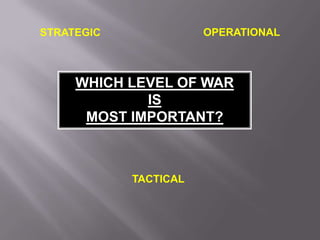
TACTICAL
OPERATIONAL
WHICH LEVEL OF WAR
IS
MOST IMPORTANT?
STRATEGIC
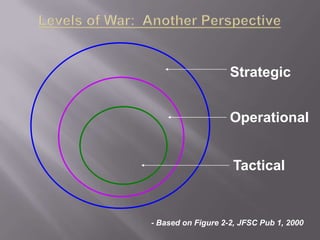
Strategic
Operational
Tactical
Strategic
Operational
Tactical
- Based on Figure 2-2, JFSC Pub 1, 2000
Fundamentals of Joint
Operations
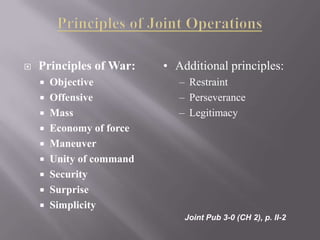
 Principles of War:
 Objective
 Offensive
 Mass
 Economy of force
 Maneuver
 Unity of command
 Security
 Surprise
 Simplicity
• Additional principles:
– Restraint
– Perseverance
– Legitimacy
Joint Pub 3-0 (CH 2), p. II-2
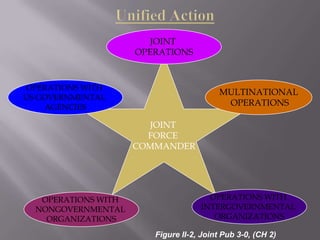
JOINT
FORCE
COMMANDER
JOINT
OPERATIONS
OPERATIONS WITH
INTERGOVERNMENTAL
ORGANIZATIONS
MULTINATIONAL
OPERATIONS
OPERATIONS WITH
US GOVERNMENTAL
AGENCIES
OPERATIONS WITH
NONGOVERNMENTAL
ORGANIZATIONS
Figure II-2, Joint Pub 3-0, (CH 2)
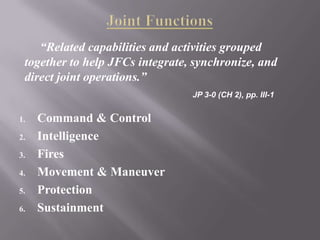
1. Command & Control
2. Intelligence
3. Fires
4. Movement & Maneuver
5. Protection
6. Sustainment
JP 3-0 (CH 2), pp. III-1
“Related capabilities and activities grouped
together to help JFCs integrate, synchronize, and
direct joint operations.”
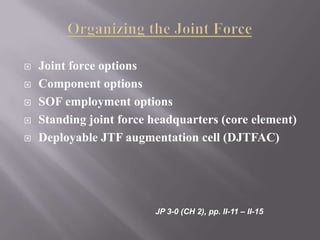
 Joint force options
 Component options
 SOF employment options
 Standing joint force headquarters (core element)
 Deployable JTF augmentation cell (DJTFAC)
JP 3-0 (CH 2), pp. II-11 – II-15
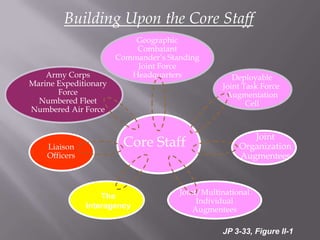
Core Staff
Building Upon the Core Staff
Geographic
Combatant
Commander’s Standing
Joint Force
Headquarters Deployable
Joint Task Force
Augmentation
Cell
Liaison
Officers
Joint/Multinational
Individual
Augmentees
Joint
Organization
Augmentees
The
Interagency
Army Corps
Marine Expeditionary
Force
Numbered Fleet
Numbered Air Force
JP 3-33, Figure II-1
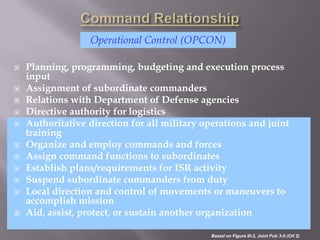
 Planning, programming, budgeting and execution process
input
 Assignment of subordinate commanders
 Relations with Department of Defense agencies
 Directive authority for logistics
 Authoritative direction for all military operations and joint
training
 Organize and employ commands and forces
 Assign command functions to subordinates
 Establish plans/requirements for ISR activity
 Suspend subordinate commanders from duty
 Local direction and control of movements or maneuvers to
accomplish mission
 Aid, assist, protect, or sustain another organization
Combatant Command (Command Authority)
Based on Figure III-2, Joint Pub 3-0 (CH 2)
 Planning, programming, budgeting and execution process
input
 Assignment of subordinate commanders
 Relations with Department of Defense agencies
 Directive authority for logistics
 Authoritative direction for all military operations and joint
training
 Organize and employ commands and forces
 Assign command functions to subordinates
 Establish plans/requirements for ISR activity
 Suspend subordinate commanders from duty
 Local direction and control of movements or maneuvers to
accomplish mission
 Aid, assist, protect, or sustain another organization
Operational Control (OPCON)
Based on Figure III-2, Joint Pub 3-0 (CH 2)
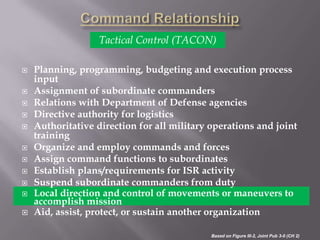
 Planning, programming, budgeting and execution process
input
 Assignment of subordinate commanders
 Relations with Department of Defense agencies
 Directive authority for logistics
 Authoritative direction for all military operations and joint
training
 Organize and employ commands and forces
 Assign command functions to subordinates
 Establish plans/requirements for ISR activity
 Suspend subordinate commanders from duty
 Local direction and control of movements or maneuvers to
accomplish mission
 Aid, assist, protect, or sustain another organization
Tactical Control (TACON)
Based on Figure III-2, Joint Pub 3-0 (CH 2)
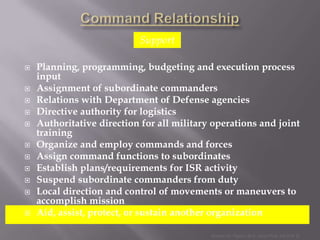
 Planning, programming, budgeting and execution process
input
 Assignment of subordinate commanders
 Relations with Department of Defense agencies
 Directive authority for logistics
 Authoritative direction for all military operations and joint
training
 Organize and employ commands and forces
 Assign command functions to subordinates
 Establish plans/requirements for ISR activity
 Suspend subordinate commanders from duty
 Local direction and control of movements or maneuvers to
accomplish mission
 Aid, assist, protect, or sustain another organization
Support
Based on Figure III-2, Joint Pub 3-0 (CH 2)
Joint Pub 3-0 (CH 2), Figure II-3
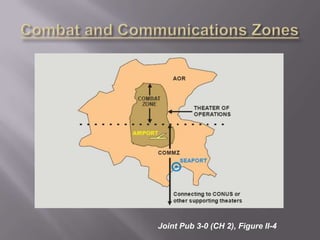
Joint Pub 3-0 (CH 2), Figure II-4
Joint Pub 3-0 (CH 2), Figure II-5
1. Identify Operation ANACONDA command & control
issues. Explain their significance.
2. Based on assigned readings, diagram the C2
arrangements for Operation ANACONDA. Include
organizational options and command relationships,
from the combatant command through task forces.
3. Identify and explain why the following operational
areas could have been established or likely would not
have been designated during the operation: AOR,
Theater of War, Theater of Operations, JOA, AOA,
JSOA, AO, JSA.
4. Based on your assigned doctrine readings, diagram the
C2 arrangements that could have been established for
Operation ANACONDA. Include organizational
options, and command relationships, from the
combatant command through task forces.
Grossman, Elaine M. “Army Analyst Blames Afghan Battle Failings
on Bad Command Set-Up.” Inside the Pentagon, 29 July 2004
JFSC Publication 1, The Joint Staff Officers Guide 2000, August
2011
JP 3-0, Joint Operations, 11 August 2011.
JP 3-33, Joint Taskforce Headquarters, 30 July 2012
JP 5-0, Joint Operation Planning, 26 December 2006

Joint operations

  • 1.
    TACTICAL OPERATIONAL WHICH LEVEL OFWAR IS MOST IMPORTANT? STRATEGIC
  • 2.
  • 3.
    Strategic Operational Tactical - Based onFigure 2-2, JFSC Pub 1, 2000
  • 4.
  • 5.
     Principles ofWar:  Objective  Offensive  Mass  Economy of force  Maneuver  Unity of command  Security  Surprise  Simplicity • Additional principles: – Restraint – Perseverance – Legitimacy Joint Pub 3-0 (CH 2), p. II-2
  • 6.
    JOINT FORCE COMMANDER JOINT OPERATIONS OPERATIONS WITH INTERGOVERNMENTAL ORGANIZATIONS MULTINATIONAL OPERATIONS OPERATIONS WITH USGOVERNMENTAL AGENCIES OPERATIONS WITH NONGOVERNMENTAL ORGANIZATIONS Figure II-2, Joint Pub 3-0, (CH 2)
  • 7.
    1. Command &Control 2. Intelligence 3. Fires 4. Movement & Maneuver 5. Protection 6. Sustainment JP 3-0 (CH 2), pp. III-1 “Related capabilities and activities grouped together to help JFCs integrate, synchronize, and direct joint operations.”
  • 8.
     Joint forceoptions  Component options  SOF employment options  Standing joint force headquarters (core element)  Deployable JTF augmentation cell (DJTFAC) JP 3-0 (CH 2), pp. II-11 – II-15
  • 9.
    Core Staff Building Uponthe Core Staff Geographic Combatant Commander’s Standing Joint Force Headquarters Deployable Joint Task Force Augmentation Cell Liaison Officers Joint/Multinational Individual Augmentees Joint Organization Augmentees The Interagency Army Corps Marine Expeditionary Force Numbered Fleet Numbered Air Force JP 3-33, Figure II-1
  • 10.
     Planning, programming,budgeting and execution process input  Assignment of subordinate commanders  Relations with Department of Defense agencies  Directive authority for logistics  Authoritative direction for all military operations and joint training  Organize and employ commands and forces  Assign command functions to subordinates  Establish plans/requirements for ISR activity  Suspend subordinate commanders from duty  Local direction and control of movements or maneuvers to accomplish mission  Aid, assist, protect, or sustain another organization Combatant Command (Command Authority) Based on Figure III-2, Joint Pub 3-0 (CH 2)
  • 11.
     Planning, programming,budgeting and execution process input  Assignment of subordinate commanders  Relations with Department of Defense agencies  Directive authority for logistics  Authoritative direction for all military operations and joint training  Organize and employ commands and forces  Assign command functions to subordinates  Establish plans/requirements for ISR activity  Suspend subordinate commanders from duty  Local direction and control of movements or maneuvers to accomplish mission  Aid, assist, protect, or sustain another organization Operational Control (OPCON) Based on Figure III-2, Joint Pub 3-0 (CH 2)
  • 12.
     Planning, programming,budgeting and execution process input  Assignment of subordinate commanders  Relations with Department of Defense agencies  Directive authority for logistics  Authoritative direction for all military operations and joint training  Organize and employ commands and forces  Assign command functions to subordinates  Establish plans/requirements for ISR activity  Suspend subordinate commanders from duty  Local direction and control of movements or maneuvers to accomplish mission  Aid, assist, protect, or sustain another organization Tactical Control (TACON) Based on Figure III-2, Joint Pub 3-0 (CH 2)
  • 13.
     Planning, programming,budgeting and execution process input  Assignment of subordinate commanders  Relations with Department of Defense agencies  Directive authority for logistics  Authoritative direction for all military operations and joint training  Organize and employ commands and forces  Assign command functions to subordinates  Establish plans/requirements for ISR activity  Suspend subordinate commanders from duty  Local direction and control of movements or maneuvers to accomplish mission  Aid, assist, protect, or sustain another organization Support Based on Figure III-2, Joint Pub 3-0 (CH 2)
  • 14.
    Joint Pub 3-0(CH 2), Figure II-3
  • 15.
    Joint Pub 3-0(CH 2), Figure II-4
  • 16.
    Joint Pub 3-0(CH 2), Figure II-5
  • 17.
    1. Identify OperationANACONDA command & control issues. Explain their significance. 2. Based on assigned readings, diagram the C2 arrangements for Operation ANACONDA. Include organizational options and command relationships, from the combatant command through task forces. 3. Identify and explain why the following operational areas could have been established or likely would not have been designated during the operation: AOR, Theater of War, Theater of Operations, JOA, AOA, JSOA, AO, JSA. 4. Based on your assigned doctrine readings, diagram the C2 arrangements that could have been established for Operation ANACONDA. Include organizational options, and command relationships, from the combatant command through task forces.
  • 18.
    Grossman, Elaine M.“Army Analyst Blames Afghan Battle Failings on Bad Command Set-Up.” Inside the Pentagon, 29 July 2004 JFSC Publication 1, The Joint Staff Officers Guide 2000, August 2011 JP 3-0, Joint Operations, 11 August 2011. JP 3-33, Joint Taskforce Headquarters, 30 July 2012 JP 5-0, Joint Operation Planning, 26 December 2006