International Journal of Advances in Engineering & Technology, June, 2017.
©IJAET ISSN: 22311963
383 Vol. 10, Issue 3, pp. 383-389
STRUCTURAL RELIABILITY ASSESSMENT WITH
STOCHASTIC PARAMETERS
Biswajit Barman
Asst. Prof., Dept. of Civil Engineering,
Bengal College of Engineering &Technology, Durgapur, West Bengal, India.
ABSTRACT
The performance of a structure [23] is assessed by its safety [1], serviceability [1] and economy [1]. Since we
do not know the exact details of loads [4] acting on a structure at any time, there is always some uncertainty
about the total loads on structure. Thus random variables (means stochastic variable) of loads and other
parameters are the main criteria of design variables [18]. They vary with space and time. The input variables is
never certain and complete. The safety factor provided in the existing codes and standers primarily based on
practice, judgment and experience, may not be adequate and economical. Using the techniques presented
earlier, we can design or analyze individual members in the contest of structural reliability [2][3][22][24].
However we are not examined how the system performs [23] or how to calculate the reliability of the structure
as a whole.
KEYWORDS: Economy, Loads, Random Variables, Reliability, Stochastic, Safety, Uncertainty.
I. INTRODUCTION
The design parameters[21] of loading and load carrying capacities of structural members are not
deterministic[20] quantities, but variable quantities except dead load (i.e. self weight of structure).
Since we do not know the exact details of loads acting on a structure at any time, there is always some
uncertainty about the total loads on structure. Thus random variable of loads are the main criterion of
design variables. Hence safety of structure is uncertain. A reasonable safety level is always accepted
which recommends IS Code. When safety of structure becomes certain, there is zero probability of
failure[12]. It means that reducing the probability of failure is the increasing of reliability i.e.
structural safety[12] level.
II. PROBABILITY THEORY
Partially knowing about an event sometimes we make statements are probabilistic[8][15][19][20] in
nature, such as a child to born will be a son, or it may rain tomorrow, or India will win in a cricket
match, or a bus will arrive on time, and so on. Now questions may arise, what is the characteristic
feature in all the above phenomena? Answer is that they all lack a deterministic nature. The above
phenomena are random phenomena. In the deterministic study parameters, parameters may be
considered as a function of time (i.e. time variant). Similarly probabilistic study are time variant but in
some cases it is time variant (e.g. Wind load, earthquake load etc.). When a random variable assumes
values as a function of time the variable is called a stochastic variables
III. LITERATURE REVIEW
In the earlier days engineers were not confident to applying probability theory or evaluating of safety.
A master builder often tried to copy a successful structure. Heavy stone arches often had a
considerable safety reserve. Actually the procedure was essentially trial and error method. The first
International Journal of Advances in Engineering & Technology, June, 2017.
©IJAET ISSN: 22311963
384 Vol. 10, Issue 3, pp. 383-389
mathematical formulation of structural safety problem can be attributed to Mayer(1926),
Streletzki(1947). They recognized that load and resistance parameters are random variables and
therefore, for each structure, there is a finite probability of failure. It was further developed by
Freudenthal (1950)
Deepthi C. Epaarachchi et .al.(2002) develops a probabilistic model to estimate the probability of
structural collapse significant proportion of reinforced concrete Building structural failures occur
during construction Carper 1997 observe, a system failure will occur when the slab capacity in
flexure or shear is exceeded. Failure of shores or re-shore nonstructural element failure is not
considered a system failure unless it leads to structural failure of the slab. J.W. van de Lindt et
.al.(2004) develops a basic method to better estimate the effect of earthquake duration on structural
reliability using (1) an ultimate strength and a (2) low-cycle structural damage-based on limit state
function. This study is unique in that it allows variation in the peaks of the highly non-linear
structural response without actually performing time domain analyses, which are commonly
employed in earthquake engineering analysis. A simple measure was introduced and termed the
duration effect factor (DEFβ) and is defined as the slope of a best-fit line for multiple reliability
indices plotted against duration.
IV. OVERVIEW
PROBABILITY DENSITY FUNCTION (PDF):
For continuous random variables, the probability density function (PDF) is defined as the first
derivative of cumulative distribution function(CDF). The PDF [fx(x)] and the CDF [Fx (x)] for
continuous random variables are related as follows.
Standard deviation of random variable, ‘X.’ The standard deviation of X is defined as the positive
square root of the variance:
σx =√ σx
2
The non dimensional co-efficient of variation Vx, is defined as the standard deviation divided by the
mean
Vx = σx/µx
This parameter is always taken to be positive by convention even through the mean may be negative.
An important relationship existing among the mean, variance, and second moment of a random
variable X:
σx
2
=[E (X2
) - µx
2
]
HYBRID SYSTEM ORCOMBINEDSYSTEM
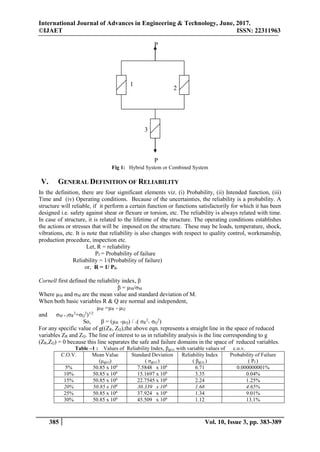
Many structures can be considered as a combination of series and parallel systems. Such systems are
referred to as hybrid or combined systems. The following figure is a schematic of a hybrid system in
which elements 1 and 2 are in parallel, and the combination of 1 and 2 is in series with element 3.
International Journal of Advances in Engineering & Technology, June, 2017.
©IJAET ISSN: 22311963
385 Vol. 10, Issue 3, pp. 383-389
Fig 1: Hybrid System or Combined System
V. GENERAL DEFINITION OF RELIABILITY
In the definition, there are four significant elements viz. (i) Probability, (ii) Intended function, (iii)
Time and (iv) Operating conditions. Because of the uncertainties, the reliability is a probability. A
structure will reliable, if it perform a certain function or functions satisfactorily for which it has been
designed i.e. safety against shear or flexure or torsion, etc. The reliability is always related with time.
In case of structure, it is related to the lifetime of the structure. The operating conditions establishes
the actions or stresses that will be imposed on the structure. These may be loads, temperature, shock,
vibrations, etc. It is note that reliability is also changes with respect to quality control, workmanship,
production procedure, inspection etc.
Let, R = reliability
Pf = Probability of failure
Reliability = 1/(Probability of failure)
or, R = 1/ Pf.
Cornell first defined the reliability index, β
β = µM/σM
Where µM and σM are the mean value and standard deviation of M.
When both basic variables R & Q are normal and independent,
µM =µR - µQ
and σM = (σR
2
+σQ
2
)1/2
So, β = (µR -µQ) / √( σR
2
+ σQ
2
)
For any specific value of g((ZR, ZQ),the above eqn. represents a straight line in the space of reduced
variables ZR and ZQ. The line of interest to us in reliability analysis is the line corresponding to g
(ZR,ZQ) = 0 because this line separates the safe and failure domains in the space of reduced variables.
Table –1 : Values of Reliability Index, βg(x) with variable values of c.o.v.
C.O.V. Mean Value
(µg(x))
Standard Deviation
( σg(x) )
Reliability Index
( βg(x) )
Probability of Failure
( Pf )
5% 50.85 x 10⁶
7.5848 x 10⁶
6.71 0.000000001%
10% 50.85 x 10⁶
15.1697 x 10⁶
3.35 0.04%
15% 50.85 x 10⁶
22.7545 x 10⁶
2.24 1.25%
20% 50.85 x 10⁶
30.339 x 10⁶
1.68 4.65%
25% 50.85 x 10⁶
37.924 x 10⁶
1.34 9.01%
30% 50.85 x 10⁶
45.509 x 10⁶
1.12 13.1%
P
P
3
2
1
International Journal of Advances in Engineering & Technology, June, 2017.
©IJAET ISSN: 22311963
386 Vol. 10, Issue 3, pp. 383-389
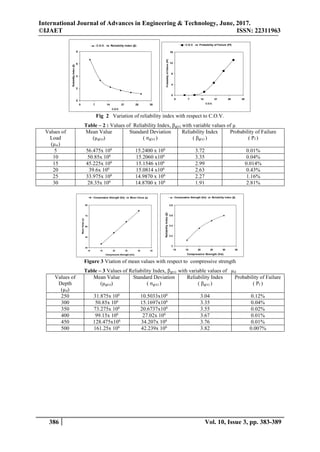
Fig 2 Variation of reliability index with respect to C.O.V.
Table – 2 : Values of Reliability Index, βg(x) with variable values of µ
Values of
Load
(µw)
Mean Value
(µg(x))
Standard Deviation
( σg(x) )
Reliability Index
( βg(x) )
Probability of Failure
( Pf )
5 56.475x 10⁶
15.2400 x 10⁶
3.72 0.01%
10 50.85x 10⁶
15.2060 x10⁶
3.35 0.04%
15 45.225x 10⁶
15.1546 x10⁶
2.99 0.014%
20 39.6x 10⁶
15.0814 x10⁶
2.63 0.43%
25 33.975x 10⁶
14.9870 x 10⁶
2.27 1.16%
30 28.35x 10⁶
14.8700 x 10⁶
1.91 2.81%
Figure 3 Viation of mean values with respect to compressive strength
Table – 3 Values of Reliability Index, βg(x) with variable values of µd
Values of
Depth
(µd)
Mean Value
(µg(x))
Standard Deviation
( σg(x) )
Reliability Index
( βg(x) )
Probability of Failure
( Pf )
250 31.875x 10⁶
10.5033x10⁶
3.04 0.12%
300 50.85x 10⁶
15.1697x10⁶
3.35 0.04%
350 73.275x 10⁶
20.6737x10⁶
3.55 0.02%
400 99.15x 10⁶
27.02x 10⁶
3.67 0.01%
450 128.475x10⁶
34.207x 10⁶
3.76 0.01%
500 161.25x 10⁶
42.239x 10⁶
3.82 0.007%
0
2
4
6
8
0 7 14 21 28 35
C.O.V.
ReliabilityIndex(β)
C.O.V. vs Reliability Index (β)
0
4
8
12
16
0 7 14 21 28 35
C.O.V.
ProbabilityofFailure(Pf)
C.O.V. vs Probability of Failure (Pf)
30
45
60
75
90
10 15 20 25 30 35
Compressive Strength (fck)
MeanValue(µ)
Compressive Strength (fck) vs Mean Value (µ)
3
3.2
3.4
3.6
3.8
10 15 20 25 30 35
Compressive Strength (fck)
ReliabilityIndex(β)
Compressive Strength (fck) vs Reliability Index (β)
International Journal of Advances in Engineering & Technology, June, 2017.
©IJAET ISSN: 22311963
387 Vol. 10, Issue 3, pp. 383-389
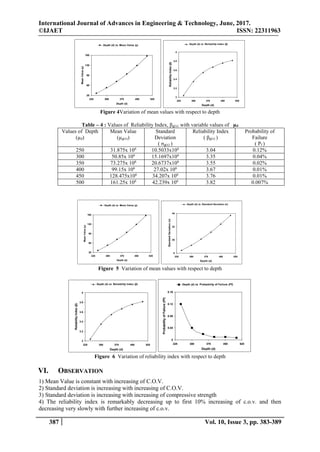
Figure 4Variation of mean values with respect to depth
Table – 4 : Values of Reliability Index, βg(x) with variable values of µd
Values of Depth
(µd)
Mean Value
(µg(x))
Standard
Deviation
( σg(x) )
Reliability Index
( βg(x) )
Probability of
Failure
( Pf )
250 31.875x 10⁶
10.5033x10⁶
3.04 0.12%
300 50.85x 10⁶
15.1697x10⁶
3.35 0.04%
350 73.275x 10⁶
20.6737x10⁶
3.55 0.02%
400 99.15x 10⁶
27.02x 10⁶
3.67 0.01%
450 128.475x10⁶
34.207x 10⁶
3.76 0.01%
500 161.25x 10⁶
42.239x 10⁶
3.82 0.007%
Figure 5 Variation of mean values with respect to depth
Figure 6 Variation of reliability index with respect to depth
VI. OBSERVATION
1) Mean Value is constant with increasing of C.O.V.
2) Standard deviation is increasing with increasing of C.O.V.
3) Standard deviation is increasing with increasing of compressive strength
4) The reliability index is remarkably decreasing up to first 10% increasing of c.o.v. and then
decreasing very slowly with further increasing of c.o.v.
25
60
95
130
165
225 300 375 450 525
Depth (d)
MeanValue(µ)
Depth (d) vs Mean Value (µ)
3
3.2
3.4
3.6
3.8
4
225 300 375 450 525
Depth (d)
ReliabilityIndex(β)
Depth (d) vs Reliability Index (β)
25
60
95
130
165
225 300 375 450 525
Depth (d)
MeanValue(µ)
Depth (d) vs Mean Value (µ)
8
20
32
44
225 300 375 450 525
Depth (d)
StandardDeviation(σ)
Depth (d) vs Standard Deviation (σ)
3
3.2
3.4
3.6
3.8
4
225 300 375 450 525
Depth (d)
ReliabilityIndex(β)
Depth (d) vs Reliability Index (β)
0
0.04
0.08
0.12
0.16
225 300 375 450 525
Depth (d)
ProbabilityofFailure(Pf)
Depth (d) vs Probability of Failure (Pf)
International Journal of Advances in Engineering & Technology, June, 2017.
©IJAET ISSN: 22311963
388 Vol. 10, Issue 3, pp. 383-389
VII. CONCLUSION
The results are the nature of variation are consistent with result obtained by Schueremans (Int.
conf.,Canada, 1999) The decreasing safety index is found to be remarkably more after certain level
of load and uncertainty(instead of a straight line) variation. Hence sensitivity of reliability index is
widely varying depending on the uncertainty and parametric values. Hence extrapolating of reliability
index without knowing its variation is dangerous.
Future Scope of Work: To incorporate different types of uncertainty
Application on realistic structures, e.g. building frame under seismic excitation.
REFERENCES
[1]Allen, J. K., Krishnamachari, R. S., Masseta, J., Pearce, D., Rigby, D., and Mistree, F. (1992). “Fuzzy
Compromise: An Effective Way to Solve Hierarchical Design Problems.”Structural Optimization, 4, 115-120.
[2]Akgül, F., and Frangopol, D. M. (2003). “Rating and reliability of existing bridges in a network.”J. Bridge
Eng., 8(6), 383–393.
[3]Akgül, F., and Frangopol, D. M. (2004). “Computational platform for predicting lifetime system reliability
profiles for different structure types in a network,”J. Comput. Civ. Eng., 18(2), 92–104
[4]Bommer, J. J., and Mendis, R.(2005). “Scaling of spectral displacement ordinates with damping ratios.”
Earthquake Eng. Struct. Dyn., 34(2), 145–165.
[5]Chan, C. M., and Zou, X. K. (2004). “Elastic and inelastic drift performance optimization for reinforced
concrete building under earthquake loads.”Earthquake Eng. Struct. Dyn., 33(8), 929–950.
[6]Cheng, F. Y., and Li, D. _1996_. “Multiobjective optimization of structures with and without control.”J.
Guid. Control Dyn., 19(2), 393–397.
[7]Chopra, A. K., and Goel, R. K. (2002). “A modal pushover analysis procedure for estimating seismic
demands for buildings.” EarthquakeEng. Struct. Dyn., 31(3), 561–582
[8]Chen, Q., Nikolaidis, E., Cudney, H., Rosca, R., and Haftka, R. T. (1998). “Comparison of Probabilistic and
Fuzzy Set-Based Methods for Designing under Uncertainty,” 40 th AIAA/ASME/ASCE/AHS/ASC Structures,
Structural Dynamics, and Materials Conference and Exhibit, St. Louis, MO, 2860-2874.
[9]Das, P. C. (1999). “Prioritization of bridge maintenance needs.”Case studies in optimal design and
maintenance planning of civil infrastructure systems, D. M. Frangopol, ed., ASCE, Reston, Va., 26–44.
[10]Elseifi, M., A., Gurdal, Z., and Nikolaidis, E. (1999). “Convex and Probabilistic Models of Uncertainties in
Geometric Imperfections of Stiffened Composite Panels.” AIAA Journal, 37(4), 468-474.
[11]French, S. (1986). Decision theory: An introduction to the Mathematics of Rationality, Ellis Horwood Ltd.,
Chichester.
[12]Frangopol, D. M. (1997). “Application of life-cycle risk-based criteria to bridge assessment and design.”
Safety of bridges, P. C. Das, ed., Thomas Telford, London, 151–157.
[13]Frangopol, D. M. (1999). “Chapter 9: Life-cycle cost analysis for bridges.”Bridge safety and reliability, D.
M. Frangopol, ed., ASCE, Reston, Va., 210–236.
[14]Giles, R. (1982). “Foundations for a Theory of Possibility.” Fuzzy Information and Decision Processes,
North-Holland.
[15]Gao, X. W., and Bao, A. B. (1985). “Probabilistic model and its statistical parameters for seismic load.”
Earthquake Eng. Eng. Vibration, 5(1), 13–22.
[16]Klir, G. J., and Yuan, B. (1995). "Fuzzy Sets and Fuzzy Logic-Theory and Applications", Prentice Hall,
Upper Saddle River.
[17]Li, G. _1998_. “Reliability and performance based optimal design for seismic high-rising structures.”
Ph.D. dissertation, Dalian Univ. of Technology, China.
[18]Lee, S. H., Min, K. W., Hwang, J. S., and Kim, J. (2004). “Evaluation of equivalent damping ratio of a
structure with added dampers.”Eng. Struct., 26(3), 335–346.
[19]Maglaras, G., Nikolaidis, E., Haftka, R. T., and Cudney, H. H. (1997). “Analytical-Experimental
Comparison of Probabilistic Methods and Fuzzy-Set based Methods for Designing under Uncertainty.”
Structural Optimization, 13(2-3), 69-80.
[20]Maglaras, G., Ponslet, P., Haftka, R. T., Nikolaidis, E., Sensharma, P., and Cudney, H. H. (1996).
“Analytical and Experimental Comparison of Probabilistic and Deterministic Optimization.” AIAA Journal,
34(7), 1512-1518.
[21]Nikolaidis, E., Chen, Q., and Cudney, H. (1999). “Comparison of Bayesian and Possibility-based Methods
for Design Under Uncertainty.” 13th ASCEEngineering Mechanics Division Conference, ASCE, Baltimore,
Maryland.
International Journal of Advances in Engineering & Technology, June, 2017.
©IJAET ISSN: 22311963
389 Vol. 10, Issue 3, pp. 383-389
[22]Nikolaidis, E., Hernandez, R. R., and Maglaras, G. (1995) “Comparison of Methods for Reliability
Assessment under Incomplete Information.”AIAA/ ASME/ ASCE/ AHS/ ASC, 36th Structures, Structural
Dynamics and Materials Conference, 1346-1353.
[23]Structural Engineers Association of California (SEAOC). (1995). Vision 2000, "performance based seismic
engineering of buildings". Part 2: Conceptual framework, Sacramento, Calif.
[24]Thoft-Christensen, P., Jensen, F. M., Middleton, C. R., and Blackmore, A. (1997). “Assessment of the
reliability of concrete slab bridges. Reliabilityand optimization of structural systems", D. M. Frangopol, R. B.
[25]Wen, Y. K., and Kang, Y. J. (2001). “Minimum building life-cycle cost design criteria. I: Methodology.” J.
Struct. Eng., 127(3), 330–337.
[26]Zou, X. K., and Chan, C. M. (2005a). “An optimal resizing technique for seismic drift design of concrete
buildings subjected to response spectrum and time history loadings.”Comput. Struct., 83, 1689–1704.
SAMPLE AUTHORS BIOGRAPHY
BISWAJIT BARMAN, was born in MALDA, West Bengal, India ,in the Year. 8th
January
1964. Passed BE(Civil Engg.) from Jalpaiguri Govt. Engg. College, Jalpaiguri under the
University of North Bengal in 1989. And passed ME(in Structure) from BESU, Shibpur,
Howrahin the year 2008 Presently I am working as an Asst. Prof. in CE Dept. at MCET,
Berhampur, Murshidabad West Bengal, India and try to complete my Ph. D. Work from NIT
Durgapur.

STRUCTURAL RELIABILITY ASSESSMENT WITH STOCHASTIC PARAMETERS

  • 1.
    International Journal ofAdvances in Engineering & Technology, June, 2017. ©IJAET ISSN: 22311963 383 Vol. 10, Issue 3, pp. 383-389 STRUCTURAL RELIABILITY ASSESSMENT WITH STOCHASTIC PARAMETERS Biswajit Barman Asst. Prof., Dept. of Civil Engineering, Bengal College of Engineering &Technology, Durgapur, West Bengal, India. ABSTRACT The performance of a structure [23] is assessed by its safety [1], serviceability [1] and economy [1]. Since we do not know the exact details of loads [4] acting on a structure at any time, there is always some uncertainty about the total loads on structure. Thus random variables (means stochastic variable) of loads and other parameters are the main criteria of design variables [18]. They vary with space and time. The input variables is never certain and complete. The safety factor provided in the existing codes and standers primarily based on practice, judgment and experience, may not be adequate and economical. Using the techniques presented earlier, we can design or analyze individual members in the contest of structural reliability [2][3][22][24]. However we are not examined how the system performs [23] or how to calculate the reliability of the structure as a whole. KEYWORDS: Economy, Loads, Random Variables, Reliability, Stochastic, Safety, Uncertainty. I. INTRODUCTION The design parameters[21] of loading and load carrying capacities of structural members are not deterministic[20] quantities, but variable quantities except dead load (i.e. self weight of structure). Since we do not know the exact details of loads acting on a structure at any time, there is always some uncertainty about the total loads on structure. Thus random variable of loads are the main criterion of design variables. Hence safety of structure is uncertain. A reasonable safety level is always accepted which recommends IS Code. When safety of structure becomes certain, there is zero probability of failure[12]. It means that reducing the probability of failure is the increasing of reliability i.e. structural safety[12] level. II. PROBABILITY THEORY Partially knowing about an event sometimes we make statements are probabilistic[8][15][19][20] in nature, such as a child to born will be a son, or it may rain tomorrow, or India will win in a cricket match, or a bus will arrive on time, and so on. Now questions may arise, what is the characteristic feature in all the above phenomena? Answer is that they all lack a deterministic nature. The above phenomena are random phenomena. In the deterministic study parameters, parameters may be considered as a function of time (i.e. time variant). Similarly probabilistic study are time variant but in some cases it is time variant (e.g. Wind load, earthquake load etc.). When a random variable assumes values as a function of time the variable is called a stochastic variables III. LITERATURE REVIEW In the earlier days engineers were not confident to applying probability theory or evaluating of safety. A master builder often tried to copy a successful structure. Heavy stone arches often had a considerable safety reserve. Actually the procedure was essentially trial and error method. The first
  • 2.
    International Journal ofAdvances in Engineering & Technology, June, 2017. ©IJAET ISSN: 22311963 384 Vol. 10, Issue 3, pp. 383-389 mathematical formulation of structural safety problem can be attributed to Mayer(1926), Streletzki(1947). They recognized that load and resistance parameters are random variables and therefore, for each structure, there is a finite probability of failure. It was further developed by Freudenthal (1950) Deepthi C. Epaarachchi et .al.(2002) develops a probabilistic model to estimate the probability of structural collapse significant proportion of reinforced concrete Building structural failures occur during construction Carper 1997 observe, a system failure will occur when the slab capacity in flexure or shear is exceeded. Failure of shores or re-shore nonstructural element failure is not considered a system failure unless it leads to structural failure of the slab. J.W. van de Lindt et .al.(2004) develops a basic method to better estimate the effect of earthquake duration on structural reliability using (1) an ultimate strength and a (2) low-cycle structural damage-based on limit state function. This study is unique in that it allows variation in the peaks of the highly non-linear structural response without actually performing time domain analyses, which are commonly employed in earthquake engineering analysis. A simple measure was introduced and termed the duration effect factor (DEFβ) and is defined as the slope of a best-fit line for multiple reliability indices plotted against duration. IV. OVERVIEW PROBABILITY DENSITY FUNCTION (PDF): For continuous random variables, the probability density function (PDF) is defined as the first derivative of cumulative distribution function(CDF). The PDF [fx(x)] and the CDF [Fx (x)] for continuous random variables are related as follows. Standard deviation of random variable, ‘X.’ The standard deviation of X is defined as the positive square root of the variance: σx =√ σx 2 The non dimensional co-efficient of variation Vx, is defined as the standard deviation divided by the mean Vx = σx/µx This parameter is always taken to be positive by convention even through the mean may be negative. An important relationship existing among the mean, variance, and second moment of a random variable X: σx 2 =[E (X2 ) - µx 2 ] HYBRID SYSTEM ORCOMBINEDSYSTEM Many structures can be considered as a combination of series and parallel systems. Such systems are referred to as hybrid or combined systems. The following figure is a schematic of a hybrid system in which elements 1 and 2 are in parallel, and the combination of 1 and 2 is in series with element 3.
  • 3.
    International Journal ofAdvances in Engineering & Technology, June, 2017. ©IJAET ISSN: 22311963 385 Vol. 10, Issue 3, pp. 383-389 Fig 1: Hybrid System or Combined System V. GENERAL DEFINITION OF RELIABILITY In the definition, there are four significant elements viz. (i) Probability, (ii) Intended function, (iii) Time and (iv) Operating conditions. Because of the uncertainties, the reliability is a probability. A structure will reliable, if it perform a certain function or functions satisfactorily for which it has been designed i.e. safety against shear or flexure or torsion, etc. The reliability is always related with time. In case of structure, it is related to the lifetime of the structure. The operating conditions establishes the actions or stresses that will be imposed on the structure. These may be loads, temperature, shock, vibrations, etc. It is note that reliability is also changes with respect to quality control, workmanship, production procedure, inspection etc. Let, R = reliability Pf = Probability of failure Reliability = 1/(Probability of failure) or, R = 1/ Pf. Cornell first defined the reliability index, β β = µM/σM Where µM and σM are the mean value and standard deviation of M. When both basic variables R & Q are normal and independent, µM =µR - µQ and σM = (σR 2 +σQ 2 )1/2 So, β = (µR -µQ) / √( σR 2 + σQ 2 ) For any specific value of g((ZR, ZQ),the above eqn. represents a straight line in the space of reduced variables ZR and ZQ. The line of interest to us in reliability analysis is the line corresponding to g (ZR,ZQ) = 0 because this line separates the safe and failure domains in the space of reduced variables. Table –1 : Values of Reliability Index, βg(x) with variable values of c.o.v. C.O.V. Mean Value (µg(x)) Standard Deviation ( σg(x) ) Reliability Index ( βg(x) ) Probability of Failure ( Pf ) 5% 50.85 x 10⁶ 7.5848 x 10⁶ 6.71 0.000000001% 10% 50.85 x 10⁶ 15.1697 x 10⁶ 3.35 0.04% 15% 50.85 x 10⁶ 22.7545 x 10⁶ 2.24 1.25% 20% 50.85 x 10⁶ 30.339 x 10⁶ 1.68 4.65% 25% 50.85 x 10⁶ 37.924 x 10⁶ 1.34 9.01% 30% 50.85 x 10⁶ 45.509 x 10⁶ 1.12 13.1% P P 3 2 1
  • 4.
    International Journal ofAdvances in Engineering & Technology, June, 2017. ©IJAET ISSN: 22311963 386 Vol. 10, Issue 3, pp. 383-389 Fig 2 Variation of reliability index with respect to C.O.V. Table – 2 : Values of Reliability Index, βg(x) with variable values of µ Values of Load (µw) Mean Value (µg(x)) Standard Deviation ( σg(x) ) Reliability Index ( βg(x) ) Probability of Failure ( Pf ) 5 56.475x 10⁶ 15.2400 x 10⁶ 3.72 0.01% 10 50.85x 10⁶ 15.2060 x10⁶ 3.35 0.04% 15 45.225x 10⁶ 15.1546 x10⁶ 2.99 0.014% 20 39.6x 10⁶ 15.0814 x10⁶ 2.63 0.43% 25 33.975x 10⁶ 14.9870 x 10⁶ 2.27 1.16% 30 28.35x 10⁶ 14.8700 x 10⁶ 1.91 2.81% Figure 3 Viation of mean values with respect to compressive strength Table – 3 Values of Reliability Index, βg(x) with variable values of µd Values of Depth (µd) Mean Value (µg(x)) Standard Deviation ( σg(x) ) Reliability Index ( βg(x) ) Probability of Failure ( Pf ) 250 31.875x 10⁶ 10.5033x10⁶ 3.04 0.12% 300 50.85x 10⁶ 15.1697x10⁶ 3.35 0.04% 350 73.275x 10⁶ 20.6737x10⁶ 3.55 0.02% 400 99.15x 10⁶ 27.02x 10⁶ 3.67 0.01% 450 128.475x10⁶ 34.207x 10⁶ 3.76 0.01% 500 161.25x 10⁶ 42.239x 10⁶ 3.82 0.007% 0 2 4 6 8 0 7 14 21 28 35 C.O.V. ReliabilityIndex(β) C.O.V. vs Reliability Index (β) 0 4 8 12 16 0 7 14 21 28 35 C.O.V. ProbabilityofFailure(Pf) C.O.V. vs Probability of Failure (Pf) 30 45 60 75 90 10 15 20 25 30 35 Compressive Strength (fck) MeanValue(µ) Compressive Strength (fck) vs Mean Value (µ) 3 3.2 3.4 3.6 3.8 10 15 20 25 30 35 Compressive Strength (fck) ReliabilityIndex(β) Compressive Strength (fck) vs Reliability Index (β)
  • 5.
    International Journal ofAdvances in Engineering & Technology, June, 2017. ©IJAET ISSN: 22311963 387 Vol. 10, Issue 3, pp. 383-389 Figure 4Variation of mean values with respect to depth Table – 4 : Values of Reliability Index, βg(x) with variable values of µd Values of Depth (µd) Mean Value (µg(x)) Standard Deviation ( σg(x) ) Reliability Index ( βg(x) ) Probability of Failure ( Pf ) 250 31.875x 10⁶ 10.5033x10⁶ 3.04 0.12% 300 50.85x 10⁶ 15.1697x10⁶ 3.35 0.04% 350 73.275x 10⁶ 20.6737x10⁶ 3.55 0.02% 400 99.15x 10⁶ 27.02x 10⁶ 3.67 0.01% 450 128.475x10⁶ 34.207x 10⁶ 3.76 0.01% 500 161.25x 10⁶ 42.239x 10⁶ 3.82 0.007% Figure 5 Variation of mean values with respect to depth Figure 6 Variation of reliability index with respect to depth VI. OBSERVATION 1) Mean Value is constant with increasing of C.O.V. 2) Standard deviation is increasing with increasing of C.O.V. 3) Standard deviation is increasing with increasing of compressive strength 4) The reliability index is remarkably decreasing up to first 10% increasing of c.o.v. and then decreasing very slowly with further increasing of c.o.v. 25 60 95 130 165 225 300 375 450 525 Depth (d) MeanValue(µ) Depth (d) vs Mean Value (µ) 3 3.2 3.4 3.6 3.8 4 225 300 375 450 525 Depth (d) ReliabilityIndex(β) Depth (d) vs Reliability Index (β) 25 60 95 130 165 225 300 375 450 525 Depth (d) MeanValue(µ) Depth (d) vs Mean Value (µ) 8 20 32 44 225 300 375 450 525 Depth (d) StandardDeviation(σ) Depth (d) vs Standard Deviation (σ) 3 3.2 3.4 3.6 3.8 4 225 300 375 450 525 Depth (d) ReliabilityIndex(β) Depth (d) vs Reliability Index (β) 0 0.04 0.08 0.12 0.16 225 300 375 450 525 Depth (d) ProbabilityofFailure(Pf) Depth (d) vs Probability of Failure (Pf)
  • 6.
    International Journal ofAdvances in Engineering & Technology, June, 2017. ©IJAET ISSN: 22311963 388 Vol. 10, Issue 3, pp. 383-389 VII. CONCLUSION The results are the nature of variation are consistent with result obtained by Schueremans (Int. conf.,Canada, 1999) The decreasing safety index is found to be remarkably more after certain level of load and uncertainty(instead of a straight line) variation. Hence sensitivity of reliability index is widely varying depending on the uncertainty and parametric values. Hence extrapolating of reliability index without knowing its variation is dangerous. Future Scope of Work: To incorporate different types of uncertainty Application on realistic structures, e.g. building frame under seismic excitation. REFERENCES [1]Allen, J. K., Krishnamachari, R. S., Masseta, J., Pearce, D., Rigby, D., and Mistree, F. (1992). “Fuzzy Compromise: An Effective Way to Solve Hierarchical Design Problems.”Structural Optimization, 4, 115-120. [2]Akgül, F., and Frangopol, D. M. (2003). “Rating and reliability of existing bridges in a network.”J. Bridge Eng., 8(6), 383–393. [3]Akgül, F., and Frangopol, D. M. (2004). “Computational platform for predicting lifetime system reliability profiles for different structure types in a network,”J. Comput. Civ. Eng., 18(2), 92–104 [4]Bommer, J. J., and Mendis, R.(2005). “Scaling of spectral displacement ordinates with damping ratios.” Earthquake Eng. Struct. Dyn., 34(2), 145–165. [5]Chan, C. M., and Zou, X. K. (2004). “Elastic and inelastic drift performance optimization for reinforced concrete building under earthquake loads.”Earthquake Eng. Struct. Dyn., 33(8), 929–950. [6]Cheng, F. Y., and Li, D. _1996_. “Multiobjective optimization of structures with and without control.”J. Guid. Control Dyn., 19(2), 393–397. [7]Chopra, A. K., and Goel, R. K. (2002). “A modal pushover analysis procedure for estimating seismic demands for buildings.” EarthquakeEng. Struct. Dyn., 31(3), 561–582 [8]Chen, Q., Nikolaidis, E., Cudney, H., Rosca, R., and Haftka, R. T. (1998). “Comparison of Probabilistic and Fuzzy Set-Based Methods for Designing under Uncertainty,” 40 th AIAA/ASME/ASCE/AHS/ASC Structures, Structural Dynamics, and Materials Conference and Exhibit, St. Louis, MO, 2860-2874. [9]Das, P. C. (1999). “Prioritization of bridge maintenance needs.”Case studies in optimal design and maintenance planning of civil infrastructure systems, D. M. Frangopol, ed., ASCE, Reston, Va., 26–44. [10]Elseifi, M., A., Gurdal, Z., and Nikolaidis, E. (1999). “Convex and Probabilistic Models of Uncertainties in Geometric Imperfections of Stiffened Composite Panels.” AIAA Journal, 37(4), 468-474. [11]French, S. (1986). Decision theory: An introduction to the Mathematics of Rationality, Ellis Horwood Ltd., Chichester. [12]Frangopol, D. M. (1997). “Application of life-cycle risk-based criteria to bridge assessment and design.” Safety of bridges, P. C. Das, ed., Thomas Telford, London, 151–157. [13]Frangopol, D. M. (1999). “Chapter 9: Life-cycle cost analysis for bridges.”Bridge safety and reliability, D. M. Frangopol, ed., ASCE, Reston, Va., 210–236. [14]Giles, R. (1982). “Foundations for a Theory of Possibility.” Fuzzy Information and Decision Processes, North-Holland. [15]Gao, X. W., and Bao, A. B. (1985). “Probabilistic model and its statistical parameters for seismic load.” Earthquake Eng. Eng. Vibration, 5(1), 13–22. [16]Klir, G. J., and Yuan, B. (1995). "Fuzzy Sets and Fuzzy Logic-Theory and Applications", Prentice Hall, Upper Saddle River. [17]Li, G. _1998_. “Reliability and performance based optimal design for seismic high-rising structures.” Ph.D. dissertation, Dalian Univ. of Technology, China. [18]Lee, S. H., Min, K. W., Hwang, J. S., and Kim, J. (2004). “Evaluation of equivalent damping ratio of a structure with added dampers.”Eng. Struct., 26(3), 335–346. [19]Maglaras, G., Nikolaidis, E., Haftka, R. T., and Cudney, H. H. (1997). “Analytical-Experimental Comparison of Probabilistic Methods and Fuzzy-Set based Methods for Designing under Uncertainty.” Structural Optimization, 13(2-3), 69-80. [20]Maglaras, G., Ponslet, P., Haftka, R. T., Nikolaidis, E., Sensharma, P., and Cudney, H. H. (1996). “Analytical and Experimental Comparison of Probabilistic and Deterministic Optimization.” AIAA Journal, 34(7), 1512-1518. [21]Nikolaidis, E., Chen, Q., and Cudney, H. (1999). “Comparison of Bayesian and Possibility-based Methods for Design Under Uncertainty.” 13th ASCEEngineering Mechanics Division Conference, ASCE, Baltimore, Maryland.
  • 7.
    International Journal ofAdvances in Engineering & Technology, June, 2017. ©IJAET ISSN: 22311963 389 Vol. 10, Issue 3, pp. 383-389 [22]Nikolaidis, E., Hernandez, R. R., and Maglaras, G. (1995) “Comparison of Methods for Reliability Assessment under Incomplete Information.”AIAA/ ASME/ ASCE/ AHS/ ASC, 36th Structures, Structural Dynamics and Materials Conference, 1346-1353. [23]Structural Engineers Association of California (SEAOC). (1995). Vision 2000, "performance based seismic engineering of buildings". Part 2: Conceptual framework, Sacramento, Calif. [24]Thoft-Christensen, P., Jensen, F. M., Middleton, C. R., and Blackmore, A. (1997). “Assessment of the reliability of concrete slab bridges. Reliabilityand optimization of structural systems", D. M. Frangopol, R. B. [25]Wen, Y. K., and Kang, Y. J. (2001). “Minimum building life-cycle cost design criteria. I: Methodology.” J. Struct. Eng., 127(3), 330–337. [26]Zou, X. K., and Chan, C. M. (2005a). “An optimal resizing technique for seismic drift design of concrete buildings subjected to response spectrum and time history loadings.”Comput. Struct., 83, 1689–1704. SAMPLE AUTHORS BIOGRAPHY BISWAJIT BARMAN, was born in MALDA, West Bengal, India ,in the Year. 8th January 1964. Passed BE(Civil Engg.) from Jalpaiguri Govt. Engg. College, Jalpaiguri under the University of North Bengal in 1989. And passed ME(in Structure) from BESU, Shibpur, Howrahin the year 2008 Presently I am working as an Asst. Prof. in CE Dept. at MCET, Berhampur, Murshidabad West Bengal, India and try to complete my Ph. D. Work from NIT Durgapur.