International Research Journal of Engineering and Technology (IRJET) e-ISSN: 2395-0056
Volume: 05 Issue: 11 | Nov 2018 www.irjet.net p-ISSN: 2395-0072
© 2018, IRJET | Impact Factor value: 7.211 | ISO 9001:2008 Certified Journal | Page 988
Dynamic Properties of Cellular Lightweight Concrete
Anjali S1, Anu V V2
1UG student, Civil Department, Toc H Institute of Science and Technology
2Asst. Professor, Civil Department, Toc H Institute of Science and Technology
---------------------------------------------------------------------***---------------------------------------------------------------------
Abstract - Cellular lightweight concrete also known as
foamed concrete, foamcrete or reduced density concrete is a
cement-based slurry with a minimum of 20% foam entrained
into mortar. They have been used widely in construction
industry for over decades. They find applications in various
forms due to their lightweight, thermal and sound insulation
properties. They are eco-friendly as well as cost efficient. This
paper aims in the study of various dynamic properties of
cellular lightweight concrete. The dynamic properties with
different strain rate can be studied using Split Hoopkins
Pressure Bar (SHPB). Dynamiccompressivestrengthincreases
with strain. Impact and toughness of lightweight cellular
concrete also increases with strain rate under impactloading.
Key Words: Cellularlightweightconcrete,strength,dynamic,
strain rate, impact, toughness.
1. INTRODUCTION
CellularLightweightConcreteismanufacturedby mixing
Portland cement, sand, fly ash, water and performedfoam in
varied proportions. The air content is maintained between
40-80% of the total volume. The amount of foaming agent
added to the concrete mixture will determine the amount of
air trapped in, which can range from 10% to 70%. The
density of CLC ranges between 400 and 1800 Kg/m3. The
ratio of the foam to the neat cement slurry controls the unit
weight of the lightweight cellular concrete CLC reduces the
self-weight of the structure whichminimizesthedimensions
of the structural members. CLC can be used as thermal
insulation in the form of bricks and blocks,bulk fillingfor old
sewer pipes walls unused cellar and basements storage
tanks etc. Main applications are as backfill of retaining wall
lightweight pavements, landslip repairs, bridge approach
and to provide shock absorptionurgesustofinditsresponse
to dynamic loads.
2. TEST METHODS
2.1 Split Hoopkins Pressure Bar
Fig-1: 100 mm-diameter SHPB apparatus
Er-Le-Bai et al, (2018). The apparatus consists ofmain body,
energy source and measurement systems. The length of
projectile is 500mm, diameterofcompressionbaris100mm.
The basic principle of SHPB is propagation theory of elastic
stress waves on the bar. The test is based on two
assumptions 1) plane assumption: in the propagation
process, each cross-section of elastic bars is always kept in
plane state 2) equal stress assumption: stress in specimen is
equal everywhere.
Er-Le-Bai et al, (2018). The specimen is placed between the
input and the output bars. When the striker bar is pulsed by
high pressure gas from the tank it strikes the input bar and
for an elastic stress wave which then spreads through the
input bar. On reaching the interface between the input bar
and the specimen, some wave passes though the interface to
reach the specimen while the restgetsreflectedback intothe
input bar. The same process takes place at the interface
between output and specimen. This process is continued
until it reaches a state of equilibrium.
Changchun Shi et al, (2017). For comparativestudyconcrete
specimens with densities of 360 kg/m3, 570 kg/m3,
820kg/m3 are considered.
2.2 Cyclic Simple Shear Testing
It is an automated computer-controlled apparatus which
uses a stack of 31 Teflon rings each 0.94mm thick which
confine the specimen laterally. A servo-motor is used to
apply the horizontal loads and a micro-stepper is used to
apply vertical loads.
Binod Tiwari et al, (2018). The specimens are placed on the
rubber membrane confined by the sack of Teflon rings and
secured in the apparatus. The computer connected to the
device displays the real time logarithm of time versus
displacement curves which are used to determine the end of
primary consolidation.
At this point the cyclic loading phase begins. Chat-1
represents the cyclic loading function. These cyclic loading
contains a series of sinusoidal waves with a frequency of 0.5
Hz. The sinusoidal waves had double amplitude shear strain
values of 0.08, 0.10, 0.12, 0.14, 0.16, 0.18, 0.20, 0.30, 0.40,
0.50, 0.60, 0.70, 0.80, 0.90, and 1.00%.
International Research Journal of Engineering and Technology (IRJET) e-ISSN: 2395-0056
Volume: 05 Issue: 11 | Nov 2018 www.irjet.net p-ISSN: 2395-0072
© 2018, IRJET | Impact Factor value: 7.211 | ISO 9001:2008 Certified Journal | Page 989
Chart-1: . Cyclic loading function used in the cyclic simple
shear tests conducted
3. DYAMIC PROPERTIES
3.1 Stress-strain curve
Changchun Shi et al, (2017) The nominal stress strain curve
for CLC with three differentdensitiesareillustratedinChart-
2. Nominal stress-strain refers to the stress and strain that
are not taken into account for the geometric discontinuity of
the mater
Chart-2: Nominal stress-strain curves of CLC with three
different densities
At the initial stages of material compression, the stress-
strain curves show a linear and rapid growth trend, stress
reaches its peak value for a small rate of strain. Microcracks
appear on the material at this stage and stressconcentration
begins to appear in local areas. When the local stress is
greater than the breaking strength of the material, macro-
cracks appear in the concrete and lead to brittle fracture. At
this moment, the nominal stress-strain curve of the material
suddenly to a certain point and the curve gradually
stabilizes, but it does not reach 0, this shows that there is no
instantaneous failure whenthepressureexceedsitsultimate
compressive strengthandthereisstill somebearingcapacity
left.
The second stage which is the platform stage is where
energy is absorbed by the concrete. The stresses are
decreased significantly at this stage, and then the stress
continuously oscillates at a low level, which indicates that
there are both strain-hardening as well as strain-softening
behaviors in this stage. Macro appears at this stage which
causes surface spalling. Towards the end of this stage most
of the cells are destroyed and the cell walls touch and rub
with each other and the external load is borne by the
deformation of concrete mass.Duringthedensificationstage
the stress-strain curve shows a rebound. Greaterthedensity
of concrete earlier will be the densification stage.
Chart-3: Dynamic stress-strain curves at different impact
velocities
From Chart- 3 it is inferred that the dynamic strength of CLC
is small.
Chart-4: Strain rate curves at different impact velocities
As from Chart-4 it can be seen that the strainrateandimpact
velocity in concrete show a positive correlation.
3.1.1 Strength Properties
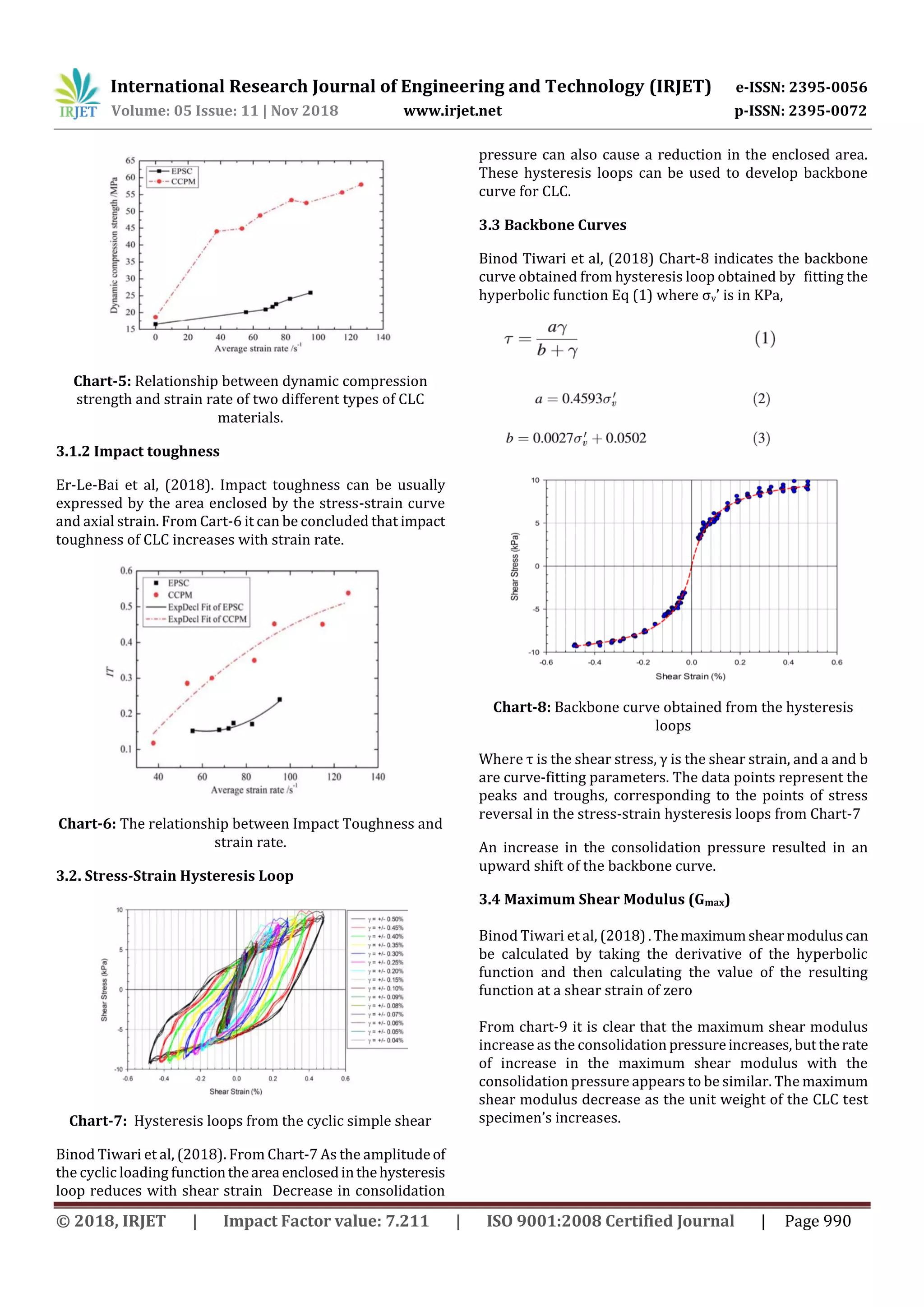
Er-Le-Bai et al, (2018) The dynamic compressive strengthis
defined as the peak stress in the dynamiccompressioncurve
and is one of the major indicator that reflects the dynamic
strength of the material.
From chart-6 It can be seen that the dynamic compression
strength increases with an increase in strain rate.
International Research Journal of Engineering and Technology (IRJET) e-ISSN: 2395-0056
Volume: 05 Issue: 11 | Nov 2018 www.irjet.net p-ISSN: 2395-0072
© 2018, IRJET | Impact Factor value: 7.211 | ISO 9001:2008 Certified Journal | Page 990
Chart-5: Relationship between dynamic compression
strength and strain rate of two different types of CLC
materials.
3.1.2 Impact toughness
Er-Le-Bai et al, (2018). Impact toughness can be usually
expressed by the area enclosed by the stress-strain curve
and axial strain. From Cart-6 it can be concluded that impact
toughness of CLC increases with strain rate.
Chart-6: The relationship between Impact Toughness and
strain rate.
3.2. Stress-Strain Hysteresis Loop
Chart-7: Hysteresis loops from the cyclic simple shear
Binod Tiwari et al, (2018). From Chart-7 As the amplitudeof
the cyclic loading functionthearea enclosedinthehysteresis
loop reduces with shear strain Decrease in consolidation
pressure can also cause a reduction in the enclosed area.
These hysteresis loops can be used to develop backbone
curve for CLC.
3.3 Backbone Curves
Binod Tiwari et al, (2018) Chart-8 indicates the backbone
curve obtained from hysteresis loop obtained by fitting the
hyperbolic function Eq (1) where σv’ is in KPa,
Chart-8: Backbone curve obtained from the hysteresis
loops
Where τ is the shear stress, γ is the shear strain, and a and b
are curve-fitting parameters. The data points represent the
peaks and troughs, corresponding to the points of stress
reversal in the stress-strain hysteresis loops from Chart-7
An increase in the consolidation pressure resulted in an
upward shift of the backbone curve.
3.4 Maximum Shear Modulus (Gmax)
Binod Tiwari et al, (2018) .Themaximumshearmoduluscan
be calculated by taking the derivative of the hyperbolic
function and then calculating the value of the resulting
function at a shear strain of zero
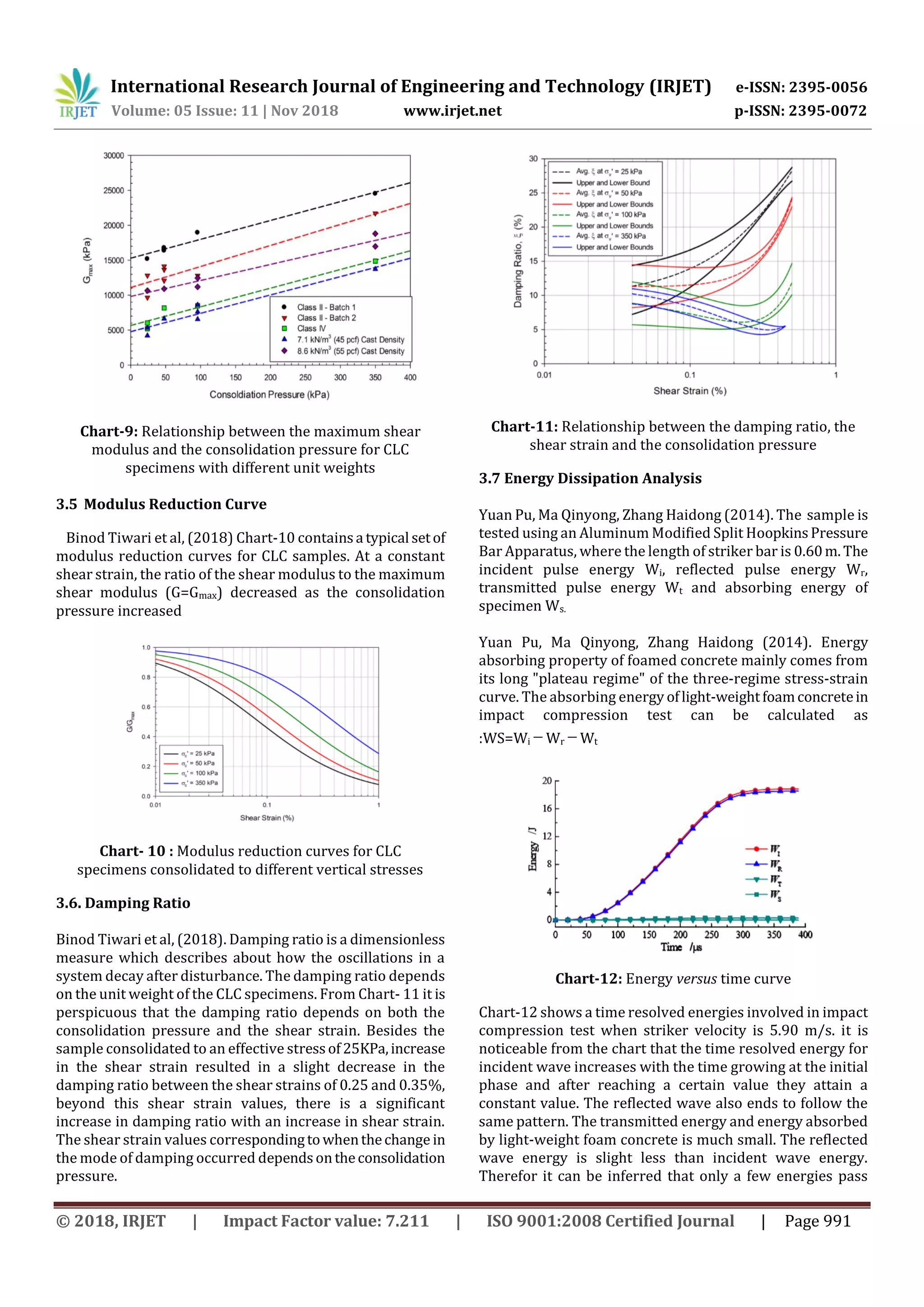
From chart-9 it is clear that the maximum shear modulus
increase as the consolidation pressureincreases, buttherate
of increase in the maximum shear modulus with the
consolidation pressure appears to be similar. The maximum
shear modulus decrease as the unit weight of the CLC test
specimen’s increases.
International Research Journal of Engineering and Technology (IRJET) e-ISSN: 2395-0056
Volume: 05 Issue: 11 | Nov 2018 www.irjet.net p-ISSN: 2395-0072
© 2018, IRJET | Impact Factor value: 7.211 | ISO 9001:2008 Certified Journal | Page 991
Chart-9: Relationship between the maximum shear
modulus and the consolidation pressure for CLC
specimens with different unit weights
3.5 Modulus Reduction Curve
Binod Tiwari et al, (2018) Chart-10 containsa typical setof
modulus reduction curves for CLC samples. At a constant
shear strain, the ratio of the shear modulus to the maximum
shear modulus (G=Gmax) decreased as the consolidation
pressure increased
Chart- 10 : Modulus reduction curves for CLC
specimens consolidated to different vertical stresses
3.6. Damping Ratio
Binod Tiwari et al, (2018). Damping ratio is a dimensionless
measure which describes about how the oscillations in a
system decay after disturbance. The damping ratio depends
on the unit weight of the CLC specimens. From Chart- 11 it is
perspicuous that the damping ratio depends on both the
consolidation pressure and the shear strain. Besides the
sample consolidated to an effective stressof25KPa,increase
in the shear strain resulted in a slight decrease in the
damping ratio between the shear strains of 0.25 and 0.35%,
beyond this shear strain values, there is a significant
increase in damping ratio with an increase in shear strain.
The shear strain values correspondingtowhenthechange in
the mode of damping occurred dependsontheconsolidation
pressure.
Chart-11: Relationship between the damping ratio, the
shear strain and the consolidation pressure
3.7 Energy Dissipation Analysis
Yuan Pu, Ma Qinyong, Zhang Haidong (2014). The sample is
tested using an Aluminum Modified Split HoopkinsPressure
Bar Apparatus, where the length of striker bar is 0.60m.The
incident pulse energy Wi, reflected pulse energy Wr,
transmitted pulse energy Wt and absorbing energy of
specimen Ws.
Yuan Pu, Ma Qinyong, Zhang Haidong (2014). Energy
absorbing property of foamed concrete mainly comes from
its long "plateau regime" of the three-regime stress-strain
curve. The absorbing energy oflight-weightfoamconcretein
impact compression test can be calculated as
:WS=Wi-Wr-Wt
Chart-12: Energy versus time curve
Chart-12 shows a time resolved energies involved in impact
compression test when striker velocity is 5.90 m/s. it is
noticeable from the chart that the time resolved energy for
incident wave increases with the time growing at the initial
phase and after reaching a certain value they attain a
constant value. The reflected wave also ends to follow the
same pattern. The transmitted energy and energy absorbed
by light-weight foam concrete is much small. The reflected
wave energy is slight less than incident wave energy.
Therefor it can be inferred that only a few energies pass
International Research Journal of Engineering and Technology (IRJET) e-ISSN: 2395-0056
Volume: 05 Issue: 11 | Nov 2018 www.irjet.net p-ISSN: 2395-0072
© 2018, IRJET | Impact Factor value: 7.211 | ISO 9001:2008 Certified Journal | Page 992
through the specimen to reach the output bar most of the
incident energy is reflected back into the input bar. EAR
decreases as the incident wave energy Wi increasing in a
negative power relation approach. In the initial phase EAR
decreases in a fast rate, then becomes constant after
reaching a certain point. Anotherscatterdiagramisdrawnin
a similar way with striker velocity on x-axis and EAR on the
y-axis as shown in chat 13 b). EAR decreases as the striker
velocity v increases.
a)
b)
Chart-13: Curve of EAR vs Wi
3.8 Shrinkage Deformation in CLC
A I Kudyakov and A B Steshenko (2015). The primary cause
of shrinkage deformation of foam concrete of natural
hardening are cracks occurring in concrete’s interporous
partition walls during the technological processing of raw
materials and hardening of the cement stone. The energy of
any loaded volume is converted into crack and leads to the
destruction of the material.
Raj Vardhan Singh Chandel, Rashmi Sakale (2016 ) Due to
the intensive percolation of wall pores it causes the pores to
combine to form larger pores which increases the shrinkage
and causes the deterioration of its operational properties. A
significant decrease in the values of shrinkage strain of the
foam concrete during the natural hardening can predict a
reduced level of stresses formation in the structure of foam
concrete. Shrinkage deformation of CLCoccursduetocracks
occurring in concrete’s interporous partition walls.
4. CONCLUSIONS
The shape of the backbone curve depended significantly on
effective normal stress. The maximum shear modulus
increased with a decrease in unit weight of the CLC material
and an increase in the effective normal stress. Reduction in
the shear modulus with the shear strain also depends on the
effective normal stress. The damping ratio which decreases
with increasing shear strain for shear strains less than
0.25% to 0.35%. On the other hand, for shear strainsgreater
than 0.25% to 0.35%, the damping ratio increases with an
increase in the shear strain.
The reflected wave energy Wr as from SHPB test is in same
order of magnitude with incident wave energy WI and their
values are almost the same. Energy absorption rate EAR of
CLC decreases with incident wave energy Wi. There is also a
similar relation between Energy absorption rate EAR and
striker velocity v. The whole processofuniaxial compression
of foam concrete is divided into three stages, namely the
material’s elastic and plastic stage, the platform stage, and
the material densification stage.
REFERENCES
[1] Binod Tiwari, Beena Ajmera, Diego Villegas (2018):
Dynamic properties of lightweight cellular concrete for
geotechnical applications. ASCE journal of materials in
civil engineering Vol 30 (2)
[2] Changchun Shi, Xinghai Song, Chengjie Wang (2017):
study on Quasi static and Dynamic mechanical
properties of chemical foaming concrete. Chemical
engineering transactions Vol 6.
[3] Er-Lei bai, Jin-Yu Xu, Song Lu, Ke-Xin Lin and Yi-Ming
Zhang (2018); Comparative study on the dynamic
properties of lightweight porous concrete. The Royal
Society of Chemistry (26).
[4] Raj Vardhan Singh Chandel, Rashmi Sakale (2016);
study of cellular lightweight concrete. International
Journal for scientific research & development Vol 4,
(07).
[5] Yuan Pu, Ma Qinyong, Zhang Haidong (2014); Energy
Dissipation Analyses on Lightweight Foam Concrete
under Impact Loads. Electronic Journal of Geotechnical
Engineering Vol 19.
[6] A I Kudyakov and A B Steshenko (2015), ʻʻShrinkage
deformation of cement foam concrete’’. Proceedings of
IOP Conf. Series: Materials Science and Engineering 71
in Tomsk, Russia.

IRJET- Dynamic Properties of Cellular Lightweight Concrete

  • 1.
    International Research Journalof Engineering and Technology (IRJET) e-ISSN: 2395-0056 Volume: 05 Issue: 11 | Nov 2018 www.irjet.net p-ISSN: 2395-0072 © 2018, IRJET | Impact Factor value: 7.211 | ISO 9001:2008 Certified Journal | Page 988 Dynamic Properties of Cellular Lightweight Concrete Anjali S1, Anu V V2 1UG student, Civil Department, Toc H Institute of Science and Technology 2Asst. Professor, Civil Department, Toc H Institute of Science and Technology ---------------------------------------------------------------------***--------------------------------------------------------------------- Abstract - Cellular lightweight concrete also known as foamed concrete, foamcrete or reduced density concrete is a cement-based slurry with a minimum of 20% foam entrained into mortar. They have been used widely in construction industry for over decades. They find applications in various forms due to their lightweight, thermal and sound insulation properties. They are eco-friendly as well as cost efficient. This paper aims in the study of various dynamic properties of cellular lightweight concrete. The dynamic properties with different strain rate can be studied using Split Hoopkins Pressure Bar (SHPB). Dynamiccompressivestrengthincreases with strain. Impact and toughness of lightweight cellular concrete also increases with strain rate under impactloading. Key Words: Cellularlightweightconcrete,strength,dynamic, strain rate, impact, toughness. 1. INTRODUCTION CellularLightweightConcreteismanufacturedby mixing Portland cement, sand, fly ash, water and performedfoam in varied proportions. The air content is maintained between 40-80% of the total volume. The amount of foaming agent added to the concrete mixture will determine the amount of air trapped in, which can range from 10% to 70%. The density of CLC ranges between 400 and 1800 Kg/m3. The ratio of the foam to the neat cement slurry controls the unit weight of the lightweight cellular concrete CLC reduces the self-weight of the structure whichminimizesthedimensions of the structural members. CLC can be used as thermal insulation in the form of bricks and blocks,bulk fillingfor old sewer pipes walls unused cellar and basements storage tanks etc. Main applications are as backfill of retaining wall lightweight pavements, landslip repairs, bridge approach and to provide shock absorptionurgesustofinditsresponse to dynamic loads. 2. TEST METHODS 2.1 Split Hoopkins Pressure Bar Fig-1: 100 mm-diameter SHPB apparatus Er-Le-Bai et al, (2018). The apparatus consists ofmain body, energy source and measurement systems. The length of projectile is 500mm, diameterofcompressionbaris100mm. The basic principle of SHPB is propagation theory of elastic stress waves on the bar. The test is based on two assumptions 1) plane assumption: in the propagation process, each cross-section of elastic bars is always kept in plane state 2) equal stress assumption: stress in specimen is equal everywhere. Er-Le-Bai et al, (2018). The specimen is placed between the input and the output bars. When the striker bar is pulsed by high pressure gas from the tank it strikes the input bar and for an elastic stress wave which then spreads through the input bar. On reaching the interface between the input bar and the specimen, some wave passes though the interface to reach the specimen while the restgetsreflectedback intothe input bar. The same process takes place at the interface between output and specimen. This process is continued until it reaches a state of equilibrium. Changchun Shi et al, (2017). For comparativestudyconcrete specimens with densities of 360 kg/m3, 570 kg/m3, 820kg/m3 are considered. 2.2 Cyclic Simple Shear Testing It is an automated computer-controlled apparatus which uses a stack of 31 Teflon rings each 0.94mm thick which confine the specimen laterally. A servo-motor is used to apply the horizontal loads and a micro-stepper is used to apply vertical loads. Binod Tiwari et al, (2018). The specimens are placed on the rubber membrane confined by the sack of Teflon rings and secured in the apparatus. The computer connected to the device displays the real time logarithm of time versus displacement curves which are used to determine the end of primary consolidation. At this point the cyclic loading phase begins. Chat-1 represents the cyclic loading function. These cyclic loading contains a series of sinusoidal waves with a frequency of 0.5 Hz. The sinusoidal waves had double amplitude shear strain values of 0.08, 0.10, 0.12, 0.14, 0.16, 0.18, 0.20, 0.30, 0.40, 0.50, 0.60, 0.70, 0.80, 0.90, and 1.00%.
  • 2.
    International Research Journalof Engineering and Technology (IRJET) e-ISSN: 2395-0056 Volume: 05 Issue: 11 | Nov 2018 www.irjet.net p-ISSN: 2395-0072 © 2018, IRJET | Impact Factor value: 7.211 | ISO 9001:2008 Certified Journal | Page 989 Chart-1: . Cyclic loading function used in the cyclic simple shear tests conducted 3. DYAMIC PROPERTIES 3.1 Stress-strain curve Changchun Shi et al, (2017) The nominal stress strain curve for CLC with three differentdensitiesareillustratedinChart- 2. Nominal stress-strain refers to the stress and strain that are not taken into account for the geometric discontinuity of the mater Chart-2: Nominal stress-strain curves of CLC with three different densities At the initial stages of material compression, the stress- strain curves show a linear and rapid growth trend, stress reaches its peak value for a small rate of strain. Microcracks appear on the material at this stage and stressconcentration begins to appear in local areas. When the local stress is greater than the breaking strength of the material, macro- cracks appear in the concrete and lead to brittle fracture. At this moment, the nominal stress-strain curve of the material suddenly to a certain point and the curve gradually stabilizes, but it does not reach 0, this shows that there is no instantaneous failure whenthepressureexceedsitsultimate compressive strengthandthereisstill somebearingcapacity left. The second stage which is the platform stage is where energy is absorbed by the concrete. The stresses are decreased significantly at this stage, and then the stress continuously oscillates at a low level, which indicates that there are both strain-hardening as well as strain-softening behaviors in this stage. Macro appears at this stage which causes surface spalling. Towards the end of this stage most of the cells are destroyed and the cell walls touch and rub with each other and the external load is borne by the deformation of concrete mass.Duringthedensificationstage the stress-strain curve shows a rebound. Greaterthedensity of concrete earlier will be the densification stage. Chart-3: Dynamic stress-strain curves at different impact velocities From Chart- 3 it is inferred that the dynamic strength of CLC is small. Chart-4: Strain rate curves at different impact velocities As from Chart-4 it can be seen that the strainrateandimpact velocity in concrete show a positive correlation. 3.1.1 Strength Properties Er-Le-Bai et al, (2018) The dynamic compressive strengthis defined as the peak stress in the dynamiccompressioncurve and is one of the major indicator that reflects the dynamic strength of the material. From chart-6 It can be seen that the dynamic compression strength increases with an increase in strain rate.
  • 3.
    International Research Journalof Engineering and Technology (IRJET) e-ISSN: 2395-0056 Volume: 05 Issue: 11 | Nov 2018 www.irjet.net p-ISSN: 2395-0072 © 2018, IRJET | Impact Factor value: 7.211 | ISO 9001:2008 Certified Journal | Page 990 Chart-5: Relationship between dynamic compression strength and strain rate of two different types of CLC materials. 3.1.2 Impact toughness Er-Le-Bai et al, (2018). Impact toughness can be usually expressed by the area enclosed by the stress-strain curve and axial strain. From Cart-6 it can be concluded that impact toughness of CLC increases with strain rate. Chart-6: The relationship between Impact Toughness and strain rate. 3.2. Stress-Strain Hysteresis Loop Chart-7: Hysteresis loops from the cyclic simple shear Binod Tiwari et al, (2018). From Chart-7 As the amplitudeof the cyclic loading functionthearea enclosedinthehysteresis loop reduces with shear strain Decrease in consolidation pressure can also cause a reduction in the enclosed area. These hysteresis loops can be used to develop backbone curve for CLC. 3.3 Backbone Curves Binod Tiwari et al, (2018) Chart-8 indicates the backbone curve obtained from hysteresis loop obtained by fitting the hyperbolic function Eq (1) where σv’ is in KPa, Chart-8: Backbone curve obtained from the hysteresis loops Where τ is the shear stress, γ is the shear strain, and a and b are curve-fitting parameters. The data points represent the peaks and troughs, corresponding to the points of stress reversal in the stress-strain hysteresis loops from Chart-7 An increase in the consolidation pressure resulted in an upward shift of the backbone curve. 3.4 Maximum Shear Modulus (Gmax) Binod Tiwari et al, (2018) .Themaximumshearmoduluscan be calculated by taking the derivative of the hyperbolic function and then calculating the value of the resulting function at a shear strain of zero From chart-9 it is clear that the maximum shear modulus increase as the consolidation pressureincreases, buttherate of increase in the maximum shear modulus with the consolidation pressure appears to be similar. The maximum shear modulus decrease as the unit weight of the CLC test specimen’s increases.
  • 4.
    International Research Journalof Engineering and Technology (IRJET) e-ISSN: 2395-0056 Volume: 05 Issue: 11 | Nov 2018 www.irjet.net p-ISSN: 2395-0072 © 2018, IRJET | Impact Factor value: 7.211 | ISO 9001:2008 Certified Journal | Page 991 Chart-9: Relationship between the maximum shear modulus and the consolidation pressure for CLC specimens with different unit weights 3.5 Modulus Reduction Curve Binod Tiwari et al, (2018) Chart-10 containsa typical setof modulus reduction curves for CLC samples. At a constant shear strain, the ratio of the shear modulus to the maximum shear modulus (G=Gmax) decreased as the consolidation pressure increased Chart- 10 : Modulus reduction curves for CLC specimens consolidated to different vertical stresses 3.6. Damping Ratio Binod Tiwari et al, (2018). Damping ratio is a dimensionless measure which describes about how the oscillations in a system decay after disturbance. The damping ratio depends on the unit weight of the CLC specimens. From Chart- 11 it is perspicuous that the damping ratio depends on both the consolidation pressure and the shear strain. Besides the sample consolidated to an effective stressof25KPa,increase in the shear strain resulted in a slight decrease in the damping ratio between the shear strains of 0.25 and 0.35%, beyond this shear strain values, there is a significant increase in damping ratio with an increase in shear strain. The shear strain values correspondingtowhenthechange in the mode of damping occurred dependsontheconsolidation pressure. Chart-11: Relationship between the damping ratio, the shear strain and the consolidation pressure 3.7 Energy Dissipation Analysis Yuan Pu, Ma Qinyong, Zhang Haidong (2014). The sample is tested using an Aluminum Modified Split HoopkinsPressure Bar Apparatus, where the length of striker bar is 0.60m.The incident pulse energy Wi, reflected pulse energy Wr, transmitted pulse energy Wt and absorbing energy of specimen Ws. Yuan Pu, Ma Qinyong, Zhang Haidong (2014). Energy absorbing property of foamed concrete mainly comes from its long "plateau regime" of the three-regime stress-strain curve. The absorbing energy oflight-weightfoamconcretein impact compression test can be calculated as :WS=Wi-Wr-Wt Chart-12: Energy versus time curve Chart-12 shows a time resolved energies involved in impact compression test when striker velocity is 5.90 m/s. it is noticeable from the chart that the time resolved energy for incident wave increases with the time growing at the initial phase and after reaching a certain value they attain a constant value. The reflected wave also ends to follow the same pattern. The transmitted energy and energy absorbed by light-weight foam concrete is much small. The reflected wave energy is slight less than incident wave energy. Therefor it can be inferred that only a few energies pass
  • 5.
    International Research Journalof Engineering and Technology (IRJET) e-ISSN: 2395-0056 Volume: 05 Issue: 11 | Nov 2018 www.irjet.net p-ISSN: 2395-0072 © 2018, IRJET | Impact Factor value: 7.211 | ISO 9001:2008 Certified Journal | Page 992 through the specimen to reach the output bar most of the incident energy is reflected back into the input bar. EAR decreases as the incident wave energy Wi increasing in a negative power relation approach. In the initial phase EAR decreases in a fast rate, then becomes constant after reaching a certain point. Anotherscatterdiagramisdrawnin a similar way with striker velocity on x-axis and EAR on the y-axis as shown in chat 13 b). EAR decreases as the striker velocity v increases. a) b) Chart-13: Curve of EAR vs Wi 3.8 Shrinkage Deformation in CLC A I Kudyakov and A B Steshenko (2015). The primary cause of shrinkage deformation of foam concrete of natural hardening are cracks occurring in concrete’s interporous partition walls during the technological processing of raw materials and hardening of the cement stone. The energy of any loaded volume is converted into crack and leads to the destruction of the material. Raj Vardhan Singh Chandel, Rashmi Sakale (2016 ) Due to the intensive percolation of wall pores it causes the pores to combine to form larger pores which increases the shrinkage and causes the deterioration of its operational properties. A significant decrease in the values of shrinkage strain of the foam concrete during the natural hardening can predict a reduced level of stresses formation in the structure of foam concrete. Shrinkage deformation of CLCoccursduetocracks occurring in concrete’s interporous partition walls. 4. CONCLUSIONS The shape of the backbone curve depended significantly on effective normal stress. The maximum shear modulus increased with a decrease in unit weight of the CLC material and an increase in the effective normal stress. Reduction in the shear modulus with the shear strain also depends on the effective normal stress. The damping ratio which decreases with increasing shear strain for shear strains less than 0.25% to 0.35%. On the other hand, for shear strainsgreater than 0.25% to 0.35%, the damping ratio increases with an increase in the shear strain. The reflected wave energy Wr as from SHPB test is in same order of magnitude with incident wave energy WI and their values are almost the same. Energy absorption rate EAR of CLC decreases with incident wave energy Wi. There is also a similar relation between Energy absorption rate EAR and striker velocity v. The whole processofuniaxial compression of foam concrete is divided into three stages, namely the material’s elastic and plastic stage, the platform stage, and the material densification stage. REFERENCES [1] Binod Tiwari, Beena Ajmera, Diego Villegas (2018): Dynamic properties of lightweight cellular concrete for geotechnical applications. ASCE journal of materials in civil engineering Vol 30 (2) [2] Changchun Shi, Xinghai Song, Chengjie Wang (2017): study on Quasi static and Dynamic mechanical properties of chemical foaming concrete. Chemical engineering transactions Vol 6. [3] Er-Lei bai, Jin-Yu Xu, Song Lu, Ke-Xin Lin and Yi-Ming Zhang (2018); Comparative study on the dynamic properties of lightweight porous concrete. The Royal Society of Chemistry (26). [4] Raj Vardhan Singh Chandel, Rashmi Sakale (2016); study of cellular lightweight concrete. International Journal for scientific research & development Vol 4, (07). [5] Yuan Pu, Ma Qinyong, Zhang Haidong (2014); Energy Dissipation Analyses on Lightweight Foam Concrete under Impact Loads. Electronic Journal of Geotechnical Engineering Vol 19. [6] A I Kudyakov and A B Steshenko (2015), ʻʻShrinkage deformation of cement foam concrete’’. Proceedings of IOP Conf. Series: Materials Science and Engineering 71 in Tomsk, Russia.