Structural
Mineralogy
By: Ahmed Essam
Crystal Chemistry
• What is Lattice?
• Lattice is a regular network of points which represents
atoms of elements usually major elements forming a
certain mineral.
• Lattice points or atoms are usually connected by lines
which represents different types of bonds between
atoms.
• Space lattice is a regular repetation of lattice points in
space in 3 dimensions at constant interval.
• Unit cell is the smallest building unit of crystal lattice
which usually a box-like in 3 dimensions.
• Lattice plane is a plane or a group of parallel planes
which intersect the lattice and divide it into layers.
2By: Ahmed Essam Ayad
Crystal Chemistry
By: Ahmed Essam Ayad 3
Crystal Chemistry
By: Ahmed Essam Ayad 4
Crystal Chemistry
By: Ahmed Essam Ayad 5
Crystal Chemistry
By: Ahmed Essam Ayad 6
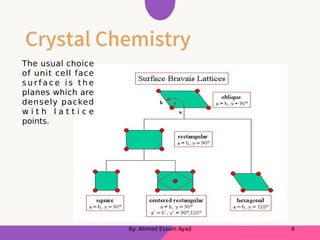
The usual choice
of unit cell face
s u r f a c e i s t h e
planes which are
densely packed
w i t h l a t t i c e
points.
Crystal Chemistry
By: Ahmed Essam Ayad 7
Crystal Chemistry
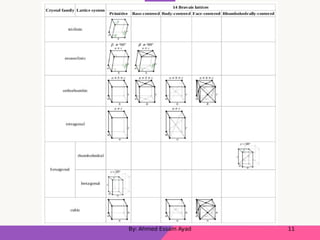
• Unit cell Types:-
A. Primitive " Simple " cell ( P ): one atom at each corner.
By: Ahmed Essam Ayad 8
Crystal Chemistry
B. Compound cell:
1- Body centred: one atom at each corner and one in
the center.
2- Face centred: one atom at each corner and one at
each end of crystallographic axes.
3- Side centred: one atom at each corner and one at
the ends of just single crystallographic axis " on two
opposite faces ".
I. a - side centred: at the ends of a-axis.
II. b - side centred: at the ends of b-axis.
III. c - side centred: at the ends of c-axis.
By: Ahmed Essam Ayad 9
Crystal Chemistry
By: Ahmed Essam Ayad 10
By: Ahmed Essam Ayad 11
Crystal Chemistry
By: Ahmed Essam Ayad 12
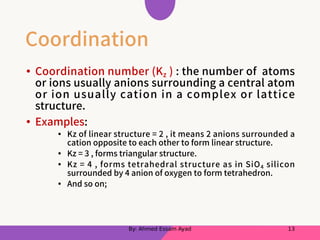
Coordination
• Coordination number (Kz ) : the number of atoms
or ions usually anions surrounding a central atom
or ion usually cation in a complex or lattice
structure.
• Examples:
• Kz of linear structure = 2 , it means 2 anions surrounded a
cation opposite to each other to form linear structure.
• Kz = 3 , forms triangular structure.
• Kz = 4 , forms tetrahedral structure as in SiO4 silicon
surrounded by 4 anion of oxygen to form tetrahedron.
• And so on;
By: Ahmed Essam Ayad 13
Coordination
By: Ahmed Essam Ayad 14
Coordination
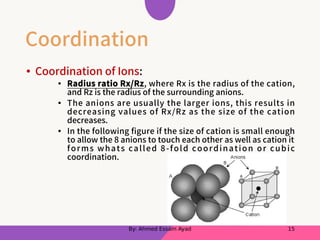
• Coordination of Ions:
• Radius ratio Rx/Rz, where Rx is the radius of the cation,
and Rz is the radius of the surrounding anions.
• The anions are usually the larger ions, this results in
decreasing values of Rx/Rz as the size of the cation
decreases.
• In the following figure if the size of cation is small enough
to allow the 8 anions to touch each other as well as cation it
forms whats called 8-fold coordination or cubic
coordination.
By: Ahmed Essam Ayad 15
Coordination
4 - fold coordination 3 - fold coordination
2 - fold coordination
By: Ahmed Essam Ayad 16
coordination
• Table summarizes the cation to anion radius
ratios, Rx/Rz, for various coordination numbers
and gives the name of the coordination
polyhedron for each coordination number.
By: Ahmed Essam Ayad 17
Coordination
Table gives the
ionic radius and
coordination of
the common
metal cations
coordinated
with oxygen.
By: Ahmed Essam Ayad 18
Structural Classification
OF Minerals
• Metallic Bond: it is the sharing of many detached
electrons between many positive ions, where the
electrons act as a "glue" giving the substance a
definite structure.
By: Ahmed Essam Ayad 19
Structural Classification
OF Minerals
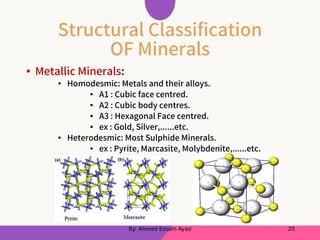
• Metallic Minerals:
• Homodesmic: Metals and their alloys.
• A1 : Cubic face centred.
• A2 : Cubic body centres.
• A3 : Hexagonal Face centred.
• ex : Gold, Silver,......etc.
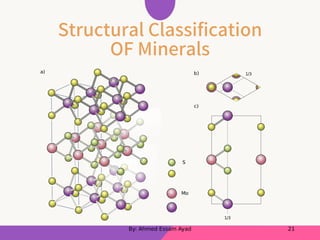
• Heterodesmic: Most Sulphide Minerals.
• ex : Pyrite, Marcasite, Molybdenite,......etc.
By: Ahmed Essam Ayad 20
Structural Classification
OF Minerals
By: Ahmed Essam Ayad 21
Structural Classification
OF Minerals
• Covalent or Molecular Bond: is a chemical bond
that involves the sharing of electron pairs between
atoms.
• These electron pairs are known as shared pairs or bonding
pairs, and the stable balance of attractive and repulsive
forces between atoms, when they share electrons, is known
as covalent bonding.
By: Ahmed Essam Ayad 22
Structural Classification
OF Minerals
• Examples of Minerals with Covalent bond :-
• Diamond C:
By: Ahmed Essam Ayad 23
Structural Classification
OF Minerals
• Sphalerite ZnS:
By: Ahmed Essam Ayad 24
Structural Classification
OF Minerals
• Cuprite Cu2O:
By: Ahmed Essam Ayad 25
Structural Classification
OF Minerals
• Sulfur S: 8 atoms puckered ring.
By: Ahmed Essam Ayad 26
Structural Classification
OF Minerals
• Graphite C:
By: Ahmed Essam Ayad 27
Structural Classification
OF Minerals
• Ionic Bond: is the complete transfer of valence
electron(s) between atoms. It is a type of chemical
bond that generates two oppositely charged ions.
• In ionic bonds, the metal loses electrons to become a
positively charged cation, whereas the nonmetal accepts
those electrons to become a negatively charged anion.
By: Ahmed Essam Ayad 28
Structural Classification
OF Minerals
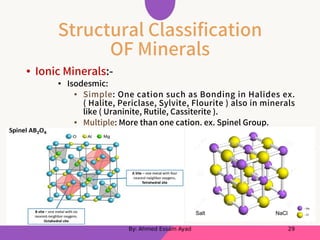
• Ionic Minerals:-
• Isodesmic:
• Simple: One cation such as Bonding in Halides ex.
( Halite, Periclase, Sylvite, Flourite ) also in minerals
like ( Uraninite, Rutile, Cassiterite ).
• Multiple: More than one cation. ex. Spinel Group.
By: Ahmed Essam Ayad 29
Structural Classification
OF Minerals
By: Ahmed Essam Ayad 30
Structural Classification
OF Minerals
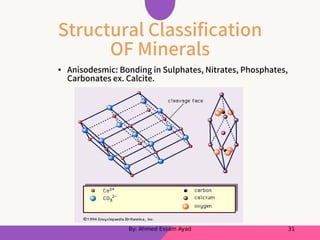
• Anisodesmic: Bonding in Sulphates, Nitrates, Phosphates,
Carbonates ex. Calcite.
By: Ahmed Essam Ayad 31
Structural Classification
OF Minerals
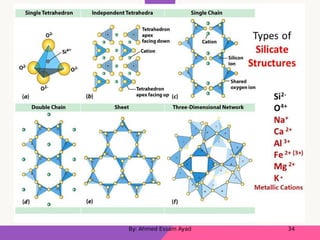
• Mesodesmic: Bonding in silicates.
By: Ahmed Essam Ayad 32
By: Ahmed Essam Ayad 33
By: Ahmed Essam Ayad 34
THANKS
• E-mail: geo.ahmedessam@gmail.com
35By: Ahmed Essam Ayad

Structural mineralogy 101

  • 1.
  • 2.
    Crystal Chemistry • Whatis Lattice? • Lattice is a regular network of points which represents atoms of elements usually major elements forming a certain mineral. • Lattice points or atoms are usually connected by lines which represents different types of bonds between atoms. • Space lattice is a regular repetation of lattice points in space in 3 dimensions at constant interval. • Unit cell is the smallest building unit of crystal lattice which usually a box-like in 3 dimensions. • Lattice plane is a plane or a group of parallel planes which intersect the lattice and divide it into layers. 2By: Ahmed Essam Ayad
  • 3.
  • 4.
  • 5.
  • 6.
    Crystal Chemistry By: AhmedEssam Ayad 6 The usual choice of unit cell face s u r f a c e i s t h e planes which are densely packed w i t h l a t t i c e points.
  • 7.
  • 8.
    Crystal Chemistry • Unitcell Types:- A. Primitive " Simple " cell ( P ): one atom at each corner. By: Ahmed Essam Ayad 8
  • 9.
    Crystal Chemistry B. Compoundcell: 1- Body centred: one atom at each corner and one in the center. 2- Face centred: one atom at each corner and one at each end of crystallographic axes. 3- Side centred: one atom at each corner and one at the ends of just single crystallographic axis " on two opposite faces ". I. a - side centred: at the ends of a-axis. II. b - side centred: at the ends of b-axis. III. c - side centred: at the ends of c-axis. By: Ahmed Essam Ayad 9
  • 10.
  • 11.
  • 12.
  • 13.
    Coordination • Coordination number(Kz ) : the number of atoms or ions usually anions surrounding a central atom or ion usually cation in a complex or lattice structure. • Examples: • Kz of linear structure = 2 , it means 2 anions surrounded a cation opposite to each other to form linear structure. • Kz = 3 , forms triangular structure. • Kz = 4 , forms tetrahedral structure as in SiO4 silicon surrounded by 4 anion of oxygen to form tetrahedron. • And so on; By: Ahmed Essam Ayad 13
  • 14.
  • 15.
    Coordination • Coordination ofIons: • Radius ratio Rx/Rz, where Rx is the radius of the cation, and Rz is the radius of the surrounding anions. • The anions are usually the larger ions, this results in decreasing values of Rx/Rz as the size of the cation decreases. • In the following figure if the size of cation is small enough to allow the 8 anions to touch each other as well as cation it forms whats called 8-fold coordination or cubic coordination. By: Ahmed Essam Ayad 15
  • 16.
    Coordination 4 - foldcoordination 3 - fold coordination 2 - fold coordination By: Ahmed Essam Ayad 16
  • 17.
    coordination • Table summarizesthe cation to anion radius ratios, Rx/Rz, for various coordination numbers and gives the name of the coordination polyhedron for each coordination number. By: Ahmed Essam Ayad 17
  • 18.
    Coordination Table gives the ionicradius and coordination of the common metal cations coordinated with oxygen. By: Ahmed Essam Ayad 18
  • 19.
    Structural Classification OF Minerals •Metallic Bond: it is the sharing of many detached electrons between many positive ions, where the electrons act as a "glue" giving the substance a definite structure. By: Ahmed Essam Ayad 19
  • 20.
    Structural Classification OF Minerals •Metallic Minerals: • Homodesmic: Metals and their alloys. • A1 : Cubic face centred. • A2 : Cubic body centres. • A3 : Hexagonal Face centred. • ex : Gold, Silver,......etc. • Heterodesmic: Most Sulphide Minerals. • ex : Pyrite, Marcasite, Molybdenite,......etc. By: Ahmed Essam Ayad 20
  • 21.
  • 22.
    Structural Classification OF Minerals •Covalent or Molecular Bond: is a chemical bond that involves the sharing of electron pairs between atoms. • These electron pairs are known as shared pairs or bonding pairs, and the stable balance of attractive and repulsive forces between atoms, when they share electrons, is known as covalent bonding. By: Ahmed Essam Ayad 22
  • 23.
    Structural Classification OF Minerals •Examples of Minerals with Covalent bond :- • Diamond C: By: Ahmed Essam Ayad 23
  • 24.
    Structural Classification OF Minerals •Sphalerite ZnS: By: Ahmed Essam Ayad 24
  • 25.
    Structural Classification OF Minerals •Cuprite Cu2O: By: Ahmed Essam Ayad 25
  • 26.
    Structural Classification OF Minerals •Sulfur S: 8 atoms puckered ring. By: Ahmed Essam Ayad 26
  • 27.
    Structural Classification OF Minerals •Graphite C: By: Ahmed Essam Ayad 27
  • 28.
    Structural Classification OF Minerals •Ionic Bond: is the complete transfer of valence electron(s) between atoms. It is a type of chemical bond that generates two oppositely charged ions. • In ionic bonds, the metal loses electrons to become a positively charged cation, whereas the nonmetal accepts those electrons to become a negatively charged anion. By: Ahmed Essam Ayad 28
  • 29.
    Structural Classification OF Minerals •Ionic Minerals:- • Isodesmic: • Simple: One cation such as Bonding in Halides ex. ( Halite, Periclase, Sylvite, Flourite ) also in minerals like ( Uraninite, Rutile, Cassiterite ). • Multiple: More than one cation. ex. Spinel Group. By: Ahmed Essam Ayad 29
  • 30.
  • 31.
    Structural Classification OF Minerals •Anisodesmic: Bonding in Sulphates, Nitrates, Phosphates, Carbonates ex. Calcite. By: Ahmed Essam Ayad 31
  • 32.
    Structural Classification OF Minerals •Mesodesmic: Bonding in silicates. By: Ahmed Essam Ayad 32
  • 33.
  • 34.
  • 35.