Introduction to Structural Dynamics:
Single-Degree-of-Freedom (SDOF) Systems
Geotechnical Engineer’s
View of the World
Structural Engineer’s
View of the World
Basic Concepts
• Degrees of Freedom
• Newton’s Law
• Equation of Motion (external force)
• Equation of Motion (base motion)
• Solutions to Equations of Motion
– Free Vibration
– Natural Period/Frequency
Degrees of Freedom
The number of variables required to describe the motion of the
masses is the number of degrees of freedom of the system
Continuous systems – infinite
number of degrees of freedom
Lumped mass systems – masses can be
assumed to be concentrated at specific
locations, and to be connected by massless
elements such as springs. Very useful for
buildings where most of mass is at (or attached
to) floors.
Degrees of Freedom
Single-degree-of-freedom (SDOF) systems
Vertical translation Horizontal translation Horizontal translation Rotation
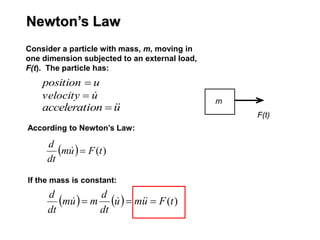
Newton’s Law
u
velocity 

u
on
accelerati 


u
position 
Consider a particle with mass, m, moving in
one dimension subjected to an external load,
F(t). The particle has:
According to Newton’s Law:
  )
(t
F
u
m
dt
d


If the mass is constant:
    )
(t
F
u
m
u
dt
d
m
u
m
dt
d


 



m
F(t)
Equation of Motion (external load)
Mass
Dashpot
Spring
External load
External load
Dashpot force
Spring force
From Newton’s Law, F = mü
Q(t) - fD - fS = mü
Equation of Motion (external load)
Elastic resistance
Viscous resistance
)
(t
Q
ku
u
c
u
m 

 


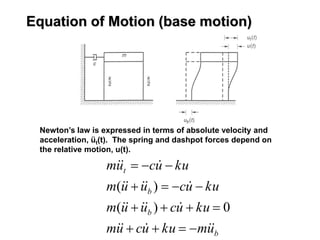
Equation of Motion (base motion)
Newton’s law is expressed in terms of absolute velocity and
acceleration, üt(t). The spring and dashpot forces depend on
the relative motion, u(t).
b
b
b
t
u
m
ku
u
c
u
m
ku
u
c
u
u
m
ku
u
c
u
u
m
ku
u
c
u
m

































0
)
(
)
(
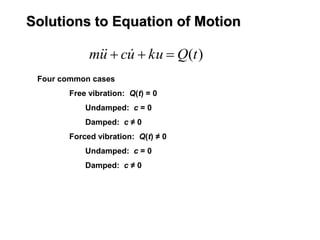
Solutions to Equation of Motion
Four common cases
Free vibration: Q(t) = 0
Undamped: c = 0
Damped: c ≠ 0
Forced vibration: Q(t) ≠ 0
Undamped: c = 0
Damped: c ≠ 0
)
(t
Q
ku
u
c
u
m 

 


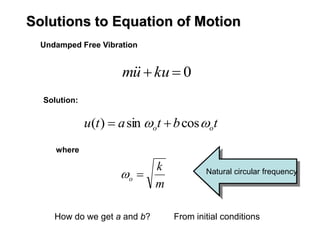
Solutions to Equation of Motion
Undamped Free Vibration
0

ku
u
m 

Solution:
t
b
t
a
t
u o
o 
 cos
sin
)
( 

where
m
k
o 
 Natural circular frequency
How do we get a and b? From initial conditions
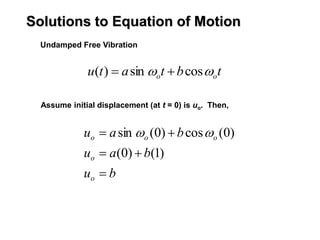
Solutions to Equation of Motion
Undamped Free Vibration
t
b
t
a
t
u o
o 
 cos
sin
)
( 

Assume initial displacement (at t = 0) is uo. Then,
b
u
b
a
u
b
a
u
o
o
o
o
o





)
1
(
)
0
(
)
0
(
cos
)
0
(
sin 

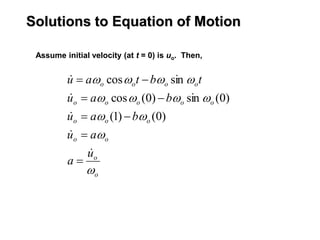
Solutions to Equation of Motion
Assume initial velocity (at t = 0) is uo. Then,
o
o
o
o
o
o
o
o
o
o
o
o
o
o
o
o
u
a
a
u
b
a
u
b
a
u
t
b
t
a
u

























)
0
(
)
1
(
)
0
(
sin
)
0
(
cos
sin
cos

Structural Dynamics - SDOF

  • 1.
    Introduction to StructuralDynamics: Single-Degree-of-Freedom (SDOF) Systems
  • 2.
    Geotechnical Engineer’s View ofthe World Structural Engineer’s View of the World
  • 3.
    Basic Concepts • Degreesof Freedom • Newton’s Law • Equation of Motion (external force) • Equation of Motion (base motion) • Solutions to Equations of Motion – Free Vibration – Natural Period/Frequency
  • 4.
    Degrees of Freedom Thenumber of variables required to describe the motion of the masses is the number of degrees of freedom of the system Continuous systems – infinite number of degrees of freedom Lumped mass systems – masses can be assumed to be concentrated at specific locations, and to be connected by massless elements such as springs. Very useful for buildings where most of mass is at (or attached to) floors.
  • 5.
    Degrees of Freedom Single-degree-of-freedom(SDOF) systems Vertical translation Horizontal translation Horizontal translation Rotation
  • 6.
    Newton’s Law u velocity   u on accelerati   u position  Consider a particle with mass, m, moving in one dimension subjected to an external load, F(t). The particle has: According to Newton’s Law:   ) (t F u m dt d   If the mass is constant:     ) (t F u m u dt d m u m dt d        m F(t)
  • 7.
    Equation of Motion(external load) Mass Dashpot Spring External load External load Dashpot force Spring force From Newton’s Law, F = mü Q(t) - fD - fS = mü
  • 8.
    Equation of Motion(external load) Elastic resistance Viscous resistance ) (t Q ku u c u m      
  • 9.
    Equation of Motion(base motion) Newton’s law is expressed in terms of absolute velocity and acceleration, üt(t). The spring and dashpot forces depend on the relative motion, u(t). b b b t u m ku u c u m ku u c u u m ku u c u u m ku u c u m                                  0 ) ( ) (
  • 10.
    Solutions to Equationof Motion Four common cases Free vibration: Q(t) = 0 Undamped: c = 0 Damped: c ≠ 0 Forced vibration: Q(t) ≠ 0 Undamped: c = 0 Damped: c ≠ 0 ) (t Q ku u c u m      
  • 11.
    Solutions to Equationof Motion Undamped Free Vibration 0  ku u m   Solution: t b t a t u o o   cos sin ) (   where m k o   Natural circular frequency How do we get a and b? From initial conditions
  • 12.
    Solutions to Equationof Motion Undamped Free Vibration t b t a t u o o   cos sin ) (   Assume initial displacement (at t = 0) is uo. Then, b u b a u b a u o o o o o      ) 1 ( ) 0 ( ) 0 ( cos ) 0 ( sin  
  • 13.
    Solutions to Equationof Motion Assume initial velocity (at t = 0) is uo. Then, o o o o o o o o o o o o o o o o u a a u b a u b a u t b t a u                          ) 0 ( ) 1 ( ) 0 ( sin ) 0 ( cos sin cos