Localization of stroke
Dr. Mohammed firoz
Post graduate
Final year
Andhra medical College
 stroke, or cerebrovascular accident, is defined
as an acute onset of a neurologic deficit that is
due to a focal vascular cause.
 • Transient Ischemic Attack (TIA) or ‘mini
stroke’ is when those symptoms resolve in 24
hours (usually under 1hr) without evidence of
brain infarction on brain imaging.
 Stroke is classified into two major types:
 Brain ischemia due to thrombosis,
embolism, or systemic hypoperfusion (80%).
 Brain hemorrhage due to intracerebral
hemorrhage (ICH) or subarachnoid
hemorrhage (SAH)(20%).
Localization of stroke syndromes
Three steps
1.Clinical localization of the site of the lesion.
2.Identifying the vascular territory and the vessel
involved.
3.Correlating with the imaging findings
 Prerequisites
 1.Functional anatomy of brain.
 2.Blood supply to the different parts of brain
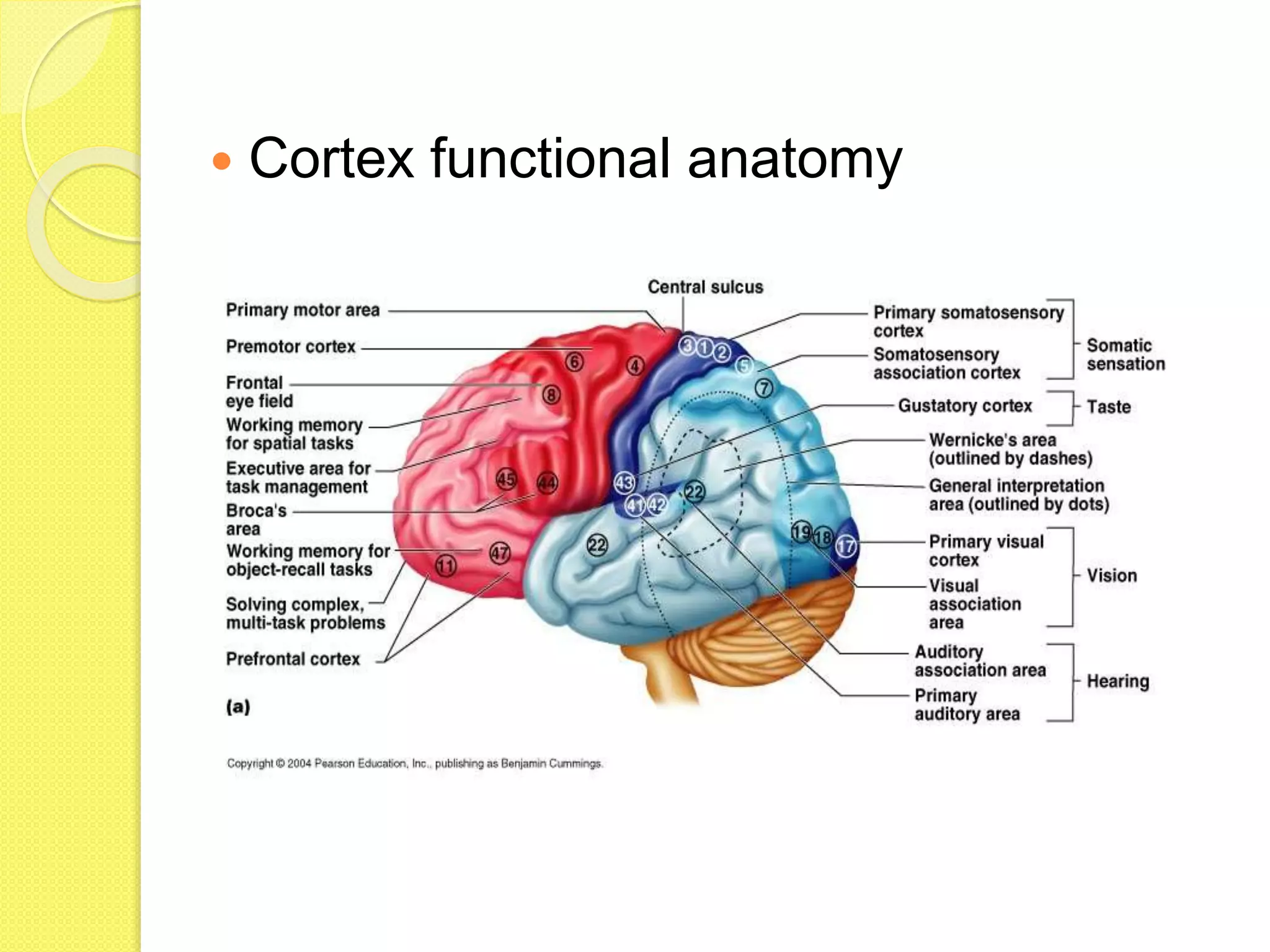
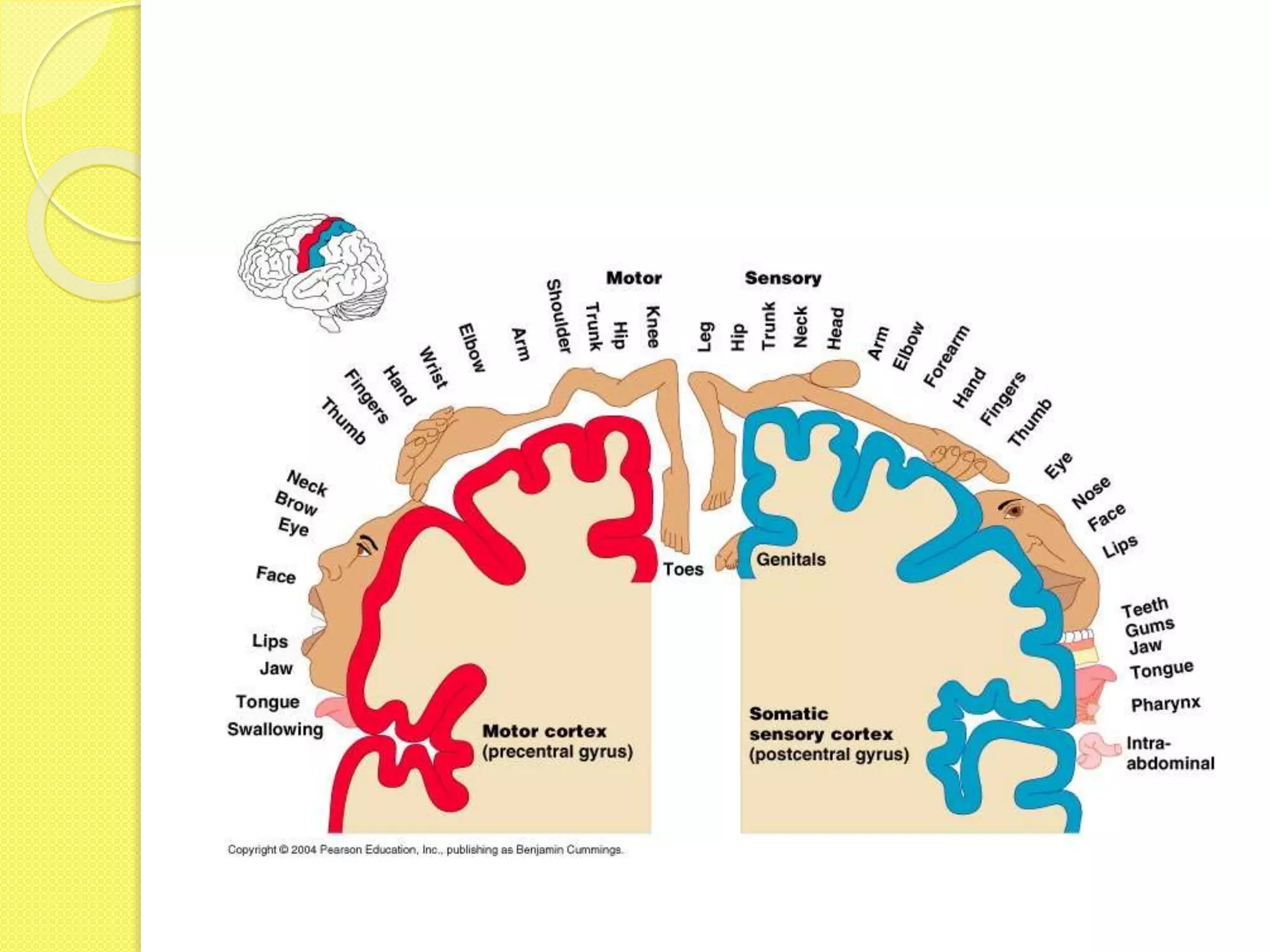
 Cortex functional anatomy
Frontal lobe dysfunction
 Emotions,judgement
 Memory,reasoning
 Abstract thinking
 Motor cortex
 Dominent
cortex(brocas area44)
 Non dominant side
 Frontal eye field (8)
 Social disinhibition,
Poor judgement,poor
memory, impaired
abstract
thinking,urinary
incontinence
 Weakness of opposite
 Non fluent aphasia(t)
 Lack of
prosody(expression)
 Contralateral
conjugate horizontal
gaze palsy
Parital lobe dysfunction
 Cortical sensations
 optic radiation
 Loss of tactile
localization,
 two point
discriminaton,
 Stereognosis,
 graphesthesia.
 Inferior
quadrantanopia
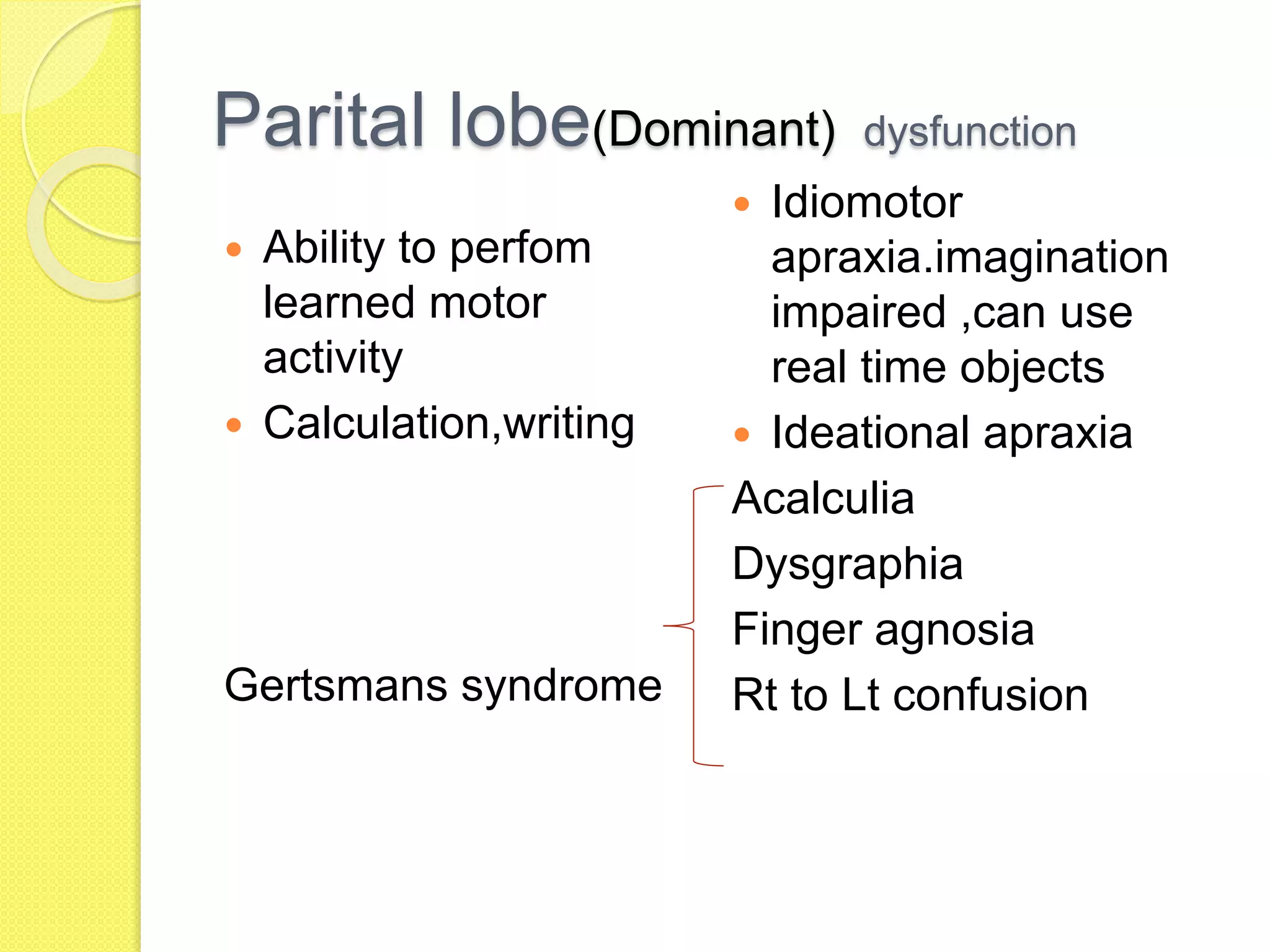
Parital lobe(Dominant) dysfunction
 Ability to perfom
learned motor
activity
 Calculation,writing
Gertsmans syndrome
 Idiomotor
apraxia.imagination
impaired ,can use
real time objects
 Ideational apraxia
Acalculia
Dysgraphia
Finger agnosia
Rt to Lt confusion
Parital lobe (non dominant)
 Visuospatial
integration
 Left hemi neglect
 Anosognosia-pt
deny existance of
left limbs
 Constructional and
dressing apraxia
Temporal lobe
 Memory
 Emotions (limbic area)
 Wernickes area
 Optic radiations
(visual field)
 Recent
memory(hypocamps)
 Memory of
fear(amygdala)
kluver bucy syndrome
 Emotional distruance
 Wernikes apahsia
without hemiplegia
 Superior
quadrantanopia
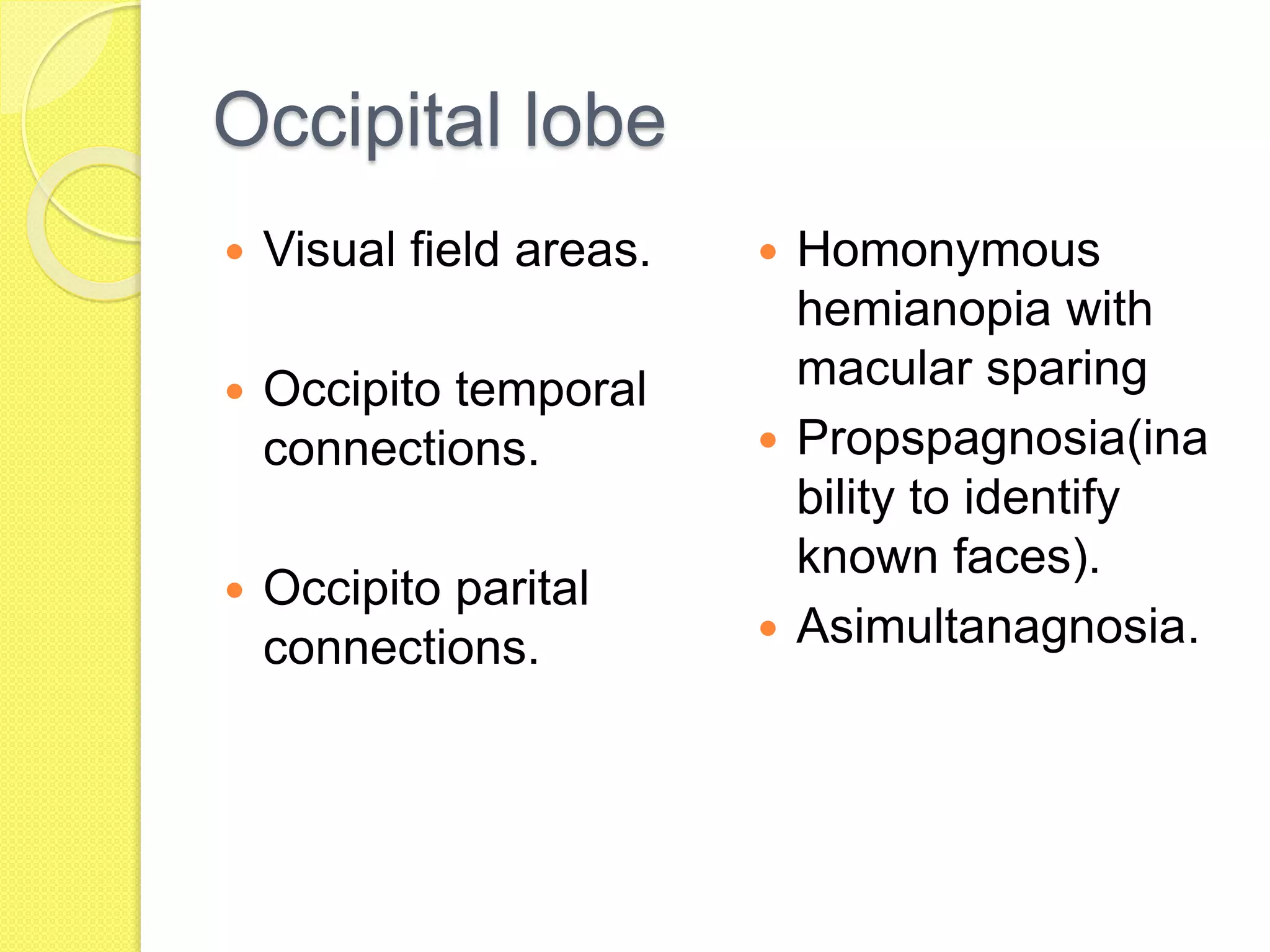
Occipital lobe
 Visual field areas.
 Occipito temporal
connections.
 Occipito parital
connections.
 Homonymous
hemianopia with
macular sparing
 Propspagnosia(ina
bility to identify
known faces).
 Asimultanagnosia.
Circle of willis
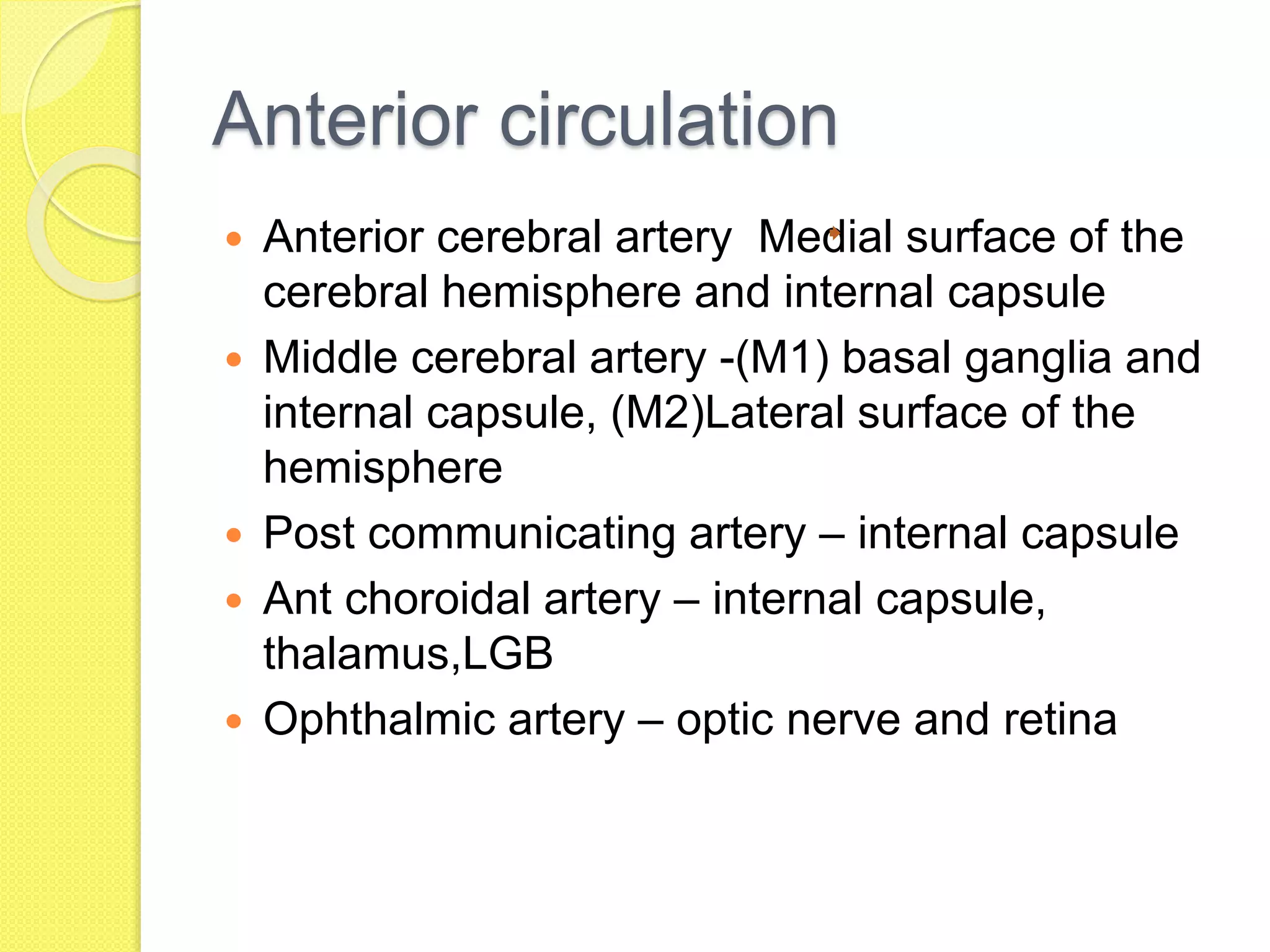
Anterior circulation
 Anterior cerebral artery Medial surface of the
cerebral hemisphere and internal capsule
 Middle cerebral artery -(M1) basal ganglia and
internal capsule, (M2)Lateral surface of the
hemisphere
 Post communicating artery – internal capsule
 Ant choroidal artery – internal capsule,
thalamus,LGB
 Ophthalmic artery – optic nerve and retina
Internal carotid artery
occlusion
 AMOUROSIS FUGAX
 only feature that distinguishes between
internal carotid artery syndrome and MCA
syndrome
 Sudden onset of transient monocular visual
loss
 Curtain pattern moving superior to inferiorly
 Spontaneous, unrelated to position usually
lasting for 1 to 5 minutes rarely beyond 30
mins
Blood supply
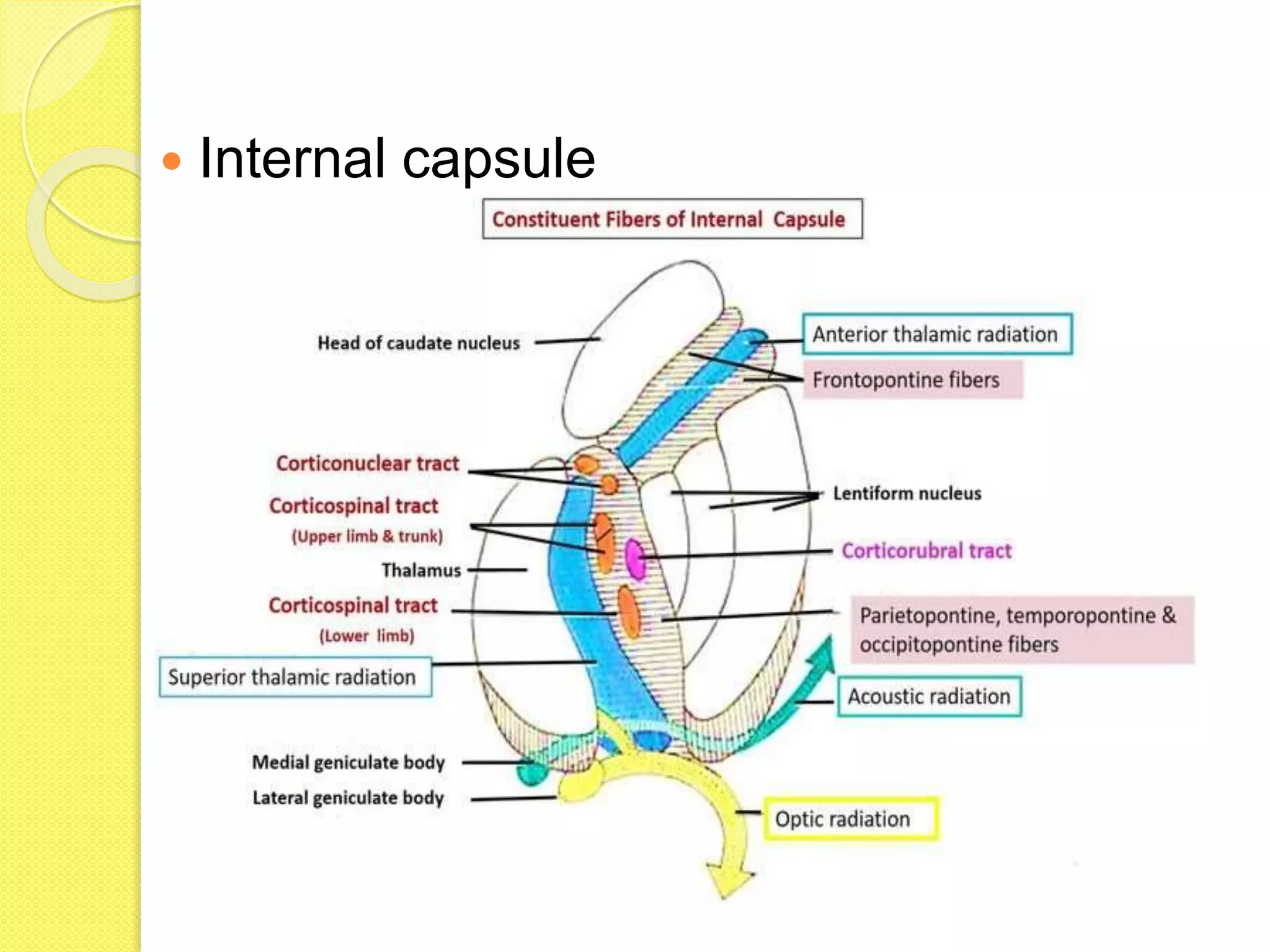
 Internal capsule
Internal capsule
 Anterior limb
 genu
 Posterior limb
 Retro&sub
lenticular
 Fronto ponto
cerebellar fibers
 Papez circuit
 Saccadic pathway
 Corticobulbar fiber
 Corticospinal,thalamic
radiations
 Visual and auditory
radiations.
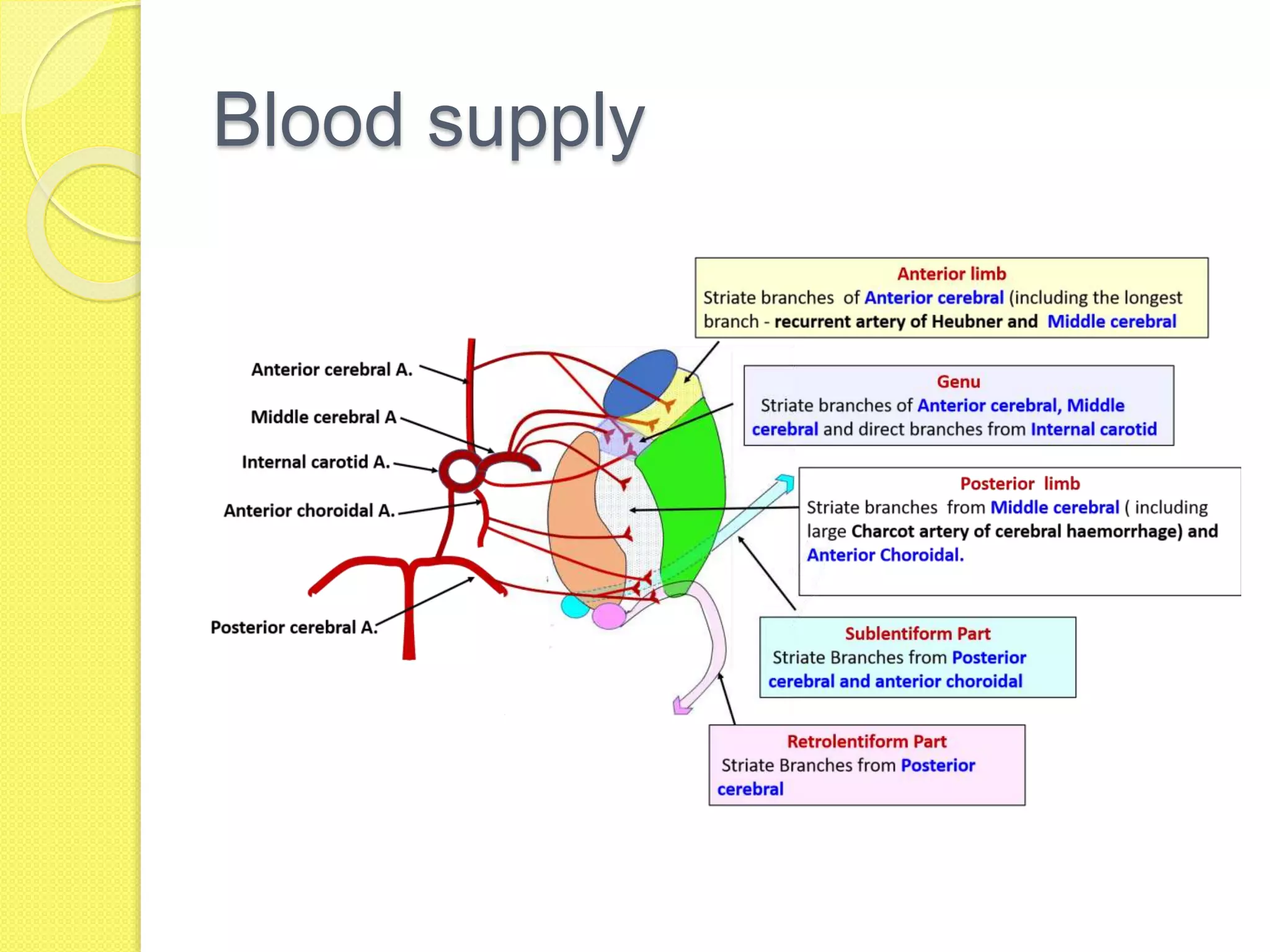
Blood supply
 LESION AT LEVEL OF INTERNAL
CAPSULE:
 Dense hemiplegia (UL weekness=LL
weeknes)
 Hemisensory loss
 UMN type of facial palsy
 Homonymous hemianopia
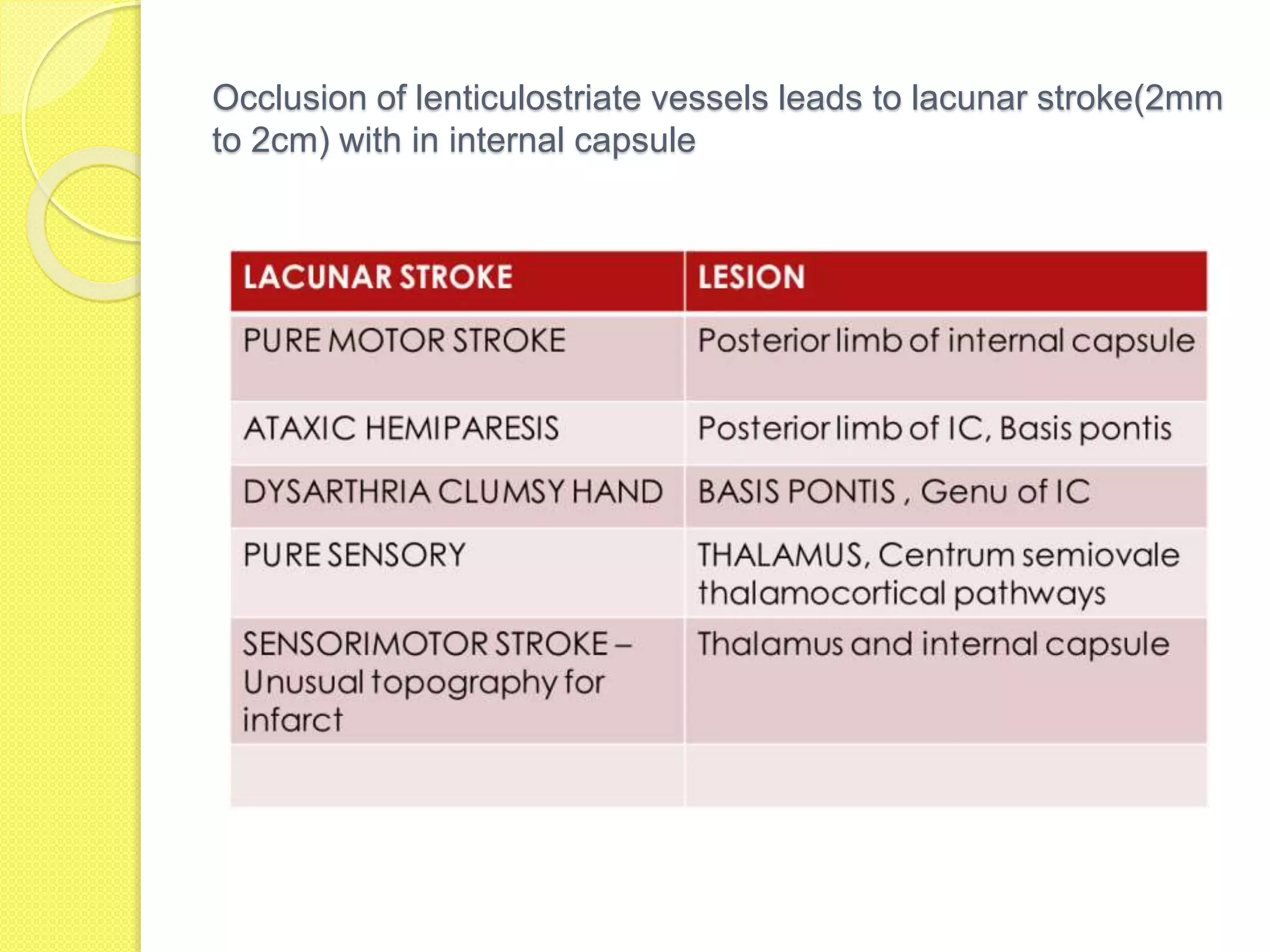
Occlusion of lenticulostriate vessels leads to lacunar stroke(2mm
to 2cm) with in internal capsule
Posterior circulation
 Vertebral artery- medulla and
cerebellum
 Basilar artery pons and cerebellum
 Posterior cerebral artery midbrain,
thalamus, hippocampus, occipital
lobe, temporal lobe and cerebellum
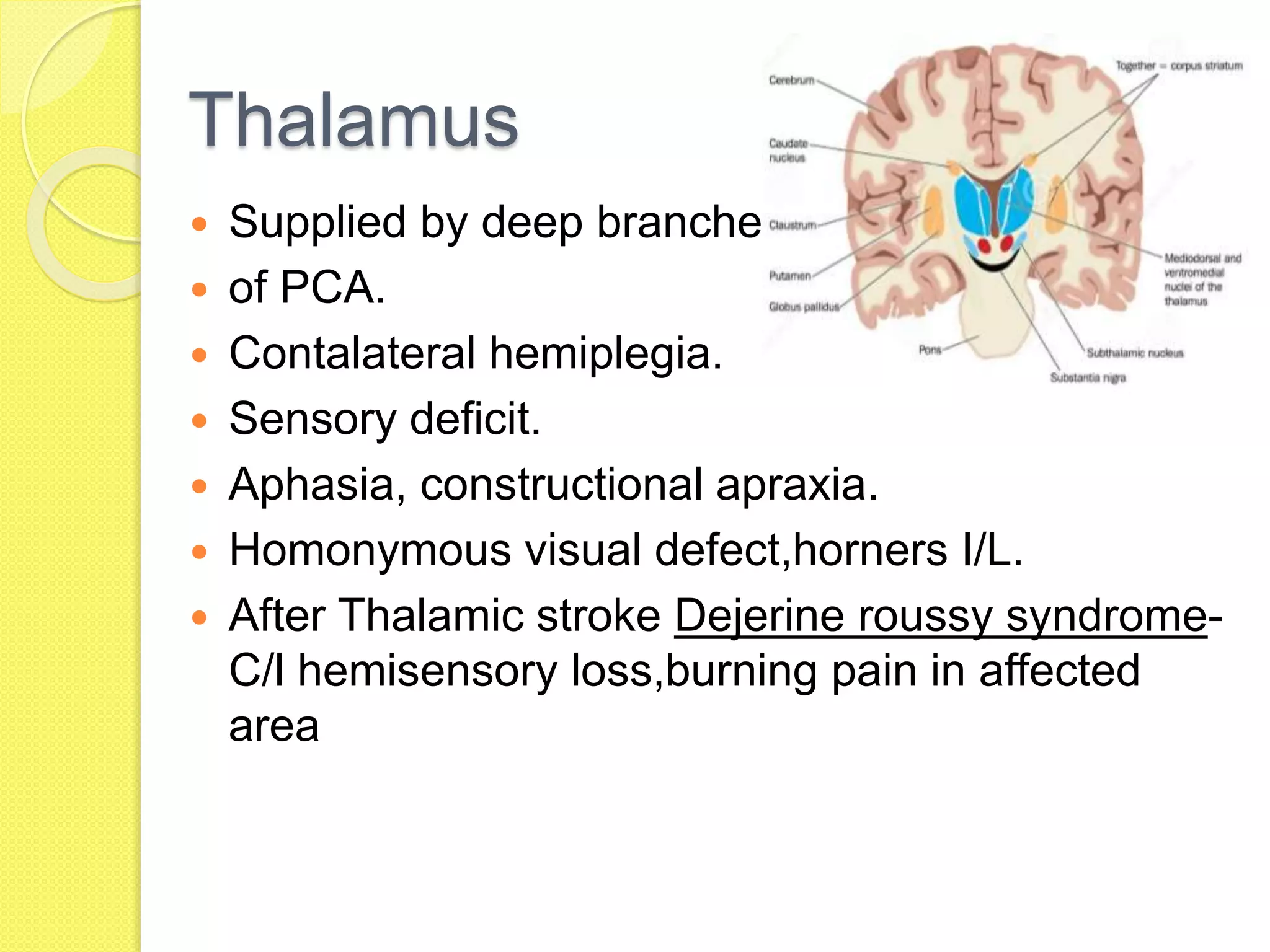
Thalamus
 Supplied by deep branches
 of PCA.
 Contalateral hemiplegia.
 Sensory deficit.
 Aphasia, constructional apraxia.
 Homonymous visual defect,horners I/L.
 After Thalamic stroke Dejerine roussy syndrome-
C/l hemisensory loss,burning pain in affected
area
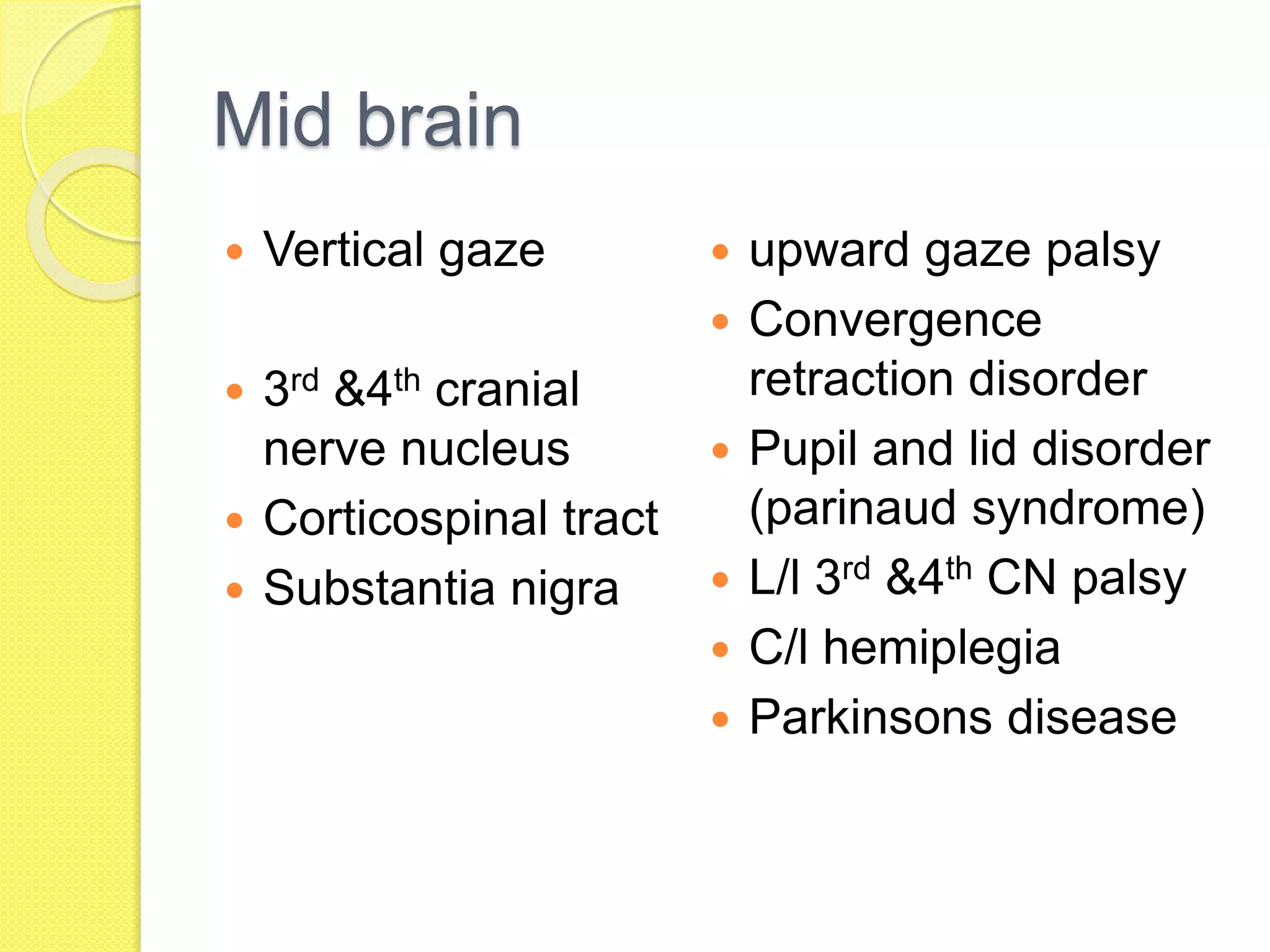
Mid brain
Mid brain
 Vertical gaze
 3rd &4th cranial
nerve nucleus
 Corticospinal tract
 Substantia nigra
 upward gaze palsy
 Convergence
retraction disorder
 Pupil and lid disorder
(parinaud syndrome)
 L/l 3rd &4th CN palsy
 C/l hemiplegia
 Parkinsons disease
P1 syndromes
Webers syndrome
Site: anterior cerebral peduncle ,3rd&7th cranial
nerves, corticospinal tract
Signs:I/L3rd CN palsy,C/L 7th CN palsy UMN,C/L
hemiplegia
Claude syndrome
site: superior cerebellar peduncle ,3rdC/N nucleus
Signs: I/L3rd CN palsy+C/L cerebellar ataxia
nothnagel syndrome
Site:tectum ,superior cerebellar peduncle
Signs:I/L 3rd CN palsy+ C/L cerebellar ataxia
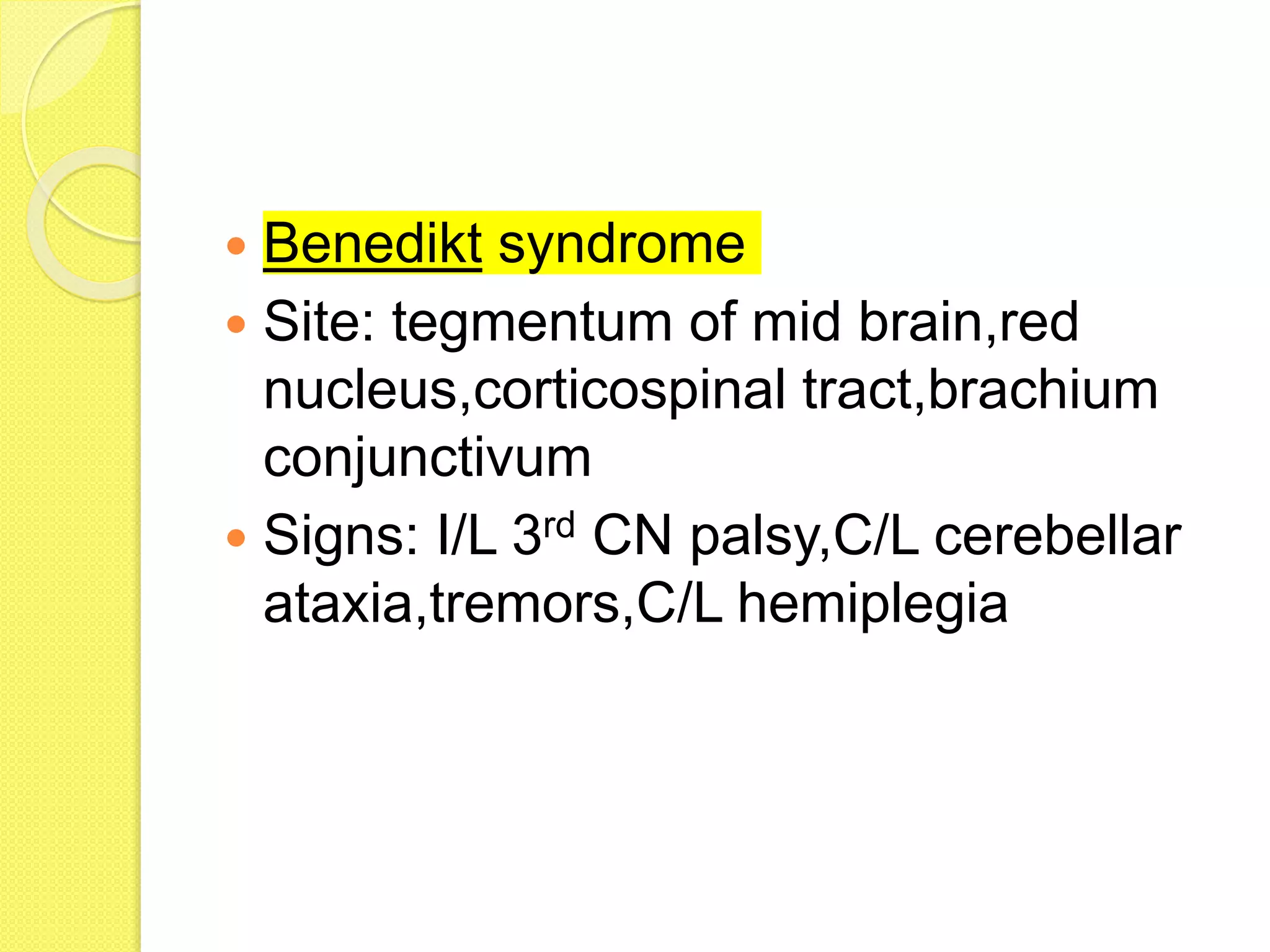
 Benedikt syndrome
 Site: tegmentum of mid brain,red
nucleus,corticospinal tract,brachium
conjunctivum
 Signs: I/L 3rd CN palsy,C/L cerebellar
ataxia,tremors,C/L hemiplegia
 P2 syndromes
 Antons syndrome
 Site:B/L infract in Distal PCAs
 Sign:cortical blindness,pupillary light reflex
preserved,pt often unaware of blindness
 Balints syndrome
 Site:visual association areas(water shed area)
 Signs:optic ataxia,Asimultagnosia,Oculomotor
apraxia
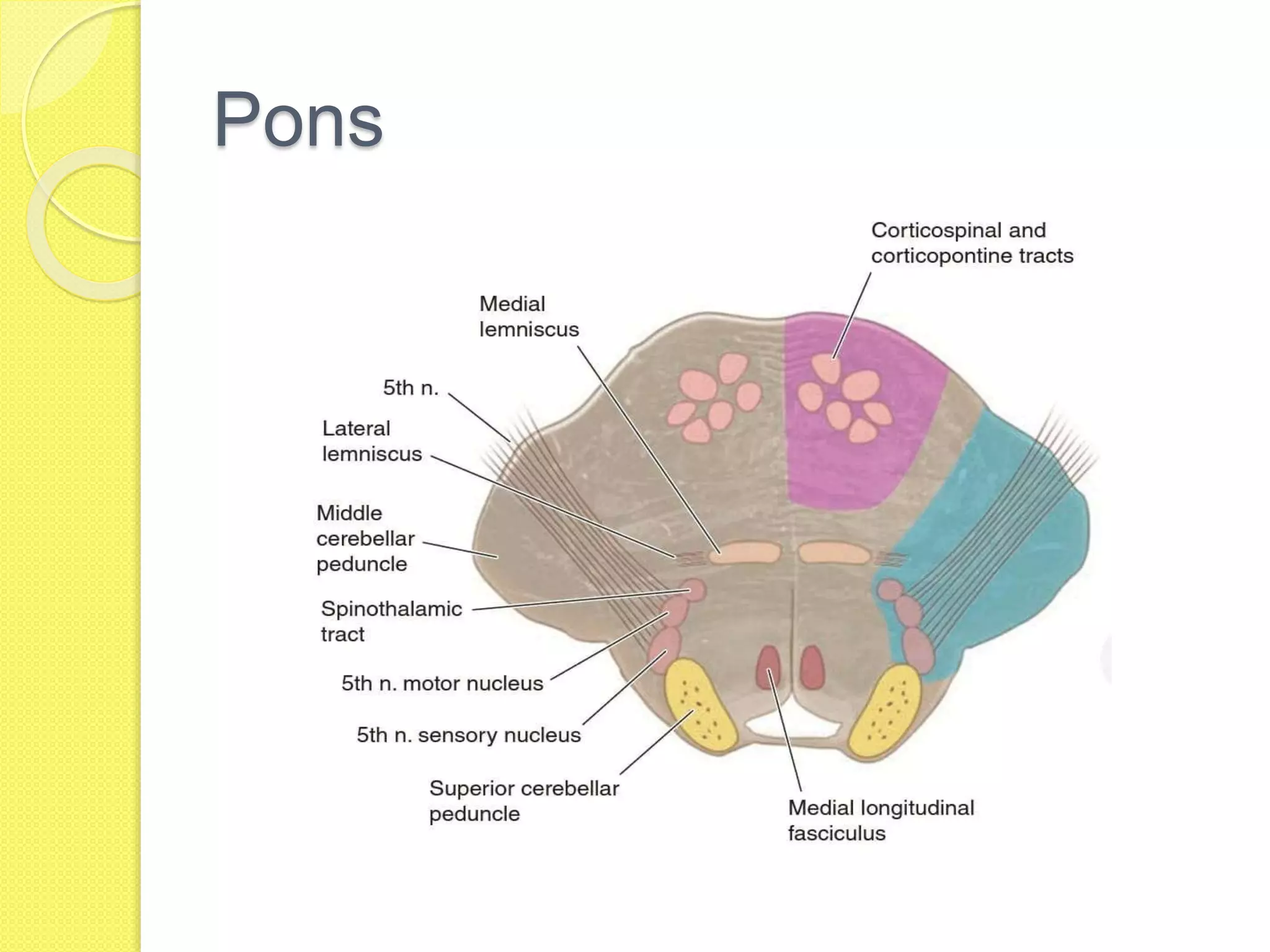
Pons
pons
 Horizontal
gaze(pprf)
 5,6,7&8nerve nuclei
 Corticospinal tract
 Millard gubler
syndrome
Raymond-foville
syndrome
 Horizontal gaze
palsy
 I/L 6th&(LMN)7th
CN palsy
 C/L hemiplegia
Medulla
 Medial medulla
(posterior column,12th
CN, Cortico spinaltract)
 Lateral medulla
Spinal tract of 5thCN
spinothalamic tract,
vestibular nucleus,
inferior cerebellar
peduncle,sympathetic
tract
Dejerine syndrome
 Hemiesthesia
,hemiplegia,12thCN
palsy
Wallenberg syndrome
 I/L facial sensory
loss with C/L loss of
pain,temp,
nystagmus,vertigo,a
taxia,horners
syndrome
cerebellum
 Flocculonodular
lobe (archi
cerebellum)
 Vermis(paleo
cerebellum)
 Cerebellar
hemispheres(neo
cerebellum)
 Eye movement
control and gross
orientation in space
 Concerned with
gait and locomotion
 Concerned with
precise movements
of the extremities
 UL weakness>LLweakness=brachial
hemiplegia,MCA territory infract
 UL weakness<LLweakness=crural
hemiplegia,ACA territory infract
 ULweakness=LLweakness=densehemiplegia,
internal capsule infract
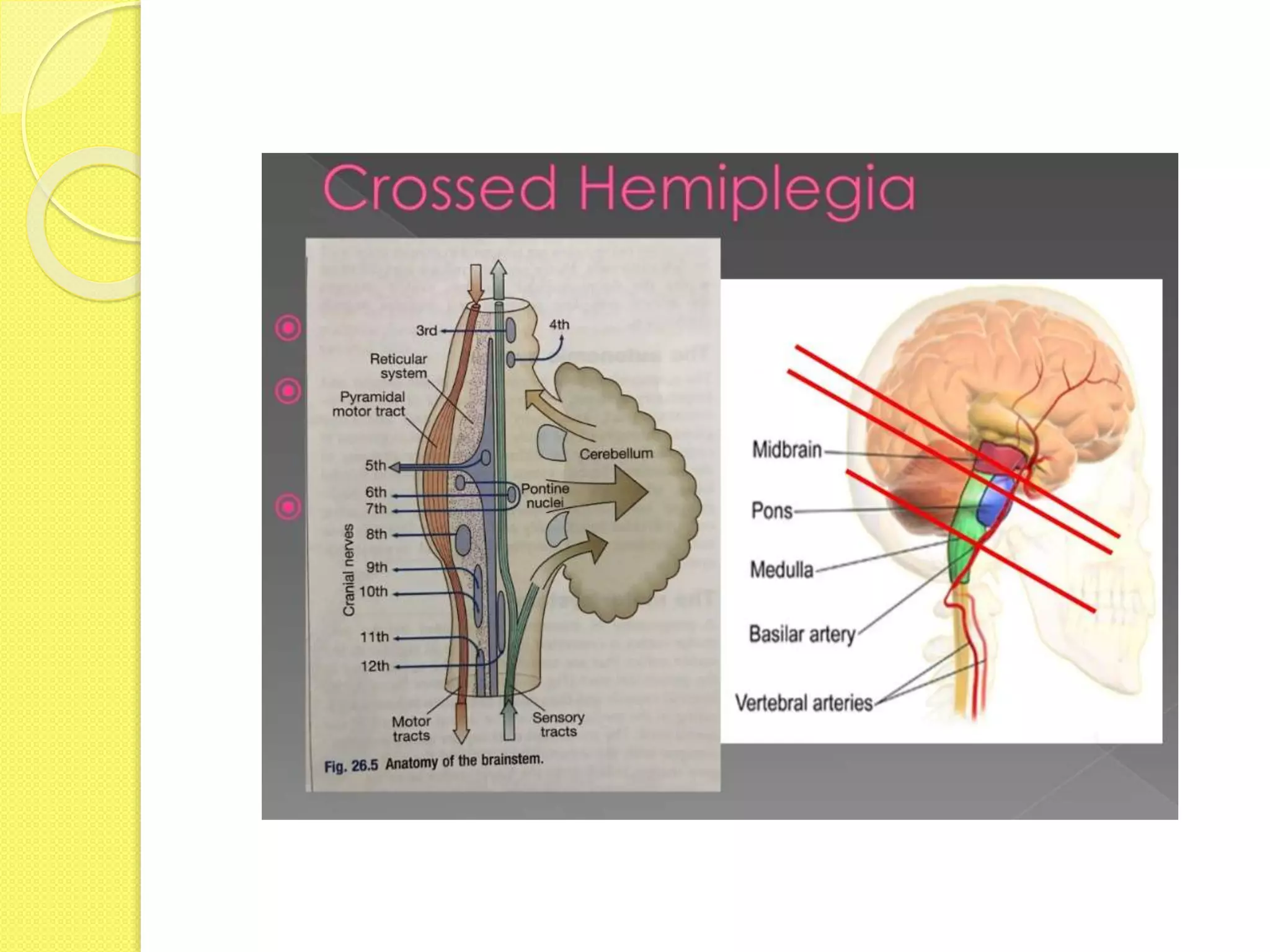
 I/L CN&C/L hemiplegia =crossed hemiplegia
 U/L one side &L/L opposite site=Cruciate
hemiplegia= at level of dicussation
 My reference Harrison 20th edition
 Uptodate
Stroke localization by Dr. Md. firoz

Stroke localization by Dr. Md. firoz

  • 1.
    Localization of stroke Dr.Mohammed firoz Post graduate Final year Andhra medical College
  • 2.
     stroke, orcerebrovascular accident, is defined as an acute onset of a neurologic deficit that is due to a focal vascular cause.  • Transient Ischemic Attack (TIA) or ‘mini stroke’ is when those symptoms resolve in 24 hours (usually under 1hr) without evidence of brain infarction on brain imaging.
  • 3.
     Stroke isclassified into two major types:  Brain ischemia due to thrombosis, embolism, or systemic hypoperfusion (80%).  Brain hemorrhage due to intracerebral hemorrhage (ICH) or subarachnoid hemorrhage (SAH)(20%).
  • 4.
    Localization of strokesyndromes Three steps 1.Clinical localization of the site of the lesion. 2.Identifying the vascular territory and the vessel involved. 3.Correlating with the imaging findings
  • 5.
     Prerequisites  1.Functionalanatomy of brain.  2.Blood supply to the different parts of brain
  • 6.
  • 9.
    Frontal lobe dysfunction Emotions,judgement  Memory,reasoning  Abstract thinking  Motor cortex  Dominent cortex(brocas area44)  Non dominant side  Frontal eye field (8)  Social disinhibition, Poor judgement,poor memory, impaired abstract thinking,urinary incontinence  Weakness of opposite  Non fluent aphasia(t)  Lack of prosody(expression)  Contralateral conjugate horizontal gaze palsy
  • 10.
    Parital lobe dysfunction Cortical sensations  optic radiation  Loss of tactile localization,  two point discriminaton,  Stereognosis,  graphesthesia.  Inferior quadrantanopia
  • 11.
    Parital lobe(Dominant) dysfunction Ability to perfom learned motor activity  Calculation,writing Gertsmans syndrome  Idiomotor apraxia.imagination impaired ,can use real time objects  Ideational apraxia Acalculia Dysgraphia Finger agnosia Rt to Lt confusion
  • 12.
    Parital lobe (nondominant)  Visuospatial integration  Left hemi neglect  Anosognosia-pt deny existance of left limbs  Constructional and dressing apraxia
  • 13.
    Temporal lobe  Memory Emotions (limbic area)  Wernickes area  Optic radiations (visual field)  Recent memory(hypocamps)  Memory of fear(amygdala) kluver bucy syndrome  Emotional distruance  Wernikes apahsia without hemiplegia  Superior quadrantanopia
  • 14.
    Occipital lobe  Visualfield areas.  Occipito temporal connections.  Occipito parital connections.  Homonymous hemianopia with macular sparing  Propspagnosia(ina bility to identify known faces).  Asimultanagnosia.
  • 15.
  • 16.
    Anterior circulation  Anteriorcerebral artery Medial surface of the cerebral hemisphere and internal capsule  Middle cerebral artery -(M1) basal ganglia and internal capsule, (M2)Lateral surface of the hemisphere  Post communicating artery – internal capsule  Ant choroidal artery – internal capsule, thalamus,LGB  Ophthalmic artery – optic nerve and retina
  • 17.
    Internal carotid artery occlusion AMOUROSIS FUGAX  only feature that distinguishes between internal carotid artery syndrome and MCA syndrome  Sudden onset of transient monocular visual loss  Curtain pattern moving superior to inferiorly  Spontaneous, unrelated to position usually lasting for 1 to 5 minutes rarely beyond 30 mins
  • 18.
  • 20.
  • 21.
    Internal capsule  Anteriorlimb  genu  Posterior limb  Retro&sub lenticular  Fronto ponto cerebellar fibers  Papez circuit  Saccadic pathway  Corticobulbar fiber  Corticospinal,thalamic radiations  Visual and auditory radiations.
  • 22.
  • 23.
     LESION ATLEVEL OF INTERNAL CAPSULE:  Dense hemiplegia (UL weekness=LL weeknes)  Hemisensory loss  UMN type of facial palsy  Homonymous hemianopia
  • 24.
    Occlusion of lenticulostriatevessels leads to lacunar stroke(2mm to 2cm) with in internal capsule
  • 25.
    Posterior circulation  Vertebralartery- medulla and cerebellum  Basilar artery pons and cerebellum  Posterior cerebral artery midbrain, thalamus, hippocampus, occipital lobe, temporal lobe and cerebellum
  • 26.
    Thalamus  Supplied bydeep branches  of PCA.  Contalateral hemiplegia.  Sensory deficit.  Aphasia, constructional apraxia.  Homonymous visual defect,horners I/L.  After Thalamic stroke Dejerine roussy syndrome- C/l hemisensory loss,burning pain in affected area
  • 28.
  • 30.
    Mid brain  Verticalgaze  3rd &4th cranial nerve nucleus  Corticospinal tract  Substantia nigra  upward gaze palsy  Convergence retraction disorder  Pupil and lid disorder (parinaud syndrome)  L/l 3rd &4th CN palsy  C/l hemiplegia  Parkinsons disease
  • 31.
    P1 syndromes Webers syndrome Site:anterior cerebral peduncle ,3rd&7th cranial nerves, corticospinal tract Signs:I/L3rd CN palsy,C/L 7th CN palsy UMN,C/L hemiplegia Claude syndrome site: superior cerebellar peduncle ,3rdC/N nucleus Signs: I/L3rd CN palsy+C/L cerebellar ataxia nothnagel syndrome Site:tectum ,superior cerebellar peduncle Signs:I/L 3rd CN palsy+ C/L cerebellar ataxia
  • 32.
     Benedikt syndrome Site: tegmentum of mid brain,red nucleus,corticospinal tract,brachium conjunctivum  Signs: I/L 3rd CN palsy,C/L cerebellar ataxia,tremors,C/L hemiplegia
  • 33.
     P2 syndromes Antons syndrome  Site:B/L infract in Distal PCAs  Sign:cortical blindness,pupillary light reflex preserved,pt often unaware of blindness  Balints syndrome  Site:visual association areas(water shed area)  Signs:optic ataxia,Asimultagnosia,Oculomotor apraxia
  • 34.
  • 35.
    pons  Horizontal gaze(pprf)  5,6,7&8nervenuclei  Corticospinal tract  Millard gubler syndrome Raymond-foville syndrome  Horizontal gaze palsy  I/L 6th&(LMN)7th CN palsy  C/L hemiplegia
  • 36.
    Medulla  Medial medulla (posteriorcolumn,12th CN, Cortico spinaltract)  Lateral medulla Spinal tract of 5thCN spinothalamic tract, vestibular nucleus, inferior cerebellar peduncle,sympathetic tract Dejerine syndrome  Hemiesthesia ,hemiplegia,12thCN palsy Wallenberg syndrome  I/L facial sensory loss with C/L loss of pain,temp, nystagmus,vertigo,a taxia,horners syndrome
  • 37.
    cerebellum  Flocculonodular lobe (archi cerebellum) Vermis(paleo cerebellum)  Cerebellar hemispheres(neo cerebellum)  Eye movement control and gross orientation in space  Concerned with gait and locomotion  Concerned with precise movements of the extremities
  • 38.
     UL weakness>LLweakness=brachial hemiplegia,MCAterritory infract  UL weakness<LLweakness=crural hemiplegia,ACA territory infract  ULweakness=LLweakness=densehemiplegia, internal capsule infract  I/L CN&C/L hemiplegia =crossed hemiplegia  U/L one side &L/L opposite site=Cruciate hemiplegia= at level of dicussation
  • 39.
     My referenceHarrison 20th edition  Uptodate