Stress Management
Agenda for Stress Management 1


• What is stress?
• What are the symptoms of stress?


                                         2
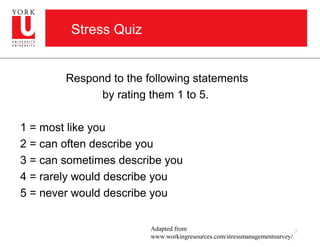
Stress Quiz


        Respond to the following statements
              by rating them 1 to 5.

1 = most like you
2 = can often describe you
3 = can sometimes describe you
4 = rarely would describe you
5 = never would describe you


                        Adapted from                                     3
                        www.workingresources.com/stressmanagementsurvey/
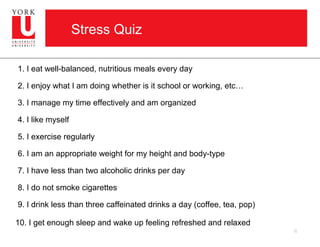
Stress Quiz

1. I eat well-balanced, nutritious meals every day

2. I enjoy what I am doing whether is it school or working, etc…

3. I manage my time effectively and am organized

4. I like myself

5. I exercise regularly

6. I am an appropriate weight for my height and body-type

7. I have less than two alcoholic drinks per day

8. I do not smoke cigarettes

9. I drink less than three caffeinated drinks a day (coffee, tea, pop)

10. I get enough sleep and wake up feeling refreshed and relaxed
                                                                         4
Stress Quiz

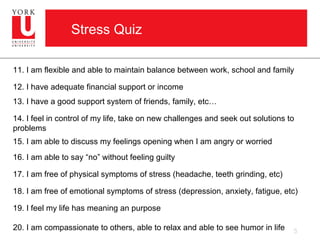
11. I am flexible and able to maintain balance between work, school and family

12. I have adequate financial support or income
13. I have a good support system of friends, family, etc…

14. I feel in control of my life, take on new challenges and seek out solutions to
problems
15. I am able to discuss my feelings opening when I am angry or worried
16. I am able to say “no” without feeling guilty

17. I am free of physical symptoms of stress (headache, teeth grinding, etc)

18. I am free of emotional symptoms of stress (depression, anxiety, fatigue, etc)

19. I feel my life has meaning an purpose

20. I am compassionate to others, able to relax and able to see humor in life    5
Scoring the quiz


Add up your responses to get a final score.

Your score should be somewhere between 20 and 100.


                                                 6
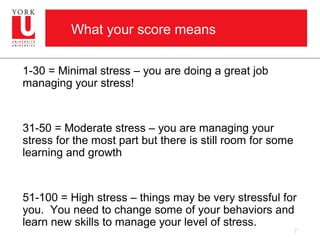
What your score means

1-30 = Minimal stress – you are doing a great job
managing your stress!


31-50 = Moderate stress – you are managing your
stress for the most part but there is still room for some
learning and growth


51-100 = High stress – things may be very stressful for
you. You need to change some of your behaviors and
learn new skills to manage your level of stress.
                                                            7
Activator


       What stresses you out?

    Take a moment to think about
        the stress in your life.

     Write down these stressors.


                                   8
What is stress?


“The inability to cope with a perceived, real, or imagined threat to
one’s mental, physical, emotional, and spiritual wellbeing which
results in a series of physiological responses and adaptations.” (Brian
Seaward).


“A state of anxiety produced when events and responsibilities exceed
one’s coping abilities.” (Richard Lazarus).


“The non-specific response of the body to any demand placed upon it
to adapt.” (Hans Selye).

                                                                    9
What is stress?


“A condition or state of imbalance between the stressful situation and
our ability or capacity to cope with that situation.” (Andrew Goliszek).


“Stress is the physiological and emotional reaction to psychological
events. Stress is often experienced as a consistent, exaggerated, and
overwhelming sense of urgency, often couple with frustration.
Achievement stress, triggered by school tasks, is a learned,
inappropriate distress habit which impairs school performance.”
(Ronald Rubenzer).


                                                                     10
Areas Stress Affects


                    • Mind

                    • Body

                 • Behaviour


Work in pairs to develop a list of ways that stress
  may affect your mind, body and behaviour

                                                      11
How does stress affect your mind?


Problems with memory           Inability to slow down
Difficulty making decisions    Loss of objectivity
Trouble concentrating
Shortened attention span
Confusion
Repetitive thoughts
Misunderstanding information
Poor judgment
Thoughts of running away
                                                        12
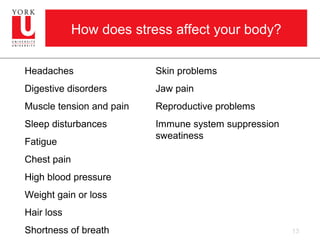
How does stress affect your body?

Headaches                 Skin problems
Digestive disorders       Jaw pain
Muscle tension and pain   Reproductive problems
Sleep disturbances        Immune system suppression
                          sweatiness
Fatigue
Chest pain
High blood pressure
Weight gain or loss
Hair loss
Shortness of breath                                   13
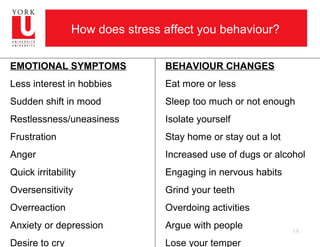
How does stress affect you behaviour?

EMOTIONAL SYMPTOMS              BEHAVIOUR CHANGES
Less interest in hobbies        Eat more or less
Sudden shift in mood            Sleep too much or not enough
Restlessness/uneasiness         Isolate yourself
Frustration                     Stay home or stay out a lot
Anger                           Increased use of dugs or alcohol
Quick irritability              Engaging in nervous habits
Oversensitivity                 Grind your teeth
Overreaction                    Overdoing activities
Anxiety or depression           Argue with people             14
Desire to cry                   Lose your temper
How does stress affect me?


 Take a moment to fill out the
 Symptoms of Stress Checklist


                                 15
Wrap up


What I hope you take away:

- What stress is

- How stress can affect our mind, body and behaviour

- Start thinking about the stress in your life and how it is
affecting you


                                                               16

Stress management - Session 1 (August 2012)

  • 1.
  • 2.
    Agenda for StressManagement 1 • What is stress? • What are the symptoms of stress? 2
  • 3.
    Stress Quiz Respond to the following statements by rating them 1 to 5. 1 = most like you 2 = can often describe you 3 = can sometimes describe you 4 = rarely would describe you 5 = never would describe you Adapted from 3 www.workingresources.com/stressmanagementsurvey/
  • 4.
    Stress Quiz 1. Ieat well-balanced, nutritious meals every day 2. I enjoy what I am doing whether is it school or working, etc… 3. I manage my time effectively and am organized 4. I like myself 5. I exercise regularly 6. I am an appropriate weight for my height and body-type 7. I have less than two alcoholic drinks per day 8. I do not smoke cigarettes 9. I drink less than three caffeinated drinks a day (coffee, tea, pop) 10. I get enough sleep and wake up feeling refreshed and relaxed 4
  • 5.
    Stress Quiz 11. Iam flexible and able to maintain balance between work, school and family 12. I have adequate financial support or income 13. I have a good support system of friends, family, etc… 14. I feel in control of my life, take on new challenges and seek out solutions to problems 15. I am able to discuss my feelings opening when I am angry or worried 16. I am able to say “no” without feeling guilty 17. I am free of physical symptoms of stress (headache, teeth grinding, etc) 18. I am free of emotional symptoms of stress (depression, anxiety, fatigue, etc) 19. I feel my life has meaning an purpose 20. I am compassionate to others, able to relax and able to see humor in life 5
  • 6.
    Scoring the quiz Addup your responses to get a final score. Your score should be somewhere between 20 and 100. 6
  • 7.
    What your scoremeans 1-30 = Minimal stress – you are doing a great job managing your stress! 31-50 = Moderate stress – you are managing your stress for the most part but there is still room for some learning and growth 51-100 = High stress – things may be very stressful for you. You need to change some of your behaviors and learn new skills to manage your level of stress. 7
  • 8.
    Activator What stresses you out? Take a moment to think about the stress in your life. Write down these stressors. 8
  • 9.
    What is stress? “Theinability to cope with a perceived, real, or imagined threat to one’s mental, physical, emotional, and spiritual wellbeing which results in a series of physiological responses and adaptations.” (Brian Seaward). “A state of anxiety produced when events and responsibilities exceed one’s coping abilities.” (Richard Lazarus). “The non-specific response of the body to any demand placed upon it to adapt.” (Hans Selye). 9
  • 10.
    What is stress? “Acondition or state of imbalance between the stressful situation and our ability or capacity to cope with that situation.” (Andrew Goliszek). “Stress is the physiological and emotional reaction to psychological events. Stress is often experienced as a consistent, exaggerated, and overwhelming sense of urgency, often couple with frustration. Achievement stress, triggered by school tasks, is a learned, inappropriate distress habit which impairs school performance.” (Ronald Rubenzer). 10
  • 11.
    Areas Stress Affects • Mind • Body • Behaviour Work in pairs to develop a list of ways that stress may affect your mind, body and behaviour 11
  • 12.
    How does stressaffect your mind? Problems with memory Inability to slow down Difficulty making decisions Loss of objectivity Trouble concentrating Shortened attention span Confusion Repetitive thoughts Misunderstanding information Poor judgment Thoughts of running away 12
  • 13.
    How does stressaffect your body? Headaches Skin problems Digestive disorders Jaw pain Muscle tension and pain Reproductive problems Sleep disturbances Immune system suppression sweatiness Fatigue Chest pain High blood pressure Weight gain or loss Hair loss Shortness of breath 13
  • 14.
    How does stressaffect you behaviour? EMOTIONAL SYMPTOMS BEHAVIOUR CHANGES Less interest in hobbies Eat more or less Sudden shift in mood Sleep too much or not enough Restlessness/uneasiness Isolate yourself Frustration Stay home or stay out a lot Anger Increased use of dugs or alcohol Quick irritability Engaging in nervous habits Oversensitivity Grind your teeth Overreaction Overdoing activities Anxiety or depression Argue with people 14 Desire to cry Lose your temper
  • 15.
    How does stressaffect me? Take a moment to fill out the Symptoms of Stress Checklist 15
  • 16.
    Wrap up What Ihope you take away: - What stress is - How stress can affect our mind, body and behaviour - Start thinking about the stress in your life and how it is affecting you 16