Stress and Coping
(BSP-326)
Instructor : Dr. Kavita Pandey
Life is largely a process of adaptation to the circumstances in
which we exist.
Hans Selye
According to Selye- Stress is the nonspecific response of the
body to any demand, whether it is caused by, or results in, pleasant
or unpleasant conditions.”
American Psychological Association defines stress as
"any uncomfortable emotional experience accompanied by
predictable biochemical, physiological and behavioral changes.
History and perspectives
Stress as stimulus- Psychological stress is anchored in the environment and its
characteristics. There are objective external circumstances which are
psychologically demanding, threatening, benign, and so forth. Stimulus
definitions also include conditions arising within the person, for example,
drive stimuli such as hunger or sex. Environmental events typically cited as
stress stimuli speak of three types: major changes, often cataclysmic and
affecting large numbers of persons (disaster, war); major changes affecting one
or a few persons; and daily hassles (Lazarus and Cohen 1977)
According to Elliott & Eisdorfer, 1982 there are four types of stressors
(1) Acute, time-limited stressors, such as going parachute jumping, awaiting surgery, or,
encountering a rattlesnake;
(2) Stressor sequences, or series of events that occur over an extended period of time as the
result of an initiating event such as job loss, divorce, or bereavement;
(3) Chronic intermittent stressors such as conflict-filled visits to in-laws or sexual difficulties,
which may occur once a day, once a week, once a month
(4) Chronic stressors such as permanent disabilities, parental discord, or chronic job stress,
which persist continuously for a long time.
Stress as response- Stress is viewed as the response of the organism to the complex adaptive
demands of the environment. In Biology and medicine stress is most commonly defined in
response terms. Here the emphasis is on the state of stress, an organism reacting with stress,
being under stress, being disrupted, distressed, and so on.
When defined in response term the focus is less on categorizing the stressors. We must await the
reaction. Also many responses which can indicate psychological stress , are actually not
stressful. Heart rate, for example, will rise sharply from jogging while the individual seems to
feel psychologically relaxed and at peace. The response cannot reliably be judged as a
psychological stress reaction without reference to the stimulus
Stress as interaction
Issues with earlier view- knowledge of the environment does not always predict the
responses; individual differences matters. From a response perspective, there are numerous
indicators to draw upon (different emotions, psycho-physiologic, or hormonal indices), many
of which displayed different relationships with distinct environmental challenges (Weiner
1992). To address some of these limitations, psychological stress has been proposed to
represent a particular relationship between organism and environment. This third perspective
holds that psychological stress is the product of the individual’s ongoing transactions with
circumstances, particularly circumstances that are perceived as taxing or exceeding
Research shows that even the routine hassles may have significant negative
effects on a person’s mental and physical health (Pettit et al., 2010). In one of
the study (which looked at whether everyday hassles and major stressful
events, both measured over a period of fifteen years, predicted mortality in an
elderly sample of men) it was found that elevated levels of both types of stress
were associated with increased mortality, but the impact of hassles was
actually somewhat greater than that of major stressors. (Aldwin et al., 2014)
Fight or Flight
One of the earliest contribution to stress research was Walter Cannon’s
(1932) description of the fight-or-flight response. Cannon proposed that
when an organism perceives a threat, the body is rapidly aroused and
motivated via the sympathetic nervous system and the endocrine system.
This rigorous physiological response mobilizes the organism to attack the
threat or to flee; hence, it is called the fight-or-flight response. On the one
hand, the fight-or-flight response is adaptive because it enables the
organism to respond quickly to threat. On the other hand, it can be harmful
because stress disrupts emotional and physiological functioning, and when
stress continues unabated, it lays the ground-work for health problems.
Selye’s General Adaptation Syndrome
• General Adaptation
Syndrome = GAS
– Physiological
reaction to
prolonged stress
• Three Phases
1. Alarm
2. Resistance
3. Exhaustion
Selye’s General Adaptation Syndrome
• Alarm - 1st phase - similar to ‘fight or flight’
– Activation of sympathetic nervous system
– Release of stress hormones - important = Cortisol
• Triggers increase in blood sugars
• Suppresses immune system
• Cannot last indefinitely
– Parasympathetic system tries to restore homeostasis
– If stressor persists - so does response!
Selye’s General Adaptation Syndrome
• Resistance – 2nd phase
– Continued recruitment of resources
– Can last long time, but resources being depleted
– Eventually are no longer sufficient
• Exhaustion – 3rd phase
– Resources dangerously depleted
– Increased vulnerability to disease
– Can manifest itself with cardiovascular problems;
immune system difficulties
Criticisms of the General Adaptation Syndrome :
❑ Very limited role to psychological factors ; psychological appraisal of
events is critical to experiencing stress (Lazarus & Folkman, 1984).
❑ The fact is that not all stressors produce the same endocrinological
responses (Kemeny, 2003). How people respond to stress is influenced by their
personalities emotions, and biological constitutions (e.g., Moons, Eisenberger,
& Taylor, 2010).
❑ A third criticism concerns whether exhaustion of physiological resources or
their chronic activation is most implicated in stress; research suggests that
continued activation (the second phase) may be most important for
accumulating damage to physiological systems.
❑ Finally, Selye assessed stress as an outcome, that is, the endpoint of the
general adaptation syndrome. In fact, people experience many debilitating
effects of stress after an event has ended and even in anticipation of its
occurrence. Despite these limitations and reservations, Selye’s model remains
a cornerstone in the field.
Stress as Transaction
What is Appraisal?
Grinker and Spiegel (1945) -- "appraisal of the situation
requires mental activity involving judgment, discrimination, and
choice of activity, based largely on past experience"
Arnold (1960, 1970) made an attempt to systematically
understand the concept. According to her appraisal is the
cognitive determinant of emotion; it is rapid, intuitive process ;
occurs automatically.
If we see somebody stab at our eye with his finger, we avoid the threat instantly, even though
we may know that he does not intend to hurt or even to touch us. Before we can make such
an instant response, we must have estimated somehow that the stabbing finger could hurt.
Since the movement is immediate, unwitting, or even contrary to our better knowledge, this
appraisal of possible harm must be similarly immediate.
❑ Cognitive appraisal can be most readily understood as the
process of categorizing an encounter, and its various facets, with
respect to its significance for well-being.
❑ Primary appraisal (irrelevant, benign-positive, stressful)
"Am I in trouble or being benefited, now or in the future, and in
what way?"
❑ Secondary appraisal “Can anything be done about it?”
Transactional theory of stress and coping (TTSC)
(Lazarus, 1966; Lazarus & Folkman, 1984)
❑ Stress as a product of a transaction between a person (including multiple
systems: cognitive, physiological, affective, psychological, neurological) and
his or her complex environment.
❑ Appraisal of a stressor very important. How an individual appraises a
stressor determines how he or she copes with or responds to the stressor.
❑ Whether or not a stressor is experienced as discomforting is influenced by a
variety of personal and contextual factors including capacities, skills and
abilities, constraints, resources, and norms (Mechanic, 1978).
❑ Lazarus and Folkman (1984) model of stress appraisal, includes primary,
secondary, and reappraisal components
❑ Primary appraisal involves determining whether the stressor poses a threat.
❑ Secondary appraisal involves the individual’s evaluation of the resources or coping
strategies at his or her disposal for addressing any perceived threats. The process
of reappraisal is ongoing and involves continually reappraising both the nature of the
stressor and the resources available for responding to the stressor.
According to Lazarus, the perception of stress, or its appraisal, depends upon
the extent of the environmental demand and the amount of resources that an
individual has available to cope with that demand. Stress results from an
imbalance between the requirements of the environmental situation and one’s
ability to cope with it.
Study
❑ Tomaka and his colleagues (993) conducted a study –Researcher told the
participants that they were interested in measuring their physiological
responses (heart rate, pulse) while they performed a mental task: counting
backward from 2737 by sevens—that is, 2730, 2723, 2716, and so on. Just
before the participants began counting, the researchers assessed their primary
and secondary appraisals of the task. They assessed primary appraisals by
asking them, “How threatening do you expect the upcoming task to be?” They
assessed secondary appraisals by asking, “How able are you to cope with this
task?”
❑ It was expected that persons who felt they could not successfully perform the task
would perceive it as threatening (“threat group”) and would therefore experience
psychological stress.
❑ Participants who were more confident in their abilities might perceive the task as a
challenge (“challenge group”) and would not experience psychological stress also
they would in fact exhibit greater physiological arousal as they prepared to meet
the challenge. All predictions were confirmed.
❑ Participants in the threat group reported feeling greater stress, while participants
in the challenge group actually showed greater physiological arousal. Moreover,
the challenge group scored higher on both perceived and actual measures of
performance.
Secondary Appraisal: Managing situation
What can be done? Evaluate what options are available ? Will the coping
option accomplish what it is supposed to?
Secondary appraisals of coping options and primary appraisals of what is at
stake interact with each other in shaping the degree of stress and the strength
and quality (or content) of the emotional reaction.
Secondary Appraisal
Internal Options : Will power, inner Strength
External Options : Peer group , Professional help
Reappraisal : Refers to a changed appraisal on the basis of new information
from the environment, which may resist or nourish pressures on the person,
and/or information from the person's own reactions.
For example -anger (it is reacted by others as well ) may result in guilt or
shame, or it may generate a feeling of righteousness or even fear.
Mediating these complex two-way transactions between the person and the
environment are cognitive appraisal processes. A reappraisal is simply an
appraisal that follows an earlier appraisal in the same encounter and modifies
it.
Sources of Stress
❑ Frustration: Can’t get what is desired or trying to achieve – Delay,
failure, lack of resources, discrimination etc can all lead to frustration.
❑ Conflict : Two or more incompatible motivations or behavioral impulses
compete for expression. Higher levels of conflict to be associated with higher
levels of psychological distress. (King & Emmons 1991).
Lewin (1935)- Three types of conflict
❖ Approach-approach conflict : choice must be made between two attractive goals.
❖ Avoidance-avoidance conflict : choice must be made between two unattractive goals.
❖ Approach-avoidance conflict : choice must be made about whether to pursue a single goal
that has both attractive and unattractive aspects.
❑ Change : Changes in one’s living circumstances which requires
readjustment.
❑ Pressure : Expectations or demands that one behave in a certain way.
Pressure can be divided into two subtypes: the pressure to perform and
the pressure to conform.
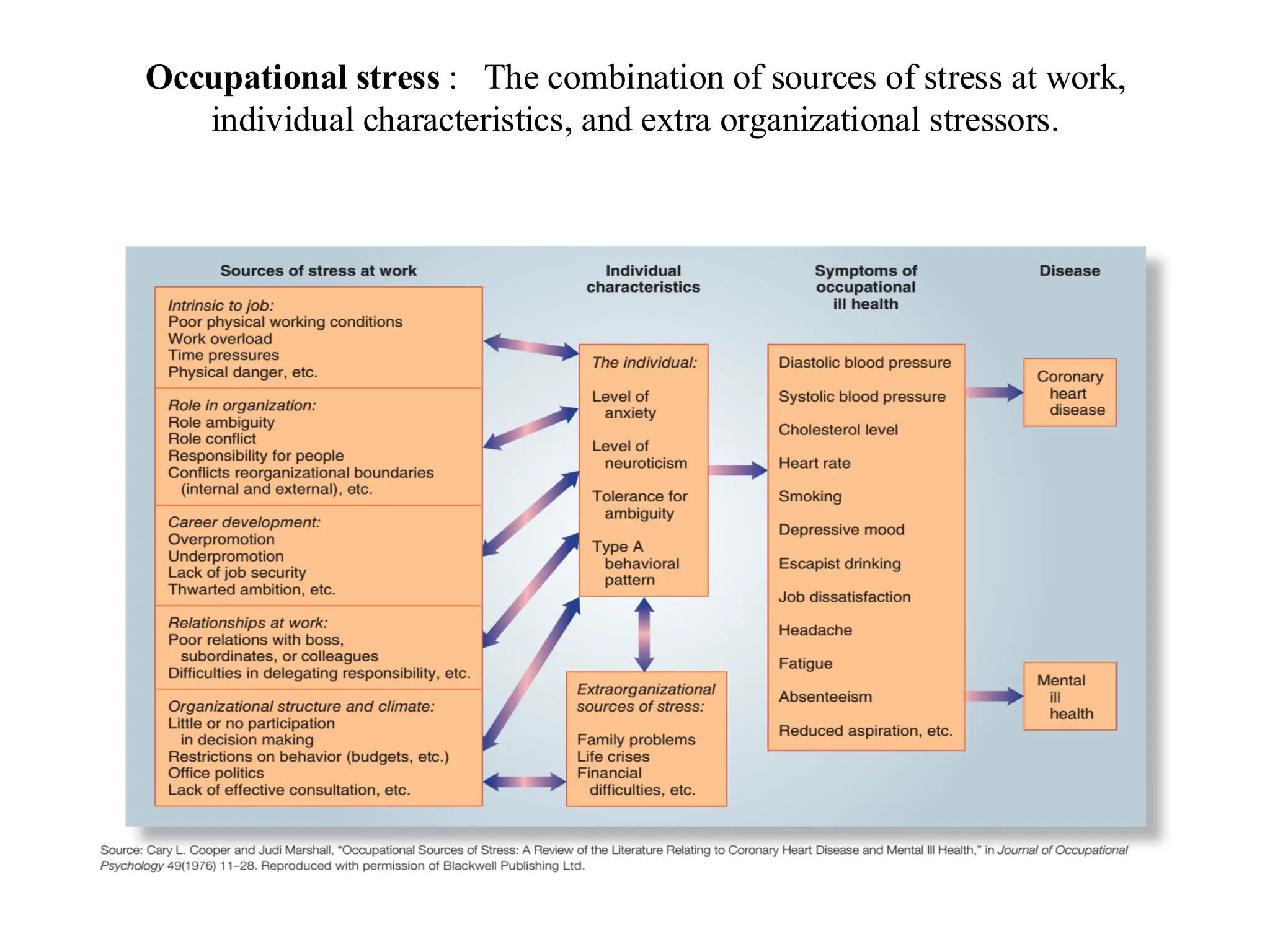
Occupational stress : The combination of sources of stress at work,
individual characteristics, and extra organizational stressors.

Stress -INTRODUCTION ON STRESS students.pdf

  • 1.
  • 2.
    Life is largelya process of adaptation to the circumstances in which we exist. Hans Selye According to Selye- Stress is the nonspecific response of the body to any demand, whether it is caused by, or results in, pleasant or unpleasant conditions.” American Psychological Association defines stress as "any uncomfortable emotional experience accompanied by predictable biochemical, physiological and behavioral changes.
  • 3.
    History and perspectives Stressas stimulus- Psychological stress is anchored in the environment and its characteristics. There are objective external circumstances which are psychologically demanding, threatening, benign, and so forth. Stimulus definitions also include conditions arising within the person, for example, drive stimuli such as hunger or sex. Environmental events typically cited as stress stimuli speak of three types: major changes, often cataclysmic and affecting large numbers of persons (disaster, war); major changes affecting one or a few persons; and daily hassles (Lazarus and Cohen 1977) According to Elliott & Eisdorfer, 1982 there are four types of stressors (1) Acute, time-limited stressors, such as going parachute jumping, awaiting surgery, or, encountering a rattlesnake; (2) Stressor sequences, or series of events that occur over an extended period of time as the result of an initiating event such as job loss, divorce, or bereavement; (3) Chronic intermittent stressors such as conflict-filled visits to in-laws or sexual difficulties, which may occur once a day, once a week, once a month (4) Chronic stressors such as permanent disabilities, parental discord, or chronic job stress, which persist continuously for a long time.
  • 4.
    Stress as response-Stress is viewed as the response of the organism to the complex adaptive demands of the environment. In Biology and medicine stress is most commonly defined in response terms. Here the emphasis is on the state of stress, an organism reacting with stress, being under stress, being disrupted, distressed, and so on. When defined in response term the focus is less on categorizing the stressors. We must await the reaction. Also many responses which can indicate psychological stress , are actually not stressful. Heart rate, for example, will rise sharply from jogging while the individual seems to feel psychologically relaxed and at peace. The response cannot reliably be judged as a psychological stress reaction without reference to the stimulus Stress as interaction Issues with earlier view- knowledge of the environment does not always predict the responses; individual differences matters. From a response perspective, there are numerous indicators to draw upon (different emotions, psycho-physiologic, or hormonal indices), many of which displayed different relationships with distinct environmental challenges (Weiner 1992). To address some of these limitations, psychological stress has been proposed to represent a particular relationship between organism and environment. This third perspective holds that psychological stress is the product of the individual’s ongoing transactions with circumstances, particularly circumstances that are perceived as taxing or exceeding
  • 5.
    Research shows thateven the routine hassles may have significant negative effects on a person’s mental and physical health (Pettit et al., 2010). In one of the study (which looked at whether everyday hassles and major stressful events, both measured over a period of fifteen years, predicted mortality in an elderly sample of men) it was found that elevated levels of both types of stress were associated with increased mortality, but the impact of hassles was actually somewhat greater than that of major stressors. (Aldwin et al., 2014)
  • 6.
    Fight or Flight Oneof the earliest contribution to stress research was Walter Cannon’s (1932) description of the fight-or-flight response. Cannon proposed that when an organism perceives a threat, the body is rapidly aroused and motivated via the sympathetic nervous system and the endocrine system. This rigorous physiological response mobilizes the organism to attack the threat or to flee; hence, it is called the fight-or-flight response. On the one hand, the fight-or-flight response is adaptive because it enables the organism to respond quickly to threat. On the other hand, it can be harmful because stress disrupts emotional and physiological functioning, and when stress continues unabated, it lays the ground-work for health problems.
  • 8.
    Selye’s General AdaptationSyndrome • General Adaptation Syndrome = GAS – Physiological reaction to prolonged stress • Three Phases 1. Alarm 2. Resistance 3. Exhaustion
  • 9.
    Selye’s General AdaptationSyndrome • Alarm - 1st phase - similar to ‘fight or flight’ – Activation of sympathetic nervous system – Release of stress hormones - important = Cortisol • Triggers increase in blood sugars • Suppresses immune system • Cannot last indefinitely – Parasympathetic system tries to restore homeostasis – If stressor persists - so does response!
  • 10.
    Selye’s General AdaptationSyndrome • Resistance – 2nd phase – Continued recruitment of resources – Can last long time, but resources being depleted – Eventually are no longer sufficient • Exhaustion – 3rd phase – Resources dangerously depleted – Increased vulnerability to disease – Can manifest itself with cardiovascular problems; immune system difficulties
  • 11.
    Criticisms of theGeneral Adaptation Syndrome : ❑ Very limited role to psychological factors ; psychological appraisal of events is critical to experiencing stress (Lazarus & Folkman, 1984). ❑ The fact is that not all stressors produce the same endocrinological responses (Kemeny, 2003). How people respond to stress is influenced by their personalities emotions, and biological constitutions (e.g., Moons, Eisenberger, & Taylor, 2010). ❑ A third criticism concerns whether exhaustion of physiological resources or their chronic activation is most implicated in stress; research suggests that continued activation (the second phase) may be most important for accumulating damage to physiological systems. ❑ Finally, Selye assessed stress as an outcome, that is, the endpoint of the general adaptation syndrome. In fact, people experience many debilitating effects of stress after an event has ended and even in anticipation of its occurrence. Despite these limitations and reservations, Selye’s model remains a cornerstone in the field.
  • 12.
    Stress as Transaction Whatis Appraisal? Grinker and Spiegel (1945) -- "appraisal of the situation requires mental activity involving judgment, discrimination, and choice of activity, based largely on past experience" Arnold (1960, 1970) made an attempt to systematically understand the concept. According to her appraisal is the cognitive determinant of emotion; it is rapid, intuitive process ; occurs automatically. If we see somebody stab at our eye with his finger, we avoid the threat instantly, even though we may know that he does not intend to hurt or even to touch us. Before we can make such an instant response, we must have estimated somehow that the stabbing finger could hurt. Since the movement is immediate, unwitting, or even contrary to our better knowledge, this appraisal of possible harm must be similarly immediate.
  • 13.
    ❑ Cognitive appraisalcan be most readily understood as the process of categorizing an encounter, and its various facets, with respect to its significance for well-being. ❑ Primary appraisal (irrelevant, benign-positive, stressful) "Am I in trouble or being benefited, now or in the future, and in what way?" ❑ Secondary appraisal “Can anything be done about it?”
  • 14.
    Transactional theory ofstress and coping (TTSC) (Lazarus, 1966; Lazarus & Folkman, 1984) ❑ Stress as a product of a transaction between a person (including multiple systems: cognitive, physiological, affective, psychological, neurological) and his or her complex environment. ❑ Appraisal of a stressor very important. How an individual appraises a stressor determines how he or she copes with or responds to the stressor. ❑ Whether or not a stressor is experienced as discomforting is influenced by a variety of personal and contextual factors including capacities, skills and abilities, constraints, resources, and norms (Mechanic, 1978). ❑ Lazarus and Folkman (1984) model of stress appraisal, includes primary, secondary, and reappraisal components ❑ Primary appraisal involves determining whether the stressor poses a threat. ❑ Secondary appraisal involves the individual’s evaluation of the resources or coping strategies at his or her disposal for addressing any perceived threats. The process of reappraisal is ongoing and involves continually reappraising both the nature of the stressor and the resources available for responding to the stressor.
  • 15.
    According to Lazarus,the perception of stress, or its appraisal, depends upon the extent of the environmental demand and the amount of resources that an individual has available to cope with that demand. Stress results from an imbalance between the requirements of the environmental situation and one’s ability to cope with it.
  • 16.
    Study ❑ Tomaka andhis colleagues (993) conducted a study –Researcher told the participants that they were interested in measuring their physiological responses (heart rate, pulse) while they performed a mental task: counting backward from 2737 by sevens—that is, 2730, 2723, 2716, and so on. Just before the participants began counting, the researchers assessed their primary and secondary appraisals of the task. They assessed primary appraisals by asking them, “How threatening do you expect the upcoming task to be?” They assessed secondary appraisals by asking, “How able are you to cope with this task?” ❑ It was expected that persons who felt they could not successfully perform the task would perceive it as threatening (“threat group”) and would therefore experience psychological stress. ❑ Participants who were more confident in their abilities might perceive the task as a challenge (“challenge group”) and would not experience psychological stress also they would in fact exhibit greater physiological arousal as they prepared to meet the challenge. All predictions were confirmed. ❑ Participants in the threat group reported feeling greater stress, while participants in the challenge group actually showed greater physiological arousal. Moreover, the challenge group scored higher on both perceived and actual measures of performance.
  • 17.
    Secondary Appraisal: Managingsituation What can be done? Evaluate what options are available ? Will the coping option accomplish what it is supposed to? Secondary appraisals of coping options and primary appraisals of what is at stake interact with each other in shaping the degree of stress and the strength and quality (or content) of the emotional reaction. Secondary Appraisal Internal Options : Will power, inner Strength External Options : Peer group , Professional help Reappraisal : Refers to a changed appraisal on the basis of new information from the environment, which may resist or nourish pressures on the person, and/or information from the person's own reactions. For example -anger (it is reacted by others as well ) may result in guilt or shame, or it may generate a feeling of righteousness or even fear. Mediating these complex two-way transactions between the person and the environment are cognitive appraisal processes. A reappraisal is simply an appraisal that follows an earlier appraisal in the same encounter and modifies it.
  • 18.
    Sources of Stress ❑Frustration: Can’t get what is desired or trying to achieve – Delay, failure, lack of resources, discrimination etc can all lead to frustration. ❑ Conflict : Two or more incompatible motivations or behavioral impulses compete for expression. Higher levels of conflict to be associated with higher levels of psychological distress. (King & Emmons 1991). Lewin (1935)- Three types of conflict ❖ Approach-approach conflict : choice must be made between two attractive goals. ❖ Avoidance-avoidance conflict : choice must be made between two unattractive goals. ❖ Approach-avoidance conflict : choice must be made about whether to pursue a single goal that has both attractive and unattractive aspects. ❑ Change : Changes in one’s living circumstances which requires readjustment. ❑ Pressure : Expectations or demands that one behave in a certain way. Pressure can be divided into two subtypes: the pressure to perform and the pressure to conform.
  • 19.
    Occupational stress :The combination of sources of stress at work, individual characteristics, and extra organizational stressors.