
Strength & Conditioning
Futsal specific
Ismajl Krasniqi
Strength and conditioning coach
Who am I?
- Ismajl Krasniqi Master of Sport Science i
worked as a fitness trainer in clubs...
Major trophies:
- I've been working as a
club trainer for years...
Some key facts about futsal:
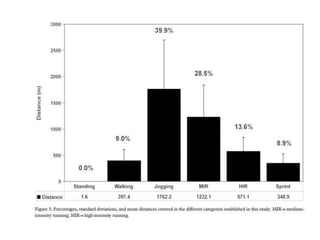
• Analysis of movement demands has shown that
locomotor activities in futsal match changing every
3.28 seconds
• One study reported 8.6 activities per minute of play
with a high-intensity effort every 23 seconds
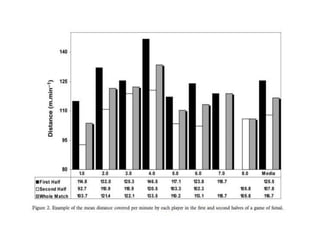
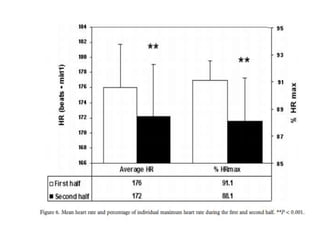
• Futsal players at high competetive level cover 121
(105–137) meters per minute
• Aerobic capacity (Vo2max) of professional futsal
players is 58-65 ml/kg/min
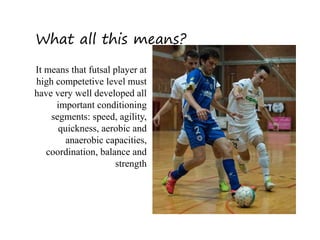
What all this means?
It means that futsal player at
high competetive level must
have very well developed all
important conditioning
segments: speed, agility,
quickness, aerobic and
anaerobic capacities,
coordination, balance and
strength
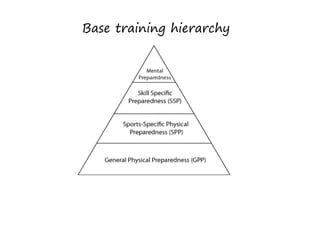
Base training hierarchy
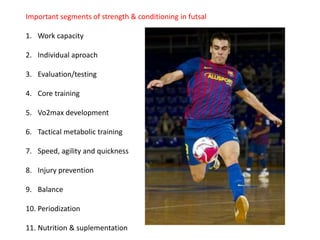
Important segments of strength & conditioning in futsal
1. Work capacity
2. Individual aproach
3. Evaluation/testing
4. Core training
5. Vo2max development
6. Tactical metabolic training
7. Speed, agility and quickness
8. Injury prevention
9. Balance
10. Periodization
11. Nutrition & suplementation
1. Work capacity
Work capacity definition by Vern
Gambetta:
- The ability to tolerate a high
workload
- The ability to recover from
the workload sufficiently for
the next training session or
competition
- The ability to resist fatigue
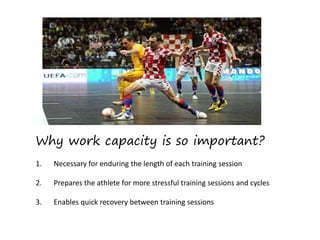
Why work capacity is so important?
1. Necessary for enduring the length of each training session
2. Prepares the athlete for more stressful training sessions and cycles
3. Enables quick recovery between training sessions
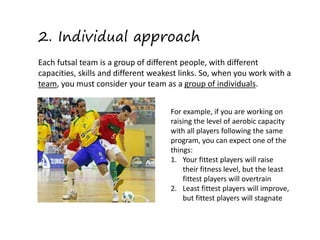
2. Individual approach
Each futsal team is a group of different people, with different
capacities, skills and different weakest links. So, when you work with a
team, you must consider your team as a group of individuals.
For example, if you are working on
raising the level of aerobic capacity
with all players following the same
program, you can expect one of the
things:
1. Your fittest players will raise
their fitness level, but the least
fittest players will overtrain
2. Least fittest players will improve,
but fittest players will stagnate
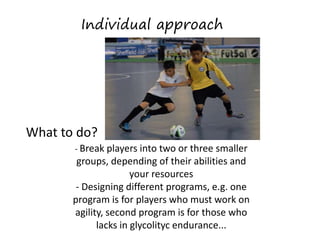
What to do?
- Break players into two or three smaller
groups, depending of their abilities and
your resources
- Designing different programs, e.g. one
program is for players who must work on
agility, second program is for those who
lacks in glycolityc endurance...
Individual approach
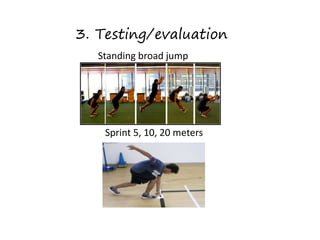
3. Testing/evaluation
Standing broad jump
Sprint 5, 10, 20 meters
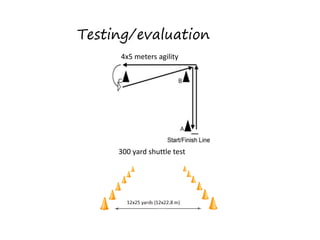
4x5 meters agility
Testing/evaluation
300 yard shuttle test
Testing/evaluation
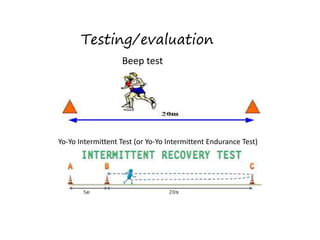
Beep test
Yo-Yo Intermittent Test (or Yo-Yo Intermittent Endurance Test)
Testing/evaluation
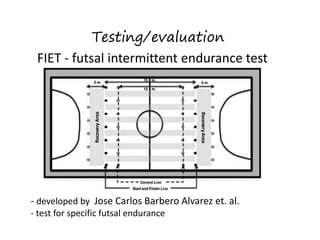
FIET - futsal intermittent endurance test
- developed by Jose Carlos Barbero Alvarez et. al.
- test for specific futsal endurance
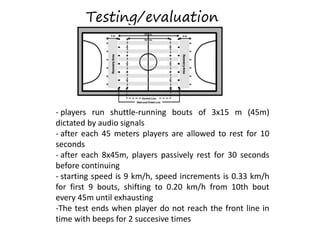
- players run shuttle-running bouts of 3x15 m (45m)
dictated by audio signals
- after each 45 meters players are allowed to rest for 10
seconds
- after each 8x45m, players passively rest for 30 seconds
before continuing
- starting speed is 9 km/h, speed increments is 0.33 km/h
for first 9 bouts, shifting to 0.20 km/h from 10th bout
every 45m until exhausting
-The test ends when player do not reach the front line in
time with beeps for 2 succesive times
Testing/evaluation
4. Core training
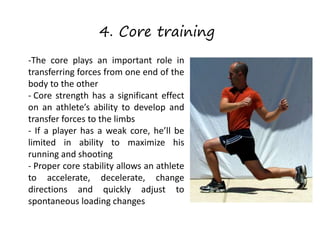
-The core plays an important role in
transferring forces from one end of the
body to the other
- Core strength has a significant effect
on an athlete’s ability to develop and
transfer forces to the limbs
- If a player has a weak core, he’ll be
limited in ability to maximize his
running and shooting
- Proper core stability allows an athlete
to accelerate, decelerate, change
directions and quickly adjust to
spontaneous loading changes
Core training
Core training is often neglected, underrated od misunderstood
- Hundreds of crunches – totaly wrong
- Hours in plank position – far from enough for quality core
- Core is the most important link in kinetic chain!
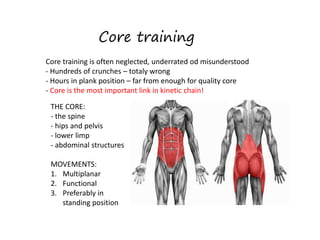
THE CORE:
- the spine
- hips and pelvis
- lower limp
- abdominal structures
MOVEMENTS:
1. Multiplanar
2. Functional
3. Preferably in
standing position
Core training
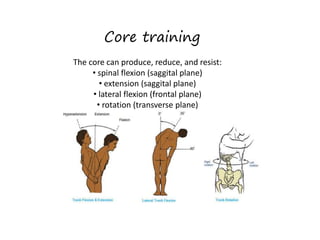
The core can produce, reduce, and resist:
• spinal flexion (saggital plane)
• extension (saggital plane)
• lateral flexion (frontal plane)
• rotation (transverse plane)
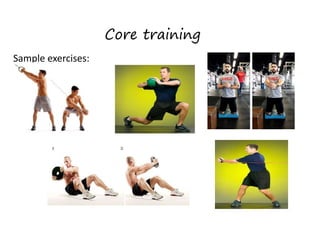
Core training
Sample exercises:
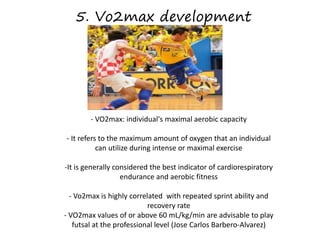
5. Vo2max development
- VO2max: individual's maximal aerobic capacity
- It refers to the maximum amount of oxygen that an individual
can utilize during intense or maximal exercise
-It is generally considered the best indicator of cardiorespiratory
endurance and aerobic fitness
- Vo2max is highly correlated with repeated sprint ability and
recovery rate
- VO2max values of or above 60 mL/kg/min are advisable to play
futsal at the professional level (Jose Carlos Barbero-Alvarez)
Vo2max development
M
E
T
H
O
D
S
M
E
T
H
O
D
S
1. Billlat protocol
15/15 or 30/30 interval training: run 15 od 30 seconds
at 90% of HRmax) followed by 15 or 30 seconds
running at 70% of intensity. 12-20 reps in training,
once or twice a week
2. 4x4 interval training
4 intervals of 4 minutes of high intensity exercise at
90% of HRmax followed with 3 minutes of active
recovery at 70% HRmax
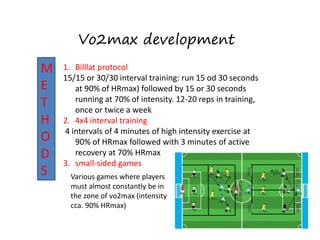
3. small-sided games
Various games where players
must almost constantly be in
the zone of vo2max (intensity
cca. 90% HRmax)
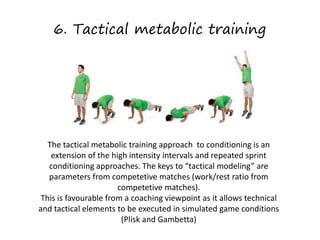
6. Tactical metabolic training
The tactical metabolic training approach to conditioning is an
extension of the high intensity intervals and repeated sprint
conditioning approaches. The keys to “tactical modeling” are
parameters from competetive matches (work/rest ratio from
competetive matches).
This is favourable from a coaching viewpoint as it allows technical
and tactical elements to be executed in simulated game conditions
(Plisk and Gambetta)
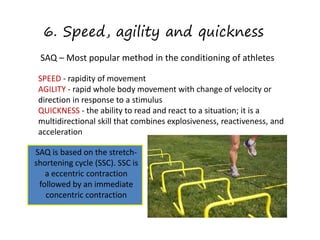
6. Speed, agility and quickness
SAQ – Most popular method in the conditioning of athletes
SPEED - rapidity of movement
AGILITY - rapid whole body movement with change of velocity or
direction in response to a stimulus
QUICKNESS - the ability to read and react to a situation; it is a
multidirectional skill that combines explosiveness, reactiveness, and
acceleration
SAQ is based on the stretch-
shortening cycle (SSC). SSC
is a eccentric contraction
followed by an immediate
concentric contraction
SAQ is based on the stretch-
shortening cycle (SSC). SSC is
a eccentric contraction
followed by an immediate
concentric contraction
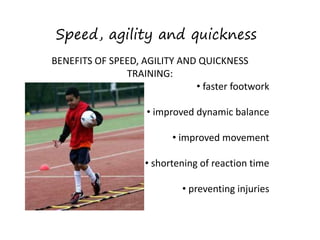
Speed, agility and quickness
BENEFITS OF SPEED, AGILITY AND QUICKNESS
TRAINING:
• faster footwork
• improved dynamic balance
• improved movement
• shortening of reaction time
• preventing injuries
Speed, agility and quickness
Framework of Speed, agility and quickness (SAQ) program:
1. Dynamic flexibility
Dynamic flexibility increase muscular flexibility through the
neuromuscular system and reduce injury via decreasing
reflexive muscle contractions
2. Mechanics of movement (running technique)
Hurdle drills; Knee-lifts, dead leg, multiple hops, sidesteps, forward
and lateral jumps...
3. Innervation
Ladder drills; various linear and lateral exercises
4. Accumulation of potential
This phase brings together the areas of work already practiced.
Short and very explosive drills, and the emphasis is on quality.
Combination runs.
5. Explosion
Short speed bursts, resistance running, contrast training
6. Expression of potential
Sixth phase brings together all the elements of the SAQ
programme into highly competitive situations
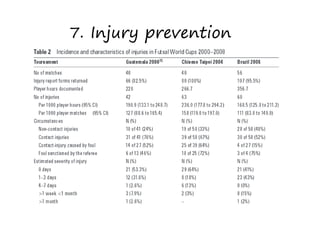
7. Injury prevention
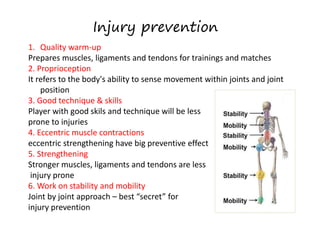
Injury prevention
1. Quality warm-up
Prepares muscles, ligaments and tendons for trainings and matches
2. Proprioception
It refers to the body's ability to sense movement within joints and joint
position
3. Good technique & skills
Player with good skils and technique will be less
prone to injuries
4. Eccentric muscle contractions
eccentric strengthening have big preventive effect
5. Strengthening
Stronger muscles, ligaments and tendons are less
injury prone
6. Work on stability and mobility
Joint by joint approach – best “secret” for
injury prevention
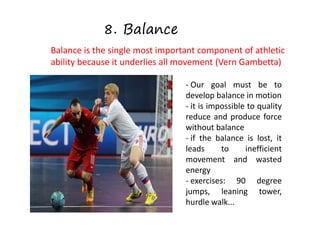
8. Balance
Balance is the single most important component of athletic
ability because it underlies all movement (Vern Gambetta)
- Our goal must be to
develop balance in motion
- it is impossible to quality
reduce and produce force
without balance
- if the balance is lost, it
leads to inefficient
movement and wasted
energy
- exercises: 90 degree
jumps, leaning tower,
hurdle walk...
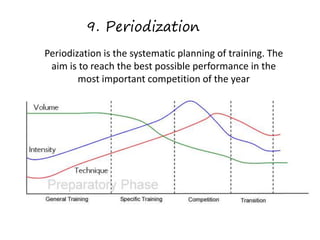
9. Periodization
Periodization is the systematic planning of training. The
aim is to reach the best possible performance in the
most important competition of the year
periodization
•GENERAL PREPARATION PERIOD 6 – 8 weeks
First two-three weeks: general preparation with 60-70%
strength and conditioning programs (testing, prevention,
proprioception, aerobic and muscular endurance, general
strength), 30-40% futsal technique and tactics
Third to fourth or fifth week: futsal specific strength and
conditioning, 50% of conditioning programmes and 50% od
technical and tactical preparation
Last two to three weeks: emphasis on technical and tactical
programmes (70-80%), conditioning programmes are strictly
specific (SAQ programmes, small-sided games...)
10. Nutrition and supplements
Don’t underestimate power of quality nutrition!
1. Don’t eat simple carbs
and sugars
2. After training first replace
fluids (water or isotonic
drinks)
3. Eat lots of fish, eventually
add some quality omega-
3 supplement
4. Include healthy fats(olive
oil, nuts, seeds...)
5. Never miss your meal
6. Avoid fried foods
7. Don’t trust everything
you hear from
supplements industry
Important things to know
1.Train movements, not muscles
2.In every training session create an
challenging environment
3.Involve as many speed sessions as
possible
4.Stress core before extremities
5.Don’t involve single-joint
movements
6.Folow the right progression
REFERENCES:
1. Gambetta, Vern: Gambetta Method, a Common sense guide
to functional training for athletic performance
2. Castagna, C., Barbero Alvarez, J. C.: Physiological demands of
an intermittent Futsal-oriented high-intensity test
3. Barbero Alvarez, J.C., et. al.: Match demands of professional
Futsal: a case study
4. Barbero Alvarez, J. C. et. al.: Match analysis and heart rate of
futsal players during competition
5. Fitzgibbon, Shane; Getting to the core:
http://irelandstrengthandconditioning.wordpress.com/2013/
09/27/getting-to-the-core-what-is-core-training-anyway/
6. Kelso, Tom: Core Strength and the Athlete: Keeping It in
Perspective
7. Junge A, Dvorak J: Injury risk of playing football in Futsal
World Cups
8. Rowbottom, David J.: Periodization of Training
9. Arnd Krüger: Periodization or Peaking at the right time
10. Gamble, Paul: Strength and Conditioning for Team Sports:
Sport-Specific Physical Preparation for High Performance

Strength & Conditioning Fut sall specific

  • 1.
    Strength & Conditioning Futsalspecific Ismajl Krasniqi Strength and conditioning coach
  • 2.
    Who am I? -Ismajl Krasniqi Master of Sport Science i worked as a fitness trainer in clubs... Major trophies: - I've been working as a club trainer for years...
  • 3.
    Some key factsabout futsal: • Analysis of movement demands has shown that locomotor activities in futsal match changing every 3.28 seconds • One study reported 8.6 activities per minute of play with a high-intensity effort every 23 seconds • Futsal players at high competetive level cover 121 (105–137) meters per minute • Aerobic capacity (Vo2max) of professional futsal players is 58-65 ml/kg/min
  • 7.
    What all thismeans? It means that futsal player at high competetive level must have very well developed all important conditioning segments: speed, agility, quickness, aerobic and anaerobic capacities, coordination, balance and strength
  • 8.
  • 9.
    Important segments ofstrength & conditioning in futsal 1. Work capacity 2. Individual aproach 3. Evaluation/testing 4. Core training 5. Vo2max development 6. Tactical metabolic training 7. Speed, agility and quickness 8. Injury prevention 9. Balance 10. Periodization 11. Nutrition & suplementation
  • 10.
    1. Work capacity Workcapacity definition by Vern Gambetta: - The ability to tolerate a high workload - The ability to recover from the workload sufficiently for the next training session or competition - The ability to resist fatigue
  • 11.
    Why work capacityis so important? 1. Necessary for enduring the length of each training session 2. Prepares the athlete for more stressful training sessions and cycles 3. Enables quick recovery between training sessions
  • 12.
    2. Individual approach Eachfutsal team is a group of different people, with different capacities, skills and different weakest links. So, when you work with a team, you must consider your team as a group of individuals. For example, if you are working on raising the level of aerobic capacity with all players following the same program, you can expect one of the things: 1. Your fittest players will raise their fitness level, but the least fittest players will overtrain 2. Least fittest players will improve, but fittest players will stagnate
  • 13.
    What to do? -Break players into two or three smaller groups, depending of their abilities and your resources - Designing different programs, e.g. one program is for players who must work on agility, second program is for those who lacks in glycolityc endurance... Individual approach
  • 14.
    3. Testing/evaluation Standing broadjump Sprint 5, 10, 20 meters
  • 15.
  • 16.
    Testing/evaluation Beep test Yo-Yo IntermittentTest (or Yo-Yo Intermittent Endurance Test)
  • 17.
    Testing/evaluation FIET - futsalintermittent endurance test - developed by Jose Carlos Barbero Alvarez et. al. - test for specific futsal endurance
  • 18.
    - players runshuttle-running bouts of 3x15 m (45m) dictated by audio signals - after each 45 meters players are allowed to rest for 10 seconds - after each 8x45m, players passively rest for 30 seconds before continuing - starting speed is 9 km/h, speed increments is 0.33 km/h for first 9 bouts, shifting to 0.20 km/h from 10th bout every 45m until exhausting -The test ends when player do not reach the front line in time with beeps for 2 succesive times Testing/evaluation
  • 19.
    4. Core training -Thecore plays an important role in transferring forces from one end of the body to the other - Core strength has a significant effect on an athlete’s ability to develop and transfer forces to the limbs - If a player has a weak core, he’ll be limited in ability to maximize his running and shooting - Proper core stability allows an athlete to accelerate, decelerate, change directions and quickly adjust to spontaneous loading changes
  • 20.
    Core training Core trainingis often neglected, underrated od misunderstood - Hundreds of crunches – totaly wrong - Hours in plank position – far from enough for quality core - Core is the most important link in kinetic chain! THE CORE: - the spine - hips and pelvis - lower limp - abdominal structures MOVEMENTS: 1. Multiplanar 2. Functional 3. Preferably in standing position
  • 21.
    Core training The corecan produce, reduce, and resist: • spinal flexion (saggital plane) • extension (saggital plane) • lateral flexion (frontal plane) • rotation (transverse plane)
  • 22.
  • 23.
    5. Vo2max development -VO2max: individual's maximal aerobic capacity - It refers to the maximum amount of oxygen that an individual can utilize during intense or maximal exercise -It is generally considered the best indicator of cardiorespiratory endurance and aerobic fitness - Vo2max is highly correlated with repeated sprint ability and recovery rate - VO2max values of or above 60 mL/kg/min are advisable to play futsal at the professional level (Jose Carlos Barbero-Alvarez)
  • 24.
    Vo2max development M E T H O D S M E T H O D S 1. Billlatprotocol 15/15 or 30/30 interval training: run 15 od 30 seconds at 90% of HRmax) followed by 15 or 30 seconds running at 70% of intensity. 12-20 reps in training, once or twice a week 2. 4x4 interval training 4 intervals of 4 minutes of high intensity exercise at 90% of HRmax followed with 3 minutes of active recovery at 70% HRmax 3. small-sided games Various games where players must almost constantly be in the zone of vo2max (intensity cca. 90% HRmax)
  • 25.
    6. Tactical metabolictraining The tactical metabolic training approach to conditioning is an extension of the high intensity intervals and repeated sprint conditioning approaches. The keys to “tactical modeling” are parameters from competetive matches (work/rest ratio from competetive matches). This is favourable from a coaching viewpoint as it allows technical and tactical elements to be executed in simulated game conditions (Plisk and Gambetta)
  • 26.
    6. Speed, agilityand quickness SAQ – Most popular method in the conditioning of athletes SPEED - rapidity of movement AGILITY - rapid whole body movement with change of velocity or direction in response to a stimulus QUICKNESS - the ability to read and react to a situation; it is a multidirectional skill that combines explosiveness, reactiveness, and acceleration SAQ is based on the stretch- shortening cycle (SSC). SSC is a eccentric contraction followed by an immediate concentric contraction SAQ is based on the stretch- shortening cycle (SSC). SSC is a eccentric contraction followed by an immediate concentric contraction
  • 27.
    Speed, agility andquickness BENEFITS OF SPEED, AGILITY AND QUICKNESS TRAINING: • faster footwork • improved dynamic balance • improved movement • shortening of reaction time • preventing injuries
  • 28.
    Speed, agility andquickness Framework of Speed, agility and quickness (SAQ) program: 1. Dynamic flexibility Dynamic flexibility increase muscular flexibility through the neuromuscular system and reduce injury via decreasing reflexive muscle contractions 2. Mechanics of movement (running technique) Hurdle drills; Knee-lifts, dead leg, multiple hops, sidesteps, forward and lateral jumps... 3. Innervation Ladder drills; various linear and lateral exercises 4. Accumulation of potential This phase brings together the areas of work already practiced. Short and very explosive drills, and the emphasis is on quality. Combination runs. 5. Explosion Short speed bursts, resistance running, contrast training 6. Expression of potential Sixth phase brings together all the elements of the SAQ programme into highly competitive situations
  • 29.
  • 30.
    Injury prevention 1. Qualitywarm-up Prepares muscles, ligaments and tendons for trainings and matches 2. Proprioception It refers to the body's ability to sense movement within joints and joint position 3. Good technique & skills Player with good skils and technique will be less prone to injuries 4. Eccentric muscle contractions eccentric strengthening have big preventive effect 5. Strengthening Stronger muscles, ligaments and tendons are less injury prone 6. Work on stability and mobility Joint by joint approach – best “secret” for injury prevention
  • 31.
    8. Balance Balance isthe single most important component of athletic ability because it underlies all movement (Vern Gambetta) - Our goal must be to develop balance in motion - it is impossible to quality reduce and produce force without balance - if the balance is lost, it leads to inefficient movement and wasted energy - exercises: 90 degree jumps, leaning tower, hurdle walk...
  • 32.
    9. Periodization Periodization isthe systematic planning of training. The aim is to reach the best possible performance in the most important competition of the year
  • 33.
    periodization •GENERAL PREPARATION PERIOD6 – 8 weeks First two-three weeks: general preparation with 60-70% strength and conditioning programs (testing, prevention, proprioception, aerobic and muscular endurance, general strength), 30-40% futsal technique and tactics Third to fourth or fifth week: futsal specific strength and conditioning, 50% of conditioning programmes and 50% od technical and tactical preparation Last two to three weeks: emphasis on technical and tactical programmes (70-80%), conditioning programmes are strictly specific (SAQ programmes, small-sided games...)
  • 34.
    10. Nutrition andsupplements Don’t underestimate power of quality nutrition! 1. Don’t eat simple carbs and sugars 2. After training first replace fluids (water or isotonic drinks) 3. Eat lots of fish, eventually add some quality omega- 3 supplement 4. Include healthy fats(olive oil, nuts, seeds...) 5. Never miss your meal 6. Avoid fried foods 7. Don’t trust everything you hear from supplements industry
  • 35.
    Important things toknow 1.Train movements, not muscles 2.In every training session create an challenging environment 3.Involve as many speed sessions as possible 4.Stress core before extremities 5.Don’t involve single-joint movements 6.Folow the right progression
  • 36.
    REFERENCES: 1. Gambetta, Vern:Gambetta Method, a Common sense guide to functional training for athletic performance 2. Castagna, C., Barbero Alvarez, J. C.: Physiological demands of an intermittent Futsal-oriented high-intensity test 3. Barbero Alvarez, J.C., et. al.: Match demands of professional Futsal: a case study 4. Barbero Alvarez, J. C. et. al.: Match analysis and heart rate of futsal players during competition 5. Fitzgibbon, Shane; Getting to the core: http://irelandstrengthandconditioning.wordpress.com/2013/ 09/27/getting-to-the-core-what-is-core-training-anyway/ 6. Kelso, Tom: Core Strength and the Athlete: Keeping It in Perspective 7. Junge A, Dvorak J: Injury risk of playing football in Futsal World Cups 8. Rowbottom, David J.: Periodization of Training 9. Arnd Krüger: Periodization or Peaking at the right time 10. Gamble, Paul: Strength and Conditioning for Team Sports: Sport-Specific Physical Preparation for High Performance