STRENGTH ANALYSIS OF CONCRETE 
USING M-SAND AND COCONUT SHELL 
BY, 
ALWIS DEVA KIRUPA J.P 
1st YEAR ME (STRUCTURAL ENGINEERING) 
REGIONAL CENTER OF ANNA UNIVERSITY, 
THIRUNELVELI.
INTRODUCTION 
Concrete is the widely used building material in 
Civil Engineering constructions because of its 
versatility. 
River sand, a natural resource and a main 
constituent of conventional concrete, is 
increasingly depleting nowadays due to illicit sand 
mining from river. 
Dwindling sand resources poses the 
environmental problem and hence government 
restrictions on sand quarrying resulted in scarcity 
and significant increase in its cost
Scarcity of natural sand due to heavy demand in 
growing construction activities forces us to find 
the suitable substitute. 
Replacing fine aggregate by Manufactured sand 
(M-sand) in concrete is a better solution for this 
ecological imbalance and economic construction. 
Utilizing coconut shell as coarse aggregate in 
concrete production not only solves the problem of 
disposing this solid waste but also helps to 
conserve natural resources. Use of coconut shell in 
concrete reduces its density. 
The strength of the light weight concrete made by 
using M-sand and coconut shell at certain 
percentage is equal to the conventional concrete.
Materials used 1. CEMENT 
For general purpose of ordinary Portland cement 
43grade is suitable for the construction of all 
engineering works. 
Properties of ordinary Portland cement:- 
As per IS 269-1967-1975 , 
The fineness residue does not exceed 10% on is 
sieve no 90μ. 
Soundness of ordinary Portland cement is not 
more than 10mm in Le-chatterer apparatus. 
Initial setting time is not less than 30 minutes.
Final setting time not more than 10 hours. 
Compressive strength after 3days is not less 
than11.5Nmm2. 
Strength after 7 days is not less than 17.5Nmm2. 
2. FINE AGGREGATE 
2.1 River Sand 
River sand shall conform to IS:383 and relevant 
portion of IS:515.It shall pass through the 4.75mm 
IS sieve leaving a residue of not more than 5%. 
2.2 M-sand 
M-sand is a term used for aggregate materials less 
than 4.75mm size which are processed from 
crushed rock or gravel.
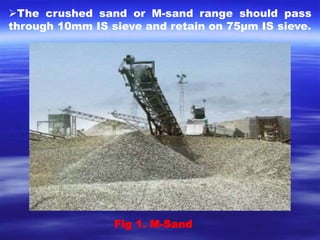
The crushed sand or M-sand range should pass 
through 10mm IS sieve and retain on 75μm IS sieve. 
Fig 1. M-Sand
3. COARSE AGGREGATE 
3.1 Crushed or broken stone 
It shall be obtained from crushing Granite, trap or 
similar approved stone from approved quarry and 
shall be conformed to IS 383 and IS 515. 95% of 
which shall be retained on 4.75mm IS sieve. Size of 
course aggregate shall be 20mm. Should be cubical 
in shape. 
3.2 Coconut shell 
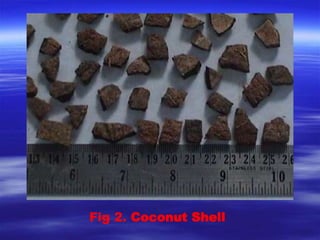
Coconut shell is one of agricultural by-product. 
They were sun dried for 1 month before being 
crushed manually. The crushed materials were later 
taken to the lab where it is processed. The particle 
size of the coconut shell is range from 5 to 20mm.
Fig 2. Coconut Shell
4. WATER 
Water used for mixing and curing shall be clean 
free from oils, acids, alkalis, salts, sugar, organic 
materials or other substances that may be 
deleterious to concrete. Portable water is 
generally considered satisfactory for mixing 
concrete. Water used in concrete is of PH value is 
not less than 6.
Mix design 
The process of selecting suitable ingredients of 
concrete and determining their relative amounts 
with the objective of producing a concrete of the 
required, strength, durability, and workability as 
economically as possible, is termed the concrete 
mix design. 
 Factors affecting the mix design 
Compressive Strength 
Workability 
Durability 
Maximum Nominal Size of Aggregate 
Grading and Type of Aggregate 
Quality Control
PROCEDURE 
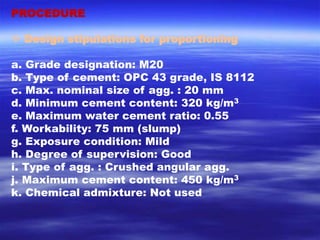
 Design stipulations for proportioning 
a. Grade designation: M20 
b. Type of cement: OPC 43 grade, IS 8112 
c. Max. nominal size of agg. : 20 mm 
d. Minimum cement content: 320 kg/m3 
e. Maximum water cement ratio: 0.55 
f. Workability: 75 mm (slump) 
g. Exposure condition: Mild 
h. Degree of supervision: Good 
i. Type of agg. : Crushed angular agg. 
j. Maximum cement content: 450 kg/m3 
k. Chemical admixture: Not used
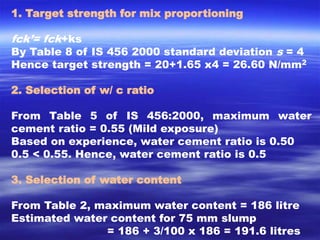
1. Target strength for mix proportioning 
fck’= fck+ks 
By Table 8 of IS 456 2000 standard deviation s = 4 
Hence target strength = 20+1.65 x4 = 26.60 N/mm2 
2. Selection of w/ c ratio 
From Table 5 of IS 456:2000, maximum water 
cement ratio = 0.55 (Mild exposure) 
Based on experience, water cement ratio is 0.50 
0.5 < 0.55. Hence, water cement ratio is 0.5 
3. Selection of water content 
From Table 2, maximum water content = 186 litre 
Estimated water content for 75 mm slump 
= 186 + 3/100 x 186 = 191.6 litres
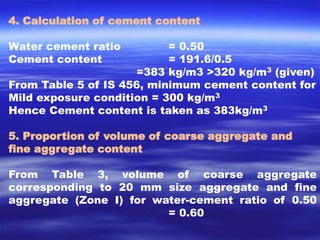
4. Calculation of cement content 
Water cement ratio = 0.50 
Cement content = 191.6/0.5 
=383 kg/m3 >320 kg/m3 (given) 
From Table 5 of IS 456, minimum cement content for 
Mild exposure condition = 300 kg/m3 
Hence Cement content is taken as 383kg/m3 
5. Proportion of volume of coarse aggregate and 
fine aggregate content 
From Table 3, volume of coarse aggregate 
corresponding to 20 mm size aggregate and fine 
aggregate (Zone I) for water-cement ratio of 0.50 
= 0.60
6. Mix calculations 
The mix calculations per unit volume of concrete 
shall be as follows 
a) Volume of concrete = 1 m3 
b) Volume of cement =(mass of cement/specific 
gravity of cement ) x (1/1000) 
= [383.16/3.15] x [1/1000] 
= 0.122 m3 
c) Volume of water = [192/1] x [1/1000] 
= 0.192 m3 
d) Volume of all aggregates (e) = a – (b + c) 
= 1 – (0.122 + 0.192) = 0.686 m3 
e) Volume and weight of coarse aggregates 
Volume = 0.686 x 0.6 = 0.412 m3 
Weight = Volume of CA x specific gravity of CA 
= 1103 kg
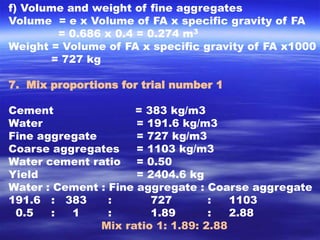
f) Volume and weight of fine aggregates 
Volume = e x Volume of FA x specific gravity of FA 
= 0.686 x 0.4 = 0.274 m3 
Weight = Volume of FA x specific gravity of FA x1000 
= 727 kg 
7. Mix proportions for trial number 1 
Cement = 383 kg/m3 
Water = 191.6 kg/m3 
Fine aggregate = 727 kg/m3 
Coarse aggregates = 1103 kg/m3 
Water cement ratio = 0.50 
Yield = 2404.6 kg 
Water : Cement : Fine aggregate : Coarse aggregate 
191.6 : 383 : 727 : 1103 
0.5 : 1 : 1.89 : 2.88 
Mix ratio 1: 1.89: 2.88
Results & discussions 
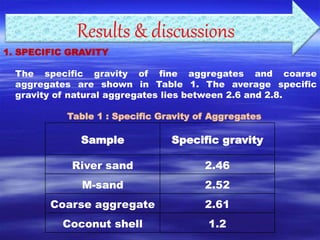
1. SPECIFIC GRAVITY 
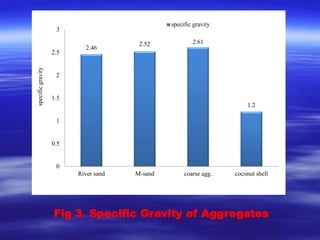
The specific gravity of fine aggregates and coarse 
aggregates are shown in Table 1. The average specific 
gravity of natural aggregates lies between 2.6 and 2.8. 
Table 1 : Specific Gravity of Aggregates 
Sample Specific gravity 
River sand 2.46 
M-sand 2.52 
Coarse aggregate 2.61 
Coconut shell 1.2
2.46 
2.52 2.61 
1.2 
3 
2.5 
2 
1.5 
1 
0.5 
0 
River sand M-sand coarse agg. coconut shell 
specific gravity 
specific gravity 
Fig 3. Specific Gravity of Aggregates
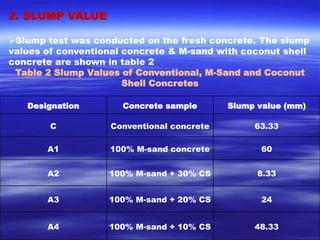
2. SLUMP VALUE 
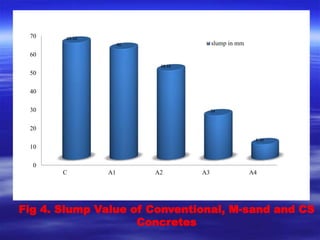
Slump test was conducted on the fresh concrete. The slump 
values of conventional concrete & M-sand with coconut shell 
concrete are shown in table 2 
Table 2 Slump Values of Conventional, M-Sand and Coconut 
Shell Concretes 
Designation Concrete sample Slump value (mm) 
C Conventional concrete 63.33 
A1 100% M-sand concrete 60 
A2 100% M-sand + 30% CS 8.33 
A3 100% M-sand + 20% CS 24 
A4 100% M-sand + 10% CS 48.33
70 
60 
50 
40 
30 
20 
10 
0 
63.33 
60 
48.33 
slump in mm 
24 
8.33 
C A1 A2 A3 A4 
Fig 4. Slump Value of Conventional, M-sand and CS 
Concretes
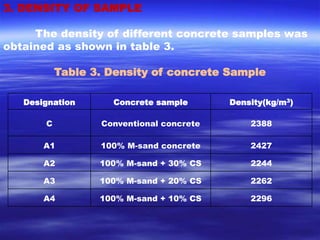
3. DENSITY OF SAMPLE 
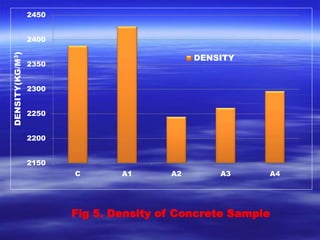
The density of different concrete samples was 
obtained as shown in table 3. 
Table 3. Density of concrete Sample 
Designation Concrete sample Density(kg/m3) 
C Conventional concrete 2388 
A1 100% M-sand concrete 2427 
A2 100% M-sand + 30% CS 2244 
A3 100% M-sand + 20% CS 2262 
A4 100% M-sand + 10% CS 2296
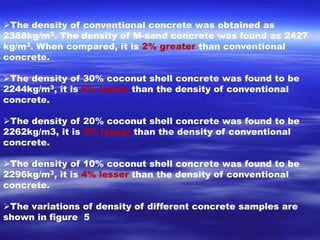
The density of conventional concrete was obtained as 
2388kg/m3. The density of M-sand concrete was found as 2427 
kg/m3. When compared, it is 2% greater than conventional 
concrete. 
The density of 30% coconut shell concrete was found to be 
2244kg/m3, it is 6% lesser than the density of conventional 
concrete. 
The density of 20% coconut shell concrete was found to be 
2262kg/m3, it is 5% lesser than the density of conventional 
concrete. 
The density of 10% coconut shell concrete was found to be 
2296kg/m3, it is 4% lesser than the density of conventional 
concrete. 
The variations of density of different concrete samples are 
shown in figure 5
2450 
2400 
2350 
2300 
2250 
2200 
2150 
C A1 A2 A3 A4 
DENSITY(KG/M3) 
DENSITY 
Fig 5. Density of Concrete Sample
7 days compressive strength 
(N/mm2) 
21 days compressive 
strength (N/mm2) 
28 days compressive 
strength (N/mm2) 
Sampl 
e 1 
Samp 
le 2 
Samp 
le 
3 
Averag 
e 
Sampl 
e 1 
Samp 
le 2 
Sampl 
e 
3 
Averag 
e 
Sampl 
e 1 
Sample 
2 
Sample 
3 
18.22 17.78 19.56 18.52 23.56 24.22 23.33 23.72 25.56 24.44 26.22 
23.77 24.66 24.22 24.22 28 30.89 28.44 29.11 36.67 35.56 36 
13.11 13.33 13.56 13.33 21.11 20 20.67 20.59 22.22 21.56 22.67 
15.56 15.11 15.56 15.41 23.78 24.44 22.44 23.56 25.33 25.11 24.67 
18.67 19.33 19.11 19.04 25.78 26 24.89 25.56 27.11 26.67 27.78 
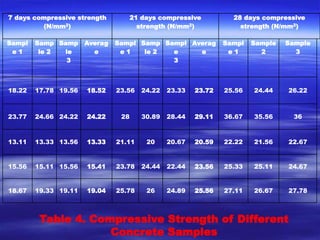
Table 4. Compressive Strength of Different 
Concrete Samples
18.52 
24.22 
13.33 
15.41 
19.04 
30 
25 
20 
15 
10 
5 
0 
C A1 A2 A3 A4 
COMPRESSIVE STRENGTH(N/퐦퐦2) 
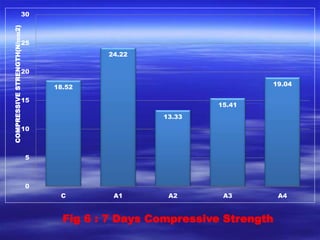
Fig 6 : 7 Days Compressive Strength
23.72 
29.11 
20.59 
23.56 
25.56 
35 
30 
25 
20 
15 
10 
5 
0 
C A1 A2 A3 A4 
COMPRESSIVE STRENGTH(N/퐦퐦2) 
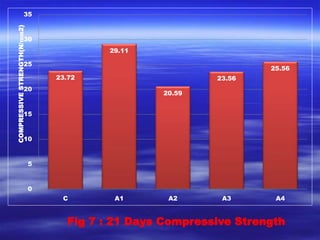
Fig 7 : 21 Days Compressive Strength
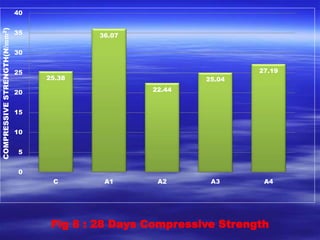
25.38 
36.07 
22.44 
25.04 
27.19 
40 
35 
30 
25 
20 
15 
10 
5 
0 
C A1 A2 A3 A4 
COMPRESSIVE STRENGTH(N/퐦퐦2) 
Fig 8 : 28 Days Compressive Strength
40 
35 
30 
25 
20 
15 
10 
5 
0 
C A1 A2 A3 A4 
COMPRESSIVE STRENGTH(N/MM2) 
7 DAYS COMPRESSIVE STRENGTH 
21DAYS COMPRESSIVE STRENGTH 
28DAYS COMPRESSIVE STRENGTH 
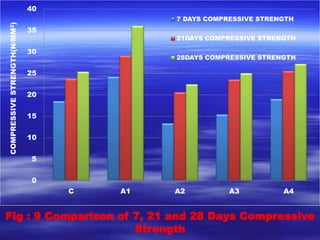
Fig : 9 Comparison of 7, 21 and 28 Days Compressive 
Strength
conclusion 
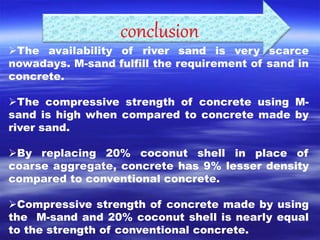
The availability of river sand is very scarce 
nowadays. M-sand fulfill the requirement of sand in 
concrete. 
The compressive strength of concrete using M-sand 
is high when compared to concrete made by 
river sand. 
By replacing 20% coconut shell in place of 
coarse aggregate, concrete has 9% lesser density 
compared to conventional concrete. 
Compressive strength of concrete made by using 
the M-sand and 20% coconut shell is nearly equal 
to the strength of conventional concrete.
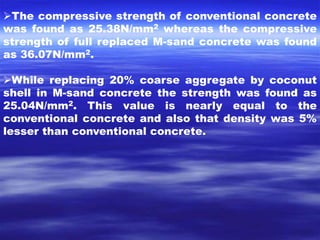
The compressive strength of conventional concrete 
was found as 25.38N/mm2 whereas the compressive 
strength of full replaced M-sand concrete was found 
as 36.07N/mm2. 
While replacing 20% coarse aggregate by coconut 
shell in M-sand concrete the strength was found as 
25.04N/mm2. This value is nearly equal to the 
conventional concrete and also that density was 5% 
lesser than conventional concrete.
..

Strength analysis of concrete

  • 1.
    STRENGTH ANALYSIS OFCONCRETE USING M-SAND AND COCONUT SHELL BY, ALWIS DEVA KIRUPA J.P 1st YEAR ME (STRUCTURAL ENGINEERING) REGIONAL CENTER OF ANNA UNIVERSITY, THIRUNELVELI.
  • 2.
    INTRODUCTION Concrete isthe widely used building material in Civil Engineering constructions because of its versatility. River sand, a natural resource and a main constituent of conventional concrete, is increasingly depleting nowadays due to illicit sand mining from river. Dwindling sand resources poses the environmental problem and hence government restrictions on sand quarrying resulted in scarcity and significant increase in its cost
  • 3.
    Scarcity of naturalsand due to heavy demand in growing construction activities forces us to find the suitable substitute. Replacing fine aggregate by Manufactured sand (M-sand) in concrete is a better solution for this ecological imbalance and economic construction. Utilizing coconut shell as coarse aggregate in concrete production not only solves the problem of disposing this solid waste but also helps to conserve natural resources. Use of coconut shell in concrete reduces its density. The strength of the light weight concrete made by using M-sand and coconut shell at certain percentage is equal to the conventional concrete.
  • 4.
    Materials used 1.CEMENT For general purpose of ordinary Portland cement 43grade is suitable for the construction of all engineering works. Properties of ordinary Portland cement:- As per IS 269-1967-1975 , The fineness residue does not exceed 10% on is sieve no 90μ. Soundness of ordinary Portland cement is not more than 10mm in Le-chatterer apparatus. Initial setting time is not less than 30 minutes.
  • 5.
    Final setting timenot more than 10 hours. Compressive strength after 3days is not less than11.5Nmm2. Strength after 7 days is not less than 17.5Nmm2. 2. FINE AGGREGATE 2.1 River Sand River sand shall conform to IS:383 and relevant portion of IS:515.It shall pass through the 4.75mm IS sieve leaving a residue of not more than 5%. 2.2 M-sand M-sand is a term used for aggregate materials less than 4.75mm size which are processed from crushed rock or gravel.
  • 6.
    The crushed sandor M-sand range should pass through 10mm IS sieve and retain on 75μm IS sieve. Fig 1. M-Sand
  • 7.
    3. COARSE AGGREGATE 3.1 Crushed or broken stone It shall be obtained from crushing Granite, trap or similar approved stone from approved quarry and shall be conformed to IS 383 and IS 515. 95% of which shall be retained on 4.75mm IS sieve. Size of course aggregate shall be 20mm. Should be cubical in shape. 3.2 Coconut shell Coconut shell is one of agricultural by-product. They were sun dried for 1 month before being crushed manually. The crushed materials were later taken to the lab where it is processed. The particle size of the coconut shell is range from 5 to 20mm.
  • 8.
  • 9.
    4. WATER Waterused for mixing and curing shall be clean free from oils, acids, alkalis, salts, sugar, organic materials or other substances that may be deleterious to concrete. Portable water is generally considered satisfactory for mixing concrete. Water used in concrete is of PH value is not less than 6.
  • 10.
    Mix design Theprocess of selecting suitable ingredients of concrete and determining their relative amounts with the objective of producing a concrete of the required, strength, durability, and workability as economically as possible, is termed the concrete mix design.  Factors affecting the mix design Compressive Strength Workability Durability Maximum Nominal Size of Aggregate Grading and Type of Aggregate Quality Control
  • 11.
    PROCEDURE  Designstipulations for proportioning a. Grade designation: M20 b. Type of cement: OPC 43 grade, IS 8112 c. Max. nominal size of agg. : 20 mm d. Minimum cement content: 320 kg/m3 e. Maximum water cement ratio: 0.55 f. Workability: 75 mm (slump) g. Exposure condition: Mild h. Degree of supervision: Good i. Type of agg. : Crushed angular agg. j. Maximum cement content: 450 kg/m3 k. Chemical admixture: Not used
  • 12.
    1. Target strengthfor mix proportioning fck’= fck+ks By Table 8 of IS 456 2000 standard deviation s = 4 Hence target strength = 20+1.65 x4 = 26.60 N/mm2 2. Selection of w/ c ratio From Table 5 of IS 456:2000, maximum water cement ratio = 0.55 (Mild exposure) Based on experience, water cement ratio is 0.50 0.5 < 0.55. Hence, water cement ratio is 0.5 3. Selection of water content From Table 2, maximum water content = 186 litre Estimated water content for 75 mm slump = 186 + 3/100 x 186 = 191.6 litres
  • 13.
    4. Calculation ofcement content Water cement ratio = 0.50 Cement content = 191.6/0.5 =383 kg/m3 >320 kg/m3 (given) From Table 5 of IS 456, minimum cement content for Mild exposure condition = 300 kg/m3 Hence Cement content is taken as 383kg/m3 5. Proportion of volume of coarse aggregate and fine aggregate content From Table 3, volume of coarse aggregate corresponding to 20 mm size aggregate and fine aggregate (Zone I) for water-cement ratio of 0.50 = 0.60
  • 14.
    6. Mix calculations The mix calculations per unit volume of concrete shall be as follows a) Volume of concrete = 1 m3 b) Volume of cement =(mass of cement/specific gravity of cement ) x (1/1000) = [383.16/3.15] x [1/1000] = 0.122 m3 c) Volume of water = [192/1] x [1/1000] = 0.192 m3 d) Volume of all aggregates (e) = a – (b + c) = 1 – (0.122 + 0.192) = 0.686 m3 e) Volume and weight of coarse aggregates Volume = 0.686 x 0.6 = 0.412 m3 Weight = Volume of CA x specific gravity of CA = 1103 kg
  • 15.
    f) Volume andweight of fine aggregates Volume = e x Volume of FA x specific gravity of FA = 0.686 x 0.4 = 0.274 m3 Weight = Volume of FA x specific gravity of FA x1000 = 727 kg 7. Mix proportions for trial number 1 Cement = 383 kg/m3 Water = 191.6 kg/m3 Fine aggregate = 727 kg/m3 Coarse aggregates = 1103 kg/m3 Water cement ratio = 0.50 Yield = 2404.6 kg Water : Cement : Fine aggregate : Coarse aggregate 191.6 : 383 : 727 : 1103 0.5 : 1 : 1.89 : 2.88 Mix ratio 1: 1.89: 2.88
  • 16.
    Results & discussions 1. SPECIFIC GRAVITY The specific gravity of fine aggregates and coarse aggregates are shown in Table 1. The average specific gravity of natural aggregates lies between 2.6 and 2.8. Table 1 : Specific Gravity of Aggregates Sample Specific gravity River sand 2.46 M-sand 2.52 Coarse aggregate 2.61 Coconut shell 1.2
  • 17.
    2.46 2.52 2.61 1.2 3 2.5 2 1.5 1 0.5 0 River sand M-sand coarse agg. coconut shell specific gravity specific gravity Fig 3. Specific Gravity of Aggregates
  • 18.
    2. SLUMP VALUE Slump test was conducted on the fresh concrete. The slump values of conventional concrete & M-sand with coconut shell concrete are shown in table 2 Table 2 Slump Values of Conventional, M-Sand and Coconut Shell Concretes Designation Concrete sample Slump value (mm) C Conventional concrete 63.33 A1 100% M-sand concrete 60 A2 100% M-sand + 30% CS 8.33 A3 100% M-sand + 20% CS 24 A4 100% M-sand + 10% CS 48.33
  • 19.
    70 60 50 40 30 20 10 0 63.33 60 48.33 slump in mm 24 8.33 C A1 A2 A3 A4 Fig 4. Slump Value of Conventional, M-sand and CS Concretes
  • 20.
    3. DENSITY OFSAMPLE The density of different concrete samples was obtained as shown in table 3. Table 3. Density of concrete Sample Designation Concrete sample Density(kg/m3) C Conventional concrete 2388 A1 100% M-sand concrete 2427 A2 100% M-sand + 30% CS 2244 A3 100% M-sand + 20% CS 2262 A4 100% M-sand + 10% CS 2296
  • 21.
    The density ofconventional concrete was obtained as 2388kg/m3. The density of M-sand concrete was found as 2427 kg/m3. When compared, it is 2% greater than conventional concrete. The density of 30% coconut shell concrete was found to be 2244kg/m3, it is 6% lesser than the density of conventional concrete. The density of 20% coconut shell concrete was found to be 2262kg/m3, it is 5% lesser than the density of conventional concrete. The density of 10% coconut shell concrete was found to be 2296kg/m3, it is 4% lesser than the density of conventional concrete. The variations of density of different concrete samples are shown in figure 5
  • 22.
    2450 2400 2350 2300 2250 2200 2150 C A1 A2 A3 A4 DENSITY(KG/M3) DENSITY Fig 5. Density of Concrete Sample
  • 23.
    7 days compressivestrength (N/mm2) 21 days compressive strength (N/mm2) 28 days compressive strength (N/mm2) Sampl e 1 Samp le 2 Samp le 3 Averag e Sampl e 1 Samp le 2 Sampl e 3 Averag e Sampl e 1 Sample 2 Sample 3 18.22 17.78 19.56 18.52 23.56 24.22 23.33 23.72 25.56 24.44 26.22 23.77 24.66 24.22 24.22 28 30.89 28.44 29.11 36.67 35.56 36 13.11 13.33 13.56 13.33 21.11 20 20.67 20.59 22.22 21.56 22.67 15.56 15.11 15.56 15.41 23.78 24.44 22.44 23.56 25.33 25.11 24.67 18.67 19.33 19.11 19.04 25.78 26 24.89 25.56 27.11 26.67 27.78 Table 4. Compressive Strength of Different Concrete Samples
  • 24.
    18.52 24.22 13.33 15.41 19.04 30 25 20 15 10 5 0 C A1 A2 A3 A4 COMPRESSIVE STRENGTH(N/퐦퐦2) Fig 6 : 7 Days Compressive Strength
  • 25.
    23.72 29.11 20.59 23.56 25.56 35 30 25 20 15 10 5 0 C A1 A2 A3 A4 COMPRESSIVE STRENGTH(N/퐦퐦2) Fig 7 : 21 Days Compressive Strength
  • 26.
    25.38 36.07 22.44 25.04 27.19 40 35 30 25 20 15 10 5 0 C A1 A2 A3 A4 COMPRESSIVE STRENGTH(N/퐦퐦2) Fig 8 : 28 Days Compressive Strength
  • 27.
    40 35 30 25 20 15 10 5 0 C A1 A2 A3 A4 COMPRESSIVE STRENGTH(N/MM2) 7 DAYS COMPRESSIVE STRENGTH 21DAYS COMPRESSIVE STRENGTH 28DAYS COMPRESSIVE STRENGTH Fig : 9 Comparison of 7, 21 and 28 Days Compressive Strength
  • 28.
    conclusion The availabilityof river sand is very scarce nowadays. M-sand fulfill the requirement of sand in concrete. The compressive strength of concrete using M-sand is high when compared to concrete made by river sand. By replacing 20% coconut shell in place of coarse aggregate, concrete has 9% lesser density compared to conventional concrete. Compressive strength of concrete made by using the M-sand and 20% coconut shell is nearly equal to the strength of conventional concrete.
  • 29.
    The compressive strengthof conventional concrete was found as 25.38N/mm2 whereas the compressive strength of full replaced M-sand concrete was found as 36.07N/mm2. While replacing 20% coarse aggregate by coconut shell in M-sand concrete the strength was found as 25.04N/mm2. This value is nearly equal to the conventional concrete and also that density was 5% lesser than conventional concrete.
  • 30.