


Copyright © 2014 Gallup, Inc. All rights reserved.
Shannon Lea Pickering, MS Psychology
Shannon Lea Enterprises, LLC
2
ACCELERATING THE STRENGTHS
MOVEMENT
Copyright © 2014 Gallup, Inc. All rights reserved. 3
The #1 selling book on
Amazon isn’t a book.
It’s a movement.
Copyright © 2014 Gallup, Inc. All rights reserved. 4
The core of the
strengths
movement is
focusing on
what’s right,
not fixing
what’s wrong.
Copyright © 2014 Gallup, Inc. All rights reserved. 5
Thousands of the world’s BEST
organizations ingrain Gallup’s strengths
science deep into their culture.
Copyright © 2014 Gallup, Inc. All rights reserved. 6
6
“At Facebook, we try to be a strengths-based organization…”
New York Times Recommend the best business book you’ve read in recent
years
Sheryl Sandberg
Chief Operating
Officer
Facebook Inc.
“Now, Discover Your Strengths, by Marcus Buckingham
and Donald O. Clifton. This book has been instrumental in
how we think about developing talent at Facebook. ...we try
to make jobs fit around people rather than make people fit
around jobs. We focus on what people’s natural strengths
are and spend our management time trying to find ways for
them to use those strengths every day.”
Copyright © 2014 Gallup, Inc. All rights reserved. 7
7
“At Rackspace Hosting we’re religious about using
Gallup’s StrengthsFinder 2.0.”
Robert Scoble
Startup Liaison
Officer
Rackspace
“Every employee has their five strengths on the back of their
badges and if you ever meet our chairman, Graham Weston
don’t bring this up, because you’ll end up with a multi-hour
interesting conversation about corporate culture, people, and
how to build great teams using this system.”
Copyright © 2014 Gallup, Inc. All rights reserved. 8
8
THE BEST
Businesses
Coaches
Organizations
Partnerships
Schools
Team
s
take 10 STEPS to
join the strengths
movement.
Copyright © 2014 Gallup, Inc. All rights reserved. 9
9
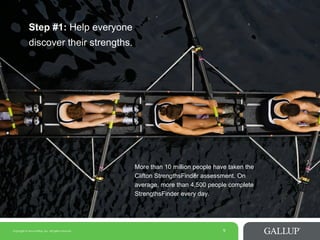
Step #1: Help everyone
discover their strengths.
More than 10 million people have taken the
Clifton StrengthsFinder assessment. On
average, more than 4,500 people complete
StrengthsFinder every day.
Copyright © 2014 Gallup, Inc. All rights reserved. 10
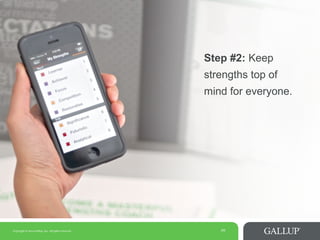
Step #2: Keep
strengths top of
mind for everyone.
Copyright © 2014 Gallup, Inc. All rights reserved. 11
11
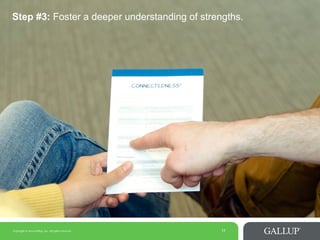
Step #3: Foster a deeper understanding of strengths.
Copyright © 2014 Gallup, Inc. All rights reserved. 12
Step #4: Embrace the unique language of strengths.
Johnson County (KS)
Community College displays
strengths language
throughout campus.
Copyright © 2014 Gallup, Inc. All rights reserved. 13
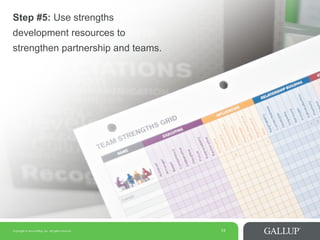
Step #5: Use strengths
development resources to
strengthen partnership and teams.
Copyright © 2014 Gallup, Inc. All rights reserved. 14
Step #6: Learn about
how strengths apply
specifically to various
roles and
responsibilities.
Copyright © 2014 Gallup, Inc. All rights reserved. 15
Step #7: Boost employee engagement by focusing on strengths.
■ People who focus on using
their strengths are 6X as
likely to be engaged in their
jobs.
■ People who regularly apply
their strengths are 6X as
likely to strongly agree that
they have the opportunity to
do what they do best every
day.
Copyright © 2014 Gallup, Inc. All rights reserved. 16
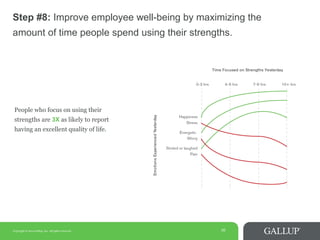
Step #8: Improve employee well-being by maximizing the
amount of time people spend using their strengths.
People who focus on using their
strengths are 3X as likely to report
having an excellent quality of life.
Copyright © 2014 Gallup, Inc. All rights reserved. 17
Step #9: Understand the importance of
investing in strengths coaching.
“Everyone needs a coach.”
Eric Schmidt
Executive Chairman, Google
Copyright © 2014 Gallup, Inc. All rights reserved. 18
Step #10: Every leader must always invest in strengths.
“Leaders around the world
are thinking about
empowerment these days,
and there is no more
effective way to empower
people than to see each
person in terms of his or her
strengths.”
Donald O. Clifton, Ph.D.
Father of Strengths-Based Psychology
When leaders focus on individuals’ strengths, their employees are
8x more likely to be engaged.
Copyright © 2014 Gallup, Inc. All rights reserved. 19
People who learn to use their strengths every day have
7.8% greater productivity.
Teams who focus on strengths every day have
12.5% greater productivity.
Copyright © 2014 Gallup, Inc. All rights reserved. 20
Teams who received
strengths feedback have
8.9% greater profitability.
Copyright © 2014 Gallup, Inc. All rights reserved. 21
Employees who received strengths
feedback have 14.9% lower turnover.
Copyright © 2014 Gallup, Inc. All rights reserved. 22
Sales associates who received
coaching on their strengths
experience 11% higher volume
per customer and a 6% higher
closing percentage on average.
Copyright © 2014 Gallup, Inc. All rights reserved. 23
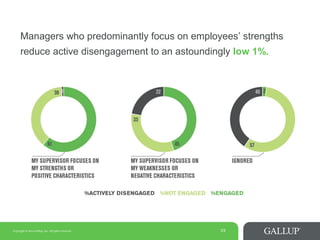
Managers who predominantly focus on employees’ strengths
reduce active disengagement to an astoundingly low 1%.
Copyright © 2014 Gallup, Inc. All rights reserved. 24
Join the movement.
Start building a strengths-based culture. Contant Shannon today at
shannon@bossladycoach.com or 512.461.2856
Shannon Lea Pickering, MS
Shannon Lea Enterprises, LLC
Gallup Certified Strengths Coach
Gallup Entrepreneurial Profile 10 Coach
Strengths Strategy, Inc. Affiliate Partner
ICF Austin Board Communications Director

sstrengthsmovementdeck 2SLPppt

  • 2.
    Copyright © 2014Gallup, Inc. All rights reserved. Shannon Lea Pickering, MS Psychology Shannon Lea Enterprises, LLC 2 ACCELERATING THE STRENGTHS MOVEMENT
  • 3.
    Copyright © 2014Gallup, Inc. All rights reserved. 3 The #1 selling book on Amazon isn’t a book. It’s a movement.
  • 4.
    Copyright © 2014Gallup, Inc. All rights reserved. 4 The core of the strengths movement is focusing on what’s right, not fixing what’s wrong.
  • 5.
    Copyright © 2014Gallup, Inc. All rights reserved. 5 Thousands of the world’s BEST organizations ingrain Gallup’s strengths science deep into their culture.
  • 6.
    Copyright © 2014Gallup, Inc. All rights reserved. 6 6 “At Facebook, we try to be a strengths-based organization…” New York Times Recommend the best business book you’ve read in recent years Sheryl Sandberg Chief Operating Officer Facebook Inc. “Now, Discover Your Strengths, by Marcus Buckingham and Donald O. Clifton. This book has been instrumental in how we think about developing talent at Facebook. ...we try to make jobs fit around people rather than make people fit around jobs. We focus on what people’s natural strengths are and spend our management time trying to find ways for them to use those strengths every day.”
  • 7.
    Copyright © 2014Gallup, Inc. All rights reserved. 7 7 “At Rackspace Hosting we’re religious about using Gallup’s StrengthsFinder 2.0.” Robert Scoble Startup Liaison Officer Rackspace “Every employee has their five strengths on the back of their badges and if you ever meet our chairman, Graham Weston don’t bring this up, because you’ll end up with a multi-hour interesting conversation about corporate culture, people, and how to build great teams using this system.”
  • 8.
    Copyright © 2014Gallup, Inc. All rights reserved. 8 8 THE BEST Businesses Coaches Organizations Partnerships Schools Team s take 10 STEPS to join the strengths movement.
  • 9.
    Copyright © 2014Gallup, Inc. All rights reserved. 9 9 Step #1: Help everyone discover their strengths. More than 10 million people have taken the Clifton StrengthsFinder assessment. On average, more than 4,500 people complete StrengthsFinder every day.
  • 10.
    Copyright © 2014Gallup, Inc. All rights reserved. 10 Step #2: Keep strengths top of mind for everyone.
  • 11.
    Copyright © 2014Gallup, Inc. All rights reserved. 11 11 Step #3: Foster a deeper understanding of strengths.
  • 12.
    Copyright © 2014Gallup, Inc. All rights reserved. 12 Step #4: Embrace the unique language of strengths. Johnson County (KS) Community College displays strengths language throughout campus.
  • 13.
    Copyright © 2014Gallup, Inc. All rights reserved. 13 Step #5: Use strengths development resources to strengthen partnership and teams.
  • 14.
    Copyright © 2014Gallup, Inc. All rights reserved. 14 Step #6: Learn about how strengths apply specifically to various roles and responsibilities.
  • 15.
    Copyright © 2014Gallup, Inc. All rights reserved. 15 Step #7: Boost employee engagement by focusing on strengths. ■ People who focus on using their strengths are 6X as likely to be engaged in their jobs. ■ People who regularly apply their strengths are 6X as likely to strongly agree that they have the opportunity to do what they do best every day.
  • 16.
    Copyright © 2014Gallup, Inc. All rights reserved. 16 Step #8: Improve employee well-being by maximizing the amount of time people spend using their strengths. People who focus on using their strengths are 3X as likely to report having an excellent quality of life.
  • 17.
    Copyright © 2014Gallup, Inc. All rights reserved. 17 Step #9: Understand the importance of investing in strengths coaching. “Everyone needs a coach.” Eric Schmidt Executive Chairman, Google
  • 18.
    Copyright © 2014Gallup, Inc. All rights reserved. 18 Step #10: Every leader must always invest in strengths. “Leaders around the world are thinking about empowerment these days, and there is no more effective way to empower people than to see each person in terms of his or her strengths.” Donald O. Clifton, Ph.D. Father of Strengths-Based Psychology When leaders focus on individuals’ strengths, their employees are 8x more likely to be engaged.
  • 19.
    Copyright © 2014Gallup, Inc. All rights reserved. 19 People who learn to use their strengths every day have 7.8% greater productivity. Teams who focus on strengths every day have 12.5% greater productivity.
  • 20.
    Copyright © 2014Gallup, Inc. All rights reserved. 20 Teams who received strengths feedback have 8.9% greater profitability.
  • 21.
    Copyright © 2014Gallup, Inc. All rights reserved. 21 Employees who received strengths feedback have 14.9% lower turnover.
  • 22.
    Copyright © 2014Gallup, Inc. All rights reserved. 22 Sales associates who received coaching on their strengths experience 11% higher volume per customer and a 6% higher closing percentage on average.
  • 23.
    Copyright © 2014Gallup, Inc. All rights reserved. 23 Managers who predominantly focus on employees’ strengths reduce active disengagement to an astoundingly low 1%.
  • 24.
    Copyright © 2014Gallup, Inc. All rights reserved. 24 Join the movement. Start building a strengths-based culture. Contant Shannon today at shannon@bossladycoach.com or 512.461.2856 Shannon Lea Pickering, MS Shannon Lea Enterprises, LLC Gallup Certified Strengths Coach Gallup Entrepreneurial Profile 10 Coach Strengths Strategy, Inc. Affiliate Partner ICF Austin Board Communications Director

Editor's Notes

  • #7 Found online at http://www.nytimes.com/2013/03/17/books/review/sheryl-sandberg-by-the-book.html?_r=1& Also: “A version of this article appears in print on March 17, 2013, on page BR8 of the Sunday Book Review with the headline: By the Book: Sheryl Sandberg.”
  • #8 Sourced from the following Facebook post by Robert Scobel: https://www.facebook.com/RobertScoble/posts/510317608997749
  • #13 Photo source: http://www.jccc.edu/photo_stories/2013/0114-strengths-finder-workshop.html
  • #16 Source for both bullets = Rath, T. (2007). StrengthsFinder 2.0. New York: Gallup Press.
  • #17 Source for quality of life info = Rath, T. (2007). StrengthsFinder 2.0. New York: Gallup Press. Source for graph = Source: Gallup Daily tracking August 23-27; Gallup-Healthways Well-Being Index. These findings are based on Gallup Daily tracking interviews with 5,049 American adults on August 23-27, 2012. Respondents were asked, "About how many hours out of the day yesterday were you able to use your strengths to do what you do best?" Sorenson, S. “How Employees’ Strengths Make Your Company Stronger.” Gallup Business Journal.
  • #18 Quote pulled from the following presentation: https://www.youtube.com/watch?v=a7qnTMvw92U
  • #19 Source = Clifton, D. (1995). Soar With Your Strengths.
  • #20 Sources: A study of 1,874 individual employees, most of them in sales functions, found that productivity improved by 7.8% after a strengths intervention. And in another study of 469 business units in organizations ranging from retail stores to large manufacturing facilities, units who received strengths feedback showed 8.9% greater profitability. Asplund, J., & Blacksmith, N. “Strengthening Your Company’s Performance.” Gallup Business Journal. A study of 530 work units with productivity data found that teams who received strengths feedback showed 12.5% greater productivity post-intervention than teams who received no feedback. Asplund, J., & Blacksmith, N. “The Secret of Higher Performance.” Gallup Business Journal.
  • #21 Source: A study of 1,874 individual employees, most of them in sales functions, found that productivity improved by 7.8% after a strengths intervention. And in another study of 469 business units in organizations ranging from retail stores to large manufacturing facilities, units who received strengths feedback showed 8.9% greater profitability. Asplund, J., & Blacksmith, N. “Strengthening Your Company’s Performance.” Gallup Business Journal.
  • #22 Source: Gallup found that those who received strengths feedback had turnover rates that were 14.9% lower than for employees who received no feedback (controlling for job type and tenure). Asplund, J., & Blacksmith, N. “The Secret of Higher Performance.” Gallup Business Journal.
  • #23 Source: Rutigliano, T and Brim, B, Strengths-Based Selling, page 22
  • #24 Source: Gallup conducted a study with a random sample of U.S. employees to determine their level of agreement with two statements: “My supervisor focuses on my strengths or positive characteristics” and “My supervisor focuses on my weaknesses or negative characteristics.” Gallup put employees who did not agree with either statement into an “ignored” category. Supervisors who focus on employees’ strengths were able to engage employees at a 61% rate, compared with weakness-focusing managers who only engaged employees at a 45% rate. Managers who predominantly focused on weaknesses stimulated active disengagement among their employees at a 22% rate, while strengths-focused managers reduced active disengagement to an astoundingly low 1%. One conclusion a person can make from these results is that a strengths-based management approach is the best way to improve the employee-manager relationship. Rath, Tom, StrengthsFinder 2.0, page iv.