GLOBAL CONSTELLATIONS OF 
STRATOSPHERIC SATELLITES 
Presentation to the 
NASA Institute for Advanced Concepts (NIAC) 
3rd Annual Meeting: 
Visions of the Future in Aeronautics and Space 
by 
Kerry T. Nock 
Global Aerospace Corporation 
http://www.gaerospace.com 
June 5-6, 2001 
Global 
Aerospace Corporation
Global Constellations of Stratospheric Satellites 
Global 
Aerospace Corporation PHASE II STUDY 
CONTRIBUTORS 
Global Aerospace Corporation (GAC) 
Dr. Kim M. Aaron 
Dale R. Burger 
Dr. Matthew Heun 
Brenda Wistor-Linfield 
Kerry T. Nock, Principal Investigator and NIAC Fellow 
Dr. Alexey A. Pankine, Project Scientist 
R. Stephen Schlaifer 
Princeton University 
Dr. Naomi Leonard 
Dr. Edward Belbruno 
Consultant 
Dr. Elliot Weinstock, Harvard University 
Global Aerospace Corporation 2 KTN - NIAC Annual Meeting June 6, 2001
Global Constellations of Stratospheric Satellites 
Global 
Aerospace Corporation TOPICS 
CONSTELLATION CONCEPT 
STRATOSAT SYSTEMS 
EARTH SCIENCE AND OBSERVATIONS 
DEMONSTRATION MISSIONS 
SUMMARY 
Global Aerospace Corporation 3 KTN - NIAC Annual Meeting June 6, 2001
CONSTELLATIONS OF 
STRATOSPHERIC SATELLITES
Global Constellations of Stratospheric Satellites 
Global 
Aerospace Corporation CONCEPT 
• Tens to hundreds of small, long-life (3-10 years) 
stratospheric balloons or StratoSats 
• Uniform global and regional constellations maintained 
by trajectory control systems (TCS) 
• Flight altitudes of 35 km achievable with advanced, 
lightweight, superpressure balloon technology 
BENEFITS 
• Provide low-cost, continuous, simultaneous, global and 
regional earth observations 
• Provides in situ and remote sensing from very low earth 
“orbit” 
Global Aerospace Corporation 5 KTN - NIAC Annual Meeting June 6, 2001
Global Constellations of Stratospheric Satellites 
Global 
Aerospace Corporation CONCEPT SCHEMATIC 
Global Constellation StratoSat Flight System 
Gondola 
Balloon 
35 km Altitude 
Dropsonde 
Science 
Pod 
StratoSail® 
TCS 
20 km Altitude 
Global Aerospace Corporation 6 KTN - NIAC Annual Meeting June 6, 2001
Global Constellations of Stratospheric Satellites 
Global 
Aerospace Corporation BENEFITS OF 
GLOBAL BALLOON PLATFORMS 
• Good diurnal coverage of entire globe 
• Low altitude observations that can improve resolution 
and/or signal-to-noise ratios of measurements 
• Provide frequent to continuous measurements 
• Provide horizontal gradients in addition to vertical profiles 
• Extended duration and low-cost potentially provide a cost-effective 
method for earth science and/or satellite 
calibration and validation 
Global Aerospace Corporation 7 KTN - NIAC Annual Meeting June 6, 2001
Global Constellations of Stratospheric Satellites 
Global 
Aerospace Corporation 
7504 m/s 
REMOTE SENSING 
StratoSat vs Satellite Remote Sensing Factors 
• Surface image: R - 20-times closer 
• Surface emission: R2 - 400-times better 
• Lidar at 15 km: R2 - 1200-times better 
• Radar at surface: R4 - 160,000-times better 
• Integration time at surface: ~8-times more 
<50 m/s 
StratoSat 
35 km 
Satellite 
700 km 
Angular Nadir Rate = 11 mrad/s 
Angular Nadir 
Rate = 1.4 mrad/s 
´© Global Aerospace Corporation 2000 
Global Aerospace Corporation 8 KTN - NIAC Annual Meeting June 6, 2001
Global Constellations of Stratospheric Satellites 
Global 
Aerospace SSTTRRCorporAaAtion TTOOSSAATT™ BBAALLLLOOOONN DDEESSIIGGNN 
• Euler Elastica Pumpkin Design 
• Volume ~ 70,000 m3 
• Advanced Composite Film, 15 g/m2 
• 140 Gores ~1.3 m Wide 
• Zylon® Load Tendons 
• Balloon Mass ~ 250 kg 
NASA ULDB 
Scale Model Tests 
Global Aerospace Corporation 9 KTN - NIAC Annual Meeting June 6, 2001
Global Constellations of Stratospheric Satellites 
Global 
Aerospace Corporation 
INTEGRATED SOLAR ARRAY 
& BALLOON ENVELOPE 
Gore Center 
As 
Solar Array 
Envelope Film 
Thin Film Amorphous Si 
Solar Array Cells 
(~30 cm wide) 
Example Power 
• 48 m dia 
• 100 Gores/Seams 
• 30 cm Wide Solar Array 
• 10 % Efficiency 
• ~45 kW 
Global Aerospace Corporation 10 KTN - NIAC Annual Meeting June 6, 2001
THE NEED FOR GLOBAL 
CONSTELLATION MANAGEMENT 
FREE FLIGHT SIMPLE CONTROL 
ASSUMPTIONS 
• 100 StratoSats @ 35 km 
• 82 day Simulation 
• 5 m/s Control
Global Constellations of Stratospheric Satellites 
Global 
Aerospace Corporation CONSTELLATION 
MANAGEMENT 
• Constellation management is the process of maintaining a desired 
spatial distribution of balloons in constellation 
• Constellation management DOF 
– Environment information used 
– Fidelity of balloon model 
– Coordinate system 
– Constellation control method 
• Nearest neighbor (molecular) 
• Biological analogs (flocks, pods, 
schools, herds) 
• Weak Stability Boundary (WSB) theory 
• Constellation management objectives 
– Uniform global and regional distributions 
– Targeted overflight 
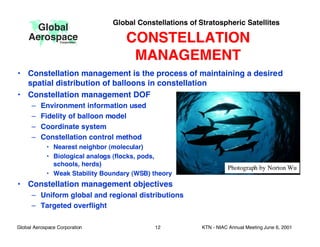
Photograph by Norton Wu 
Global Aerospace Corporation 12 KTN - NIAC Annual Meeting June 6, 2001
Global Constellations of Stratospheric Satellites 
Global 
Aerospace Corporation BALLOON TRAJECTORY 
CONTROL 
First Generation System 
Trajectory Control System (TCS) 
– Wing hanging vertically on long tether in higher 
density air below balloon system 
– Rudder controls angle of attack 
– Relative wind at StratoSail® TCS generates lift 
force, which alters balloon trajectory 
15 km 
Tether 
Global Aerospace Corporation 13 KTN - NIAC Annual Meeting June 6, 2001
Global Constellations of Stratospheric Satellites 
Global 
Aerospace Corporation TCS FEATURES 
• Passively exploits natural wind 
conditions 
• Operates day and night 
• Offers a wide range of control 
directions regardless of wind 
conditions 
• Can be made of lightweight 
materials, mass <100 kg 
• Does not require consumables 
• Requires very little electrical 
power 
Radio-Controlled Dynamically-scaled 
Model (1:4) Tested in Natural Winds 
Suspended From Tethered Blimp, 
April 2001 
Global Aerospace Corporation 14 KTN - NIAC Annual Meeting June 6, 2001
TCS Wing Assembly (TWA) 
Instruments/ 
Counterweight 
Wing 
Control Pod 
Boom 
Rudder 
Tether
SSCCAALLEE MMOODDEELL TTEESSTT
Global Constellations of Stratospheric Satellites 
Global 
Aerospace Corporation ADVANCED TCS CONCEPT 
Advanced StratoSail® 
TCS Design Features 
– Lift force can be greater 
than weight 
– Will stay down in 
denser air 
– Less roll response in 
gusts 
– Employs high lift 
cambered airfoil 
– Greater operational 
flexibility 
– Possible Dynamic 
Power Generation 
Global Aerospace Corporation 17 KTN - NIAC Annual Meeting June 6, 2001
Global Constellations of Stratospheric Satellites 
Global 
Aerospace Corporation CENTRALIZED STRATOSAT 
OPERATIONS 
Commands 
Stratospheric 
Forecast 
Center 
Gondola 
calculates 
TCS commands 
TWA 
Observed Strat. 
Location & 
Environment 
Constellation 
Geometry & 
Atm. Param. 
Constellation 
Geometry & 
Environments 
Winds & 
In-situ Data Constellation 
Operations 
Center Improved 
Stratospheric 
Forecasts 
TCS 
Standard Sat. 
& In-situ 
Observations 
Global Aerospace Corporation 18 KTN - NIAC Annual Meeting June 6, 2001
EXAMPLE 
Global Constellations of Stratospheric Satellites 
Global 
Aerospace Corporation 
STRATOSAT GONDOLA 
StratoSat Mass 
of 221 kg 
Global Aerospace Corporation 19 KTN - NIAC Annual Meeting June 6, 2001
Global Constellations of Stratospheric Satellites 
Global 
Aerospace Corporation PROMISING EARTH 
SCIENCE THEMES 
• Climate Change Studies 
– Water vapor and global circulation in the tropics 
– Radiative studies in the tropics 
– Global radiation balance 
• Ozone Studies 
– Mid-latitude ozone loss 
– Arctic ozone loss 
– Global distribution of ozone 
• Global Circulation and Age of Air 
• Global Ocean Productivity 
• Weather and Adaptive Sampling 
– Hurricane forecasting and tracking 
– Tropospheric winds 
– Forecasting weather from ocean basins & remote areas 
• Hazard Detection and Monitoring 
Global Aerospace Corporation 20 KTN - NIAC Annual Meeting June 6, 2001
Global Constellations of Stratospheric Satellites 
Global 
Aerospace Corporation ADVANTAGES OF 
STRATOSATS TO ERB 
• Radiative flux measured directly at 35 km 
– Commonly accepted TOA to which ERBE/ERBS products are extrapolated; 
no extrapolation required from 800 km down to 35 km 
– High spatial resolution measurements 
– No angular modeling needed 
• Complete diurnal coverage (no diurnal model required, the leading 
source of uncertainty in daily and monthly regional flux averages) 
• No sun angle bias (Sun synchronous orbits, except ERBE/ERBS and 
CERES/TRMM) 
• Global synoptic coverage allows actual dynamics of ERB to be seen 
(including horizontal fluxes); never before possible 
Global Aerospace Corporation 21 KTN - NIAC Annual Meeting June 6, 2001
Global Constellations of Stratospheric Satellites 
Global 
Aerospace Corporation ERB COVERAGE 
Global Aerospace Corporation 22 KTN - NIAC Annual Meeting June 6, 2001
Global Constellations of Stratospheric Satellites 
Global 
Aerospace Corporation HURRICANE PREDICTION 
• More accurate prediction of a hurricane track and its intensity can 
avoid economic disruption and save lives 
• Current data sources 
– Satellites provide low resolution atmospheric data, 
– Buoys provide surface wind, pressure, air and ocean temperature, and 
– Crewed aircraft fly into the storm to supplement the wind, pressure and 
temperature data around the storm. 
• While this data and better models have continued to improve 
hurricane forecasting, more high quality, high resolution in situ data 
is needed 
• For example, more accurate wind data is needed 
– The winds in the vicinity of the hurricane are important for predicting the 
hurricane’s path 
– The winds inside the hurricane are important to estimating its eventual 
intensity 
Global Aerospace Corporation 23 KTN - NIAC Annual Meeting June 6, 2001
Global Constellations of Stratospheric Satellites 
Global 
Aerospace Corporation 
ECONOMIC BENEFITS TO 
IMPROVED PREDICTION 
• In a 72 hour forecast the current average hurricane landfall error is 
200 miles 
• When a hurricane is predicted to hit a coast, up to 300 miles of a 
coastal zone is placed under a warning, which is 4-times the area 
actually seriously effected 
• The estimated financial impact on US of a hurricane warning is 
between $1-50 M per mile of coast, depending on economic sectors 
along that stretch of coast 
• If landfall prediction could be improved by 50% a potential savings of 
at least $150 M per hurricane landfall could be achieved 
Global Aerospace Corporation 24 KTN - NIAC Annual Meeting June 6, 2001
HHUURRRRIICCAANNEE AALLBBEERRTTOO
Global Constellations of Stratospheric Satellites 
Global 
Aerospace Corporation POSSIBLE HURRICANE 
TRACKING NETWORK 
• Track a moving target (hurricane) with multiple balloons 
• As one balloon moves beyond the horizon, new balloon 
enters the scene for observations 
• Deploy one or more StratoSat “string-of-pearls” around 
the World near the latitude of hurricanes 
• Example constellation management strategy 
– When > 90° longitude from hurricane, maintain hurricane's 
latitude 
– When < 90° longitude from hurricane, aim directly for the eye 
• After Northern Hemisphere hurricane season the network 
could move to the Southern Hemisphere 
Global Aerospace Corporation 26 KTN - NIAC Annual Meeting June 6, 2001
• Hurricane 
Alberto 
• 20 balloons 
• 1-day look-ahead 
• 4 hrs/frame 
• 31 days 
• Actual easterly 
winds at 35 km 
• Advanced TCS 
(0.5-5 m/s) 
• Lat control 
strategy 
– >90° track lat 
– <90° aim eye 
SSSTTTRRRIIINNNGGG OOOFFF PPPEEEAAARRRLLLSSS
DEMONSTRATION MISSIONS
Global Constellations of Stratospheric Satellites 
Global 
Aerospace Corporation EXAMPLE DEMONSTRATION 
MISSION OPTIONS 
• Hurricane Intercept Mission 
• Satellite Radiometry Calibration and Validation 
• Wind Lidar Measurements 
• Demonstration Earth Radiation Budget Experiment 
(DERBE) 
• Or a Combination of Mission Objectives 
Global Aerospace Corporation 29 KTN - NIAC Annual Meeting June 6, 2001
HURRICANE INTERCEPT MISSION (HIM) 
• Potential Primary Objectives 
– Intercept and Possibly Follow Hurricane 
– Obtain High Resolution Meteorological Measurements 
– Demonstrate Hurricane Intercept Trajectory Control Capability 
• Possible Science Experiments 
– Meteorological Dropsondes 
– High Resolution Wind Lidar 
– GPS Reflection Sea-state 
– Precipitation Radar 
– Low Resolution Imager 
• Hurricane 
Alberto 
• UKMO winds at 
35 & 20 km 
• Red 
– Aerodynamic 
TCS model 
– ~ 2 m/s control 
authority 
– Maintains lat. 
• Blue 
– Uncontrolled 
– Floats with 
winds 
• 4 hrs/frame 
• 4.25 days
Global Constellations of Stratospheric Satellites 
Global 
Aerospace Corporation EXAMPLE DERBE 
MISSION PROFILE 
• Radiative flux measurements of the Earth 
• Float altitude of 35 km 
• Generally “orbit” Earth at +15° latitude 
• ~5 overflights of SGP CART at +35° latitude 
• 100 day mission 
Global Aerospace Corporation 31 KTN - NIAC Annual Meeting June 6, 2001
Global Constellations of Stratospheric Satellites 
Global 
Aerospace Corporation EXAMPLE DERBE 
TRAJECTORY SIMULATION 
Trajectory Objectives 
• Achieve overflight of SGP CART site 
• Avoid overfight of China and Libya 
Global Aerospace Corporation 32 KTN - NIAC Annual Meeting June 6, 2001
Global Constellations of Stratospheric Satellites 
Global 
Aerospace Corporation EXAMPLE DERBE 
SCIENCE PAYLOAD 
• Pyranometers 
– Four instruments of different types 
– Hemispherical FOV 
– Short-wave (0.3-3 μm) 
• Pyrgeometers 
– Two instruments of different types 
– Hemispherical FOV 
– Long-wave (4-40 μm) 
• Radiometers are modified Earth science instruments 
• Instruments located on an optical benches 
• Calibration system 
Global Aerospace Corporation 33 KTN - NIAC Annual Meeting June 6, 2001
Global Constellations of Stratospheric Satellites 
Global 
Aerospace Corporation CALIBRATION SYSTEM 
• Pyranometers 
– Periodically view Sun to provide known input source 
– Issues 
• Reflections off balloon will contaminate solar signal 
• Cosine response of instrument may necessitate corrections 
• 0.1° pointing knowledge with respect to the Sun required 
– Collimator tube to eliminate all other signal sources 
• Pyrgeometers 
– Rotate to a “black body” to cover field of view of pyrgeometer 
– Black body temperature must be known to ± TBD (0.1) K 
– Emissivity of black body must be known to ± TBD (0.5) % 
Global Aerospace Corporation 34 KTN - NIAC Annual Meeting June 6, 2001
Global Constellations of Stratospheric Satellites 
Global 
Aerospace Corporation EXAMPLE DERBE BALLOON 
SYSTEM CONCEPT 
Flight Train 
(ladder, parachute) ~100 m 
~15 km 
Gondola 
(<500 kg) 
TCS Tether 
(~1 mm dia) 
Super-pressure ULDB 
(~60-80 m dia) 
Instrument Platform 
StratoSail® TCS 
(~50 kg) 
Global Aerospace Corporation 35 KTN - NIAC Annual Meeting June 6, 2001
EXAMPLE DERBE GONDOLA
INTERNATIONAL PATHWAYS 
TO OVERFLIGHT
Global Constellations of Stratospheric Satellites 
Global 
Aerospace Corporation INTERNATIONAL 
OVERFLIGHT OPTIONS 
• Free flight in upper stratosphere 
• Expand on the 1992 Treaty on Open Skies 
• Exploit World Meteorological Organization (WMO) 
cooperation 
• Seek new treaties 
– Committee on Space Research (COSPAR) study 
– World pollution issues 
– Growing interest in providing method for all countries of the world 
to participate in global observations 
Global Aerospace Corporation 38 KTN - NIAC Annual Meeting June 6, 2001
Global Constellations of Stratospheric Satellites 
Global 
Aerospace Corporation COSPAR RESOLUTION 
• 33rd COSPAR Scientific Assembly in Warsaw, Poland in 2000 
• Scientific Balloon Panel formulated a resolution to the COSPAR 
Executive Council 
• Resolution requested a task group be formed to study and report to the 
bureau on the technical aspects of overflight of scientific balloons 
including: 
– altitudes, 
– balloon sizes and payload masses, 
– characteristics and features of payloads, and 
– safety requirements) and 
– possible international actions to enable the geographically-unrestrained 
and the peaceful free flight of such apparatus over all countries. 
• This resolution was accepted as COSPAR Internal Decision No. 1/2000. 
Global Aerospace Corporation 39 KTN - NIAC Annual Meeting June 6, 2001
Global Constellations of Stratospheric Satellites 
Global 
Aerospace Corporation PROPOSED OVERFLIGHT 
REQUIREMENTS 
• Airworthiness certificates from appropriate organization, 
perhaps ICAO, indicating the craft meets equipment and 
safety requirements 
• A means of identification 
• Evidence of liability insurance 
• Payloads must not compromise any State’s national 
security 
• Launch and payload oversight 
• Any nation free to operate stratospheric platforms if they 
meet all requirements 
Global Aerospace Corporation 40 KTN - NIAC Annual Meeting June 6, 2001
SUMMARY
Global Constellations of Stratospheric Satellites 
Global 
Aerospace Corporation SUMMARY 
• The StratoSat™ platform is a stratospheric satellite that 
can provide: 
– Low-cost, continuous, simultaneous, global and regional 
observations options 
– In situ and remote sensing from very low earth “orbit” 
• Global and regional stratospheric constellations will 
expand scientific knowledge of the Earth system 
• A demonstration mission is essential first step toward 
regional and global measurements from 35 km 
• Mission definition has progressed on two demonstration 
missions, 
– Demonstration Earth Radiation Budget Experiment (DERBE) 
– Hurricane Intercept Mission (HIM) 
Global Aerospace Corporation 42 KTN - NIAC Annual Meeting June 6, 2001

Stratospheric satellitesjun01

  • 1.
    GLOBAL CONSTELLATIONS OF STRATOSPHERIC SATELLITES Presentation to the NASA Institute for Advanced Concepts (NIAC) 3rd Annual Meeting: Visions of the Future in Aeronautics and Space by Kerry T. Nock Global Aerospace Corporation http://www.gaerospace.com June 5-6, 2001 Global Aerospace Corporation
  • 2.
    Global Constellations ofStratospheric Satellites Global Aerospace Corporation PHASE II STUDY CONTRIBUTORS Global Aerospace Corporation (GAC) Dr. Kim M. Aaron Dale R. Burger Dr. Matthew Heun Brenda Wistor-Linfield Kerry T. Nock, Principal Investigator and NIAC Fellow Dr. Alexey A. Pankine, Project Scientist R. Stephen Schlaifer Princeton University Dr. Naomi Leonard Dr. Edward Belbruno Consultant Dr. Elliot Weinstock, Harvard University Global Aerospace Corporation 2 KTN - NIAC Annual Meeting June 6, 2001
  • 3.
    Global Constellations ofStratospheric Satellites Global Aerospace Corporation TOPICS CONSTELLATION CONCEPT STRATOSAT SYSTEMS EARTH SCIENCE AND OBSERVATIONS DEMONSTRATION MISSIONS SUMMARY Global Aerospace Corporation 3 KTN - NIAC Annual Meeting June 6, 2001
  • 4.
  • 5.
    Global Constellations ofStratospheric Satellites Global Aerospace Corporation CONCEPT • Tens to hundreds of small, long-life (3-10 years) stratospheric balloons or StratoSats • Uniform global and regional constellations maintained by trajectory control systems (TCS) • Flight altitudes of 35 km achievable with advanced, lightweight, superpressure balloon technology BENEFITS • Provide low-cost, continuous, simultaneous, global and regional earth observations • Provides in situ and remote sensing from very low earth “orbit” Global Aerospace Corporation 5 KTN - NIAC Annual Meeting June 6, 2001
  • 6.
    Global Constellations ofStratospheric Satellites Global Aerospace Corporation CONCEPT SCHEMATIC Global Constellation StratoSat Flight System Gondola Balloon 35 km Altitude Dropsonde Science Pod StratoSail® TCS 20 km Altitude Global Aerospace Corporation 6 KTN - NIAC Annual Meeting June 6, 2001
  • 7.
    Global Constellations ofStratospheric Satellites Global Aerospace Corporation BENEFITS OF GLOBAL BALLOON PLATFORMS • Good diurnal coverage of entire globe • Low altitude observations that can improve resolution and/or signal-to-noise ratios of measurements • Provide frequent to continuous measurements • Provide horizontal gradients in addition to vertical profiles • Extended duration and low-cost potentially provide a cost-effective method for earth science and/or satellite calibration and validation Global Aerospace Corporation 7 KTN - NIAC Annual Meeting June 6, 2001
  • 8.
    Global Constellations ofStratospheric Satellites Global Aerospace Corporation 7504 m/s REMOTE SENSING StratoSat vs Satellite Remote Sensing Factors • Surface image: R - 20-times closer • Surface emission: R2 - 400-times better • Lidar at 15 km: R2 - 1200-times better • Radar at surface: R4 - 160,000-times better • Integration time at surface: ~8-times more <50 m/s StratoSat 35 km Satellite 700 km Angular Nadir Rate = 11 mrad/s Angular Nadir Rate = 1.4 mrad/s ´© Global Aerospace Corporation 2000 Global Aerospace Corporation 8 KTN - NIAC Annual Meeting June 6, 2001
  • 9.
    Global Constellations ofStratospheric Satellites Global Aerospace SSTTRRCorporAaAtion TTOOSSAATT™ BBAALLLLOOOONN DDEESSIIGGNN • Euler Elastica Pumpkin Design • Volume ~ 70,000 m3 • Advanced Composite Film, 15 g/m2 • 140 Gores ~1.3 m Wide • Zylon® Load Tendons • Balloon Mass ~ 250 kg NASA ULDB Scale Model Tests Global Aerospace Corporation 9 KTN - NIAC Annual Meeting June 6, 2001
  • 10.
    Global Constellations ofStratospheric Satellites Global Aerospace Corporation INTEGRATED SOLAR ARRAY & BALLOON ENVELOPE Gore Center As Solar Array Envelope Film Thin Film Amorphous Si Solar Array Cells (~30 cm wide) Example Power • 48 m dia • 100 Gores/Seams • 30 cm Wide Solar Array • 10 % Efficiency • ~45 kW Global Aerospace Corporation 10 KTN - NIAC Annual Meeting June 6, 2001
  • 11.
    THE NEED FORGLOBAL CONSTELLATION MANAGEMENT FREE FLIGHT SIMPLE CONTROL ASSUMPTIONS • 100 StratoSats @ 35 km • 82 day Simulation • 5 m/s Control
  • 12.
    Global Constellations ofStratospheric Satellites Global Aerospace Corporation CONSTELLATION MANAGEMENT • Constellation management is the process of maintaining a desired spatial distribution of balloons in constellation • Constellation management DOF – Environment information used – Fidelity of balloon model – Coordinate system – Constellation control method • Nearest neighbor (molecular) • Biological analogs (flocks, pods, schools, herds) • Weak Stability Boundary (WSB) theory • Constellation management objectives – Uniform global and regional distributions – Targeted overflight Photograph by Norton Wu Global Aerospace Corporation 12 KTN - NIAC Annual Meeting June 6, 2001
  • 13.
    Global Constellations ofStratospheric Satellites Global Aerospace Corporation BALLOON TRAJECTORY CONTROL First Generation System Trajectory Control System (TCS) – Wing hanging vertically on long tether in higher density air below balloon system – Rudder controls angle of attack – Relative wind at StratoSail® TCS generates lift force, which alters balloon trajectory 15 km Tether Global Aerospace Corporation 13 KTN - NIAC Annual Meeting June 6, 2001
  • 14.
    Global Constellations ofStratospheric Satellites Global Aerospace Corporation TCS FEATURES • Passively exploits natural wind conditions • Operates day and night • Offers a wide range of control directions regardless of wind conditions • Can be made of lightweight materials, mass <100 kg • Does not require consumables • Requires very little electrical power Radio-Controlled Dynamically-scaled Model (1:4) Tested in Natural Winds Suspended From Tethered Blimp, April 2001 Global Aerospace Corporation 14 KTN - NIAC Annual Meeting June 6, 2001
  • 15.
    TCS Wing Assembly(TWA) Instruments/ Counterweight Wing Control Pod Boom Rudder Tether
  • 16.
  • 17.
    Global Constellations ofStratospheric Satellites Global Aerospace Corporation ADVANCED TCS CONCEPT Advanced StratoSail® TCS Design Features – Lift force can be greater than weight – Will stay down in denser air – Less roll response in gusts – Employs high lift cambered airfoil – Greater operational flexibility – Possible Dynamic Power Generation Global Aerospace Corporation 17 KTN - NIAC Annual Meeting June 6, 2001
  • 18.
    Global Constellations ofStratospheric Satellites Global Aerospace Corporation CENTRALIZED STRATOSAT OPERATIONS Commands Stratospheric Forecast Center Gondola calculates TCS commands TWA Observed Strat. Location & Environment Constellation Geometry & Atm. Param. Constellation Geometry & Environments Winds & In-situ Data Constellation Operations Center Improved Stratospheric Forecasts TCS Standard Sat. & In-situ Observations Global Aerospace Corporation 18 KTN - NIAC Annual Meeting June 6, 2001
  • 19.
    EXAMPLE Global Constellationsof Stratospheric Satellites Global Aerospace Corporation STRATOSAT GONDOLA StratoSat Mass of 221 kg Global Aerospace Corporation 19 KTN - NIAC Annual Meeting June 6, 2001
  • 20.
    Global Constellations ofStratospheric Satellites Global Aerospace Corporation PROMISING EARTH SCIENCE THEMES • Climate Change Studies – Water vapor and global circulation in the tropics – Radiative studies in the tropics – Global radiation balance • Ozone Studies – Mid-latitude ozone loss – Arctic ozone loss – Global distribution of ozone • Global Circulation and Age of Air • Global Ocean Productivity • Weather and Adaptive Sampling – Hurricane forecasting and tracking – Tropospheric winds – Forecasting weather from ocean basins & remote areas • Hazard Detection and Monitoring Global Aerospace Corporation 20 KTN - NIAC Annual Meeting June 6, 2001
  • 21.
    Global Constellations ofStratospheric Satellites Global Aerospace Corporation ADVANTAGES OF STRATOSATS TO ERB • Radiative flux measured directly at 35 km – Commonly accepted TOA to which ERBE/ERBS products are extrapolated; no extrapolation required from 800 km down to 35 km – High spatial resolution measurements – No angular modeling needed • Complete diurnal coverage (no diurnal model required, the leading source of uncertainty in daily and monthly regional flux averages) • No sun angle bias (Sun synchronous orbits, except ERBE/ERBS and CERES/TRMM) • Global synoptic coverage allows actual dynamics of ERB to be seen (including horizontal fluxes); never before possible Global Aerospace Corporation 21 KTN - NIAC Annual Meeting June 6, 2001
  • 22.
    Global Constellations ofStratospheric Satellites Global Aerospace Corporation ERB COVERAGE Global Aerospace Corporation 22 KTN - NIAC Annual Meeting June 6, 2001
  • 23.
    Global Constellations ofStratospheric Satellites Global Aerospace Corporation HURRICANE PREDICTION • More accurate prediction of a hurricane track and its intensity can avoid economic disruption and save lives • Current data sources – Satellites provide low resolution atmospheric data, – Buoys provide surface wind, pressure, air and ocean temperature, and – Crewed aircraft fly into the storm to supplement the wind, pressure and temperature data around the storm. • While this data and better models have continued to improve hurricane forecasting, more high quality, high resolution in situ data is needed • For example, more accurate wind data is needed – The winds in the vicinity of the hurricane are important for predicting the hurricane’s path – The winds inside the hurricane are important to estimating its eventual intensity Global Aerospace Corporation 23 KTN - NIAC Annual Meeting June 6, 2001
  • 24.
    Global Constellations ofStratospheric Satellites Global Aerospace Corporation ECONOMIC BENEFITS TO IMPROVED PREDICTION • In a 72 hour forecast the current average hurricane landfall error is 200 miles • When a hurricane is predicted to hit a coast, up to 300 miles of a coastal zone is placed under a warning, which is 4-times the area actually seriously effected • The estimated financial impact on US of a hurricane warning is between $1-50 M per mile of coast, depending on economic sectors along that stretch of coast • If landfall prediction could be improved by 50% a potential savings of at least $150 M per hurricane landfall could be achieved Global Aerospace Corporation 24 KTN - NIAC Annual Meeting June 6, 2001
  • 25.
  • 26.
    Global Constellations ofStratospheric Satellites Global Aerospace Corporation POSSIBLE HURRICANE TRACKING NETWORK • Track a moving target (hurricane) with multiple balloons • As one balloon moves beyond the horizon, new balloon enters the scene for observations • Deploy one or more StratoSat “string-of-pearls” around the World near the latitude of hurricanes • Example constellation management strategy – When > 90° longitude from hurricane, maintain hurricane's latitude – When < 90° longitude from hurricane, aim directly for the eye • After Northern Hemisphere hurricane season the network could move to the Southern Hemisphere Global Aerospace Corporation 26 KTN - NIAC Annual Meeting June 6, 2001
  • 27.
    • Hurricane Alberto • 20 balloons • 1-day look-ahead • 4 hrs/frame • 31 days • Actual easterly winds at 35 km • Advanced TCS (0.5-5 m/s) • Lat control strategy – >90° track lat – <90° aim eye SSSTTTRRRIIINNNGGG OOOFFF PPPEEEAAARRRLLLSSS
  • 28.
  • 29.
    Global Constellations ofStratospheric Satellites Global Aerospace Corporation EXAMPLE DEMONSTRATION MISSION OPTIONS • Hurricane Intercept Mission • Satellite Radiometry Calibration and Validation • Wind Lidar Measurements • Demonstration Earth Radiation Budget Experiment (DERBE) • Or a Combination of Mission Objectives Global Aerospace Corporation 29 KTN - NIAC Annual Meeting June 6, 2001
  • 30.
    HURRICANE INTERCEPT MISSION(HIM) • Potential Primary Objectives – Intercept and Possibly Follow Hurricane – Obtain High Resolution Meteorological Measurements – Demonstrate Hurricane Intercept Trajectory Control Capability • Possible Science Experiments – Meteorological Dropsondes – High Resolution Wind Lidar – GPS Reflection Sea-state – Precipitation Radar – Low Resolution Imager • Hurricane Alberto • UKMO winds at 35 & 20 km • Red – Aerodynamic TCS model – ~ 2 m/s control authority – Maintains lat. • Blue – Uncontrolled – Floats with winds • 4 hrs/frame • 4.25 days
  • 31.
    Global Constellations ofStratospheric Satellites Global Aerospace Corporation EXAMPLE DERBE MISSION PROFILE • Radiative flux measurements of the Earth • Float altitude of 35 km • Generally “orbit” Earth at +15° latitude • ~5 overflights of SGP CART at +35° latitude • 100 day mission Global Aerospace Corporation 31 KTN - NIAC Annual Meeting June 6, 2001
  • 32.
    Global Constellations ofStratospheric Satellites Global Aerospace Corporation EXAMPLE DERBE TRAJECTORY SIMULATION Trajectory Objectives • Achieve overflight of SGP CART site • Avoid overfight of China and Libya Global Aerospace Corporation 32 KTN - NIAC Annual Meeting June 6, 2001
  • 33.
    Global Constellations ofStratospheric Satellites Global Aerospace Corporation EXAMPLE DERBE SCIENCE PAYLOAD • Pyranometers – Four instruments of different types – Hemispherical FOV – Short-wave (0.3-3 μm) • Pyrgeometers – Two instruments of different types – Hemispherical FOV – Long-wave (4-40 μm) • Radiometers are modified Earth science instruments • Instruments located on an optical benches • Calibration system Global Aerospace Corporation 33 KTN - NIAC Annual Meeting June 6, 2001
  • 34.
    Global Constellations ofStratospheric Satellites Global Aerospace Corporation CALIBRATION SYSTEM • Pyranometers – Periodically view Sun to provide known input source – Issues • Reflections off balloon will contaminate solar signal • Cosine response of instrument may necessitate corrections • 0.1° pointing knowledge with respect to the Sun required – Collimator tube to eliminate all other signal sources • Pyrgeometers – Rotate to a “black body” to cover field of view of pyrgeometer – Black body temperature must be known to ± TBD (0.1) K – Emissivity of black body must be known to ± TBD (0.5) % Global Aerospace Corporation 34 KTN - NIAC Annual Meeting June 6, 2001
  • 35.
    Global Constellations ofStratospheric Satellites Global Aerospace Corporation EXAMPLE DERBE BALLOON SYSTEM CONCEPT Flight Train (ladder, parachute) ~100 m ~15 km Gondola (<500 kg) TCS Tether (~1 mm dia) Super-pressure ULDB (~60-80 m dia) Instrument Platform StratoSail® TCS (~50 kg) Global Aerospace Corporation 35 KTN - NIAC Annual Meeting June 6, 2001
  • 36.
  • 37.
  • 38.
    Global Constellations ofStratospheric Satellites Global Aerospace Corporation INTERNATIONAL OVERFLIGHT OPTIONS • Free flight in upper stratosphere • Expand on the 1992 Treaty on Open Skies • Exploit World Meteorological Organization (WMO) cooperation • Seek new treaties – Committee on Space Research (COSPAR) study – World pollution issues – Growing interest in providing method for all countries of the world to participate in global observations Global Aerospace Corporation 38 KTN - NIAC Annual Meeting June 6, 2001
  • 39.
    Global Constellations ofStratospheric Satellites Global Aerospace Corporation COSPAR RESOLUTION • 33rd COSPAR Scientific Assembly in Warsaw, Poland in 2000 • Scientific Balloon Panel formulated a resolution to the COSPAR Executive Council • Resolution requested a task group be formed to study and report to the bureau on the technical aspects of overflight of scientific balloons including: – altitudes, – balloon sizes and payload masses, – characteristics and features of payloads, and – safety requirements) and – possible international actions to enable the geographically-unrestrained and the peaceful free flight of such apparatus over all countries. • This resolution was accepted as COSPAR Internal Decision No. 1/2000. Global Aerospace Corporation 39 KTN - NIAC Annual Meeting June 6, 2001
  • 40.
    Global Constellations ofStratospheric Satellites Global Aerospace Corporation PROPOSED OVERFLIGHT REQUIREMENTS • Airworthiness certificates from appropriate organization, perhaps ICAO, indicating the craft meets equipment and safety requirements • A means of identification • Evidence of liability insurance • Payloads must not compromise any State’s national security • Launch and payload oversight • Any nation free to operate stratospheric platforms if they meet all requirements Global Aerospace Corporation 40 KTN - NIAC Annual Meeting June 6, 2001
  • 41.
  • 42.
    Global Constellations ofStratospheric Satellites Global Aerospace Corporation SUMMARY • The StratoSat™ platform is a stratospheric satellite that can provide: – Low-cost, continuous, simultaneous, global and regional observations options – In situ and remote sensing from very low earth “orbit” • Global and regional stratospheric constellations will expand scientific knowledge of the Earth system • A demonstration mission is essential first step toward regional and global measurements from 35 km • Mission definition has progressed on two demonstration missions, – Demonstration Earth Radiation Budget Experiment (DERBE) – Hurricane Intercept Mission (HIM) Global Aerospace Corporation 42 KTN - NIAC Annual Meeting June 6, 2001