Creating a
seamless customer
experience
Cross-channel
integration in
retail
2 Strategy&
Contacts
Amsterdam
Marco Kesteloo
Partner
+31-20-504-1942
marco.kesteloo
@strategyand.pwc.com
Beirut
Bahjat El-Darwiche
Partner
+961-1-985-655
bahjat.el-darwiche
@strategyand.pwc.com
Düsseldorf
Peter Heckmann
Partner
+49-211-3890-122
peter.heckmann
@strategyand.pwc.com
Frankfurt
Benedikt Schmaus
Principal
+49-69-97167-437
benedikt.schmaus
@strategyand.pwc.com
Hong Kong/Shanghai
Edward Tse
Senior Executive Advisor
+852-3650-6100
+86-21-2327-9800
edward.tse
@strategyand.pwc.com
Houston
Henning Hagen
Partner
+1-713-650-4165
henning.hagen
@strategyand.pwc.com
London
John Potter
Partner
+44-20-7393-3736
john.potter
@strategyand.pwc.com
New York
Matthew Egol
Partner
+1-212-551-6716
matthew.egol
@strategyand.pwc.com
Paris
Pierre Péladeau
Partner
+33-1-44-34-3074
pierre.peladeau
@strategyand.pwc.com
São Paulo
Fernando Fernandes
Partner
+55-11-5501-6222
fernando.fernandes
@strategyand.pwc.com
Sweden
Per-Ola Karlsson
Senior Partner
+46-8-506-190-49
per-ola.karlsson
@strategyand.pwc.com
Vienna
Harald Dutzler
Partner
+43-1-518-22-904
harald.dutzler
@strategyand.pwc.com
3Strategy&
About the authors
This report was originally published by Booz & Company in 2012.
Peter Heckmann is a partner with Strategy& based in Düsseldorf, with
more than 20 years of consulting experience. His current focus is on
sourcing, supply chain management, and transformation programs
within the consumer packaged goods and retail industries. He leads the
consumer and retail team in Germany, Switzerland, and Austria.
Marco Kesteloo is a partner with Strategy& based in Amsterdam, and
leader of the firm’s global retail practice. He has more than 20 years of
consulting experience in strategy, organizational and operational
improvements, and the collaborative value chain between retail and
consumer goods organizations.
Benedikt Schmaus is a principal with Strategy& based in Frankfurt,
and a member of the firm’s consumer and retail practice.
He has more than 10 years of consulting experience in cost and
organizational transformations from offline to cross-channel and
online. He currently focuses specifically on cross-channel retail
strategy.
Robbert Huisman was formerly an associate with Booz & Company.
4 Strategy&
Executive summary
In July 1995, a startup called Amazon.com sold its first product —
a science book — and the clock started ticking on a new era of retail.
Nearly two decades later, Amazon is a US$50 billion company, and the
digitization of retail has profoundly changed the nature of the shopping
experience. With more and more sales shifting online each year, most
traditional retailers are facing the biggest challenge in their histories:
How do they meet consumers’ expectations of a seamless shopping
experience?
The ability to integrate across channels enables retailers to give
consumers what they want, and increasingly demand. For traditional
retailers, cross-channel integration is fast becoming a competitive
necessity. Many have lost market share to Amazon and other online
competitors. Developing a viable cross-channel capability is within the
reach of traditional retailers, if they make the right moves in five areas
— changing the structures of their organizations, improving their
logistics, creating a common technology backbone, using business
intelligence more skillfully, and reinventing their cultures. It won’t be
easy, but retailers no longer have a choice.
5Strategy&
Dramatic shifts in the
retail landscape
E-commerce and mobile commerce have reached critical mass in many
industries, a result of huge changes in how consumers use technology.
In 2011, unit sales of smartphones surpassed those of personal
computers for the first time. Tablet computers are part of the same shift
away from traditional computing; unit sales of tablets more than tripled
in 2011, to about 73 million units, with Apple selling more iPads than
Hewlett-Packard sold PCs. People now spend almost as much time
online and using their mobile phones as they do watching television.
The shift to online and specifically to mobile Internet use — eBay says it
did some US$5 billion in mobile sales in 2011 — has had a significant
impact on consumers’ shopping behavior. Digital consumers today
expect to have the flexibility to find and buy the product or service they
want no matter where they are — sitting on their living-room couch,
riding in the passenger seat of a car, or even browsing in a physical
store. Likewise, they expect to be able to provide feedback and receive
service in multiple channels; they want the option of ordering a product
online, and then picking it up at the store or getting it delivered to their
home. (Today’s consumers also increasingly expect free shipping and
returns.) This has created intense pressure for retailers to make the
shopping experience seamless, and to give consumers new levels of
convenience and choice. It also creates enormous cost pressure because
of the need to upgrade logistics and handle online transactions.
Despite consumers’ expectations, very few traditional retailers offer a
seamless shopping experience across multiple channels. Even the ones
that have significant online sales generally treat their online and offline
businesses separately — each in its own silo. This won’t stop consumers
from pushing for an experience that feels more integrated. Retailers
that understand this, and start to develop a capability of cross-channel
integration, are the ones that will have a chance to win.
6 Strategy&
New sources of
competition
Retailers used to be able to gain advantage through their product
portfolios and the quality of their sales personnel — by employing floor
staff who knew the products and could help shoppers find what they
wanted. Then, for a while, the source of advantage shifted to price. In
an age of digitization, most retailers’ source of advantage has shifted
again — to greater selection, price transparency, and convenience;
improved service, including the ability to process orders at any time of
day or night; superior customer insights; and access to ratings and peer
reviews. Amid these changes, retailers are facing significant new
sources of competition.
Manufacturers going direct
Digitization enables a more direct link between consumers and
manufacturers, and manufacturers are starting to take advantage of
this reality. Online marketing and advertising are the least of it —
manufacturers have been doing that for years. Now, more
manufacturers are actually selling online, especially higher-margin
products in high-growth markets. In doing so, they not only increase
their profitability (by recovering some of the margin given up to
retailers) but also get valuable new insights as they engage in more
direct relationships with their customers than they have ever had
before.
Adidas’s opening of retail stores in Russia is a good example of a
manufacturer going direct. At its own branded retail outlets and on its
online platform, the sneaker maker can sell its whole line, especially
high-end footwear, without having to negotiate for shelf space or
relinquish percentage points of margin. Manufacturers that have
success in going direct may stop working with retailers altogether —
or use retailers only for low-margin products.
7Strategy&
New gatekeepers of consumers
In another era, consumers often started their shopping experience by
heading to a retail store or to a mall with multiple retailers. Now, a
shopping expedition is just as likely to begin on a search engine like
Google (with 730 million daily visitors), a social media platform like
Facebook (with 900 million monthly active users), or a price comparison
engine or ratings platform such as TripAdvisor (with 50 million
customer reviews).
Because of the unique kinds of information and utility they offer, these
services have eroded some of the power previously held by retailers,
including in the area of product pre-selection and pricing, and have put
that power in the hands of consumers. In an earlier era, a retailer might
have been able to maintain high prices on infrequently purchased items,
because customers might not come to the store with any particular
expectation of what they should pay. A search engine like Google
changes that dynamic, introducing a kind of transparency that shifts
the money flows around shopping. Because their revenue comes from
traffic, clicks, and advertising, Google and other gatekeepers are
removed from traditional retail economics. In the future, as they
inevitably start operating in the purchase stage of the funnel, the new
gatekeepers’ impact on retailers will become even bigger, to the point
where the profits involved in selling products might vanish, replaced by
profits from advertising and other business-to-business services. The
number of products that are “loss leaders” — there for a purpose other
than any profit they themselves produce — will likely expand.
Online-only retailers
Indigenous online retailers are a relatively new breed. By and large,
they don’t operate by the old metrics of traditional retailers; things like
margin per square foot or margin per catalog page are irrelevant (or at
least less relevant) to them. Nor do they need to open retail stores in
populous, easily accessed, high-rent locations; they can gain scale and
market share in other ways, such as by creating a great user experience,
exploiting their knowledge of search engine optimization, and using
technology to support shopping functions that previously had to be done
in person. The pure online retailers that have become successful tend to
be extremely focused on a few differentiated capabilities; examples are
Amazon with its logistics and payment systems and the German online
store Zalando with its marketing and data analytics. The fact that pure
online players are often still venture capital–funded and not required to
make a profit in the short term increases the challenge they pose to
traditional retailers.
The pure online
retailers that
have become
successful tend
to be extremely
focused on a few
differentiated
capabilities.
8 Strategy&
Where they see an opportunity, online retailers are also challenging
traditional retailers on their home turf — and occasionally making big
inroads. Apple is the most dramatic example. Its retail stores have been
a huge success, generating more than 17 times the sales per square foot
of the average U.S. mall retail space. Other online retailers are also
adding offline assets, such as print catalogs and temporary stores (see
“Cross-Channel Integration for Online-Only Retailers”).
First-mover traditional retailers
A final source of competition is other traditional retailers that may be
pushing ahead more quickly to create integrated cross-channel
experiences. For instance, Germany’s Otto Group, a big catalog retailer,
has been an early adopter of online and mobile commerce, bypassing
competitors like Neckermann (which declared bankruptcy in the
summer of 2012) and Quelle GmbH (now defunct). The race to the
cross-channel future has already produced casualties.
Cross-channel integration for online-only retailers
cross-channel integration may only seem
relevant to offline retailers, with their
entrenched bricks-and-mortar assets.
In fact, integration is important to some
indigenous online retailers as well,
specifically to those starting to use such
traditional assets as catalogs, direct mail,
and the occasional real-world outlet.
For instance, eBay opened a temporary
pop-up store in London for the 2011
Christmas shopping season. And
Zalando, a German online shoe and
fashion store, is one of an increasing
number of online retailers that now
publish an innovative print catalog,
mixing a classic catalog with an
editorial magazine style to appeal
to new and existing customers. It
also recently opened a bricks-and-
mortar outlet store, where online
customers can shop returned products
and special deals.
9Strategy&
A question of when, not if
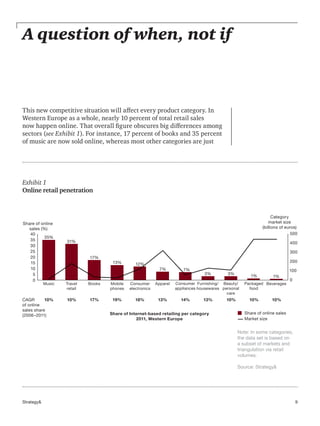
This new competitive situation will affect every product category. In
Western Europe as a whole, nearly 10 percent of total retail sales
now happen online. That overall figure obscures big differences among
sectors (see Exhibit 1). For instance, 17 percent of books and 35 percent
of music are now sold online, whereas most other categories are just
0
5
10
15
20
25
30
35
40
Consumer
electronics
Mobile
phones
BooksTravel
retail
Music BeveragesPackaged
food
Beauty/
personal
care
Furnishing/
housewares
Consumer
appliances
1%1%3%3%
7%
13%
17%
31%
35%
12%
7%
Apparel
Share of online
sales (%)
Category
market size
(billions of euros)
0
500
400
300
200
100
Share of online sales
Market size
Share of Internet-based retailing per category
2011, Western Europe
10% 17% 19% 18% 13% 14% 13% 10% 10% 10%10%CAGR
of online
sales share
(2006–2011)
Exhibit 1
Online retail penetration
Note: In some categories,
the data set is based on
a subset of markets and
triangulation via retail
volumes.
Source: Strategy&
10 Strategy&
moving into the online space. Online sales of groceries and personal
care are among the categories that have not yet reached critical mass;
both remain far below 5 percent. Ten percent seems to be a rough
turning point. Once online sales in a category reach that level, the
influence of online — and of consumer expectations — becomes
impossible to ignore and the business models start to shift across the
complete category. This may also reflect the attention that the sector’s
leading companies start paying to cross-channel initiatives once online
sales pass that threshold.
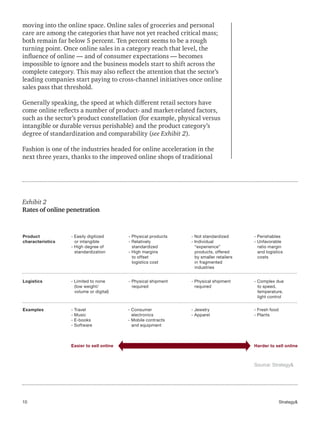
Generally speaking, the speed at which different retail sectors have
come online reflects a number of product- and market-related factors,
such as the sector’s product constellation (for example, physical versus
intangible or durable versus perishable) and the product category’s
degree of standardization and comparability (see Exhibit 2).
Fashion is one of the industries headed for online acceleration in the
next three years, thanks to the improved online shops of traditional
Easier to sell online Harder to sell online
Product
characteristics
- Easily digitized
or intangible
- High degree of
standardization
- Physical products
- Relatively
standardized
- High margins
to offset
logistics cost
- Not standardized
- Individual
“experience”
products, offered
by smaller retailers
in fragmented
industries
- Perishables
- Unfavorable
ratio margin
and logistics
costs
Logistics
Examples
- Limited to none
(low weight/
volume or digital)
- Physical shipment
required
- Physical shipment
required
- Complex due
to speed,
temperature,
light control
- Travel
- Music
- E-books
- Software
- Consumer
electronics
- Mobile contracts
and equipment
- Jewelry
- Apparel
- Fresh food
- Plants
Exhibit 2
Rates of online penetration
Source: Strategy&
11Strategy&
apparel retailers, the rise of some dynamic online pure-play entrants
(for example, Mytheresa.com and Asos.com), and the line extensions of
existing online retailers (for example, Zalando). Furniture is another
category poised to take off online, partly because of the creation of new
home lines by some non-furniture companies (such as H&M and Zara).
In late 2011, the CEO of Rocket Internet, a Berlin-based incubator that
has sold early-stage companies to Groupon and eBay, advised his
management team that the time had come for “full-scale investment” in
the furniture category.
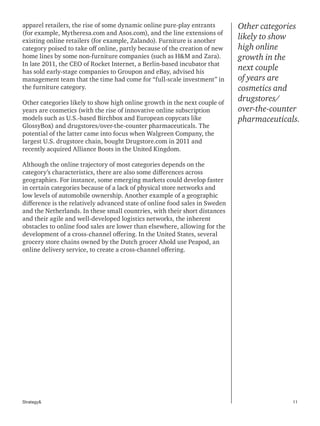
Other categories likely to show high online growth in the next couple of
years are cosmetics (with the rise of innovative online subscription
models such as U.S.-based Birchbox and European copycats like
GlossyBox) and drugstores/over-the-counter pharmaceuticals. The
potential of the latter came into focus when Walgreen Company, the
largest U.S. drugstore chain, bought Drugstore.com in 2011 and
recently acquired Alliance Boots in the United Kingdom.
Although the online trajectory of most categories depends on the
category’s characteristics, there are also some differences across
geographies. For instance, some emerging markets could develop faster
in certain categories because of a lack of physical store networks and
low levels of automobile ownership. Another example of a geographic
difference is the relatively advanced state of online food sales in Sweden
and the Netherlands. In these small countries, with their short distances
and their agile and well-developed logistics networks, the inherent
obstacles to online food sales are lower than elsewhere, allowing for the
development of a cross-channel offering. In the United States, several
grocery store chains owned by the Dutch grocer Ahold use Peapod, an
online delivery service, to create a cross-channel offering.
Other categories
likely to show
high online
growth in the
next couple
of years are
cosmetics and
drugstores/
over-the-counter
pharmaceuticals.
12 Strategy&
Cross-channel as a
competitive necessity
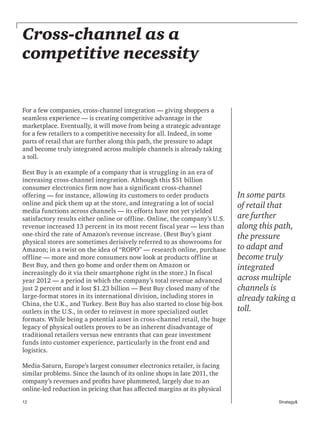
For a few companies, cross-channel integration — giving shoppers a
seamless experience — is creating competitive advantage in the
marketplace. Eventually, it will move from being a strategic advantage
for a few retailers to a competitive necessity for all. Indeed, in some
parts of retail that are further along this path, the pressure to adapt
and become truly integrated across multiple channels is already taking
a toll.
Best Buy is an example of a company that is struggling in an era of
increasing cross-channel integration. Although this $51 billion
consumer electronics firm now has a significant cross-channel
offering — for instance, allowing its customers to order products
online and pick them up at the store, and integrating a lot of social
media functions across channels — its efforts have not yet yielded
satisfactory results either online or offline. Online, the company’s U.S.
revenue increased 13 percent in its most recent fiscal year — less than
one-third the rate of Amazon’s revenue increase. (Best Buy’s giant
physical stores are sometimes derisively referred to as showrooms for
Amazon; in a twist on the idea of “ROPO” — research online, purchase
offline — more and more consumers now look at products offline at
Best Buy, and then go home and order them on Amazon or
increasingly do it via their smartphone right in the store.) In fiscal
year 2012 — a period in which the company’s total revenue advanced
just 2 percent and it lost $1.23 billion — Best Buy closed many of the
large-format stores in its international division, including stores in
China, the U.K., and Turkey. Best Buy has also started to close big-box
outlets in the U.S., in order to reinvest in more specialized outlet
formats. While being a potential asset in cross-channel retail, the huge
legacy of physical outlets proves to be an inherent disadvantage of
traditional retailers versus new entrants that can gear investment
funds into customer experience, particularly in the front end and
logistics.
Media-Saturn, Europe’s largest consumer electronics retailer, is facing
similar problems. Since the launch of its online shops in late 2011, the
company’s revenues and profits have plummeted, largely due to an
online-led reduction in pricing that has affected margins at its physical
In some parts
of retail that
are further
along this path,
the pressure
to adapt and
become truly
integrated
across multiple
channels is
already taking a
toll.
13Strategy&
stores. Media-Saturn’s difficulties may be temporary — exacerbated by
the relatively early stage of its cross-channel efforts. Indeed, a 2011
study by the University of St. Gallen put Media-Saturn near the top of a
group of German retailers for its channel integration and
harmonization. In other words, the company may well bounce back.
Still, what has been happening at Media-Saturn during its transition
shows why so many retailers shake their heads when we talk to them
about their cross-channel strategies and say, “Cross-channel just means
crossed signals — and a lot of problems.”
Best Buy and Media-Saturn highlight the challenges of an industry in
which cross-channel integration is already a competitive necessity.
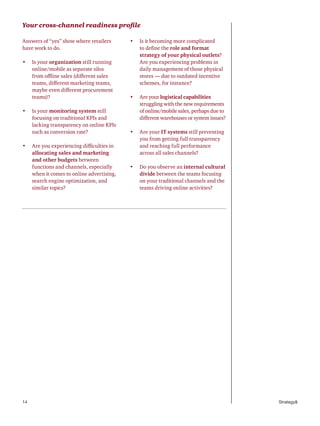
Retailers in other industries can use a simple diagnostic to figure out
their own stage of development, and their readiness for cross-channel
integration as their customers increasingly demand it (see “Your Cross-
Channel Readiness Profile,” next page).
14 Strategy&
Your cross-channel readiness profile
Answers of “yes” show where retailers
have work to do.
•	 Is your organization still running
online/mobile as separate silos
from offline sales (different sales
teams, different marketing teams,
maybe even different procurement
teams)?
•	 Is your monitoring system still
focusing on traditional KPIs and
lacking transparency on online KPIs
such as conversion rate?
•	 Are you experiencing difficulties in
allocating sales and marketing
and other budgets between
functions and channels, especially
when it comes to online advertising,
search engine optimization, and
similar topics?
•	 Is it becoming more complicated
to define the role and format
strategy of your physical outlets?
Are you experiencing problems in
daily management of those physical
stores — due to outdated incentive
schemes, for instance?
•	 Are your logistical capabilities
struggling with the new requirements
of online/mobile sales, perhaps due to
different warehouses or system issues?
•	 Are your IT systems still preventing
you from getting full transparency
and reaching full performance
across all sales channels?
•	 Do you observe an internal cultural
divide between the teams focusing
on your traditional channels and the
teams driving online activities?
15Strategy&
The cross-channel
future: Five success
factors
There are five success factors that retailers must address to position
themselves to compete in a cross-channel future.
1. 	Restructure your organization and processes to enable a true cross-
channel experience. Processes that exist in silos are the enemy of
cross-channel integration. For instance, retailers should not have
different return policies for products bought in-store and online.
Likewise, a customer stopping in at a physical store to check on an
item that was ordered online — and never arrived — should not have
to explain what product she ordered. At a retailer that is truly
integrated across channels, the processes should be seamless and the
customer experience should be consistent. Yet this is almost never
the reality. One frequent cause of trouble is the existence of a
dedicated online sales department. A dedicated sales department is
useful to get the online business going, but it creates a barrier that
can be counterproductive later on, when the organization needs to
provide more of a cross-channel experience.
The aforementioned Otto Group recently moved to free itself from
this trap. To minimize channel conflicts, the company’s leadership
restructured its marketing, format management, and category
management functions so they are now run centrally across
channels, not separately by online and offline units.
2. 	Improve operations and logistics. Whereas traditional distance
retailers (for example, mail-order companies) have ample experience
mailing products to private households and processing returns, most
retailers don’t. They need to build the capabilities to manage returns
efficiently or risk being overwhelmed. This challenge has been
intensified by some leading companies’ moves to constantly up their
game in terms of delivery options, raising customer expectations. For
instance, Amazon’s next-day delivery is still not matched by most
online competitors, yet Amazon has now introduced same-day
delivery in select urban areas. In another example, Tesco, the U.K.
food giant, is offering a 90-minute delivery service in London. The
16 Strategy&
same holds true for delivery charges and return policies. Free
shipping and returns have started to become the norm around
Europe. The U.K. fashion and beauty store Asos.com has taken this
idea one step further; it offers free shipping throughout the world.
The ante keeps going up, every day.
3. 	Create a common IT backbone. If a retailer’s channels are to be truly
integrated, they must be linked to a single IT backbone with a
dedicated cross-channel integration layer. The idea is to provide
visibility and a seamless experience across channels, so that, for
instance, customers checking the website can determine the
availability (and the quantity available) of an item in the store. With
the batch systems in place at many traditional retailers, the fact that
the last item of something has been sold won’t necessarily be evident
to online shoppers. They could show up at the store and discover
they’d wasted a trip. There are few faster ways to frustrate a customer.
The creation of a common IT backbone starts with a clear definition
of requirements. But that is just the beginning of the job. Complex IT
integration projects don’t come together overnight — and they
require a significant investment. Upgrading the often outdated
enterprise resource planning (ERP) system, for instance, can easily
be a multiyear journey and for large retailers often requires an
investment of hundreds of millions of euros.
4. 	Use business intelligence and customer relationship management in a
more sophisticated way. In the cross-channel future, the analytics
that are increasingly becoming part of retailers’ tool kits must
operate in every place that customers make transactions, and must
benefit every part of the business. This is key to the concept of
customer lifetime value. A good CRM system is essential. The idea is
to make intelligent product suggestions à la Amazon, except to do it
across channels — for instance, to use mobile location services to
make an offer when a customer is in a mall, or to use e-mail to make
a special, related online offer to a customer who has just bought
something offline. An example is the partnership American Express
has forged with Twitter and selected retailers. An Amex cardholder
can send out a tweet using a customized hashtag and receive special
offers from merchants, with Amex issuing a credit within a few days
on qualified purchases. Another example is Shopkick, which
integrates bonus schemes for consumers across retail channels.
5. 	Reinvent the company culture. The imperative to offer a cross-channel
experience represents the largest transformation that many retail
leaders have ever faced. It requires a willingness to make big bets,
adopt new business models, make greater use of analytics, and
17Strategy&
change in other fundamental ways. This is not the time to think
incrementally. The required changes are so dramatic that they stand
no chance of catching on unless senior leadership shows the way.
This may require some tough decisions involving personnel. It will
certainly require recruiting some new talent from the outside — and
perhaps from outside the traditional, purchasing-driven retail
culture. What retail companies increasingly need are people who
would fit in well at Facebook or Google. To be sure, this will make
some staffers and managers uncomfortable and force just about
everyone to adapt. But there is no way to get to the future without
shaking up the present.
18 Strategy&
One retailer’s adaptation
A large retailer illustrates the challenges
of creating a cross-channel offering. At
a relatively early stage in the Internet
boom, the company brought in a new
team of young, tech-savvy managers to
run the online part of its business. It was
a useful way of building the required
online capabilities, and it enabled senior
leadership to quickly build know-how
and create a sizable online business,
which now accounts for more than half
of the company’s revenues.
Still, the company has faced challenges
in competing against its nimbler
online rivals. Amazon, as well as
some “category killers,” has offered
lower prices on products in areas core
to the company — such as fashion,
consumer electronics, and furniture —
or value propositions that are superior
in other ways. This has hurt the
company’s market share and reduced
its profitability. In addition, the original
organizational structure, which kept
the online part of the business separate
from the traditional catalog business,
led to turf wars between the mail sales
channels.
Recently, the company has moved
to reduce these conflicts and
harmonize the business. There is now
an “e-commerce first” philosophy,
and functions such as marketing,
procurement, and pricing are all in
the process of being integrated. The
company is also changing its incentive
schemes and revising its logistics
strategy to meet evolving industry
norms in areas like product returns. It
is also addressing the required cultural
transformation of new and old talent.
To be sure, this company is only partway
through its transformation, and it will
have to remain flexible. But it has begun
to make the adaptations that all retailers
must make if they are to preserve their
right to win.
19Strategy&
Conclusion
Consumer expectations about shopping have changed dramatically in
the last few years. Many consumers now take for granted that shopping
should be a seamless experience, allowing them to carry out
transactions wherever they happen to be. In some respects, the reality
already matches this ideal. A consumer’s ability to buy just about
anything through a computer or mobile device removes one advantage
of traditional retailers, their physical presence. Indeed, in some parts of
retail, having too many physical assets has become a liability. This is
evident in the move by many retailers to close stores or reduce their
footprints in other ways.
The imperative for traditional retailers is to create a cross-channel
offering, one in which their customers have the same experience
online as in their stores, and can move between the two channels
without friction. Here, most retailers have lagged behind. Either they
have kept their online and offline channels organizationally separate for
too long — a common mistake — or they have combined their online
and offline operations but are still struggling to integrate them. What
they should evolve into may be clear, but getting there can be hard.
There may be opportunities for pilot programs and quick successes to
educate the larger organization. If so, retailers should embrace them.
This is a years-long journey that every retailer will have to make
unless it has a clear niche positioning. Those that start the soonest
will have an advantage.
www.strategyand.pwc.com
Strategy& is a global team
of practical strategists
committed to helping you
seize essential advantage.
We do that by working
alongside you to solve your
toughest problems and
helping you capture your
greatest opportunities.
These are complex and
high-stakes undertakings
— often game-changing
transformations. We bring
100 years of strategy
consulting experience
and the unrivaled industry
and functional capabilities
of the PwC network to the
task. Whether you’re
charting your corporate
strategy, transforming a
function or business unit, or
building critical capabilities,
we’ll help you create the
value you’re looking for
with speed, confidence,
and impact.
We are a member of the
PwC network of firms in
157 countries with more
than 184,000 people
committed to delivering
quality in assurance, tax,
and advisory services. Tell us
what matters to you and find
out more by visiting us at
strategyand.pwc.com.
© 2012 PwC. All rights reserved. PwC refers to the PwC network and/or one or more of its member firms, each of which is a separate legal entity. Please see www.pwc.com/structure for further
details. Disclaimer: This content is for general information purposes only, and should not be used as a substitute for consultation with professional advisors.
This report was originally published by Booz & Company in 2012.

Strategyand_Cross-Channel-Integration-in-Retail

  • 1.
  • 2.
    2 Strategy& Contacts Amsterdam Marco Kesteloo Partner +31-20-504-1942 marco.kesteloo @strategyand.pwc.com Beirut BahjatEl-Darwiche Partner +961-1-985-655 bahjat.el-darwiche @strategyand.pwc.com Düsseldorf Peter Heckmann Partner +49-211-3890-122 peter.heckmann @strategyand.pwc.com Frankfurt Benedikt Schmaus Principal +49-69-97167-437 benedikt.schmaus @strategyand.pwc.com Hong Kong/Shanghai Edward Tse Senior Executive Advisor +852-3650-6100 +86-21-2327-9800 edward.tse @strategyand.pwc.com Houston Henning Hagen Partner +1-713-650-4165 henning.hagen @strategyand.pwc.com London John Potter Partner +44-20-7393-3736 john.potter @strategyand.pwc.com New York Matthew Egol Partner +1-212-551-6716 matthew.egol @strategyand.pwc.com Paris Pierre Péladeau Partner +33-1-44-34-3074 pierre.peladeau @strategyand.pwc.com São Paulo Fernando Fernandes Partner +55-11-5501-6222 fernando.fernandes @strategyand.pwc.com Sweden Per-Ola Karlsson Senior Partner +46-8-506-190-49 per-ola.karlsson @strategyand.pwc.com Vienna Harald Dutzler Partner +43-1-518-22-904 harald.dutzler @strategyand.pwc.com
  • 3.
    3Strategy& About the authors Thisreport was originally published by Booz & Company in 2012. Peter Heckmann is a partner with Strategy& based in Düsseldorf, with more than 20 years of consulting experience. His current focus is on sourcing, supply chain management, and transformation programs within the consumer packaged goods and retail industries. He leads the consumer and retail team in Germany, Switzerland, and Austria. Marco Kesteloo is a partner with Strategy& based in Amsterdam, and leader of the firm’s global retail practice. He has more than 20 years of consulting experience in strategy, organizational and operational improvements, and the collaborative value chain between retail and consumer goods organizations. Benedikt Schmaus is a principal with Strategy& based in Frankfurt, and a member of the firm’s consumer and retail practice. He has more than 10 years of consulting experience in cost and organizational transformations from offline to cross-channel and online. He currently focuses specifically on cross-channel retail strategy. Robbert Huisman was formerly an associate with Booz & Company.
  • 4.
    4 Strategy& Executive summary InJuly 1995, a startup called Amazon.com sold its first product — a science book — and the clock started ticking on a new era of retail. Nearly two decades later, Amazon is a US$50 billion company, and the digitization of retail has profoundly changed the nature of the shopping experience. With more and more sales shifting online each year, most traditional retailers are facing the biggest challenge in their histories: How do they meet consumers’ expectations of a seamless shopping experience? The ability to integrate across channels enables retailers to give consumers what they want, and increasingly demand. For traditional retailers, cross-channel integration is fast becoming a competitive necessity. Many have lost market share to Amazon and other online competitors. Developing a viable cross-channel capability is within the reach of traditional retailers, if they make the right moves in five areas — changing the structures of their organizations, improving their logistics, creating a common technology backbone, using business intelligence more skillfully, and reinventing their cultures. It won’t be easy, but retailers no longer have a choice.
  • 5.
    5Strategy& Dramatic shifts inthe retail landscape E-commerce and mobile commerce have reached critical mass in many industries, a result of huge changes in how consumers use technology. In 2011, unit sales of smartphones surpassed those of personal computers for the first time. Tablet computers are part of the same shift away from traditional computing; unit sales of tablets more than tripled in 2011, to about 73 million units, with Apple selling more iPads than Hewlett-Packard sold PCs. People now spend almost as much time online and using their mobile phones as they do watching television. The shift to online and specifically to mobile Internet use — eBay says it did some US$5 billion in mobile sales in 2011 — has had a significant impact on consumers’ shopping behavior. Digital consumers today expect to have the flexibility to find and buy the product or service they want no matter where they are — sitting on their living-room couch, riding in the passenger seat of a car, or even browsing in a physical store. Likewise, they expect to be able to provide feedback and receive service in multiple channels; they want the option of ordering a product online, and then picking it up at the store or getting it delivered to their home. (Today’s consumers also increasingly expect free shipping and returns.) This has created intense pressure for retailers to make the shopping experience seamless, and to give consumers new levels of convenience and choice. It also creates enormous cost pressure because of the need to upgrade logistics and handle online transactions. Despite consumers’ expectations, very few traditional retailers offer a seamless shopping experience across multiple channels. Even the ones that have significant online sales generally treat their online and offline businesses separately — each in its own silo. This won’t stop consumers from pushing for an experience that feels more integrated. Retailers that understand this, and start to develop a capability of cross-channel integration, are the ones that will have a chance to win.
  • 6.
    6 Strategy& New sourcesof competition Retailers used to be able to gain advantage through their product portfolios and the quality of their sales personnel — by employing floor staff who knew the products and could help shoppers find what they wanted. Then, for a while, the source of advantage shifted to price. In an age of digitization, most retailers’ source of advantage has shifted again — to greater selection, price transparency, and convenience; improved service, including the ability to process orders at any time of day or night; superior customer insights; and access to ratings and peer reviews. Amid these changes, retailers are facing significant new sources of competition. Manufacturers going direct Digitization enables a more direct link between consumers and manufacturers, and manufacturers are starting to take advantage of this reality. Online marketing and advertising are the least of it — manufacturers have been doing that for years. Now, more manufacturers are actually selling online, especially higher-margin products in high-growth markets. In doing so, they not only increase their profitability (by recovering some of the margin given up to retailers) but also get valuable new insights as they engage in more direct relationships with their customers than they have ever had before. Adidas’s opening of retail stores in Russia is a good example of a manufacturer going direct. At its own branded retail outlets and on its online platform, the sneaker maker can sell its whole line, especially high-end footwear, without having to negotiate for shelf space or relinquish percentage points of margin. Manufacturers that have success in going direct may stop working with retailers altogether — or use retailers only for low-margin products.
  • 7.
    7Strategy& New gatekeepers ofconsumers In another era, consumers often started their shopping experience by heading to a retail store or to a mall with multiple retailers. Now, a shopping expedition is just as likely to begin on a search engine like Google (with 730 million daily visitors), a social media platform like Facebook (with 900 million monthly active users), or a price comparison engine or ratings platform such as TripAdvisor (with 50 million customer reviews). Because of the unique kinds of information and utility they offer, these services have eroded some of the power previously held by retailers, including in the area of product pre-selection and pricing, and have put that power in the hands of consumers. In an earlier era, a retailer might have been able to maintain high prices on infrequently purchased items, because customers might not come to the store with any particular expectation of what they should pay. A search engine like Google changes that dynamic, introducing a kind of transparency that shifts the money flows around shopping. Because their revenue comes from traffic, clicks, and advertising, Google and other gatekeepers are removed from traditional retail economics. In the future, as they inevitably start operating in the purchase stage of the funnel, the new gatekeepers’ impact on retailers will become even bigger, to the point where the profits involved in selling products might vanish, replaced by profits from advertising and other business-to-business services. The number of products that are “loss leaders” — there for a purpose other than any profit they themselves produce — will likely expand. Online-only retailers Indigenous online retailers are a relatively new breed. By and large, they don’t operate by the old metrics of traditional retailers; things like margin per square foot or margin per catalog page are irrelevant (or at least less relevant) to them. Nor do they need to open retail stores in populous, easily accessed, high-rent locations; they can gain scale and market share in other ways, such as by creating a great user experience, exploiting their knowledge of search engine optimization, and using technology to support shopping functions that previously had to be done in person. The pure online retailers that have become successful tend to be extremely focused on a few differentiated capabilities; examples are Amazon with its logistics and payment systems and the German online store Zalando with its marketing and data analytics. The fact that pure online players are often still venture capital–funded and not required to make a profit in the short term increases the challenge they pose to traditional retailers. The pure online retailers that have become successful tend to be extremely focused on a few differentiated capabilities.
  • 8.
    8 Strategy& Where theysee an opportunity, online retailers are also challenging traditional retailers on their home turf — and occasionally making big inroads. Apple is the most dramatic example. Its retail stores have been a huge success, generating more than 17 times the sales per square foot of the average U.S. mall retail space. Other online retailers are also adding offline assets, such as print catalogs and temporary stores (see “Cross-Channel Integration for Online-Only Retailers”). First-mover traditional retailers A final source of competition is other traditional retailers that may be pushing ahead more quickly to create integrated cross-channel experiences. For instance, Germany’s Otto Group, a big catalog retailer, has been an early adopter of online and mobile commerce, bypassing competitors like Neckermann (which declared bankruptcy in the summer of 2012) and Quelle GmbH (now defunct). The race to the cross-channel future has already produced casualties. Cross-channel integration for online-only retailers cross-channel integration may only seem relevant to offline retailers, with their entrenched bricks-and-mortar assets. In fact, integration is important to some indigenous online retailers as well, specifically to those starting to use such traditional assets as catalogs, direct mail, and the occasional real-world outlet. For instance, eBay opened a temporary pop-up store in London for the 2011 Christmas shopping season. And Zalando, a German online shoe and fashion store, is one of an increasing number of online retailers that now publish an innovative print catalog, mixing a classic catalog with an editorial magazine style to appeal to new and existing customers. It also recently opened a bricks-and- mortar outlet store, where online customers can shop returned products and special deals.
  • 9.
    9Strategy& A question ofwhen, not if This new competitive situation will affect every product category. In Western Europe as a whole, nearly 10 percent of total retail sales now happen online. That overall figure obscures big differences among sectors (see Exhibit 1). For instance, 17 percent of books and 35 percent of music are now sold online, whereas most other categories are just 0 5 10 15 20 25 30 35 40 Consumer electronics Mobile phones BooksTravel retail Music BeveragesPackaged food Beauty/ personal care Furnishing/ housewares Consumer appliances 1%1%3%3% 7% 13% 17% 31% 35% 12% 7% Apparel Share of online sales (%) Category market size (billions of euros) 0 500 400 300 200 100 Share of online sales Market size Share of Internet-based retailing per category 2011, Western Europe 10% 17% 19% 18% 13% 14% 13% 10% 10% 10%10%CAGR of online sales share (2006–2011) Exhibit 1 Online retail penetration Note: In some categories, the data set is based on a subset of markets and triangulation via retail volumes. Source: Strategy&
  • 10.
    10 Strategy& moving intothe online space. Online sales of groceries and personal care are among the categories that have not yet reached critical mass; both remain far below 5 percent. Ten percent seems to be a rough turning point. Once online sales in a category reach that level, the influence of online — and of consumer expectations — becomes impossible to ignore and the business models start to shift across the complete category. This may also reflect the attention that the sector’s leading companies start paying to cross-channel initiatives once online sales pass that threshold. Generally speaking, the speed at which different retail sectors have come online reflects a number of product- and market-related factors, such as the sector’s product constellation (for example, physical versus intangible or durable versus perishable) and the product category’s degree of standardization and comparability (see Exhibit 2). Fashion is one of the industries headed for online acceleration in the next three years, thanks to the improved online shops of traditional Easier to sell online Harder to sell online Product characteristics - Easily digitized or intangible - High degree of standardization - Physical products - Relatively standardized - High margins to offset logistics cost - Not standardized - Individual “experience” products, offered by smaller retailers in fragmented industries - Perishables - Unfavorable ratio margin and logistics costs Logistics Examples - Limited to none (low weight/ volume or digital) - Physical shipment required - Physical shipment required - Complex due to speed, temperature, light control - Travel - Music - E-books - Software - Consumer electronics - Mobile contracts and equipment - Jewelry - Apparel - Fresh food - Plants Exhibit 2 Rates of online penetration Source: Strategy&
  • 11.
    11Strategy& apparel retailers, therise of some dynamic online pure-play entrants (for example, Mytheresa.com and Asos.com), and the line extensions of existing online retailers (for example, Zalando). Furniture is another category poised to take off online, partly because of the creation of new home lines by some non-furniture companies (such as H&M and Zara). In late 2011, the CEO of Rocket Internet, a Berlin-based incubator that has sold early-stage companies to Groupon and eBay, advised his management team that the time had come for “full-scale investment” in the furniture category. Other categories likely to show high online growth in the next couple of years are cosmetics (with the rise of innovative online subscription models such as U.S.-based Birchbox and European copycats like GlossyBox) and drugstores/over-the-counter pharmaceuticals. The potential of the latter came into focus when Walgreen Company, the largest U.S. drugstore chain, bought Drugstore.com in 2011 and recently acquired Alliance Boots in the United Kingdom. Although the online trajectory of most categories depends on the category’s characteristics, there are also some differences across geographies. For instance, some emerging markets could develop faster in certain categories because of a lack of physical store networks and low levels of automobile ownership. Another example of a geographic difference is the relatively advanced state of online food sales in Sweden and the Netherlands. In these small countries, with their short distances and their agile and well-developed logistics networks, the inherent obstacles to online food sales are lower than elsewhere, allowing for the development of a cross-channel offering. In the United States, several grocery store chains owned by the Dutch grocer Ahold use Peapod, an online delivery service, to create a cross-channel offering. Other categories likely to show high online growth in the next couple of years are cosmetics and drugstores/ over-the-counter pharmaceuticals.
  • 12.
    12 Strategy& Cross-channel asa competitive necessity For a few companies, cross-channel integration — giving shoppers a seamless experience — is creating competitive advantage in the marketplace. Eventually, it will move from being a strategic advantage for a few retailers to a competitive necessity for all. Indeed, in some parts of retail that are further along this path, the pressure to adapt and become truly integrated across multiple channels is already taking a toll. Best Buy is an example of a company that is struggling in an era of increasing cross-channel integration. Although this $51 billion consumer electronics firm now has a significant cross-channel offering — for instance, allowing its customers to order products online and pick them up at the store, and integrating a lot of social media functions across channels — its efforts have not yet yielded satisfactory results either online or offline. Online, the company’s U.S. revenue increased 13 percent in its most recent fiscal year — less than one-third the rate of Amazon’s revenue increase. (Best Buy’s giant physical stores are sometimes derisively referred to as showrooms for Amazon; in a twist on the idea of “ROPO” — research online, purchase offline — more and more consumers now look at products offline at Best Buy, and then go home and order them on Amazon or increasingly do it via their smartphone right in the store.) In fiscal year 2012 — a period in which the company’s total revenue advanced just 2 percent and it lost $1.23 billion — Best Buy closed many of the large-format stores in its international division, including stores in China, the U.K., and Turkey. Best Buy has also started to close big-box outlets in the U.S., in order to reinvest in more specialized outlet formats. While being a potential asset in cross-channel retail, the huge legacy of physical outlets proves to be an inherent disadvantage of traditional retailers versus new entrants that can gear investment funds into customer experience, particularly in the front end and logistics. Media-Saturn, Europe’s largest consumer electronics retailer, is facing similar problems. Since the launch of its online shops in late 2011, the company’s revenues and profits have plummeted, largely due to an online-led reduction in pricing that has affected margins at its physical In some parts of retail that are further along this path, the pressure to adapt and become truly integrated across multiple channels is already taking a toll.
  • 13.
    13Strategy& stores. Media-Saturn’s difficultiesmay be temporary — exacerbated by the relatively early stage of its cross-channel efforts. Indeed, a 2011 study by the University of St. Gallen put Media-Saturn near the top of a group of German retailers for its channel integration and harmonization. In other words, the company may well bounce back. Still, what has been happening at Media-Saturn during its transition shows why so many retailers shake their heads when we talk to them about their cross-channel strategies and say, “Cross-channel just means crossed signals — and a lot of problems.” Best Buy and Media-Saturn highlight the challenges of an industry in which cross-channel integration is already a competitive necessity. Retailers in other industries can use a simple diagnostic to figure out their own stage of development, and their readiness for cross-channel integration as their customers increasingly demand it (see “Your Cross- Channel Readiness Profile,” next page).
  • 14.
    14 Strategy& Your cross-channelreadiness profile Answers of “yes” show where retailers have work to do. • Is your organization still running online/mobile as separate silos from offline sales (different sales teams, different marketing teams, maybe even different procurement teams)? • Is your monitoring system still focusing on traditional KPIs and lacking transparency on online KPIs such as conversion rate? • Are you experiencing difficulties in allocating sales and marketing and other budgets between functions and channels, especially when it comes to online advertising, search engine optimization, and similar topics? • Is it becoming more complicated to define the role and format strategy of your physical outlets? Are you experiencing problems in daily management of those physical stores — due to outdated incentive schemes, for instance? • Are your logistical capabilities struggling with the new requirements of online/mobile sales, perhaps due to different warehouses or system issues? • Are your IT systems still preventing you from getting full transparency and reaching full performance across all sales channels? • Do you observe an internal cultural divide between the teams focusing on your traditional channels and the teams driving online activities?
  • 15.
    15Strategy& The cross-channel future: Fivesuccess factors There are five success factors that retailers must address to position themselves to compete in a cross-channel future. 1. Restructure your organization and processes to enable a true cross- channel experience. Processes that exist in silos are the enemy of cross-channel integration. For instance, retailers should not have different return policies for products bought in-store and online. Likewise, a customer stopping in at a physical store to check on an item that was ordered online — and never arrived — should not have to explain what product she ordered. At a retailer that is truly integrated across channels, the processes should be seamless and the customer experience should be consistent. Yet this is almost never the reality. One frequent cause of trouble is the existence of a dedicated online sales department. A dedicated sales department is useful to get the online business going, but it creates a barrier that can be counterproductive later on, when the organization needs to provide more of a cross-channel experience. The aforementioned Otto Group recently moved to free itself from this trap. To minimize channel conflicts, the company’s leadership restructured its marketing, format management, and category management functions so they are now run centrally across channels, not separately by online and offline units. 2. Improve operations and logistics. Whereas traditional distance retailers (for example, mail-order companies) have ample experience mailing products to private households and processing returns, most retailers don’t. They need to build the capabilities to manage returns efficiently or risk being overwhelmed. This challenge has been intensified by some leading companies’ moves to constantly up their game in terms of delivery options, raising customer expectations. For instance, Amazon’s next-day delivery is still not matched by most online competitors, yet Amazon has now introduced same-day delivery in select urban areas. In another example, Tesco, the U.K. food giant, is offering a 90-minute delivery service in London. The
  • 16.
    16 Strategy& same holdstrue for delivery charges and return policies. Free shipping and returns have started to become the norm around Europe. The U.K. fashion and beauty store Asos.com has taken this idea one step further; it offers free shipping throughout the world. The ante keeps going up, every day. 3. Create a common IT backbone. If a retailer’s channels are to be truly integrated, they must be linked to a single IT backbone with a dedicated cross-channel integration layer. The idea is to provide visibility and a seamless experience across channels, so that, for instance, customers checking the website can determine the availability (and the quantity available) of an item in the store. With the batch systems in place at many traditional retailers, the fact that the last item of something has been sold won’t necessarily be evident to online shoppers. They could show up at the store and discover they’d wasted a trip. There are few faster ways to frustrate a customer. The creation of a common IT backbone starts with a clear definition of requirements. But that is just the beginning of the job. Complex IT integration projects don’t come together overnight — and they require a significant investment. Upgrading the often outdated enterprise resource planning (ERP) system, for instance, can easily be a multiyear journey and for large retailers often requires an investment of hundreds of millions of euros. 4. Use business intelligence and customer relationship management in a more sophisticated way. In the cross-channel future, the analytics that are increasingly becoming part of retailers’ tool kits must operate in every place that customers make transactions, and must benefit every part of the business. This is key to the concept of customer lifetime value. A good CRM system is essential. The idea is to make intelligent product suggestions à la Amazon, except to do it across channels — for instance, to use mobile location services to make an offer when a customer is in a mall, or to use e-mail to make a special, related online offer to a customer who has just bought something offline. An example is the partnership American Express has forged with Twitter and selected retailers. An Amex cardholder can send out a tweet using a customized hashtag and receive special offers from merchants, with Amex issuing a credit within a few days on qualified purchases. Another example is Shopkick, which integrates bonus schemes for consumers across retail channels. 5. Reinvent the company culture. The imperative to offer a cross-channel experience represents the largest transformation that many retail leaders have ever faced. It requires a willingness to make big bets, adopt new business models, make greater use of analytics, and
  • 17.
    17Strategy& change in otherfundamental ways. This is not the time to think incrementally. The required changes are so dramatic that they stand no chance of catching on unless senior leadership shows the way. This may require some tough decisions involving personnel. It will certainly require recruiting some new talent from the outside — and perhaps from outside the traditional, purchasing-driven retail culture. What retail companies increasingly need are people who would fit in well at Facebook or Google. To be sure, this will make some staffers and managers uncomfortable and force just about everyone to adapt. But there is no way to get to the future without shaking up the present.
  • 18.
    18 Strategy& One retailer’sadaptation A large retailer illustrates the challenges of creating a cross-channel offering. At a relatively early stage in the Internet boom, the company brought in a new team of young, tech-savvy managers to run the online part of its business. It was a useful way of building the required online capabilities, and it enabled senior leadership to quickly build know-how and create a sizable online business, which now accounts for more than half of the company’s revenues. Still, the company has faced challenges in competing against its nimbler online rivals. Amazon, as well as some “category killers,” has offered lower prices on products in areas core to the company — such as fashion, consumer electronics, and furniture — or value propositions that are superior in other ways. This has hurt the company’s market share and reduced its profitability. In addition, the original organizational structure, which kept the online part of the business separate from the traditional catalog business, led to turf wars between the mail sales channels. Recently, the company has moved to reduce these conflicts and harmonize the business. There is now an “e-commerce first” philosophy, and functions such as marketing, procurement, and pricing are all in the process of being integrated. The company is also changing its incentive schemes and revising its logistics strategy to meet evolving industry norms in areas like product returns. It is also addressing the required cultural transformation of new and old talent. To be sure, this company is only partway through its transformation, and it will have to remain flexible. But it has begun to make the adaptations that all retailers must make if they are to preserve their right to win.
  • 19.
    19Strategy& Conclusion Consumer expectations aboutshopping have changed dramatically in the last few years. Many consumers now take for granted that shopping should be a seamless experience, allowing them to carry out transactions wherever they happen to be. In some respects, the reality already matches this ideal. A consumer’s ability to buy just about anything through a computer or mobile device removes one advantage of traditional retailers, their physical presence. Indeed, in some parts of retail, having too many physical assets has become a liability. This is evident in the move by many retailers to close stores or reduce their footprints in other ways. The imperative for traditional retailers is to create a cross-channel offering, one in which their customers have the same experience online as in their stores, and can move between the two channels without friction. Here, most retailers have lagged behind. Either they have kept their online and offline channels organizationally separate for too long — a common mistake — or they have combined their online and offline operations but are still struggling to integrate them. What they should evolve into may be clear, but getting there can be hard. There may be opportunities for pilot programs and quick successes to educate the larger organization. If so, retailers should embrace them. This is a years-long journey that every retailer will have to make unless it has a clear niche positioning. Those that start the soonest will have an advantage.
  • 20.
    www.strategyand.pwc.com Strategy& is aglobal team of practical strategists committed to helping you seize essential advantage. We do that by working alongside you to solve your toughest problems and helping you capture your greatest opportunities. These are complex and high-stakes undertakings — often game-changing transformations. We bring 100 years of strategy consulting experience and the unrivaled industry and functional capabilities of the PwC network to the task. Whether you’re charting your corporate strategy, transforming a function or business unit, or building critical capabilities, we’ll help you create the value you’re looking for with speed, confidence, and impact. We are a member of the PwC network of firms in 157 countries with more than 184,000 people committed to delivering quality in assurance, tax, and advisory services. Tell us what matters to you and find out more by visiting us at strategyand.pwc.com. © 2012 PwC. All rights reserved. PwC refers to the PwC network and/or one or more of its member firms, each of which is a separate legal entity. Please see www.pwc.com/structure for further details. Disclaimer: This content is for general information purposes only, and should not be used as a substitute for consultation with professional advisors. This report was originally published by Booz & Company in 2012.