The Eisenhower Matrix
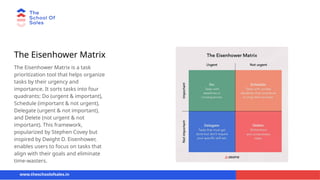
TheEisenhower Matrix is a task
prioritization tool that helps organize
tasks by their urgency and
importance. It sorts tasks into four
quadrants: Do (urgent & important),
Schedule (important & not urgent),
Delegate (urgent & not important),
and Delete (not urgent & not
important). This framework,
popularized by Stephen Covey but
inspired by Dwight D. Eisenhower,
enables users to focus on tasks that
align with their goals and eliminate
time-wasters.
www.theschoolofsales.in
4.
The SWOT Analysis
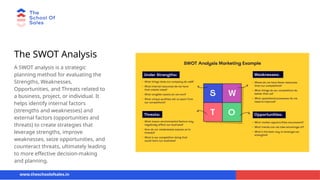
ASWOT analysis is a strategic
planning method for evaluating the
Strengths, Weaknesses,
Opportunities, and Threats related to
a business, project, or individual. It
helps identify internal factors
(strengths and weaknesses) and
external factors (opportunities and
threats) to create strategies that
leverage strengths, improve
weaknesses, seize opportunities, and
counteract threats, ultimately leading
to more effective decision-making
and planning.
www.theschoolofsales.in
5.
The BCG Box
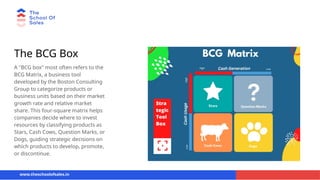
A"BCG box" most often refers to the
BCG Matrix, a business tool
developed by the Boston Consulting
Group to categorize products or
business units based on their market
growth rate and relative market
share. This four-square matrix helps
companies decide where to invest
resources by classifying products as
Stars, Cash Cows, Question Marks, or
Dogs, guiding strategic decisions on
which products to develop, promote,
or discontinue.
www.theschoolofsales.in
6.
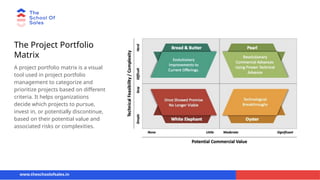
The Project Portfolio
Matrix
Aproject portfolio matrix is a visual
tool used in project portfolio
management to categorize and
prioritize projects based on different
criteria. It helps organizations
decide which projects to pursue,
invest in, or potentially discontinue,
based on their potential value and
associated risks or complexities.
www.theschoolofsales.in
7.
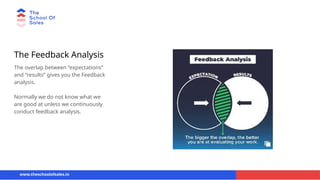
The Feedback Analysis
Theoverlap between “expectations”
and “results” gives you the Feedback
analysis.
Normally we do not know what we
are good at unless we continuously
conduct feedback analysis.
www.theschoolofsales.in
8.
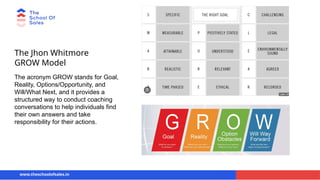
The Jhon Whitmore
GROWModel
www.theschoolofsales.in
The acronym GROW stands for Goal,
Reality, Options/Opportunity, and
Will/What Next, and it provides a
structured way to conduct coaching
conversations to help individuals find
their own answers and take
responsibility for their actions.
9.
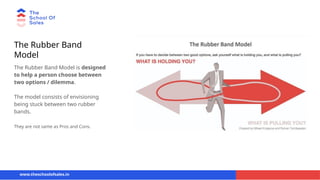
The Rubber Band
Model
TheRubber Band Model is designed
to help a person choose between
two options / dilemma.
The model consists of envisioning
being stuck between two rubber
bands.
They are not same as Pros and Cons.
www.theschoolofsales.in
10.
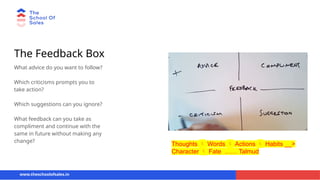
The Feedback Box
Whatadvice do you want to follow?
Which criticisms prompts you to
take action?
Which suggestions can you ignore?
What feedback can you take as
compliment and continue with the
same in future without making any
change?
www.theschoolofsales.in
Thoughts Words Actions Habits __>
Character Fate …… Talmud
11.
The Yes /No Rule
Strike out all MAYBE options to
arrive at clear cut “Yes” or “No”.
www.theschoolofsales.in
12.
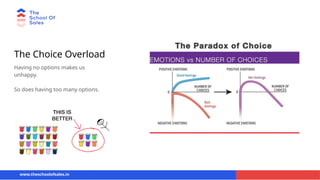
The Choice Overload
Havingno options makes us
unhappy.
So does having too many options.
www.theschoolofsales.in
13.
The Gap inthe Market
Model
X Axis – Pricing
Y Axis – Popularity
Z Axis – Potential
When you map all competitors on
these three axes , you will see a
niche which is vacant for your
product to occupy.
This is the Gap in the Market Model
www.theschoolofsales.in
14.
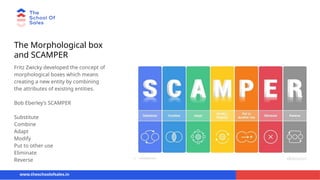
The Morphological box
andSCAMPER
Fritz Zwicky developed the concept of
morphological boxes which means
creating a new entity by combining
the attributes of existing entities.
Bob Eberley’s SCAMPER
Substitute
Combine
Adapt
Modify
Put to other use
Eliminate
Reverse
www.theschoolofsales.in
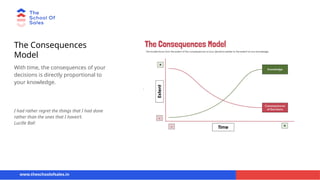
The Consequences
Model
With time,the consequences of your
decisions is directly proportional to
your knowledge.
I had rather regret the things that I had done
rather than the ones that I haven’t.
Lucille Ball
www.theschoolofsales.in
17.
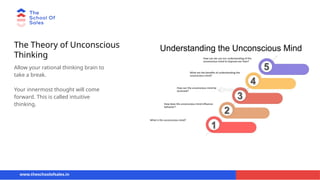
The Theory ofUnconscious
Thinking
Allow your rational thinking brain to
take a break.
Your innermost thought will come
forward. This is called intuitive
thinking.
www.theschoolofsales.in
18.
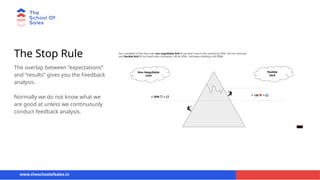
The Stop Rule
Theoverlap between “expectations”
and “results” gives you the Feedback
analysis.
Normally we do not know what we
are good at unless we continuously
conduct feedback analysis.
www.theschoolofsales.in
19.
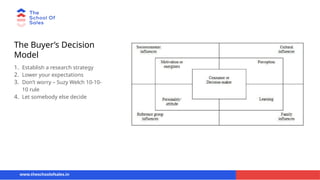
The Buyer’s Decision
Model
1.Establish a research strategy
2. Lower your expectations
3. Don’t worry – Suzy Welch 10-10-
10 rule
4. Let somebody else decide
www.theschoolofsales.in
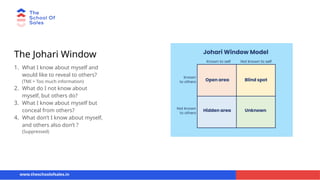
The Johari Window
1.What I know about myself and
would like to reveal to others?
(TMI = Too much information)
2. What do I not know about
myself, but others do?
3. What I know about myself but
conceal from others?
4. What don’t I know about myself,
and others also don’t ?
(Suppressed)
www.theschoolofsales.in
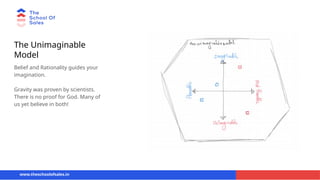
The Unimaginable
Model
Belief andRationality guides your
imagination.
Gravity was proven by scientists.
There is no proof for God. Many of
us yet believe in both!
www.theschoolofsales.in
25.
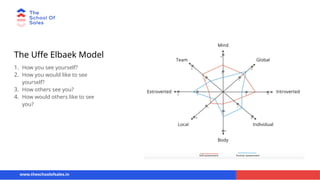
The Uffe ElbaekModel
1. How you see yourself?
2. How you would like to see
yourself?
3. How others see you?
4. How would others like to see
you?
www.theschoolofsales.in
26.
The Energy Model
Areyou leaving in the here and
now?
You cannot change the past. But you
can surely ruin the present by thinking
about the future.
www.theschoolofsales.in
27.
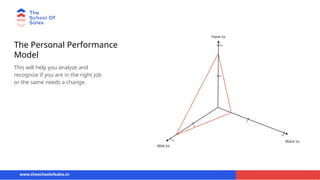
The Personal Performance
Model
Thiswill help you analyze and
recognize if you are in the right job
or the same needs a change.
www.theschoolofsales.in
28.
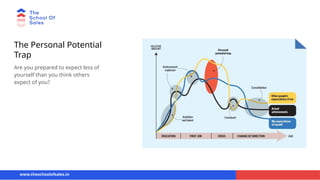
The Personal Potential
Trap
Areyou prepared to expect less of
yourself than you think others
expect of you?
www.theschoolofsales.in
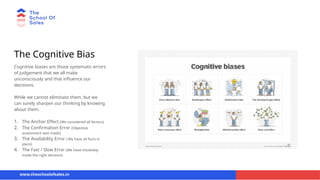
The Cognitive Bias
Cognitivebiases are those systematic errors
of judgement that we all make
unconsciously and that influence our
decisions.
While we cannot eliminate them, but we
can surely sharpen our thinking by knowing
about them.
1. The Anchor Effect (We considered all factors)
2. The Confirmation Error (Objective
assessment was made)
3. The Availability Error ( We have all facts in
place)
4. The Fast / Slow Error (We have intuitively
made the right decision)
www.theschoolofsales.in
31.
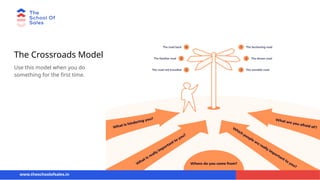
The Crossroads Model
Usethis model when you do
something for the first time.
www.theschoolofsales.in
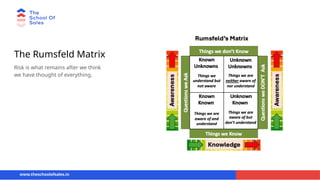
The Rumsfeld Matrix
Riskis what remains after we think
we have thought of everything.
www.theschoolofsales.in
34.
www.theschoolofsales.in
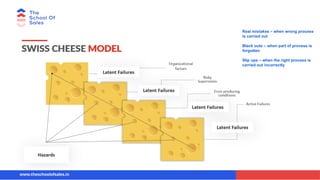
Real mistakes –when wrong process
is carried out
Black outs – when part of process is
forgotten
Slip ups – when the right process is
carried out incorrectly
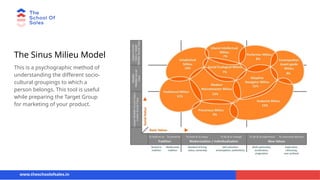
The Sinus MilieuModel
This is a psychographic method of
understanding the different socio-
cultural groupings to which a
person belongs. This tool is useful
while preparing the Target Group
for marketing of your product.
www.theschoolofsales.in
37.
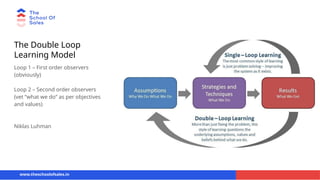
The Double Loop
LearningModel
Loop 1 – First order observers
(obviously)
Loop 2 – Second order observers
(vet “what we do” as per objectives
and values)
Niklas Luhman
www.theschoolofsales.in
38.
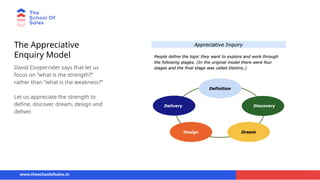
The Appreciative
Enquiry Model
DavidCooperrider says that let us
focus on “what is the strength?”
rather than “what is the weakness?”
Let us appreciate the strength to
define, discover, dream, design and
deliver.
www.theschoolofsales.in
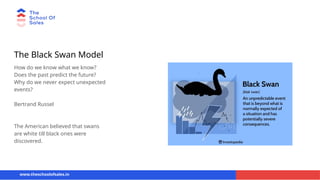
The Black SwanModel
How do we know what we know?
Does the past predict the future?
Why do we never expect unexpected
events?
Bertrand Russel
The American believed that swans
are white till black ones were
discovered.
www.theschoolofsales.in
43.
The Chasm -The
Diffusion Model
First, they ignore you, then they laugh
at you, then they fight you, then you
win.
Mahatma Gandhi
www.theschoolofsales.in
44.
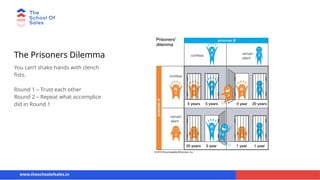
The Prisoners Dilemma
Youcan’t shake hands with clench
fists.
Round 1 – Trust each other
Round 2 – Repeat what accomplice
did in Round 1
www.theschoolofsales.in
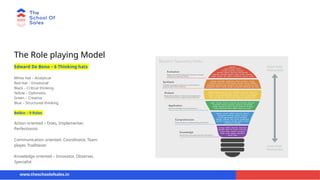
The Role playingModel
Edward De Bono – 6 Thinking hats
White Hat – Analytical
Red Hat – Emotional
Black – Critical thinking
Yellow – Optimistic
Green – Creative
Blue – Structured thinking
Belbin – 9 Roles
Action oriented – Does, Implementer,
Perfectionist
Communication oriented- Coordinator, Team
player, Trailblazer
Knowledge oriented – Innovator, Observer,
Specialist
www.theschoolofsales.in
In a Nutshell
●How to improve yourself?
● How to understand yourself?
● How to understand others better?
www.theschoolofsales.in
These 50 strategic tools will give you the narrative to think strategically and align your thought process in the right
direction/