Growth acceleration workshop Subba Iyer
Objectives Understand that growth is a default option Discuss growth choices: A dynamic situation and an environment An environment poised for change with multiple options See the “whole”in you, and not just the parts. Look at unconventional approaches -- the 10X imperative 3 surefire approaches that will improve your chances significantly Case studies, examples, worksheets to stretch you mentally Have serious fun!
Agenda and format: Agenda: Introduction Growth architecture Application (Robin Hood case study) Post case study conclusions. Unconventional approaches Some successful management approaches for small business Case study (optional) 3 sure fire approaches to boost your business. Format: Informal yet structured. 1 case study detailed analysis I case study (optional) Mini work sheets. Frankness and openness Challenging and respectful
Simple rules in the beep-once or silent mode You decide when to start and stop You decide when you want breaks The only foolish question is the one that was not asked If you are glad, tell us about it If you are sad or mad, tell us about it We all accept responsibility for time boundaries  The agenda is flexible and we can change emphasis.
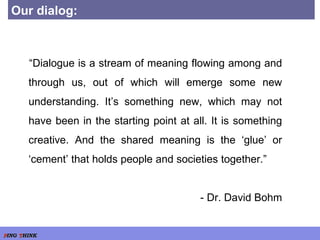
Our dialog: “ Dialogue is a stream of meaning flowing among and through us, out of which will emerge some new understanding. It’s something new, which may not have been in the starting point at all. It is something creative. And the shared meaning is the ‘glue’ or ‘cement’ that holds people and societies together.”  - Dr. David Bohm
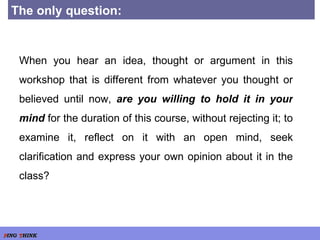
The only question: When you hear an idea, thought or argument in this workshop that is different from whatever you thought or believed until now,  are you willing to hold it in your mind  for the duration of this course, without rejecting it; to examine it, reflect on it with an open mind, seek clarification and express your own opinion about it in the class?
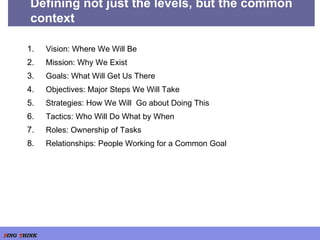
Defining not just the levels, but the common context Vision: Where We Will Be Mission: Why We Exist Goals: What Will Get Us There Objectives: Major Steps We Will Take Strategies: How We Will  Go about Doing This Tactics: Who Will Do What by When Roles: Ownership of Tasks Relationships: People Working for a Common Goal
How much should you grow?
        
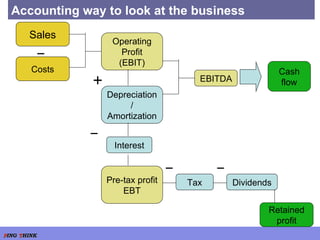
Accounting way to look at the business Sales Costs Operating Profit (EBIT) Depreciation / Amortization Pre-tax profit EBT Interest EBITDA Cash flow Tax Dividends Retained profit     
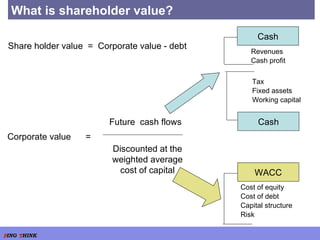
What is shareholder value? Share holder value  =  Corporate value - debt Corporate value  = Future  cash flows Discounted at the weighted average cost of capital Cash Cash WACC Revenues Cash profit Tax Fixed assets Working capital Cost of equity Cost of debt Capital structure Risk
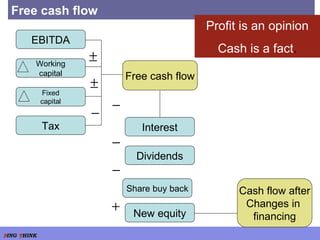
Free cash flow EBITDA Working capital Fixed capital Tax Interest Dividends Share buy back New equity Free cash flow Cash flow after Changes in  financing        Profit is an opinion Cash is a fact .
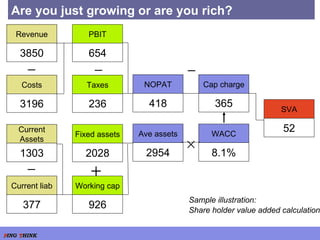
Are you just growing or are you rich? 3850 Revenue 3196 Costs 1303 Current Assets 377 Current liab 654 PBIT 236 Taxes 2028 Fixed assets 926 Working cap 418 NOPAT 2954 Ave assets 365 Cap charge 8.1% WACC 52 SVA      Sample illustration:  Share holder value added calculation 
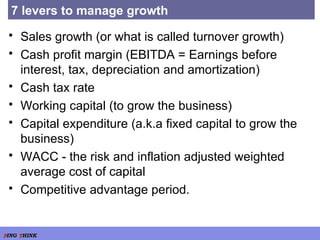
7 levers to manage growth Sales growth (or what is called turnover growth) Cash profit margin (EBITDA = Earnings before interest, tax, depreciation and amortization) Cash tax rate Working capital (to grow the business) Capital expenditure (a.k.a fixed capital to grow the business) WACC - the risk and inflation adjusted weighted average cost of capital Competitive advantage period.
Now, look at your business and analyze The financials are over..let’s change the thinking hat..!!!
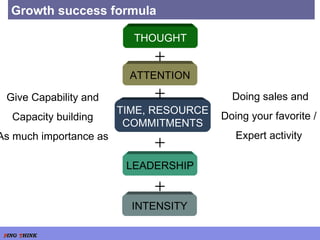
Growth success formula THOUGHT ATTENTION LEADERSHIP INTENSITY TIME, RESOURCE COMMITMENTS     Give Capability and Capacity building As much importance as Doing sales and Doing your favorite /  Expert activity
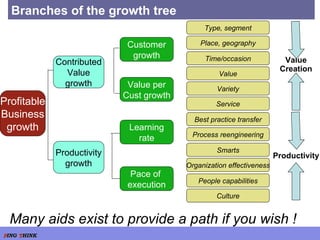
Branches of the growth tree Type, segment Place, geography Time/occasion Value Variety Service Best practice transfer Process reengineering Smarts Organization effectiveness People capabilities Culture Customer growth Value per Cust growth Learning rate Pace of  execution Contributed Value growth Productivity growth Profitable Business growth Value Creation Productivity Many aids exist to provide a path if you wish !
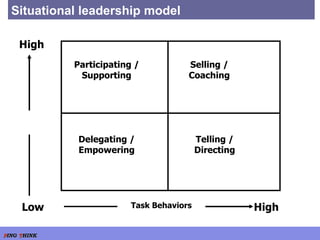
Situational leadership model Participating / Supporting Selling / Coaching Delegating / Empowering Telling / Directing Task Behaviors Low High High
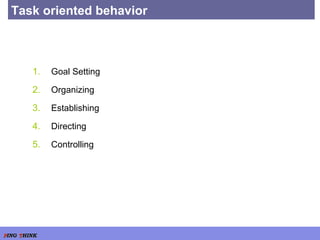
Task oriented behavior Goal Setting Organizing Establishing Directing Controlling
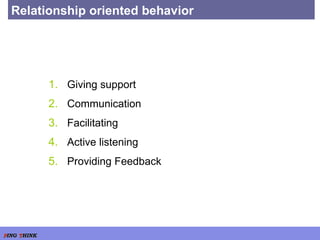
Relationship oriented behavior Giving support Communication Facilitating Active listening Providing Feedback
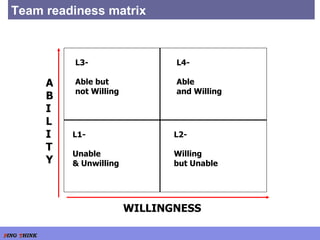
Team readiness matrix WILLINGNESS A B I L I T Y L1-  Unable  & Unwilling L2-  Willing  but Unable L3-  Able but  not Willing L4-  Able  and Willing
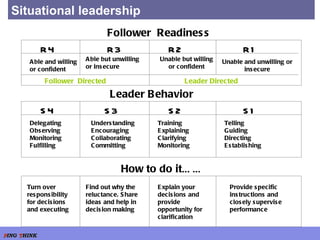
Situational leadership R4 R3 R2 R1 Turn over responsibility for decisions and executing Find out why the reluctance. Share ideas and help in decision making Explain your decisions and provide opportunity for clarification Provide specific instructions and closely supervise performance Able and willing or confident Able but unwilling or insecure Unable but willing or confident Unable and unwilling or insecure Follower  Directed Leader Directed How to do it …… Follower  Readiness Leader Behavior S4 S3 S2 S1 Delegating Observing Monitoring Fulfilling Understanding  Encouraging Collaborating Committing Training Explaining Clarifying Monitoring Telling Guiding Directing Establishing
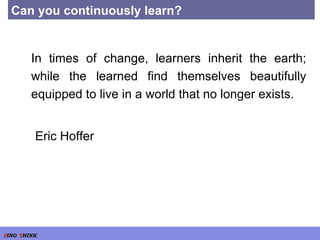
Can you continuously learn? In times of change, learners inherit the earth; while the learned find themselves beautifully equipped to live in a world that no longer exists. Eric Hoffer
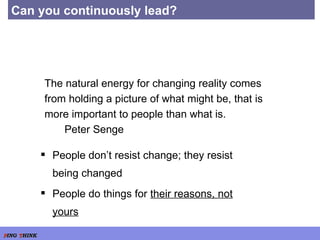
Can you continuously lead? The natural energy for changing reality comes from holding a picture of what might be, that is more important to people than what is. Peter Senge People don’t resist change; they resist being changed People do things for  their reasons, not yours
The core belief Never underestimate the enemy. Respect him, but equally always remember, regardless of the odd, team to team, yours is better. If there is any doubt in your mind in regard to this previous sentence, you had better start training harder, or hand over your command. (source: Australian Army Leadership Manual   1994)
Case study : Robin Hood So, what’s the situation that Robin Hood is facing? What approaches makes sense? What are the underlying considerations for the approach? What is unique about the approach?
Reflections: Any similarity between your growth dilemma and Robin Hood? Amongst the various approaches that have been outlined, which one seems the best? Which approach comes closer to your growth dilemma? What are the implications for you? What are the implications for the business model?
 
 
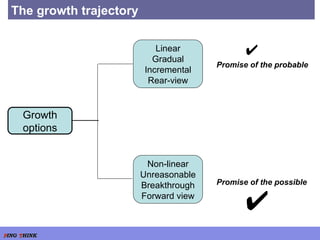
The growth trajectory Growth options Linear Gradual Incremental Rear-view Non-linear Unreasonable Breakthrough Forward view Promise of the probable Promise of the possible  
Think different! “ Here's to the crazy ones, the misfits, the rebels, the troublemakers, the round pegs in the square holes... the ones who see things differently -- they're not fond of rules... You can quote them, disagree with them, glorify or vilify them, but the only thing you can't do is ignore them because they change things... they push the human race forward, and while some may see them as the crazy ones, we see genius, because the ones who are crazy enough to think that they can change the world, are the ones who do.”
25 words that changed a nation’s history There are risks and costs to a program of action. But they are far less than the long range risks and costs of uncomfortable inaction -- J F Kennedy
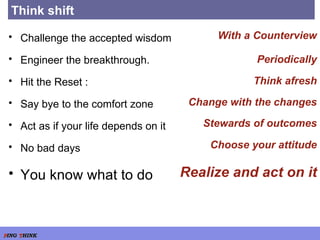
Think shift Challenge the accepted wisdom Engineer the breakthrough. Hit the Reset : Say bye to the comfort zone Act as if your life depends on it No bad days You know what to do Periodically With a Counterview Think afresh Change with the changes Stewards of outcomes Choose your attitude Realize and act on it
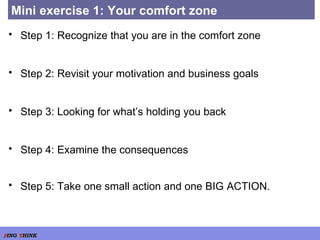
Mini exercise 1: Your comfort zone Step 1: Recognize that you are in the comfort zone Step 2: Revisit your motivation and business goals Step 3: Looking for what’s holding you back Step 4: Examine the consequences Step 5: Take one small action and one BIG ACTION.
Mini Exercise 2:  Make a list of 10 to do items that can grow your business by 2.5X in the next 18 months. Review the list. Review the list once again. Find just the one item that stands out Circle it DO IT. You know what to do. Do it
Strategic thinking
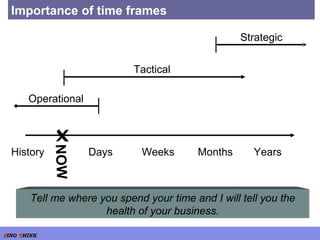
Importance of time frames History Weeks Months Years Days NOW Operational Tactical Strategic Tell me where you spend your time and I will tell you the health of your business. 
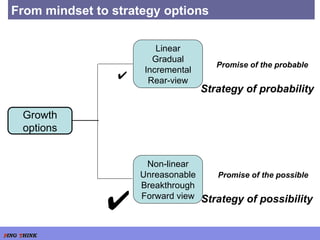
From mindset to strategy options Growth options Linear Gradual Incremental Rear-view Non-linear Unreasonable Breakthrough Forward view Promise of the probable Promise of the possible   Strategy of probability Strategy of possibility
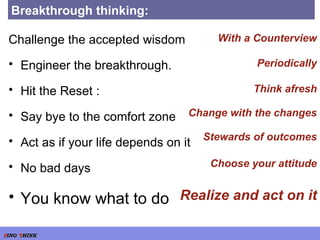
Breakthrough thinking: Challenge the accepted wisdom Engineer the breakthrough. Hit the Reset : Say bye to the comfort zone Act as if your life depends on it No bad days You know what to do Think afresh Change with the changes Stewards of outcomes Periodically With a Counterview Choose your attitude Realize and act on it
Your strategic considerations If ever there was a way.. I don’t know. The Merlin method : Think backwards Something worth accomplishing 10% or 10X thinking End from the beginning I don’t know  yet ! Be the possibility strategist Seeing the end at the beginning  Reduce the detour Invent the goal Only way to stay ahead What’s your exit
Mini Exercise: Your exit zone
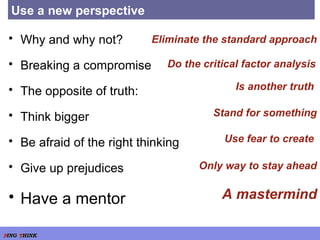
Use a new perspective Why and why not? Breaking a compromise The opposite of truth: Think bigger Be afraid of the right thinking Give up prejudices Have a mentor Do the critical factor analysis Eliminate the standard approach Is another truth  Stand for something Use fear to create  Only way to stay ahead A mastermind
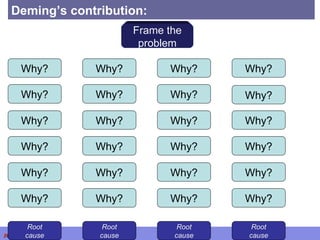
Deming’s contribution: Frame the problem Why? Why? Why? Why? Why? Why? Root cause Why? Why? Why? Why? Why? Why? Root cause Why? Why? Why? Why? Why? Why? Root cause Why? Why? Why? Why? Why? Why? Root cause
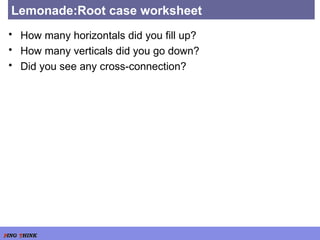
Lemonade:Root case worksheet How many horizontals did you fill up? How many verticals did you go down? Did you see any cross-connection?
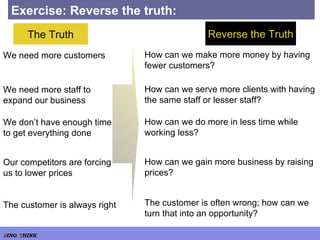
Exercise: Reverse the truth: The Truth Reverse the Truth We need more customers How can we make more money by having fewer customers? We need more staff to expand our business How can we serve more clients with having the same staff or lesser staff? We don’t have enough time to get everything done How can we do more in less time while working less? Our competitors are forcing us to lower prices How can we gain more business by raising prices? The customer is always right The customer is often wrong; how can we turn that into an opportunity?
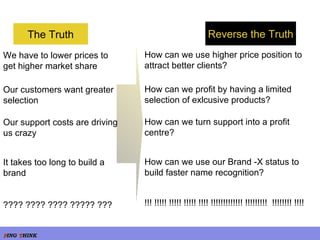
We have to lower prices to get higher market share How can we use higher price position to attract better clients? Our customers want greater selection How can we profit by having a limited selection of exlcusive products? Our support costs are driving us crazy How can we turn support into a profit centre? It takes too long to build a brand How can we use our Brand -X status to build faster name recognition? ???? ???? ???? ????? ??? !!! !!!!! !!!!! !!!!! !!!! !!!!!!!!!!!!! !!!!!!!!!  !!!!!!!! !!!!  The Truth Reverse the Truth
Execution
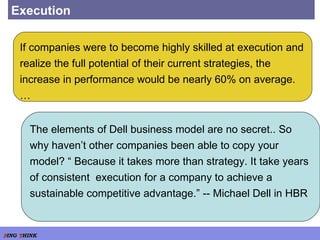
Execution If companies were to become highly skilled at execution and realize the full potential of their current strategies, the increase in performance would be nearly 60% on average. … The elements of Dell business model are no secret.. So why haven’t other companies been able to copy your model? “ Because it takes more than strategy. It take years of consistent  execution for a company to achieve a sustainable competitive advantage.” -- Michael Dell in HBR
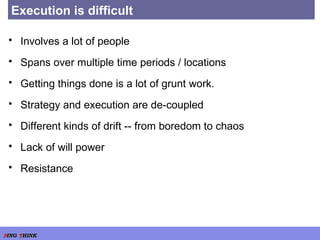
Execution is difficult Involves a lot of people Spans over multiple time periods / locations Getting things done is a lot of grunt work. Strategy and execution are de-coupled Different kinds of drift -- from boredom to chaos Lack of will power Resistance
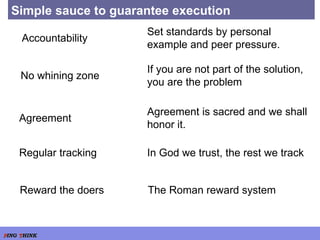
Simple sauce to guarantee execution Accountability Set standards by personal example and peer pressure. No whining zone If you are not part of the solution, you are the problem  Agreement  Agreement is sacred and we shall honor it.  Regular tracking In God we trust, the rest we track  Reward the doers The Roman reward system
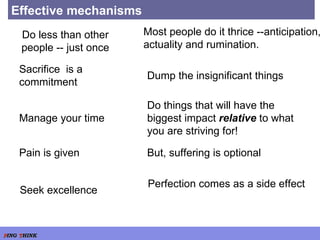
Effective mechanisms Do less than other people -- just once Most people do it thrice --anticipation, actuality and rumination. Sacrifice  is a commitment Dump the insignificant things  Manage your time  Do things that will have the biggest impact  relative  to what you are striving for!  Pain is given But, suffering is optional  Seek excellence Perfection comes as a side effect

Pingthink corp

  • 1.
  • 2.
    Objectives Understand thatgrowth is a default option Discuss growth choices: A dynamic situation and an environment An environment poised for change with multiple options See the “whole”in you, and not just the parts. Look at unconventional approaches -- the 10X imperative 3 surefire approaches that will improve your chances significantly Case studies, examples, worksheets to stretch you mentally Have serious fun!
  • 3.
    Agenda and format:Agenda: Introduction Growth architecture Application (Robin Hood case study) Post case study conclusions. Unconventional approaches Some successful management approaches for small business Case study (optional) 3 sure fire approaches to boost your business. Format: Informal yet structured. 1 case study detailed analysis I case study (optional) Mini work sheets. Frankness and openness Challenging and respectful
  • 4.
    Simple rules inthe beep-once or silent mode You decide when to start and stop You decide when you want breaks The only foolish question is the one that was not asked If you are glad, tell us about it If you are sad or mad, tell us about it We all accept responsibility for time boundaries The agenda is flexible and we can change emphasis.
  • 5.
    Our dialog: “Dialogue is a stream of meaning flowing among and through us, out of which will emerge some new understanding. It’s something new, which may not have been in the starting point at all. It is something creative. And the shared meaning is the ‘glue’ or ‘cement’ that holds people and societies together.” - Dr. David Bohm
  • 6.
    The only question:When you hear an idea, thought or argument in this workshop that is different from whatever you thought or believed until now, are you willing to hold it in your mind for the duration of this course, without rejecting it; to examine it, reflect on it with an open mind, seek clarification and express your own opinion about it in the class?
  • 7.
    Defining not justthe levels, but the common context Vision: Where We Will Be Mission: Why We Exist Goals: What Will Get Us There Objectives: Major Steps We Will Take Strategies: How We Will Go about Doing This Tactics: Who Will Do What by When Roles: Ownership of Tasks Relationships: People Working for a Common Goal
  • 8.
    How much shouldyou grow?
  • 9.
       
  • 10.
    Accounting way tolook at the business Sales Costs Operating Profit (EBIT) Depreciation / Amortization Pre-tax profit EBT Interest EBITDA Cash flow Tax Dividends Retained profit     
  • 11.
    What is shareholdervalue? Share holder value = Corporate value - debt Corporate value = Future cash flows Discounted at the weighted average cost of capital Cash Cash WACC Revenues Cash profit Tax Fixed assets Working capital Cost of equity Cost of debt Capital structure Risk
  • 12.
    Free cash flowEBITDA Working capital Fixed capital Tax Interest Dividends Share buy back New equity Free cash flow Cash flow after Changes in financing        Profit is an opinion Cash is a fact .
  • 13.
    Are you justgrowing or are you rich? 3850 Revenue 3196 Costs 1303 Current Assets 377 Current liab 654 PBIT 236 Taxes 2028 Fixed assets 926 Working cap 418 NOPAT 2954 Ave assets 365 Cap charge 8.1% WACC 52 SVA      Sample illustration: Share holder value added calculation 
  • 14.
    7 levers tomanage growth Sales growth (or what is called turnover growth) Cash profit margin (EBITDA = Earnings before interest, tax, depreciation and amortization) Cash tax rate Working capital (to grow the business) Capital expenditure (a.k.a fixed capital to grow the business) WACC - the risk and inflation adjusted weighted average cost of capital Competitive advantage period.
  • 15.
    Now, look atyour business and analyze The financials are over..let’s change the thinking hat..!!!
  • 16.
    Growth success formulaTHOUGHT ATTENTION LEADERSHIP INTENSITY TIME, RESOURCE COMMITMENTS     Give Capability and Capacity building As much importance as Doing sales and Doing your favorite / Expert activity
  • 17.
    Branches of thegrowth tree Type, segment Place, geography Time/occasion Value Variety Service Best practice transfer Process reengineering Smarts Organization effectiveness People capabilities Culture Customer growth Value per Cust growth Learning rate Pace of execution Contributed Value growth Productivity growth Profitable Business growth Value Creation Productivity Many aids exist to provide a path if you wish !
  • 18.
    Situational leadership modelParticipating / Supporting Selling / Coaching Delegating / Empowering Telling / Directing Task Behaviors Low High High
  • 19.
    Task oriented behaviorGoal Setting Organizing Establishing Directing Controlling
  • 20.
    Relationship oriented behaviorGiving support Communication Facilitating Active listening Providing Feedback
  • 21.
    Team readiness matrixWILLINGNESS A B I L I T Y L1- Unable & Unwilling L2- Willing but Unable L3- Able but not Willing L4- Able and Willing
  • 22.
    Situational leadership R4R3 R2 R1 Turn over responsibility for decisions and executing Find out why the reluctance. Share ideas and help in decision making Explain your decisions and provide opportunity for clarification Provide specific instructions and closely supervise performance Able and willing or confident Able but unwilling or insecure Unable but willing or confident Unable and unwilling or insecure Follower Directed Leader Directed How to do it …… Follower Readiness Leader Behavior S4 S3 S2 S1 Delegating Observing Monitoring Fulfilling Understanding Encouraging Collaborating Committing Training Explaining Clarifying Monitoring Telling Guiding Directing Establishing
  • 23.
    Can you continuouslylearn? In times of change, learners inherit the earth; while the learned find themselves beautifully equipped to live in a world that no longer exists. Eric Hoffer
  • 24.
    Can you continuouslylead? The natural energy for changing reality comes from holding a picture of what might be, that is more important to people than what is. Peter Senge People don’t resist change; they resist being changed People do things for their reasons, not yours
  • 25.
    The core beliefNever underestimate the enemy. Respect him, but equally always remember, regardless of the odd, team to team, yours is better. If there is any doubt in your mind in regard to this previous sentence, you had better start training harder, or hand over your command. (source: Australian Army Leadership Manual 1994)
  • 26.
    Case study :Robin Hood So, what’s the situation that Robin Hood is facing? What approaches makes sense? What are the underlying considerations for the approach? What is unique about the approach?
  • 27.
    Reflections: Any similaritybetween your growth dilemma and Robin Hood? Amongst the various approaches that have been outlined, which one seems the best? Which approach comes closer to your growth dilemma? What are the implications for you? What are the implications for the business model?
  • 28.
  • 29.
  • 30.
    The growth trajectoryGrowth options Linear Gradual Incremental Rear-view Non-linear Unreasonable Breakthrough Forward view Promise of the probable Promise of the possible  
  • 31.
    Think different! “Here's to the crazy ones, the misfits, the rebels, the troublemakers, the round pegs in the square holes... the ones who see things differently -- they're not fond of rules... You can quote them, disagree with them, glorify or vilify them, but the only thing you can't do is ignore them because they change things... they push the human race forward, and while some may see them as the crazy ones, we see genius, because the ones who are crazy enough to think that they can change the world, are the ones who do.”
  • 32.
    25 words thatchanged a nation’s history There are risks and costs to a program of action. But they are far less than the long range risks and costs of uncomfortable inaction -- J F Kennedy
  • 33.
    Think shift Challengethe accepted wisdom Engineer the breakthrough. Hit the Reset : Say bye to the comfort zone Act as if your life depends on it No bad days You know what to do Periodically With a Counterview Think afresh Change with the changes Stewards of outcomes Choose your attitude Realize and act on it
  • 34.
    Mini exercise 1:Your comfort zone Step 1: Recognize that you are in the comfort zone Step 2: Revisit your motivation and business goals Step 3: Looking for what’s holding you back Step 4: Examine the consequences Step 5: Take one small action and one BIG ACTION.
  • 35.
    Mini Exercise 2: Make a list of 10 to do items that can grow your business by 2.5X in the next 18 months. Review the list. Review the list once again. Find just the one item that stands out Circle it DO IT. You know what to do. Do it
  • 36.
  • 37.
    Importance of timeframes History Weeks Months Years Days NOW Operational Tactical Strategic Tell me where you spend your time and I will tell you the health of your business. 
  • 38.
    From mindset tostrategy options Growth options Linear Gradual Incremental Rear-view Non-linear Unreasonable Breakthrough Forward view Promise of the probable Promise of the possible   Strategy of probability Strategy of possibility
  • 39.
    Breakthrough thinking: Challengethe accepted wisdom Engineer the breakthrough. Hit the Reset : Say bye to the comfort zone Act as if your life depends on it No bad days You know what to do Think afresh Change with the changes Stewards of outcomes Periodically With a Counterview Choose your attitude Realize and act on it
  • 40.
    Your strategic considerationsIf ever there was a way.. I don’t know. The Merlin method : Think backwards Something worth accomplishing 10% or 10X thinking End from the beginning I don’t know yet ! Be the possibility strategist Seeing the end at the beginning Reduce the detour Invent the goal Only way to stay ahead What’s your exit
  • 41.
  • 42.
    Use a newperspective Why and why not? Breaking a compromise The opposite of truth: Think bigger Be afraid of the right thinking Give up prejudices Have a mentor Do the critical factor analysis Eliminate the standard approach Is another truth Stand for something Use fear to create Only way to stay ahead A mastermind
  • 43.
    Deming’s contribution: Framethe problem Why? Why? Why? Why? Why? Why? Root cause Why? Why? Why? Why? Why? Why? Root cause Why? Why? Why? Why? Why? Why? Root cause Why? Why? Why? Why? Why? Why? Root cause
  • 44.
    Lemonade:Root case worksheetHow many horizontals did you fill up? How many verticals did you go down? Did you see any cross-connection?
  • 45.
    Exercise: Reverse thetruth: The Truth Reverse the Truth We need more customers How can we make more money by having fewer customers? We need more staff to expand our business How can we serve more clients with having the same staff or lesser staff? We don’t have enough time to get everything done How can we do more in less time while working less? Our competitors are forcing us to lower prices How can we gain more business by raising prices? The customer is always right The customer is often wrong; how can we turn that into an opportunity?
  • 46.
    We have tolower prices to get higher market share How can we use higher price position to attract better clients? Our customers want greater selection How can we profit by having a limited selection of exlcusive products? Our support costs are driving us crazy How can we turn support into a profit centre? It takes too long to build a brand How can we use our Brand -X status to build faster name recognition? ???? ???? ???? ????? ??? !!! !!!!! !!!!! !!!!! !!!! !!!!!!!!!!!!! !!!!!!!!! !!!!!!!! !!!! The Truth Reverse the Truth
  • 47.
  • 48.
    Execution If companieswere to become highly skilled at execution and realize the full potential of their current strategies, the increase in performance would be nearly 60% on average. … The elements of Dell business model are no secret.. So why haven’t other companies been able to copy your model? “ Because it takes more than strategy. It take years of consistent execution for a company to achieve a sustainable competitive advantage.” -- Michael Dell in HBR
  • 49.
    Execution is difficultInvolves a lot of people Spans over multiple time periods / locations Getting things done is a lot of grunt work. Strategy and execution are de-coupled Different kinds of drift -- from boredom to chaos Lack of will power Resistance
  • 50.
    Simple sauce toguarantee execution Accountability Set standards by personal example and peer pressure. No whining zone If you are not part of the solution, you are the problem Agreement Agreement is sacred and we shall honor it. Regular tracking In God we trust, the rest we track Reward the doers The Roman reward system
  • 51.
    Effective mechanisms Doless than other people -- just once Most people do it thrice --anticipation, actuality and rumination. Sacrifice is a commitment Dump the insignificant things Manage your time Do things that will have the biggest impact relative to what you are striving for! Pain is given But, suffering is optional Seek excellence Perfection comes as a side effect