EDUC.214
PLANNING IN
EDUCATIONAL
MANAGEMENT
SECOND SEMESTER 2020-
2021
Northwestern Visayan
Colleges
GRADUATE SCHOOL
JUNETTE T. CASIMERO
Discussant
Strategic Plan for Planning
JESSE E. BEREBER
Professor
A strategic plan is a document that summarizes all
the critical strategic thinking from the strategic
planning process. It defines where the entity sees
itself today and the challenges it is facing . It also
describes the ultimate end-state it wants to create (its
vision), the high-level path it plans to take to move
from where it is today to its vision and finally the key
near-term priorities to begin this journey. It is also
called a long-range plan.
What is Strategic Plan?
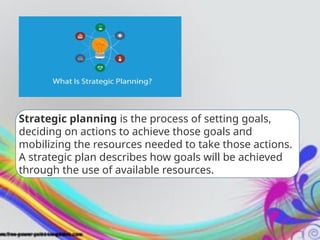
Strategic planning is the process of setting goals,
deciding on actions to achieve those goals and
mobilizing the resources needed to take those actions.
A strategic plan describes how goals will be achieved
through the use of available resources.
Reasons for Strategic Planning
 First, one may wish to plan and carry out all the
activities that people deem necessary, but without
achieving the ultimate goals and result.
Second, more resources do not necessarily stand
for the best results. The way one uses these
resources can lead to different levels of benefits and
results.
Third, it has become more and more difficult to plan
everything one would wish to do. One ought to
make choices, often tough ones, through a balanced
decision-making, tradeoffs across the education
system and through a consensus building process.
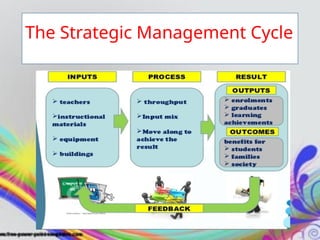
The Strategic Management Cycle
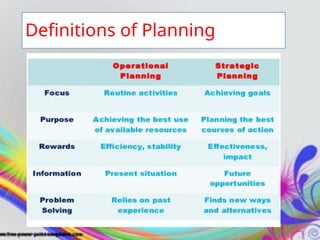
Definitions of Planning
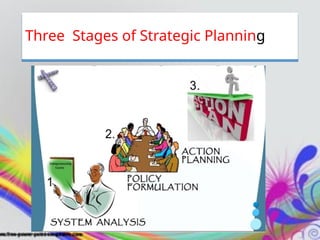
Three Stages of Strategic Planning
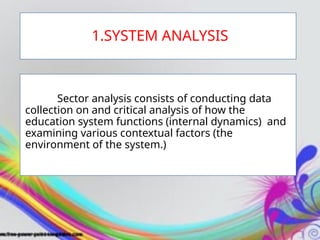
1.SYSTEM ANALYSIS
Sector analysis consists of conducting data
collection on and critical analysis of how the
education system functions (internal dynamics) and
examining various contextual factors (the
environment of the system.)
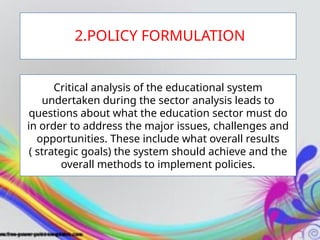
Critical analysis of the educational system
undertaken during the sector analysis leads to
questions about what the education sector must do
in order to address the major issues, challenges and
opportunities. These include what overall results
( strategic goals) the system should achieve and the
overall methods to implement policies.
2.POLICY FORMULATION
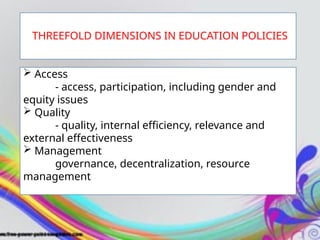
 Access
- access, participation, including gender and
equity issues
 Quality
- quality, internal efficiency, relevance and
external effectiveness
 Management
governance, decentralization, resource
management
THREEFOLD DIMENSIONS IN EDUCATION POLICIES
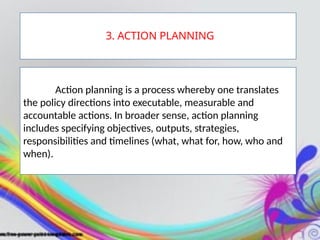
Action planning is a process whereby one translates
the policy directions into executable, measurable and
accountable actions. In broader sense, action planning
includes specifying objectives, outputs, strategies,
responsibilities and timelines (what, what for, how, who and
when).
3. ACTION PLANNING
What is the future of strategic planning
in education?
• Educators, realizing the value of diverse perspectives and
community support are inviting parents, employees,
student and other education stakeholders to inform their
strategic planning. The education and community
development sectors have embraced the idea that strategic
planning is best accomplished with the inclusion of
community. Technology has enabled this.
• Without a connected and accessible “environment” like the
Internet, genuine and affordable community engagement
in strategic planning would not be feasible. Our connected
environment, the ubiquity of email and user-friendly
technology has changed, and will continue to change, the
strategic planning process.
THANK
YOU
FOR
LISTENIN
G !

Curriculum Development report in Masteral Eucation.pptx

  • 1.
    EDUC.214 PLANNING IN EDUCATIONAL MANAGEMENT SECOND SEMESTER2020- 2021 Northwestern Visayan Colleges GRADUATE SCHOOL
  • 2.
    JUNETTE T. CASIMERO Discussant StrategicPlan for Planning JESSE E. BEREBER Professor
  • 3.
    A strategic planis a document that summarizes all the critical strategic thinking from the strategic planning process. It defines where the entity sees itself today and the challenges it is facing . It also describes the ultimate end-state it wants to create (its vision), the high-level path it plans to take to move from where it is today to its vision and finally the key near-term priorities to begin this journey. It is also called a long-range plan. What is Strategic Plan?
  • 4.
    Strategic planning isthe process of setting goals, deciding on actions to achieve those goals and mobilizing the resources needed to take those actions. A strategic plan describes how goals will be achieved through the use of available resources.
  • 5.
    Reasons for StrategicPlanning  First, one may wish to plan and carry out all the activities that people deem necessary, but without achieving the ultimate goals and result. Second, more resources do not necessarily stand for the best results. The way one uses these resources can lead to different levels of benefits and results. Third, it has become more and more difficult to plan everything one would wish to do. One ought to make choices, often tough ones, through a balanced decision-making, tradeoffs across the education system and through a consensus building process.
  • 6.
  • 7.
  • 8.
    Three Stages ofStrategic Planning
  • 9.
    1.SYSTEM ANALYSIS Sector analysisconsists of conducting data collection on and critical analysis of how the education system functions (internal dynamics) and examining various contextual factors (the environment of the system.)
  • 10.
    Critical analysis ofthe educational system undertaken during the sector analysis leads to questions about what the education sector must do in order to address the major issues, challenges and opportunities. These include what overall results ( strategic goals) the system should achieve and the overall methods to implement policies. 2.POLICY FORMULATION
  • 11.
     Access - access,participation, including gender and equity issues  Quality - quality, internal efficiency, relevance and external effectiveness  Management governance, decentralization, resource management THREEFOLD DIMENSIONS IN EDUCATION POLICIES
  • 12.
    Action planning isa process whereby one translates the policy directions into executable, measurable and accountable actions. In broader sense, action planning includes specifying objectives, outputs, strategies, responsibilities and timelines (what, what for, how, who and when). 3. ACTION PLANNING
  • 13.
    What is thefuture of strategic planning in education? • Educators, realizing the value of diverse perspectives and community support are inviting parents, employees, student and other education stakeholders to inform their strategic planning. The education and community development sectors have embraced the idea that strategic planning is best accomplished with the inclusion of community. Technology has enabled this. • Without a connected and accessible “environment” like the Internet, genuine and affordable community engagement in strategic planning would not be feasible. Our connected environment, the ubiquity of email and user-friendly technology has changed, and will continue to change, the strategic planning process.
  • 15.