PART II: Planning 3
Learning Outcomes   After this class, I will be able to:
1. Define  planning .
2. Explain the potential  benefits  of planning.
3. Identify potential  drawbacks  to planning.
4. Recognize when  directional plans  are preferred over specific plans.
5. Distinguish between  strategic  and  tactical  plans.
6. Define  management by objectives (MBO)  and identify its common elements.
7. Outline the  steps  in the strategic management process.
8. Describe the  four grand  strategies.
9. Identify which  work/life concepts  are affecting employees.
10 Explain why many corporations in the west have downsized.
10. Explain  SWOT  analysis.
11. Describe how entrepreneurs identify a  competitive advantage .
Planning Defined Defining the organization’s objectives or  goals Establishing an overall  strategy  for achieving those goals Developing a comprehensive  hierarchy  of plans to integrate and coordinate activities Planning is concerned with ends (what is to be done) as well as with means (how it is to be done).
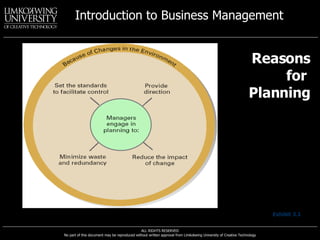
Reasons for  Planning Exhibit 3.1
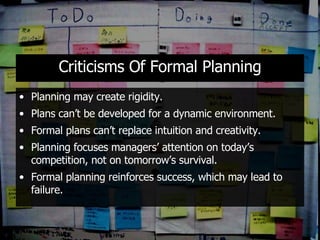
Criticisms Of Formal Planning Planning may create rigidity. Plans can’t be developed for a dynamic environment. Formal plans can’t replace intuition and creativity. Planning focuses managers’ attention on today’s competition, not on tomorrow’s survival. Formal planning reinforces success, which may lead to failure.
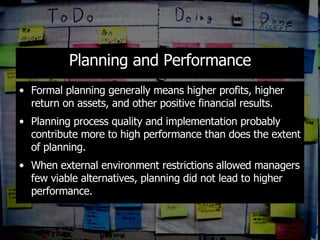
Planning and Performance Formal planning generally means higher profits, higher return on assets, and other positive financial results. Planning process quality and implementation probably contribute more to high performance than does the extent of planning. When external environment restrictions allowed managers few viable alternatives, planning did not lead to higher performance.
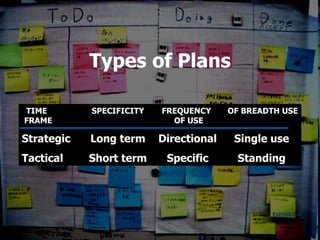
Types of Plans Exhibit 3.2 TIME  SPECIFICITY FREQUENCY   OF BREADTH USE  FRAME   OF USE Strategic Long term Directional Single use Tactical Short term Specific Standing
Planning: Focus and Time  Strategic  plans Plans that are organization-wide, establish overall objectives, and position an organization in terms of its environment Tactical  plans Plans that specify the details of how an organization’s overall objectives are to be achieved Short-term  plans Plans that cover less than one year Long-term  plans Plans that extend beyond five years
Strategic Planning Strategic plans  Apply broadly to the entire organization. Establish the organization’s overall objectives. Seek to position the organization in terms of its environment.  Provide direction to drive an organization’s efforts to achieve its goals. Serve as the basis for the tactical plans. Cover extended periods of time. Are less specific in their details.
Tactical Planning Tactical plans (operational plans) Apply to specific parts of the organization. Are derived from strategic objectives. Specify the details of how the overall objectives are to be achieved. Cover shorter periods of time. Must be updated continuously to meet current challenges.
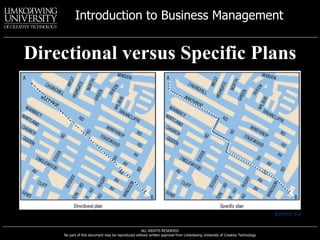
Directional versus Specific Plans Exhibit 3.3
Specific and Directional Plans Specific  plans Plans that have clearly defined objectives and leave no room for misinterpretation. “ What, when, where, how much, and by whom” (process-focus) Directional  plans Flexible plans that set out general guidelines. “ Go from here to there” (outcome-focus)
Single-Use and Standing Plans Single-use plans A plan that is used to meet the needs of a particular or unique situation Single-day sales advertisement Standing plan A plan that is ongoing and provides guidance for repeatedly performed actions in an organization Customer satisfaction policy
Management by Objectives Management by Objectives (MBO) A system in which specific performance objectives are jointly determined by subordinates and their supervisors, progress toward objectives is periodically reviewed, and rewards are allocated on the basis of that progress. Links individual and unit performance objectives at all levels with overall organizational objectives. Focuses operational efforts on organizationally important results. Motivates rather than controls.
Elements of MBO Goal specificity Participative decision making Explicit time period for performance Performance feedback
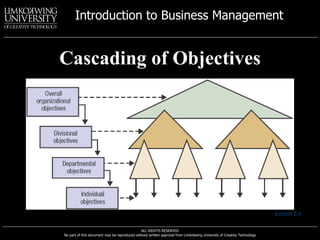
Cascading of Objectives Exhibit 3.4
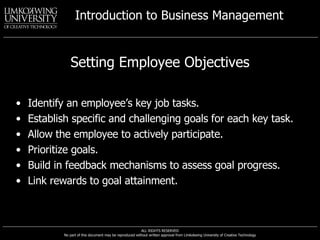
Setting Employee Objectives Identify an employee’s key job tasks. Establish specific and challenging goals for each key task. Allow the employee to actively participate. Prioritize goals. Build in feedback mechanisms to assess goal progress. Link rewards to goal attainment.
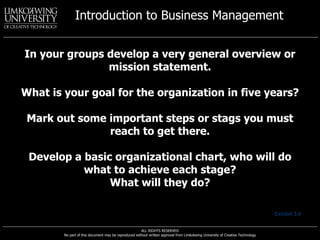
In your groups develop a very general overview or mission statement. What is your goal for the organization in five years? Mark out some important steps or stags you must reach to get there. Develop a basic organizational chart, who will do what to achieve each stage? What will they do? Exhibit 3.4
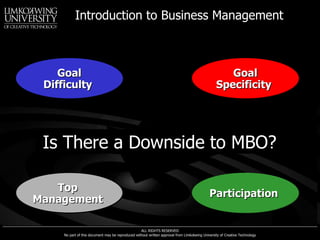
Goal Difficulty   Is There a Downside to MBO? Goal Specificity   Top  Management   Participation
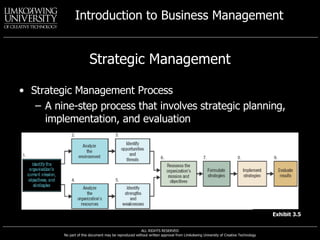
Strategic Management Strategic Management Process A nine-step process that involves strategic planning, implementation, and evaluation Exhibit 3.5
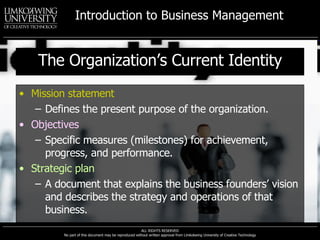
The Organization’s Current Identity Mission statement Defines the present purpose of the organization. Objectives Specific measures (milestones) for achievement, progress, and performance. Strategic plan A document that explains the business founders’ vision and describes the strategy and operations of that business.
Analyze the Environment Environmental scanning Screening large amounts of information to detect emerging trends and create a set of scenarios Competitive intelligence Accurate information about competitors that allows managers to anticipate competitors’ actions rather than merely react to them
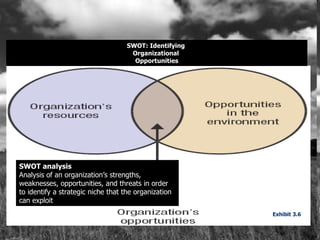
SWOT: Identifying  Organizational  Opportunities SWOT analysis Analysis of an organization’s strengths, weaknesses, opportunities, and threats in order to identify a strategic niche that the organization can exploit Exhibit 3.6
SWOT Analysis Strengths (strategic) Internal resources that are available or things that an organization does well. Core competency: a unique skill or resource that represents a competitive edge. Weaknesses Resources that an organization lacks or activities that it does not do well. Opportunities (strategic) Positive external environmental factors. Threats Negative external environmental factors.
Grand Strategies Growth strategy A strategy in which an organization attempts to increase the level of its operations.  Stability strategy A strategy that is characterized by an absence of significant change. Retrenchment strategy A strategy characteristic of a company that is reducing its size, usually in an environment of decline. Combination strategy The simultaneous pursuit by an organization of two or more of growth, stability, and retrenchment strategies.
Growth Strategies Direct Expansion Involves increasing a company’s size, revenues, operation, or workforce. Merger Occurs when two companies, usually of similar size, combine their resources to form a new company. Acquisition Occurs when a larger company  buys a smaller one and incorporates  the acquired company’s operations  into its own.
Competitive Strategies Strategies that position an organization in such a way that it will have a distinct advantage over its competition: Cost-leadership strategy Becoming the lowest-cost producer in an industry. Differentiation strategy Attempting to be unique in an industry within a broad market. Focus strategy Attempting to establish an advantage (such as cost or differentiation) in a narrow market segment.
Sustaining a Competitive Advantage Competitive advantage counts for little if it cannot be sustained over the long-term. Factors reducing competitive advantage Evolutionary changes in the industry Technological changes Customer preferences Imitation by competitors Defending competitive advantage Patents, copyrights, trademarks, regulations, and tariffs Competing on price Long-term contracts with suppliers (and customers)
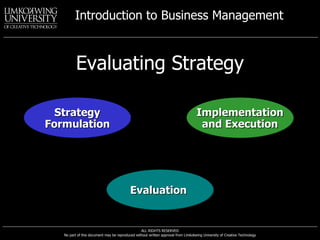
Evaluating Strategy Strategy Formulation Evaluation   Implementation and Execution
Quality as a Strategic Weapon Benchmarking The search for the best practices among competitors or noncompetitors that lead to their superior performance. ISO 9000 series Standards designed by the International Organization for Standardization (ISO) that reflect a process whereby independent auditors attest that a company’s factory, laboratory, or office has met quality management requirements.
Attaining Six Sigma Quality Six Sigma A philosophy and measurement process developed in the 1980s at Motorola. To design, measure, analyze, and control the input side of a production process to achieve the goal of no more than 3.4 defects per million parts or procedures. A philosophy and measurement process that attempts to design in quality as a product is being made.
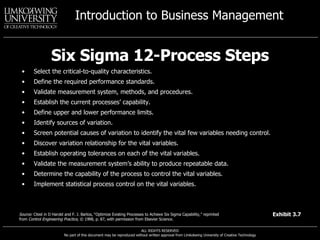
Six Sigma 12-Process Steps Select the critical-to-quality characteristics. Define the required performance standards. Validate measurement system, methods, and procedures. Establish the current processes’ capability. Define upper and lower performance limits. Identify sources of variation. Screen potential causes of variation to identify the vital few variables needing control. Discover variation relationship for the vital variables. Establish operating tolerances on each of the vital variables. Validate the measurement system’s ability to produce repeatable data. Determine the capability of the process to control the vital variables. Implement statistical process control on the vital variables. Exhibit 3.7 Source:  Cited in D Harold and F. J. Bartos, “Optimize Existing Processes to Achieve Six Sigma Capability,” reprinted from  Control Engineering Practice , © 1998, p. 87, with permission from Elsevier Science.
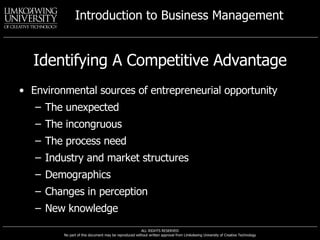
Identifying A Competitive Advantage Environmental sources of entrepreneurial opportunity The unexpected The incongruous The process need Industry and market structures Demographics Changes in perception New knowledge

Day3

  • 1.
  • 2.
    Learning Outcomes After this class, I will be able to:
  • 3.
    1. Define planning .
  • 4.
    2. Explain thepotential benefits of planning.
  • 5.
    3. Identify potential drawbacks to planning.
  • 6.
    4. Recognize when directional plans are preferred over specific plans.
  • 7.
    5. Distinguish between strategic and tactical plans.
  • 8.
    6. Define management by objectives (MBO) and identify its common elements.
  • 9.
    7. Outline the steps in the strategic management process.
  • 10.
    8. Describe the four grand strategies.
  • 11.
    9. Identify which work/life concepts are affecting employees.
  • 12.
    10 Explain whymany corporations in the west have downsized.
  • 13.
    10. Explain SWOT analysis.
  • 14.
    11. Describe howentrepreneurs identify a competitive advantage .
  • 15.
    Planning Defined Definingthe organization’s objectives or goals Establishing an overall strategy for achieving those goals Developing a comprehensive hierarchy of plans to integrate and coordinate activities Planning is concerned with ends (what is to be done) as well as with means (how it is to be done).
  • 16.
    Reasons for Planning Exhibit 3.1
  • 17.
    Criticisms Of FormalPlanning Planning may create rigidity. Plans can’t be developed for a dynamic environment. Formal plans can’t replace intuition and creativity. Planning focuses managers’ attention on today’s competition, not on tomorrow’s survival. Formal planning reinforces success, which may lead to failure.
  • 18.
    Planning and PerformanceFormal planning generally means higher profits, higher return on assets, and other positive financial results. Planning process quality and implementation probably contribute more to high performance than does the extent of planning. When external environment restrictions allowed managers few viable alternatives, planning did not lead to higher performance.
  • 19.
    Types of PlansExhibit 3.2 TIME SPECIFICITY FREQUENCY OF BREADTH USE FRAME OF USE Strategic Long term Directional Single use Tactical Short term Specific Standing
  • 20.
    Planning: Focus andTime Strategic plans Plans that are organization-wide, establish overall objectives, and position an organization in terms of its environment Tactical plans Plans that specify the details of how an organization’s overall objectives are to be achieved Short-term plans Plans that cover less than one year Long-term plans Plans that extend beyond five years
  • 21.
    Strategic Planning Strategicplans Apply broadly to the entire organization. Establish the organization’s overall objectives. Seek to position the organization in terms of its environment. Provide direction to drive an organization’s efforts to achieve its goals. Serve as the basis for the tactical plans. Cover extended periods of time. Are less specific in their details.
  • 22.
    Tactical Planning Tacticalplans (operational plans) Apply to specific parts of the organization. Are derived from strategic objectives. Specify the details of how the overall objectives are to be achieved. Cover shorter periods of time. Must be updated continuously to meet current challenges.
  • 23.
    Directional versus SpecificPlans Exhibit 3.3
  • 24.
    Specific and DirectionalPlans Specific plans Plans that have clearly defined objectives and leave no room for misinterpretation. “ What, when, where, how much, and by whom” (process-focus) Directional plans Flexible plans that set out general guidelines. “ Go from here to there” (outcome-focus)
  • 25.
    Single-Use and StandingPlans Single-use plans A plan that is used to meet the needs of a particular or unique situation Single-day sales advertisement Standing plan A plan that is ongoing and provides guidance for repeatedly performed actions in an organization Customer satisfaction policy
  • 26.
    Management by ObjectivesManagement by Objectives (MBO) A system in which specific performance objectives are jointly determined by subordinates and their supervisors, progress toward objectives is periodically reviewed, and rewards are allocated on the basis of that progress. Links individual and unit performance objectives at all levels with overall organizational objectives. Focuses operational efforts on organizationally important results. Motivates rather than controls.
  • 27.
    Elements of MBOGoal specificity Participative decision making Explicit time period for performance Performance feedback
  • 28.
  • 29.
    Setting Employee ObjectivesIdentify an employee’s key job tasks. Establish specific and challenging goals for each key task. Allow the employee to actively participate. Prioritize goals. Build in feedback mechanisms to assess goal progress. Link rewards to goal attainment.
  • 30.
    In your groupsdevelop a very general overview or mission statement. What is your goal for the organization in five years? Mark out some important steps or stags you must reach to get there. Develop a basic organizational chart, who will do what to achieve each stage? What will they do? Exhibit 3.4
  • 31.
    Goal Difficulty Is There a Downside to MBO? Goal Specificity Top Management Participation
  • 32.
    Strategic Management StrategicManagement Process A nine-step process that involves strategic planning, implementation, and evaluation Exhibit 3.5
  • 33.
    The Organization’s CurrentIdentity Mission statement Defines the present purpose of the organization. Objectives Specific measures (milestones) for achievement, progress, and performance. Strategic plan A document that explains the business founders’ vision and describes the strategy and operations of that business.
  • 34.
    Analyze the EnvironmentEnvironmental scanning Screening large amounts of information to detect emerging trends and create a set of scenarios Competitive intelligence Accurate information about competitors that allows managers to anticipate competitors’ actions rather than merely react to them
  • 35.
    SWOT: Identifying Organizational Opportunities SWOT analysis Analysis of an organization’s strengths, weaknesses, opportunities, and threats in order to identify a strategic niche that the organization can exploit Exhibit 3.6
  • 36.
    SWOT Analysis Strengths(strategic) Internal resources that are available or things that an organization does well. Core competency: a unique skill or resource that represents a competitive edge. Weaknesses Resources that an organization lacks or activities that it does not do well. Opportunities (strategic) Positive external environmental factors. Threats Negative external environmental factors.
  • 37.
    Grand Strategies Growthstrategy A strategy in which an organization attempts to increase the level of its operations. Stability strategy A strategy that is characterized by an absence of significant change. Retrenchment strategy A strategy characteristic of a company that is reducing its size, usually in an environment of decline. Combination strategy The simultaneous pursuit by an organization of two or more of growth, stability, and retrenchment strategies.
  • 38.
    Growth Strategies DirectExpansion Involves increasing a company’s size, revenues, operation, or workforce. Merger Occurs when two companies, usually of similar size, combine their resources to form a new company. Acquisition Occurs when a larger company buys a smaller one and incorporates the acquired company’s operations into its own.
  • 39.
    Competitive Strategies Strategiesthat position an organization in such a way that it will have a distinct advantage over its competition: Cost-leadership strategy Becoming the lowest-cost producer in an industry. Differentiation strategy Attempting to be unique in an industry within a broad market. Focus strategy Attempting to establish an advantage (such as cost or differentiation) in a narrow market segment.
  • 40.
    Sustaining a CompetitiveAdvantage Competitive advantage counts for little if it cannot be sustained over the long-term. Factors reducing competitive advantage Evolutionary changes in the industry Technological changes Customer preferences Imitation by competitors Defending competitive advantage Patents, copyrights, trademarks, regulations, and tariffs Competing on price Long-term contracts with suppliers (and customers)
  • 41.
    Evaluating Strategy StrategyFormulation Evaluation Implementation and Execution
  • 42.
    Quality as aStrategic Weapon Benchmarking The search for the best practices among competitors or noncompetitors that lead to their superior performance. ISO 9000 series Standards designed by the International Organization for Standardization (ISO) that reflect a process whereby independent auditors attest that a company’s factory, laboratory, or office has met quality management requirements.
  • 43.
    Attaining Six SigmaQuality Six Sigma A philosophy and measurement process developed in the 1980s at Motorola. To design, measure, analyze, and control the input side of a production process to achieve the goal of no more than 3.4 defects per million parts or procedures. A philosophy and measurement process that attempts to design in quality as a product is being made.
  • 44.
    Six Sigma 12-ProcessSteps Select the critical-to-quality characteristics. Define the required performance standards. Validate measurement system, methods, and procedures. Establish the current processes’ capability. Define upper and lower performance limits. Identify sources of variation. Screen potential causes of variation to identify the vital few variables needing control. Discover variation relationship for the vital variables. Establish operating tolerances on each of the vital variables. Validate the measurement system’s ability to produce repeatable data. Determine the capability of the process to control the vital variables. Implement statistical process control on the vital variables. Exhibit 3.7 Source: Cited in D Harold and F. J. Bartos, “Optimize Existing Processes to Achieve Six Sigma Capability,” reprinted from Control Engineering Practice , © 1998, p. 87, with permission from Elsevier Science.
  • 45.
    Identifying A CompetitiveAdvantage Environmental sources of entrepreneurial opportunity The unexpected The incongruous The process need Industry and market structures Demographics Changes in perception New knowledge