
PLANNING
MPA 207: Planning Process
Jo B. Bitonio, DPA
Socio Economic Development
DEVELOPMENT PLANNING – is basically the act
of choosing. It is deciding in advance the
WHAT, the HOW, the WHEN, and the WHO of
determining goals, policies and plans and
conscious setting of alternative courses of
action, procedures and strategies needed to
achieve the purposes of government (NEDA,
1982)
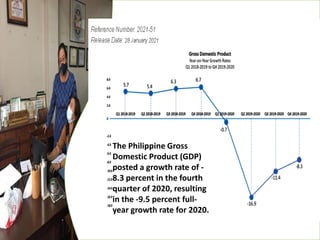
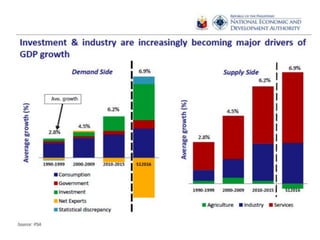
The Philippine Gross
Domestic Product (GDP)
posted a growth rate of -
8.3 percent in the fourth
quarter of 2020, resulting
in the -9.5 percent full-
year growth rate for 2020.
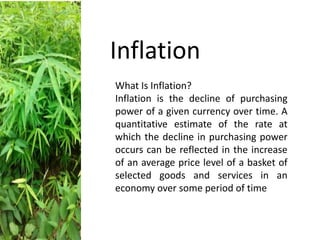
What Is Inflation?
Inflation is the decline of purchasing
power of a given currency over time. A
quantitative estimate of the rate at
which the decline in purchasing power
occurs can be reflected in the increase
of an average price level of a basket of
selected goods and services in an
economy over some period of time
Inflation
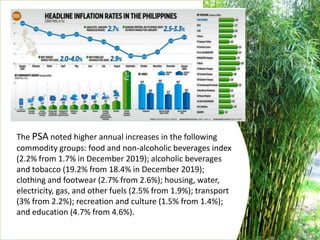
The PSA noted higher annual increases in the following
commodity groups: food and non-alcoholic beverages index
(2.2% from 1.7% in December 2019); alcoholic beverages
and tobacco (19.2% from 18.4% in December 2019);
clothing and footwear (2.7% from 2.6%); housing, water,
electricity, gas, and other fuels (2.5% from 1.9%); transport
(3% from 2.2%); recreation and culture (1.5% from 1.4%);
and education (4.7% from 4.6%).
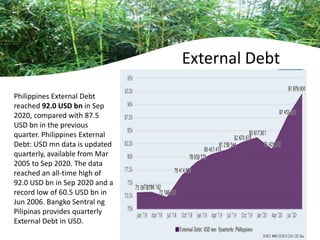
Philippines External Debt
reached 92.0 USD bn in Sep
2020, compared with 87.5
USD bn in the previous
quarter. Philippines External
Debt: USD mn data is updated
quarterly, available from Mar
2005 to Sep 2020. The data
reached an all-time high of
92.0 USD bn in Sep 2020 and a
record low of 60.5 USD bn in
Jun 2006. Bangko Sentral ng
Pilipinas provides quarterly
External Debt in USD.
External Debt
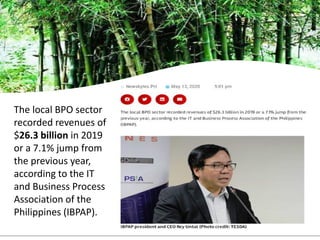
The local BPO sector
recorded revenues of
$26.3 billion in 2019
or a 7.1% jump from
the previous year,
according to the IT
and Business Process
Association of the
Philippines (IBPAP).
Metro Manila (CNN Philippines,
January 12) — The number of foreign
visitors who arrived in the country
plummeted by 83.7% last year amid
coronavirus restrictions, the
Department of Tourism said on
Tuesday
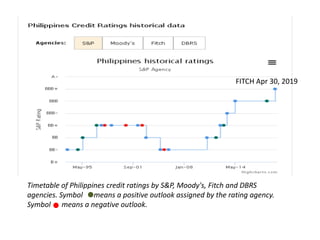
Timetable of Philippines credit ratings by S&P, Moody's, Fitch and DBRS
agencies. Symbol means a positive outlook assigned by the rating agency.
Symbol means a negative outlook.
FITCH Apr 30, 2019
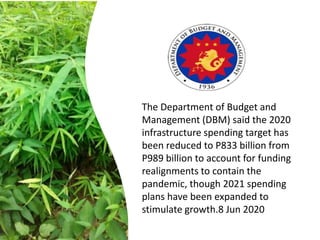
The Department of Budget and
Management (DBM) said the 2020
infrastructure spending target has
been reduced to P833 billion from
P989 billion to account for funding
realignments to contain the
pandemic, though 2021 spending
plans have been expanded to
stimulate growth.8 Jun 2020
Poorest Provinces:
1. Lanao del Sur (ARMM) 74.3%
2. Sulu 65.7%
3. Sarangani 61.7%
4. Northern Samar 61.6%
5. Manguindanao (ARMM)
59.4%
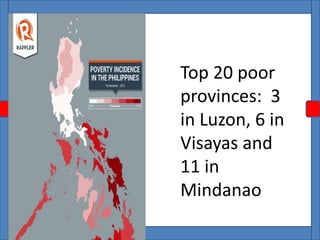
Top 20 poor
provinces: 3
in Luzon, 6 in
Visayas and
11 in
Mindanao
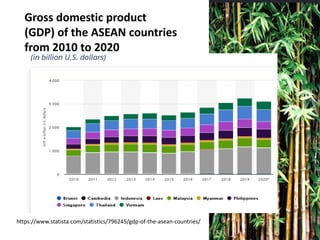
Gross domestic product
(GDP) of the ASEAN countries
from 2010 to 2020
https://www.statista.com/statistics/796245/gdp-of-the-asean-countries/
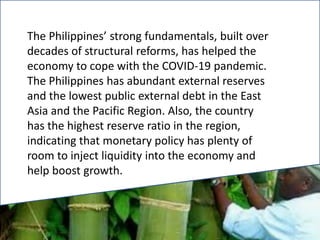
The Philippines’ strong fundamentals, built over
decades of structural reforms, has helped the
economy to cope with the COVID-19 pandemic.
The Philippines has abundant external reserves
and the lowest public external debt in the East
Asia and the Pacific Region. Also, the country
has the highest reserve ratio in the region,
indicating that monetary policy has plenty of
room to inject liquidity into the economy and
help boost growth.
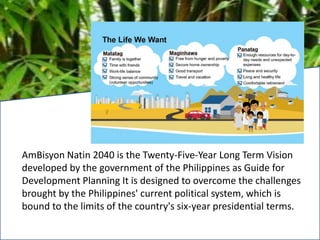
AmBisyon Natin 2040 is the Twenty-Five-Year Long Term Vision
developed by the government of the Philippines as Guide for
Development Planning It is designed to overcome the challenges
brought by the Philippines' current political system, which is
bound to the limits of the country's six-year presidential terms.
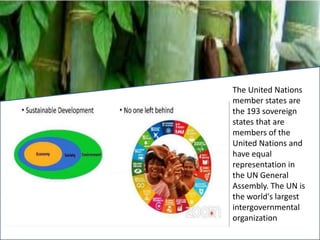
The United Nations
member states are
the 193 sovereign
states that are
members of the
United Nations and
have equal
representation in
the UN General
Assembly. The UN is
the world's largest
intergovernmental
organization
Theories of
Planning
Planning as a human and professional
activity and an area of academic
inquiry lacks disciplinary focus
• Planning, just like her mother PA, has
no intellectual turf of its own. Each is
like a moon which borrows its light
from the sun and stars
• Thus, its heavy reliance from multiple
disciplines makes planning an easy
target for question and debate
H. Simon (1969) describes it as an
“artificial” science
Wildavsky (1973) observes: “If
planning is everything, maybe it is
nothing”
S.J. Klees (1986) argues that “it is
technocratic cultism and political
curtailment of individual freedom”
D. Adams (1991) – “Planning s a
quasi-science that incorporates
the latest developments in the
information technology and
administrative sciences, the
insights of the social science
disciplines, and the design
capabilities of engineering
profession
Planning is a process for
accomplishing purpose.
•It is blue print of business growth
and a road map of development.
•It helps in deciding objectives both
in quantitative and qualitative
terms.
•It is setting of goals on the basis of
objectives and keeping in view the
resources
In spite of new and powerful
technology capable of
analyzing vast amounts of
data, determining trends, and
modeling alternative futures,
planning suffers from identity,
theory and utility
Four Major Intellectual
Traditions in Planning
Theory
According to Adams (1991) these are:
1. Philosophical synthesis
2. Rationalism
3. Organizational Development (OD)
4. Empericism
PHILOSOPHICAL SYNTHESIS –
tends to emphasize a broad aspect
to planning which seek insights
into social, economic, and ethical
conditions as well as
environmental context of the
institution or sector for which
planning is being undertaken
RATIONALISM models of
planning assume a
sequential, observable,
cycle that includes setting
of goals, determining
objectives, making plans,
implementing the plans,
and reviewing the results
ORGANIZATIONAL DEVELOPMENT – focuses
primarily on ways to achieve organizational
change. It includes a human relations approach
to innovation and change in management style,
employee satisfaction, decision-making process.
And the general health of the organization
EMPERICISM –
recognizes the
significance of system
behavior studies by
public administrators,
economists and other
social scientists
concerned with
planning theory
Concepts
BUSINESS PLANNING
•1922 – Harvard Dean Wallace Donham made the argument that
unless businesses systematized decision-making practices, they
were not much from gambling efforts
•1960s-’70s – Harvard Business Review had indicated its interest
articles on long-range strategic planning (N. Capon et al., 1987)
•1976 Lorange and Vancil viewed strategic planning (SP) as a single process
whereby managers must agree on a detailed integrated plan of action for the
coming year starting with the delineation of corporate objectives and
concluding with one-or two-year profit plan
•Further, they identified six processes that top management has to deal
with:
a) communicating corporate goals,
b) developing the goal setting process,
c) scanning the environment,
d) understanding the subordinate-manager focus
e) developing the planner’s role, and
f) developing the link between planning and budgeting
•1974 defines SP as the continuous process of
making entrepreneurial decisions systematically and
with the greatest knowledge of their futurity,
organizing systematically the efforts needed to carry
out these decisions and measuring the results of
these decisions against expectations through
organized feedback (Peter Drucker).
•1981 in the perspective of education and social
development, SP is perceived as a set of purposeful
actions influencing and organization or some part
therein to effect change (K.C. Tanner and E.J.
Williams)
•1984 SP is viewed as the effective application of the
best alternative information to decisions that have to
be made now to ensure a secure future (G.S. Day)
•1994 SP is viewed as a long-term planning to achieve
a preferred vision for an organization, school or school
district. It defines the WHATS to be achieved
• SP as a dynamic process which scans
current realities and opportunities in
order to yield useful strategies and tactics
for arriving a better tomorrow.
• It is not a linear, lock-step process derived
or implemented in an authoritarian
manner. Nor it is intuitive or built on
hunches and raw feelings.
• It involves the educational partners in
defining and supporting the purposes and
missions and its provides blueprints for
result-oriented program ( R.A. Kaufman,
1972, 1988 R.A. Kaufman and J. Herman,
1991, R.A. Kaufman, J. Herman and K.
Watters, 1996)
• It appears that no single definition has been
able to capture all facets of contemporary SP
practices despite the array of disciplinary
perspective. Six common distinguishing features,
however, shape the acceptable meaning:
1. external orientation,
2. a holistic or systematic approach,
3. a process of formulating plan,
objectives, strategies and programs,
4. use of systematic methods in the
analysis of strategic situation and
alternatives,
5. commitment to actions, and
6. a knowledge of results
Rationale of Strategic Planning
• To reorient the organization to the needs of
the community in order to foster relevant and
quality service
• As we plan for expansion, a certain level of
minimum standard to be observed to
guarantee a certain level of minimum quality
performance
• Effective SP efforts make the organization become
more viable instrument of socio-economic
development of the nation
• Since resources for sectoral services are irreversibly
becoming less, priorities have to be established
The galloping inundation and explosion of a new
knowledge and the emergence of new technologies as
brought about by advances in science and ICT.
• SP means realistic forecasting of events and in
exercise “futurology”
Deep Diving Analysis
Public servants are champions
of change working closely
with society
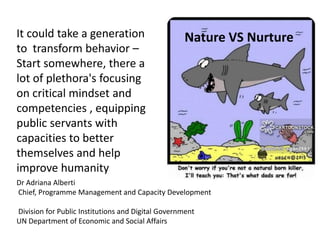
Dr Adriana Alberti
Chief, Programme Management and Capacity Development
Division for Public Institutions and Digital Government
UN Department of Economic and Social Affairs
Nature VS Nurture
It could take a generation
to transform behavior –
Start somewhere, there a
lot of plethora's focusing
on critical mindset and
competencies , equipping
public servants with
capacities to better
themselves and help
improve humanity
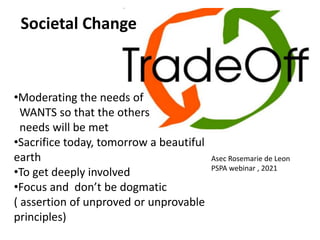
•Moderating the needs of
WANTS so that the others
needs will be met
•Sacrifice today, tomorrow a beautiful
earth
•To get deeply involved
•Focus and don’t be dogmatic
( assertion of unproved or unprovable
principles)
Asec Rosemarie de Leon
PSPA webinar , 2021
Societal Change
You play an important role . . .

MPA 207

  • 1.
    PLANNING MPA 207: PlanningProcess Jo B. Bitonio, DPA
  • 2.
    Socio Economic Development DEVELOPMENTPLANNING – is basically the act of choosing. It is deciding in advance the WHAT, the HOW, the WHEN, and the WHO of determining goals, policies and plans and conscious setting of alternative courses of action, procedures and strategies needed to achieve the purposes of government (NEDA, 1982)
  • 4.
    The Philippine Gross DomesticProduct (GDP) posted a growth rate of - 8.3 percent in the fourth quarter of 2020, resulting in the -9.5 percent full- year growth rate for 2020.
  • 6.
    What Is Inflation? Inflationis the decline of purchasing power of a given currency over time. A quantitative estimate of the rate at which the decline in purchasing power occurs can be reflected in the increase of an average price level of a basket of selected goods and services in an economy over some period of time Inflation
  • 7.
    The PSA notedhigher annual increases in the following commodity groups: food and non-alcoholic beverages index (2.2% from 1.7% in December 2019); alcoholic beverages and tobacco (19.2% from 18.4% in December 2019); clothing and footwear (2.7% from 2.6%); housing, water, electricity, gas, and other fuels (2.5% from 1.9%); transport (3% from 2.2%); recreation and culture (1.5% from 1.4%); and education (4.7% from 4.6%).
  • 8.
    Philippines External Debt reached92.0 USD bn in Sep 2020, compared with 87.5 USD bn in the previous quarter. Philippines External Debt: USD mn data is updated quarterly, available from Mar 2005 to Sep 2020. The data reached an all-time high of 92.0 USD bn in Sep 2020 and a record low of 60.5 USD bn in Jun 2006. Bangko Sentral ng Pilipinas provides quarterly External Debt in USD. External Debt
  • 10.
    The local BPOsector recorded revenues of $26.3 billion in 2019 or a 7.1% jump from the previous year, according to the IT and Business Process Association of the Philippines (IBPAP).
  • 11.
    Metro Manila (CNNPhilippines, January 12) — The number of foreign visitors who arrived in the country plummeted by 83.7% last year amid coronavirus restrictions, the Department of Tourism said on Tuesday
  • 12.
    Timetable of Philippinescredit ratings by S&P, Moody's, Fitch and DBRS agencies. Symbol means a positive outlook assigned by the rating agency. Symbol means a negative outlook. FITCH Apr 30, 2019
  • 13.
    The Department ofBudget and Management (DBM) said the 2020 infrastructure spending target has been reduced to P833 billion from P989 billion to account for funding realignments to contain the pandemic, though 2021 spending plans have been expanded to stimulate growth.8 Jun 2020
  • 15.
    Poorest Provinces: 1. Lanaodel Sur (ARMM) 74.3% 2. Sulu 65.7% 3. Sarangani 61.7% 4. Northern Samar 61.6% 5. Manguindanao (ARMM) 59.4%
  • 16.
    Top 20 poor provinces:3 in Luzon, 6 in Visayas and 11 in Mindanao
  • 17.
    Gross domestic product (GDP)of the ASEAN countries from 2010 to 2020 https://www.statista.com/statistics/796245/gdp-of-the-asean-countries/
  • 18.
    The Philippines’ strongfundamentals, built over decades of structural reforms, has helped the economy to cope with the COVID-19 pandemic. The Philippines has abundant external reserves and the lowest public external debt in the East Asia and the Pacific Region. Also, the country has the highest reserve ratio in the region, indicating that monetary policy has plenty of room to inject liquidity into the economy and help boost growth.
  • 19.
    AmBisyon Natin 2040is the Twenty-Five-Year Long Term Vision developed by the government of the Philippines as Guide for Development Planning It is designed to overcome the challenges brought by the Philippines' current political system, which is bound to the limits of the country's six-year presidential terms.
  • 20.
    The United Nations memberstates are the 193 sovereign states that are members of the United Nations and have equal representation in the UN General Assembly. The UN is the world's largest intergovernmental organization
  • 21.
  • 22.
    Planning as ahuman and professional activity and an area of academic inquiry lacks disciplinary focus • Planning, just like her mother PA, has no intellectual turf of its own. Each is like a moon which borrows its light from the sun and stars • Thus, its heavy reliance from multiple disciplines makes planning an easy target for question and debate
  • 23.
    H. Simon (1969)describes it as an “artificial” science Wildavsky (1973) observes: “If planning is everything, maybe it is nothing” S.J. Klees (1986) argues that “it is technocratic cultism and political curtailment of individual freedom”
  • 24.
    D. Adams (1991)– “Planning s a quasi-science that incorporates the latest developments in the information technology and administrative sciences, the insights of the social science disciplines, and the design capabilities of engineering profession
  • 25.
    Planning is aprocess for accomplishing purpose. •It is blue print of business growth and a road map of development. •It helps in deciding objectives both in quantitative and qualitative terms. •It is setting of goals on the basis of objectives and keeping in view the resources
  • 26.
    In spite ofnew and powerful technology capable of analyzing vast amounts of data, determining trends, and modeling alternative futures, planning suffers from identity, theory and utility
  • 27.
    Four Major Intellectual Traditionsin Planning Theory According to Adams (1991) these are: 1. Philosophical synthesis 2. Rationalism 3. Organizational Development (OD) 4. Empericism
  • 28.
    PHILOSOPHICAL SYNTHESIS – tendsto emphasize a broad aspect to planning which seek insights into social, economic, and ethical conditions as well as environmental context of the institution or sector for which planning is being undertaken
  • 29.
    RATIONALISM models of planningassume a sequential, observable, cycle that includes setting of goals, determining objectives, making plans, implementing the plans, and reviewing the results
  • 30.
    ORGANIZATIONAL DEVELOPMENT –focuses primarily on ways to achieve organizational change. It includes a human relations approach to innovation and change in management style, employee satisfaction, decision-making process. And the general health of the organization
  • 31.
    EMPERICISM – recognizes the significanceof system behavior studies by public administrators, economists and other social scientists concerned with planning theory
  • 32.
    Concepts BUSINESS PLANNING •1922 –Harvard Dean Wallace Donham made the argument that unless businesses systematized decision-making practices, they were not much from gambling efforts •1960s-’70s – Harvard Business Review had indicated its interest articles on long-range strategic planning (N. Capon et al., 1987)
  • 33.
    •1976 Lorange andVancil viewed strategic planning (SP) as a single process whereby managers must agree on a detailed integrated plan of action for the coming year starting with the delineation of corporate objectives and concluding with one-or two-year profit plan •Further, they identified six processes that top management has to deal with: a) communicating corporate goals, b) developing the goal setting process, c) scanning the environment, d) understanding the subordinate-manager focus e) developing the planner’s role, and f) developing the link between planning and budgeting
  • 34.
    •1974 defines SPas the continuous process of making entrepreneurial decisions systematically and with the greatest knowledge of their futurity, organizing systematically the efforts needed to carry out these decisions and measuring the results of these decisions against expectations through organized feedback (Peter Drucker). •1981 in the perspective of education and social development, SP is perceived as a set of purposeful actions influencing and organization or some part therein to effect change (K.C. Tanner and E.J. Williams)
  • 35.
    •1984 SP isviewed as the effective application of the best alternative information to decisions that have to be made now to ensure a secure future (G.S. Day) •1994 SP is viewed as a long-term planning to achieve a preferred vision for an organization, school or school district. It defines the WHATS to be achieved
  • 36.
    • SP asa dynamic process which scans current realities and opportunities in order to yield useful strategies and tactics for arriving a better tomorrow. • It is not a linear, lock-step process derived or implemented in an authoritarian manner. Nor it is intuitive or built on hunches and raw feelings. • It involves the educational partners in defining and supporting the purposes and missions and its provides blueprints for result-oriented program ( R.A. Kaufman, 1972, 1988 R.A. Kaufman and J. Herman, 1991, R.A. Kaufman, J. Herman and K. Watters, 1996)
  • 37.
    • It appearsthat no single definition has been able to capture all facets of contemporary SP practices despite the array of disciplinary perspective. Six common distinguishing features, however, shape the acceptable meaning: 1. external orientation, 2. a holistic or systematic approach, 3. a process of formulating plan, objectives, strategies and programs, 4. use of systematic methods in the analysis of strategic situation and alternatives, 5. commitment to actions, and 6. a knowledge of results
  • 38.
    Rationale of StrategicPlanning • To reorient the organization to the needs of the community in order to foster relevant and quality service • As we plan for expansion, a certain level of minimum standard to be observed to guarantee a certain level of minimum quality performance
  • 39.
    • Effective SPefforts make the organization become more viable instrument of socio-economic development of the nation • Since resources for sectoral services are irreversibly becoming less, priorities have to be established The galloping inundation and explosion of a new knowledge and the emergence of new technologies as brought about by advances in science and ICT.
  • 40.
    • SP meansrealistic forecasting of events and in exercise “futurology”
  • 41.
    Deep Diving Analysis Publicservants are champions of change working closely with society
  • 42.
    Dr Adriana Alberti Chief,Programme Management and Capacity Development Division for Public Institutions and Digital Government UN Department of Economic and Social Affairs Nature VS Nurture It could take a generation to transform behavior – Start somewhere, there a lot of plethora's focusing on critical mindset and competencies , equipping public servants with capacities to better themselves and help improve humanity
  • 43.
    •Moderating the needsof WANTS so that the others needs will be met •Sacrifice today, tomorrow a beautiful earth •To get deeply involved •Focus and don’t be dogmatic ( assertion of unproved or unprovable principles) Asec Rosemarie de Leon PSPA webinar , 2021 Societal Change
  • 44.
    You play animportant role . . .