McGraw-Hill/Irwin © 2007 The McGraw-Hill Companies, Inc. All rights reserved.
6
Chapter Title
15/e PPT
Supplementing
the Chosen
Competitive
Strategy
Screen graphics created by:
Jana F. Kuzmicki, Ph.D.
Troy University-Florida Region
6-2
“Successful business
strategy is about actively
shaping the game you play,
not just playing the game
you find.”
Adam M. Brandenburger and Barry J. Nalebuff
6-3
“The sure path to
oblivion is to stay
where you are.”
Bernard Fauber
6-4
Chapter Roadmap
 Collaborative Strategies: Alliances and Partnerships
 Merger and Acquisition Strategies
 Vertical Integration Strategies: Operating Across More
Stages of the Industry Value Chain
 Outsourcing Strategies: Narrowing the Boundaries of the
Business
 Offensive Strategies: Improving Market Position and
Building Competitive Advantage
 Defensive Strategies: Protecting Market Position and
Competitive Advantage
 Web Site Strategies
 Choosing Appropriate Functional-Area Strategies
 First-Mover Advantages and Disadvantages
6-5
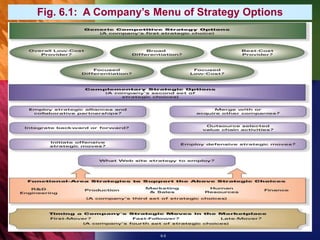
Fig. 6.1: A Company’s Menu of Strategy Options
6-6
Companies sometimes use
strategic alliances or
collaborative partnerships to
complement their own strategic
initiatives and strengthen their
competitiveness. Such
cooperative strategies go beyond
normal company-to-company
dealings but fall short of merger
or full joint venture partnership.
Collaborative Strategies:
Alliances and Partnerships
6-7
Alliances Can Enhance a
Firm’s Competitiveness
 Alliances and partnerships can help companies
cope with two demanding competitive challenges
 Racing against rivals to build a
market presence in many
different national markets
 Racing against rivals to seize
opportunities on the frontiers
of advancing technology
 Collaborative arrangements can help a company
lower its costs and/or gain access to needed
expertise and capabilities
6-8
Characteristics of a Strategic Alliance
 Strategic alliance – A formal agreement between two or
more separate companies where there is
 Strategically relevant collaboration of some sort
 Joint contribution of resources
 Shared risk
 Shared control
 Mutual dependence
 Alliances often involve
 Joint marketing
 Joint sales or distribution
 Joint production
 Design collaboration
 Joint research
 Projects to jointly develop new technologies or products
6-9
What Factors Make an Alliance Strategic?
 It is critical to a company’s achievement of an
important objective
 It helps build, sustain, or enhance a core
competence or competitive advantage
 It helps block a competitive threat
 It helps open up important
market opportunities
 It mitigates a significant risk
to a company’s business
6-10
 To collaborate on technology development or new
product development
 To fill gaps in technical or manufacturing expertise
 To create new skill sets and capabilities
 To improve supply chain efficiency
 To gain economies of scale in
production and/or marketing
 To acquire or improve market access
via joint marketing agreements
Why Are Strategic Alliances Formed?
6-11
 Get into critical country markets quickly to accelerate
process of building a global presence
 Gain inside knowledge about unfamiliar markets and
cultures
 Access valuable skills and competencies concentrated
in particular geographic locations
 Establish a beachhead to participate in target industry
 Master new technologies and build new expertise faster
than would be possible internally
 Open up expanded opportunities in target industry by
combining firm’s capabilities with resources of partners
Potential Benefits of Alliances to
Achieve Global and Industry Leadership
6-12
Capturing the Benefits
of Strategic Alliances
 Benefits from forming partnerships are a function of
 Picking a good partner
 Being sensitive to cultural differences
 Recognizing an alliance
must benefit both parties
 Ensuring both parties live
up to their commitments
 Structuring the decision-making process
so actions can be taken swiftly when needed
 Managing the learning process and then adjusting the
alliance agreement over time to fit new circumstances
6-13
Why Alliances Fail
 Ability of an alliance to endure depends on
 How well partners work together
 Success of partners in responding
and adapting to changing conditions
 Willingness of partners to
renegotiate the bargain
 Reasons for alliance failure
 Diverging objectives and priorities of partners
 Inability of partners to work well together
 Changing conditions rendering purpose of alliance obsolete
 Emergence of more attractive technological paths
 Marketplace rivalry between one or more allies
6-14
Test Your Knowledge
Which one of the following is not a factor that makes an
alliance “strategic” as opposed to just a convenient business
arrangement?
A. The alliance involves joint contribution of resources, shared
risk, and is mutually beneficial.
B. The alliance helps block a competitive threat or open up new
market opportunities.
C. The alliance helps mitigate a significant risk to a company’s
business.
D. The alliance helps build, enhance, or sustain a core competence
or competitive advantage.
E. The alliance is critical to the company’s achievement of an
important objective.
6-15
 Merger – Combination and pooling of equals, with
newly created firm often taking on a new name
 Acquisition – One firm, the acquirer, purchases
and absorbs operations of another, the acquired
 Merger-acquisition strategy
 Much-used strategic option
 Especially suited for situations where
alliances do not provide a firm with needed
capabilities or cost-reducing opportunities
 Ownership allows for tightly integrated operations,
creating more control and autonomy than alliances
Merger and Acquisition Strategies
6-16
 To create a more cost-efficient operation
 To expand a firm’s geographic coverage
 To extend a firm’s business into new
product categories or international markets
 To gain quick access to new technologies
or competitive capabilities
 To invent a new industry and lead the
convergence of industries whose boundaries
are blurred by changing technologies and
new market opportunities
Objectives of Mergers and Acquisitions
6-17
 Combining operations may result in
 Resistance from rank-and-file employees
 Hard-to-resolve conflicts in management styles and
corporate cultures
 Tough problems of integration
 Greater-than-anticipated difficulties in
 Achieving expected cost-savings
 Sharing of expertise
 Achieving enhanced competitive capabilities
Pitfalls of Mergers and Acquisitions
6-18
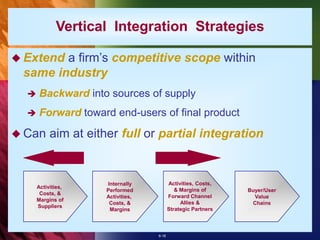
Vertical Integration Strategies
 Extend a firm’s competitive scope within
same industry
 Backward into sources of supply
 Forward toward end-users of final product
 Can aim at either full or partial integration
Internally
Performed
Activities,
Costs, &
Margins
Activities,
Costs, &
Margins of
Suppliers
Buyer/User
Value
Chains
Activities, Costs,
& Margins of
Forward Channel
Allies &
Strategic Partners
6-19
Strategic Advantages
of Backward Integration
 Generates cost savings only if volume needed is
big enough to capture efficiencies of suppliers
 Potential to reduce costs exists when
 Suppliers have sizable profit margins
 Item supplied is a major cost component
 Resource requirements are easily met
 Can produce a differentiation-based competitive
advantage when it results in a better quality part
 Reduces risk of depending on suppliers of crucial
raw materials / parts / components
6-20
Strategic Advantages
of Forward Integration
 To gain better access to end users
and better market visibility
 To compensate for undependable distribution
channels which undermine steady operations
 To offset the lack of a broad product line, a firm
may sell directly to end users
 To bypass regular distribution channels in favor of
direct sales and Internet retailing which may
 Lower distribution costs
 Produce a relative cost advantage over rivals
 Enable lower selling prices to end users
6-21
Strategic Disadvantages
of Vertical Integration
 Boosts resource requirements
 Locks firm deeper into same industry
 Results in fixed sources of supply and
less flexibility in accommodating buyer
demands for product variety
 Poses all types of capacity-matching problems
 May require radically different skills / capabilities
 Reduces flexibility to make changes in component
parts which may lengthen design time and ability to
introduce new products
6-22
 Whether vertical integration is a viable
strategic option depends on its
 Ability to lower cost, build expertise,
increase differentiation, or enhance
performance of strategy-critical activities
 Impact on investment cost, flexibility,
and administrative overhead
 Contribution to enhancing a firm’s competitiveness
Pros and Cons of
Integration vs. De-Integration
Many companies are finding that
de-integrating value chain activities is a
more flexible, economic strategic option!
6-23
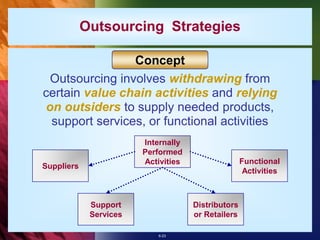
Outsourcing Strategies
Outsourcing involves withdrawing from
certain value chain activities and relying
on outsiders to supply needed products,
support services, or functional activities
Concept
Internally
Performed
Activities
Suppliers
Support
Services
Functional
Activities
Distributors
or Retailers
6-24
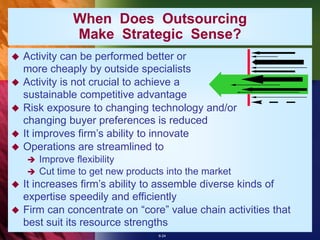
 Activity can be performed better or
more cheaply by outside specialists
 Activity is not crucial to achieve a
sustainable competitive advantage
 Risk exposure to changing technology and/or
changing buyer preferences is reduced
 It improves firm’s ability to innovate
 Operations are streamlined to
 Improve flexibility
 Cut time to get new products into the market
 It increases firm’s ability to assemble diverse kinds of
expertise speedily and efficiently
 Firm can concentrate on “core” value chain activities that
best suit its resource strengths
When Does Outsourcing
Make Strategic Sense?
6-25
 Farming out too many or the wrong activities,
thus
 Hollowing out capabilities
 Losing touch with activities and expertise that
determine overall long-term success
Risk of an Outsourcing Strategy
6-26
Offensive and Defensive Strategies
Used to build new
or stronger market
position and/or create
competitive advantage
Used to protect
competitive advantage
(rarely lead to creating
advantage)
Offensive Strategies Defensive Strategies
6-27
Principles of Offensive Strategies
 Focus relentlessly on
 Building competitive advantage and
 Striving to convert it into decisive advantage
 Employ the element of surprise as
opposed to doing what rivals expect
 Apply resources where rivals are least able to
defend themselves
 Be impatient with the status quo and display a
strong bias for swift, decisive actions to boost a
firm’s competitive position vis-à-vis rivals
6-28
Types of Offensive Strategy Options
1. Offer an equally good or better product at a lower
price
2. Leapfrog competitors by being
 First adopter of next-generation technologies or
 First to market with next-generation products
3. Pursue continuous product innovation
to draw sales and market share away
from less innovative rivals
4. Adopt and improve on the
good ideas of other companies
6-29
Types of Offensive Strategy Options (con’t)
5. Deliberately attack market segments where a key
rival makes big profits
6. Attack competitive weaknesses of rivals
7. Maneuver around competitors and
concentrate on capturing unoccupied
or less contested market territory
8. Use hit-and-run or guerrilla warfare tactics to grab
sales and market share from complacent rivals
9. Launch a preemptive strike to secure an
advantageous position that rivals are prevented
from duplicating
6-30
What Is a Blue Ocean Strategy?
 Seeks to gain a dramatic, durable
competitive advantage by
 Abandoning efforts to beat out
competitors in existing markets and
 Inventing a new industry or distinctive
market segment to render existing
competitors largely irrelevant and
 Allowing a company to create and
capture altogether new demand
6-31
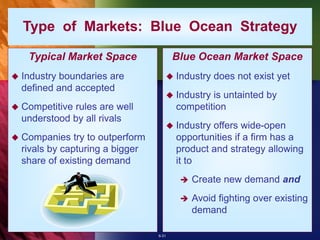
Type of Markets: Blue Ocean Strategy
Typical Market Space
 Industry boundaries are
defined and accepted
 Competitive rules are well
understood by all rivals
 Companies try to outperform
rivals by capturing a bigger
share of existing demand
Blue Ocean Market Space
 Industry does not exist yet
 Industry is untainted by
competition
 Industry offers wide-open
opportunities if a firm has a
product and strategy allowing
it to
 Create new demand and
 Avoid fighting over existing
demand
6-32
For Discussion: Your Opinion
Which of the following is the best example of a blue
ocean strategy — Apple’s entry into MP3 players with
its iPod models or Dell’s entry into LCD TVs or Audi’s
recent move to bring out a luxury SUV? Explain.
6-33
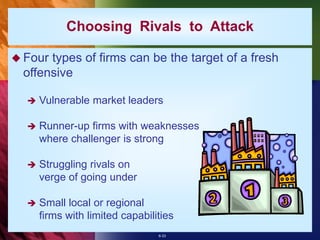
Choosing Rivals to Attack
 Four types of firms can be the target of a fresh
offensive
 Vulnerable market leaders
 Runner-up firms with weaknesses
where challenger is strong
 Struggling rivals on
verge of going under
 Small local or regional
firms with limited capabilities
6-34
Using Offensive Strategy to
Achieve Competitive Advantage
 Strategic offensives offering strongest basis for
competitive advantage entail
 An important core competence
 A unique competitive capability
 A better-known brand name
 A cost advantage in manufacturing
or distribution
 Technological superiority
 A superior product
6-35
Test Your Knowledge
Which one of the following is not a good type of rival for
an offensive-minded company to target?
A. Market leaders that are vulnerable
B. Runner-up firms with weaknesses in areas where the
challenger is strong.
C. Small local and regional companies with limited
capabilities
D. Companies with lower costs and lower prices
E. Struggling enterprises that are on the verge of going
under
6-36
Defensive Strategy
 Lessen risk of being attacked
 Blunt impact of any attack that occurs
 Influence challengers to aim attacks at other rivals
 Block avenues open to challengers
 Signal challengers vigorous
retaliation is likely
Objectives
Approaches
6-37
Block Avenues Open to Challengers
 Participate in alternative technologies
 Introduce new features, add new models, or broaden
product line to close gaps rivals may pursue
 Maintain economy-priced models
 Increase warranty coverage
 Offer free training and support services
 Reduce delivery times for spare parts
 Make early announcements about new
products or price changes
 Challenge quality or safety of rivals’ products
using legal tactics
 Sign exclusive agreements with distributors
6-38
 Publicly announce management’s strong
commitment to maintain present market share
 Publicly commit firm to policy of
matching rivals’ terms or prices
 Maintain war chest of cash reserves
 Make occasional counter-response
to moves of weaker rivals
Signal Challengers Retaliation Is Likely
6-39
Web Site Strategies
 Strategic Challenge – What use of the Internet
should a company make in staking out its position
in the marketplace?
 Five Web site approaches
 Use to disseminate only product information
 Use as minor distribution channel
to sell direct to customers
 Use as one of several important distribution
channels to access customers
 Use as primary distribution channel to access buyers
 Use as exclusive channel to transact sales with
customers
6-40
Using the Internet to
Disseminate Product Information
 Approach – Website used to provide product
information of manufacturers or wholesalers
 Relies on click-throughs to websites of
dealers for sales transactions
 Informs end-users of location of retail stores
 Issues – Pursuing online sales may
 Signal weak strategic commitment to dealers
 Signal willingness to cannibalize dealers’ sales
 Prompt dealers to aggressively market rivals’ brands
 Avoids channel conflict with dealers – Important
where strong support of dealer networks is
essential
6-41
 Approach – Use online sales to
 Achieve incremental sales
 Gain online sales experience
 Conduct marketing research
 Learn more about buyer tastes and preferences
 Test reactions to new products
 Create added market buzz about products
 Unlikely to provoke much outcry from dealers
Using the Internet as a
Minor Distribution Channel
6-42
 Manufacturer’s profit margin from
online sales is bigger than that from
sales through traditional channels
 Encouraging buyers to visit a firm’s
website educates them to the ease
and convenience of purchasing online
 Selling directly to end users allows a
manufacturer to make greater use of
build-to-order manufacturing and assembly
Reasons to Use the Internet
as a Minor Distribution Channel
6-43
 Approach
 Sell directly to consumers and
 Use traditional wholesale/retail channels
 Strategic appeal for wholesalers and retailers
 Economic means of expanding a company’s economic
reach
 Provide both existing and potential customers another
choice of how to
 Communicate with a company
 Shop for product information
 Make purchases
 Resolve customer service problems
Brick-and-Click Strategies:
An Appealing Middle Ground Approach
6-44
 Approach – Use Internet as the exclusive channel for
all buyer-seller contact and transactions
 Strategic issues for an online company
 How to deliver unique value to buyers
 Whether it will pursue competitive advantage based on lower
costs, differentiation, or better value for the money
 Whether it will have a broad or narrow product offering
 Whether to perform order fulfillment activities internally or to
outsource them
 How it will draw traffic to its Web site and then convert page
views into revenues
Strategies for Online Enterprises
6-45
Test Your Knowledge
One very important advantage of a product-information-
only Web site strategy is
A. lower advertising costs.
B. avoiding the extra costs associated with operating Web
site e-stores.
C. avoiding channel conflict—trying to sell online in direct
competition with retail dealers signals both a weak
strategic commitment to dealers and a willingness to
cannibalize dealers’ sales and growth potential.
D. added ability to create a positive image of the company.
E. lower sales force costs.
6-46
For Discussion: Your Opinion
Suppose that you are a retailer of athletic footwear
and one of the major brands you stock in your store is
New Balance. What would be your reaction if you
learned that New Balance announced that it would
soon begin selling its footwear online at the
company’s Web site? What actions would you
consider taking?
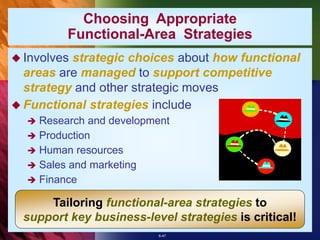
6-47
 Involves strategic choices about how functional
areas are managed to support competitive
strategy and other strategic moves
 Functional strategies include
 Research and development
 Production
 Human resources
 Sales and marketing
 Finance
Tailoring functional-area strategies to
support key business-level strategies is critical!
Choosing Appropriate
Functional-Area Strategies
6-48
 When to make a strategic move is often as crucial
as what move to make
 First-mover advantages arise when
 Pioneering helps build firm’s image and reputation
 Early commitments to new technologies,
new-style components, and distribution
channels can produce cost advantage
 Loyalty of first time buyers is high
 Moving first can be a preemptive strike
First-Mover Advantages
6-49
First-Mover Disadvantages
 Moving early can be a disadvantage (or fail to
produce an advantage) when
 When costs of pioneering are more than being an
imitative follower and only negligible learning/experience
curve benefits accrue to the leader
 Innovator’s products are primitive, not living up to buyer
expectations
 Demand side of the market is skeptical about the
benefits of new technology/product of a first-mover
 Rapid technological change allows followers to leapfrog
pioneers
6-50
Strategic Issues:
To Be a First-Mover or Not
 Key issue – Is the race to market leadership in an
industry a marathon or a sprint?
 Seeking a competitive advantage by being a first-
mover involves addressing several questions
 Does market takeoff depend on development of
complementary products or services not currently available?
 Is new infrastructure required before buyer demand can
surge?
 Will buyers need to learn new skills or adopt new behaviors?
 Will buyers encounter high switching costs?
 Are there influential competitors in a position
to delay or derail the efforts of a first-mover?

Chap006.ppt

  • 1.
    McGraw-Hill/Irwin © 2007The McGraw-Hill Companies, Inc. All rights reserved. 6 Chapter Title 15/e PPT Supplementing the Chosen Competitive Strategy Screen graphics created by: Jana F. Kuzmicki, Ph.D. Troy University-Florida Region
  • 2.
    6-2 “Successful business strategy isabout actively shaping the game you play, not just playing the game you find.” Adam M. Brandenburger and Barry J. Nalebuff
  • 3.
    6-3 “The sure pathto oblivion is to stay where you are.” Bernard Fauber
  • 4.
    6-4 Chapter Roadmap  CollaborativeStrategies: Alliances and Partnerships  Merger and Acquisition Strategies  Vertical Integration Strategies: Operating Across More Stages of the Industry Value Chain  Outsourcing Strategies: Narrowing the Boundaries of the Business  Offensive Strategies: Improving Market Position and Building Competitive Advantage  Defensive Strategies: Protecting Market Position and Competitive Advantage  Web Site Strategies  Choosing Appropriate Functional-Area Strategies  First-Mover Advantages and Disadvantages
  • 5.
    6-5 Fig. 6.1: ACompany’s Menu of Strategy Options
  • 6.
    6-6 Companies sometimes use strategicalliances or collaborative partnerships to complement their own strategic initiatives and strengthen their competitiveness. Such cooperative strategies go beyond normal company-to-company dealings but fall short of merger or full joint venture partnership. Collaborative Strategies: Alliances and Partnerships
  • 7.
    6-7 Alliances Can Enhancea Firm’s Competitiveness  Alliances and partnerships can help companies cope with two demanding competitive challenges  Racing against rivals to build a market presence in many different national markets  Racing against rivals to seize opportunities on the frontiers of advancing technology  Collaborative arrangements can help a company lower its costs and/or gain access to needed expertise and capabilities
  • 8.
    6-8 Characteristics of aStrategic Alliance  Strategic alliance – A formal agreement between two or more separate companies where there is  Strategically relevant collaboration of some sort  Joint contribution of resources  Shared risk  Shared control  Mutual dependence  Alliances often involve  Joint marketing  Joint sales or distribution  Joint production  Design collaboration  Joint research  Projects to jointly develop new technologies or products
  • 9.
    6-9 What Factors Makean Alliance Strategic?  It is critical to a company’s achievement of an important objective  It helps build, sustain, or enhance a core competence or competitive advantage  It helps block a competitive threat  It helps open up important market opportunities  It mitigates a significant risk to a company’s business
  • 10.
    6-10  To collaborateon technology development or new product development  To fill gaps in technical or manufacturing expertise  To create new skill sets and capabilities  To improve supply chain efficiency  To gain economies of scale in production and/or marketing  To acquire or improve market access via joint marketing agreements Why Are Strategic Alliances Formed?
  • 11.
    6-11  Get intocritical country markets quickly to accelerate process of building a global presence  Gain inside knowledge about unfamiliar markets and cultures  Access valuable skills and competencies concentrated in particular geographic locations  Establish a beachhead to participate in target industry  Master new technologies and build new expertise faster than would be possible internally  Open up expanded opportunities in target industry by combining firm’s capabilities with resources of partners Potential Benefits of Alliances to Achieve Global and Industry Leadership
  • 12.
    6-12 Capturing the Benefits ofStrategic Alliances  Benefits from forming partnerships are a function of  Picking a good partner  Being sensitive to cultural differences  Recognizing an alliance must benefit both parties  Ensuring both parties live up to their commitments  Structuring the decision-making process so actions can be taken swiftly when needed  Managing the learning process and then adjusting the alliance agreement over time to fit new circumstances
  • 13.
    6-13 Why Alliances Fail Ability of an alliance to endure depends on  How well partners work together  Success of partners in responding and adapting to changing conditions  Willingness of partners to renegotiate the bargain  Reasons for alliance failure  Diverging objectives and priorities of partners  Inability of partners to work well together  Changing conditions rendering purpose of alliance obsolete  Emergence of more attractive technological paths  Marketplace rivalry between one or more allies
  • 14.
    6-14 Test Your Knowledge Whichone of the following is not a factor that makes an alliance “strategic” as opposed to just a convenient business arrangement? A. The alliance involves joint contribution of resources, shared risk, and is mutually beneficial. B. The alliance helps block a competitive threat or open up new market opportunities. C. The alliance helps mitigate a significant risk to a company’s business. D. The alliance helps build, enhance, or sustain a core competence or competitive advantage. E. The alliance is critical to the company’s achievement of an important objective.
  • 15.
    6-15  Merger –Combination and pooling of equals, with newly created firm often taking on a new name  Acquisition – One firm, the acquirer, purchases and absorbs operations of another, the acquired  Merger-acquisition strategy  Much-used strategic option  Especially suited for situations where alliances do not provide a firm with needed capabilities or cost-reducing opportunities  Ownership allows for tightly integrated operations, creating more control and autonomy than alliances Merger and Acquisition Strategies
  • 16.
    6-16  To createa more cost-efficient operation  To expand a firm’s geographic coverage  To extend a firm’s business into new product categories or international markets  To gain quick access to new technologies or competitive capabilities  To invent a new industry and lead the convergence of industries whose boundaries are blurred by changing technologies and new market opportunities Objectives of Mergers and Acquisitions
  • 17.
    6-17  Combining operationsmay result in  Resistance from rank-and-file employees  Hard-to-resolve conflicts in management styles and corporate cultures  Tough problems of integration  Greater-than-anticipated difficulties in  Achieving expected cost-savings  Sharing of expertise  Achieving enhanced competitive capabilities Pitfalls of Mergers and Acquisitions
  • 18.
    6-18 Vertical Integration Strategies Extend a firm’s competitive scope within same industry  Backward into sources of supply  Forward toward end-users of final product  Can aim at either full or partial integration Internally Performed Activities, Costs, & Margins Activities, Costs, & Margins of Suppliers Buyer/User Value Chains Activities, Costs, & Margins of Forward Channel Allies & Strategic Partners
  • 19.
    6-19 Strategic Advantages of BackwardIntegration  Generates cost savings only if volume needed is big enough to capture efficiencies of suppliers  Potential to reduce costs exists when  Suppliers have sizable profit margins  Item supplied is a major cost component  Resource requirements are easily met  Can produce a differentiation-based competitive advantage when it results in a better quality part  Reduces risk of depending on suppliers of crucial raw materials / parts / components
  • 20.
    6-20 Strategic Advantages of ForwardIntegration  To gain better access to end users and better market visibility  To compensate for undependable distribution channels which undermine steady operations  To offset the lack of a broad product line, a firm may sell directly to end users  To bypass regular distribution channels in favor of direct sales and Internet retailing which may  Lower distribution costs  Produce a relative cost advantage over rivals  Enable lower selling prices to end users
  • 21.
    6-21 Strategic Disadvantages of VerticalIntegration  Boosts resource requirements  Locks firm deeper into same industry  Results in fixed sources of supply and less flexibility in accommodating buyer demands for product variety  Poses all types of capacity-matching problems  May require radically different skills / capabilities  Reduces flexibility to make changes in component parts which may lengthen design time and ability to introduce new products
  • 22.
    6-22  Whether verticalintegration is a viable strategic option depends on its  Ability to lower cost, build expertise, increase differentiation, or enhance performance of strategy-critical activities  Impact on investment cost, flexibility, and administrative overhead  Contribution to enhancing a firm’s competitiveness Pros and Cons of Integration vs. De-Integration Many companies are finding that de-integrating value chain activities is a more flexible, economic strategic option!
  • 23.
    6-23 Outsourcing Strategies Outsourcing involveswithdrawing from certain value chain activities and relying on outsiders to supply needed products, support services, or functional activities Concept Internally Performed Activities Suppliers Support Services Functional Activities Distributors or Retailers
  • 24.
    6-24  Activity canbe performed better or more cheaply by outside specialists  Activity is not crucial to achieve a sustainable competitive advantage  Risk exposure to changing technology and/or changing buyer preferences is reduced  It improves firm’s ability to innovate  Operations are streamlined to  Improve flexibility  Cut time to get new products into the market  It increases firm’s ability to assemble diverse kinds of expertise speedily and efficiently  Firm can concentrate on “core” value chain activities that best suit its resource strengths When Does Outsourcing Make Strategic Sense?
  • 25.
    6-25  Farming outtoo many or the wrong activities, thus  Hollowing out capabilities  Losing touch with activities and expertise that determine overall long-term success Risk of an Outsourcing Strategy
  • 26.
    6-26 Offensive and DefensiveStrategies Used to build new or stronger market position and/or create competitive advantage Used to protect competitive advantage (rarely lead to creating advantage) Offensive Strategies Defensive Strategies
  • 27.
    6-27 Principles of OffensiveStrategies  Focus relentlessly on  Building competitive advantage and  Striving to convert it into decisive advantage  Employ the element of surprise as opposed to doing what rivals expect  Apply resources where rivals are least able to defend themselves  Be impatient with the status quo and display a strong bias for swift, decisive actions to boost a firm’s competitive position vis-à-vis rivals
  • 28.
    6-28 Types of OffensiveStrategy Options 1. Offer an equally good or better product at a lower price 2. Leapfrog competitors by being  First adopter of next-generation technologies or  First to market with next-generation products 3. Pursue continuous product innovation to draw sales and market share away from less innovative rivals 4. Adopt and improve on the good ideas of other companies
  • 29.
    6-29 Types of OffensiveStrategy Options (con’t) 5. Deliberately attack market segments where a key rival makes big profits 6. Attack competitive weaknesses of rivals 7. Maneuver around competitors and concentrate on capturing unoccupied or less contested market territory 8. Use hit-and-run or guerrilla warfare tactics to grab sales and market share from complacent rivals 9. Launch a preemptive strike to secure an advantageous position that rivals are prevented from duplicating
  • 30.
    6-30 What Is aBlue Ocean Strategy?  Seeks to gain a dramatic, durable competitive advantage by  Abandoning efforts to beat out competitors in existing markets and  Inventing a new industry or distinctive market segment to render existing competitors largely irrelevant and  Allowing a company to create and capture altogether new demand
  • 31.
    6-31 Type of Markets:Blue Ocean Strategy Typical Market Space  Industry boundaries are defined and accepted  Competitive rules are well understood by all rivals  Companies try to outperform rivals by capturing a bigger share of existing demand Blue Ocean Market Space  Industry does not exist yet  Industry is untainted by competition  Industry offers wide-open opportunities if a firm has a product and strategy allowing it to  Create new demand and  Avoid fighting over existing demand
  • 32.
    6-32 For Discussion: YourOpinion Which of the following is the best example of a blue ocean strategy — Apple’s entry into MP3 players with its iPod models or Dell’s entry into LCD TVs or Audi’s recent move to bring out a luxury SUV? Explain.
  • 33.
    6-33 Choosing Rivals toAttack  Four types of firms can be the target of a fresh offensive  Vulnerable market leaders  Runner-up firms with weaknesses where challenger is strong  Struggling rivals on verge of going under  Small local or regional firms with limited capabilities
  • 34.
    6-34 Using Offensive Strategyto Achieve Competitive Advantage  Strategic offensives offering strongest basis for competitive advantage entail  An important core competence  A unique competitive capability  A better-known brand name  A cost advantage in manufacturing or distribution  Technological superiority  A superior product
  • 35.
    6-35 Test Your Knowledge Whichone of the following is not a good type of rival for an offensive-minded company to target? A. Market leaders that are vulnerable B. Runner-up firms with weaknesses in areas where the challenger is strong. C. Small local and regional companies with limited capabilities D. Companies with lower costs and lower prices E. Struggling enterprises that are on the verge of going under
  • 36.
    6-36 Defensive Strategy  Lessenrisk of being attacked  Blunt impact of any attack that occurs  Influence challengers to aim attacks at other rivals  Block avenues open to challengers  Signal challengers vigorous retaliation is likely Objectives Approaches
  • 37.
    6-37 Block Avenues Opento Challengers  Participate in alternative technologies  Introduce new features, add new models, or broaden product line to close gaps rivals may pursue  Maintain economy-priced models  Increase warranty coverage  Offer free training and support services  Reduce delivery times for spare parts  Make early announcements about new products or price changes  Challenge quality or safety of rivals’ products using legal tactics  Sign exclusive agreements with distributors
  • 38.
    6-38  Publicly announcemanagement’s strong commitment to maintain present market share  Publicly commit firm to policy of matching rivals’ terms or prices  Maintain war chest of cash reserves  Make occasional counter-response to moves of weaker rivals Signal Challengers Retaliation Is Likely
  • 39.
    6-39 Web Site Strategies Strategic Challenge – What use of the Internet should a company make in staking out its position in the marketplace?  Five Web site approaches  Use to disseminate only product information  Use as minor distribution channel to sell direct to customers  Use as one of several important distribution channels to access customers  Use as primary distribution channel to access buyers  Use as exclusive channel to transact sales with customers
  • 40.
    6-40 Using the Internetto Disseminate Product Information  Approach – Website used to provide product information of manufacturers or wholesalers  Relies on click-throughs to websites of dealers for sales transactions  Informs end-users of location of retail stores  Issues – Pursuing online sales may  Signal weak strategic commitment to dealers  Signal willingness to cannibalize dealers’ sales  Prompt dealers to aggressively market rivals’ brands  Avoids channel conflict with dealers – Important where strong support of dealer networks is essential
  • 41.
    6-41  Approach –Use online sales to  Achieve incremental sales  Gain online sales experience  Conduct marketing research  Learn more about buyer tastes and preferences  Test reactions to new products  Create added market buzz about products  Unlikely to provoke much outcry from dealers Using the Internet as a Minor Distribution Channel
  • 42.
    6-42  Manufacturer’s profitmargin from online sales is bigger than that from sales through traditional channels  Encouraging buyers to visit a firm’s website educates them to the ease and convenience of purchasing online  Selling directly to end users allows a manufacturer to make greater use of build-to-order manufacturing and assembly Reasons to Use the Internet as a Minor Distribution Channel
  • 43.
    6-43  Approach  Selldirectly to consumers and  Use traditional wholesale/retail channels  Strategic appeal for wholesalers and retailers  Economic means of expanding a company’s economic reach  Provide both existing and potential customers another choice of how to  Communicate with a company  Shop for product information  Make purchases  Resolve customer service problems Brick-and-Click Strategies: An Appealing Middle Ground Approach
  • 44.
    6-44  Approach –Use Internet as the exclusive channel for all buyer-seller contact and transactions  Strategic issues for an online company  How to deliver unique value to buyers  Whether it will pursue competitive advantage based on lower costs, differentiation, or better value for the money  Whether it will have a broad or narrow product offering  Whether to perform order fulfillment activities internally or to outsource them  How it will draw traffic to its Web site and then convert page views into revenues Strategies for Online Enterprises
  • 45.
    6-45 Test Your Knowledge Onevery important advantage of a product-information- only Web site strategy is A. lower advertising costs. B. avoiding the extra costs associated with operating Web site e-stores. C. avoiding channel conflict—trying to sell online in direct competition with retail dealers signals both a weak strategic commitment to dealers and a willingness to cannibalize dealers’ sales and growth potential. D. added ability to create a positive image of the company. E. lower sales force costs.
  • 46.
    6-46 For Discussion: YourOpinion Suppose that you are a retailer of athletic footwear and one of the major brands you stock in your store is New Balance. What would be your reaction if you learned that New Balance announced that it would soon begin selling its footwear online at the company’s Web site? What actions would you consider taking?
  • 47.
    6-47  Involves strategicchoices about how functional areas are managed to support competitive strategy and other strategic moves  Functional strategies include  Research and development  Production  Human resources  Sales and marketing  Finance Tailoring functional-area strategies to support key business-level strategies is critical! Choosing Appropriate Functional-Area Strategies
  • 48.
    6-48  When tomake a strategic move is often as crucial as what move to make  First-mover advantages arise when  Pioneering helps build firm’s image and reputation  Early commitments to new technologies, new-style components, and distribution channels can produce cost advantage  Loyalty of first time buyers is high  Moving first can be a preemptive strike First-Mover Advantages
  • 49.
    6-49 First-Mover Disadvantages  Movingearly can be a disadvantage (or fail to produce an advantage) when  When costs of pioneering are more than being an imitative follower and only negligible learning/experience curve benefits accrue to the leader  Innovator’s products are primitive, not living up to buyer expectations  Demand side of the market is skeptical about the benefits of new technology/product of a first-mover  Rapid technological change allows followers to leapfrog pioneers
  • 50.
    6-50 Strategic Issues: To Bea First-Mover or Not  Key issue – Is the race to market leadership in an industry a marathon or a sprint?  Seeking a competitive advantage by being a first- mover involves addressing several questions  Does market takeoff depend on development of complementary products or services not currently available?  Is new infrastructure required before buyer demand can surge?  Will buyers need to learn new skills or adopt new behaviors?  Will buyers encounter high switching costs?  Are there influential competitors in a position to delay or derail the efforts of a first-mover?