STRATEGIC MANAGEMENT


                       1
STRATEGIC MANAGEMENT

                  A
 CONCEPT ON STRATEGIC THINKING
AND MODUS OPERANDI FOR SURVIVAL
         IN 21st CENTURY


                              2
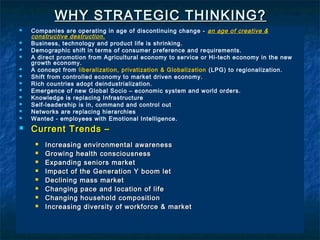
WHY STRATEGIC THINKING?
   Companies are operating in age of discontinuing change - an age of creative &
    constructive destruction.
   Business, technology and product life is shrinking.
   Demographic shift in terms of consumer preference and requirements.
   A direct promotion from Agricultural economy to service or Hi-tech economy in the new
    growth economy.
   A concept from liberalization, privatization & Globalization (LPG) to regionalization.
   Shift from controlled economy to market driven economy.
   Rich countries adopt deindustrialization.
   Emergence of new Global Socio – economic system and world orders.
   Knowledge is replacing Infrastructure
   Self-leadership is in, command and control out
   Networks are replacing hierarchies
   Wanted - employees with Emotional Intelligence.
   Current Trends –
        Increasing environmental awareness
        Growing health consciousness
        Expanding seniors market
        Impact of the Generation Y boom let
        Declining mass market
        Changing pace and location of life
        Changing household composition
        Increasing diversity of workforce & market


                                                                                             3
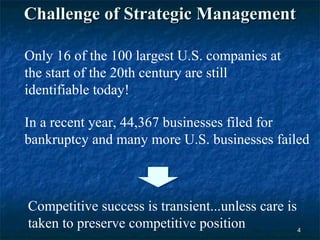
Challenge of Strategic Management

Only 16 of the 100 largest U.S. companies at
the start of the 20th century are still
identifiable today!

In a recent year, 44,367 businesses filed for
bankruptcy and many more U.S. businesses failed


Competitive success is transient...unless care is
taken to preserve competitive position            4
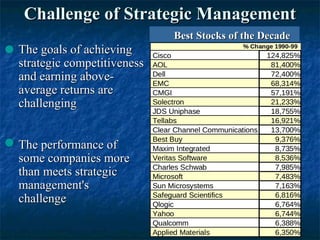
Challenge of Strategic Management
                            Best Stocks of the Decade
The goals of achieving
strategic competitiveness
and earning above-
average returns are
challenging


The performance of
some companies more
than meets strategic
management's
challenge

                                                        5
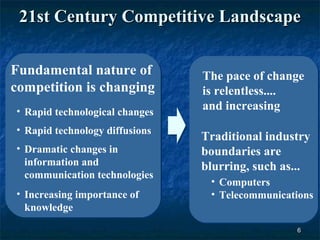
21st Century Competitive Landscape

Fundamental nature of           The pace of change
competition is changing         is relentless....
• Rapid technological changes   and increasing
• Rapid technology diffusions
                                Traditional industry
• Dramatic changes in           boundaries are
  information and               blurring, such as...
  communication technologies
                                 • Computers
• Increasing importance of       • Telecommunications
  knowledge

                                                 6
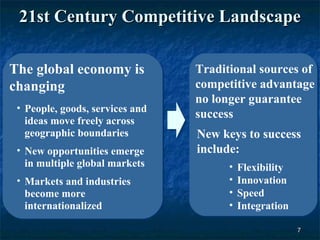
21st Century Competitive Landscape

The global economy is            Traditional sources of
changing                         competitive advantage
                                 no longer guarantee
 • People, goods, services and
                                 success
   ideas move freely across
   geographic boundaries         New keys to success
 • New opportunities emerge      include:
   in multiple global markets          •   Flexibility
 • Markets and industries              •   Innovation
   become more                         •   Speed
   internationalized                   •   Integration

                                                         7
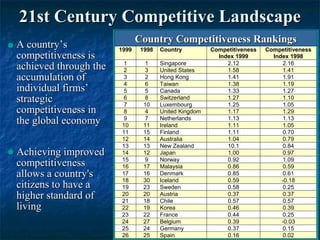
21st Century Competitive Landscape
A country’s                   Country Competitiveness Rankings
                       1999    1998   Country          Competitiveness   Competitiveness
competitiveness is                                       Index 1999        Index 1998
achieved through the    1
                        2
                                1
                                3
                                      Singapore
                                      United States
                                                            2.12
                                                            1.58
                                                                              2.16
                                                                              1.41
accumulation of         3       2     Hong Kong             1.41              1.91
                        4       6     Taiwan                1.38              1.19
individual firms’       5       5     Canada                1.33              1.27
strategic               6
                        7
                                8
                                10
                                      Switzerland
                                      Luxembourg
                                                            1.27
                                                            1.25
                                                                              1.10
                                                                              1.05
competitiveness in      8       4     United Kingdom        1.17              1.29
the global economy      9
                        10
                                7
                                11
                                      Netherlands
                                      Ireland
                                                            1.13
                                                            1.11
                                                                              1.13
                                                                              1.05
                        11      15    Finland               1.11              0.70
                        12      14    Australia             1.04              0.79
                        13      13    New Zealand           10.1              0.84
Achieving improved      14      12    Japan                 1.00              0.97
                        15      9     Norway                0.92              1.09
competitiveness         16      17    Malaysia              0.86              0.59
allows a country's      17      16    Denmark               0.85              0.61
                        18      30    Iceland               0.59              -0.18
citizens to have a      19      23    Sweden                0.58              0.25
higher standard of      20
                        21
                                20
                                18
                                      Austria
                                      Chile
                                                            0.37
                                                            0.57
                                                                              0.37
                                                                              0.57
living                  22      19    Korea                 0.46              0.39
                        23      22    France                0.44              0.25
                        24      27    Belgium               0.39              -0.03
                        25      24    Germany               0.37              0.15 8
                        26      25    Spain                 0.16              0.02
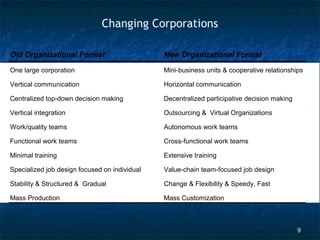
Changing Corporations

Old Organizational Format                      New Organizational Format

One large corporation                          Mini-business units & cooperative relationships

Vertical communication                         Horizontal communication

Centralized top-down decision making           Decentralized participative decision making

Vertical integration                           Outsourcing & Virtual Organizations

Work/quality teams                             Autonomous work teams

Functional work teams                          Cross-functional work teams

Minimal training                               Extensive training

Specialized job design focused on individual   Value-chain team-focused job design

Stability & Structured & Gradual               Change & Flexibility & Speedy, Fast

Mass Production                                Mass Customization


                                                                                             9
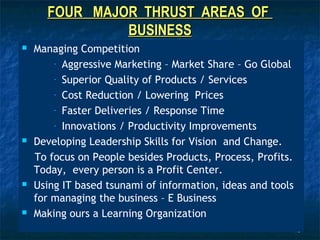
FOUR MAJOR THRUST AREAS OF
               BUSINESS
   Managing Competition
        - Aggressive Marketing – Market Share – Go Global

        - Superior Quality of Products / Services

        - Cost Reduction / Lowering Prices

        - Faster Deliveries / Response Time

        - Innovations / Productivity Improvements

   Developing Leadership Skills for Vision and Change.
    To focus on People besides Products, Process, Profits.
    Today, every person is a Profit Center.
   Using IT based tsunami of information, ideas and tools
    for managing the business – E Business
   Making ours a Learning Organization
                                                             10
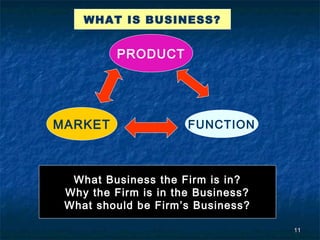
WHAT IS BUSINESS?


          PRODUCT


MARKET                FUNCTION


  What Business the Firm is in?
 Why the Firm is in the Business?
 What should be Firm’s Business?

                                    11
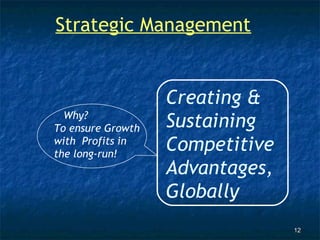
Strategic Management


                   Creating &
  Why?
To ensure Growth   Sustaining
with Profits in
the long-run!
                   Competitive
                   Advantages,
                   Globally
                                 12
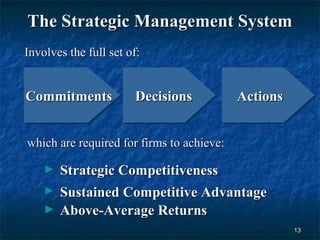
The Strategic Management System
Involves the full set of:


Commitments            Decisions           Actions


which are required for firms to achieve:

       Strategic Competitiveness
       Sustained Competitive Advantage
       Above-Average Returns
                                                     13
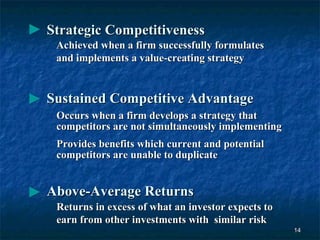
Strategic Competitiveness
 Achieved when a firm successfully formulates
 and implements a value-creating strategy


Sustained Competitive Advantage
 Occurs when a firm develops a strategy that
 competitors are not simultaneously implementing
 Provides benefits which current and potential
 competitors are unable to duplicate


Above-Average Returns
 Returns in excess of what an investor expects to
 earn from other investments with similar risk
                                                    14
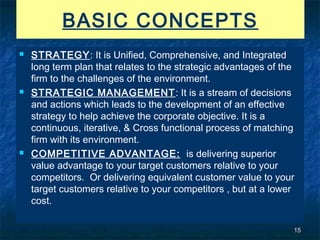
BASIC CONCEPTS
   STRATEGY: It is Unified, Comprehensive, and Integrated
    long term plan that relates to the strategic advantages of the
    firm to the challenges of the environment.
   STRATEGIC MANAGEMENT : It is a stream of decisions
    and actions which leads to the development of an effective
    strategy to help achieve the corporate objective. It is a
    continuous, iterative, & Cross functional process of matching
    firm with its environment.
   COMPETITIVE ADVANTAGE: is delivering superior
    value advantage to your target customers relative to your
    competitors. Or delivering equivalent customer value to your
    target customers relative to your competitors , but at a lower
    cost.

                                                                 15
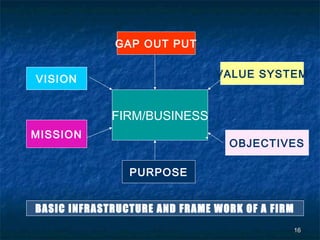
GAP OUT PUT


VISION                         VALUE SYSTEM


             FIRM/BUSINESS
MISSION
                                 OBJECTIVES

                PURPOSE


BASIC INFRASTRUCTURE AND FRAME WORK OF A FIRM
                                                16
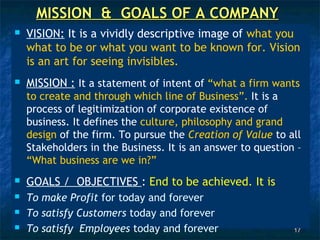
MISSION & GOALS OF A COMPANY
   VISION: It is a vividly descriptive image of what you
    what to be or what you want to be known for. Vision
    is an art for seeing invisibles.
   MISSION : It a statement of intent of “what a firm wants
    to create and through which line of Business”. It is a
    process of legitimization of corporate existence of
    business. It defines the culture, philosophy and grand
    design of the firm. To pursue the Creation of Value to all
    Stakeholders in the Business. It is an answer to question –
    “What business are we in?”
   GOALS / OBJECTIVES : End to be achieved. It is
   To make Profit for today and forever
   To satisfy Customers today and forever
   To satisfy Employees today and forever                   17
Strategic Planning


                     18
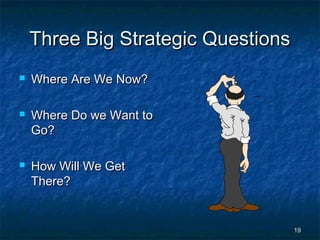
Three Big Strategic Questions
   Where Are We Now?

   Where Do we Want to
    Go?

   How Will We Get
    There?


                                    19
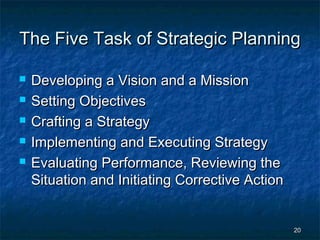
The Five Task of Strategic Planning

   Developing a Vision and a Mission
   Setting Objectives
   Crafting a Strategy
   Implementing and Executing Strategy
   Evaluating Performance, Reviewing the
    Situation and Initiating Corrective Action


                                                 20
An organization’s MISSION
   reflects management’s vision of what the
    organization seeks to do and to become
   sets forth a meaningful direction for the
    organization
   indicates an intent to stake out a particular
    business position
   outline “Who we are, What we do, and Where
    we are headed”.

                                                    21
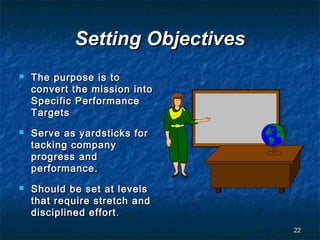
Setting Objectives
   The purpose is to
    convert the mission into
    Specific Performance
    Targets
   Serve as yardsticks for
    tacking company
    progress and
    performance.
   Should be set at levels
    that require stretch and
    disciplined effort .
                                 22
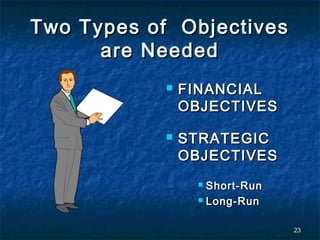
Two Types of Objectives
      are Needed
               FINANCIAL
                OBJECTIVES

               STRATEGIC
                OBJECTIVES
                   Short-Run
                   Long-Run


                                23
Crafting a Strategy
   HOW to out compete rivals and win a
    competitive advantage.
   HOW to respond to changing industry and
    competitive conditions
   HOW to defend against threats to the
    company’s well-being
   HOW to pursue attractive opportunities

                                          24
Crafting Strategy is an
            Exercise in
        Entrepreneurship
   Risk-taking and
    venture someone's
   Innovation and
    business creativity·
   A keen eye for
    spotting emerging
    market opportunities·
   Choosing among
    alternatives

                                25
Why Good Management of Strategy Matters

   Powerful execution of a powerful strategy is a
    proven recipe for success.
   Crafting and implementing a strategy are CORE
    management functions.
   To qualify as WELL-MANAGED, a company
    should · Have an attractive strategy
   A good strategy builds a position that is strong
    enough to overpower rivals and flexible enough
    to overcome unexpected obstacles .


                                                   26
Why is a Company’s Strategy
       Constantly Evolving?
   Changing market conditions·
   Moves of competitors·
   New technologies and production
    capabilities·
   Evolving buyer needs and preferences·
   Political and regulatory factors·
   New windows of opportunity·
   Fresh ideas to improve the current strategy·
   A crisis situation
                                               27
What is a Strategic Plan?
                A strategic plan
                 specifies where a
                 company is
                 headed and HOW
                 management
                 intends to
                 achieve the
                 targeted levels of
                 performance .
                                  28
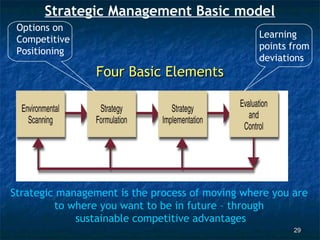
Strategic Management Basic model
 Options on
                                                 Learning
 Competitive
                                                 points from
 Positioning
                                                 deviations
                 Four Basic Elements


Strategic management is the process of moving where you are
         to where you want to be in future – through
             sustainable competitive advantages
                                                        29
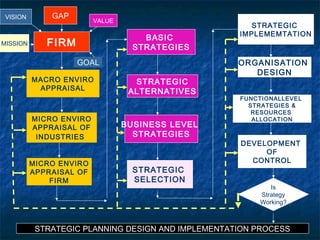
VISION       GAP
                         VALUE
                                                       STRATEGIC
                                                    IMPLEMEMTATION
                                     BASIC
MISSION      FIRM                  STRATEGIES
                    GOAL                            ORGANISATION
                                                       DESIGN
          MACRO ENVIRO             STRATEGIC
           APPRAISAL              ALTERNATIVES
                                                    FUNCTIONALLEVEL
                                                      STRATEGIES &
                                                       RESOURCES
          MICRO ENVIRO                                 ALLOCATION
          APPRAISAL OF           BUSINESS LEVEL
           INDUSTRIES              STRATEGIES
                                                    DEVELOPMENT
                                                         OF
          MICRO ENVIRO                                CONTROL
          APPRAISAL OF             STRATEGIC
              FIRM                 SELECTION
                                                           Is
                                                        Strategy
                                                        Working?


           STRATEGIC PLANNING DESIGN AND IMPLEMENTATION PROCESS    30
Characteristic of the Strategic
   Management Process
   An ongoing exercise
   Boundaries among the tasks are blurry rather than clear-
    cut
   Doing the 5 task is not isolated from other managerial
    responsibilities and activities.
   The time required to do the tasks of strategic
    management comes in lumps and spurts rather than
    being constant and regular.
   Involves pushing to get the best strategy supportive
    performance from each employee, perfecting the current
    strategy.
                                                          31
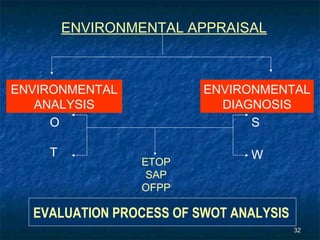
ENVIRONMENTAL APPRAISAL


ENVIRONMENTAL            ENVIRONMENTAL
   ANALYSIS                DIAGNOSIS
     O                         S

    T                          W
                ETOP
                 SAP
                OFPP

  EVALUATION PROCESS OF SWOT ANALYSIS
                                        32
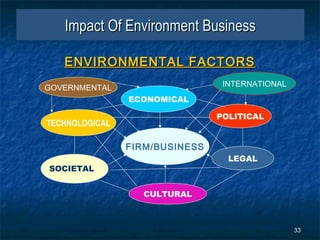
Impact Of Environment Business
   ENVIRONMENTAL FACTORS
GOVERNMENTAL                     INTERNATIONAL
                ECONOMICAL

                                POLITICAL
TECHNOLOGICAL

                FIRM/BUSINESS
                                  LEGAL
SOCIETAL


                  CULTURAL


                                                 33
34
35
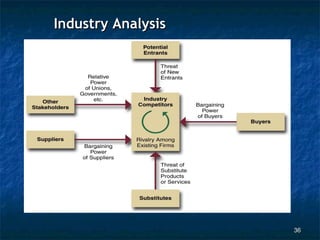
Industry Analysis


                    36
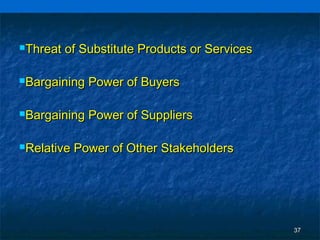
Threat   of Substitute Products or Services

Bargaining   Power of Buyers

Bargaining   Power of Suppliers

Relative   Power of Other Stakeholders


                                               37
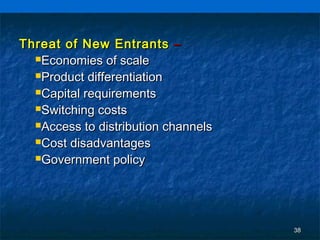
Threat of New Entrants –
  Economies of scale

  Product differentiation

  Capital requirements

  Switching costs

  Access to distribution channels

  Cost disadvantages

  Government policy


                                     38
Rivalry Among Existing Firms –

  Number   of competitors
  Rate of industry growth

  Product or service characteristics

  Amount of fixed costs

  Capacity

  Height of exit barriers

  Diversity of rivals


                                        39
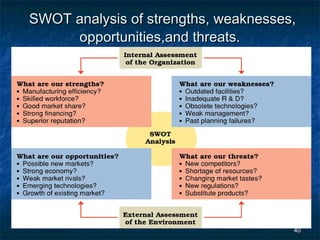
SWOT analysis of strengths, weaknesses,
     opportunities,and threats.


                                      40
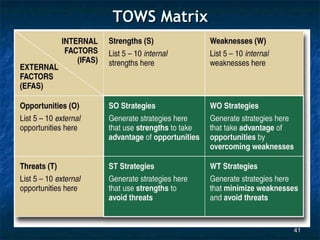
TOWS Matrix


              41
CREATING STRATEGIC
     MIND SET


                     42
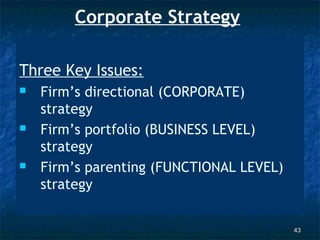
Corporate Strategy

Three Key Issues:
   Firm’s directional (CORPORATE)
    strategy
   Firm’s portfolio (BUSINESS LEVEL)
    strategy
   Firm’s parenting (FUNCTIONAL LEVEL)
    strategy


                                          43
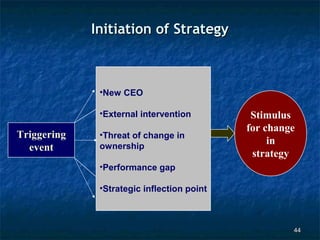
Initiation of Strategy


              •New CEO

              •External intervention         Stimulus
                                            for change
Triggering    •Threat of change in
              ownership
                                                 in
  event
                                             strategy
              •Performance gap

              •Strategic inflection point


                                                     44
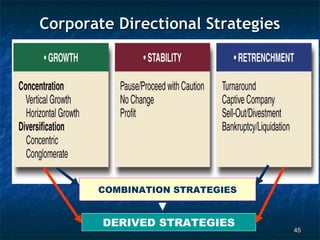
Corporate Directional Strategies


       COMBINATION STRATEGIES


        DERIVED STRATEGIES
                                   45
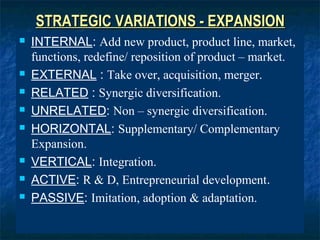
STRATEGIC VARIATIONS - EXPANSION
   INTERNAL: Add new product, product line, market,
    functions, redefine/ reposition of product – market.
   EXTERNAL : Take over, acquisition, merger.
   RELATED : Synergic diversification.
   UNRELATED: Non – synergic diversification.
   HORIZONTAL: Supplementary/ Complementary
    Expansion.
   VERTICAL: Integration.
   ACTIVE: R & D, Entrepreneurial development.
   PASSIVE: Imitation, adoption & adaptation.

                                                       46
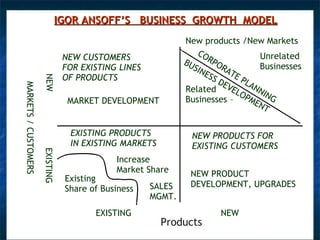
IGOR ANSOFF’S BUSINESS GROWTH MODEL
                                                              New products /New Markets
                                                                 CO             Unrelated
                                 NEW CUSTOMERS                BU    RP
                                 FOR EXISTING LINES             SIN ORA         Businesses
                                                                   ES     T
                                 OF PRODUCTS                         S D E PL
                      NEW


                                                                        E     A
                                                              Related VELO NNI
MARKETS / CUSTOMERS


                                                                                 N
                                  MARKET DEVELOPMENT          Businesses – PME G
                                                                                NT


                                  EXISTING PRODUCTS             NEW PRODUCTS FOR
                                  IN EXISTING MARKETS           EXISTING CUSTOMERS
                      EXISTING


                                             Increase
                                             Market Share      NEW PRODUCT
                                 Existing
                                                      SALES    DEVELOPMENT, UPGRADES
                                 Share of Business
                                                      MGMT.
                                        EXISTING                      NEW
                                                        Products
                                                      PRODUCTS                          47
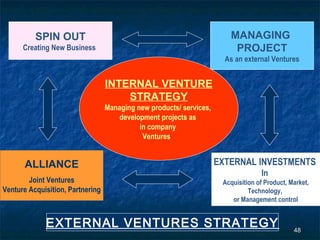
SPIN OUT                                                      MANAGING
      Creating New Business                                              PROJECT
                                                                       As an external Ventures


                                  INTERNAL VENTURE
                                      STRATEGY
                                  Managing new products/ services,
                                      development projects as
                                            in company
                                             Ventures


      ALLIANCE                                                       EXTERNAL INVESTMENTS
                                                                                   In
        Joint Ventures                                                Acquisition of Product, Market,
Venture Acquisition, Partnering                                                Technology,
                                                                         or Management control


             EXTERNAL VENTURES STRATEGY                                                        48
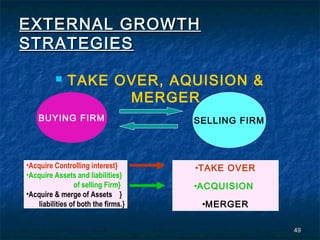
EXTERNAL GROWTH
STRATEGIES

             TAKE OVER, AQUISION &
                    MERGER
    BUYING FIRM                       SELLING FIRM


•Acquire Controlling interest}        •TAKE OVER
•Acquire Assets and liabilities}
                 of selling Firm}     •ACQUISION
•Acquire & merge of Assets }
    liabilities of both the firms.}    •MERGER

                                                     49
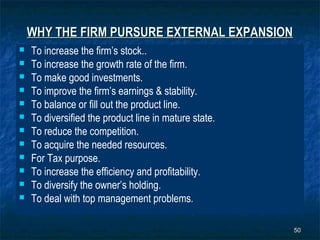
WHY THE FIRM PURSURE EXTERNAL EXPANSION
   To increase the firm’s stock..
   To increase the growth rate of the firm.
   To make good investments.
   To improve the firm’s earnings & stability.
   To balance or fill out the product line.
   To diversified the product line in mature state.
   To reduce the competition.
   To acquire the needed resources.
   For Tax purpose.
   To increase the efficiency and profitability.
   To diversify the owner’s holding.
   To deal with top management problems.

                                                       50
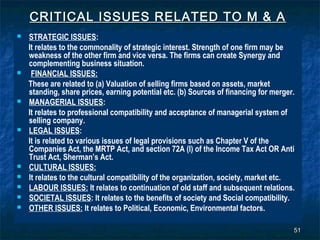
CRITICAL ISSUES RELATED TO M & A
   STRATEGIC ISSUES:
    It relates to the commonality of strategic interest. Strength of one firm may be
    weakness of the other firm and vice versa. The firms can create Synergy and
    complementing business situation.
    FINANCIAL ISSUES:
    These are related to (a) Valuation of selling firms based on assets, market
    standing, share prices, earning potential etc. (b) Sources of financing for merger.
   MANAGERIAL ISSUES:
    It relates to professional compatibility and acceptance of managerial system of
    selling company.
   LEGAL ISSUES:
    It is related to various issues of legal provisions such as Chapter V of the
    Companies Act, the MRTP Act, and section 72A (I) of the Income Tax Act OR Anti
    Trust Act, Sherman’s Act.
   CULTURAL ISSUES:
   It relates to the cultural compatibility of the organization, society, market etc.
   LABOUR ISSUES: It relates to continuation of old staff and subsequent relations.
   SOCIETAL ISSUES: It relates to the benefits of society and Social compatibility.
   OTHER ISSUES: It relates to Political, Economic, Environmental factors.

                                                                                      51
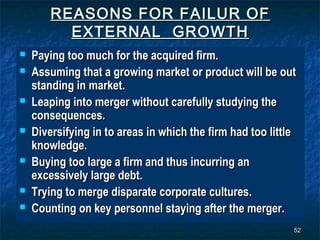
REASONS FOR FAILUR OF
          EXTERNAL GROWTH
   Paying too much for the acquired firm.
   Assuming that a growing market or product will be out
    standing in market.
   Leaping into merger without carefully studying the
    consequences.
   Diversifying in to areas in which the firm had too little
    knowledge.
   Buying too large a firm and thus incurring an
    excessively large debt.
   Trying to merge disparate corporate cultures.
   Counting on key personnel staying after the merger.
                                                            52
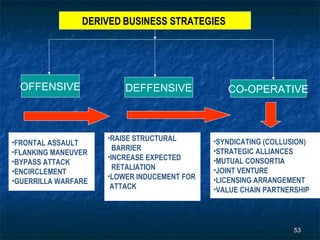
DERIVED BUSINESS STRATEGIES


 OFFENSIVE               DEFFENSIVE             CO-OPERATIVE


                     •RAISE STRUCTURAL       •SYNDICATING (COLLUSION)
•FRONTAL ASSAULT
                       BARRIER               •STRATEGIC ALLIANCES
•FLANKING MANEUVER
                     •INCREASE EXPECTED      •MUTUAL CONSORTIA
•BYPASS ATTACK
                       RETALIATION           •JOINT VENTURE
•ENCIRCLEMENT
                     •LOWER INDUCEMENT FOR   •LICENSING ARRANGEMENT
•GUERRILLA WARFARE
                      ATTACK                 •VALUE CHAIN PARTNERSHIP


                                                                 53
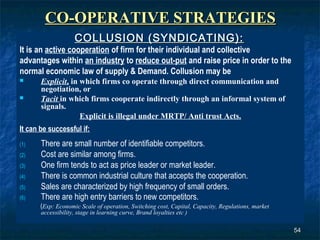
CO-OPERATIVE STRATEGIES
                     COLLUSION (SYNDICATING):
It is an active cooperation of firm for their individual and collective
advantages within an industry to reduce out-put and raise price in order to the
normal economic law of supply & Demand. Collusion may be
      Explicit, in which firms co operate through direct communication and
       negotiation, or
      Tacit in which firms cooperate indirectly through an informal system of
       signals.
                    Explicit is illegal under MRTP/ Anti trust Acts.
It can be successful if:
(1)    There are small number of identifiable competitors.
(2)    Cost are similar among firms.
(3)    One firm tends to act as price leader or market leader.
(4)    There is common industrial culture that accepts the cooperation.
(5)    Sales are characterized by high frequency of small orders.
(6)    There are high entry barriers to new competitors.
       (Exp: Economic Scale of operation, Switching cost, Capital, Capacity, Regulations, market
       accessibility, stage in learning curve, Brand loyalties etc )

                                                                                                   54
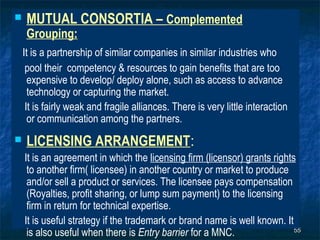
    MUTUAL CONSORTIA – Complemented
     Grouping:
    It is a partnership of similar companies in similar industries who
     pool their competency & resources to gain benefits that are too
      expensive to develop/ deploy alone, such as access to advance
      technology or capturing the market.
     It is fairly weak and fragile alliances. There is very little interaction
      or communication among the partners.
    LICENSING ARRANGEMENT:
    It is an agreement in which the licensing firm (licensor) grants rights
     to another firm( licensee) in another country or market to produce
     and/or sell a product or services. The licensee pays compensation
     (Royalties, profit sharing, or lump sum payment) to the licensing
     firm in return for technical expertise.
    It is useful strategy if the trademark or brand name is well known. It
     is also useful when there is Entry barrier for a MNC.                 55
STRATEGIC ALLIANCE
(Partnering):
 It is a partnership of two or more corporations or business units to achieve
      strategically significant objectives which can be mutually beneficial. Some alliance
      are short term till the product is established, while the others are longer lasting,
      resulting in merger.
The reasons for alliance are:

(a)   To obtain technological, management and/or manufacturing capabilities.
(b)   To enter into specific markets.
(c)   To reduce financial risk.
(d)   To reduce political and economic risk.
(e)   To achieve or ensure competitive advantages in new businesses or markets
(f)   It plays vital role in today’s market condition and environment to solve some complicated
      issues.
(g)   It provides vital role in providing the firms synergic strength.
(h)   It helps to develop product, process, market & share the investment outlay jointly.
(i)   It facilitates the development of unique technological capabilities to meet the challenges of
      technological revolution.
(j)   It create a compulsion for alliance to enter in the local market through JV.
(k)   Building brand image in local market is mostly possible through alliance.


                                                                                                56
SPECIFIC ALLIANCE
   Production Alliance: Two or more companies share the
    common manufacturing facilities, existing or new facilities.
   Marketing Alliance: Two or more companies share
    marketing services expertise and facilities.
   Financial Alliance: Companies joint together in order to
    reduce financial risks associated with the activities & share the
    profit in proportion to financial contribution.
   Research & Development Alliances: Fast
    changing technology, high cost of R & D and need of being
    ahead of changes, force companies to form alliance in R & D
    area.
   Human Resources Alliance : Alliance for outsourcing
                                                                    57
BREAK – UP OF ALLIANCE:
   Incompatibility between/among partners in
    management style, financial position,
    culture, business interest.
   Access to information.
   Distribution of Income.
   Change in business environment.
   Acquiring the strength of partner: The
    companies over a period of alliance,
    acquire the strengths of the partner and
    starts new operations in competitions.
                                            58
STRATEGIC JOINT VENTURE
    Joint ventures (JV) are partnership in which two or more firms carry
     out a specific project or business in a selected area of industry in a
     form of new venture. Ownership of the original firms remains
     unchanged. Actually, corporate partnership are formed with
     specific and time bound objectives which, once achieved, leaves
     little reasons for the alliance to continue. Joint venture can be
     temporary or it can be long term. JV that last longer do so because
     their objectives have been redesigned.
 Every JV:
1.   Has a scheduled life – cycle, which will end sooner or later
     (5 to 10 years)
2.   Has to be dissolved when it has outlived its life – cycle.
3.   Change in environment forces joint venture to be redesigned
     regularly
4.   Translations seek to absorb their partner’s competencies.
5.   It is a contractual obligation on fragile platform.
                                                                         59
Strategic reasons for Formation of JV
1.   Foreign firms are allowed to operate only if they enter into a JV with local
     partner.
2.   Size of the project may be very large and one company accomplish it.
3.   Some projects require multidimensional technology that no one firm
     possesses. Firm with different, but compatible technology may join
     together.
4.   One firm with technology competence and another with managerial
     competence join together.
5.   A foreign firm with technology competence joins with a domestic firm with
     marketing competence.
6.   While setting up of an organization requires surmounting hurdles such as
     import quota, tariffs, nationalistic political interest and cultural road block,
     Government’s support for the JV.
7.   JV are undertaken for a variety of reasons like political, economic or
     technological

TYPES OF JV:
               (A) SPIDER WEB
               (B) GO-TOGATHER & SPLIT
               (C) SUCCESSIVE INTEGRATION
                                                                                   60
Building Competitive
Advantage Through Business
      Level Strategy


                             61
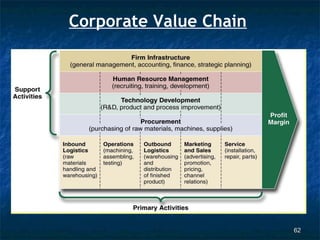
Corporate Value Chain


                        62
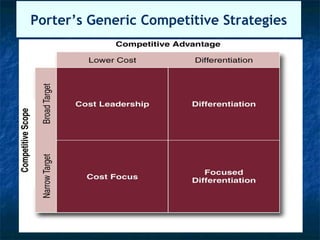
Porter’s Generic Competitive Strategies


                                          63
What is a Business level strategy

•   Business level strategies are firm-specific business model
    that will allow a company to gain a competitive
    advantage over its rivals in a market or industry.
•   It aims at improving the effectiveness of a company’s
    operations and thus its ability to attend superior
    efficiency, quality, innovation and customer
    responsiveness .
•   Its ability to improve company’s operations helps in
    achieving cost leadership or helps the company in
    differentiating its product from the rival company.
                                                             64
Distinctive Competencies…

  They are firm specific strengths that allow a
   company to differentiate its products and/or
   achieve substantially lower costs than its rivals
   and thus gain a competitive advantage.
  E.g. Toyota…
They arise from two sources:
1) Resources

2) Capabilities


                                                       65
Build
 RESOURCES

                                  Differentiation

                 BUSINESS
                 STRATEGIES
                 Superior:
                 •Efficiency
 DISTINCTIVE     •Quality                        Value     profitability
COMPETENCIES     •Innovation                    creation
                 •Customer
                 responsiveness

                                   Low cost


               Build
CAPABILITIES


                                                                   66
Product/Market/Distinctive-Competency
     Choices and Generic Competitive
                Strategies
                     Cost
                                    Differentiation        Focus
                  Leadership
                       Low                               Low to High
    Product                         High (Principally
                  (Principally by                         (Price or
Differentiation                     by Uniqueness)
                      Price)                             Uniqueness)
                                      High (Many
   Market          Low (Mass                             Low (One or a
                                        Market
Segmentation        Market)                             few Segments)
                                      Segments)
                                      Research &
                  Manufacturing                          Any kind of
 Distinctive                         Development,
                  and Materials                           Distinctive
Competency                              Sales &
                  Management                             Competency
                                       Marketing
                                                                   67
Cost Leadership
 It is based on the intent to outperform competitors by
  doing every thing to establish a cost structure that allows it
  to produce or provide goods or services at a lower unit
  cost.
 Cost leader chooses a low to moderate level of product

  differentiation relative to its competitors.
 Aims for a differentiation not markedly inferior to that of

  the differentiator but a level obtainable at a low cost.
 Frequently ignores the many different market segments in

  industry to appeal the average customers.
                                                           68
Advantages and Disadvantages
Advantages                        Disadvantages
   Protected from industry          Cost leadership approach
    competitors                       lurk in competitors’ ability
   Less affected by                  to find ways to lower their
    competitors price change          cost structure
   Requires a big market share      Ability to imitate cost
    so they purchases in              leader’s methods easily
    relatively large quantities      The single minded desire
   Barrier to entry.                 to reduce costs might
                                      drastically affect the
                                      demand
                                                             69
Implications
 To pursue a full blown cost-leadership, strategic
  managers need to devote enormous efforts to incorporate
  all the latest information, materials, management, and
  manufacturing technology into their operations to find
  new ways to reduce costs.
 A differentiator cannot let a cost leader get too great a

  cost advantage because the leader might then be able to
  use its high profits to invest more in product
  differentiation and beat leaders.
 Must respond to the strategic moves of its differential

  competitors and increase the quality and features of its
  products if it is to prosper in the long run
                                                              70
Differentiation Strategy
   The objective of the differentiation strategy is to achieve a
    competitive advantage by creating a product that consumers
    perceive as different or distinct in some important way.
   Product differentiation can be achieved in three ways
       Quality
       Innovation
       Responsiveness to customers
   Generally, a differentiator chooses to segment its market
    into many segments and niches
   A differentiated company concentrates on the
    organizational functions that provide the source of its
    differentiation advantage.
                                                           71
Advantages and Disadvantages
Advantages                                   Disadvantages
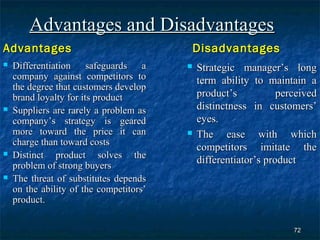
   Differentiation safeguards a            Strategic manager’s long
    company against competitors to           term ability to maintain a
    the degree that customers develop
    brand loyalty for its product            product’s           perceived
   Suppliers are rarely a problem as        distinctness in customers’
    company’s strategy is geared             eyes.
    more toward the price it can            The ease with which
    charge than toward costs
                                             competitors imitate the
   Distinct product solves the
                                             differentiator’s product
    problem of strong buyers
   The threat of substitutes depends
    on the ability of the competitors’
    product.


                                                                    72
Focus Strategies
   Focus Strategies position a company to
    compete for customers in a particular market
    segment, which can be defined
    geographically, by type of customers, or by
    region or even by locality.


                                                   73
Focus Strategies
   Focused Cost Leadership Strategy :
    If a company uses a focused low – cost approach, it
    competes against the cost leader in the market
    segment in which it has no cost disadvantage.
   Focused Differentiation Strategy :
    If a company uses a focused differentiation
    approach, then all the means of differentiation that
    are open to the differentiator are available to the
    focused company.

                                                       74
Advantages
   A focused company’s competitive advantage stem
    from the source of its distinctive competency:
    efficiency, quality, innovation, or responsiveness to
    customers.
   The company is protected from rivals to the extent
    that it can provide a product or service they cannot.
   This ability also gives the focuser power over its
    buyers because they cannot get the same things
    from anyone else.


                                                            75
Disadvantages

   Powerful suppliers
   The focuser’s niche can suddenly disappear
    because of technological change or change in
    customer’s tastes.
   The focuser is vulnerable and has to defend its
    niche constantly.


                                                  76
Competitive positioning and
        business – level strategy
   Strategic group Analysis

   Investment Analysis

   Game Theory


                                     77
Strategic group Analysis

   Strategic group analysis helps a company identify the
    strategies that its industry rivals are pursuing.
   It allows managers to uncover the most important basis
    of competition in an industry and identify products and
    market segments where they can compete most
    successfully for customers.
   Such analysis also helps to reveal what competencies are
    likely to be most valuable in the future so that companies
    can make the right investment decision.

                                                            78
Investment Analysis

   An Investment Strategy sets the amount and type of
    resources – human, financial and functional – that
    must be invested to maximize a company’s
    profitability over time.
   Two factors are crucial in choosing an investment
    strategy:
       The strength of a company’s position in an industry relative
        to its competitors.
       The stage of the industry’s life cycle in which the company
        is competing.

                                                                  79
Game Theory

    Game such as chess, player move in turn, and
    one player can select a strategy to pursue after
    considering its rival’s choice of strategies or
    the players act at the same time, in ignorance
    of their rival’s current action.


                                                   80
Business Level Strategies Help To
Improve
1.Efficiency
2.Quality
3.Innovation
4.Customer   responsiveness


                                    81
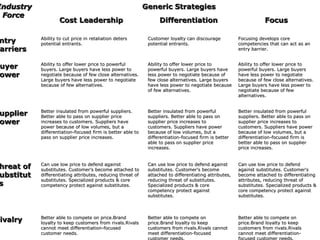
Industry                                                     Generic Strategies
 Force
                    Cost Leadership                                Differentiation                                 Focus

            Ability to cut price in retaliation deters        Customer loyalty can discourage           Focusing develops core
 ntry       potential entrants.                               potential entrants.                       competencies that can act as an
 arriers
Barriers                                                                                                entry barrier.


            Ability to offer lower price to powerful          Ability to offer lower price to           Ability to offer lower price to
 uyer
Buyer       buyers. Large buyers have less power to           powerful buyers. Large buyers have        powerful buyers. Large buyers
 ower       negotiate because of few close alternatives.      less power to negotiate because of        have less power to negotiate
            Large buyers have less power to negotiate         few close alternatives. Large buyers      because of few close alternatives.
            because of few alternatives.                      have less power to negotiate because      Large buyers have less power to
                                                              of few alternatives.                      negotiate because of few
                                                                                                        alternatives.


            Better insulated from powerful suppliers.         Better insulated from powerful            Better insulated from powerful
 upplier    Better able to pass on supplier price             suppliers. Better able to pass on         suppliers. Better able to pass on
 ower       increases to customers. Suppliers have            supplier price increases to               supplier price increases to
            power because of low volumes, but a               customers. Suppliers have power           customers. Suppliers have power
            differentiation-focused firm is better able to    because of low volumes, but a             because of low volumes, but a
            pass on supplier price increases.                 differentiation-focused firm is better    differentiation-focused firm is
                                                              able to pass on supplier price            better able to pass on supplier
                                                              increases.                                price increases.


            Can use low price to defend against               Can use low price to defend against       Can use low price to defend
 hreat of   substitutes. Customer's become attached to        substitutes. Customer's become            against substitutes. Customer's
 ubstitut   differentiating attributes, reducing threat of    attached to differentiating attributes,   become attached to differentiating
            substitutes. Specialized products & core          reducing threat of substitutes.           attributes, reducing threat of
 s          competency protect against substitutes.           Specialized products & core               substitutes. Specialized products &
                                                              competency protect against                core competency protect against
                                                              substitutes.                              substitutes.


            Better able to compete on price.Brand             Better able to compete on                 Better able to compete on
 ivalry
Rivalry     loyalty to keep customers from rivals.Rivals      price.Brand loyalty to keep               price.Brand loyalty to keep
            cannot meet differentiation-focused               customers from rivals.Rivals cannot       customers from rivals.Rivals
            customer needs.                                   meet differentiation-focused
                                                                                                                                 82
                                                                                                        cannot meet differentiation-
                                                              customer needs.                           focused customer needs.
RETRENCHMENT STRATEGY
Common Retrenchment Strategies: Turnaround,   restructuring,
Divesting, Bankruptcy, Liquidation
WHY FIRM GO FOR RETRENCHMENT:
   Prevalence of poor economic conditions.
   Competitive pressure may also cause firms to curtail their
    operations.
   The comp. is not doing well or perceive itself as doing poorly.
   The comp. has not met its objectives and there is pressure
    from shareholders, customers, or others to improve
    performance.
   The external environment poses threats and internal strengths
    are insufficient to face the threats.
   Better opportunities in the environments are perceived else
    where were firms strength can be utilized.
   Inability to implement latest technology cause by tech.
    revolution.
                                                                  83
International Strategy


                         84
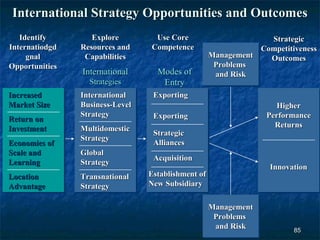
International Strategy Opportunities and Outcomes
   Identify        Explore        Use Core                       Strategic
Internatiodgd   Resources and    Competence                    Competitiveness
     gnal        Capabilities                       Management   Outcomes
Opportunities                                        Problems
                International      Modes of          and Risk
                  Strategies        Entry
Increased       International     Exporting
Market Size     Business-Level                                      Higher
                Strategy          Exporting                      Performance
Return on
Investment      Multidomestic                                      Returns
                                  Strategic
                Strategy
Economies of                      Alliances
Scale and       Global
                                  Acquisition
Learning        Strategy
                                                                  Innovation
Location        Transnational    Establishment of
Advantage       Strategy         New Subsidiary

                                                    Management
                                                     Problems
                                                     and Risk           85
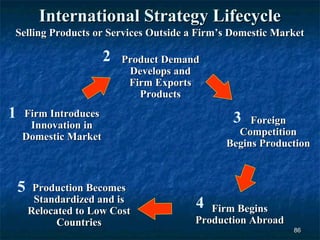
International Strategy Lifecycle
Selling Products or Services Outside a Firm’s Domestic Market

                       2   Product Demand
                            Develops and
                            Firm Exports
                              Products
1   Firm Introduces
                                               3  Foreign
     Innovation in
    Domestic Market                            Competition
                                             Begins Production


    5    Production Becomes
         Standardized and is            4
        Relocated to Low Cost              Firm Begins
              Countries                 Production Abroad
                                                            86
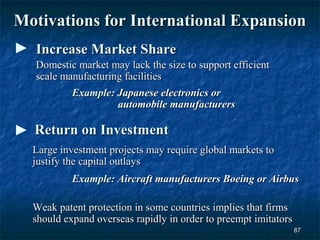
Motivations for International Expansion
  Increase Market Share
  Domestic market may lack the size to support efficient
  scale manufacturing facilities
          Example: Japanese electronics or
                    automobile manufacturers

  Return on Investment
  Large investment projects may require global markets to
  justify the capital outlays
           Example: Aircraft manufacturers Boeing or Airbus

  Weak patent protection in some countries implies that firms
  should expand overseas rapidly in order to preempt imitators
                                                                 87
Motivations for International Expansion
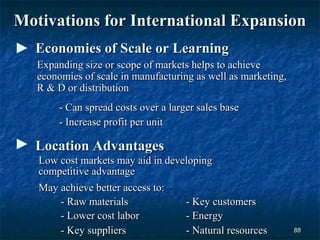
  Economies of Scale or Learning
   Expanding size or scope of markets helps to achieve
   economies of scale in manufacturing as well as marketing,
   R & D or distribution
        - Can spread costs over a larger sales base
        - Increase profit per unit

  Location Advantages
   Low cost markets may aid in developing
   competitive advantage
   May achieve better access to:
       - Raw materials             - Key customers
       - Lower cost labor          - Energy
       - Key suppliers             - Natural resources         88
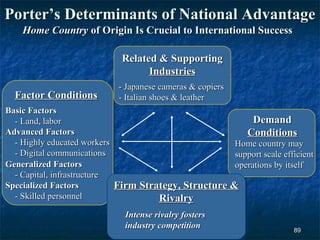
Porter’s Determinants of National Advantage
    Home Country of Origin Is Crucial to International Success

                             Related & Supporting
                                   Industries
                            - Japanese cameras & copiers
  Factor Conditions         - Italian shoes & leather
Basic Factors
  - Land, labor                                            Demand
Advanced Factors                                         Conditions
  - Highly educated workers                           Home country may
  - Digital communications                            support scale efficient
Generalized Factors                                   operations by itself
  - Capital, infrastructure
Specialized Factors         Firm Strategy, Structure &
  - Skilled personnel                Rivalry
                             Intense rivalry fosters
                             industry competition                       89
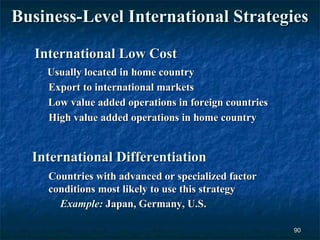
Business-Level International Strategies

   International Low Cost
    Usually located in home country
    Export to international markets
    Low value added operations in foreign countries
    High value added operations in home country


  International Differentiation
     Countries with advanced or specialized factor
     conditions most likely to use this strategy
       Example: Japan, Germany, U.S.

                                                      90
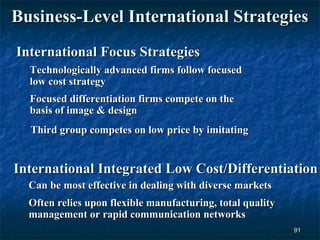
Business-Level International Strategies
International Focus Strategies
  Technologically advanced firms follow focused
  low cost strategy
  Focused differentiation firms compete on the
  basis of image & design
  Third group competes on low price by imitating


International Integrated Low Cost/Differentiation
  Can be most effective in dealing with diverse markets
  Often relies upon flexible manufacturing, total quality
  management or rapid communication networks
                                                            91
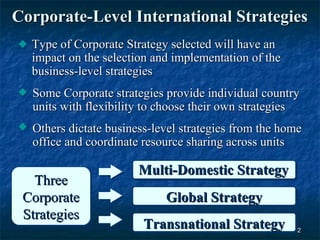
Corporate-Level International Strategies
  Type of Corporate Strategy selected will have an
  impact on the selection and implementation of the
  business-level strategies
  Some Corporate strategies provide individual country
  units with flexibility to choose their own strategies
  Others dictate business-level strategies from the home
  office and coordinate resource sharing across units

                       Multi-Domestic Strategy
   Three
 Corporate                  Global Strategy
 Strategies
                        Transnational Strategy        92
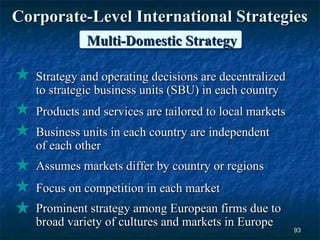
Corporate-Level International Strategies
             Multi-Domestic Strategy

   Strategy and operating decisions are decentralized
   to strategic business units (SBU) in each country
   Products and services are tailored to local markets
   Business units in each country are independent
   of each other
   Assumes markets differ by country or regions
   Focus on competition in each market
   Prominent strategy among European firms due to
   broad variety of cultures and markets in Europe
                                                         93
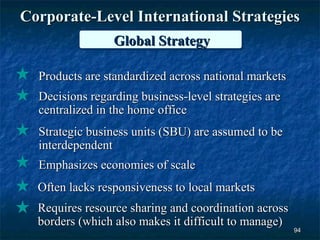
Corporate-Level International Strategies
                 Global Strategy

  Products are standardized across national markets
  Decisions regarding business-level strategies are
  centralized in the home office
  Strategic business units (SBU) are assumed to be
  interdependent
  Emphasizes economies of scale
  Often lacks responsiveness to local markets
  Requires resource sharing and coordination across
  borders (which also makes it difficult to manage)
                                                      94
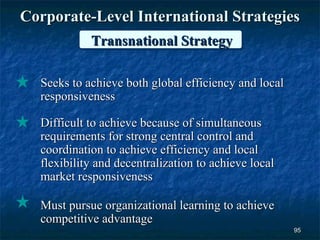
Corporate-Level International Strategies
            Transnational Strategy

  Seeks to achieve both global efficiency and local
  responsiveness

  Difficult to achieve because of simultaneous
  requirements for strong central control and
  coordination to achieve efficiency and local
  flexibility and decentralization to achieve local
  market responsiveness

  Must pursue organizational learning to achieve
  competitive advantage
                                                      95
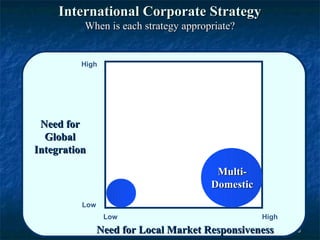
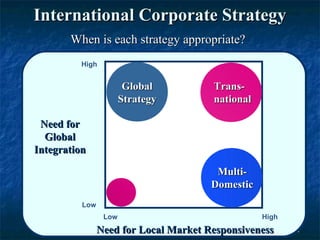
International Corporate Strategy
          When is each strategy appropriate?


         High


 Need for
  Global
Integration

                                        Multi-
                                       Domestic
          Low
                 Low                              High
                Need for Local Market Responsiveness     96
International Corporate Strategy
       When is each strategy appropriate?
         High


                        Global         Trans-
                       Strategy        national

 Need for
  Global
Integration

                                        Multi-
                                       Domestic
          Low
                 Low                              High
                Need for Local Market Responsiveness     97
Choice of International Entry Mode
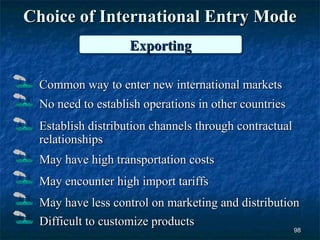
                   Exporting
                   Exporting

 Common way to enter new international markets
 No need to establish operations in other countries
 Establish distribution channels through contractual
 relationships
 May have high transportation costs
 May encounter high import tariffs
 May have less control on marketing and distribution
 Difficult to customize products
                                                       98
Choice of International Entry Mode
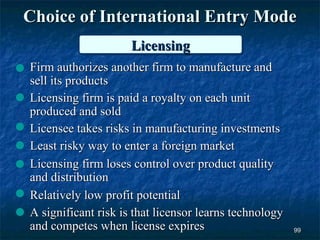
                     Licensing
                     Licensing
Firm authorizes another firm to manufacture and
sell its products
Licensing firm is paid a royalty on each unit
produced and sold
Licensee takes risks in manufacturing investments
Least risky way to enter a foreign market
Licensing firm loses control over product quality
and distribution
Relatively low profit potential
A significant risk is that licensor learns technology
and competes when license expires                       99
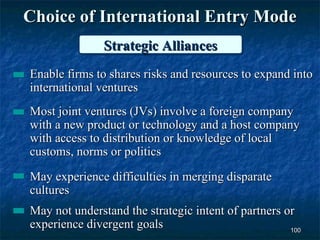
Choice of International Entry Mode
               Strategic Alliances
               Strategic Alliances
Enable firms to shares risks and resources to expand into
international ventures
Most joint ventures (JVs) involve a foreign company
with a new product or technology and a host company
with access to distribution or knowledge of local
customs, norms or politics

May experience difficulties in merging disparate
cultures
May not understand the strategic intent of partners or
experience divergent goals                           100
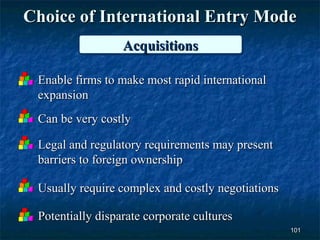
Choice of International Entry Mode
                  Acquisitions
                  Acquisitions

 Enable firms to make most rapid international
 expansion
 Can be very costly

 Legal and regulatory requirements may present
 barriers to foreign ownership

 Usually require complex and costly negotiations

 Potentially disparate corporate cultures
                                                   101
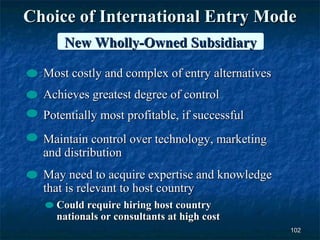
Choice of International Entry Mode
      New Wholly-Owned Subsidiary

  Most costly and complex of entry alternatives
  Achieves greatest degree of control
  Potentially most profitable, if successful
  Maintain control over technology, marketing
  and distribution
  May need to acquire expertise and knowledge
  that is relevant to host country
    Could require hiring host country
    nationals or consultants at high cost
                                                  102
Strategic Competitiveness Outcomes
 International diversification facilitates innovation in
 the firm
 Provides larger market to gain more and faster returns
 form investments in innovation
 May generate resources necessary to sustain a large-
 scale R&D program
 Generally related to above-average returns, assuming
 effective implementation and management of
 international operations
 International diversification provides greater
 economies of scope and learning                           103
Major Risks of International Diversification
                     Political Risk

   Rebel fighting in Chechnya (Russia) and
   Liberia (Africa)

   Continual warfare among Middle Eastern nations

   Potential renationalization of privatized enterprises
   in Russia

   Failure of European Community in quest for
   economic superpower status because of intercountry
   disagreements
                                                    104
Major Risks of International Diversification
                     Economic Risk

  Mexico’s effect on world trade with low wages and high
  quality but strong currency risks

  China’s difficulty in enforcing intellectual property rights
  on CDs, software, etc.

  Germany’s struggle with high unemployment, high
  interest rates, sagging competitiveness, and cuts in social
  programs

  China’s trade policies. $44 billion trade surplus with
  United States in 1977. China’s overall trade surplus
  increased twentyfold in first half of 1997.           105
Limits To International Expansion
           Management Problems

Cost of Coordination across diverse geographical
business units

Institutional and cultural barriers

Understanding strategic intent of competitors

The overall complexity of competition


                                                   106
PORTFOLIO
 ANALYSIS


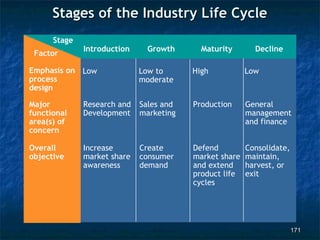
            107
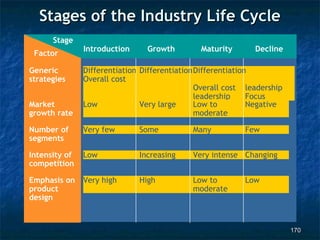
Stages of the Industry Life Cycle


                                    108
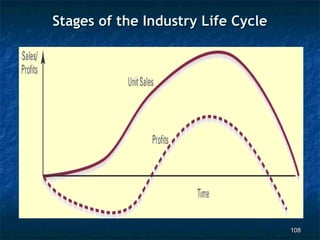
PRODUCT LIFE CYCLE
   Most product sales observed over long periods can be
    portrayed as bell shaped curves – Product life cycle curves
    which can be typically divided into four stages: Introduction,
    Growth, Maturity and Decline.
   Product Life Cycle asserts four things.
   1. Products have limited life.
   2. Product Sales pass through distinct stages, each posing
    different challenges, opportunities and problems to the seller.
   3. Profits rise and fall through different stages of the life cycle.
   4. Products require different marketing, financial,
    manufacturing, purchasing and H.R. strategies in each life cycle
    stage.
   Growth-Slump-Maturity pattern (small kitchen appliances)
   Cycle Recycle Pattern
   Scalloped Pattern (succession of PLC’s; eg: Nylon)
                                                                  109
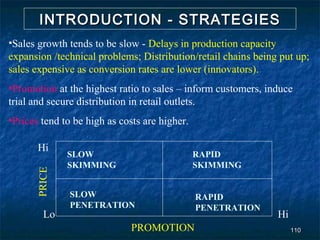
INTRODUCTION - STRATEGIES
•Sales growth tends to be slow - Delays in production capacity
expansion /technical problems; Distribution/retail chains being put up;
sales expensive as conversion rates are lower (innovators).
•Promotion at the highest ratio to sales – inform customers, induce
trial and secure distribution in retail outlets.
•Prices tend to be high as costs are higher.

       Hi
              SLOW                             RAPID
              SKIMMING                         SKIMMING
      PRICE


              SLOW                             RAPID
              PENETRATION                      PENETRATION
        Lo                                                     Hi
                             PROMOTION                              110
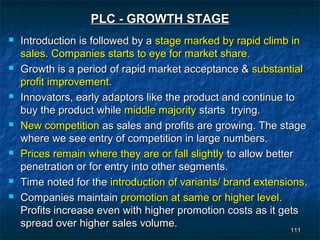
PLC - GROWTH STAGE
   Introduction is followed by a stage marked by rapid climb in
    sales. Companies starts to eye for market share.
   Growth is a period of rapid market acceptance & substantial
    profit improvement.
   Innovators, early adaptors like the product and continue to
    buy the product while middle majority starts trying.
   New competition as sales and profits are growing. The stage
    where we see entry of competition in large numbers.
   Prices remain where they are or fall slightly to allow better
    penetration or for entry into other segments.
   Time noted for the introduction of variants/ brand extensions.
   Companies maintain promotion at same or higher level.
    Profits increase even with higher promotion costs as it gets
    spread over higher sales volume.
                                                                111
                                                               111
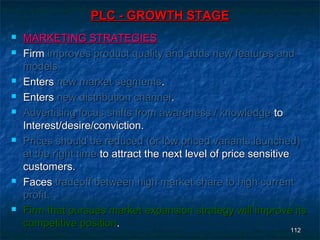
PLC - GROWTH STAGE
   MARKETING STRATEGIES
   Firm improves product quality and adds new features and
    models.
   Enters new market segments.
   Enters new distribution channel.
   Advertising focus shifts from awareness / knowledge to
    Interest/desire/conviction.
   Prices should be reduced (or low priced variants launched)
    at the right time to attract the next level of price sensitive
    customers.
   Faces tradeoff between high market share to high current
    profit.
   Firm that pursues market expansion strategy will improve its
    competitive position.
                                                                   112
                                                                  112
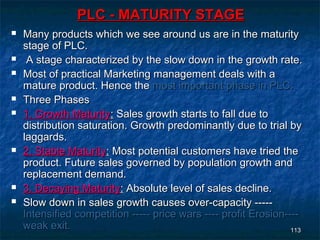
PLC - MATURITY STAGE
   Many products which we see around us are in the maturity
    stage of PLC.
    A stage characterized by the slow down in the growth rate.
   Most of practical Marketing management deals with a
    mature product. Hence the most important phase in PLC.
   Three Phases
   1. Growth Maturity: Sales growth starts to fall due to
    distribution saturation. Growth predominantly due to trial by
    laggards.
   2. Stable Maturity: Most potential customers have tried the
    product. Future sales governed by population growth and
    replacement demand.
   3. Decaying Maturity: Absolute level of sales decline.
   Slow down in sales growth causes over-capacity -----
    Intensified competition ----- price wars ---- profit Erosion----
    weak exit.                                                    113
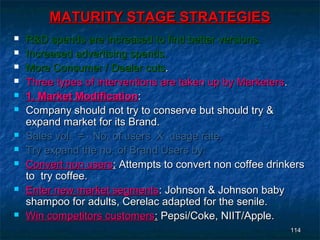
MATURITY STAGE STRATEGIES
   R&D spends are increased to find better versions.
   Increased advertising spends.
   More Consumer / Dealer cuts.
   Three types of interventions are taken up by Marketers.
   1. Market Modification:
   Company should not try to conserve but should try &
    expand market for its Brand.
   Sales vol. = No. of users X usage rate.
   Try expand the no. of Brand Users by:
   Convert non users: Attempts to convert non coffee drinkers
    to try coffee.
   Enter new market segments: Johnson & Johnson baby
    shampoo for adults, Cerelac adapted for the senile.
   Win competitors customers: Pepsi/Coke, NIIT/Apple.
                                                          114
MATURITY STAGE STRATEGIES
   Volume can also be increased by focusing on the Current
    Users – convincing them to use more.
   More frequent use: Biscuits an all time snack, Coke instead
    of coffee/tea, clinic shampoo, variety of SKU, vending
    machines.
   More usage per Occasion: Shampoo giving better results in
    two rinsing, more SKU’s.
   New more varied uses: Recipe route tried out by microwave
    oven manufacturers, Sachets by shampoo manufacturers
    for travelers, Arm & Hammer Baking soda as a refrigerator
    deodorant.
   2. PRODUCT MODIFICATION
   Stimulate sales by modifying the product’s characteristics
    by improvements in quality, feature and style.
                                                           115
STRATEGIES FOR MATURE STAGE
   2. PRODUCT MODIFICATION
   Quality Improvement:
    Functional performance improved- for cars, TV, white
    goods - New Improved eg: Santro Xing, Indica V2.
   Plus launch - from FMCG manufacturers --------- stronger,
    bigger, better,– Lifebuoy Plus.
   Aimed at triggering Brand switching
   Style Improvement:
   Aimed at increasing aesthetic appeal.
   Periodic intro of color variants by auto manufacturers.
   Consumer/packaged food bringing packaging /color
    variants.
   Advantages: Unique identity / can secure loyal customers.
   Major disadvantage arises from the fact that it is difficult to
    judge customer preferences --- risk of losing those who
    liked earlier version
                                                                116
STRATEGIES FOR MATURE STAGE (contd.)
   Advantages of feature improvements
   Build progressive and leadership image for co. (Maruti)
   New features can be made optional (adapted or dropped
    easily).
   Helps to win loyalty of some segments.
   Cost effective publicity.
   Can generate enthusiasm for sales force and dealers.
   Main disadvantage is that many of these can be easily
    imitated.
   3. Marketing Mix Modifications:
   Product Manager should also try to stimulate sales by
    modifying Mktg. Mix.
   Price: Decision whether a price cut will attract new
    customers.
   Trying price specials, early bird discounts, easier credit
    terms to retain loyal customers..
                                                            117
MATURITY STAGE STRATEGIES
   3. Marketing Mix Modifications:
   Advertising: Change message- copy, media- vehicle mix,
    timing/frequency, to target new audience.
   Build new brand identity / image.
   Direct comparison Ads about competition.
   Sales Promotion: Step up trade discount
   Price offs, Rebates, warranties, festival offers, gifts etc.
   Personal selling: should the quality of sales people or their
    area of specialization need to be changed.
   Questions on territory revisions; incentive plans; planning of
    sales call etc.
   Services: can the company speed up delivery. Extending
    technical services.
   Disadvantages: can be easily copied. Mass distribution and
    penetration efforts may not help – can lead to profit erosion.
                                                                 118
STRATEGIES FOR DECLINE STAGE
   Sales of most products/brands eventually decline –.
   1. Technological advancements in the product category.
   2. Consumer shifts in taste & perception.
   3. Increased domestic & foreign competition------
   price cutting/ over capacity/ profit erosion.

   Sales may plunge to zero or gradually fall for a long period.
   As sales decline, profits fall. Some of the weaker firms
    withdraw.
   Those remaining drop smaller market segments & marginal
    trade channels to conserve profits.
   They may cut their promotion budgets and may reduce
    prices further.
   Unless strong reasons for retention exist, carrying a weak
    product is very costly to the firm.
   It can delay aggressive search for alternatives/replacement.
                                                               119
                                                              119
STRATEGIES FOR DECLINE STAGE
   MARKETING STRATEGIES:
   1. Increase firms investment (Dominate the market or to
    strengthen its competitive position)
   2. Hold investment level until uncertainties about the
    industry are resolved.
    3. Decreasing investment selectively. (Unprofitable target
    groups/ markets/ products will have to be identified and
    instead look for strong niche’s.)
   4. Harvesting: milking to recover cash quickly (Brands with
    high loyalty can continue longer without any investments).
   5. Divest the business quickly by disposing off its assets
    as advantageously as possible.
   Drop Decision:
   Sell/transfer to someone
   Should drop slowly or fast.
   Inventory/service level to be maintained.
                                                            120
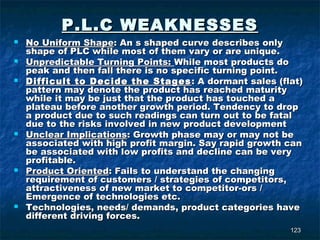
P.L.C WEAKNESSES
   No Uniform Shape:
   An ‘S’ shaped curve describes only shape of PLC while most
    of them vary or are unique.
   Unpredictable Turning Points:
   While most products do peak and then fall there is no
    specific turning point.
   Difficult to Decide the Stages:
   A dormant sales (flat) pattern may denote the product has
    reached maturity while it may be just that the product has
    touched a plateau before another growth period.
   Tendency to drop a product due to such readings can turn
    out to be fatal due to the risks involved in new product
    development.
                                                          121
P.L.C WEAKNESSES
   Unclear Implications:
    Growth phase may or may not be associated with
    high profit margin.
   Rapid growth can be associated with low profits and
    decline can be very profitable.

   Product Oriented:
   Fails to understand the changes in the requirement
    of customers / strategies of competitors,
    attractiveness of new market to competitors/
    Emergence of technologies etc.
   Technologies, needs/ demands, product categories
    have different driving forces.
                                                    122
P.L.C WEAKNESSES
   No Uniform Shape: An s shaped curve describes only
    shape of PLC while most of them vary or are unique.
   Unpredictable Turning Points: While most products do
    peak and then fall there is no specific turning point.
   Difficult to Decide the Stages : A dormant sales (flat)
    pattern may denote the product has reached maturity
    while it may be just that the product has touched a
    plateau before another growth period. Tendency to drop
    a product due to such readings can turn out to be fatal
    due to the risks involved in new product development
   Unclear Implications: Growth phase may or may not be
    associated with high profit margin. Say rapid growth can
    be associated with low profits and decline can be very
    profitable.
   Product Oriented: Fails to understand the changing
    requirement of customers / strategies of competitors,
    attractiveness of new market to competitor-ors /
    Emergence of technologies etc.
   Technologies, needs/ demands, product categories have
    different driving forces.
                                                         123
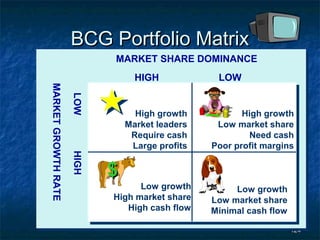
BCG Portfolio Matrix
                            MARKET SHARE DOMINANCE
                                  HIGH            LOW
MARKET GROWTH RATE

                     LOW


                                  High growth           High growth
                                Market leaders    Low market share
                                 Require cash            Need cash
                                 Large profits   Poor profit margins
                     HIGH


                            $
                                  Low growth          Low growth
                            High market share    Low market share
                               High cash flow    Minimal cash flow

                                                                     124
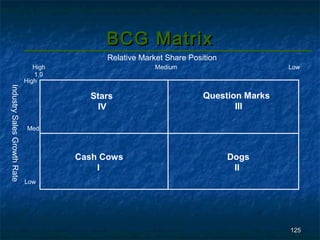
BCG Matrix
                                             Relative Market Share Position
                                High                      Medium                        Low
                                1.0
                             High
Industry Sales Growth Rate


                                         Stars                         Question Marks
                                          IV                                  III

                              Med


                                       Cash Cows                              Dogs
                                           I                                   II
                             Low


                                                                                        125
BCG Matrix


             126
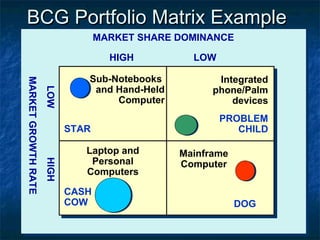
BCG Portfolio Matrix Example
                                   MARKET SHARE DOMINANCE

                                     HIGH         LOW

                               Sub-Notebooks           Integrated
MARKET GROWTH RATE


                                and Hand-Held         phone/Palm
                     LOW


                                    Computer              devices
                                                        PROBLEM
                            STAR                           CHILD

                               Laptop and       Mainframe
                                Personal
                     HIGH


                                                Computer
                               Computers

                            CASH
                            COW                             DOG

                                                                    127
Boston Consulting Group
          (BCG) Matrix
   When a firm’s divisions compete in
    different industries, a separate strategy
    often must be developed for each
    business.
   To enhance and formulate strategies.
   To manage its portfolio of businesses
   Focuses on relative market share
    position and the industry growth rate .
                                            128
BCG Matrix
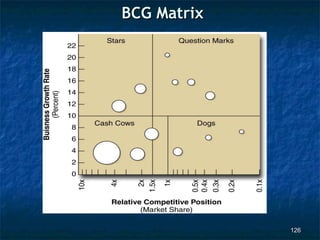
   Pie Chart corresponds to corporate revenue
    generated by that business unit.
   The pie slice indicates the proportion of
    division’s profit.
   Divisions located
   Quadrant I is called Cash Cows ,
   Quadrant II is called Dogs .
   Quadrant III is called Question Marks ,
   Quadrant IV is called Stars ,
                                                 129
Cash Cows
   High relative market share but compete in a
    low-growth industry
       Generate cash in excess of their needs
       Milked i.e. cash for other purposes
   Manages to maintain strong position as long as
    possible
       Product development
       Concentric diversification
       Retrenchment or divestiture if the division becomes
        weak

                                                              130
Dogs
   Low relative market share and compete in
    a slow- or no-growth industry
   Weak internal and external position
       Liquidation
       Divestiture
       Retrenchment


                                          131
Question Marks
   Low relative market share—compete in a
    high growth industry
       Cash needs are high
       Cash generation is low
   Decision: strengthen by pursuing an
    intensive strategy, e.g. to sell them.


                                             132
Stars
   High relative market share and a high
    industry growth rate
   Represent the organization’s best long-
    run opportunities for growth and
    profitability.
   Substantial investment to maintain or
    strengthen their dominant position.
       Integration strategies
       Intensive strategies
       Joint ventures
                                              133
BCG Matrix & Benefit

   Setting the path for growth
   Knowing dead investments
   Draws attention to the cash flow,
   Investment characteristics
   Needs of an organization’s various
    divisions.
   To achieve a portfolio of divisions that are
    Stars.
                                              134
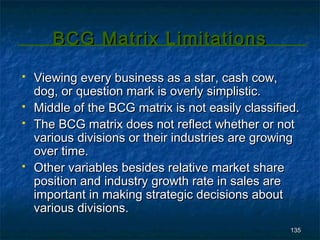
BCG Matrix Limitations
   Viewing every business as a star, cash cow,
    dog, or question mark is overly simplistic.
   Middle of the BCG matrix is not easily classified.
   The BCG matrix does not reflect whether or not
    various divisions or their industries are growing
    over time.
   Other variables besides relative market share
    position and industry growth rate in sales are
    important in making strategic decisions about
    various divisions.
                                                    135
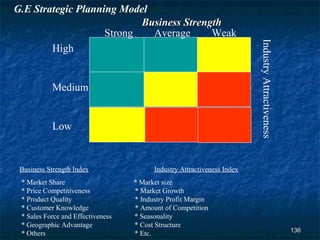
G.E Strategic Planning Model
                           Business Strength
                    Strong   Average      Weak


                                                                         Industry Attractiveness
        High


           Medium


           Low


 Business Strength Index                 Industry Attractiveness Index
 * Market Share                    * Market size
 * Price Competitiveness           * Market Growth
 * Product Quality                 * Industry Profit Margin
 * Customer Knowledge              * Amount of Competition
 * Sales Force and Effectiveness   * Seasonality
 * Geographic Advantage            * Cost Structure
                                                                                                   136
 * Others                          * Etc.
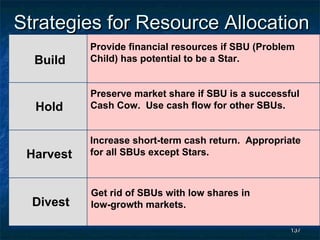
Strategies for Resource Allocation
           Provide financial resources if SBU (Problem
  Build
  Build    Child) has potential to be a Star.


           Preserve market share if SBU is a successful
  Hold
  Hold     Cash Cow. Use cash flow for other SBUs.


           Increase short-term cash return. Appropriate
 Harvest   for all SBUs except Stars.
 Harvest

           Get rid of SBUs with low shares in
  Divest
  Divest   low-growth markets.

                                                     137
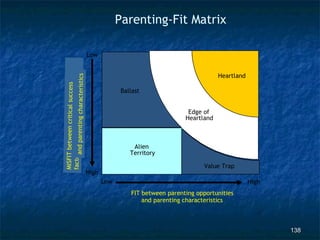
Parenting-Fit Matrix

                                     Low


                                                                                    Heartland
     and parenting characteristics
MISFIT between critical success


                                                   Ballast


                                                                         Edge of
                                                                        Heartland


                                                       Alien
                                                      Territory
factors


                                                                              Value Trap
                                     High
                                            Low                                                 High
                                                      FIT between parenting opportunities
                                                          and parenting characteristics


                                                                                                       138
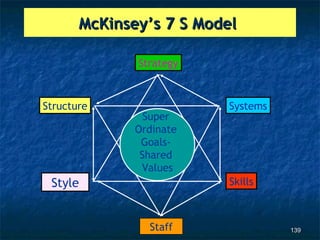
McKinsey’s 7 S Model

              Strategy


Structure                 Systems
                Super
              Ordinate
               Goals-
               Shared
               Values
 Style                    Skills


                Staff               139
Implementation of a strategy


                               140
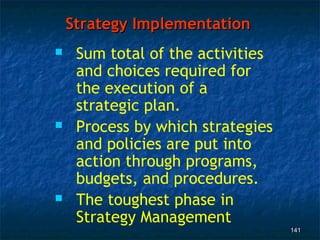
Strategy Implementation
    Sum total of the activities
     and choices required for
     the execution of a
     strategic plan.
    Process by which strategies
     and policies are put into
     action through programs,
     budgets, and procedures.
    The toughest phase in
     Strategy Management
                                   141
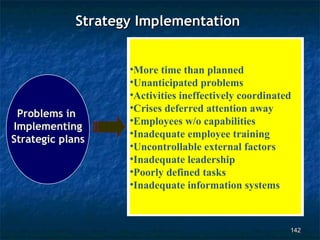
Strategy Implementation


                    •More time than planned
                    •Unanticipated problems
                    •Activities ineffectively coordinated
                    •Crises deferred attention away
 Problems in
                    •Employees w/o capabilities
Implementing
                    •Inadequate employee training
Strategic plans
                    •Uncontrollable external factors
                    •Inadequate leadership
                    •Poorly defined tasks
                    •Inadequate information systems


                                                        142
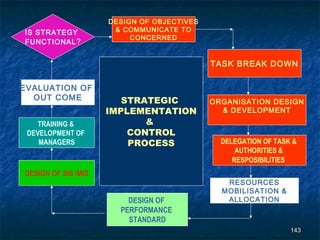
DESIGN OF OBJECTIVES
IS STRATEGY           & COMMUNICATE TO
                          CONCERNED
FUNCTIONAL ?


                                            TASK BREAK DOWN


EVALUATION OF
  OUT COME              STRATEGIC           ORGANISATION DESIGN
                     IMPLEMENTATION           & DEVELOPMENT
    TRAINING &              &
 DEVELOPMENT OF          CONTROL
    MANAGERS             PROCESS              DELEGATION OF TASK &
                                                  AUTHORITIES &
                                                 RESPOSIBILITIES
DESIGN OF SIS /MIS
                                               RESOURCES
                                              MOBILISATION &
                         DESIGN OF             ALLOCATION
                       PERFORMANCE
                         STANDARD
                                                                143
The Nature of Strategy Implementation


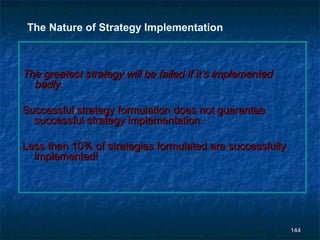
The greatest strategy will be failed if it’s implemented
  badly.

Successful strategy formulation does not guarantee
  successful strategy implementation.

Less than 10% of strategies formulated are successfully
  implemented!


                                                           144
The Nature of Strategy Implementation
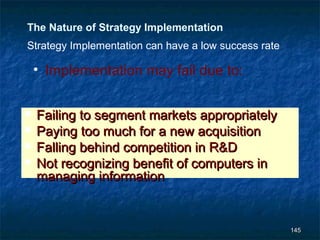
Strategy Implementation can have a low success rate

    • Implementation may fail due to:

   Failing to segment markets appropriately
   Paying too much for a new acquisition
   Falling behind competition in R&D
   Not recognizing benefit of computers in
    managing information


                                                      145
The Nature of Strategy
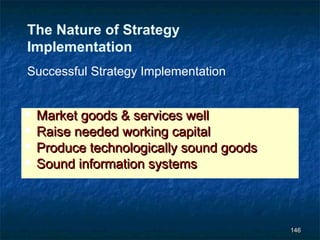
Implementation
Successful Strategy Implementation


   Market goods & services well
   Raise needed working capital
   Produce technologically sound goods
   Sound information systems


                                          146
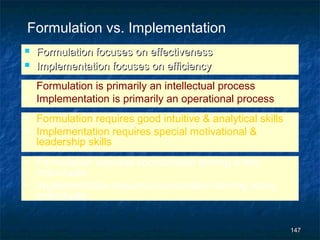
Formulation vs. Implementation
   Formulation focuses on effectiveness
   Implementation focuses on efficiency
• Formulation is primarily an intellectual process
• Implementation is primarily an operational process
• Formulation requires good intuitive & analytical skills
• Implementation requires special motivational &
  leadership skills
• Formulation requires coordination among a few
  individuals
• Implementation requires coordination among many
  individuals


                                                            147
Nature of Strategy
Implementation
Strategy Implementation


   Varies among different types & sizes of
    organizations


                                              148
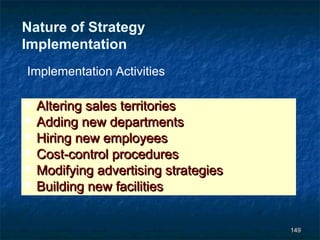
Nature of Strategy
Implementation
Implementation Activities

   Altering sales territories
   Adding new departments
   Hiring new employees
   Cost-control procedures
   Modifying advertising strategies
   Building new facilities


                                       149
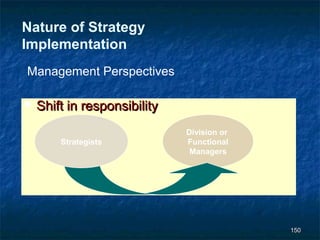
Nature of Strategy
Implementation
Management Perspectives

   Shift in responsibility
                              Division or
        Strategists           Functional
                               Managers


                                            150
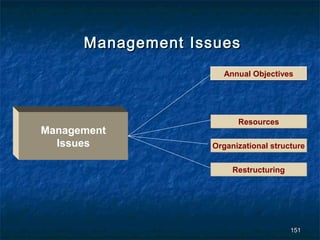
Management Issues
                     Annual Objectives


                         Resources
Management
  Issues           Organizational structure


                        Restructuring


                                        151
Management Issues    (cont’d)

                      Resistance to Change


Management
  Issues              Production/Operations


                                        152
Management Issues
Purpose of Annual Objectives --

Basis for resource allocation
Mechanism for management (e.g. IT
management) evaluation
Metric for gauging progress on long-term
objectives
Establish priorities (organizational, division,
& departmental)

                                                   153
Management Issues

-- Central management activity that
allows for the execution of strategy

Resource Allocation
   enables resources to be allocated
   according to priorities established by
   annual objectives.


                                            154
Management Issues


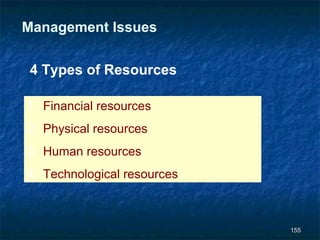
 4 Types of Resources

1. Financial resources
2. Physical resources
3. Human resources
4. Technological resources


                             155
Management Issues

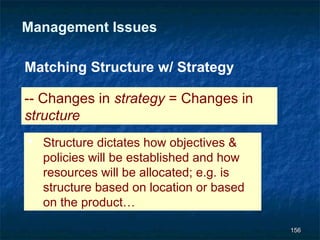
Matching Structure w/ Strategy

-- Changes in strategy = Changes in
structure
 Structure dictates how objectives &
  policies will be established and how
  resources will be allocated; e.g. is
  structure based on location or based
  on the product…

                                         156
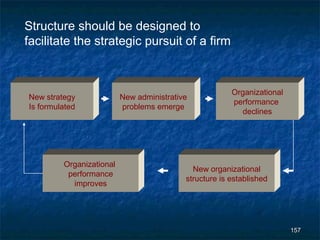
Structure should be designed to
facilitate the strategic pursuit of a firm


                                                        Organizational
New strategy              New administrative
                                                        performance
Is formulated             problems emerge
                                                          declines


         Organizational
                                             New organizational
          performance
                                           structure is established
           improves


                                                                         157
Management Issues

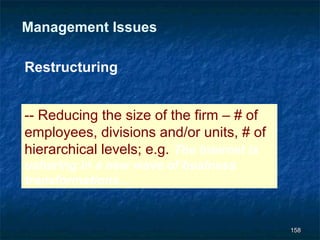
Restructuring


-- Reducing the size of the firm – # of
employees, divisions and/or units, # of
hierarchical levels; e.g. The Internet is
ushering in a new wave of business
transformations…


                                            158
Management Issues
Reengineering
In reengineering, a firm uses
information technology to break down
functional barriers and create a work
system based on business
processes… Reconfiguring or
redesigning work, jobs, & processes to
improve cost, quality… (alteration of
Scott Morton’s value chain) Think of
an example.
                                         159
Management Issues
Resistance to Change -- Single
greatest threat to successful strategy
implementation
Raises anxiety; fear concerning:
economic loss, Inconvenience or Uncertainty

Force Change Strategy
Educative Change Strategy
Rational or Self-Interest Change Strategy
                                              160
Management Issues
Production/Operations Concerns
Production processes typically
constitute more than 70% of firm’s total
assets
Decisions concern e.g. :
   Plant size
   Quality control
   Technological innovation


                                           161
Marketing Issues

 Marketing variables affect success/failure
 of strategy implementation


1. Market segmentation

1. Product positioning


                                              162
Marketing Issues
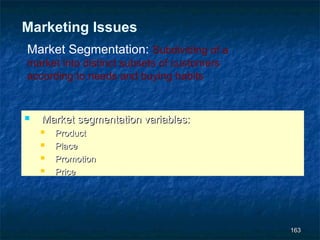
Market Segmentation: Subdividing of a
market into distinct subsets of customers
according to needs and buying habits


   Market segmentation variables:
       Product
       Place
       Promotion
       Price


                                            163
Marketing Mix – Component Factors
Product           Place               Promotion          Price

                  Distribution
Quality                               Advertising        Level
                  channels
                  Distribution                           Discounts &
Features                              Personal selling
                  coverage                               allowances

Style             Outlet location     Sales promotion    Payment terms

Brand name        Sales territories   Publicity

                  Inventory
Packaging
                  levels/locations
                  Transportation
Product line
                  carriers

Warranty

Service level

                                                                       164
                                                                       164
Marketing Issues

Product Positioning


 Schematic representations that reflect how
 products/services compare to competitors’ on
 dimensions most important to success in the
 industry; I.e. according to customer wants and
 customer needs


                                                  165
Finance/Accounting Issues


Essential for implementation


   Acquiring needed capital
   Developing projected financial statements
   Preparing financial budgets
   Evaluating worth of a business


                                                166
Research & Development
Issues

    New products and improvement of
    existing products that allow for effective
    strategy implementation
   Use an R&D strategy that ties external
    opportunities to internal strengths and is
    linked with objectives.


                                                 167
Research & Development
 Issues

 3 Major R&D approaches to implementing
 strategies

1.   1st firm to market new technological
     products
2.   Innovative imitator of successful products
3.   Low-cost producer of similar but less
     expensive products


                                                  168
Management Information
    Systems (MIS) Issues

     Information is the basis for
     understanding the firm. One of the
     most important factors differentiating
     successful from unsuccessful firms

•    MIS used to :
•    Information collection, retrieval, & storage
•    Keeping managers informed
•    Coordination of activities among divisions
•    Allow firm to reduce costs
                                                    169
Stages of the Industry Life Cycle
      Stage
               Introduction     Growth        Maturity       Decline
 Factor

Generic        Differentiation DifferentiationDifferentiation
strategies     Overall cost
                                              Overall cost leadership
                                              leadership     Focus
Market         Low             Very large     Low to         Negative
growth rate                                   moderate

Number of      Very few       Some          Many          Few
segments

Intensity of   Low            Increasing    Very intense Changing
competition

Emphasis on    Very high      High          Low to        Low
product                                     moderate
design


                                                                        170
Stages of the Industry Life Cycle
      Stage
              Introduction    Growth       Maturity       Decline
 Factor

Emphasis on Low              Low to      High           Low
process                      moderate
design

Major         Research and   Sales and   Production     General
functional    Development    marketing                  management
area(s) of                                              and finance
concern

Overall       Increase       Create      Defend         Consolidate,
objective     market share   consumer    market share   maintain,
              awareness      demand      and extend     harvest, or
                                         product life   exit
                                         cycles


                                                                       171
Evaluation and Control

                     Return on
                     Investment
                        (ROI)

                    Earnings per
Traditional
                       Share
 Financial             (EPS)
 Measures
                     Return on
                      Equity
                       (ROE)


                                   172
THANK YOU.


Shefali (GIMT)
                 173

Strategic management

  • 1.
  • 2.
    STRATEGIC MANAGEMENT A CONCEPT ON STRATEGIC THINKING AND MODUS OPERANDI FOR SURVIVAL IN 21st CENTURY 2
  • 3.
    WHY STRATEGIC THINKING?  Companies are operating in age of discontinuing change - an age of creative & constructive destruction.  Business, technology and product life is shrinking.  Demographic shift in terms of consumer preference and requirements.  A direct promotion from Agricultural economy to service or Hi-tech economy in the new growth economy.  A concept from liberalization, privatization & Globalization (LPG) to regionalization.  Shift from controlled economy to market driven economy.  Rich countries adopt deindustrialization.  Emergence of new Global Socio – economic system and world orders.  Knowledge is replacing Infrastructure  Self-leadership is in, command and control out  Networks are replacing hierarchies  Wanted - employees with Emotional Intelligence.  Current Trends –  Increasing environmental awareness  Growing health consciousness  Expanding seniors market  Impact of the Generation Y boom let  Declining mass market  Changing pace and location of life  Changing household composition  Increasing diversity of workforce & market 3
  • 4.
    Challenge of StrategicManagement Only 16 of the 100 largest U.S. companies at the start of the 20th century are still identifiable today! In a recent year, 44,367 businesses filed for bankruptcy and many more U.S. businesses failed Competitive success is transient...unless care is taken to preserve competitive position 4
  • 5.
    Challenge of StrategicManagement Best Stocks of the Decade The goals of achieving strategic competitiveness and earning above- average returns are challenging The performance of some companies more than meets strategic management's challenge 5
  • 6.
    21st Century CompetitiveLandscape Fundamental nature of The pace of change competition is changing is relentless.... • Rapid technological changes and increasing • Rapid technology diffusions Traditional industry • Dramatic changes in boundaries are information and blurring, such as... communication technologies • Computers • Increasing importance of • Telecommunications knowledge 6
  • 7.
    21st Century CompetitiveLandscape The global economy is Traditional sources of changing competitive advantage no longer guarantee • People, goods, services and success ideas move freely across geographic boundaries New keys to success • New opportunities emerge include: in multiple global markets • Flexibility • Markets and industries • Innovation become more • Speed internationalized • Integration 7
  • 8.
    21st Century CompetitiveLandscape A country’s Country Competitiveness Rankings 1999 1998 Country Competitiveness Competitiveness competitiveness is Index 1999 Index 1998 achieved through the 1 2 1 3 Singapore United States 2.12 1.58 2.16 1.41 accumulation of 3 2 Hong Kong 1.41 1.91 4 6 Taiwan 1.38 1.19 individual firms’ 5 5 Canada 1.33 1.27 strategic 6 7 8 10 Switzerland Luxembourg 1.27 1.25 1.10 1.05 competitiveness in 8 4 United Kingdom 1.17 1.29 the global economy 9 10 7 11 Netherlands Ireland 1.13 1.11 1.13 1.05 11 15 Finland 1.11 0.70 12 14 Australia 1.04 0.79 13 13 New Zealand 10.1 0.84 Achieving improved 14 12 Japan 1.00 0.97 15 9 Norway 0.92 1.09 competitiveness 16 17 Malaysia 0.86 0.59 allows a country's 17 16 Denmark 0.85 0.61 18 30 Iceland 0.59 -0.18 citizens to have a 19 23 Sweden 0.58 0.25 higher standard of 20 21 20 18 Austria Chile 0.37 0.57 0.37 0.57 living 22 19 Korea 0.46 0.39 23 22 France 0.44 0.25 24 27 Belgium 0.39 -0.03 25 24 Germany 0.37 0.15 8 26 25 Spain 0.16 0.02
  • 9.
    Changing Corporations Old OrganizationalFormat New Organizational Format One large corporation Mini-business units & cooperative relationships Vertical communication Horizontal communication Centralized top-down decision making Decentralized participative decision making Vertical integration Outsourcing & Virtual Organizations Work/quality teams Autonomous work teams Functional work teams Cross-functional work teams Minimal training Extensive training Specialized job design focused on individual Value-chain team-focused job design Stability & Structured & Gradual Change & Flexibility & Speedy, Fast Mass Production Mass Customization 9
  • 10.
    FOUR MAJOR THRUSTAREAS OF BUSINESS  Managing Competition - Aggressive Marketing – Market Share – Go Global - Superior Quality of Products / Services - Cost Reduction / Lowering Prices - Faster Deliveries / Response Time - Innovations / Productivity Improvements  Developing Leadership Skills for Vision and Change. To focus on People besides Products, Process, Profits. Today, every person is a Profit Center.  Using IT based tsunami of information, ideas and tools for managing the business – E Business  Making ours a Learning Organization 10
  • 11.
    WHAT IS BUSINESS? PRODUCT MARKET FUNCTION What Business the Firm is in? Why the Firm is in the Business? What should be Firm’s Business? 11
  • 12.
    Strategic Management Creating & Why? To ensure Growth Sustaining with Profits in the long-run! Competitive Advantages, Globally 12
  • 13.
    The Strategic ManagementSystem Involves the full set of: Commitments Decisions Actions which are required for firms to achieve: Strategic Competitiveness Sustained Competitive Advantage Above-Average Returns 13
  • 14.
    Strategic Competitiveness Achievedwhen a firm successfully formulates and implements a value-creating strategy Sustained Competitive Advantage Occurs when a firm develops a strategy that competitors are not simultaneously implementing Provides benefits which current and potential competitors are unable to duplicate Above-Average Returns Returns in excess of what an investor expects to earn from other investments with similar risk 14
  • 15.
    BASIC CONCEPTS  STRATEGY: It is Unified, Comprehensive, and Integrated long term plan that relates to the strategic advantages of the firm to the challenges of the environment.  STRATEGIC MANAGEMENT : It is a stream of decisions and actions which leads to the development of an effective strategy to help achieve the corporate objective. It is a continuous, iterative, & Cross functional process of matching firm with its environment.  COMPETITIVE ADVANTAGE: is delivering superior value advantage to your target customers relative to your competitors. Or delivering equivalent customer value to your target customers relative to your competitors , but at a lower cost. 15
  • 16.
    GAP OUT PUT VISION VALUE SYSTEM FIRM/BUSINESS MISSION OBJECTIVES PURPOSE BASIC INFRASTRUCTURE AND FRAME WORK OF A FIRM 16
  • 17.
    MISSION & GOALSOF A COMPANY  VISION: It is a vividly descriptive image of what you what to be or what you want to be known for. Vision is an art for seeing invisibles.  MISSION : It a statement of intent of “what a firm wants to create and through which line of Business”. It is a process of legitimization of corporate existence of business. It defines the culture, philosophy and grand design of the firm. To pursue the Creation of Value to all Stakeholders in the Business. It is an answer to question – “What business are we in?”  GOALS / OBJECTIVES : End to be achieved. It is  To make Profit for today and forever  To satisfy Customers today and forever  To satisfy Employees today and forever 17
  • 18.
  • 19.
    Three Big StrategicQuestions  Where Are We Now?  Where Do we Want to Go?  How Will We Get There? 19
  • 20.
    The Five Taskof Strategic Planning  Developing a Vision and a Mission  Setting Objectives  Crafting a Strategy  Implementing and Executing Strategy  Evaluating Performance, Reviewing the Situation and Initiating Corrective Action 20
  • 21.
    An organization’s MISSION  reflects management’s vision of what the organization seeks to do and to become  sets forth a meaningful direction for the organization  indicates an intent to stake out a particular business position  outline “Who we are, What we do, and Where we are headed”. 21
  • 22.
    Setting Objectives  The purpose is to convert the mission into Specific Performance Targets  Serve as yardsticks for tacking company progress and performance.  Should be set at levels that require stretch and disciplined effort . 22
  • 23.
    Two Types ofObjectives are Needed  FINANCIAL OBJECTIVES  STRATEGIC OBJECTIVES  Short-Run  Long-Run 23
  • 24.
    Crafting a Strategy  HOW to out compete rivals and win a competitive advantage.  HOW to respond to changing industry and competitive conditions  HOW to defend against threats to the company’s well-being  HOW to pursue attractive opportunities 24
  • 25.
    Crafting Strategy isan Exercise in Entrepreneurship  Risk-taking and venture someone's  Innovation and business creativity·  A keen eye for spotting emerging market opportunities·  Choosing among alternatives 25
  • 26.
    Why Good Managementof Strategy Matters  Powerful execution of a powerful strategy is a proven recipe for success.  Crafting and implementing a strategy are CORE management functions.  To qualify as WELL-MANAGED, a company should · Have an attractive strategy  A good strategy builds a position that is strong enough to overpower rivals and flexible enough to overcome unexpected obstacles . 26
  • 27.
    Why is aCompany’s Strategy Constantly Evolving?  Changing market conditions·  Moves of competitors·  New technologies and production capabilities·  Evolving buyer needs and preferences·  Political and regulatory factors·  New windows of opportunity·  Fresh ideas to improve the current strategy·  A crisis situation 27
  • 28.
    What is aStrategic Plan?  A strategic plan specifies where a company is headed and HOW management intends to achieve the targeted levels of performance . 28
  • 29.
    Strategic Management Basicmodel Options on Learning Competitive points from Positioning deviations Four Basic Elements Strategic management is the process of moving where you are to where you want to be in future – through sustainable competitive advantages 29
  • 30.
    VISION GAP VALUE STRATEGIC IMPLEMEMTATION BASIC MISSION FIRM STRATEGIES GOAL ORGANISATION DESIGN MACRO ENVIRO STRATEGIC APPRAISAL ALTERNATIVES FUNCTIONALLEVEL STRATEGIES & RESOURCES MICRO ENVIRO ALLOCATION APPRAISAL OF BUSINESS LEVEL INDUSTRIES STRATEGIES DEVELOPMENT OF MICRO ENVIRO CONTROL APPRAISAL OF STRATEGIC FIRM SELECTION Is Strategy Working? STRATEGIC PLANNING DESIGN AND IMPLEMENTATION PROCESS 30
  • 31.
    Characteristic of theStrategic Management Process  An ongoing exercise  Boundaries among the tasks are blurry rather than clear- cut  Doing the 5 task is not isolated from other managerial responsibilities and activities.  The time required to do the tasks of strategic management comes in lumps and spurts rather than being constant and regular.  Involves pushing to get the best strategy supportive performance from each employee, perfecting the current strategy. 31
  • 32.
    ENVIRONMENTAL APPRAISAL ENVIRONMENTAL ENVIRONMENTAL ANALYSIS DIAGNOSIS O S T W ETOP SAP OFPP EVALUATION PROCESS OF SWOT ANALYSIS 32
  • 33.
    Impact Of EnvironmentBusiness ENVIRONMENTAL FACTORS GOVERNMENTAL INTERNATIONAL ECONOMICAL POLITICAL TECHNOLOGICAL FIRM/BUSINESS LEGAL SOCIETAL CULTURAL 33
  • 34.
  • 35.
  • 36.
  • 37.
    Threat of Substitute Products or Services Bargaining Power of Buyers Bargaining Power of Suppliers Relative Power of Other Stakeholders 37
  • 38.
    Threat of NewEntrants – Economies of scale Product differentiation Capital requirements Switching costs Access to distribution channels Cost disadvantages Government policy 38
  • 39.
    Rivalry Among ExistingFirms – Number of competitors Rate of industry growth Product or service characteristics Amount of fixed costs Capacity Height of exit barriers Diversity of rivals 39
  • 40.
    SWOT analysis ofstrengths, weaknesses, opportunities,and threats. 40
  • 41.
  • 42.
  • 43.
    Corporate Strategy Three KeyIssues:  Firm’s directional (CORPORATE) strategy  Firm’s portfolio (BUSINESS LEVEL) strategy  Firm’s parenting (FUNCTIONAL LEVEL) strategy 43
  • 44.
    Initiation of Strategy •New CEO •External intervention Stimulus for change Triggering •Threat of change in ownership in event strategy •Performance gap •Strategic inflection point 44
  • 45.
    Corporate Directional Strategies COMBINATION STRATEGIES DERIVED STRATEGIES 45
  • 46.
    STRATEGIC VARIATIONS -EXPANSION  INTERNAL: Add new product, product line, market, functions, redefine/ reposition of product – market.  EXTERNAL : Take over, acquisition, merger.  RELATED : Synergic diversification.  UNRELATED: Non – synergic diversification.  HORIZONTAL: Supplementary/ Complementary Expansion.  VERTICAL: Integration.  ACTIVE: R & D, Entrepreneurial development.  PASSIVE: Imitation, adoption & adaptation. 46
  • 47.
    IGOR ANSOFF’S BUSINESSGROWTH MODEL New products /New Markets CO Unrelated NEW CUSTOMERS BU RP FOR EXISTING LINES SIN ORA Businesses ES T OF PRODUCTS S D E PL NEW E A Related VELO NNI MARKETS / CUSTOMERS N MARKET DEVELOPMENT Businesses – PME G NT EXISTING PRODUCTS NEW PRODUCTS FOR IN EXISTING MARKETS EXISTING CUSTOMERS EXISTING Increase Market Share NEW PRODUCT Existing SALES DEVELOPMENT, UPGRADES Share of Business MGMT. EXISTING NEW Products PRODUCTS 47
  • 48.
    SPIN OUT MANAGING Creating New Business PROJECT As an external Ventures INTERNAL VENTURE STRATEGY Managing new products/ services, development projects as in company Ventures ALLIANCE EXTERNAL INVESTMENTS In Joint Ventures Acquisition of Product, Market, Venture Acquisition, Partnering Technology, or Management control EXTERNAL VENTURES STRATEGY 48
  • 49.
    EXTERNAL GROWTH STRATEGIES  TAKE OVER, AQUISION & MERGER BUYING FIRM SELLING FIRM •Acquire Controlling interest} •TAKE OVER •Acquire Assets and liabilities} of selling Firm} •ACQUISION •Acquire & merge of Assets } liabilities of both the firms.} •MERGER 49
  • 50.
    WHY THE FIRMPURSURE EXTERNAL EXPANSION  To increase the firm’s stock..  To increase the growth rate of the firm.  To make good investments.  To improve the firm’s earnings & stability.  To balance or fill out the product line.  To diversified the product line in mature state.  To reduce the competition.  To acquire the needed resources.  For Tax purpose.  To increase the efficiency and profitability.  To diversify the owner’s holding.  To deal with top management problems. 50
  • 51.
    CRITICAL ISSUES RELATEDTO M & A  STRATEGIC ISSUES: It relates to the commonality of strategic interest. Strength of one firm may be weakness of the other firm and vice versa. The firms can create Synergy and complementing business situation.  FINANCIAL ISSUES: These are related to (a) Valuation of selling firms based on assets, market standing, share prices, earning potential etc. (b) Sources of financing for merger.  MANAGERIAL ISSUES: It relates to professional compatibility and acceptance of managerial system of selling company.  LEGAL ISSUES: It is related to various issues of legal provisions such as Chapter V of the Companies Act, the MRTP Act, and section 72A (I) of the Income Tax Act OR Anti Trust Act, Sherman’s Act.  CULTURAL ISSUES:  It relates to the cultural compatibility of the organization, society, market etc.  LABOUR ISSUES: It relates to continuation of old staff and subsequent relations.  SOCIETAL ISSUES: It relates to the benefits of society and Social compatibility.  OTHER ISSUES: It relates to Political, Economic, Environmental factors. 51
  • 52.
    REASONS FOR FAILUROF EXTERNAL GROWTH  Paying too much for the acquired firm.  Assuming that a growing market or product will be out standing in market.  Leaping into merger without carefully studying the consequences.  Diversifying in to areas in which the firm had too little knowledge.  Buying too large a firm and thus incurring an excessively large debt.  Trying to merge disparate corporate cultures.  Counting on key personnel staying after the merger. 52
  • 53.
    DERIVED BUSINESS STRATEGIES OFFENSIVE DEFFENSIVE CO-OPERATIVE •RAISE STRUCTURAL •SYNDICATING (COLLUSION) •FRONTAL ASSAULT BARRIER •STRATEGIC ALLIANCES •FLANKING MANEUVER •INCREASE EXPECTED •MUTUAL CONSORTIA •BYPASS ATTACK RETALIATION •JOINT VENTURE •ENCIRCLEMENT •LOWER INDUCEMENT FOR •LICENSING ARRANGEMENT •GUERRILLA WARFARE ATTACK •VALUE CHAIN PARTNERSHIP 53
  • 54.
    CO-OPERATIVE STRATEGIES COLLUSION (SYNDICATING): It is an active cooperation of firm for their individual and collective advantages within an industry to reduce out-put and raise price in order to the normal economic law of supply & Demand. Collusion may be  Explicit, in which firms co operate through direct communication and negotiation, or  Tacit in which firms cooperate indirectly through an informal system of signals. Explicit is illegal under MRTP/ Anti trust Acts. It can be successful if: (1) There are small number of identifiable competitors. (2) Cost are similar among firms. (3) One firm tends to act as price leader or market leader. (4) There is common industrial culture that accepts the cooperation. (5) Sales are characterized by high frequency of small orders. (6) There are high entry barriers to new competitors. (Exp: Economic Scale of operation, Switching cost, Capital, Capacity, Regulations, market accessibility, stage in learning curve, Brand loyalties etc ) 54
  • 55.
    MUTUAL CONSORTIA – Complemented Grouping: It is a partnership of similar companies in similar industries who pool their competency & resources to gain benefits that are too expensive to develop/ deploy alone, such as access to advance technology or capturing the market. It is fairly weak and fragile alliances. There is very little interaction or communication among the partners.  LICENSING ARRANGEMENT: It is an agreement in which the licensing firm (licensor) grants rights to another firm( licensee) in another country or market to produce and/or sell a product or services. The licensee pays compensation (Royalties, profit sharing, or lump sum payment) to the licensing firm in return for technical expertise. It is useful strategy if the trademark or brand name is well known. It is also useful when there is Entry barrier for a MNC. 55
  • 56.
    STRATEGIC ALLIANCE (Partnering):  Itis a partnership of two or more corporations or business units to achieve strategically significant objectives which can be mutually beneficial. Some alliance are short term till the product is established, while the others are longer lasting, resulting in merger. The reasons for alliance are: (a) To obtain technological, management and/or manufacturing capabilities. (b) To enter into specific markets. (c) To reduce financial risk. (d) To reduce political and economic risk. (e) To achieve or ensure competitive advantages in new businesses or markets (f) It plays vital role in today’s market condition and environment to solve some complicated issues. (g) It provides vital role in providing the firms synergic strength. (h) It helps to develop product, process, market & share the investment outlay jointly. (i) It facilitates the development of unique technological capabilities to meet the challenges of technological revolution. (j) It create a compulsion for alliance to enter in the local market through JV. (k) Building brand image in local market is mostly possible through alliance. 56
  • 57.
    SPECIFIC ALLIANCE  Production Alliance: Two or more companies share the common manufacturing facilities, existing or new facilities.  Marketing Alliance: Two or more companies share marketing services expertise and facilities.  Financial Alliance: Companies joint together in order to reduce financial risks associated with the activities & share the profit in proportion to financial contribution.  Research & Development Alliances: Fast changing technology, high cost of R & D and need of being ahead of changes, force companies to form alliance in R & D area.  Human Resources Alliance : Alliance for outsourcing 57
  • 58.
    BREAK – UPOF ALLIANCE:  Incompatibility between/among partners in management style, financial position, culture, business interest.  Access to information.  Distribution of Income.  Change in business environment.  Acquiring the strength of partner: The companies over a period of alliance, acquire the strengths of the partner and starts new operations in competitions. 58
  • 59.
    STRATEGIC JOINT VENTURE  Joint ventures (JV) are partnership in which two or more firms carry out a specific project or business in a selected area of industry in a form of new venture. Ownership of the original firms remains unchanged. Actually, corporate partnership are formed with specific and time bound objectives which, once achieved, leaves little reasons for the alliance to continue. Joint venture can be temporary or it can be long term. JV that last longer do so because their objectives have been redesigned. Every JV: 1. Has a scheduled life – cycle, which will end sooner or later (5 to 10 years) 2. Has to be dissolved when it has outlived its life – cycle. 3. Change in environment forces joint venture to be redesigned regularly 4. Translations seek to absorb their partner’s competencies. 5. It is a contractual obligation on fragile platform. 59
  • 60.
    Strategic reasons forFormation of JV 1. Foreign firms are allowed to operate only if they enter into a JV with local partner. 2. Size of the project may be very large and one company accomplish it. 3. Some projects require multidimensional technology that no one firm possesses. Firm with different, but compatible technology may join together. 4. One firm with technology competence and another with managerial competence join together. 5. A foreign firm with technology competence joins with a domestic firm with marketing competence. 6. While setting up of an organization requires surmounting hurdles such as import quota, tariffs, nationalistic political interest and cultural road block, Government’s support for the JV. 7. JV are undertaken for a variety of reasons like political, economic or technological TYPES OF JV: (A) SPIDER WEB (B) GO-TOGATHER & SPLIT (C) SUCCESSIVE INTEGRATION 60
  • 61.
    Building Competitive Advantage ThroughBusiness Level Strategy 61
  • 62.
  • 63.
  • 64.
    What is aBusiness level strategy • Business level strategies are firm-specific business model that will allow a company to gain a competitive advantage over its rivals in a market or industry. • It aims at improving the effectiveness of a company’s operations and thus its ability to attend superior efficiency, quality, innovation and customer responsiveness . • Its ability to improve company’s operations helps in achieving cost leadership or helps the company in differentiating its product from the rival company. 64
  • 65.
    Distinctive Competencies… They are firm specific strengths that allow a company to differentiate its products and/or achieve substantially lower costs than its rivals and thus gain a competitive advantage. E.g. Toyota… They arise from two sources: 1) Resources 2) Capabilities 65
  • 66.
    Build RESOURCES Differentiation BUSINESS STRATEGIES Superior: •Efficiency DISTINCTIVE •Quality Value profitability COMPETENCIES •Innovation creation •Customer responsiveness Low cost Build CAPABILITIES 66
  • 67.
    Product/Market/Distinctive-Competency Choices and Generic Competitive Strategies Cost Differentiation Focus Leadership Low Low to High Product High (Principally (Principally by (Price or Differentiation by Uniqueness) Price) Uniqueness) High (Many Market Low (Mass Low (One or a Market Segmentation Market) few Segments) Segments) Research & Manufacturing Any kind of Distinctive Development, and Materials Distinctive Competency Sales & Management Competency Marketing 67
  • 68.
    Cost Leadership  Itis based on the intent to outperform competitors by doing every thing to establish a cost structure that allows it to produce or provide goods or services at a lower unit cost.  Cost leader chooses a low to moderate level of product differentiation relative to its competitors.  Aims for a differentiation not markedly inferior to that of the differentiator but a level obtainable at a low cost.  Frequently ignores the many different market segments in industry to appeal the average customers. 68
  • 69.
    Advantages and Disadvantages Advantages Disadvantages  Protected from industry  Cost leadership approach competitors lurk in competitors’ ability  Less affected by to find ways to lower their competitors price change cost structure  Requires a big market share  Ability to imitate cost so they purchases in leader’s methods easily relatively large quantities  The single minded desire  Barrier to entry. to reduce costs might drastically affect the demand 69
  • 70.
    Implications  To pursuea full blown cost-leadership, strategic managers need to devote enormous efforts to incorporate all the latest information, materials, management, and manufacturing technology into their operations to find new ways to reduce costs.  A differentiator cannot let a cost leader get too great a cost advantage because the leader might then be able to use its high profits to invest more in product differentiation and beat leaders.  Must respond to the strategic moves of its differential competitors and increase the quality and features of its products if it is to prosper in the long run 70
  • 71.
    Differentiation Strategy  The objective of the differentiation strategy is to achieve a competitive advantage by creating a product that consumers perceive as different or distinct in some important way.  Product differentiation can be achieved in three ways  Quality  Innovation  Responsiveness to customers  Generally, a differentiator chooses to segment its market into many segments and niches  A differentiated company concentrates on the organizational functions that provide the source of its differentiation advantage. 71
  • 72.
    Advantages and Disadvantages Advantages Disadvantages  Differentiation safeguards a  Strategic manager’s long company against competitors to term ability to maintain a the degree that customers develop brand loyalty for its product product’s perceived  Suppliers are rarely a problem as distinctness in customers’ company’s strategy is geared eyes. more toward the price it can  The ease with which charge than toward costs competitors imitate the  Distinct product solves the differentiator’s product problem of strong buyers  The threat of substitutes depends on the ability of the competitors’ product. 72
  • 73.
    Focus Strategies  Focus Strategies position a company to compete for customers in a particular market segment, which can be defined geographically, by type of customers, or by region or even by locality. 73
  • 74.
    Focus Strategies  Focused Cost Leadership Strategy : If a company uses a focused low – cost approach, it competes against the cost leader in the market segment in which it has no cost disadvantage.  Focused Differentiation Strategy : If a company uses a focused differentiation approach, then all the means of differentiation that are open to the differentiator are available to the focused company. 74
  • 75.
    Advantages  A focused company’s competitive advantage stem from the source of its distinctive competency: efficiency, quality, innovation, or responsiveness to customers.  The company is protected from rivals to the extent that it can provide a product or service they cannot.  This ability also gives the focuser power over its buyers because they cannot get the same things from anyone else. 75
  • 76.
    Disadvantages  Powerful suppliers  The focuser’s niche can suddenly disappear because of technological change or change in customer’s tastes.  The focuser is vulnerable and has to defend its niche constantly. 76
  • 77.
    Competitive positioning and business – level strategy  Strategic group Analysis  Investment Analysis  Game Theory 77
  • 78.
    Strategic group Analysis  Strategic group analysis helps a company identify the strategies that its industry rivals are pursuing.  It allows managers to uncover the most important basis of competition in an industry and identify products and market segments where they can compete most successfully for customers.  Such analysis also helps to reveal what competencies are likely to be most valuable in the future so that companies can make the right investment decision. 78
  • 79.
    Investment Analysis  An Investment Strategy sets the amount and type of resources – human, financial and functional – that must be invested to maximize a company’s profitability over time.  Two factors are crucial in choosing an investment strategy:  The strength of a company’s position in an industry relative to its competitors.  The stage of the industry’s life cycle in which the company is competing. 79
  • 80.
    Game Theory  Game such as chess, player move in turn, and one player can select a strategy to pursue after considering its rival’s choice of strategies or the players act at the same time, in ignorance of their rival’s current action. 80
  • 81.
    Business Level StrategiesHelp To Improve 1.Efficiency 2.Quality 3.Innovation 4.Customer responsiveness 81
  • 82.
    Industry Generic Strategies Force Cost Leadership Differentiation Focus Ability to cut price in retaliation deters Customer loyalty can discourage Focusing develops core ntry potential entrants. potential entrants. competencies that can act as an arriers Barriers entry barrier. Ability to offer lower price to powerful Ability to offer lower price to Ability to offer lower price to uyer Buyer buyers. Large buyers have less power to powerful buyers. Large buyers have powerful buyers. Large buyers ower negotiate because of few close alternatives. less power to negotiate because of have less power to negotiate Large buyers have less power to negotiate few close alternatives. Large buyers because of few close alternatives. because of few alternatives. have less power to negotiate because Large buyers have less power to of few alternatives. negotiate because of few alternatives. Better insulated from powerful suppliers. Better insulated from powerful Better insulated from powerful upplier Better able to pass on supplier price suppliers. Better able to pass on suppliers. Better able to pass on ower increases to customers. Suppliers have supplier price increases to supplier price increases to power because of low volumes, but a customers. Suppliers have power customers. Suppliers have power differentiation-focused firm is better able to because of low volumes, but a because of low volumes, but a pass on supplier price increases. differentiation-focused firm is better differentiation-focused firm is able to pass on supplier price better able to pass on supplier increases. price increases. Can use low price to defend against Can use low price to defend against Can use low price to defend hreat of substitutes. Customer's become attached to substitutes. Customer's become against substitutes. Customer's ubstitut differentiating attributes, reducing threat of attached to differentiating attributes, become attached to differentiating substitutes. Specialized products & core reducing threat of substitutes. attributes, reducing threat of s competency protect against substitutes. Specialized products & core substitutes. Specialized products & competency protect against core competency protect against substitutes. substitutes. Better able to compete on price.Brand Better able to compete on Better able to compete on ivalry Rivalry loyalty to keep customers from rivals.Rivals price.Brand loyalty to keep price.Brand loyalty to keep cannot meet differentiation-focused customers from rivals.Rivals cannot customers from rivals.Rivals customer needs. meet differentiation-focused 82 cannot meet differentiation- customer needs. focused customer needs.
  • 83.
    RETRENCHMENT STRATEGY Common RetrenchmentStrategies: Turnaround, restructuring, Divesting, Bankruptcy, Liquidation WHY FIRM GO FOR RETRENCHMENT:  Prevalence of poor economic conditions.  Competitive pressure may also cause firms to curtail their operations.  The comp. is not doing well or perceive itself as doing poorly.  The comp. has not met its objectives and there is pressure from shareholders, customers, or others to improve performance.  The external environment poses threats and internal strengths are insufficient to face the threats.  Better opportunities in the environments are perceived else where were firms strength can be utilized.  Inability to implement latest technology cause by tech. revolution. 83
  • 84.
  • 85.
    International Strategy Opportunitiesand Outcomes Identify Explore Use Core Strategic Internatiodgd Resources and Competence Competitiveness gnal Capabilities Management Outcomes Opportunities Problems International Modes of and Risk Strategies Entry Increased International Exporting Market Size Business-Level Higher Strategy Exporting Performance Return on Investment Multidomestic Returns Strategic Strategy Economies of Alliances Scale and Global Acquisition Learning Strategy Innovation Location Transnational Establishment of Advantage Strategy New Subsidiary Management Problems and Risk 85
  • 86.
    International Strategy Lifecycle SellingProducts or Services Outside a Firm’s Domestic Market 2 Product Demand Develops and Firm Exports Products 1 Firm Introduces 3 Foreign Innovation in Domestic Market Competition Begins Production 5 Production Becomes Standardized and is 4 Relocated to Low Cost Firm Begins Countries Production Abroad 86
  • 87.
    Motivations for InternationalExpansion Increase Market Share Domestic market may lack the size to support efficient scale manufacturing facilities Example: Japanese electronics or automobile manufacturers Return on Investment Large investment projects may require global markets to justify the capital outlays Example: Aircraft manufacturers Boeing or Airbus Weak patent protection in some countries implies that firms should expand overseas rapidly in order to preempt imitators 87
  • 88.
    Motivations for InternationalExpansion Economies of Scale or Learning Expanding size or scope of markets helps to achieve economies of scale in manufacturing as well as marketing, R & D or distribution - Can spread costs over a larger sales base - Increase profit per unit Location Advantages Low cost markets may aid in developing competitive advantage May achieve better access to: - Raw materials - Key customers - Lower cost labor - Energy - Key suppliers - Natural resources 88
  • 89.
    Porter’s Determinants ofNational Advantage Home Country of Origin Is Crucial to International Success Related & Supporting Industries - Japanese cameras & copiers Factor Conditions - Italian shoes & leather Basic Factors - Land, labor Demand Advanced Factors Conditions - Highly educated workers Home country may - Digital communications support scale efficient Generalized Factors operations by itself - Capital, infrastructure Specialized Factors Firm Strategy, Structure & - Skilled personnel Rivalry Intense rivalry fosters industry competition 89
  • 90.
    Business-Level International Strategies International Low Cost Usually located in home country Export to international markets Low value added operations in foreign countries High value added operations in home country International Differentiation Countries with advanced or specialized factor conditions most likely to use this strategy Example: Japan, Germany, U.S. 90
  • 91.
    Business-Level International Strategies InternationalFocus Strategies Technologically advanced firms follow focused low cost strategy Focused differentiation firms compete on the basis of image & design Third group competes on low price by imitating International Integrated Low Cost/Differentiation Can be most effective in dealing with diverse markets Often relies upon flexible manufacturing, total quality management or rapid communication networks 91
  • 92.
    Corporate-Level International Strategies Type of Corporate Strategy selected will have an impact on the selection and implementation of the business-level strategies Some Corporate strategies provide individual country units with flexibility to choose their own strategies Others dictate business-level strategies from the home office and coordinate resource sharing across units Multi-Domestic Strategy Three Corporate Global Strategy Strategies Transnational Strategy 92
  • 93.
    Corporate-Level International Strategies Multi-Domestic Strategy Strategy and operating decisions are decentralized to strategic business units (SBU) in each country Products and services are tailored to local markets Business units in each country are independent of each other Assumes markets differ by country or regions Focus on competition in each market Prominent strategy among European firms due to broad variety of cultures and markets in Europe 93
  • 94.
    Corporate-Level International Strategies Global Strategy Products are standardized across national markets Decisions regarding business-level strategies are centralized in the home office Strategic business units (SBU) are assumed to be interdependent Emphasizes economies of scale Often lacks responsiveness to local markets Requires resource sharing and coordination across borders (which also makes it difficult to manage) 94
  • 95.
    Corporate-Level International Strategies Transnational Strategy Seeks to achieve both global efficiency and local responsiveness Difficult to achieve because of simultaneous requirements for strong central control and coordination to achieve efficiency and local flexibility and decentralization to achieve local market responsiveness Must pursue organizational learning to achieve competitive advantage 95
  • 96.
    International Corporate Strategy When is each strategy appropriate? High Need for Global Integration Multi- Domestic Low Low High Need for Local Market Responsiveness 96
  • 97.
    International Corporate Strategy When is each strategy appropriate? High Global Trans- Strategy national Need for Global Integration Multi- Domestic Low Low High Need for Local Market Responsiveness 97
  • 98.
    Choice of InternationalEntry Mode Exporting Exporting Common way to enter new international markets No need to establish operations in other countries Establish distribution channels through contractual relationships May have high transportation costs May encounter high import tariffs May have less control on marketing and distribution Difficult to customize products 98
  • 99.
    Choice of InternationalEntry Mode Licensing Licensing Firm authorizes another firm to manufacture and sell its products Licensing firm is paid a royalty on each unit produced and sold Licensee takes risks in manufacturing investments Least risky way to enter a foreign market Licensing firm loses control over product quality and distribution Relatively low profit potential A significant risk is that licensor learns technology and competes when license expires 99
  • 100.
    Choice of InternationalEntry Mode Strategic Alliances Strategic Alliances Enable firms to shares risks and resources to expand into international ventures Most joint ventures (JVs) involve a foreign company with a new product or technology and a host company with access to distribution or knowledge of local customs, norms or politics May experience difficulties in merging disparate cultures May not understand the strategic intent of partners or experience divergent goals 100
  • 101.
    Choice of InternationalEntry Mode Acquisitions Acquisitions Enable firms to make most rapid international expansion Can be very costly Legal and regulatory requirements may present barriers to foreign ownership Usually require complex and costly negotiations Potentially disparate corporate cultures 101
  • 102.
    Choice of InternationalEntry Mode New Wholly-Owned Subsidiary Most costly and complex of entry alternatives Achieves greatest degree of control Potentially most profitable, if successful Maintain control over technology, marketing and distribution May need to acquire expertise and knowledge that is relevant to host country Could require hiring host country nationals or consultants at high cost 102
  • 103.
    Strategic Competitiveness Outcomes International diversification facilitates innovation in the firm Provides larger market to gain more and faster returns form investments in innovation May generate resources necessary to sustain a large- scale R&D program Generally related to above-average returns, assuming effective implementation and management of international operations International diversification provides greater economies of scope and learning 103
  • 104.
    Major Risks ofInternational Diversification Political Risk Rebel fighting in Chechnya (Russia) and Liberia (Africa) Continual warfare among Middle Eastern nations Potential renationalization of privatized enterprises in Russia Failure of European Community in quest for economic superpower status because of intercountry disagreements 104
  • 105.
    Major Risks ofInternational Diversification Economic Risk Mexico’s effect on world trade with low wages and high quality but strong currency risks China’s difficulty in enforcing intellectual property rights on CDs, software, etc. Germany’s struggle with high unemployment, high interest rates, sagging competitiveness, and cuts in social programs China’s trade policies. $44 billion trade surplus with United States in 1977. China’s overall trade surplus increased twentyfold in first half of 1997. 105
  • 106.
    Limits To InternationalExpansion Management Problems Cost of Coordination across diverse geographical business units Institutional and cultural barriers Understanding strategic intent of competitors The overall complexity of competition 106
  • 107.
  • 108.
    Stages of theIndustry Life Cycle 108
  • 109.
    PRODUCT LIFE CYCLE  Most product sales observed over long periods can be portrayed as bell shaped curves – Product life cycle curves which can be typically divided into four stages: Introduction, Growth, Maturity and Decline.  Product Life Cycle asserts four things.  1. Products have limited life.  2. Product Sales pass through distinct stages, each posing different challenges, opportunities and problems to the seller.  3. Profits rise and fall through different stages of the life cycle.  4. Products require different marketing, financial, manufacturing, purchasing and H.R. strategies in each life cycle stage.  Growth-Slump-Maturity pattern (small kitchen appliances)  Cycle Recycle Pattern  Scalloped Pattern (succession of PLC’s; eg: Nylon) 109
  • 110.
    INTRODUCTION - STRATEGIES •Salesgrowth tends to be slow - Delays in production capacity expansion /technical problems; Distribution/retail chains being put up; sales expensive as conversion rates are lower (innovators). •Promotion at the highest ratio to sales – inform customers, induce trial and secure distribution in retail outlets. •Prices tend to be high as costs are higher. Hi SLOW RAPID SKIMMING SKIMMING PRICE SLOW RAPID PENETRATION PENETRATION Lo Hi PROMOTION 110
  • 111.
    PLC - GROWTHSTAGE  Introduction is followed by a stage marked by rapid climb in sales. Companies starts to eye for market share.  Growth is a period of rapid market acceptance & substantial profit improvement.  Innovators, early adaptors like the product and continue to buy the product while middle majority starts trying.  New competition as sales and profits are growing. The stage where we see entry of competition in large numbers.  Prices remain where they are or fall slightly to allow better penetration or for entry into other segments.  Time noted for the introduction of variants/ brand extensions.  Companies maintain promotion at same or higher level. Profits increase even with higher promotion costs as it gets spread over higher sales volume. 111 111
  • 112.
    PLC - GROWTHSTAGE  MARKETING STRATEGIES  Firm improves product quality and adds new features and models.  Enters new market segments.  Enters new distribution channel.  Advertising focus shifts from awareness / knowledge to Interest/desire/conviction.  Prices should be reduced (or low priced variants launched) at the right time to attract the next level of price sensitive customers.  Faces tradeoff between high market share to high current profit.  Firm that pursues market expansion strategy will improve its competitive position. 112 112
  • 113.
    PLC - MATURITYSTAGE  Many products which we see around us are in the maturity stage of PLC.  A stage characterized by the slow down in the growth rate.  Most of practical Marketing management deals with a mature product. Hence the most important phase in PLC.  Three Phases  1. Growth Maturity: Sales growth starts to fall due to distribution saturation. Growth predominantly due to trial by laggards.  2. Stable Maturity: Most potential customers have tried the product. Future sales governed by population growth and replacement demand.  3. Decaying Maturity: Absolute level of sales decline.  Slow down in sales growth causes over-capacity ----- Intensified competition ----- price wars ---- profit Erosion---- weak exit. 113
  • 114.
    MATURITY STAGE STRATEGIES  R&D spends are increased to find better versions.  Increased advertising spends.  More Consumer / Dealer cuts.  Three types of interventions are taken up by Marketers.  1. Market Modification:  Company should not try to conserve but should try & expand market for its Brand.  Sales vol. = No. of users X usage rate.  Try expand the no. of Brand Users by:  Convert non users: Attempts to convert non coffee drinkers to try coffee.  Enter new market segments: Johnson & Johnson baby shampoo for adults, Cerelac adapted for the senile.  Win competitors customers: Pepsi/Coke, NIIT/Apple. 114
  • 115.
    MATURITY STAGE STRATEGIES  Volume can also be increased by focusing on the Current Users – convincing them to use more.  More frequent use: Biscuits an all time snack, Coke instead of coffee/tea, clinic shampoo, variety of SKU, vending machines.  More usage per Occasion: Shampoo giving better results in two rinsing, more SKU’s.  New more varied uses: Recipe route tried out by microwave oven manufacturers, Sachets by shampoo manufacturers for travelers, Arm & Hammer Baking soda as a refrigerator deodorant.  2. PRODUCT MODIFICATION  Stimulate sales by modifying the product’s characteristics by improvements in quality, feature and style. 115
  • 116.
    STRATEGIES FOR MATURESTAGE  2. PRODUCT MODIFICATION  Quality Improvement:  Functional performance improved- for cars, TV, white goods - New Improved eg: Santro Xing, Indica V2.  Plus launch - from FMCG manufacturers --------- stronger, bigger, better,– Lifebuoy Plus.  Aimed at triggering Brand switching  Style Improvement:  Aimed at increasing aesthetic appeal.  Periodic intro of color variants by auto manufacturers.  Consumer/packaged food bringing packaging /color variants.  Advantages: Unique identity / can secure loyal customers.  Major disadvantage arises from the fact that it is difficult to judge customer preferences --- risk of losing those who liked earlier version 116
  • 117.
    STRATEGIES FOR MATURESTAGE (contd.)  Advantages of feature improvements  Build progressive and leadership image for co. (Maruti)  New features can be made optional (adapted or dropped easily).  Helps to win loyalty of some segments.  Cost effective publicity.  Can generate enthusiasm for sales force and dealers.  Main disadvantage is that many of these can be easily imitated.  3. Marketing Mix Modifications:  Product Manager should also try to stimulate sales by modifying Mktg. Mix.  Price: Decision whether a price cut will attract new customers.  Trying price specials, early bird discounts, easier credit terms to retain loyal customers.. 117
  • 118.
    MATURITY STAGE STRATEGIES  3. Marketing Mix Modifications:  Advertising: Change message- copy, media- vehicle mix, timing/frequency, to target new audience.  Build new brand identity / image.  Direct comparison Ads about competition.  Sales Promotion: Step up trade discount  Price offs, Rebates, warranties, festival offers, gifts etc.  Personal selling: should the quality of sales people or their area of specialization need to be changed.  Questions on territory revisions; incentive plans; planning of sales call etc.  Services: can the company speed up delivery. Extending technical services.  Disadvantages: can be easily copied. Mass distribution and penetration efforts may not help – can lead to profit erosion. 118
  • 119.
    STRATEGIES FOR DECLINESTAGE  Sales of most products/brands eventually decline –.  1. Technological advancements in the product category.  2. Consumer shifts in taste & perception.  3. Increased domestic & foreign competition------  price cutting/ over capacity/ profit erosion.  Sales may plunge to zero or gradually fall for a long period.  As sales decline, profits fall. Some of the weaker firms withdraw.  Those remaining drop smaller market segments & marginal trade channels to conserve profits.  They may cut their promotion budgets and may reduce prices further.  Unless strong reasons for retention exist, carrying a weak product is very costly to the firm.  It can delay aggressive search for alternatives/replacement. 119 119
  • 120.
    STRATEGIES FOR DECLINESTAGE  MARKETING STRATEGIES:  1. Increase firms investment (Dominate the market or to strengthen its competitive position)  2. Hold investment level until uncertainties about the industry are resolved.  3. Decreasing investment selectively. (Unprofitable target groups/ markets/ products will have to be identified and instead look for strong niche’s.)  4. Harvesting: milking to recover cash quickly (Brands with high loyalty can continue longer without any investments).  5. Divest the business quickly by disposing off its assets as advantageously as possible.  Drop Decision:  Sell/transfer to someone  Should drop slowly or fast.  Inventory/service level to be maintained. 120
  • 121.
    P.L.C WEAKNESSES  No Uniform Shape:  An ‘S’ shaped curve describes only shape of PLC while most of them vary or are unique.  Unpredictable Turning Points:  While most products do peak and then fall there is no specific turning point.  Difficult to Decide the Stages:  A dormant sales (flat) pattern may denote the product has reached maturity while it may be just that the product has touched a plateau before another growth period.  Tendency to drop a product due to such readings can turn out to be fatal due to the risks involved in new product development. 121
  • 122.
    P.L.C WEAKNESSES  Unclear Implications: Growth phase may or may not be associated with high profit margin.  Rapid growth can be associated with low profits and decline can be very profitable.  Product Oriented:  Fails to understand the changes in the requirement of customers / strategies of competitors, attractiveness of new market to competitors/ Emergence of technologies etc.  Technologies, needs/ demands, product categories have different driving forces. 122
  • 123.
    P.L.C WEAKNESSES  No Uniform Shape: An s shaped curve describes only shape of PLC while most of them vary or are unique.  Unpredictable Turning Points: While most products do peak and then fall there is no specific turning point.  Difficult to Decide the Stages : A dormant sales (flat) pattern may denote the product has reached maturity while it may be just that the product has touched a plateau before another growth period. Tendency to drop a product due to such readings can turn out to be fatal due to the risks involved in new product development  Unclear Implications: Growth phase may or may not be associated with high profit margin. Say rapid growth can be associated with low profits and decline can be very profitable.  Product Oriented: Fails to understand the changing requirement of customers / strategies of competitors, attractiveness of new market to competitor-ors / Emergence of technologies etc.  Technologies, needs/ demands, product categories have different driving forces. 123
  • 124.
    BCG Portfolio Matrix MARKET SHARE DOMINANCE HIGH LOW MARKET GROWTH RATE LOW High growth High growth Market leaders Low market share Require cash Need cash Large profits Poor profit margins HIGH $ Low growth Low growth High market share Low market share High cash flow Minimal cash flow 124
  • 125.
    BCG Matrix Relative Market Share Position High Medium Low 1.0 High Industry Sales Growth Rate Stars Question Marks IV III Med Cash Cows Dogs I II Low 125
  • 126.
  • 127.
    BCG Portfolio MatrixExample MARKET SHARE DOMINANCE HIGH LOW Sub-Notebooks Integrated MARKET GROWTH RATE and Hand-Held phone/Palm LOW Computer devices PROBLEM STAR CHILD Laptop and Mainframe Personal HIGH Computer Computers CASH COW DOG 127
  • 128.
    Boston Consulting Group (BCG) Matrix  When a firm’s divisions compete in different industries, a separate strategy often must be developed for each business.  To enhance and formulate strategies.  To manage its portfolio of businesses  Focuses on relative market share position and the industry growth rate . 128
  • 129.
    BCG Matrix  Pie Chart corresponds to corporate revenue generated by that business unit.  The pie slice indicates the proportion of division’s profit.  Divisions located  Quadrant I is called Cash Cows ,  Quadrant II is called Dogs .  Quadrant III is called Question Marks ,  Quadrant IV is called Stars , 129
  • 130.
    Cash Cows  High relative market share but compete in a low-growth industry  Generate cash in excess of their needs  Milked i.e. cash for other purposes  Manages to maintain strong position as long as possible  Product development  Concentric diversification  Retrenchment or divestiture if the division becomes weak 130
  • 131.
    Dogs  Low relative market share and compete in a slow- or no-growth industry  Weak internal and external position  Liquidation  Divestiture  Retrenchment 131
  • 132.
    Question Marks  Low relative market share—compete in a high growth industry  Cash needs are high  Cash generation is low  Decision: strengthen by pursuing an intensive strategy, e.g. to sell them. 132
  • 133.
    Stars  High relative market share and a high industry growth rate  Represent the organization’s best long- run opportunities for growth and profitability.  Substantial investment to maintain or strengthen their dominant position.  Integration strategies  Intensive strategies  Joint ventures 133
  • 134.
    BCG Matrix &Benefit  Setting the path for growth  Knowing dead investments  Draws attention to the cash flow,  Investment characteristics  Needs of an organization’s various divisions.  To achieve a portfolio of divisions that are Stars. 134
  • 135.
    BCG Matrix Limitations  Viewing every business as a star, cash cow, dog, or question mark is overly simplistic.  Middle of the BCG matrix is not easily classified.  The BCG matrix does not reflect whether or not various divisions or their industries are growing over time.  Other variables besides relative market share position and industry growth rate in sales are important in making strategic decisions about various divisions. 135
  • 136.
    G.E Strategic PlanningModel Business Strength Strong Average Weak Industry Attractiveness High Medium Low Business Strength Index Industry Attractiveness Index * Market Share * Market size * Price Competitiveness * Market Growth * Product Quality * Industry Profit Margin * Customer Knowledge * Amount of Competition * Sales Force and Effectiveness * Seasonality * Geographic Advantage * Cost Structure 136 * Others * Etc.
  • 137.
    Strategies for ResourceAllocation Provide financial resources if SBU (Problem Build Build Child) has potential to be a Star. Preserve market share if SBU is a successful Hold Hold Cash Cow. Use cash flow for other SBUs. Increase short-term cash return. Appropriate Harvest for all SBUs except Stars. Harvest Get rid of SBUs with low shares in Divest Divest low-growth markets. 137
  • 138.
    Parenting-Fit Matrix Low Heartland and parenting characteristics MISFIT between critical success Ballast Edge of Heartland Alien Territory factors Value Trap High Low High FIT between parenting opportunities and parenting characteristics 138
  • 139.
    McKinsey’s 7 SModel Strategy Structure Systems Super Ordinate Goals- Shared Values Style Skills Staff 139
  • 140.
    Implementation of astrategy 140
  • 141.
    Strategy Implementation  Sum total of the activities and choices required for the execution of a strategic plan.  Process by which strategies and policies are put into action through programs, budgets, and procedures.  The toughest phase in Strategy Management 141
  • 142.
    Strategy Implementation •More time than planned •Unanticipated problems •Activities ineffectively coordinated •Crises deferred attention away Problems in •Employees w/o capabilities Implementing •Inadequate employee training Strategic plans •Uncontrollable external factors •Inadequate leadership •Poorly defined tasks •Inadequate information systems 142
  • 143.
    DESIGN OF OBJECTIVES ISSTRATEGY & COMMUNICATE TO CONCERNED FUNCTIONAL ? TASK BREAK DOWN EVALUATION OF OUT COME STRATEGIC ORGANISATION DESIGN IMPLEMENTATION & DEVELOPMENT TRAINING & & DEVELOPMENT OF CONTROL MANAGERS PROCESS DELEGATION OF TASK & AUTHORITIES & RESPOSIBILITIES DESIGN OF SIS /MIS RESOURCES MOBILISATION & DESIGN OF ALLOCATION PERFORMANCE STANDARD 143
  • 144.
    The Nature ofStrategy Implementation The greatest strategy will be failed if it’s implemented badly. Successful strategy formulation does not guarantee successful strategy implementation. Less than 10% of strategies formulated are successfully implemented! 144
  • 145.
    The Nature ofStrategy Implementation Strategy Implementation can have a low success rate • Implementation may fail due to:  Failing to segment markets appropriately  Paying too much for a new acquisition  Falling behind competition in R&D  Not recognizing benefit of computers in managing information 145
  • 146.
    The Nature ofStrategy Implementation Successful Strategy Implementation  Market goods & services well  Raise needed working capital  Produce technologically sound goods  Sound information systems 146
  • 147.
    Formulation vs. Implementation  Formulation focuses on effectiveness  Implementation focuses on efficiency • Formulation is primarily an intellectual process • Implementation is primarily an operational process • Formulation requires good intuitive & analytical skills • Implementation requires special motivational & leadership skills • Formulation requires coordination among a few individuals • Implementation requires coordination among many individuals 147
  • 148.
    Nature of Strategy Implementation StrategyImplementation  Varies among different types & sizes of organizations 148
  • 149.
    Nature of Strategy Implementation ImplementationActivities  Altering sales territories  Adding new departments  Hiring new employees  Cost-control procedures  Modifying advertising strategies  Building new facilities 149
  • 150.
    Nature of Strategy Implementation ManagementPerspectives  Shift in responsibility Division or Strategists Functional Managers 150
  • 151.
    Management Issues Annual Objectives Resources Management Issues Organizational structure Restructuring 151
  • 152.
    Management Issues (cont’d) Resistance to Change Management Issues Production/Operations 152
  • 153.
    Management Issues Purpose ofAnnual Objectives -- Basis for resource allocation Mechanism for management (e.g. IT management) evaluation Metric for gauging progress on long-term objectives Establish priorities (organizational, division, & departmental) 153
  • 154.
    Management Issues -- Centralmanagement activity that allows for the execution of strategy Resource Allocation enables resources to be allocated according to priorities established by annual objectives. 154
  • 155.
    Management Issues 4Types of Resources 1. Financial resources 2. Physical resources 3. Human resources 4. Technological resources 155
  • 156.
    Management Issues Matching Structurew/ Strategy -- Changes in strategy = Changes in structure  Structure dictates how objectives & policies will be established and how resources will be allocated; e.g. is structure based on location or based on the product… 156
  • 157.
    Structure should bedesigned to facilitate the strategic pursuit of a firm Organizational New strategy New administrative performance Is formulated problems emerge declines Organizational New organizational performance structure is established improves 157
  • 158.
    Management Issues Restructuring -- Reducingthe size of the firm – # of employees, divisions and/or units, # of hierarchical levels; e.g. The Internet is ushering in a new wave of business transformations… 158
  • 159.
    Management Issues Reengineering In reengineering,a firm uses information technology to break down functional barriers and create a work system based on business processes… Reconfiguring or redesigning work, jobs, & processes to improve cost, quality… (alteration of Scott Morton’s value chain) Think of an example. 159
  • 160.
    Management Issues Resistance toChange -- Single greatest threat to successful strategy implementation Raises anxiety; fear concerning: economic loss, Inconvenience or Uncertainty Force Change Strategy Educative Change Strategy Rational or Self-Interest Change Strategy 160
  • 161.
    Management Issues Production/Operations Concerns Productionprocesses typically constitute more than 70% of firm’s total assets Decisions concern e.g. : Plant size Quality control Technological innovation 161
  • 162.
    Marketing Issues Marketingvariables affect success/failure of strategy implementation 1. Market segmentation 1. Product positioning 162
  • 163.
    Marketing Issues Market Segmentation:Subdividing of a market into distinct subsets of customers according to needs and buying habits  Market segmentation variables:  Product  Place  Promotion  Price 163
  • 164.
    Marketing Mix –Component Factors Product Place Promotion Price Distribution Quality Advertising Level channels Distribution Discounts & Features Personal selling coverage allowances Style Outlet location Sales promotion Payment terms Brand name Sales territories Publicity Inventory Packaging levels/locations Transportation Product line carriers Warranty Service level 164 164
  • 165.
    Marketing Issues Product Positioning Schematic representations that reflect how products/services compare to competitors’ on dimensions most important to success in the industry; I.e. according to customer wants and customer needs 165
  • 166.
    Finance/Accounting Issues Essential forimplementation  Acquiring needed capital  Developing projected financial statements  Preparing financial budgets  Evaluating worth of a business 166
  • 167.
    Research & Development Issues New products and improvement of existing products that allow for effective strategy implementation  Use an R&D strategy that ties external opportunities to internal strengths and is linked with objectives. 167
  • 168.
    Research & Development Issues 3 Major R&D approaches to implementing strategies 1. 1st firm to market new technological products 2. Innovative imitator of successful products 3. Low-cost producer of similar but less expensive products 168
  • 169.
    Management Information Systems (MIS) Issues Information is the basis for understanding the firm. One of the most important factors differentiating successful from unsuccessful firms • MIS used to : • Information collection, retrieval, & storage • Keeping managers informed • Coordination of activities among divisions • Allow firm to reduce costs 169
  • 170.
    Stages of theIndustry Life Cycle Stage Introduction Growth Maturity Decline Factor Generic Differentiation DifferentiationDifferentiation strategies Overall cost Overall cost leadership leadership Focus Market Low Very large Low to Negative growth rate moderate Number of Very few Some Many Few segments Intensity of Low Increasing Very intense Changing competition Emphasis on Very high High Low to Low product moderate design 170
  • 171.
    Stages of theIndustry Life Cycle Stage Introduction Growth Maturity Decline Factor Emphasis on Low Low to High Low process moderate design Major Research and Sales and Production General functional Development marketing management area(s) of and finance concern Overall Increase Create Defend Consolidate, objective market share consumer market share maintain, awareness demand and extend harvest, or product life exit cycles 171
  • 172.
    Evaluation and Control Return on Investment (ROI) Earnings per Traditional Share Financial (EPS) Measures Return on Equity (ROE) 172
  • 173.

Editor's Notes