Strategic Interpersonal
Communication:
By Zill-e-Huma Ikram
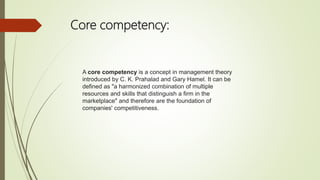
Core competency:
A core competency is a concept in management theory
introduced by C. K. Prahalad and Gary Hamel. It can be
defined as "a harmonized combination of multiple
resources and skills that distinguish a firm in the
marketplace" and therefore are the foundation of
companies' competitiveness.
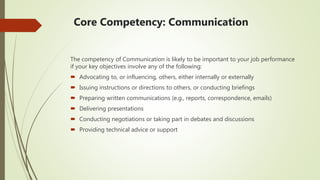
Core Competency: Communication
The competency of Communication is likely to be important to your job performance
if your key objectives involve any of the following:
 Advocating to, or influencing, others, either internally or externally
 Issuing instructions or directions to others, or conducting briefings
 Preparing written communications (e.g., reports, correspondence, emails)
 Delivering presentations
 Conducting negotiations or taking part in debates and discussions
 Providing technical advice or support
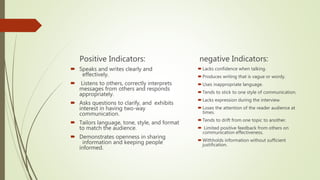
Positive Indicators:
 Speaks and writes clearly and
effectively.
 Listens to others, correctly interprets
messages from others and responds
appropriately.
 Asks questions to clarify, and exhibits
interest in having two-way
communication.
 Tailors language, tone, style, and format
to match the audience.
 Demonstrates openness in sharing
information and keeping people
informed.
negative Indicators:
Lacks confidence when talking.
Produces writing that is vague or wordy.
Uses inappropriate language.
Tends to stick to one style of communication.
Lacks expression during the interview.
Loses the attention of the reader audience at
times.
Tends to drift from one topic to another.
 Limited positive feedback from others on
communication effectiveness.
Withholds information without sufficient
justification.
Demonstration at work:
 Participating in team discussions and debates
 Preparing written documents, reports, or correspondence
 Providing technical advice or support appropriate to your audience, either face
to face, by telephone, by email, or in writing
 Delivering presentations to different audiences
 Promoting ideas, or presenting a convincing case with the aim of influencing
others
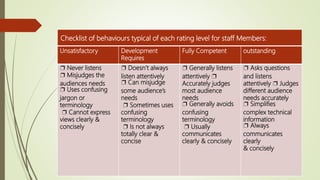
Unsatisfactory Development
Requires
Fully Competent outstanding
❐ Never listens
❐ Misjudges the
audiences needs
❐ Uses confusing
jargon or
terminology
❐ Cannot express
views clearly &
concisely
❐ Doesn’t always
listen attentively
❐ Can misjudge
some audience’s
needs
❐ Sometimes uses
confusing
terminology
❐ Is not always
totally clear &
concise
❐ Generally listens
attentively ❐
Accurately judges
most audience
needs
❐ Generally avoids
confusing
terminology
❐ Usually
communicates
clearly & concisely
❐ Asks questions
and listens
attentively ❐ Judges
different audience
needs accurately
❐ Simplifies
complex technical
information
❐ Always
communicates
clearly
& concisely
Checklist of behaviours typical of each rating level for staff Members:
Manager:
 You are required to demonstrate this competency at work:
 Leading team discussions and debates.
 Communicating instruction, directions or guidance to staff members, individually
and in groups.
 Preparing complex written documents, reports, or correspondence
 Targeting communications to address the needs of a wide range of different
audiences, either face to face, by telephone , by email, or in writing
 Delivering high level presentations
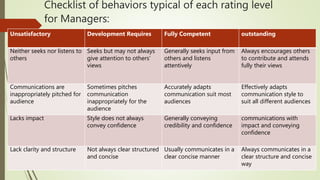
Checklist of behaviors typical of each rating level
for Managers:
Unsatisfactory Development Requires Fully Competent outstanding
Neither seeks nor listens to
others
Seeks but may not always
give attention to others’
views
Generally seeks input from
others and listens
attentively
Always encourages others
to contribute and attends
fully their views
Communications are
inappropriately pitched for
audience
Sometimes pitches
communication
inappropriately for the
audience
Accurately adapts
communication suit most
audiences
Effectively adapts
communication style to
suit all different audiences
Lacks impact Style does not always
convey confidence
Generally conveying
credibility and confidence
communications with
impact and conveying
confidence
Lack clarity and structure Not always clear structured
and concise
Usually communicates in a
clear concise manner
Always communicates in a
clear structure and concise
way
Managers of managers:
You are required to demonstrate this competency in your work:
 Communicating direction or strategy to managers
 Leading high level negotiations, often with external parties and involving complex,
sensitive, or political issues
 Preparing high level written documents, reports, or correspondence
 Communicating with diverse audiences, including internal and external parties, and the
media
 Representing the Organization formally and informally at events, including delivering high
level presentations and public speaking engagements
 Engaging in high level advocacy work
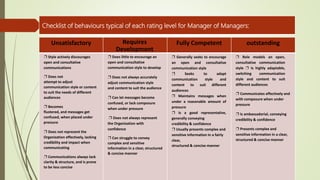
Unsatisfactory Requires
Development
Fully Competent outstanding
❐ Style actively discourages
open and consultative
communications
❐ Does not
attempt to adjust
communication style or content
to suit the needs of different
audiences
❐ Becomes
flustered, and messages get
confused, when placed under
pressure
❐ Does not represent the
Organization effectively, lacking
credibility and impact when
communicating
❐ Communications always lack
clarity & structure, and is prone
to be less concise
❐ Does little to encourage an
open and consultative
communication style to develop
❐ Does not always accurately
adjust communication style
and content to suit the audience
❐ Can let messages become
confused, or lack composure
when under pressure
❐ Does not always represent
the Organization with
confidence
❐ Can struggle to convey
complex and sensitive
information in a clear, structured
& concise manner
❐ Generally seeks to encourage
an open and consultative
communication style
❐ Seeks to adapt
communication style and
content to suit different
audiences
❐ Maintains messages when
under a reasonable amount of
pressure
❐ Is a good representative,
generally conveying
credibility & confidence
❐ Usually presents complex and
sensitive information in a fairly
clear,
structured & concise manner
❐ Role models an open,
consultative communication
style ❐ Is highly adaptable,
switching communication
style and content to suit
different audiences
❐ Communicates effectively and
with composure when under
pressure
❐ Is ambassadorial, conveying
credibility & confidence
❐ Presents complex and
sensitive information in a clear,
structured & concise manner
Checklist of behaviours typical of each rating level for Manager of Managers:
Learning by Doing:
 Consider becoming involved in social bodies or committees within the Organization. Consider
committees and societies that involve verbal presentations and public speaking (e.g. debating
societies, community groups, etc.). Volunteer to act as spokesperson at meetings to get more
practice.
 After giving a verbal presentation, identify colleagues who are present who are recognized within the
Organization as being effective communicators. Ask these people for feedback and attempt to
incorporate their feedback into future verbal presentations.
 Consider finding a mentor/colleague who can help you experiment with presentation formats and
delivery.
 Before producing a key piece of written communication, spend time identifying the main issues and
the overall goal of your communication. You should give thought to the best way of structuring the
information, (e.g., introduction, clearly headed paragraphs or main points, conclusions and
recommendations).
 Look back at some of your own written communication and ask yourself how it could be made
clearer and more concise. Is your communication jargon free with appropriate punctuation? Ask
your manager or a colleague to critically evaluate your work and give you some tips on areas of
improvement.
 When you write a letter or report for the Organization, try to think about what information the
reader needs or wants to know. Review your work to remove irrelevant or inappropriate
 information and add anything that is missing.
 Before you send out any written communication, read it through to check that it makes sense, that it
conveys the message you intend and that it contains the information required. Finally, check that the
spelling and punctuation are correct.
Cont.
 Practice and rehearse important presentations in front of a mirror. If possible, gain access to
a video or at least an audio tape recorder, and record your presentation. Play it back and
make a note of areas that didn’t come across as well as they should have, then repeat the
process and try again.
 When you make formal presentations as a representative ensure that you prepare well in
advance. You should try to identify your objectives and what you hope to achieve, and then
try to anticipate the audience’s objectives and potential reaction to your presentation. You
may wish to consider the use of visual aids or packages such as Microsoft PowerPoint to
make the presentation more interesting. Finally, practice in advance rehearsing the content
and style of delivery and being conscious of time management.
 When you are explaining something to someone, make sure that you pause to regularly
check that they have understood what you have said. If they have not understood, try to
identify what you need to alter to be more easily understood.
 After taking part in meetings, go through your own contribution and evaluate the degree to
which you effectively communicated. Look at your behaviour in comparison with that of
others present. Were you able to make contributions without being interrupted or
interrupting others inappropriately? Did you speak firmly, clearly and economically?
Learning by Listening/Watching:
 Identify some people in the Organization who you feel are excellent communicators. Take
some time to review their style and use of grammar in their communication. If possible ask
them about how they structure their communication and see which tactics you could
adopt.
 In both formal and informal group situations, try to watch other people communicating
and see what techniques, both verbal and non-verbal, that you could incorporate into your
own communication.
 You could watch and listen to television and radio programmes involving confident
communicators and try to remember to identify the differences between good and bad
communication, for instance a speech made by the Secretary-General. Pay particular
attention to differences in the content and structure of the message, as well as the style of
delivery, both verbal and non-verbal.
 Listen to how good speakers vary the tone, pitch and volume of their voices to emphasize
key points and keep the audience’s attention. If at all possible, you could record yourself
so that you can listen to how effectively you are doing this. It may also help to have a
friend or colleague critique your performance.
 Get familiar with the key figures in the Organization and try to get to listen to them speak.
Strategic interpersonal communication

Strategic interpersonal communication

  • 1.
  • 2.
    Core competency: A corecompetency is a concept in management theory introduced by C. K. Prahalad and Gary Hamel. It can be defined as "a harmonized combination of multiple resources and skills that distinguish a firm in the marketplace" and therefore are the foundation of companies' competitiveness.
  • 3.
    Core Competency: Communication Thecompetency of Communication is likely to be important to your job performance if your key objectives involve any of the following:  Advocating to, or influencing, others, either internally or externally  Issuing instructions or directions to others, or conducting briefings  Preparing written communications (e.g., reports, correspondence, emails)  Delivering presentations  Conducting negotiations or taking part in debates and discussions  Providing technical advice or support
  • 4.
    Positive Indicators:  Speaksand writes clearly and effectively.  Listens to others, correctly interprets messages from others and responds appropriately.  Asks questions to clarify, and exhibits interest in having two-way communication.  Tailors language, tone, style, and format to match the audience.  Demonstrates openness in sharing information and keeping people informed. negative Indicators: Lacks confidence when talking. Produces writing that is vague or wordy. Uses inappropriate language. Tends to stick to one style of communication. Lacks expression during the interview. Loses the attention of the reader audience at times. Tends to drift from one topic to another.  Limited positive feedback from others on communication effectiveness. Withholds information without sufficient justification.
  • 5.
    Demonstration at work: Participating in team discussions and debates  Preparing written documents, reports, or correspondence  Providing technical advice or support appropriate to your audience, either face to face, by telephone, by email, or in writing  Delivering presentations to different audiences  Promoting ideas, or presenting a convincing case with the aim of influencing others
  • 6.
    Unsatisfactory Development Requires Fully Competentoutstanding ❐ Never listens ❐ Misjudges the audiences needs ❐ Uses confusing jargon or terminology ❐ Cannot express views clearly & concisely ❐ Doesn’t always listen attentively ❐ Can misjudge some audience’s needs ❐ Sometimes uses confusing terminology ❐ Is not always totally clear & concise ❐ Generally listens attentively ❐ Accurately judges most audience needs ❐ Generally avoids confusing terminology ❐ Usually communicates clearly & concisely ❐ Asks questions and listens attentively ❐ Judges different audience needs accurately ❐ Simplifies complex technical information ❐ Always communicates clearly & concisely Checklist of behaviours typical of each rating level for staff Members:
  • 7.
    Manager:  You arerequired to demonstrate this competency at work:  Leading team discussions and debates.  Communicating instruction, directions or guidance to staff members, individually and in groups.  Preparing complex written documents, reports, or correspondence  Targeting communications to address the needs of a wide range of different audiences, either face to face, by telephone , by email, or in writing  Delivering high level presentations
  • 8.
    Checklist of behaviorstypical of each rating level for Managers: Unsatisfactory Development Requires Fully Competent outstanding Neither seeks nor listens to others Seeks but may not always give attention to others’ views Generally seeks input from others and listens attentively Always encourages others to contribute and attends fully their views Communications are inappropriately pitched for audience Sometimes pitches communication inappropriately for the audience Accurately adapts communication suit most audiences Effectively adapts communication style to suit all different audiences Lacks impact Style does not always convey confidence Generally conveying credibility and confidence communications with impact and conveying confidence Lack clarity and structure Not always clear structured and concise Usually communicates in a clear concise manner Always communicates in a clear structure and concise way
  • 9.
    Managers of managers: Youare required to demonstrate this competency in your work:  Communicating direction or strategy to managers  Leading high level negotiations, often with external parties and involving complex, sensitive, or political issues  Preparing high level written documents, reports, or correspondence  Communicating with diverse audiences, including internal and external parties, and the media  Representing the Organization formally and informally at events, including delivering high level presentations and public speaking engagements  Engaging in high level advocacy work
  • 10.
    Unsatisfactory Requires Development Fully Competentoutstanding ❐ Style actively discourages open and consultative communications ❐ Does not attempt to adjust communication style or content to suit the needs of different audiences ❐ Becomes flustered, and messages get confused, when placed under pressure ❐ Does not represent the Organization effectively, lacking credibility and impact when communicating ❐ Communications always lack clarity & structure, and is prone to be less concise ❐ Does little to encourage an open and consultative communication style to develop ❐ Does not always accurately adjust communication style and content to suit the audience ❐ Can let messages become confused, or lack composure when under pressure ❐ Does not always represent the Organization with confidence ❐ Can struggle to convey complex and sensitive information in a clear, structured & concise manner ❐ Generally seeks to encourage an open and consultative communication style ❐ Seeks to adapt communication style and content to suit different audiences ❐ Maintains messages when under a reasonable amount of pressure ❐ Is a good representative, generally conveying credibility & confidence ❐ Usually presents complex and sensitive information in a fairly clear, structured & concise manner ❐ Role models an open, consultative communication style ❐ Is highly adaptable, switching communication style and content to suit different audiences ❐ Communicates effectively and with composure when under pressure ❐ Is ambassadorial, conveying credibility & confidence ❐ Presents complex and sensitive information in a clear, structured & concise manner Checklist of behaviours typical of each rating level for Manager of Managers:
  • 11.
    Learning by Doing: Consider becoming involved in social bodies or committees within the Organization. Consider committees and societies that involve verbal presentations and public speaking (e.g. debating societies, community groups, etc.). Volunteer to act as spokesperson at meetings to get more practice.  After giving a verbal presentation, identify colleagues who are present who are recognized within the Organization as being effective communicators. Ask these people for feedback and attempt to incorporate their feedback into future verbal presentations.  Consider finding a mentor/colleague who can help you experiment with presentation formats and delivery.  Before producing a key piece of written communication, spend time identifying the main issues and the overall goal of your communication. You should give thought to the best way of structuring the information, (e.g., introduction, clearly headed paragraphs or main points, conclusions and recommendations).  Look back at some of your own written communication and ask yourself how it could be made clearer and more concise. Is your communication jargon free with appropriate punctuation? Ask your manager or a colleague to critically evaluate your work and give you some tips on areas of improvement.  When you write a letter or report for the Organization, try to think about what information the reader needs or wants to know. Review your work to remove irrelevant or inappropriate  information and add anything that is missing.  Before you send out any written communication, read it through to check that it makes sense, that it conveys the message you intend and that it contains the information required. Finally, check that the spelling and punctuation are correct.
  • 12.
    Cont.  Practice andrehearse important presentations in front of a mirror. If possible, gain access to a video or at least an audio tape recorder, and record your presentation. Play it back and make a note of areas that didn’t come across as well as they should have, then repeat the process and try again.  When you make formal presentations as a representative ensure that you prepare well in advance. You should try to identify your objectives and what you hope to achieve, and then try to anticipate the audience’s objectives and potential reaction to your presentation. You may wish to consider the use of visual aids or packages such as Microsoft PowerPoint to make the presentation more interesting. Finally, practice in advance rehearsing the content and style of delivery and being conscious of time management.  When you are explaining something to someone, make sure that you pause to regularly check that they have understood what you have said. If they have not understood, try to identify what you need to alter to be more easily understood.  After taking part in meetings, go through your own contribution and evaluate the degree to which you effectively communicated. Look at your behaviour in comparison with that of others present. Were you able to make contributions without being interrupted or interrupting others inappropriately? Did you speak firmly, clearly and economically?
  • 13.
    Learning by Listening/Watching: Identify some people in the Organization who you feel are excellent communicators. Take some time to review their style and use of grammar in their communication. If possible ask them about how they structure their communication and see which tactics you could adopt.  In both formal and informal group situations, try to watch other people communicating and see what techniques, both verbal and non-verbal, that you could incorporate into your own communication.  You could watch and listen to television and radio programmes involving confident communicators and try to remember to identify the differences between good and bad communication, for instance a speech made by the Secretary-General. Pay particular attention to differences in the content and structure of the message, as well as the style of delivery, both verbal and non-verbal.  Listen to how good speakers vary the tone, pitch and volume of their voices to emphasize key points and keep the audience’s attention. If at all possible, you could record yourself so that you can listen to how effectively you are doing this. It may also help to have a friend or colleague critique your performance.  Get familiar with the key figures in the Organization and try to get to listen to them speak.