International Association for Impact Assessment
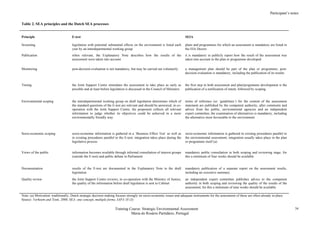
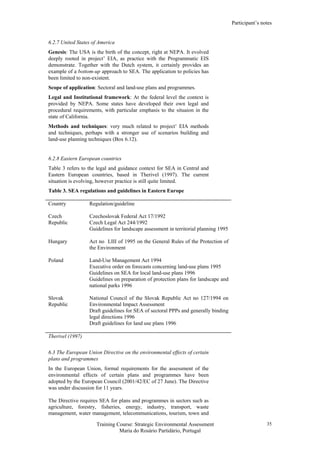
IAIA Training Courses
Course Manual
STRATEGIC ENVIRONMENTAL ASSESSMENT (SEA)
current practices, future demands and capacity-building
needs
by
Maria Rosário Partidário
(env. eng., MSc, PhD)
Portugal, Lisbon
Fax: 351-21-294 8554
e-mail: mp@fct.unl.pt
http://campus.fct.unl.pt/mp/
Training Course: Strategic Environmental Assessment
Maria do Rosário Partidário, Portugal
1
Table of contents
1. Introduction................................................................................................................1
2. Background to the development of SEA ...................................................................2
3. Concepts and notion of SEA - What is SEA?............................................................7
4. Principles of SEA.....................................................................................................14
5. Relationship with other instruments of environmental policy and management.....20
6. International experience with SEA – procedural models and approaches...............22
7. Application of SEA in urban and territorial planning..............................................38
8. Elements for an SEA framework .............................................................................40
9. SEA procedural methodologies , methods and techniques......................................42
References....................................................................................................................62
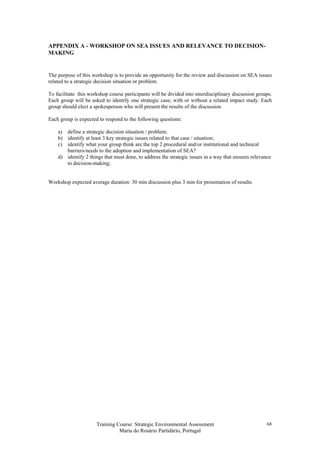
APPENDIX A - WORKSHOP ON SEA ISSUES AND RELEVANCE TO
DECISION-MAKING .................................................................................................68
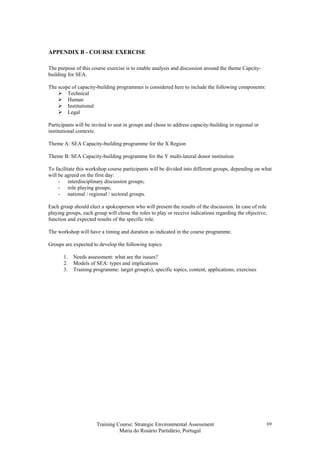
APPENDIX B - COURSE EXERCISE.......................................................................69
Participant’s notes
Training Course: Strategic Environmental Assessment
Maria do Rosário Partidário, Portugal
1
STRATEGIC ENVIRONMENTAL ASSESSMENT (SEA)
IAIA’03 Pre-Meeting Training Course
conducted by: Maria Rosário Partidário (env.eng., MSc, PhD)
1. Introduction
This manual was prepared to assist a two days training course on
Strategic Environmental Assessment, as a pre-meeting course of the
International Association for Impact Assessment (IAIA).
It contains background information on the evolution, concepts and
principles of SEA, based on existing literature. It also refers to existing
legislation, procedure and guidance on SEA, reproducing examples from
different international contexts. It addresses the practical implementation
of SEA, looking at SEA as a set of framework elements that can be built
into existing decision-making procedures, and also SEA as a more
rationale and streamlined procedure. It refers to methods used, illustrated
by examples of policy, planning and programming case-studies as applied
in practice.
This training course on SEA has the double aim of introducing key
concepts and issues that significantly distinguish SEA from other
environmental assessment and management tools while at the same time
offer a discussion forum on current SEA experiences. The course
attempts to provide a perspective on different approaches to SEA at the
international level, taking participants across key elements than define
good practice SEA in different systems, rather than focussing only on one
methodology or procedure. Numerous case-examples are used to illustrate
full process SEA, or just some key steps or issues within an SEA.
The course instructor is Dr. Maria Rosário Partidario, currently Professor
at the New University of Lisbon, Portugal. Maria is a PhD on SEA
(Aberdeen University, Scotland, 1992), has co-edited two books on SEA
and authored numerous chapters and articles on SEA. She is an
international consultant and a long-standing trainer. Maria has organized
and conducted over 20 short training courses on EIA, and 15 training
courses on SEA.
Contacts: mp@fct.unl.pt, fax: 351-21-294 8554
Participant’s notes
Training Course: Strategic Environmental Assessment
Maria do Rosário Partidário, Portugal
2
2. Background to the development of SEA
2.1 Motivation for SEA
During the last decade the world has witnessed a rapid, though
controversial, evolution of the environmental policy agenda. Increasingly,
traditional environmental decision-making is being questioned, not
because it has not developed sufficient legal mechanisms or
methodological tools, or because it did not seek to find solutions for
critical environmental degradation, but essentially because it is not
efficiently responding to the new challenges of the late 20th century, as
confirmed and proclaimed by the United Nations Conference on
Environment and Development in 1992. In particular, it is not fully
achieving the initially expected results regarding environmental
soundness and integration with economic and social issues.
Despite this apparently negative trend, much effort is dedicated to
improving environmental performances, to increasing environmental
awareness across development sectors, in public, governmental, or private
decision-making, in inviting and guiding change in decisional attitudes
and its supporting values. Significant environmental policy evolution is
occurring not only in the developed world but also in the developing and
transitional economies.
Strategic Environmental Assessment (SEA) has been emerging in this
context. May be not surprisingly. There is an increasing complexity
behind and around current development and decision-making processes
derived from the explosion of electronic communications, the speedness
of information production and outdateness, the emerging societal values
of equity and fairness, the urgence of rational decisions supported by
scarce or defective information and conflictual priorities, all development
vectors that call for new forms of proactive intervention in more strategic
contexts.
Project’ Environmental Impact Assessment (EIA), as currently practiced,
has been unable to respond to this increasing complexity and provide for
global, sustainable and sound decision-making. Such desilusion with the
capacity of project' EIA to assist, as a single tool, sound environmental
decision-making in a tiering system was the strongest argument that
determined the need for SEA in its early days (Lee and Walsh, 1992;
Therivel et al., 1992; Wood and Djeddour, 1992; Sadler and Verheem,
1996). The reasons are various and can be summarized as (Partidário,
1999):
• the timing of decisions: project’s EIA takes place at a stage when it
is too late to consider the effects of policy and planning critical
decisions; these happen in the absence of a systematic impact
assessment process, which outcome could subsequently influence
project planning and design;
• the nature of decisions: the less concrete and more vague nature of
policy and planning decisions, often its incremental nature, through
small, sequential and iterative decisions that challenge rational and
systematic processes was seen as a significant constraint to the
operation of a pragmatic, technically focused, and rationally
oriented tool such as EIA; a new impact assessment tool, inherently
adaptable to more strategic, and often incremental, levels of
decision-making, was therefore needed;
• the level of information: at the policy and planning level often there
are serious limitations in the availability of information, and a
Participant’s notes
Training Course: Strategic Environmental Assessment
Maria do Rosário Partidário, Portugal
3
reasonable uncertainty regarding action implementation and
respective timings; this impeded the satisfaction of project EIA
needs, in terms of required detailed levels of information and
certainty.
2.2 Evolution, benefits and rationale for SEA
The National Environmental Policy Act (NEPA) is the reference back to
which we can find the first requirements for what became known as SEA.
In fact, the action-forcing mechanism, shaped as a requirement and
subsequently nominated EIA, to bring about substantive environmental
reform through the US federal bureaucracy, imposed upon federal
agencies to prepare an environmental impact statement for “legislation
and other major federal actions significantly affecting the quality of the
human environment“ (Section 102(2)(c), National Environmental Policy
Act of 1969).
Since then several international initiatives subscribe the need for SEA.
Box 2.1 lists a serious of key events that have contributed to the evolution
and consolidation of SEA.
Box 2.1 SEA key historical initiatives
1969 The National Environmental Policy Act (NEPA) passed by
the U.S. Congress, mandating all federal agencies and
departments to consider and assess the environmental effects
of proposals for legislation and other major projects.
1978 US Council for Environmental Quality (USCEQ) issues
regulations for NEPA which apply to USAID and specific
requirements for programmatic assessments
1989 The World Bank adopted an internal directive (O.D. 4.00) on
EIA which allows for the preparation of sectoral and regional
assessments
1991 The UNECE Convention on EIA in a Transboundary Context
promotes the application of EA for policies, plans and
programmes
1990 The European Economic Community issues the first proposal
for a Directive on the Environmental Assessment of Policies,
Plans and Programmes
1991 The OECD Development Assistance Committee adopted a
principles calling for specific arrangements for analysing and
monitoring environmental impacts of programme assistance
1995 The UNDP introduces the environmental overview as a
planning tool
1997 The Council of the European Union adopts a proposal for a
Council Directive on the assessment of the effects of certain
plans and programmes on the environment
2001 The UNECE issues a draft protocol on Strategic
Environmental Assessment applying to policies, plans and
programmes
2001 Council of the European Union adopts the Council Directive
2001/42/CE on 27 June on the assessment of the effects of
certain plans and programmes on the environment
Participant’s notes
Training Course: Strategic Environmental Assessment
Maria do Rosário Partidário, Portugal
4
Despite the initially arguments in the prescriptive literature since the early
1990’s, as stated above, the need for SEA does not result only from
project’s EIA insufficiencies. As more recently argued, SEA has the
capacity to support the development of policy and planning practices with
a stronger environmental component and, above all, may perform a
fundamental role in promoting sustainable principles and practices and
the consideration of cumulative effects (Wood, 1995; Partidário, 1996a;
Sadler, 1998; Fischer, 1999; Goodland and Mercier, 1999; Clark, 2000;
Partidário, 2000) (Box 2.2).
Box 2.2 Aims and objectives of SEA
To help achieve environmental protection and sustainable
development by:
• Consideration of environmental effects of proposed strategic
actions
• Identification of the best practicable environmental option
• Early warning of cumulative effects and large-scale changes
To strengthen and streamline project EIA by:
• Prior identification of scope of potential impacts and
information needs
• Clearance of strategic issues and concerns related to
justification of proposals
• Reducing the time and effort necessary to conduct individual
reviews
To integrate the environment into sector-specific decision-making
by:
• Promoting environmentally sound and sustainable proposals
• Changing the way decisions are made
Source: UK-DETR, International Seminar on SEA, Lincoln, May 1998
Increasingly decision-makers believe that SEA has the capacity to
influence the environmental, and sustainability nature of such strategic
decisions, and provide for sound, integrated and sustainable policy and
planning frameworks.
It is also suggested that, as a consequence of SEA, more sound and
environmentally-sensitive policies and plans would incorporate the
necessary requirements for the subsequent development of projects.
Goodland and Tillman (1995) compare traditional reactive EA and
strategic proactive EA, arguing that "traditional reactive project level EIA
is necessary but not sufficient to exploit opportunities which exist today
but which may be gone tomorrow".
The extension of project' EIA principles to the policy and planning levels
did not succeed without some resistance. It was argued that broad
principles of environmental assessment were already incorporated in the
decision-making process at that level, and that the adoption of SEA in a
systematic manner would represent only marginal advantages.
Participant’s notes
Training Course: Strategic Environmental Assessment
Maria do Rosário Partidário, Portugal
5
Particularly in physical planning, practitioners claimed that plans already
covered project' EIA requirements, using similar methodologies such as
scope of analysis (natural, social and economic issues), comparison of
alternative solutions and conflict-resolution approaches.
Currently there seems to exist a good consensus as to the need for a new
form of environmental assessment that runs at higher levels of decision-
making, tiering to project’s EIA (Figure 1).
2.3 SEA and sustainability
The concept of SEA has been evolving strongly associated to the
achievements of sustainability practices and the consideration of
cumulative effects (Boxes 2.2 and 2.3).
It is often presented as an assessment tool contributive to the
accountability of natural capital depletion (Goodland, 1997), helping to
focus on maintaining the “source and sink” functions of natural systems
(Sadler and Verheem, 1996) or assisting the decision-making process by
influencing the design of more sustainable policies and strategies
(Partidário, 1992; Therivel and Partidário, 1996).
In some cases sustainability remains an implicit background policy. In
other cases sustainability issues are used as (Partidário, 1996b):
(i) benchmarks against which objectives and criteria in SEA can
be measured; or
(ii) a strong policy that helps to shape new forms of decision-
making in support of sustainable development.
Box 2.3 SEA contribution towards sustainability
1. Provides broader environmental vision
2. Ensures early consideration of environmental issues
3. Anticipates environmental impacts
4. Facilitates environmentally-oriented chain of actions
5. Contributes to integrated policy-making and planning
An SEA framework has the potential to allow the principles of
sustainability to be carried down from policies to individual projects if the
following conditions are met (Partidário, 1999):
• a policy framework is in place, establishing the articulation
across sectoral policies and institutional contexts;
• credible and feasible strategic options allow evaluation of a
decision based on comparable rather than in absolute values;
• recognition that policy and planning decisions are uncertain and
incremental;
• simple though pragmatic indicators that can assist monitoring of
the decisions to determine the actual effects;
• good communications mechanisms to ensure that all partners in
the SEA process are adequately involved and their perspectives
contemplated.
SEA can play a significant role in enhancing the integration of
environmental concerns in policy and planning processes, thereby helping
Participant’s notes
Training Course: Strategic Environmental Assessment
Maria do Rosário Partidário, Portugal
6
to implement sustainable development. A more integrated system of
planning means that environmental and sustainability criteria are
incorporated throughout the planning process, for example, in the
identification of suitable (or unsuitable) locations for development, and in
the assessment of policy alternatives.
More recently Sadler (1999) speaks about the shortcomings of EIA and
SEA in “realizing their full potential as a means of providing
environmental sustainability assurance (ESA) for development decision-
making”, and proposes “ESA as a new framework for assessing the
sustainability of development trends, options and proposals, identifying
EIA and SEA as front-line instruments for this purpose”.
Likewise, developments in the United Kingdom (DETR, 1999) show a
move towards the adoption of sustainability appraisal at the regional
planning level, ensuring in this way that not only environmental, but also
social and economic issues are well integrated and considered in the
policy and planning processes.
Participant’s notes
Training Course: Strategic Environmental Assessment
Maria do Rosário Partidário, Portugal
7
3. Concepts and notion of SEA - What is SEA?
3.1 SEA at policy, planning and programme level
Over the years, Strategic Environmental Assessment (SEA) became
recognized as a form of environmental assessment that can assist
managers and leaders in policy, planning and programmatic decisions.
However it would be more fair to say that SEA is a member of the family
of impact assessment tools, as the range of concerns in SEA go far
beyond environmental issues.
It has been evolving as a family of tools, covering decision-making levels
from Policy to Programming, where it more evidently interfaces the scope
of application of Project’ EIA.
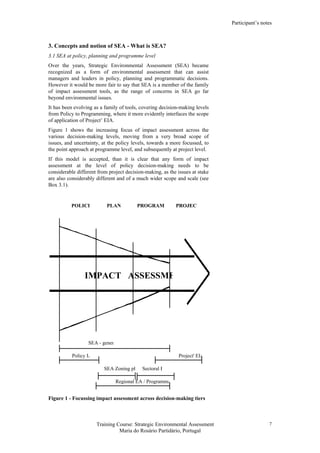
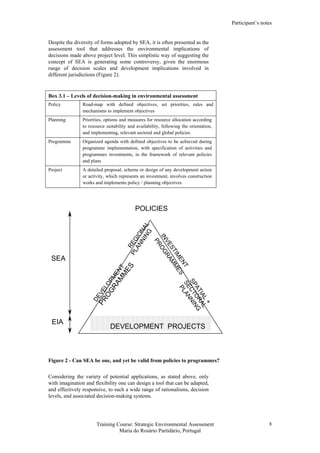
Figure 1 shows the increasing focus of impact assessment across the
various decision-making levels, moving from a very broad scope of
issues, and uncertainty, at the policy levels, towards a more focussed, to
the point approach at programme level, and subsequently at project level.
If this model is accepted, than it is clear that any form of impact
assessment at the level of policy decision-making needs to be
considerable different from project decision-making, as the issues at stake
are also considerably different and of a much wider scope and scale (see
Box 3.1).
IMPACT ASSESSME
POLICIE PLAN PROGRAMM PROJECT
SEA - gener
Policy IA Project' EIA
Regional EA / Programma
Sectoral ESEA Zoning pl
Figure 1 - Focussing impact assessment across decision-making tiers
Participant’s notes
Training Course: Strategic Environmental Assessment
Maria do Rosário Partidário, Portugal
8
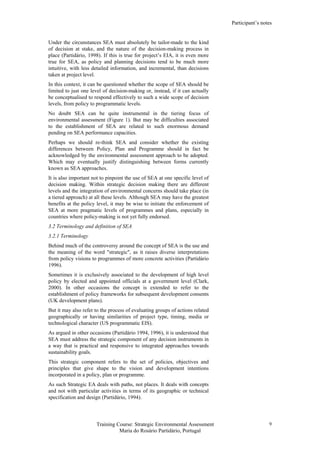
Despite the diversity of forms adopted by SEA, it is often presented as the
assessment tool that addresses the environmental implications of
decisions made above project level. This simplistic way of suggesting the
concept of SEA is generating some controversy, given the enormous
range of decision scales and development implications involved in
different jurisdictions (Figure 2).
Box 3.1 – Levels of decision-making in environmental assessment
Policy Road-map with defined objectives, set priorities, rules and
mechanisms to implement objectives
Planning Priorities, options and measures for resource allocation according
to resource suitability and availability, following the orientation,
and implementing, relevant sectoral and global policies
Programme Organized agenda with defined objectives to be achieved during
programme implementation, with specification of activities and
programmes investments, in the framework of relevant policies
and plans
Project A detailed proposal, scheme or design of any development action
or activity, which represents an investment, involves construction
works and implements policy / planning objectives
REGIONAL
DEVELOPM
ENT
PLANNING
PROGRAM
M
ES
INVESTIM
ENT
PROGRAM
M
ES
SPATIAL
+
SECTORAL
PLANNING
DEVELOPMENT PROJECTS
EIA
SEA
POLICIES
Figure 2 - Can SEA be one, and yet be valid from policies to programmes?
Considering the variety of potential applications, as stated above, only
with imagination and flexibility one can design a tool that can be adapted,
and effectively responsive, to such a wide range of rationalisms, decision
levels, and associated decision-making systems.
Participant’s notes
Training Course: Strategic Environmental Assessment
Maria do Rosário Partidário, Portugal
9
Under the circunstances SEA must absolutely be tailor-made to the kind
of decision at stake, and the nature of the decision-making process in
place (Partidário, 1998). If this is true for project’s EIA, it is even more
true for SEA, as policy and planning decisions tend to be much more
intuitive, with less detailed information, and incremental, than decisions
taken at project level.
In this context, it can be questioned whether the scope of SEA should be
limited to just one level of decision-making or, instead, if it can actually
be conceptualised to respond effectively to such a wide scope of decision
levels, from policy to programmatic levels.
No doubt SEA can be quite instrumental in the tiering focus of
environmental assessment (Figure 1). But may be difficulties associated
to the establishment of SEA are related to such enormous demand
pending on SEA performance capacities.
Perhaps we should re-think SEA and consider whether the existing
differences between Policy, Plan and Programme should in fact be
acknowledged by the environmental assessment approach to be adopted.
Which may eventually justify distinguishing between forms currently
known as SEA approaches.
It is also important not to pinpoint the use of SEA at one specific level of
decision making. Within strategic decision making there are different
levels and the integration of environmental concerns should take place (in
a tiered approach) at all these levels. Although SEA may have the greatest
benefits at the policy level, it may be wise to initiate the enforcement of
SEA at more pragmatic levels of programmes and plans, especially in
countries where policy-making is not yet fully endorsed.
3.2 Terminology and definition of SEA
3.2.1 Terminology
Behind much of the controversy around the concept of SEA is the use and
the meaning of the word "strategic", as it raises diverse interpretations
from policy visions to programmes of more concrete activities (Partidário
1996).
Sometimes it is exclusively associated to the development of high level
policy by elected and appointed officials at a government level (Clark,
2000). In other occasions the concept is extended to refer to the
establishment of policy frameworks for subsequent development consents
(UK development plans).
But it may also refer to the process of evaluating groups of actions related
geographically or having similarities of project type, timing, media or
technological character (US programmatic EIS).
As argued in other occasions (Partidário 1994, 1996), it is understood that
SEA must address the strategic component of any decision instruments in
a way that is practical and responsive to integrated approaches towards
sustainability goals.
This strategic component refers to the set of policies, objectives and
principles that give shape to the vision and development intentions
incorporated in a policy, plan or programme.
As such Strategic EA deals with paths, not places. It deals with concepts
and not with particular activities in terms of its geographic or technical
specification and design (Partidário, 1994).
Participant’s notes
Training Course: Strategic Environmental Assessment
Maria do Rosário Partidário, Portugal
10
Practice shows that an effective SEA is not only about science, but also
about values. In assessing the environmental consequences of policies,
plans and programmes sufficient attention should be given to the values
of the affected communities and to the communication mechanisms
available or necessary.
What needs to be stressed is that SEA requires great adaptiveness and
flexibility in its decision context, as it deals with a range of mixed forces,
acting in many fronts, different societal values and high levels of
uncertainty in terms of expected outcomes. But facing uncertain outcomes
does not necessarily imply a strategic decision.
Whilst the existence of uncertainty factors is inexorably linked to the
nature of a strategic decision, there is an whole range of uncertainties
associated with the development of particular projects which do not carry
the broad visionary and precluding nature that characterizes SEA.
Under the circumstances, there may be no universal approach to SEA that
can satisfy each socio-political context of decision-making. Each country
or political and economic system will need to adopt the approach that
more clearly identifies the process of EA applied to policies, planning and
programmes.
3.2.2 Definition of SEA
Defining SEA is not easy. Few have attempted to venture further than to
say that SEA is the environmental assessment of policies, plans and
programmes.
An early and widely quoted definition of SEA, by Therivel et al., 1992,
is:
“the formalised, systematic and comprehensive process of evaluating the
environmental impacts of a policy, plan or programme and its
alternatives, including the preparation of a written report on the findings
of that evaluation, and using the findings in publicly accountable
decision-making”.
This definition characterizes the earlier days of SEA representing an
extension of project EIA to the so-called earlier levels of decision-
making, as noted in the expressions “systematic procedure”, “preparation
of a written report” and “using the findings in publicly accountable
decision-making”.
This concept of SEA persisted in Sadler and Verheem, 1996 proposed
definition:
“SEA is a systematic process for evaluating the environmental
consequences of proposed policy, plan or programme initiatives in order
to ensure they are fully included and appropriately addressed at the
earliest appropriate stage of decision-making on par with economic and
social considerations”.
The complexity associated with the idea, and the need to stress the
continuous, proactive and integrated nature of SEA motivated yet another
formulation, which attempts to highlight the notion of SEA as a process,
rather than as the production of a report, its adaptive, continuing and
incremental nature, broad scope to encompass sustainability issues and
focus on visions and initiatives rather than on concrete actions and
outcomes (Partidário, 1999):
Participant’s notes
Training Course: Strategic Environmental Assessment
Maria do Rosário Partidário, Portugal
11
SEA is a systematic, on-going process for evaluating, at the earliest
appropriate stage of publicly accountable decision-making, the
environmental quality, and consequences, of alternative visions and
development intentions incorporated in policy, planning or programme
initiatives, ensuring full integration of relevant biophysical, economic,
social and political considerations (Partidário, 1999).
Despite its broader perspective, it still remains a complex definition. For
practical purposes, two other definitions are rather complementary and
can be used:
“SEA of a proposed policy is an appraisal of the environmental impacts
of a policy which is used in decision-making” (Thérivel, 1997).
“SEA is an instrument that must be adapted to existing decision-making
processes. It is more political than technical, and is related to concepts,
rather than to activities with geographic and technological specifications.”
(Partidário, 2000).
3.3 Forms and applications of SEA - The Strategic Environmental
Assessment family
SEA has been adopting a wide range of different forms as it evolved. Box
3.2 offers a perspective on the array of SEA forms as they are currently
known (Webb and Sigal 1992, World Bank 1993, Sadler and Verheem
1996, World Bank 1996, Brown 1997, Goodland 1997, Partidário, 2002).
Goodland (1997) calls it the SEA family, illustrating the variety of SEA
tools associated to similar principles.
While the rationale and general aim is essentially the same, these different
forms of SEA result fundamentally from national and institutional
development of evaluation tools according to particular policy-making
and planning processes and needs.
For example, while the World Bank created the concept of Regional and
Sectoral EAs, the United Nations Development Programme developed the
Environmental Overview as an SEA approach. Likewise, SEA in Canada
it started to be addressed as Policy Environmental Assessment, while in
the USA Programmatic Environmental Impact Assessment has been the
expression in use.
Accordingly, the emergence of different assessment objectives and needs
of varying scales and nature also generated a considerable range of
potential applications of SEA, such as those indicated in Box 3.3.
Box 3.2 Main forms of SEA applied to policies, plans or
Participant’s notes
Training Course: Strategic Environmental Assessment
Maria do Rosário Partidário, Portugal
12
programmes
Policy SEA
• Policy Impact Assessment – environmental assessment of
policy proposals to Cabinet approval (Canada)
• Environmental-test - assessment of government legislation
proposals (the Netherlands)
• SEA of governmental proposals - assessment of government
legislation proposals (Denmark)
Regional and Spatial Planning SEA
• Regional EA - evaluation of regional environmental and social
implications of multi-sectoral developments in a defined
geographic area, over a certain period (WB)
• SEAn (Strategic Environmental Assessment Analysis) – based
on community involvement applies SEA in developing
countries (Dutch Aid Agency)
• Environmental Appraisal of Development Plans – assessment
of planning policies as council level, with main biophysical
insight (UK)
• Sustainability Appraisal of Regional Planning – assessment of
regional policy proposals, attempting a broader
environmental sustainability approach (UK)
Sector Planning and Programme SEA
• Environmental Overview - applies to the formulation stages of
programmes, leads to early identification of environmental
and social impacts and opportunities and incorporation of
mitigation measures into programme redesign (UNDP)
• Sectoral EA - evaluation of sector investment programmes
involving multiple sub-projects; integration of environmental
concerns into long-term development; and investment
planning or the evaluation of sector policies (WB)
Regional, Spatial and Sector Planning
and Programme SEA
• Strategic EIA – SEA applied to spatial plans and programmes
using the project’s EIA procedure (the Netherlands)
• Programmatic environmental assessment - process of
evaluating groups of actions related geographically or having
similarities of project type, timing, media or technological
character (USA)
Participant’s notes
Training Course: Strategic Environmental Assessment
Maria do Rosário Partidário, Portugal
13
Box 3.3 Scope of SEA applications
SEA is currently or potentially applied to:
• International Treaties
• Privatisation
• Structural Operations Programmes
• National Budget
• Multi-annual investment plans
• Legislative proposals
• Sectoral and global policies
• Area-wide or land-use planning
• Sectoral planning
Participant’s notes
Training Course: Strategic Environmental Assessment
Maria do Rosário Partidário, Portugal
14
4. Principles of SEA
4.1 Priority needs for effective SEA and success factors
SEA is a well-accepted environmental assessment and decision support
tool, which role becomes increasingly more effective as earlier as it is
used. Developments on legislation and guidance are taking place in many
parts of the world, which is an evident sign of its wide acceptance.
The review of experience with practical applications of SEA has enabled
focusing on key lessons achieved, including the reasons why SEA is
considered to be important (Box 4.1), what is that SEA must do to ensure
good practice (Box 4.2) and finally what are SEA priority needs for good
practice (Box 4.3) and its success factors (Box 4.4). This has been
explored in Partidário, 1997, 1999 and 2000.
Box 4.1 Why is SEA important?
• Helps to incorporate sustainability principles in the policy-
making process
• It can influence and improve decision-making contributing to
establish an environmentally and sustainable integrated
context for the development of policies and plans
• Enables tiering of environmentally structured actions
• Provides better context for assessment of cumulative effects
• Provides screening context to lower levels EA, particularly
project’EIA
• Anticipates impacts that can occur at project level, improving
and strengthening project’ EIA
Source: adapted from Partidário, 1999
Box 4.2 For good practice SEA must:
• Discuss the policy rather than justify it, otherwise
subordination rather than added-value will occur
• Clearly identify feasible policy and planning options
(alternatives) and compare them in an assessment context
• Be clearly articulated in/with the policy-making process
• Use simple methods (e.g. strategic sustainability assessment)
• Involve the public and reflect the view of all actors
• Use good communication means
Source: Partidário, 1997
It is increasingly argued that planning and policy evaluation approaches
exist that satisfy main elements of SEA, without necessarily being
labelled as SEA. Evidence on this fact is still quite dispersed and difficult
to verify.
However, cases exist, in many parts of the world, where policy, planning
or programme development procedures require environmental
considerations. Some of these procedures require commitments, site
suitability studies and appraisal of optional locations, public consultation,
Participant’s notes
Training Course: Strategic Environmental Assessment
Maria do Rosário Partidário, Portugal
15
and a number of aspects that are similar to the SEA process. In most
situations, no SEA label is attached to those processes.
That is why it seems more adequate to invest on the notion of SEA
principles, that can influence good practice on policy-making, planning
and programme development, even where SEA does not exist as a formal
instrument.
Box 4.3- Priority needs for good practice SEA
• Policy context (sustainability policy, objectives and
strategies)
• Accountable decision-making systems
• Adaptivity nature of decision-making processes
• Be integral and well coordinated with policy-making
• Simple, interactive and flexible approaches
• Integrated approaches regarding scope and cross-interaction
of relevant factors
• Guidance and perhaps minimum regulatory context
• Demonstration of benefits - examples of good and bad
practice
• Participated process, including multiple agents and
consideration of public priorities and preferences
• Changing attitudes, overcoming prejudices, new routines in
decision-making
Source: Partidário, 1999
Box 4.4 Success factors in SEA
• Basic requirements (legal basis, administrative order, policy or
recommended requirements)
• Clear environmental policy objectives
• Good State of the Environment reporting
• Well-structured planning process
• Responsibility for compliance
• Proponent commitment and accountability
• Multiple organizations that work together
• Objectives, criteria and quality standards framework
- to assess proposal need and justification
- to assess environmental effects (losses/changes)
• Guidelines for good practice
• Resources availability
• Access to information
•Public interest and non-governmental organisations
involvement
• Independent oversight and review of the implementation and
performance (quality control)
• Inputs for decision: are SEA results timely, relevant and
influential? (use versus non-use of SEA in policy design /
approvals)
Participant’s notes
Training Course: Strategic Environmental Assessment
Maria do Rosário Partidário, Portugal
16
4.2 SEA principles of good practice
Many people are looking for an universal approach to SEA. However,
professional expertise and practical experience show that there is not such
one approach.
Professionals meeting in IAIA annual conferences agree that effective
SEA approaches have to be adapted to the specific context in which they
should operate. What is needed is agreement on the basic principles,
standards and terminology in order to be able to sell the concept of SEA
to its potential users - policy and planning decision-makers (Partidário
and Clark, 2000).
One of the recommendations that is frequently made regarding the
development of SEA is: start doing it!
Essentially the point is that practice should evolve irrespective of the
existence of a formal regulamentary or legislative framework establishing
the “boundaries” of SEA (Therivel and Partidario, 1996). If there is
something that SEA should learn from decades of EIA experience is that
good practice may be gained based on voluntary approaches without
having to establish formal legal frameworks first.
To incentivate such voluntary practice, the adoption of guiding principles
for good practice is recommended. Box 4.5 includes Principles for Good
Practice of SEA which were developed based on two main sources: the
International Study on EA Effectiveness and its Guiding Principles for
SEA (Sadler 1996) and the Key SEA Practical Issues that resulted from a
review of international experience with SEA conducted in 1994
(Partidário 1994).
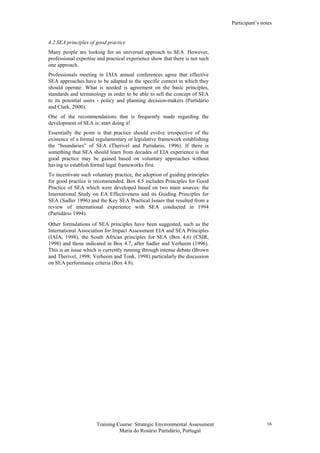
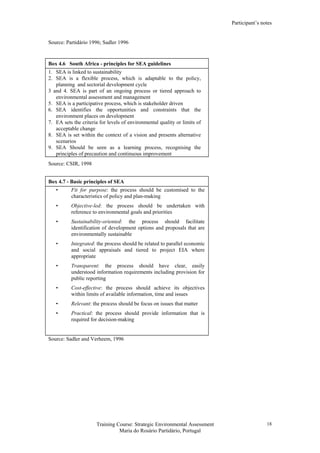
Other formulations of SEA principles have been suggested, such as the
International Association for Impact Assessment EIA and SEA Principles
(IAIA, 1998), the South African principles for SEA (Box 4.6) (CSIR,
1998) and those indicated in Box 4.7, after Sadler and Verheem (1996).
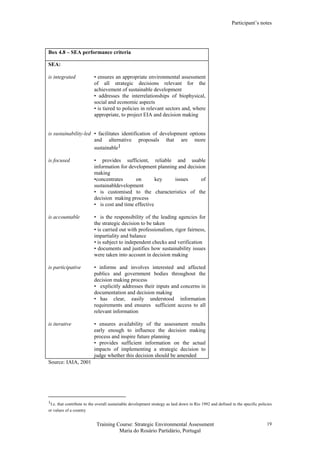
This is an issue which is currently running through intense debate (Brown
and Therivel, 1998; Verheem and Tonk, 1998) particularly the discussion
on SEA performance criteria (Box 4.8).
Participant’s notes
Training Course: Strategic Environmental Assessment
Maria do Rosário Partidário, Portugal
17
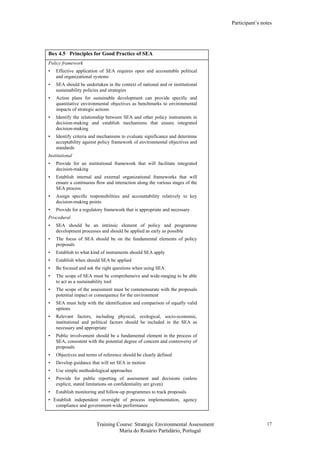
Box 4.5 Principles for Good Practice of SEA
Policy framework
• Effective application of SEA requires open and accountable political
and organizational systems
• SEA should be undertaken in the context of national and or institutional
sustainability policies and strategies
• Action plans for sustainable development can provide specific and
quantitative environmental objectives as benchmarks to environmental
impacts of strategic actions
• Identify the relationship between SEA and other policy instruments in
decision-making and establish mechanisms that ensure integrated
decision-making
• Identify criteria and mechanisms to evaluate significance and determine
acceptability against policy framework of environmental objectives and
standards
Institutional
• Provide for an institutional framework that will facilitate integrated
decision-making
• Establish internal and external organizational frameworks that will
ensure a continuous flow and interaction along the various stages of the
SEA process
• Assign specific responsibilities and accountability relatively to key
decision-making points
• Provide for a regulatory framework that is appropriate and necessary
Procedural
• SEA should be an intrinsic element of policy and programme
development processes and should be applied as early as possible
• The focus of SEA should be on the fundamental elements of policy
proposals
• Establish to what kind of instruments should SEA apply
• Establish when should SEA be applied
• Be focused and ask the right questions when using SEA
• The scope of SEA must be comprehensive and wide-ranging to be able
to act as a sustainability tool
• The scope of the assessment must be commensurate with the proposals
potential impact or consequence for the environment
• SEA must help with the identification and comparison of equally valid
options
• Relevant factors, including physical, ecological, socio-economic,
institutional and political factors should be included in the SEA as
necessary and appropriate
• Public involvement should be a fundamental element in the process of
SEA, consistent with the potential degree of concern and controversy of
proposals
• Objectives and terms of reference should be clearly defined
• Develop guidance that will set SEA in motion
• Use simple methodological approaches
• Provide for public reporting of assessment and decisions (unless
explicit, stated limitations on confidentiality are given)
• Establish monitoring and follow-up programmes to track proposals
• Establish independent oversight of process implementation, agency
compliance and government-wide performance
Participant’s notes
Training Course: Strategic Environmental Assessment
Maria do Rosário Partidário, Portugal
18
Source: Partidário 1996; Sadler 1996
Box 4.6 South Africa - principles for SEA guidelines
1. SEA is linked to sustainability
2. SEA is a flexible process, which is adaptable to the policy,
planning and sectorial development cycle
3 and 4. SEA is part of an ongoing process or tiered approach to
environmental assessment and management
5. SEA is a participative process, which is stakeholder driven
6. SEA identifies the opportunities and constraints that the
environment places on development
7. EA sets the criteria for levels of environmental quality or limits of
acceptable change
8. SEA is set within the context of a vision and presents alternative
scenarios
9. SEA Should be seen as a learning process, recognising the
principles of precaution and continuous improvement
Source: CSIR, 1998
Box 4.7 - Basic principles of SEA
• Fit for purpose: the process should be customised to the
characteristics of policy and plan-making
• Objective-led: the process should be undertaken with
reference to environmental goals and priorities
• Sustainability-oriented: the process should facilitate
identification of development options and proposals that are
environmentally sustainable
• Integrated: the process should be related to parallel economic
and social appraisals and tiered to project EIA where
appropriate
• Transparent: the process should have clear, easily
understood information requirements including provision for
public reporting
• Cost-effective: the process should achieve its objectives
within limits of available information, time and issues
• Relevant: the process should be focus on issues that matter
• Practical: the process should provide information that is
required for decision-making
Source: Sadler and Verheem, 1996
Participant’s notes
Training Course: Strategic Environmental Assessment
Maria do Rosário Partidário, Portugal
19
Box 4.8 – SEA performance criteria
SEA:
is integrated • ensures an appropriate environmental assessment
of all strategic decisions relevant for the
achievement of sustainable development
• addresses the interrelationships of biophysical,
social and economic aspects
• is tiered to policies in relevant sectors and, where
appropriate, to project EIA and decision making
is sustainability-led • facilitates identification of development options
and alternative proposals that are more
sustainable1
is focused • provides sufficient, reliable and usable
information for development planning and decision
making
•concentrates on key issues of
sustainabldevelopment
• is customised to the characteristics of the
decision making process
• is cost and time effective
is accountable • is the responsibility of the leading agencies for
the strategic decision to be taken
• is carried out with professionalism, rigor fairness,
impartiality and balance
• is subject to independent checks and verification
• documents and justifies how sustainability issues
were taken into account in decision making
is participative • informs and involves interested and affected
publics and government bodies throughout the
decision making process
• explicitly addresses their inputs and concerns in
documentation and decision making
• has clear, easily understood information
requirements and ensures sufficient access to all
relevant information
is iterative • ensures availability of the assessment results
early enough to influence the decision making
process and inspire future planning
• provides sufficient information on the actual
impacts of implementing a strategic decision to
judge whether this decision should be amended
Source: IAIA, 2001
1I.e. that contribute to the overall sustainable development strategy as laid down in Rio 1992 and defined in the specific policies
or values of a country
Participant’s notes
Training Course: Strategic Environmental Assessment
Maria do Rosário Partidário, Portugal
20
5. Relationship with other instruments of environmental policy and management
5.1 SEA and EIA relationship
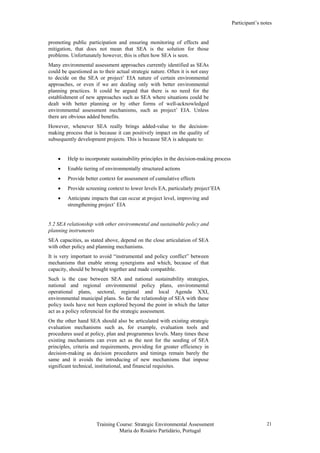
The issue about the difference of SEA in relation to EIA has been on
table from the early days. In fact, it was used as the main argument to
justify the reasons why SEA was needed. Many authors have presented
several comparisons in terms of advantages and disadvantages of SEA
with respect to EIA (Wood and Djeddour, 1992; Lee and Walsh, 1992;
EC-DGXI, 1998). Current understanding of those differences are
reflected in Table 1.
Table 1 - Main differences between SEA and EIA
SEA EIA
Nature of action Strategy, visions, concepts Construction / operation actions
Focus Critical decision moments
(decision windows) along decision
processes
Products of decision processes
(final outcomes)
Level of decision Policy, planning Project
Relation to
decision
Facilitator Evaluator, often
administrative requirement
Alternatives Spatial balance of location,
technologies, fiscal measures,
economic, social or physical
strategies
Specific alternative locations,
design, construction, operation
Scale of impacts Macroscopic,
mainly global, national, regional
Microscopic,
mainly local
Scope of impacts Sustainability issues,
economic and social issues may be
more tangible than physical or
ecological issues
Environmental with a
sustainability focus,
physical or ecological issues,
and also social and economic
Time scale Long to medium term Medium to short-term
Key data sources State of the Environment Reports,
Local Agenda 21, statistical data,
policy and planning instruments
Field work, sample analysis,
statistical data
Data Mainly descriptive but mixed with
quantifiable
Mainly quantifiable
Rigor of analysis
(uncertainty)
Less rigor/more uncertainty More rigor/less uncertainty
Assessment
benchmarks
Sustainability benchmarks (criteria
and objectives)
Legal restrictions and best
practice
Outputs Broad brush Detailed
Public perception Vague / distant More reactive (NIMBY)
Post-evaluation Other strategic actions or project
planning
Objective evidence /
construction and operation
Source: after Partidário (2001)
It is important to stress that SEA should not be seen as a solution to
occupy the empty space left by an inadequate conceptualisation of project
EIA, or to overcome the difficulties of understanding and implementing
project’s EIA. SEA is not the comparison and assessment of major or
minor project alternatives, nor should project EIAs be reduced to the
single objective of formulating mitigation measures.
Where project’ EIA is not effectively performing its role of proactively
informing decision-making on comparing and assessing the impacts of
real project alternatives, indicating effective mitigation measures,
Participant’s notes
Training Course: Strategic Environmental Assessment
Maria do Rosário Partidário, Portugal
21
promoting public participation and ensuring monitoring of effects and
mitigation, that does not mean that SEA is the solution for those
problems. Unfortunately however, this is often how SEA is seen.
Many environmental assessment approaches currently identified as SEAs
could be questioned as to their actual strategic nature. Often it is not easy
to decide on the SEA or project’ EIA nature of certain environmental
approaches, or even if we are dealing only with better environmental
planning practices. It could be argued that there is no need for the
establishment of new approaches such as SEA where situations could be
dealt with better planning or by other forms of well-acknowledged
environmental assessment mechanisms, such as project’ EIA. Unless
there are obvious added benefits.
However, whenever SEA really brings added-value to the decision-
making process that is because it can positively impact on the quality of
subsequently development projects. This is because SEA is adequate to:
• Help to incorporate sustainability principles in the decision-making process
• Enable tiering of environmentally structured actions
• Provide better context for assessment of cumulative effects
• Provide screening context to lower levels EA, particularly project’EIA
• Anticipate impacts that can occur at project level, improving and
strengthening project’ EIA
5.2 SEA relationship with other environmental and sustainable policy and
planning instruments
SEA capacities, as stated above, depend on the close articulation of SEA
with other policy and planning mechanisms.
It is very important to avoid “instrumental and policy conflict” between
mechanisms that enable strong synergisms and which, because of that
capacity, should be brought together and made compatible.
Such is the case between SEA and national sustainability strategies,
national and regional environmental policy plans, environmental
operational plans, sectoral, regional and local Agenda XXI,
environmental municipal plans. So far the relationship of SEA with these
policy tools have not been explored beyond the point in which the latter
act as a policy referencial for the strategic assessment.
On the other hand SEA should also be articulated with existing strategic
evaluation mechanisms such as, for example, evaluation tools and
procedures used at policy, plan and programmes levels. Many times these
existing mechanisms can even act as the nest for the seeding of SEA
principles, criteria and requirements, providing for greater efficiency in
decision-making as decision procedures and timings remain barely the
same and it avoids the introducing of new mechanisms that impose
significant technical, institutional, and financial requisites.
Participant’s notes
Training Course: Strategic Environmental Assessment
Maria do Rosário Partidário, Portugal
22
6. International experience with SEA – procedural models and
approaches
Several procedural approaches to SEA have been developed by different
countries. This chapter reviews different approaches to understanding
SEA procedures and outlines the key characteristics of the SEA system in
selected countries.
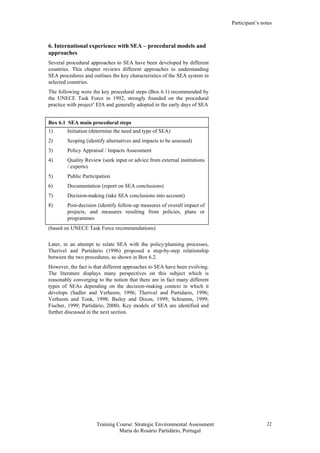
The following were the key procedural steps (Box 6.1) recommended by
the UNECE Task Force in 1992, strongly founded on the procedural
practice with project’ EIA and generally adopted in the early days of SEA
Box 6.1 SEA main procedural steps
1) Initiation (determine the need and type of SEA)
2) Scoping (identify alternatives and impacts to be assessed)
3) Policy Appraisal / Impacts Assessment
4) Quality Review (seek input or advice from external institutions
/ experts)
5) Public Participation
6) Documentation (report on SEA conclusions)
7) Decision-making (take SEA conclusions into account)
8) Post-decision (identify follow-up measures of overall impact of
projects, and measures resulting from policies, plans or
programmes
(based on UNECE Task Force recommendations)
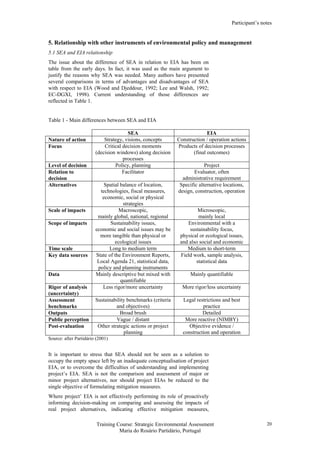
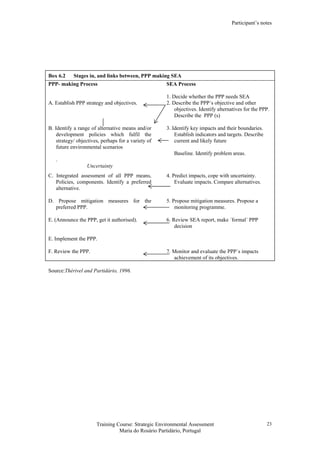
Later, in an attempt to relate SEA with the policy/planning processes,
Therivel and Partidario (1996) proposed a step-by-step relationship
between the two procedures, as shown in Box 6.2.
However, the fact is that different approaches to SEA have been evolving.
The literature displays many perspectives on this subject which is
reasonably converging to the notion that there are in fact many different
types of SEAs depending on the decision-making context in which it
develops (Sadler and Verheem, 1996; Therivel and Partidario, 1996;
Verheem and Tonk, 1998; Bailey and Dixon, 1999; Schramm, 1999;
Fischer, 1999; Partidário, 2000). Key models of SEA are identified and
further discussed in the next section.
Participant’s notes
Training Course: Strategic Environmental Assessment
Maria do Rosário Partidário, Portugal
23
Box 6.2 Stages in, and links between, PPP making SEA
PPP- making Process SEA Process
1. Decide whether the PPP needs SEA
A. Establish PPP strategy and objectives. 2. Describe the PPP´s objective and other
objectives. Identify alternatives for the PPP.
Describe the PPP (s)
B. Identify a range of alternative means and/or
development policies which fulfil the
strategy/ objectives, perhaps for a variety of
future environmental scenarios
.
3. Identify key impacts and their boundaries.
Establish indicators and targets. Describe
current and likely future
Baseline. Identify problem areas.
Uncertainty
C. Integrated assessment of all PPP means,
Policies, components. Identify a preferred
alternative.
4. Predict impacts, cope with uncertainty.
Evaluate impacts. Compare alternatives.
D. Propose mitigation measures for the
preferred PPP.
5. Propose mitigation measures. Propose a
monitoring programme.
E. (Announce the PPP, get it authorised). 6. Review SEA report, make ´formal´ PPP
decision
E. Implement the PPP.
F. Review the PPP. 7. Monitor and evaluate the PPP´s impacts
achievement of its objectives.
Source:Thérivel and Partidário, 1996.
Participant’s notes
Training Course: Strategic Environmental Assessment
Maria do Rosário Partidário, Portugal
24
6.1 Models of SEA
At the core of SEA methodologies are the familiar tools and techniques of
EIA. But the new approach called SEA is about the concept, timing,
scope and breadth of policy assessment and planning.
The rate at which SEA is patterned after policy and plan evaluation, or
project EIA, depends on the importance and strengths of each respective
procedural model, with respect to national and regional decision-making.
As a consequence, approaches to SEA commonly exhibit methodological
and procedural elements learned after policy or plan evaluation practices
(top-down approaches) or after project EIA practices (bottom-up
approaches). As argued on previous occasions (Partidário, 1996a, 1999),
it is understood that two main models provide the rationale for the
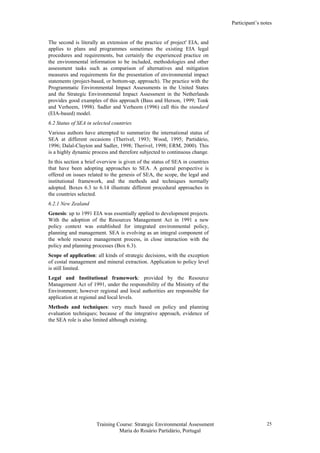
development of SEA procedural models and approaches (Figure 3):
• the policy development model, based on policy evaluation
approaches and
• the project assessment model, based on project’EIA approaches
The first adopts a policy or a planning rationale, with principles of
environmental assessment tailored in the formulation of policies and
plans, through the identification of needs and options for development
which may then be assessed, in a systematic way, in the context of a
vision for sustainable development (policy-based, or top-down,
approach). Examples of this approach are, for example, Policy Impact
Assessment in Canada (LeBlanc and Fischer, 1996; Shuttleworth and
Howell, 2000), the Resource Management Policy in New Zealand (Bailey
and Dixon, 1999), SEA of government bills in Denmark (Elling, 1997),
the E-test in the Netherlands (Tonk and Verheem, 1998). 2
POLICY-BASED APPROACH
Policy Development
SEA
Project Assessment
PROJECT-BASED APPROACH
Figure 3 – Two basic approaches to the emergence and strengthening of SEA
2 Relative to this policy-based approach, Sadler and Verheem (1996) distinguish
two procedural models: the equivalent (environmental appraisal) model, where
policy and plan evaluation are undertaken to identify and take account of
environmental effects (as in the UK); and the integrated (environmental
management) model, where SEA is undertaken as part of a comprehensive policy-
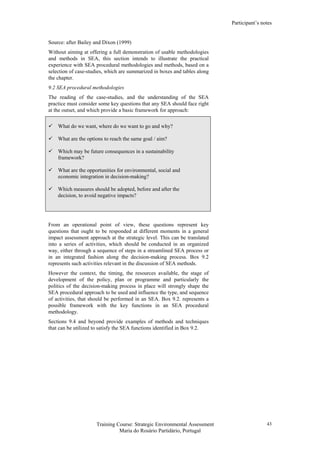
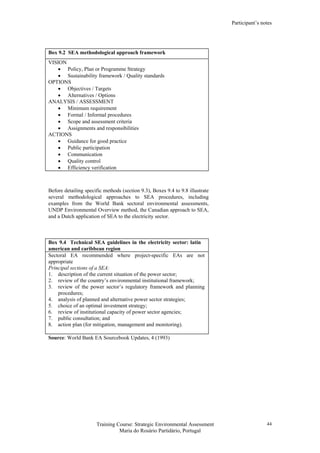
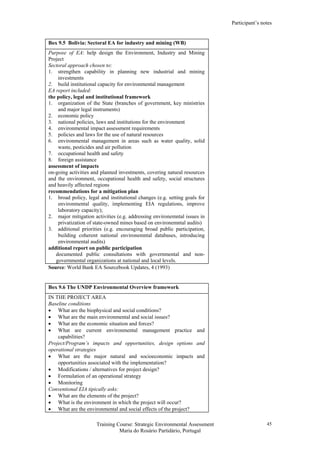
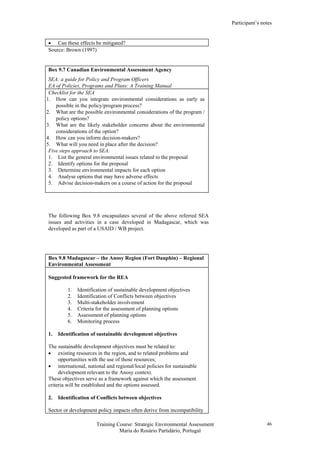
planning framework (as in New Zealand).
Participant’s notes
Training Course: Strategic Environmental Assessment
Maria do Rosário Partidário, Portugal
25
The second is literally an extension of the practice of project' EIA, and
applies to plans and programmes sometimes the existing EIA legal
procedures and requirements, but certainly the experienced practice on
the environmental information to be included, methodologies and other
assessment tasks such as comparison of alternatives and mitigation
measures and requirements for the presentation of environmental impact
statements (project-based, or bottom-up, approach). The practice with the
Programmatic Environmental Impact Assessments in the United States
and the Strategic Environmental Impact Assessment in the Netherlands
provides good examples of this approach (Bass and Herson, 1999; Tonk
and Verheem, 1998). Sadler and Verheem (1996) call this the standard
(EIA-based) model.
6.2 Status of SEA in selected countries
Various authors have attempted to summarize the international status of
SEA at different occasions (Therivel, 1993; Wood, 1995; Partidário,
1996; Dalal-Clayton and Sadler, 1998; Therivel, 1998; ERM, 2000). This
is a highly dynamic process and therefore subjected to continuous change.
In this section a brief overview is given of the status of SEA in countries
that have been adopting approaches to SEA. A general perspective is
offered on issues related to the genesis of SEA, the scope, the legal and
institutional framework, and the methods and techniques normally
adopted. Boxes 6.3 to 6.14 illustrate different procedural approaches in
the countries selected.
6.2.1 New Zealand
Genesis: up to 1991 EIA was essentially applied to development projects.
With the adoption of the Resources Management Act in 1991 a new
policy context was established for integrated environmental policy,
planning and management. SEA is evolving as an integral component of
the whole resource management process, in close interaction with the
policy and planning processes (Box 6.3).
Scope of application: all kinds of strategic decisions, with the exception
of costal management and mineral extraction. Application to policy level
is still limited.
Legal and Institutional framework: provided by the Resource
Management Act of 1991, under the responsibility of the Ministry of the
Environment; however regional and local authorities are responsible for
application at regional and local levels.
Methods and techniques: very much based on policy and planning
evaluation techniques; because of the integrative approach, evidence of
the SEA role is also limited although existing.
Participant’s notes
Training Course: Strategic Environmental Assessment
Maria do Rosário Partidário, Portugal
26
Box 6.3 Integrated policy-making, planning and assessment in
New Zealand
The Resource Management Act (1991) provides two streams and
sources of SEA:
1- Government’s system of Strategic Results Areas underpinned by the
strategic document, the Environment 2010 Strategy
The Environment 2010 Strategy is now the cornerstone for making
policy decisions, priorities and allocation of budget
2- Integrated planning and assessment process followed at the strategic
level through the preparation of:
• national policy statements, including environmental quality
standards;
• regional policy statements, outlining resource management
objectives, means of implementation, and results and expectations;
• regional district plans establishing the ground rules for land use
allocation
and evaluation carried out on the likely benefits and costs (including
environmental and social costs) to determine whether the purpose of
the Act is achieved.
6.2.2 Canada
Genesis: the policy of self-assessment influenced environmental
assessment in Canada since the early days of project’ EIA in 1972.
Canada started-off the concept of Policy Impact Assessment and in 1990
a Cabinet Directive is issued requiring all federal Departments and
agencies to apply a mandatory, yet non-legislated, environmental process
to federal policy and programme proposals submitted to Cabinet
consideration. This Directive was reviewed and a more systematic
procedure introduced in 1999 (Box 6.4).
Scope of application: all kinds of policies, plans and programmes.
Legal and Institutional framework: currently the 1999 Directive and
Guide for SEA. The implementation of this Directive is overviewed by
the Canadian Environmental Assessment Agency. However each federal
Department and Agency, and regional institutions develop specific
procedures (Box 6.5).
Methods and techniques: diverse, according to cases, but include
checklists and the environmental and sustainable benchmarking,
alternatives comparison, visioning assessment, cumulative impact
assessment, matrix evaluation.
Participant’s notes
Training Course: Strategic Environmental Assessment
Maria do Rosário Partidário, Portugal
27
Box 6.4 Canadian Environmental Assessment Agency
Guidelines on Implementing the 1999 Cabinet Directive on the
Environmental Assessment of Policy, Plan and Program Proposals
Guiding Principles
Early integration
Examine alternatives
Flexibility
Self-assessment
Appropriate level of analysis
Accountability
Use of existing mechanisms
Process to Conduct a Strategic Environmental Assessment
Preliminary Scan
Analyzing Environmental Effects
Appropriate Level of Effort
A strategic environmental assessment generally addresses the
following five questions:
1.What are the potential direct and indirect outcomes of the
proposal?
2.How do these outcomes interact with the environment?
3.What is the scope and nature of these environmental
interactions?
4.Can the adverse environmental effects be mitigated?
5.What is the overall potential environmental effect of the
proposal after opportunities for mitigation have been
incorporated?
Box 6.5 Canadian Department of Foreign Affairs and International
Trade SEA approach
Two-phased approach:
1st phase: Environmental Implications Checklist
2nd phase: Detailed environmental assessment if required
- Phase One: Environmental Implications Checklist
1. Is the Policy or Program to be considered by Cabinet or under the
Minister's Authorities?
2. Has an Environmental Review been completed for a similar
proposal (if yes, provide reference)?
3. Have similar activities in the past resulted in environmental
impacts?
4. Will someone else be considering environmental impacts as part
of the program review?
5. Does the proposal directly involve or assist in the construction of
infrastructure and thus triggers the Canadian Environmental
Assessment Act?
6. Will there be a Regulatory Impact Analysis Statement prepared?
7. Will there be public consultation as part of the Policy & Program
Analysis?
8. Do you feel an environmental review is required?
- Phase 2: Detailed Strategic Environmental Assessment
Recommended outline:
- component of the proposal;
- expected outcome;
- possible interactions with the environment;
- significance of the interaction and potential environmental
impacts;
Participant’s notes
Training Course: Strategic Environmental Assessment
Maria do Rosário Partidário, Portugal
28
- mitigation and monitoring to control or monitor potential
negative environmental impacts.
6.2.3 Denmark
Genesis: Influenced by a strong planning system since the early 70’s, the
integration of environmental issues of plans and programmes was an
inherent component in the planning process through what was initially
called environmental zoning. Policy assessment, through the
environmental assessment of government legislative proposals, is also in
place since 1993.
Scope of application: policies, including legislative governmental
proposals, through the Administrative Order, plans and programmes
through the planning system.
Legal and Institutional framework: An administrative Order of the
Prime Minister requiring an environmental assessment of all proposals
submitted to parliamentary approval was issued in 1993, and further
reviewed in 1995. Responsibility lies with the Ministry for the
Environment. For plans and programmes responsibility stays with
competent authorities for plan and programme development.
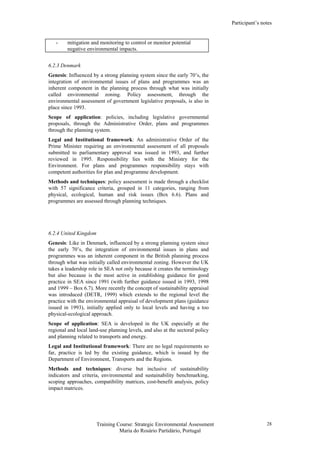
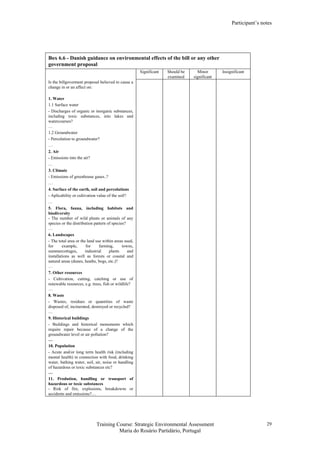
Methods and techniques: policy assessment is made through a checklist
with 57 significance criteria, grouped in 11 categories, ranging from
physical, ecological, human and risk issues (Box 6.6). Plans and
programmes are assessed through planning techniques.
6.2.4 United Kingdom
Genesis: Like in Denmark, influenced by a strong planning system since
the early 70’s, the integration of environmental issues in plans and
programmes was an inherent component in the British planning process
through what was initially called environmental zoning. However the UK
takes a leadership role in SEA not only because it creates the terminology
but also because is the most active in establishing guidance for good
practice in SEA since 1991 (with further guidance issued in 1993, 1998
and 1999 – Box 6.7). More recently the concept of sustainability appraisal
was introduced (DETR, 1999) which extends to the regional level the
practice with the environmental appraisal of development plans (guidance
issued in 1993), initially applied only to local levels and having a too
physical-ecological approach.
Scope of application: SEA is developed in the UK especially at the
regional and local land-use planning levels, and also at the sectoral policy
and planning related to transports and energy.
Legal and Institutional framework: There are no legal requirements so
far, practice is led by the existing guidance, which is issued by the
Department of Environment, Transports and the Regions.
Methods and techniques: diverse but inclusive of sustainability
indicators and criteria, environmental and sustainability benchmarking,
scoping approaches, compatibility matrices, cost-benefit analysis, policy
impact matrices.
Participant’s notes
Training Course: Strategic Environmental Assessment
Maria do Rosário Partidário, Portugal
29
Box 6.6 - Danish guidance on environmental effects of the bill or any other
government proposal
Significant Should be
examined
Minor
significant
Insignificant
Is the billgoverment proposal believed to cause a
change in or an affect on:
1. Water
1.1 Surface water
- Discharges of organic or inorganic substances,
including toxic substances, into lakes and
watercourses?
…
1.2 Groundwater
- Percolation to groundwater?
…
2. Air
- Emissions into the air?
…
3. Climate
- Emissions of greenhouse gases..?
…
4. Surface of the earth, soil and percolations
- Aplicability or cultivation value of the soil?
…
5. Flora, fauna, including habitats and
biodiversity
- The number of wild plants or animals of any
species or the distribution pattern of species?
…
6. Landscapes
- The total area or the land use within areas used,
for example, for farming, towns,
summercottages, industrial plants and
installations as well as forests or coastal and
natural areas (dunes, heaths, bogs, etc.)?
…
7. Other resources
- Cultivation, cutting, catching or use of
renewable resources, e.g. trees, fish or wildlife?
…
8. Waste
- Wastes, residues or quantities of waste
disposed of, incinerated, destroyed or recycled?
…
9. Historical buildings
- Buildings and historical monuments which
require repair because of a change of the
groundwater level or air pollution?
…
10. Population
- Acute and/or long term health risk (including
mental health) in connection with food, drinking
water, bathing water, soil, air, noise or handling
of hazardous or toxic substances etc?
…
11. Prodution, handling or transport of
hazardous or toxic substances
- Risk of fire, explosions, breakdowns or
accidents and emissions?…
Participant’s notes
Training Course: Strategic Environmental Assessment
Maria do Rosário Partidário, Portugal
30
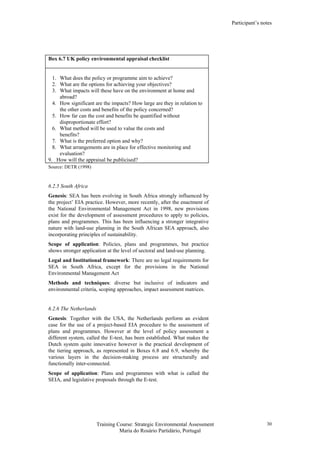
Box 6.7 UK policy environmental appraisal checklist
1. What does the policy or programme aim to achieve?
2. What are the options for achieving your objectives?
3. What impacts will these have on the environment at home and
abroad?
4. How significant are the impacts? How large are they in relation to
the other costs and benefits of the policy concerned?
5. How far can the cost and benefits be quantified without
disproportionate effort?
6. What method will be used to value the costs and
benefits?
7. What is the preferred option and why?
8. What arrangements are in place for effective monitoring and
evaluation?
9. How will the appraisal be publicised?
Source: DETR (1998)
6.2.5 South Africa
Genesis: SEA has been evolving in South Africa strongly influenced by
the project’ EIA practice. However, more recently, after the enactment of
the National Environmental Management Act in 1998, new provisions
exist for the development of assessment procedures to apply to policies,
plans and programmes. This has been influencing a stronger integrative
nature with land-use planning in the South African SEA approach, also
incorporating principles of sustainability.
Scope of application: Policies, plans and programmes, but practice
shows stronger application at the level of sectoral and land-use planning.
Legal and Institutional framework: There are no legal requirements for
SEA in South Africa, except for the provisions in the National
Environmental Management Act
Methods and techniques: diverse but inclusive of indicators and
environmental criteria, scoping approaches, impact assessment matrices.
6.2.6 The Netherlands
Genesis: Together with the USA, the Netherlands perform an evident
case for the use of a project-based EIA procedure to the assessment of
plans and programmes. However at the level of policy assessment a
different system, called the E-test, has been established. What makes the
Dutch system quite innovative however is the practical development of
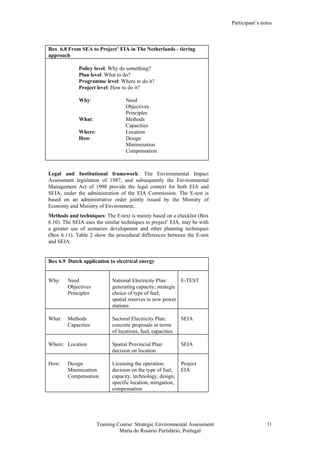
the tiering approach, as represented in Boxes 6.8 and 6.9, whereby the
various layers in the decision-making process are structurally and
functionally inter-connected.
Scope of application: Plans and programmes with what is called the
SEIA, and legislative proposals through the E-test.
Participant’s notes
Training Course: Strategic Environmental Assessment
Maria do Rosário Partidário, Portugal
31
Box 6.8 From SEA to Project’ EIA in The Netherlands - tiering
approach
Policy level: Why do something?
Plan level: What to do?
Programme level: Where to do it?
Project level: How to do it?
Why: Need
Objectives
Principles
What: Methods
Capacities
Where: Location
How: Design
Minimization
Compensation
Legal and Institutional framework: The Environmental Impact
Assessment legislation of 1987, and subsequently the Environmental
Management Act of 1998 provide the legal context for both EIA and
SEIA, under the administration of the EIA Commission. The E-test is
based on an administrative order jointly issued by the Ministry of
Economy and Ministry of Environment.
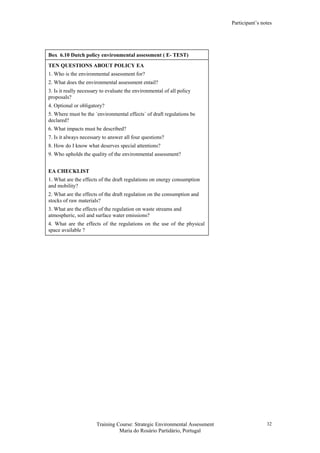
Methods and techniques: The E-text is mainly based on a checklist (Box
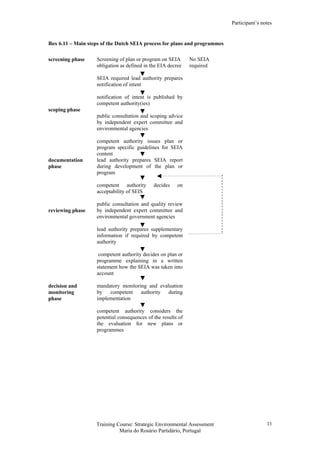
6.10). The SEIA uses the similar techniques to project’ EIA, may be with
a greater use of scenarios development and other planning techniques
(Box 6.11). Table 2 show the procedural differences between the E-test
and SEIA.
Box 6.9 Dutch application to electrical energy
Why: Need
Objectives
Principles
National Electricity Plan:
generating capacity; strategic
choice of type of fuel;
spatial reserves to new power
stations
E-TEST
What: Methods
Capacities
Sectoral Electricity Plan:
concrete proposals in terms
of locations, fuel, capacities
SEIA
Where: Location Spatial Provincial Plan:
decision on location
SEIA
How: Design
Minimization
Compensation
Licensing the operation:
decision on the type of fuel,
capacity, technology, design,
specific location, mitigation,
compensation
Project
EIA
Participant’s notes
Training Course: Strategic Environmental Assessment
Maria do Rosário Partidário, Portugal
32
Box 6.10 Dutch policy environmental assessment ( E- TEST)
TEN QUESTIONS ABOUT POLICY EA
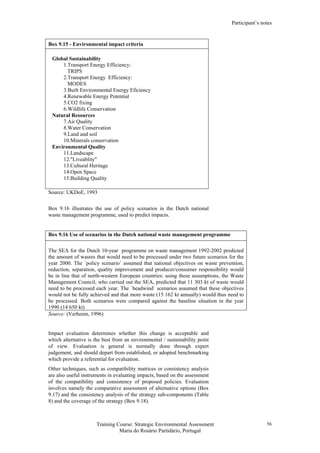
1. Who is the environmental assessment for?
2. What does the environmental assessment entail?
3. Is it really necessary to evaluate the environmental of all policy
proposals?
4. Optional or obligatory?
5. Where must be the ´environmental effects´ of draft regulations be
declared?
6. What impacts must be described?
7. Is it always necessary to answer all four questions?
8. How do I know what deserves special attentions?
9. Who upholds the quality of the environmental assessment?
EA CHECKLIST
1. What are the effects of the draft regulations on energy consumption
and mobility?
2. What are the effects of the draft regulation on the consumption and
stocks of raw materials?
3. What are the effects of the regulation on waste streams and
atmospheric, soil and surface water emissions?
4. What are the effects of the regulations on the use of the physical
space available ?
Participant’s notes
Training Course: Strategic Environmental Assessment
Maria do Rosário Partidário, Portugal
33
Box 6.11 – Main steps of the Dutch SEIA process for plans and programmes
screening phase Screening of plan or program on SEIA
obligation as defined in the EIA decree
No SEIA
required
SEIA required lead authority prepares
notification of intent
notification of intent is published by
competent authority(ies)
scoping phase
public consultation and scoping advice
by independent expert committee and
environmental agencies
competent authority issues plan or
program specific guidelines for SEIA
content
documentation
phase
lead authority prepares SEIA report
during development of the plan or
program
competent authority decides on
acceptability of SEIS
reviewing phase
public consultation and quality review
by independent expert committee and
environmental government agencies
lead authority prepares supplementary
information if required by competent
authority
competent authority decides on plan or
programme explaining in a written
statement how the SEIA was taken into
account
decision and
monitoring
phase
mandatory monitoring and evaluation
by competent authority during
implementation
competent authority considers the
potential consequences of the results of
the evaluation for new plans or
programmes
Participant’s notes
Training Course: Strategic Environmental Assessment
Maria do Rosário Partidário, Portugal
34
Table 2. SEA principles and the Dutch SEA processes
Principle E-test SEIA
Screening legislation with potential substantial effects on the environment is listed each
year by an interdepartmental working group
plans and programmes for which an assessment is mandatory are listed in
the EIA Decree
Publication when relevant, the Explanatory Note describes how the results of the
assessment were taken into account
it is mandatory to publicly report how the result of the assessment was
taken into account in the plan or programme developed
Monitoring post-decision evaluation is not mandatory, but may be carried out voluntarily a management plan should be part of the plan or programme; post-
decision evaluation is mandatory, including the publication of its results
Timing the Joint Support Centre stimulates the assessment to take place as early as
possible and at least before legislation is discussed in the Council of Ministers
the first step in both assessment and plan/programme development is the
publication of a notification of intent, followed by scoping
Environmental scoping the interdepartmental working group on draft legislation determines which of
the standard questions of the E-test are relevant and should be answered; in co-
operation with the Joint Support Centre, the proponent collects all relevant
information to judge whether its objectives could be achieved in a more
environmentally friendly way
terms of reference (or ´guidelines`) for the content of the assessment
statement are published by the competent authority, after comments and
advice from the public, environmental agencies and an independent
expert committee; the examination of alternatives is mandatory, including
the alternative most favourable to the environment
Socio-economic scoping socio-economic information is gathered in a `Business Effect Test´ as well as
in existing procedures parallel to the E-test; integration takes place during the
legislative process
socio-economic information is gathered in existing procedures parallel to
the environmental assessment; integration usually takes place in the plan
or programme itself (a)
Views of the public information becomes available through informal consultation of interest groups
(outside the E-test) and public debate in Parliament
mandatory public consultation in both scoping and reviewing stage; for
this a minimum of four weeks should be available
Documentation results of the E-test are documented in the Explanatory Note to the draft
legislation
mandatory publication of a separate report on the assessment results,
including an executive summary
Quality review the Joint Support Centre reviews, in co-operation with the Ministry of Justice,
the quality of the information before draft legislation is sent to Cabinet
an independent expert committee publishes advice to the competent
authority in both scoping and reviewing the quality of the results of the
assessment; for this a minimum of nine weeks should be available
Note: (a) Motivation: traditionally, Dutch strategic decision making focuses strongly on socio-economic issues and adequate instruments for the assessment of these are often already in place
Source: Verheem and Tonk, 2000, SEA: one concept, multiple forms, IAPA 18 (3)
Participant’s notes
Training Course: Strategic Environmental Assessment
Maria do Rosário Partidário, Portugal
35
6.2.7 United States of America
Genesis: The USA is the birth of the concept, right at NEPA. It evolved
deeply rooted in project’ EIA, as practice with the Programmatic EIS
demonstrate. Together with the Dutch system, it certainly provides an
example of a bottom-up approach to SEA. The application to policies has
been limited to non-existent.
Scope of application: Sectoral and land-use plans and programmes.
Legal and Institutional framework: At the federal level the context is
provided by NEPA. Some states have developed their own legal and
procedural requirements, with particular emphasis to the situaion in the
state of California.
Methods and techniques: very much related to project’ EIA methods
and techniques, perhaps with a stronger use of scenarios building and
land-use planning techniques (Box 6.12).
6.2.8 Eastern European countries
Table 3 refers to the legal and guidance context for SEA in Central and
Eastern European countries, based in Therivel (1997). The current
situation is evolving, however practice is still quite limited.
Table 3. SEA regulations and guidelines in Eastern Europe
Country Regulation/guideline
Czech
Republic
Czechoslovak Federal Act 17/1992
Czech Legal Act 244/1992
Guidelines for landscape assessment in territorial planning 1995
Hungary Act no LIII of 1995 on the General Rules of the Protection of
the Environment
Poland Land-Use Management Act 1994
Executive order on forecasts concerning land-use plans 1995
Guidelines on SEA for local land-use plans 1996
Guidelines on preparation of protection plans for landscape and
national parks 1996
Slovak
Republic
National Council of the Slovak Republic Act no 127/1994 on
Environmental Impact Assessment
Draft guidelines for SEA of sectoral PPPs and generally binding
legal directions 1996
Draft guidelines for land use plans 1996
Therivel (1997)
6.3 The European Union Directive on the environmental effects of certain
plans and programmes
In the European Union, formal requirements for the assessment of the
environmental effects of certain plans and programmes have been
adopted by the European Council (2001/42/EC of 27 June). The Directive
was under discussion for 11 years.
The Directive requires SEA for plans and programmes in sectors such as
agriculture, forestry, fisheries, energy, industry, transport, waste
management, water management, telecommunications, tourism, town and
Participant’s notes
Training Course: Strategic Environmental Assessment
Maria do Rosário Partidário, Portugal
36
country planning and land use and also those plans and programmes
which set the framework for future development consent of projects listed
in Annexes I and II to Directive 85/337/EEC or pursuant to articles 6 or 7
of Directive 93/43/EEC. Policies are outside the scope of application of
the Directive and no economic or social considerations are requested.
As to the procedure, the proposed SEA Directive is relatively vague and
essentially requires that an SEA report be produced, that public
participation is conducted, transboundary effects considered and
notification and justification of decision be made. However article 4
recognizes that the requirements of the Directive can be integrated in
existing procedures in Member States for the adoption of plans and
programmes, or incorporated in specifically designed procedures and that
duplication of assessment should be avoided through tiering.
It is also relevant to mention the existing experience in the European
Commission with respect to application of SEA to Commission activities.
As part of the SEA of the European Transport network, DG-transports
promoted the development of several pilot studies on 5 Transport
corridors (a review can be found in Bina, 2001), while the SEA of the full
network is yet to be completed.
Also quite meaningful is the practice followed by DG-Regions with
respect to the SEA of structural funds proposed by Member-States. After
the issuing of initial Regulations in 1992, DG-Regions, in collaboration
with DG-Environment issued guidance (EU-DG Environment, 1998) to
assist Member-States in preparing their proposals for funds (Box 6.13).
This guidance, which is also available from the EU web site, follows
quite closely the UK guidance for sustainability appraisal.
Box 6.13 - Strategic Environmental Assessment Stages
Regional Development Plans:
1. Assessment of the environmental situation - developing a baseline
2. Development of objectives and priorities
3. Drafting the Plan and its alternatives
4. Environmental assessment of the draft Plan
5. Environmental indicators for the Plan
6. Integrating the results of the assessment in the final Plan.
Community Support Framework:
1. Objectives, priorities and the role of Environmental Authorities
2. Environmental Assessment in the context of the CSF
3. Indicators.
Operational Programmes:
1. Assessment of the environmental situation - defining a baseline
2. Development of objectives and targets
3. Drafting the Operational Programme and its alternatives
4. Environmental assessment of the draft Operational Programme
5. Environmental Indicators for Operational Programmes.
6.4 The World Bank
In 1989 the World Bank adopted an Operational Directive 4.00 which for
the first time would refer to regional and sectoral EAs. At the time, these
instruments made a significant contribution for the development of SEA
tools, although it clearly evolved from a project' EIA perspective as an
attempt to look at development activities rather than individual projects.
Regional EAs were used where a number of development activities, with
potential cumulative impacts, were planned for a certain area (see Box
Participant’s notes
Training Course: Strategic Environmental Assessment
Maria do Rosário Partidário, Portugal
37
6.14). These regional EAs were fairly influenced by the already existing
US programmatic environmental impact statements. Sectoral EAs,
however, had a much more strategic character and were considered
adequate for use in the design of sectoral investment programmes. The
Environmental Assessment Sourcebook (World Bank, 1991) contains a
set of sectoral guidelines that apply to Regional and Sectoral EAs.
The World Bank experience as regards the application of Regional and
Sectoral EAs is quite vast, particularly in what concerns sectoral EAs
(World Bank, 1993 and 1994). The intention has been to include Sectoral
EAs as part of the routine of sectoral studies, providing planners with the
most environmentally and economically sound strategy for meeting
development objectives according to established priorities. Although may
not so much part of the routine as ideally it should, the variety of
situations and development actions to which Sectoral EAs have been
applied is demonstrative of its utility (Goodland and Tillman, 1995).
Within the Bank's experience regarding Strategic EA, privatization and
structural adjustments operations are amongst the Bank's most important
activities in the last couple of years. This forms an important chapter in
the range of actions and activities to which SEAs can apply to (Goodland
and Mercier, 1999).
Box 6.14 Undertaking a Regional Assessment: process
Designing the Study
1. Understanding the regional planning framework
2. Defining the spatial context
3. Determining the optimal multi-sectoral focus
4. Limiting the study goals while retaining an integral focus
5. Setting up appropriate institutional arrangements
6. Developing a detailed TOR
7. Planning appropriate public consultation
8. Defining a review process
Executing the Study
1. Policy, legal and administrative framework (national and regional
framework)
2. Baseline conditions (physical, biological, socioeconomic and
cultural environments)
3. Description of development plan and associated projects
4. Inventory of other plans and projects
5. Cumulative impact assessment
6. Analysis of alternatives
7. Recommendations towards an optimal regional investment plan
8. Environmental management strategy (mitigation, monitoring,
institutional strengthening)
Source: World Bank EA Sourcebook Updates, 15 (1996)
Participant’s notes
Training Course: Strategic Environmental Assessment
Maria do Rosário Partidário, Portugal
38
7. Application of SEA in urban and territorial planning
This chapter intends to provide a sectoral perspective into SEA, through
the current application of SEA to urban and territorial planning. To offer
this overview it will define and characterize dominant models of urban
and territorial planning SEA practice, especially based on the experience
within Europe.
The application of SEA to the level of sectoral and territorial planning,
whether at regional, municipal or urban scales, is considered to be, by
some SEA experts, one of the most complex forms of SEA.
Such statement could well be a good basis for discussion, not so much on
whether it is complex, but why is it complex. Reasons certainly relate to
planning methodological and procedural tradition, to difficulties of
communication between planners and environmental assessors, to the
timing in the development of urban and territorial plans, to the
institutional and legal contexts for planning, and for environmental
assessment, in most cases totally divorced and difficult to articulate, in
other cases so much integrated, that the difference between planning and
impact assessment is overlooked or forgotten!
In fact, what is the meaning of SEA in current environmental assessment
of urban and territorial planning? Four big picture models are suggested
to help describing the situation as it currently appears. Such four models
are synthesized in Box 7.1 and could be related to expected increasing
effectiveness in SEA performance.
Box 7.1- SEA in urban and territorial planning – four “big picture”
models
Better quality SEA
It could be argued that all these models are observed in SEA practice,
however they reflect different objects of assessment and respective
results.
• Piecemeal approach: Is relates to the assessment of a planning
proposal (perhaps a zoning proposal) in its piecemeal, individual
planning proposal elements, and possible alternatives (if available),
in terms of the environmental impacts strictu sensu (meaning
Piecemeal assessment: Planning proposal, and possible alternatives (if
available), with the planning proposal components (e.g. housing,
transportation, etc.) assessed in terms of physical and ecological impacts
and suggestion of mitigation measures
Implicit assessment: Consideration of key environmental issues in the
plan formulation and establishment of the “environmental” zoning, the
consideration of impacts is only implicit, no separate report
Explicit assessment: The environmental (physical and ecological)
impacts are explicitly considered in the plan formulation and design,
planning proposal elements contain impact avoidance or minimization
Strategic Sustainability Assessment: Establishment of sustainability
objectives, analysis of conflicts between planning and sustainability
objectives, incorporation into plan formulation, identification and public
discussion in public forums of alternative ways of achieving these
objectives through planning solutions, and incorporation in the plan
formulation
Participant’s notes
Training Course: Strategic Environmental Assessment
Maria do Rosário Partidário, Portugal
39
physical and ecological impacts) of each of the proposal elements,
and the suggestion of mitigation measures. These proposal elements
may well include, for example, the expansion of the road and rail
network (in one or more corridors), the expansion of social housing
(different typology and size), new industries, new green areas, etc.
• Implicit assessment: It involves the consideration of environmental
issues in the formulation of the zoning plan proposal, as in physical
plans by incorporating key environmental considerations in the
definition and establishment of the “environmental” zoning and the
respective policies/regulations, but where the consideration of
impacts is made only implicit without formal expressions of
impacts identification, comparison and final assessment (namely
reporting).
• Explicit assessment: It relates to the integration of environmental
issues in the formulation of the urban and territorial plan, adopting
techniques such as environmental zoning, whereby the
environmental (mostly in its physical and ecological sense) impacts
are explicitly considered at the moment of conceptualising the plan
proposal, such that the proposal elements already contain impact
avoidance or minimization concerns, and a final chapter in the plan,
or even a separate report, highlighting all those environmental
impact considerations made during the plan conceptualisation
• Strategic Sustainability Assessment: It involves the preliminary
identification of environmental objectives (and preferably indeed
sustainability objectives) before starting the plan formulation, in
accordance with the objectives of the planning strategy, the
analysis of the possible conflicts (and therefore strategic impacts)
between the various sustainability objectives (which should include
physical and ecological, social, economic, political, institutional,
territorial), and then the incorporation of these results into plan
formulation, identification and discussion, in public forums, of
alternative ways of achieving these objectives through planning
solutions, which then are converted into (blueprint or strategic)
zoning for plan development and implementation.
It can well be argued that all models above are, to some extent, forms of
SEA. These are indicated just as “big picture” SEA models that can
describe existing urban and territorial planning, in Europe and in other
parts of the world. The experience in Europe, including access countries,
expresses all these 4 models, in a wide array of different approaches,
fundamentally related to the type and nature of urban and territorial
planning system of each country (See chapter 8 for examples).
It may also be noted that the notion of strategic assessment increases from
the first to the last model. While in the first model it is essentially the
notion people have of a standard project’ EIA, and the second is the
notion of environmental zoning planning, the third and the fourth models
perform much strongly the notion of strategic assessment, with the latter
being certainly the most adequate as far as the formal concept of Strategic
Environmental Assessment is suggested in the main literature (Therivel
and Partidário, 1996; Sadler and Verheem, 1996; Partidário, 1999;
Partidário and Clark, 2000; IAPA, 2000)
The extent to which SEA practice can be judged to be acting effectively,
or not, in relation to these four models, can only be done by looking at
actual results and the extent to which it actually influences decision-
making and the quality of final plans.
Participant’s notes
Training Course: Strategic Environmental Assessment
Maria do Rosário Partidário, Portugal
40
8. Elements for an SEA framework
Bearing in mind the priority needs and principles above indicated, and the
range of experiences regarding the approaches adopted in different
countries, Box 8.1 proposes elements that must be in place in any
framework for SEA (Partidário, 2000). It is recommended that such a
framework be strongly articulated with the existing policy and planning
procedures and practices in a way that shows effectiveness in the capacity
of producing more sustainable decisions.
The elements of Box 8.1 support the principle that key questions, asked at
the right time, are sometimes all that is needed as the best approach to a
successful integration of the impact assessment principles at policy and
planning incremental decision-making processes.
Elements for an SEA framework start with the question “why is SEA
needed?”. Often legal requirements is the main, and sometimes only,
justification of the need for an SEA. But clear impact assessment and
development objectives may also provide the justification for adopting
SEA. In addition, considering that often time, human and financial
resources are scarce, decision on doing an SEA should preferably be a
function of the actual added-value that SEA can bring to decision-
making.
Who is involved in the SEA process and with which responsibilities are
critical elements to address in a process that must be accountable and well
participated. The determination of the added-value of SEA to decision-
making is ultimately related to the relevant stakeholders involved.
Practice has been showing that an effective SEA is not only about
science, but also about values. Despite any sort of technical in-depth
analysis that may be carried out, often it is the capacity to openly discuss
the underlying objectives, options and latent conflicts surrounding a
decision that determines the success of an SEA. Therefore, in assessing
the impacts of policies, plans and programmes sufficient attention should
be given to the values of the affected communities and to the
communication mechanisms to be used, and whether they are available,
or need to be put in place.
Determining what is relevant in the assessment requires higher-level
benchmarking, at regional, national, or supra-national policy frameworks
that enable a larger perspective in the assessment, thus balancing the local
values of the communities, with big-picture development objectives and
national and global trends.
The establishment of assessment criteria, clear identification of
alternative options, communication mechanisms, available guidance for
continuous learning and quality control mechanisms are five crucial
elements, identified in Box 8.1, with respect to how to carry out the SEA.
Recent discussions held in the IAIA context particularly stressed the
importance of communication in SEA, namely as a means of reducing the
potential for conflict.
Participant’s notes
Training Course: Strategic Environmental Assessment
Maria do Rosário Partidário, Portugal
41
Box 8.1 – Elements for an SEA framework
Elements for a framework Fundamental questions to address
WHY Need / Objectives • Why do you need an SEA and what
are your objectives?
• Do you have legal requirements to
comply with?
Added-value • Why is it that EIA procedures would
not be adequate in your current case?
• What is the added-value the SEA
brings to decision-making?
WHO Responsibilities • Who is the SEA for?
• Who checks the quality of the SEA?
• What is the institutional framework
for the development and
implementation of the policy, plan or
programme?
• Who are the key stakeholders in the
decision-making process?
WHAT Values / Participation • What are the key values relevant for
the assessment (sectoral agents,
NGOs, public)?
• What are the mechanisms for
enabling participation?
Benchmarks / Policy
framework
• What is your policy framework and
benchmarks that you will use as
achievable targets?
HOW Criteria • What are the criteria that will be used
in the assessment?
Alternatives / Options • What are your options and
alternatives?
Communication • How will you communicate your
findings to the public and each
stockholder and how will you ensure
the learning process?
Guidance • Is there sufficient guidance available
to assist you in the assessment
process?
• What other guidance do you need?
Quality control • How will you check if you have done
it right?
• How will you monitor the
effectiveness of your decision with
respect to the values important in the
decision?
Source: Partidário, 2000
Participant’s notes
Training Course: Strategic Environmental Assessment
Maria do Rosário Partidário, Portugal
42
9. SEA procedural methodologies , methods and techniques
9.1 Overview
Investigation on common frameworks and key elements of good practice
led to the useful compilation of case-experiences, in the form of examples
of applications of SEA and also as procedural approaches (Sadler and
Verheem, 1996; Therivel and Partidário, 1996; EU, 1996; Dalal-Clayton
and Sadler, 1998).
Several references can be found on reviews of SEA methods (DHV,
1994; Sadler and Verheem, 1996; Therivel, 1996; Bailey and Dixon,
1999; Therivel and Brown, 1999), including SEA procedural
methodologies and techniques. However, while each case normally
adopts a specific SEA methodology, encompassing a sequence of several
activities, through stages in a rather systematic phasing, independent or
integrated in the decision-making process, there are no really specific
SEA methods or techniques. In fact, what is found is that SEA borrows
methods and techniques from diverse sources ranging from policy-
making and evaluation, planning, project assessment, etc (Box 9.1). The
diversity of approaches and developments in the field of SEA opens up
opportunity for different use of methods in SEA. Partidário (1996)
exemplified methods adopted in particular contexts:
• Checklists of questions, e.g. Denmark and the Netherlands
• Assessment of significance against criteria, e.g. Denmark, the
Netherlands and UK
• Compatibility matrices, e.g. the Netherlands and UK
• Economic methods (cost-benefit analysis, hedonic pricing), e.g.
UK
• Scenarios, e.g. Canada, USA
• Expert advice (internal and external), e.g. Canada, the
Netherlands and UK
• Help desks (a support service from within an environment
agency, e.g. the Netherlands
Box 9.1 – Methods / Techniques used in SEA
From EIA methods
Checklists
Matrices
Networks
From Policy analysis (and planning) methods
Scenarios and simulations
Forecasting
Input-output models
Land suitability analysis
Geographical information systems
Systems modelling
Multi-criteria analysis
Goals achievement matrices
Planning balance sheets
Cost-benefit analysis
Cost minimization techniques
Sensitivity analysis
Participant’s notes
Training Course: Strategic Environmental Assessment
Maria do Rosário Partidário, Portugal
43
Source: after Bailey and Dixon (1999)
Without aiming at offering a full demonstration of usable methodologies
and methods in SEA, this section intends to illustrate the practical
experience with SEA procedural methodologies and methods, based on a
selection of case-studies, which are summarized in boxes and tables along
the chapter.
9.2 SEA procedural methodologies
The reading of the case-studies, and the understanding of the SEA
practice must consider some key questions that any SEA should face right
at the outset, and which provide a basic framework for approach:
What do we want, where do we want to go and why?
What are the options to reach the same goal / aim?
Which may be future consequences in a sustainability
framework?
What are the opportunities for environmental, social and
economic integration in decision-making?
Which measures should be adopted, before and after the
decision, to avoid negative impacts?
From an operational point of view, these questions represent key
questions that ought to be responded at different moments in a general
impact assessment approach at the strategic level. This can be translated
into a series of activities, which should be conducted in an organized
way, either through a sequence of steps in a streamlined SEA process or
in an integrated fashion along the decision-making process. Box 9.2
represents such activities relevant in the discussion of SEA methods.
However the context, the timing, the resources available, the stage of
development of the policy, plan or programme and particularly the
politics of the decision-making process in place will strongly shape the
SEA procedural approach to be used and influence the type, and sequence
of activities, that should be performed in an SEA. Box 9.2. represents a
possible framework with the key functions in an SEA procedural
methodology.
Sections 9.4 and beyond provide examples of methods and techniques
that can be utilized to satisfy the SEA functions identified in Box 9.2.
Participant’s notes
Training Course: Strategic Environmental Assessment
Maria do Rosário Partidário, Portugal
44
Box 9.2 SEA methodological approach framework
VISION
• Policy, Plan or Programme Strategy
• Sustainability framework / Quality standards
OPTIONS
• Objectives / Targets
• Alternatives / Options
ANALYSIS / ASSESSMENT
• Minimum requirement
• Formal / Informal procedures
• Scope and assessment criteria
• Assignments and responsibilities
ACTIONS
• Guidance for good practice
• Public participation
• Communication
• Quality control
• Efficiency verification
Before detailing specific methods (section 9.3), Boxes 9.4 to 9.8 illustrate
several methodological approaches to SEA procedures, including
examples from the World Bank sectoral environmental assessments,
UNDP Environmental Overview method, the Canadian approach to SEA,
and a Dutch application of SEA to the electricity sector.
Box 9.4 Technical SEA guidelines in the electricity sector: latin
american and caribbean region
Sectoral EA recommended where project-specific EAs are not
appropriate
Principal sections of a SEA:
1. description of the current situation of the power sector;
2. review of the country’s environmental institutional framework;
3. review of the power sector’s regulatory framework and planning
procedures;
4. analysis of planned and alternative power sector strategies;
5. choice of an optimal investment strategy;
6. review of institutional capacity of power sector agencies;
7. public consultation; and
8. action plan (for mitigation, management and monitoring).
Source: World Bank EA Sourcebook Updates, 4 (1993)
Participant’s notes
Training Course: Strategic Environmental Assessment
Maria do Rosário Partidário, Portugal
45
Box 9.5 Bolivia: Sectoral EA for industry and mining (WB)
Purpose of EA: help design the Environment, Industry and Mining
Project
Sectoral approach chosen to:
1. strengthen capability in planning new industrial and mining
investments
2. build institutional capacity for environmental management
EA report included:
the policy, legal and institutional framework
1. organization of the State (branches of government, key ministries
and major legal instruments)
2. economic policy
3. national policies, laws and institutions for the environment
4. environmental impact assessment requirements
5. policies and laws for the use of natural resources
6. environmental management in areas such as water quality, solid
waste, pesticides and air pollution
7. occupational health and safety
8. foreign assistance
assessment of impacts
on-going activities and planned investments, covering natural resources
and the environment, occupational health and safety, social structures
and heavily affected regions
recommendations for a mitigation plan
1. broad policy, legal and institutional changes (e.g. setting goals for
environmental quality, implementing EIA regulations, improve
laboratory capacity);
2. major mitigation activities (e.g. addressing environemntal issues in
privatization of state-owned mines based on environemntal audits)
3. additional priorities (e.g. encouraging broad public participation,
building coherent national environemntal databases, introducing
environmental audits)
additional report on public participation
documented public consultations with governmental and non-
governmental organizations at national and local levels.
Source: World Bank EA Sourcebook Updates, 4 (1993)
Box 9.6 The UNDP Environmental Overview framework
IN THE PROJECT AREA
Baseline conditions
• What are the biophysical and social conditions?
• What are the main environmental and social issues?
• What are the economic situation and forces?
• What are current environmental management practice and
capabilities?
Project/Program’s impacts and opportunities, design options and
operational strategies
• What are the major natural and socioeconomic impacts and
opportunities associated with the implementation?
• Modifications / alternatives for project design?
• Formulation of an operational strategy
• Monitoring
Conventional EIA tipically asks:
• What are the elements of the project?
• What is the environment in which the project will occur?
• What are the environmental and social effects of the project?
Participant’s notes
Training Course: Strategic Environmental Assessment
Maria do Rosário Partidário, Portugal
46
• Can these effects be mitigated?
Source: Brown (1997)
Box 9.7 Canadian Environmental Assessment Agency
SEA: a guide for Policy and Program Officers
EA of Policies, Programs and Plans: A Training Manual
Checklist for the SEA
1. How can you integrate environmental considerations as early as
possible in the policy/program process?
2. What are the possible environmental considerations of the program /
policy options?
3. What are the likely stakeholder concerns about the environmental
considerations of the option?
4. How can you inform decision-makers?
5. What will you need in place after the decision?
Five steps approach to SEA:
1. List the general environmental issues related to the proposal
2. Identify options for the proposal
3. Determine environmental impacts for each option
4. Analyse options that may have adverse effects
5. Advise decision-makers on a course of action for the proposal
The following Box 9.8 encapsulates several of the above referred SEA
issues and activities in a case developed in Madagascar, which was
developed as part of a USAID / WB project.
Box 9.8 Madagascar – the Anosy Region (Fort Dauphin) – Regional
Environmental Assessment
Suggested framework for the REA
1. Identification of sustainable development objectives
2. Identification of Conflicts between objectives
3. Multi-stakeholder involvement
4. Criteria for the assessment of planning options
5. Assessment of planning options
6. Monitoring process
1. Identification of sustainable development objectives
The sustainable development objectives must be related to:
• existing resources in the region, and to related problems and
opportunities with the use of those resources;
• international, national and regional/local policies for sustainable
development relevant to the Anosy context.
These objectives serve as a framework against which the assessment
criteria will be established and the options assessed.
2. Identification of Conflicts between objectives
Sector or development policy impacts often derive from incompatibility
Participant’s notes
Training Course: Strategic Environmental Assessment
Maria do Rosário Partidário, Portugal
47
between objectives. It is necessary to cross-relate and compare the
various major objectives to make sure that there will not be major
inconsistencies.
This will constitute a first assessment in the REA process.
3. Multistakeholder involvement
An assessment is about values judgement. The wider the range of
values considered in the assessment, the greater the chances of
achieving an outcome that is accepted by the majority of the
stakeholders.
The range of stakeholders to involve in a participation process is a
function of the relevance of the issue, the time and the resources
available.
Normally, stakeholders involve government officers at national,
regional and local levels, representatives of the trade and industry
sectors, other public and private sectors, non-governmental
organisations and the citizens.
4. Criteria for the assessment of planning options
An assessment process that is robust and consistent must be based on
widely approved and accepted criteria that increase the acceptance of
the assessment outcomes. Criteria to support the assessment can be
drawn from a wide range of sources, including:
• Policy frameworks established at international (e.g. Agenda 21,
international conventions, etc.), national (e.g. relevant
environmental and sector legislation, national environmental policy
plans, national sustainable development strategies, etc.) or
regional/local levels (e.g. planning regulations)
• Technical criteria based on scientific methods (e.g. economic
valuation of natural resources, habitat suitability index,
biodiversity, cumulative assessment, evaluation of landscape-
sensitivity, and jobs created etc.)
• Indicators based on state of the environment reporting (e.g.
baseline monitoring, benchmarking)
• Cultural values, based on a multi-stakeholder involvement.
5. Assessment of planning options
Based on the planning options, a set of preferred options will be
selected and compared, using the adopted criteria as referred, and taking
the initially identified sustainable development objectives as a reference
framework.
Recommendations must be based on the positive and negative impacts
of the compared development options and must indicate measures that
may be used to avoid or reduce negative impacts. Such measures may
be adopted in the design of follow-up projects that will be developed as
part of the plan implementation.
6. Monitoring process
The planning process must be assisted by the REA through a
monitoring programme, which framework must be designed once
the decision has been taken on which planning option to develop.
Source: Partidário and Eggenberger, 2000
Participant’s notes
Training Course: Strategic Environmental Assessment
Maria do Rosário Partidário, Portugal
48
9.3 SEA methods and techniques
The range of methods that can be used in SEA embraces a wide variety,
from meetings of a restricted range of parties, to the use of specialist
consultants in a detailed study, public involvement, use of GIS
applications and computer models, scenarios building, etc. A selection of
methods, based on lists provided in Sadler and Verheem, (1996) is
represented in Box 9.9.
Box 9.9 Methods used in SEA
IMPACT IDENTIFICATION
Literature search
• State of knowledge (e.g. SOE reports)
• Case comparison
Expert judgements
• Delphi survey
• Workshops
Analytical techniques
• Scenario development
• Model mapping
• Checklists
• Indicators
Consultative tools
• Interviews
• Selective consultation
• Policy dialogue
IMPACT ANALYSIS
Extended use of identification methods (e.g. literature survey, case
comparison, expert judgement, scenario development, model
mapping)
Use of matrices
Computer modelling
Geographic Information Systems
Cost effectiveness analysis
Cost-benefit analysis
Multi-criteria analysis
Aggregation methods (e.g. index)
Life cycle analysis
DECISION-MAKING
Cross-impact matrices
Consistency analysis
Sensitivity analysis
Decision ‘trees’
Source: Sadler and Verheem, 1996, after FEARO (1992); DHV (1994)
Workshop discussions at IAIA conferences, illustrated by case-studies,
tell stories of successful or outstanding use of SEA methods, contributing
to the discussion with meaningful and specific lessons learned:
a) from Ghana, the example presented demonstrated that it is important
for the effectiveness of SEA to have the assessment carried out by a team
consisting of government staff, private sector and the public (Amoyaw-
Osei 1997).
Participant’s notes
Training Course: Strategic Environmental Assessment
Maria do Rosário Partidário, Portugal
49
This is in line with lessons learned with other case-studies, at other
occasions (EC-DGXI 1996), that SEA should not be carried out by a
selective group of environmental people, but that it is essential to involve
all key actors having a role play in the planning process and in the SEA.
b) from California and Canada, the benefits of integrating SEA principles
into the planning process were demonstrated by a wealth of practice
experience and long tradition with the application of SEA, especially in
the first case (Bass 1997; Howell and Shuttleworth 1997).
c) from the Netherlands the case was made that a targeted use of SEA can
help guide companies through a period of change. Involving key staff in a
structured process helps to change the culture of the company, i.e. to
internalize environmental values and increase engineers and technicians
“ownership” over environmental issues (Verheem 1997).
d) Simple, straightforward, indicators are one condition for good practice
as indicated by Therivel (1996). Sustainability indicators, for example,
can be viewed as an attempt to give a certain dimension to sustainability.
Strategic Sustainability Assessment (SSA) is a new concept that is based
on the use of SEA when addressing sustainability objectives and targets
and it consists in a simple, but integrative approach, that aims to translate
sustainability priorities and criteria into measurable indicators (Partidário
and Moura 1997).
Other applications in SEA are making use of indicators, for example, to
measure the achievement of development plan’s objectives, such as in the
UK SEA experience (Oxford Brooks University 1997) or as measures, in
terms of sustainable development, of the environmental effects of
Operational Programmes in Sicily, Italy (RSPB 1997).
Table 4 illustrates the most popular SEA activities developed by local
authorities in the application of the Environmental Appraisal of
Development Plans approach in the UK.
Table 4. Activities developed in Environmental Appraisal
Technique
Number of
Responses
Setting sustainability objectives 48
Setting plan objectives 66
Setting environmental targets, carrying capacity 14
Comparing alternative locational strategies 36
Describing the baseline environment 49
Identifying environmental stock * 133
“Scoping” * 117
Compatibility matrix * 68
Matrix of policies/proposals vs. environmental
components *
132
Written description of policy/proposal impacts * 117
Appraisal of impacts of revised policies 46
* Technique advocated in DoE (1993)
Source: Thérivel (1998), SEA of development plans in Britain, EIA Review, 18 (1):
39-57.
Participant’s notes
Training Course: Strategic Environmental Assessment
Maria do Rosário Partidário, Portugal
50
9.3.1 Vision
The vision function in SEA is crucial for a good SEA planning. It must
ensure both the understanding of the strategy being assessed, the need for
SEA and also the policy framework within which the SEA will be
performed.
One interesting approach to the establishment of a community vision, and
understanding of the perception of stakeholders regarding a certain
policy, plan or programme is through a visioning process (Box 9.10),
whereby those interested can contribute to identifying priorities for future
strategic development.
Box 9.10 Case study: a typical "visioning" process
Country Z widely advertises an event (ranging from half a day to 3
days) where anyone who whishes to attend can help to devise a future
vision for the country. On the day, the 60-100 participants are split into
smalleer groups and taken through a number of exercises. These can
include:
• Reviewing the main eventsof the past three decades in terms of
world events, their personal lives and events in their
community, and then using to highlight trend and key concerns
• Drawing a "mind map" of key problems in the area and
determining how important these problems are to them
• Imagining the perfect world of the year 2020: where they
would live, how they would work, travel to work, etc.
• Comparing different options for future development, based on
their vision of a perfect future or the key problems they
identified earlier
The end result of the process would be an identification of main
concerns and/or an agreed staterment of a "vision" for the area, a list of
actions that can counter the concerns or achieve the vision and a
commitment to implementing these actions.
Source: Therivel and Brown, 1999
Determining what is relevant in the assessment requires higher-level
benchmarking, at regional, national, or supra-national policy frameworks
that enable a larger perspective in the assessment, thus balancing the local
values of the communities, with big-picture development objectives and
national and global trends.
Box 9.11 exemplifies sustainability criteria for setting objectives and
targets, as suggested by the European Union guidance for SEA of
structural funds proposals (EU-DGXI, 1999).
Often legal requirements are the main, and sometimes only, justification
of the need for an SEA. But clear impact assessment and development
objectives may also provide the justification for adopting SEA. In
addition, considering that often time, human and financial resources are
scarce, decision on doing an SEA should preferably be a function of the
actual added-value that SEA can bring to decision-making.
Reasons for carrying out an SEA should therefore include:
Participant’s notes
Training Course: Strategic Environmental Assessment
Maria do Rosário Partidário, Portugal
51
• Incorporating sustainability principles into the policy, plan or
programme, and therefore right at the heart of the decision-
making process;
• Linking with existing Local Agenda 21 processes;
• Ensuring environmental component and avoid negative impacts
in a proactive way;
• Fulfilling legislative requirements;
• Evaluate a policy, plan or programme before it is reviewed.
Box 9.11- Suggested Sustainability Criteria for Setting Programme
Objectives
• Minimise use of non-renewable resources
• Use renewable resources within limits of capacity for regeneration
• Environmentally-sound use and management of hazardous/polluting
substances and wastes
• Conserve and enhance the status of wildlife, habitats and landscapes
• Maintain and improve the quality of soils and water resources
• Maintain and improve the quality of historic and cultural resources
• Maintain and improve local environmental quality
• Protection of the atmosphere (global warming).
• Develop environmental awareness, education and training
• Promote public participation in decisions involving sustainable
development
9.3.2 Identify options
The options function in SEA encompasses the identification of objectives,
targets and indicators relevant for the strategic process, but also the
alternatives that will provide the support for further assessment in SEA.
Tables 5 and 6 provide an example of targets and indicators established as
part of an environmental appraisal of a development plan in the UK.
The identification and development of alternatives is a crucial step /
activity in any impact assessment process. It enables better and informed
choice in decision-making. The role of SEA is to identify alternatives that
meet the policy, planning or programmes objectives and that are
sustainable.
Alternatives identification should be part of the close interaction between
policy, planning and programme development and SEA. Public
involvement is crucial at this stage and can well contribute to identify
most favourable option.
Table 7 exemplifies alternatives identified in the context of an
environmental appraisal of development plans in Britain.
Participant’s notes
Training Course: Strategic Environmental Assessment
Maria do Rosário Partidário, Portugal
52
Table 5. Example of Environmental Targets in Environmental Appraisal
Target Relevance to Aims
Examples of Structure Plan 2011 Policies and Other
Actions Required to Achieve Targets
To reduce the loss of greenfield
land to development by 50%
compared with 1986-1991
period
Promoting environmental
stewardship - reducing the
consumption of natural
resources
SP2011- directs development to main urban areas (Policy
2)
Other actions - interpretation by local plans
To increase the extent of
protected sites covered by
management agreements by
25 %
Promoting environmental
stewardship- protecting key
natural assets and enhancing the
stock and variety of resources
SP2011- encourages management of wildlife sites (Policy
6)
Other actions- work by voluntary conservation bodies
To increase the proportion of
travel by non-car modes
Promoting environmental
stewardship-reducing pollution
SP2011- encouraging modal shift (Policy 39)
Other actions- increasing proportion of national
transportation investment in public transport
Source: Bedfordshire County Council (1995)
Table 6 Definitions and exemples of SEA topics, targets and indicators
Definition Example 1 Example 2
SEA topic
SEA target
(directional)
SEA target
(quantitative)
SEA indicator
Broad issue
General, directional aim related
to the topic
Precise, quantified aim related
to the topic
Unit of measure by which
attainment of the target can be
monitored
Air Pollution
Reduce levels of NOx in region A
Reduce ambient NOx levels in region
A by 10% of 1997 levels by the year
2007
Average ambient NOx levels of the
five monitoring stations in region A
Equity
Reduce poverty in borough X
Reduce the ratio of highest:
lowest 10% of earnings from 10:
1 in 1998 to 7: 1 by the year 2005
Average earnings of population,
in 10% bands
NOx, nitrogen oxides.
Participant’s notes
Training Course: Strategic Environmental Assessment
Maria do Rosário Partidário, Portugal
53
Table 7. Example of Location Alternatives Considered in Environmental Appraisal
Option This could achieve ... But it could also mean ...
Country towns - continuation of
existing strategy
• growth of jobs and services
with population in Banbury,
Bicester, Didcot, and
Witney
• scope for better long
distance public transport
links and public transport
within the country towns
• a boost to town centers in
the country towns,
especially Didcot
continued protection for the
Green Belt and countryside
elsewhere in the country
• potential loss of good
quality farmland or
landscape around Banbury,
Bicester, Didcot, and
Witney
• growth of commuting to
Oxford
New settlement at a disused
Royal Air Force base
• a high quality, self-
contained settlement with
potential to plan for public
transport, cycling, and
walking
• scope to travel by rail on
the Marylebone and Oxford
lines
• a low quality settlement,
heavily dependent on
private car use
• poor access to jobs and
local services
• increased traffic on rural
roads
• new road links, including to
the M40
Development along rail
corridors
• good access to jobs and
services in central
Oxfordshire by public
transport
• scope for developing better
long distance public
transport links and viable
public transport corridors
• potential loss of good
quality farmland and threats
to small settlements, high
quality landscape, and
green belt
• highway problems on
minor roads likely
• major investment in public
transport links in Oxford
needed in order to achieve
benefits
Source: Bedfordshire County Council (1995)
9.3.3 Analysis / assessment
The analysis and assessment functions are perhaps the most technical and
substantive parts of the SEA. It involves deciding on minimum
information and requirement for compliance with standards and with the
formal or informal procedures, establish crietrai that can assist scoping
and assessment, define assignments and responsibilities and carry out the
actual analysis and assessment of strategic impacts.
Collect background information and describe the existing state of the
environment, current constraints (development, environmental, political,
institutional), existing guidance and regulations relevant for the specific
strategy is one of the first activities.
Box 9.12 provides an example of how sustainability topics influence
strategic objectives and consequently the needs for baseline information
and Box 9.13 the outlining of relevant issues related to trade liberalization
and which should be made at a scoping stage.
Participant’s notes
Training Course: Strategic Environmental Assessment
Maria do Rosário Partidário, Portugal
54
Box 9.12: Using the four themes of sustainable development for
baseline studies - a transport example
Maintenance of high and stable economic growth
• hierarchical transport networks designated to strategic, distributor
and local access networks
• develop congestion indices for key sections of strategic networks:
lost time as a proportion of total time can either be estimated or
extracted from a model
• regional road network model provides total vehicle hours in base
situation
Social progress which recognises the need of everyone
• public transport accessibility indicies developed for urban and
rural areas
• identify transport deficiencies in relation to development
opportunities
• accessibility of major recreational/tourist attractions
• accident levels on defined networks for the main modes of travel
Effective protection of the environment
• existing level of vehicle/km (person/kms) on designated
network(s) by mode
• level of emissions from designated network(s) by CO2
particulates, other pollutants from traffic
• freight (tonnes) lifted and dropped in the region by mode,
including composite journeys (road/rail, road/water)
• develop indicators (indicies) to categorise level of transport
integration
Prudent use of natural resources
• estimate use of new materials for new transport infrastructure and
for maintenance
• estimate proportion of recycled material used for transport
infrastructure
• level of CO2 emissions from road traffic sources
• current use of low/zero emission vehicles
Source: DETR, 1999
Box 9.13 Case-Study: Environmental effects of trade liberalization
Trade-environment interactions, e.g.
• social impacts
• pollution spillovers
• downward pressure on environmental standards
• economic competitiveness
• loss of sovereignity
Trade liberalization affects
• the structure of economies (influencing what is produced, who will
produce it and where and how it is produced
• employment, national income and the distribution of income within
and among countries
• the rate at which, and the efficiency with which, renewable and non-
renewable resources are exploited
• the rate of innovation and rate of diffusion of new technologies
• the ability of nations to make investments in social and regional
development
• the manner in which pollution standards are set
• the mechanisms used to protect the global commons
Participant’s notes
Training Course: Strategic Environmental Assessment
Maria do Rosário Partidário, Portugal
55
Source: Schramm, 2000
An interesting methodology to assess the potential value of the
environment has been proposed by the UK Countryside Commission
(1997), named as “environmental capital” methodology, described in the
Box 9.14. This is an interesting approach to interpret the actual capacity
of the environment to deliver services, rather than just listing existing
features, which is insufficient for evaluation of impacts.
Box 9.14 Example of environmental capital methodology
A recently developed approach to describing the
baseline environment and constraints is the
´environmental capital´ methodology.
Essentially, instead of focusing on environmental
features (e.g. a woodland or a historic building),
it asks
• What are the attributes of the feature which
matter for sustainability? For instance, a wood
can provide a recreational amenity, carbon
dioxide (CO2) fixing a wildlife habitat
• How much does each of these attributes
matter, to whom and why? The woodland´s
recreational functions could matter a lot to local
residents who do not have many other areas of
open space near their homes, but its CO2- fixing
capacity may be of ony minor significance on a
global scale. Present trends may suggest that
targets for the provision of recreational areas and
CO2 fixing are unlikely to be met in the future,
whilst those for wildlife habitats are likely to be
met
• What (if anything) could replace or
substitute for these benefits if this attribute
were damaged or lost? CO2 fixing could
be substituted for by plantings of
equivalent ´fixiation´ anywhere in the
world. Recretional amenity could only be
substituted by providing a similar type of
amenity at a similar distance to the users of
the existing woodland
• What kind of management actions are
neeeded to protect and/or enhance each its
importance and degree of substitutability?
In some cases (e.g. the recreational
amenity or CO2 fixing), a better than 1:1
substitution may be required. In other caes,
where the feature is irreplaceable, absolute
protection may be called for. Where targets
for the attribute arfe being met or the
attribute is not important, litter or no
substitution may be needed
Source: (Countryside Commission et al. 1997)
The comparison and assessment of alternatives is a crucial step in this
SEA function. Boxes 9.16 to 9.18 illustrate different types of alternatives
and scenarios, which are a typical technique in the identification of
strategic options
Impact prediction involves determining how the situation can evolve,
according to indicators/criteria previously established, namely for
baseline information (e.g. environmental stock indicators) (Box 9.15),
providing information on the difference between current situation and the
given future date, with and without the strategy being assessed.
Participant’s notes
Training Course: Strategic Environmental Assessment
Maria do Rosário Partidário, Portugal
56
Box 9.15 - Environmental impact criteria
Global Sustainability
1.Transport Energy Efficiency:
TRIPS
2.Transport Energy Efficiency:
MODES
3.Built Environmental Energy Eficiency
4.Renewable Energy Potential
5.CO2 fixing
6.Wildlife Conservation
Natural Resources
7.Air Quality
8.Water Conservation
9.Land and soil
10.Minerals conservation
Environmental Quality
11.Landscape
12."Liveablity"
13.Cultural Heritage
14.Open Space
15.Building Quality
Source: UKDoE, 1993
Box 9.16 illustrates the use of policy scenarios in the Dutch national
waste management programme, used to predict impacts.
Box 9.16 Use of scenarios in the Dutch national waste management programme
The SEA for the Dutch 10-year programme on waste management 1992-2002 predicted
the amount of wasres that would need to be processed under two future scenarios for the
year 2000. The ´policy scenario´ assumed that national objectives on waste prevention,
reduction, separation, quality improvement and producer/consumer responsibility would
be in line that of north-western European countries: using these assumptions, the Waste
Management Council, who carried out the SEA, predicted that 11 303 kt of waste would
need to be processed each year. The ´headwind´ scenarios assumed that these objectives
would not be fully achieved and that more waste (15 162 kt annually) would thus need to
be processed. Both scenarios were compared against the baseline situation in the year
1990 (14 650 kt)
Source: (Verheem, 1996)
Impact evaluation determines whether this change is acceptable and
which alternative is the best from an environmental / sustainability point
of view. Evaluation is general is normally done through expert
judgement, and should depart from established, or adopted benchmarking
which provide a referential for evaluation.
Other techniques, such as compatibility matrices or consistency analysis
are also useful instruments in evaluating impacts, based on the assessment
of the compatibility and consistency of proposed policies. Evaluation
involves namely the comparative assessment of alternative options (Box
9.17) and the consistency analysis of the strategy sub-components (Table
8) and the coverage of the strategy (Box 9.18).
Participant’s notes
Training Course: Strategic Environmental Assessment
Maria do Rosário Partidário, Portugal
57
Table 8 Testing the consistency of sub-components (in this case, of a hypothetical land-use plan)
Economic
Culture
and
language
Natural
Environment
Built
environment Energy Pollution
Economy
Culture and
language
Naturalenvironmen
t
Built environment
Energy
Pollution
--
√?
√?
√?
X?
X?
--
√?
√?
O
O
--
√
O
O
--
√
√?
--
√ --
Box 9.17 Testing the coverage of strategies
The table below shows part of a consistency
analysis of the London Borough of´X´x
existing development plan, which was carried
out as part of preparing a new plan. The table
tests how well the existing plan´s objectives
accord with its strategic policies (the
subcomponents of the plan)
Objectives 3 (redress X´s esat-west
imbalance) and 9 (maximize London´s
benefiys to X)are shown not to be addressed
in any of the strategic policies; the borough
planners need to determine whether they want
to eliminate the objectives or add new
strategic policies
Objectives
Code number for strategic policies
which promote the objective
1 Improve quality of life
2 Enhance environment
3 Redress X´s east-west imbalance
4 Conserve natural environment
5 Converse built environment
6 Promote regeneration
7 Protect exixting communities, etc.
8 Enhance town centres
9 Maximize London´s benefits to X
SH1, SH2, SH5, SH8, SE1, SE10
SE1, SH3
SE1, SE4, SE5
SE5, SE6, SH4, SH6
SW9, SAO1
SS1
The process of filling out this table also
suggested that
• 2 and 4 could be merged, since they
both deal with the natural environment
• 5 and 8 could be merged, since they both
deal with the quality of the built
environment
• 9 need to be phrased more clearly, to
explain how maximizing London´s benefits
to X should be achieved
Participant’s notes
Training Course: Strategic Environmental Assessment
Maria do Rosário Partidário, Portugal
58
Box 9.18: Comparative appraisal of options
Option X: Growth of major regional
centre A
Option Y: Provision for a new
settlement B (within 50 km of
centre A and town C)
Option Z: Growth in corridor
between towns A and C
Social Progress Which
Recognises the Needs
of Everyone
To achieve a balance in the distribution of population, housing,
employment and services
Little effect because balance already
exists in A, and scale of proposal would
allow balance to be maintained
Performs well because sub-
regional imbalance could be
assisted through emphasis on
employment sites
Performs well as tendency towards
amalgamation of A and C as one unit
improves balance and maximises
choice
To reduce disparities in income, access to jobs, housing, and services
between areas within the region and between segments of the population
Town A contains significant numbers
of low income families, and increase in
job opportunities in accessible location
should help
Low numbers of low income
families in sub-region so little
effect
A contains significant
numbers of low income families, and
increase in job opportunities in
accessible location should help
To ensure good accessibility to jobs, facilities and services in the region Assists accessibility because new
population located near to major centre
Some assistance; depends on
precise location of new settlement
Significant benefit to accessibility
because new population located
between two centres, and links
between those centres improved,
assuming investment in public
transport
To provide a decent affordable home for every household Potential to meet assessed housing need and achieve appropriate mix of house types
To protect and improve
the health of all residents and workers
No discernible difference
To provide access for all the population to open space appropriate to
needs
All options provide the opportunity to build in a linked network of open spaces
Summary Option Z favoured as providing the greater opportunity to assist both, existing communities assuming investment in
public transport
Source: UKDETR, 1999
Participant’s notes
Training Course: Strategic Environmental Assessment
Maria do Rosário Partidário, Portugal
59
Who is involved in the SEA process and with which responsibilities are
critical elements to address in a process that must be accountable and well
participated.
The purpose and need for an SEA determines who should carry it out, and
how. The SEA should normally be carried out by the organization
responsible for taking a strategic decision, whether it be a private
organization or a public authority. Consultancy services can be used for
that purpose.
Efforts need to be made to ensure that the SEA is not biased, that it is
integrated in the decision-making process and that a wide enough range
of departments with a different range of competencies relevant to the
strategic issue are involved. The determination of the added-value of SEA
to decision-making is ultimately related to the relevant stakeholders
involved.
9.3.4 Actions
Actions include the preparation and use of Guidance of good practice,
effective public participation and communication mechanisms, quality
review and efficiency control. These are the critical actions for effective
SEA.
Practice has been showing that an effective SEA is not only about
science, but also about values. Despite any sort of technical in-depth
analysis that may be carried out, often it is the capacity to openly discuss
the underlying objectives, options and latent conflicts surrounding a
decision that determines the success of an SEA. Therefore, in assessing
the impacts of policies, plans and programmes sufficient attention should
be given to the values of the affected communities and to the
communication mechanisms to be used, and whether they are available,
or need to be put in place.
The participation of various stakeholders offers numerous opportunities,
including:
• Identifying public concerns
• Soliciting different perspectives on options to achieve aims and
targets
• Sharing expertise
• Checking for accuracy
• Gaining acceptance for the policy, plan or programme and
respective SEA results
As in project’ EIA, quality control in SEA is crucial to ensure that the
results achieved with the assessment process are trustful and robust. It is
also very important that this quality control is conducted by an institution
/ authority that is independent in relation to the organization responsible
for the SEA, and that the diversity of relevant stakeholders is involved to
the possible extent.
It is very difficult to verify the quality of anything that is not presented in
documented form. However, there are three methods that can be used in a
quality control of an SEA:
1- Case comparison, looking at issues related to timing,
stakeholders involvement and process activities – preferably
Participant’s notes
Training Course: Strategic Environmental Assessment
Maria do Rosário Partidário, Portugal
60
cases should be similar and related to the same, or similar,
decision-making context;
2- Check against Terms of Reference (ToR) – assuming there have
been established at the outset, an SEA should, at a minimum,
satisfy the initial ToR;
3- Quality of the documentation – whether small, incrementally
developed reports, or a large SEA report, the review of the
documentation is also a good basis for quality assessment. Box
9.19 exemplifies criteria for good quality of SEA reporting.
Box 9.19. Summary of good quality criteria
The SEA Report should:
• contain a description of the plan and the affected environmental
extending beyond the physical boundaries of the plan, focusing on key
assets, sensitive areas and threats;
• review environmental and sustainability objectives of the plan and
propose a set of criteria, targets or indicators for evaluating the effects
of the plan´s policies and their alternatives;
• contain a systematic identification, prediction and evaluation of
potential impacts, including indirect and cumulative ones, with a level
of detail appropriate for appraising the plan and the information needs
of decision-makers;
• include recommendations on preferred alternatives and a description of
suggested monitoring and mitigation measures;
• include recommendations for tiering its results to environmental
assessments at lower levels of the planning hierarchy
• clearly delineate and explain the methodology by which its findings
have been obtained and report on findings from public consultation;
• facilitate sustainability appraisal by (a) evaluating environmental
sustainability; (b) presenting its findings in a way which will facilitate an
integrated sustainability analysis (including proposing sustainability criteria).
Source: Bonde and Cherp (2000)
Monitoring of the SEA should be integrated with the monitoring of the
PPP and reflect the predictions made in the SEA and the problems, or
risks encountered. Monitoring is usually carried out through
environmental / sustainability indicators specifically established for the
SEA (e.g. baseline studies or impact assessment) or already established
for other purposes (e.g. integrated pollution control) (see for example
Tables 5 and 6 above).
Box 9.20 provides one full case-study that illustrates several of these SEA
functions and respective methods and techniques.
Participant’s notes
Training Course: Strategic Environmental Assessment
Maria do Rosário Partidário, Portugal
61
Box 9.20 Case-study: SEA of the 2nd Dutch National Structure Scheme
Electricity Supply
Action: Sectoral Plan describes long-term strategies for electricity supply in the
Netherlands
Objective - SEA carried out for decisions on:
Siting of large power stations
Fuel choice
Maximum generating capacity
Decentralised generation
Routing of power supply lines
Alternatives
Location: 24 potential locations for power stations were assessed
Demand: Two scenarios developed for electricity demand in 2010:
• high scenario: policy objectives on economic growth and
energy saving achieved
• low scenario: more pessimistic assumptions
Technology: Main alternatives investigated in the SEA:
• 50% natural gas/ 50% coal
• 33% coal/ 67% gas or oil gasification
Sub - alternatives:
• coal technology: traditional versus gasification
Environmentally friendly sub alternatives:
• use of low sulphur coal
• gas fired versus coal fired power stations
• heat recycling in gas fired plants
• extra measures for NOx and CO2 removal
Environmental criteria
For site selection
• thermal effects (cooling water)
• other surface water effects (e.g. toxicity of waste water)
• effects of fuel transport
• spatial impacts (e.g. landscape, habitats)
• noise
• safety
• radiation
For fuel choice:
• emissions: SO2, NOx and CO2, chloride, fluoride, borium, selenium, mercury
and dust
• waste and residues
• radiation (in waste and emissions)
• use of natural resources
Assessment method: Expert Judgement on the basis of existing data in literature.
Conclusions
• National targets for SO2 achievable with coal gasification
• National targets for NOx achievable only with environmental friendly
alternatives
• National targets for CO2 achievable only with CO2 removal from gases with yet
unproven technology
Lessons learned: the SEA
• was thourough and well structured, based on existing data and literature and
judged as useful by proponent/competent authority
• had a major impact on the structure scheme finally adopted
• covered some aspects in more detail than was strictly needed for decision-making
at this level
Source: Verheem, 1992; DHV, 1994; Sadler & Verheem, 1996
Training Course: Strategic Environmental Assessment
Maria do Rosário Partidário, Portugal
62
References
Guidance
AIDEnvironment, 1998, Strategic Environmental Analysis – a new planning framework for opportunity
identification and design of sustainable development policies
Bass, R., and Herson, A. 1994, Successful CEQA compliance – a step-by-step approach, Solano Press
Books.
CEAA, 1999, SEA – Guidelines for Implementing the 1999 Cabinet Directive on the Environmental
Assessment of Policy, Plan and Program Proposals, Hull.
CSIR, 2000, Strategic Environmental Assessment in South Africa – guideline document, DEAT,
Pretoria.
EU - DG Environment, 1998, Handbook on Environmental Assessment of Regional Development Plans
and EU Structural Funds, Brussels.
Ministére de l’Aménagement du Territoire et de l’Environnement, 1999, Evaluation Environnementale
Préalable des contrats de Plan Etat-Région et document uniques de programmation 2000-2006,
Paris.
Ministére de l’Aménagement du Territoire et de l’Environnement, 1999, Evaluation Environnementale
des Directives Territoriales d’Amenagement – Guide méthodologique, Paris.
Ministry VROM, 1996, Environmental test – points of interest for the testing of draft regulations on
environmental effects, The Hague.
Ministry of Environment and Energy of Denmark, 1995, SEA of bills and other governmental proposals
– guidance on procedures, Copenhagen.
Ministry of the Environment of Finland, 1999, Guidelines for the environmental assessment of pland,
programmes and policies in Finland, Helsinki.
UNDP (United Nations Development Programme), 1992. Handbook and Guidelines for Environmental
Management and Sustainable Development. New York: Environment and Natural Resources Group,
UNDP.
UK-ODPM, 2000, Good Practice Guide on Sustainability Appraisal of Regional Planning Guidance,
London: ODPM.
UK-DETR, 1998, Policy appraisal and the environment – policy guidance, London.
UK-DoE, 1993, Environmental Appraisal of Development Plans – a Good Practice Guide, London:
HMSO.
Training Course: Strategic Environmental Assessment
Maria do Rosário Partidário, Portugal
63
Literature
Bailey, J., and Dixon, J. 1999. Policy Environmental Assessment, in Petts (ed). 1999: 251-272.
Bass, R., and Herson, A. 1999. Environmental Impact Assessment of Land-Use Plans: Experience
under the National Environmental Policy Act and the California Environmental Quality Act. in Petts
(ed). 1999: 273-299.
Bass, R., 1997, SEA for water management projects: lessons from California. Paper delivered to the
IAIA’97 Conference, New Orleans.
Bedfordshire County Council, 1995, Bedfordshire Structure Plan 2011, Technical Report 5, Targets
and indicators. Bedford.
Bina, Olivia, 2001. Strategic Environmental Assessment of Transport Corridors: Lessons learned
comparing the methods of five Member States, CE-DG Environment / ERM, London.
Bonde, J. and Cherp, A., 2000, Quality review package for SEA of land-use plans, IAPA, 18 (2): 99-
110.
Brown, L, 1997, Further SEA experience in Development Assistance using the Environmental
Overview. Paper delivered to the IAIA’97 Conference, New Orleans.
Clark, R. 2000. Making EIA Count in Decision-Making. in Partidário and Clark (eds). 2000: 15-27.
Countryside Commission English Heritage, English Nature and Environment Agency, 1997.
Environmental Capital: a new approach. Cheltenham, UK.
Delcorps, Michel, 1997 “SEA and land use in Brussels”, NATO-CCMS Strategic Environmental
Assessment in Land-Use Planning, Antwerp: 96-99.
Dalal-Clayton, B. and Sadler, B.,1998, The Application of Strategic Environmental Assessment in
Developing Countries, draft report, IIED, London.
DHV (Environment and Infrastructures BV), 1994. Existing Strategic Environmental Assessment
Methodology. European Commission – DGXI, Brussels.
Dixon, J.E. and Fookes, T., 1995, Environmental Assessment in New Zealand: prospects and practical
realities. Australian Journal of Environmental Management, 2: 104-111.
EC-DGXI, 1996, Case Studies on Strategic Environmental Assessment. Final Report. Brussels.
EC-DGVII, 1997, Common Methodology for Multi-modal Trans-European Transport Networks
(COMMUTE) - Deliverable 1. COMMUTE-MEET Consortium. Brussels.
Elling, B., 1996, The Danish experience, in J.J. de Boer and B. Sadler (eds), Strategic Environmental
Assessment: Environmental Assessment of Policies, Report n. 54, Ministry of Housing, Spatial
Planning and the Environment, the Netherlands: 39-46.
Elling, B. 1997. Strategic Environmental Assessment of National Policies: the Danish experience of a
full concept assessment, Project Appraisal 12: 161-172.
Eggenberger, M., 1998. Linking SEA and Spatial Planning. Paper presented to the 18th
Annual
Conference of IAIA, Christchurch: IAIA.
Eggenberger, M., Kornov, L. and Thissen, W. 1998. Conclusions of an SEA workshop during the 18th
Annual Conference of IAIA, Christchurch: (non-published).
Eggenberger, M. and Partidário, M.R., 1999,. Development of a framework to assist the integration of
environmental, social and economic issues in spatial planning, Impact Assessment and Project
Appraisal, 18 (3): 201-207).
Training Course: Strategic Environmental Assessment
Maria do Rosário Partidário, Portugal
64
ERM (Environmental Resources Management), 2000. Strategic Environmental Assessment in the
Transport Sector: an overview of legislation and practice in EU Member States. EC – DG
Environment / ERM, London.
ERM (Environmental Resources Management), 1999. Case-studies on Regional and Sectoral EA: an
analysis of lessons learned. The World Bank / ERM, London.
European Commission, 1997. Proposal of the Council Directive on the assessment of the effects of
certain plans and programmes on the environment (97/C 129/08). Official Journal of the European
Communities, 25.04.97.
Fischer, T. 1999. Benefits arising from SEA application – a comparative review of North West
England, Noord-Holland and Brandenburg-Berlin, EIA Review 19(2): 143-173.
Fischer, T., Wood, C., and Jones, C., in press. Requirements of a tiered strategic environmental
assessment system, submitted to Environment and Planning B.
Fuller, K., S. Rendall, B. Sadler and M. Kobayasi, 1998, The status and practice of Strategic
Environmental Assessment, paper presented to the IAIA’98 Annual Conference, Christchurch, New
Zealand.
Goodland, R. and Mercier, J.-R. 1999. The Evolution of Environmental Assessment in the World Bank:
from “Approval” to Results, Paper no. 67, Washington, D.C.: Environmental Management Series,
World Bank..
Goodland, R., 1997, The Strategic Environmental Assessment Family. EA - the Magazine of the IEA
and EARA, 5 (3): 17-19.
Goodland, R. and G. Tillman, 1995, Strategic Environmental Assessment - strengthening the
environmental assessment process. Discussion Draft. The World Bank.
Howell, J. and J. Shuttleworth, 1997, Environmental Assessment of Policies and Programs within the
Government of Canada and specifically the Department of Foreign Affairs and International Trade.
Paper delivered to the IAIA’97 Conference, New Orleans
Kornov, L. and Thissen, W. 2000. Rationality in decision and policy-making: implications for strategic
environmental assessment, Impact Assessment and Project Appraisal, 18: 191-200.
Kornov, L. 1998. Strategic Environmental Assessment in an imperfect world, paper presented to the
18th
Annual Conference of IAIA, Christchurch: IAIA.
IAPA (Impact Assessment and Project Appraisal), 2000, Strategic Environmental Assessment – special
issue, edited by Wil Thissen.
IAIA (International Association for Impact Assessment), 1998, Principles of EIA and SEA, IAIA.
IAIA(International Association for Impact Assessment), 2000, Special Issue on Strategic
Environmental Assessment, 18 (3), September.
IAIA (International Association for Impact Assessment), 2001, SEA Performance Criteria, IAIA.
LeBlanc, P. and Fischer, K. 1996. The Canadian Federal Experience. In Strategic Environmental
Assessment: Environmental Assessment of Policies, J.J. de Boer and Sadler, B. (eds). Report nº 54,
the Netherlands: Ministry of Housing, Spatial Planning and the Environment.
Lee, N. and Kirkpatrick, C., 2001. Methodologies for Sustainability Impact Assessments of Proposals
for New Trade Agreements, Journal of Environmental Assessment Policy and Management, 3: 395-
412.
Lee, N. and F. Walsh, 1992, “Strategic Environmental Assessment: an overview”, Project Appraisal, 7
(3): 126-136.
Training Course: Strategic Environmental Assessment
Maria do Rosário Partidário, Portugal
65
Nordregio, 1999, Conference Proceedings on “EIA and SEA - Experience of Nordic research and
practice and prospects for the 21st
century”, Karlskrona.
OECD, 1992. Development Assistance Manual, DAC Principles for Effective Aid, Development
Assistance Committee, Paris.
Partidário, M.R., 2003. Strategic Impact Assessment for Spatial Planning – methodological guidance
for application in Portugal, Final report of a research project, FCT-UNL.
Partidário, M.R. and M. Eggenberger, 2000, Workplan and Terms of Reference for the REA of the
Anosy Regional Development Framework – Madagascar, Technical assistance for the Development
of a Methodology for Regional Environmental Assessment, IRG/PAGE – USAID, Antananarivo.
Partidário, M.R. and R. Clark (Eds), 2000, Perspectives on Strategic Environmental Assessment, Boca
Raton, FL: CRC-Lewis.
Partidário, M.R., 2000, Elements of an SEA framework – improving the added-value of SEA,
Environmental Impact Assessment Review, 20: 647-663.
Partidário, M. R., 1999, Strategic Environmental Assessment - principles and potential, ch 4, in Petts,
Judith (Ed.), Handbook on Environmental Impact Assessment, Blackwell, London: 60-73.
Partidário, M.R., 1998, Significance and the Future of Strategic Environmental Assessment,
International Workshop on Strategic Environmental Assessment, Japan Environmental Agency,
Tokyo: 13-21.
Partidário, M. R., 1997 “Case studies on Strategic Environmental Assessment in land use planning: a
comparative review”, NATO-CCMS Strategic Environmental Assessment in Land-Use Planning,
Antwerp: 138-145.
Partidário, M.R., 1996, SEA Regulations and Guidelines Worldwide, in Therivel, R. and Partidário,
M.R. (Eds), The Practice of Strategic Environmental Assessment. London, Earthscan: 15-29.
Partidário, M.R., 1996, Strategic Environmental Assessment: Key Issues Emerging from Recent
Practice. Environmental Impact Assessment Review 16: 31-55.
Partidário, M. R., 1994, Key Issues in Strategic Environmental Assessment. Final Report,
NATO/FEARO research project. Ottawa (unpublished report).
Partidário, M. 1993. Anticipation in Environmental Assessment: recent trends at the policy and
planning levels, Impact Assessment, 11 (1): 27- 44.
Petts, J. (ed), 2000. Handbook on Environmental Impact Assessment, London: Blackwell.
RSPB (Royal Society for the Protection of Birds), 1997. The Environment and the Structural Funds:
the role of Strategic Environmental Assessment. The Sicilian experience. BirdLife International.
Sadler, B. 1999. Environmental Sustainability Assessment and Assurance, in Petts (ed) 1999: 12-32.
Sadler, B. 1998. Report on the International Seminar on SEA, Lincoln: UK-DETR.
Sadler, B., 1996. Environmental Assessment in a changing world: evaluating practice to improve
performance. Final Report of the International Study of the Effectiveness of Environmental
Assessment. CEAA-IAIA.
Sadler, B. and R. Verheem, 1996. Strategic Environmental Assessment - status, challenges and future
directions. The Hague. Ministry of Housing, Spatial Planning and the Environment of the
Netherlands.
Schrage, W. 1999. The Convention on Environmental Impact Assessment in a Transboundary Context,
in Petts (ed). 1999: 85-97.
Training Course: Strategic Environmental Assessment
Maria do Rosário Partidário, Portugal
66
Schramm, W., 2000. Evaluating Trade Agreements for Environmental Impacts: a Review and Analysis,
in Partidário, M.R. and R. Clark (Eds) (2000), Perspectives on Strategic Environmental Assessment,
CRC/Lewis Publ., Boca Raton, Florida: 91-112.
Shuttleworth, J. and Howell, J. 2000. Strategic Environmental Assessment within the Government of
Canada and specifically within the Department of Foreign Affairs and International Trade, in
Partidário, M.R. and R. Clark (Eds) (2000), Perspectives on Strategic Environmental Assessment,
CRC/Lewis Publ., Boca Raton, Florida: 69-79.
Skagestad, L. and Swensen, I. 1999. Conclusions on a SEA workshop during the 19th
Annual
Conference of IAIA, Glasgow, Scotland (non-published).
Tersteeg, Vivienne, 1997. Potential role of Strategic Environmental Assessment (SEA) in land use
planning on the national level in the Netherlands, NATO-CCMS Strategic Environmental Assessment
in Land-Use Planning, Antwerp: 55-61.
Therrien-Richards, S., 2000. SEA of Parks Canada Management Plans, ch 10 in Partidário, M.R. and R.
Clark (eds), Perspectives in Strategic Environmental Assessment, CRC-Lewis Publishers, Boca
Raton, Florida: 141-154.
Therivel, R., 1998. SEA of development plans in Britain, EIA Review, 18 (1): 39-57.
Therivel, R., 1993. Systems of Strategic Environmental Assessment, EIA Review, 13 (3). 145-168.
Therivel, R. and Partidário, M.R. (eds), 1996. The Practice of Strategic Environmental Assessment.
London, Earthscan.
Therivel, R.; Wilson, E.; Thompson, S.; Heaney, D. and D. Pritchard, 1992. Strategic Environmental
Assessment. London, Earthscan.
Tonk, J. and Verheem, R. 1998. Integrating the environment in strategic decision-making – one
concept, multiple forms. Paper presented to the 18th
Annual Conference of IAIA, Christchurch:
IAIA.
Verheem, R., 1998. Present status of SEA in The Netherlands, background paper for the International
Workshop on Strategic Environmental Assessment, Japan Environmental Agency, Tokyo: 48-56.
Verheem, R, 1997. The uses of SEA and EIA in tiered decision-making on drinking water management
in the Netherlands. Paper delivered to the IAIA’97 Conference, New Orleans.
Ward, M., 2000. Environmental Assessment of Policy in New Zealand, unpublished paper.
Webb, J. W. and L. Sigal, 1992. Strategic Environmental Assessment in the United States. Project
Appraisal. 7 (3): 137-141.
Wood, C. and Djeddour, M., 1992. Strategic Environmental Assessment: EA of Policies, Plans and
Programmes. Impact Assessment Bulletin 10 (1): 3-21.
Wood, C.,1995. Environmental Impact Assessment: a Comparative Review, Longman, Edinburgh.
World Bank, 1993. Sectoral Environmental Assessment, Environmental Assessment Sourcebook.
Update number 4, Environment Department, The World Bank
World Bank, 1996. Regional Environmental Assessment, Environmental Assessment Sourcebook.
Update number 15, Environment Department, The World Bank.
Training Course: Strategic Environmental Assessment
Maria do Rosário Partidário, Portugal
67
Web sites
http://europa.eu.int/comm/environment
http://www.odpm.gov.uk/
http://www.sustainable-development.gov.uk/indicators/
http://www.ceaa.gc.ca/
http://www.info.gov.hk/epd/
http://www.mem.dk/
http://www.vyh.fi/eng/environ/
http://www.csir.co.za
http://www.iaia.org
Main journals on impact assessment issues
IAPA (Impact Assessment and Project Appraisal)
EIA Review (Environmental Impact Assessment Review)
Journal of Environmental Assessment Policy and Management
Training Course: Strategic Environmental Assessment
Maria do Rosário Partidário, Portugal
68
APPENDIX A - WORKSHOP ON SEA ISSUES AND RELEVANCE TO DECISION-
MAKING
The purpose of this workshop is to provide an opportunity for the review and discussion on SEA issues
related to a strategic decision situation or problem.
To facilitate this workshop course participants will be divided into interdisciplinary discussion groups.
Each group will be asked to identify one strategic case, with or without a related impact study. Each
group should elect a spokesperson who will present the results of the discussion.
Each group is expected to respond to the following questions:
a) define a strategic decision situation / problem;
b) identify at least 3 key strategic issues related to that case / situation;
c) identify what your group think are the top 2 procedural and/or institutional and technical
barriers/needs to the adoption and implementation of SEA?
d) identify 2 things that must done, to address the strategic issues in a way that ensures relevance
to decision-making;
Workshop expected average duration: 30 min discussion plus 3 min for presentation of results.
Training Course: Strategic Environmental Assessment
Maria do Rosário Partidário, Portugal
69
APPENDIX B - COURSE EXERCISE
The purpose of this course exercise is to enable analysis and discussion around the theme Capcity-
building for SEA.
The scope of capacity-building programmes is considered here to include the following components:
Technical
Human
Institutional
Legal
Participants will be invited to seat in groups and chose to address capacity-building in regional or
institutional contexts:
Theme A: SEA Capacity-building programme for the X Region
Theme B: SEA Capacity-building programme for the Y multi-lateral donor institution
To facilitate this workshop course participants will be divided into different groups, depending on what
will be agreed on the first day:
- interdisciplinary discussion groups;
- role playing groups;
- national / regional / sectoral groups.
Each group should elect a spokesperson who will present the results of the discussion. In case of role
playing groups, each group will chose the roles to play or receive indications regarding the objective,
function and expected results of the specific role.
The workshop will have a timing and duration as indicated in the course programme.
Groups are expected to develop the following topics:
1. Needs assessment: what are the issues?
2. Models of SEA: types and implications
3. Training programme: target group(s), specific topics, content, applications, exercises

1725 file sea_manual

  • 1.
    International Association forImpact Assessment IAIA Training Courses Course Manual STRATEGIC ENVIRONMENTAL ASSESSMENT (SEA) current practices, future demands and capacity-building needs by Maria Rosário Partidário (env. eng., MSc, PhD) Portugal, Lisbon Fax: 351-21-294 8554 e-mail: mp@fct.unl.pt http://campus.fct.unl.pt/mp/
  • 2.
    Training Course: StrategicEnvironmental Assessment Maria do Rosário Partidário, Portugal 1 Table of contents 1. Introduction................................................................................................................1 2. Background to the development of SEA ...................................................................2 3. Concepts and notion of SEA - What is SEA?............................................................7 4. Principles of SEA.....................................................................................................14 5. Relationship with other instruments of environmental policy and management.....20 6. International experience with SEA – procedural models and approaches...............22 7. Application of SEA in urban and territorial planning..............................................38 8. Elements for an SEA framework .............................................................................40 9. SEA procedural methodologies , methods and techniques......................................42 References....................................................................................................................62 APPENDIX A - WORKSHOP ON SEA ISSUES AND RELEVANCE TO DECISION-MAKING .................................................................................................68 APPENDIX B - COURSE EXERCISE.......................................................................69
  • 3.
    Participant’s notes Training Course:Strategic Environmental Assessment Maria do Rosário Partidário, Portugal 1 STRATEGIC ENVIRONMENTAL ASSESSMENT (SEA) IAIA’03 Pre-Meeting Training Course conducted by: Maria Rosário Partidário (env.eng., MSc, PhD) 1. Introduction This manual was prepared to assist a two days training course on Strategic Environmental Assessment, as a pre-meeting course of the International Association for Impact Assessment (IAIA). It contains background information on the evolution, concepts and principles of SEA, based on existing literature. It also refers to existing legislation, procedure and guidance on SEA, reproducing examples from different international contexts. It addresses the practical implementation of SEA, looking at SEA as a set of framework elements that can be built into existing decision-making procedures, and also SEA as a more rationale and streamlined procedure. It refers to methods used, illustrated by examples of policy, planning and programming case-studies as applied in practice. This training course on SEA has the double aim of introducing key concepts and issues that significantly distinguish SEA from other environmental assessment and management tools while at the same time offer a discussion forum on current SEA experiences. The course attempts to provide a perspective on different approaches to SEA at the international level, taking participants across key elements than define good practice SEA in different systems, rather than focussing only on one methodology or procedure. Numerous case-examples are used to illustrate full process SEA, or just some key steps or issues within an SEA. The course instructor is Dr. Maria Rosário Partidario, currently Professor at the New University of Lisbon, Portugal. Maria is a PhD on SEA (Aberdeen University, Scotland, 1992), has co-edited two books on SEA and authored numerous chapters and articles on SEA. She is an international consultant and a long-standing trainer. Maria has organized and conducted over 20 short training courses on EIA, and 15 training courses on SEA. Contacts: mp@fct.unl.pt, fax: 351-21-294 8554
  • 4.
    Participant’s notes Training Course:Strategic Environmental Assessment Maria do Rosário Partidário, Portugal 2 2. Background to the development of SEA 2.1 Motivation for SEA During the last decade the world has witnessed a rapid, though controversial, evolution of the environmental policy agenda. Increasingly, traditional environmental decision-making is being questioned, not because it has not developed sufficient legal mechanisms or methodological tools, or because it did not seek to find solutions for critical environmental degradation, but essentially because it is not efficiently responding to the new challenges of the late 20th century, as confirmed and proclaimed by the United Nations Conference on Environment and Development in 1992. In particular, it is not fully achieving the initially expected results regarding environmental soundness and integration with economic and social issues. Despite this apparently negative trend, much effort is dedicated to improving environmental performances, to increasing environmental awareness across development sectors, in public, governmental, or private decision-making, in inviting and guiding change in decisional attitudes and its supporting values. Significant environmental policy evolution is occurring not only in the developed world but also in the developing and transitional economies. Strategic Environmental Assessment (SEA) has been emerging in this context. May be not surprisingly. There is an increasing complexity behind and around current development and decision-making processes derived from the explosion of electronic communications, the speedness of information production and outdateness, the emerging societal values of equity and fairness, the urgence of rational decisions supported by scarce or defective information and conflictual priorities, all development vectors that call for new forms of proactive intervention in more strategic contexts. Project’ Environmental Impact Assessment (EIA), as currently practiced, has been unable to respond to this increasing complexity and provide for global, sustainable and sound decision-making. Such desilusion with the capacity of project' EIA to assist, as a single tool, sound environmental decision-making in a tiering system was the strongest argument that determined the need for SEA in its early days (Lee and Walsh, 1992; Therivel et al., 1992; Wood and Djeddour, 1992; Sadler and Verheem, 1996). The reasons are various and can be summarized as (Partidário, 1999): • the timing of decisions: project’s EIA takes place at a stage when it is too late to consider the effects of policy and planning critical decisions; these happen in the absence of a systematic impact assessment process, which outcome could subsequently influence project planning and design; • the nature of decisions: the less concrete and more vague nature of policy and planning decisions, often its incremental nature, through small, sequential and iterative decisions that challenge rational and systematic processes was seen as a significant constraint to the operation of a pragmatic, technically focused, and rationally oriented tool such as EIA; a new impact assessment tool, inherently adaptable to more strategic, and often incremental, levels of decision-making, was therefore needed; • the level of information: at the policy and planning level often there are serious limitations in the availability of information, and a
  • 5.
    Participant’s notes Training Course:Strategic Environmental Assessment Maria do Rosário Partidário, Portugal 3 reasonable uncertainty regarding action implementation and respective timings; this impeded the satisfaction of project EIA needs, in terms of required detailed levels of information and certainty. 2.2 Evolution, benefits and rationale for SEA The National Environmental Policy Act (NEPA) is the reference back to which we can find the first requirements for what became known as SEA. In fact, the action-forcing mechanism, shaped as a requirement and subsequently nominated EIA, to bring about substantive environmental reform through the US federal bureaucracy, imposed upon federal agencies to prepare an environmental impact statement for “legislation and other major federal actions significantly affecting the quality of the human environment“ (Section 102(2)(c), National Environmental Policy Act of 1969). Since then several international initiatives subscribe the need for SEA. Box 2.1 lists a serious of key events that have contributed to the evolution and consolidation of SEA. Box 2.1 SEA key historical initiatives 1969 The National Environmental Policy Act (NEPA) passed by the U.S. Congress, mandating all federal agencies and departments to consider and assess the environmental effects of proposals for legislation and other major projects. 1978 US Council for Environmental Quality (USCEQ) issues regulations for NEPA which apply to USAID and specific requirements for programmatic assessments 1989 The World Bank adopted an internal directive (O.D. 4.00) on EIA which allows for the preparation of sectoral and regional assessments 1991 The UNECE Convention on EIA in a Transboundary Context promotes the application of EA for policies, plans and programmes 1990 The European Economic Community issues the first proposal for a Directive on the Environmental Assessment of Policies, Plans and Programmes 1991 The OECD Development Assistance Committee adopted a principles calling for specific arrangements for analysing and monitoring environmental impacts of programme assistance 1995 The UNDP introduces the environmental overview as a planning tool 1997 The Council of the European Union adopts a proposal for a Council Directive on the assessment of the effects of certain plans and programmes on the environment 2001 The UNECE issues a draft protocol on Strategic Environmental Assessment applying to policies, plans and programmes 2001 Council of the European Union adopts the Council Directive 2001/42/CE on 27 June on the assessment of the effects of certain plans and programmes on the environment
  • 6.
    Participant’s notes Training Course:Strategic Environmental Assessment Maria do Rosário Partidário, Portugal 4 Despite the initially arguments in the prescriptive literature since the early 1990’s, as stated above, the need for SEA does not result only from project’s EIA insufficiencies. As more recently argued, SEA has the capacity to support the development of policy and planning practices with a stronger environmental component and, above all, may perform a fundamental role in promoting sustainable principles and practices and the consideration of cumulative effects (Wood, 1995; Partidário, 1996a; Sadler, 1998; Fischer, 1999; Goodland and Mercier, 1999; Clark, 2000; Partidário, 2000) (Box 2.2). Box 2.2 Aims and objectives of SEA To help achieve environmental protection and sustainable development by: • Consideration of environmental effects of proposed strategic actions • Identification of the best practicable environmental option • Early warning of cumulative effects and large-scale changes To strengthen and streamline project EIA by: • Prior identification of scope of potential impacts and information needs • Clearance of strategic issues and concerns related to justification of proposals • Reducing the time and effort necessary to conduct individual reviews To integrate the environment into sector-specific decision-making by: • Promoting environmentally sound and sustainable proposals • Changing the way decisions are made Source: UK-DETR, International Seminar on SEA, Lincoln, May 1998 Increasingly decision-makers believe that SEA has the capacity to influence the environmental, and sustainability nature of such strategic decisions, and provide for sound, integrated and sustainable policy and planning frameworks. It is also suggested that, as a consequence of SEA, more sound and environmentally-sensitive policies and plans would incorporate the necessary requirements for the subsequent development of projects. Goodland and Tillman (1995) compare traditional reactive EA and strategic proactive EA, arguing that "traditional reactive project level EIA is necessary but not sufficient to exploit opportunities which exist today but which may be gone tomorrow". The extension of project' EIA principles to the policy and planning levels did not succeed without some resistance. It was argued that broad principles of environmental assessment were already incorporated in the decision-making process at that level, and that the adoption of SEA in a systematic manner would represent only marginal advantages.
  • 7.
    Participant’s notes Training Course:Strategic Environmental Assessment Maria do Rosário Partidário, Portugal 5 Particularly in physical planning, practitioners claimed that plans already covered project' EIA requirements, using similar methodologies such as scope of analysis (natural, social and economic issues), comparison of alternative solutions and conflict-resolution approaches. Currently there seems to exist a good consensus as to the need for a new form of environmental assessment that runs at higher levels of decision- making, tiering to project’s EIA (Figure 1). 2.3 SEA and sustainability The concept of SEA has been evolving strongly associated to the achievements of sustainability practices and the consideration of cumulative effects (Boxes 2.2 and 2.3). It is often presented as an assessment tool contributive to the accountability of natural capital depletion (Goodland, 1997), helping to focus on maintaining the “source and sink” functions of natural systems (Sadler and Verheem, 1996) or assisting the decision-making process by influencing the design of more sustainable policies and strategies (Partidário, 1992; Therivel and Partidário, 1996). In some cases sustainability remains an implicit background policy. In other cases sustainability issues are used as (Partidário, 1996b): (i) benchmarks against which objectives and criteria in SEA can be measured; or (ii) a strong policy that helps to shape new forms of decision- making in support of sustainable development. Box 2.3 SEA contribution towards sustainability 1. Provides broader environmental vision 2. Ensures early consideration of environmental issues 3. Anticipates environmental impacts 4. Facilitates environmentally-oriented chain of actions 5. Contributes to integrated policy-making and planning An SEA framework has the potential to allow the principles of sustainability to be carried down from policies to individual projects if the following conditions are met (Partidário, 1999): • a policy framework is in place, establishing the articulation across sectoral policies and institutional contexts; • credible and feasible strategic options allow evaluation of a decision based on comparable rather than in absolute values; • recognition that policy and planning decisions are uncertain and incremental; • simple though pragmatic indicators that can assist monitoring of the decisions to determine the actual effects; • good communications mechanisms to ensure that all partners in the SEA process are adequately involved and their perspectives contemplated. SEA can play a significant role in enhancing the integration of environmental concerns in policy and planning processes, thereby helping
  • 8.
    Participant’s notes Training Course:Strategic Environmental Assessment Maria do Rosário Partidário, Portugal 6 to implement sustainable development. A more integrated system of planning means that environmental and sustainability criteria are incorporated throughout the planning process, for example, in the identification of suitable (or unsuitable) locations for development, and in the assessment of policy alternatives. More recently Sadler (1999) speaks about the shortcomings of EIA and SEA in “realizing their full potential as a means of providing environmental sustainability assurance (ESA) for development decision- making”, and proposes “ESA as a new framework for assessing the sustainability of development trends, options and proposals, identifying EIA and SEA as front-line instruments for this purpose”. Likewise, developments in the United Kingdom (DETR, 1999) show a move towards the adoption of sustainability appraisal at the regional planning level, ensuring in this way that not only environmental, but also social and economic issues are well integrated and considered in the policy and planning processes.
  • 9.
    Participant’s notes Training Course:Strategic Environmental Assessment Maria do Rosário Partidário, Portugal 7 3. Concepts and notion of SEA - What is SEA? 3.1 SEA at policy, planning and programme level Over the years, Strategic Environmental Assessment (SEA) became recognized as a form of environmental assessment that can assist managers and leaders in policy, planning and programmatic decisions. However it would be more fair to say that SEA is a member of the family of impact assessment tools, as the range of concerns in SEA go far beyond environmental issues. It has been evolving as a family of tools, covering decision-making levels from Policy to Programming, where it more evidently interfaces the scope of application of Project’ EIA. Figure 1 shows the increasing focus of impact assessment across the various decision-making levels, moving from a very broad scope of issues, and uncertainty, at the policy levels, towards a more focussed, to the point approach at programme level, and subsequently at project level. If this model is accepted, than it is clear that any form of impact assessment at the level of policy decision-making needs to be considerable different from project decision-making, as the issues at stake are also considerably different and of a much wider scope and scale (see Box 3.1). IMPACT ASSESSME POLICIE PLAN PROGRAMM PROJECT SEA - gener Policy IA Project' EIA Regional EA / Programma Sectoral ESEA Zoning pl Figure 1 - Focussing impact assessment across decision-making tiers
  • 10.
    Participant’s notes Training Course:Strategic Environmental Assessment Maria do Rosário Partidário, Portugal 8 Despite the diversity of forms adopted by SEA, it is often presented as the assessment tool that addresses the environmental implications of decisions made above project level. This simplistic way of suggesting the concept of SEA is generating some controversy, given the enormous range of decision scales and development implications involved in different jurisdictions (Figure 2). Box 3.1 – Levels of decision-making in environmental assessment Policy Road-map with defined objectives, set priorities, rules and mechanisms to implement objectives Planning Priorities, options and measures for resource allocation according to resource suitability and availability, following the orientation, and implementing, relevant sectoral and global policies Programme Organized agenda with defined objectives to be achieved during programme implementation, with specification of activities and programmes investments, in the framework of relevant policies and plans Project A detailed proposal, scheme or design of any development action or activity, which represents an investment, involves construction works and implements policy / planning objectives REGIONAL DEVELOPM ENT PLANNING PROGRAM M ES INVESTIM ENT PROGRAM M ES SPATIAL + SECTORAL PLANNING DEVELOPMENT PROJECTS EIA SEA POLICIES Figure 2 - Can SEA be one, and yet be valid from policies to programmes? Considering the variety of potential applications, as stated above, only with imagination and flexibility one can design a tool that can be adapted, and effectively responsive, to such a wide range of rationalisms, decision levels, and associated decision-making systems.
  • 11.
    Participant’s notes Training Course:Strategic Environmental Assessment Maria do Rosário Partidário, Portugal 9 Under the circunstances SEA must absolutely be tailor-made to the kind of decision at stake, and the nature of the decision-making process in place (Partidário, 1998). If this is true for project’s EIA, it is even more true for SEA, as policy and planning decisions tend to be much more intuitive, with less detailed information, and incremental, than decisions taken at project level. In this context, it can be questioned whether the scope of SEA should be limited to just one level of decision-making or, instead, if it can actually be conceptualised to respond effectively to such a wide scope of decision levels, from policy to programmatic levels. No doubt SEA can be quite instrumental in the tiering focus of environmental assessment (Figure 1). But may be difficulties associated to the establishment of SEA are related to such enormous demand pending on SEA performance capacities. Perhaps we should re-think SEA and consider whether the existing differences between Policy, Plan and Programme should in fact be acknowledged by the environmental assessment approach to be adopted. Which may eventually justify distinguishing between forms currently known as SEA approaches. It is also important not to pinpoint the use of SEA at one specific level of decision making. Within strategic decision making there are different levels and the integration of environmental concerns should take place (in a tiered approach) at all these levels. Although SEA may have the greatest benefits at the policy level, it may be wise to initiate the enforcement of SEA at more pragmatic levels of programmes and plans, especially in countries where policy-making is not yet fully endorsed. 3.2 Terminology and definition of SEA 3.2.1 Terminology Behind much of the controversy around the concept of SEA is the use and the meaning of the word "strategic", as it raises diverse interpretations from policy visions to programmes of more concrete activities (Partidário 1996). Sometimes it is exclusively associated to the development of high level policy by elected and appointed officials at a government level (Clark, 2000). In other occasions the concept is extended to refer to the establishment of policy frameworks for subsequent development consents (UK development plans). But it may also refer to the process of evaluating groups of actions related geographically or having similarities of project type, timing, media or technological character (US programmatic EIS). As argued in other occasions (Partidário 1994, 1996), it is understood that SEA must address the strategic component of any decision instruments in a way that is practical and responsive to integrated approaches towards sustainability goals. This strategic component refers to the set of policies, objectives and principles that give shape to the vision and development intentions incorporated in a policy, plan or programme. As such Strategic EA deals with paths, not places. It deals with concepts and not with particular activities in terms of its geographic or technical specification and design (Partidário, 1994).
  • 12.
    Participant’s notes Training Course:Strategic Environmental Assessment Maria do Rosário Partidário, Portugal 10 Practice shows that an effective SEA is not only about science, but also about values. In assessing the environmental consequences of policies, plans and programmes sufficient attention should be given to the values of the affected communities and to the communication mechanisms available or necessary. What needs to be stressed is that SEA requires great adaptiveness and flexibility in its decision context, as it deals with a range of mixed forces, acting in many fronts, different societal values and high levels of uncertainty in terms of expected outcomes. But facing uncertain outcomes does not necessarily imply a strategic decision. Whilst the existence of uncertainty factors is inexorably linked to the nature of a strategic decision, there is an whole range of uncertainties associated with the development of particular projects which do not carry the broad visionary and precluding nature that characterizes SEA. Under the circumstances, there may be no universal approach to SEA that can satisfy each socio-political context of decision-making. Each country or political and economic system will need to adopt the approach that more clearly identifies the process of EA applied to policies, planning and programmes. 3.2.2 Definition of SEA Defining SEA is not easy. Few have attempted to venture further than to say that SEA is the environmental assessment of policies, plans and programmes. An early and widely quoted definition of SEA, by Therivel et al., 1992, is: “the formalised, systematic and comprehensive process of evaluating the environmental impacts of a policy, plan or programme and its alternatives, including the preparation of a written report on the findings of that evaluation, and using the findings in publicly accountable decision-making”. This definition characterizes the earlier days of SEA representing an extension of project EIA to the so-called earlier levels of decision- making, as noted in the expressions “systematic procedure”, “preparation of a written report” and “using the findings in publicly accountable decision-making”. This concept of SEA persisted in Sadler and Verheem, 1996 proposed definition: “SEA is a systematic process for evaluating the environmental consequences of proposed policy, plan or programme initiatives in order to ensure they are fully included and appropriately addressed at the earliest appropriate stage of decision-making on par with economic and social considerations”. The complexity associated with the idea, and the need to stress the continuous, proactive and integrated nature of SEA motivated yet another formulation, which attempts to highlight the notion of SEA as a process, rather than as the production of a report, its adaptive, continuing and incremental nature, broad scope to encompass sustainability issues and focus on visions and initiatives rather than on concrete actions and outcomes (Partidário, 1999):
  • 13.
    Participant’s notes Training Course:Strategic Environmental Assessment Maria do Rosário Partidário, Portugal 11 SEA is a systematic, on-going process for evaluating, at the earliest appropriate stage of publicly accountable decision-making, the environmental quality, and consequences, of alternative visions and development intentions incorporated in policy, planning or programme initiatives, ensuring full integration of relevant biophysical, economic, social and political considerations (Partidário, 1999). Despite its broader perspective, it still remains a complex definition. For practical purposes, two other definitions are rather complementary and can be used: “SEA of a proposed policy is an appraisal of the environmental impacts of a policy which is used in decision-making” (Thérivel, 1997). “SEA is an instrument that must be adapted to existing decision-making processes. It is more political than technical, and is related to concepts, rather than to activities with geographic and technological specifications.” (Partidário, 2000). 3.3 Forms and applications of SEA - The Strategic Environmental Assessment family SEA has been adopting a wide range of different forms as it evolved. Box 3.2 offers a perspective on the array of SEA forms as they are currently known (Webb and Sigal 1992, World Bank 1993, Sadler and Verheem 1996, World Bank 1996, Brown 1997, Goodland 1997, Partidário, 2002). Goodland (1997) calls it the SEA family, illustrating the variety of SEA tools associated to similar principles. While the rationale and general aim is essentially the same, these different forms of SEA result fundamentally from national and institutional development of evaluation tools according to particular policy-making and planning processes and needs. For example, while the World Bank created the concept of Regional and Sectoral EAs, the United Nations Development Programme developed the Environmental Overview as an SEA approach. Likewise, SEA in Canada it started to be addressed as Policy Environmental Assessment, while in the USA Programmatic Environmental Impact Assessment has been the expression in use. Accordingly, the emergence of different assessment objectives and needs of varying scales and nature also generated a considerable range of potential applications of SEA, such as those indicated in Box 3.3. Box 3.2 Main forms of SEA applied to policies, plans or
  • 14.
    Participant’s notes Training Course:Strategic Environmental Assessment Maria do Rosário Partidário, Portugal 12 programmes Policy SEA • Policy Impact Assessment – environmental assessment of policy proposals to Cabinet approval (Canada) • Environmental-test - assessment of government legislation proposals (the Netherlands) • SEA of governmental proposals - assessment of government legislation proposals (Denmark) Regional and Spatial Planning SEA • Regional EA - evaluation of regional environmental and social implications of multi-sectoral developments in a defined geographic area, over a certain period (WB) • SEAn (Strategic Environmental Assessment Analysis) – based on community involvement applies SEA in developing countries (Dutch Aid Agency) • Environmental Appraisal of Development Plans – assessment of planning policies as council level, with main biophysical insight (UK) • Sustainability Appraisal of Regional Planning – assessment of regional policy proposals, attempting a broader environmental sustainability approach (UK) Sector Planning and Programme SEA • Environmental Overview - applies to the formulation stages of programmes, leads to early identification of environmental and social impacts and opportunities and incorporation of mitigation measures into programme redesign (UNDP) • Sectoral EA - evaluation of sector investment programmes involving multiple sub-projects; integration of environmental concerns into long-term development; and investment planning or the evaluation of sector policies (WB) Regional, Spatial and Sector Planning and Programme SEA • Strategic EIA – SEA applied to spatial plans and programmes using the project’s EIA procedure (the Netherlands) • Programmatic environmental assessment - process of evaluating groups of actions related geographically or having similarities of project type, timing, media or technological character (USA)
  • 15.
    Participant’s notes Training Course:Strategic Environmental Assessment Maria do Rosário Partidário, Portugal 13 Box 3.3 Scope of SEA applications SEA is currently or potentially applied to: • International Treaties • Privatisation • Structural Operations Programmes • National Budget • Multi-annual investment plans • Legislative proposals • Sectoral and global policies • Area-wide or land-use planning • Sectoral planning
  • 16.
    Participant’s notes Training Course:Strategic Environmental Assessment Maria do Rosário Partidário, Portugal 14 4. Principles of SEA 4.1 Priority needs for effective SEA and success factors SEA is a well-accepted environmental assessment and decision support tool, which role becomes increasingly more effective as earlier as it is used. Developments on legislation and guidance are taking place in many parts of the world, which is an evident sign of its wide acceptance. The review of experience with practical applications of SEA has enabled focusing on key lessons achieved, including the reasons why SEA is considered to be important (Box 4.1), what is that SEA must do to ensure good practice (Box 4.2) and finally what are SEA priority needs for good practice (Box 4.3) and its success factors (Box 4.4). This has been explored in Partidário, 1997, 1999 and 2000. Box 4.1 Why is SEA important? • Helps to incorporate sustainability principles in the policy- making process • It can influence and improve decision-making contributing to establish an environmentally and sustainable integrated context for the development of policies and plans • Enables tiering of environmentally structured actions • Provides better context for assessment of cumulative effects • Provides screening context to lower levels EA, particularly project’EIA • Anticipates impacts that can occur at project level, improving and strengthening project’ EIA Source: adapted from Partidário, 1999 Box 4.2 For good practice SEA must: • Discuss the policy rather than justify it, otherwise subordination rather than added-value will occur • Clearly identify feasible policy and planning options (alternatives) and compare them in an assessment context • Be clearly articulated in/with the policy-making process • Use simple methods (e.g. strategic sustainability assessment) • Involve the public and reflect the view of all actors • Use good communication means Source: Partidário, 1997 It is increasingly argued that planning and policy evaluation approaches exist that satisfy main elements of SEA, without necessarily being labelled as SEA. Evidence on this fact is still quite dispersed and difficult to verify. However, cases exist, in many parts of the world, where policy, planning or programme development procedures require environmental considerations. Some of these procedures require commitments, site suitability studies and appraisal of optional locations, public consultation,
  • 17.
    Participant’s notes Training Course:Strategic Environmental Assessment Maria do Rosário Partidário, Portugal 15 and a number of aspects that are similar to the SEA process. In most situations, no SEA label is attached to those processes. That is why it seems more adequate to invest on the notion of SEA principles, that can influence good practice on policy-making, planning and programme development, even where SEA does not exist as a formal instrument. Box 4.3- Priority needs for good practice SEA • Policy context (sustainability policy, objectives and strategies) • Accountable decision-making systems • Adaptivity nature of decision-making processes • Be integral and well coordinated with policy-making • Simple, interactive and flexible approaches • Integrated approaches regarding scope and cross-interaction of relevant factors • Guidance and perhaps minimum regulatory context • Demonstration of benefits - examples of good and bad practice • Participated process, including multiple agents and consideration of public priorities and preferences • Changing attitudes, overcoming prejudices, new routines in decision-making Source: Partidário, 1999 Box 4.4 Success factors in SEA • Basic requirements (legal basis, administrative order, policy or recommended requirements) • Clear environmental policy objectives • Good State of the Environment reporting • Well-structured planning process • Responsibility for compliance • Proponent commitment and accountability • Multiple organizations that work together • Objectives, criteria and quality standards framework - to assess proposal need and justification - to assess environmental effects (losses/changes) • Guidelines for good practice • Resources availability • Access to information •Public interest and non-governmental organisations involvement • Independent oversight and review of the implementation and performance (quality control) • Inputs for decision: are SEA results timely, relevant and influential? (use versus non-use of SEA in policy design / approvals)
  • 18.
    Participant’s notes Training Course:Strategic Environmental Assessment Maria do Rosário Partidário, Portugal 16 4.2 SEA principles of good practice Many people are looking for an universal approach to SEA. However, professional expertise and practical experience show that there is not such one approach. Professionals meeting in IAIA annual conferences agree that effective SEA approaches have to be adapted to the specific context in which they should operate. What is needed is agreement on the basic principles, standards and terminology in order to be able to sell the concept of SEA to its potential users - policy and planning decision-makers (Partidário and Clark, 2000). One of the recommendations that is frequently made regarding the development of SEA is: start doing it! Essentially the point is that practice should evolve irrespective of the existence of a formal regulamentary or legislative framework establishing the “boundaries” of SEA (Therivel and Partidario, 1996). If there is something that SEA should learn from decades of EIA experience is that good practice may be gained based on voluntary approaches without having to establish formal legal frameworks first. To incentivate such voluntary practice, the adoption of guiding principles for good practice is recommended. Box 4.5 includes Principles for Good Practice of SEA which were developed based on two main sources: the International Study on EA Effectiveness and its Guiding Principles for SEA (Sadler 1996) and the Key SEA Practical Issues that resulted from a review of international experience with SEA conducted in 1994 (Partidário 1994). Other formulations of SEA principles have been suggested, such as the International Association for Impact Assessment EIA and SEA Principles (IAIA, 1998), the South African principles for SEA (Box 4.6) (CSIR, 1998) and those indicated in Box 4.7, after Sadler and Verheem (1996). This is an issue which is currently running through intense debate (Brown and Therivel, 1998; Verheem and Tonk, 1998) particularly the discussion on SEA performance criteria (Box 4.8).
  • 19.
    Participant’s notes Training Course:Strategic Environmental Assessment Maria do Rosário Partidário, Portugal 17 Box 4.5 Principles for Good Practice of SEA Policy framework • Effective application of SEA requires open and accountable political and organizational systems • SEA should be undertaken in the context of national and or institutional sustainability policies and strategies • Action plans for sustainable development can provide specific and quantitative environmental objectives as benchmarks to environmental impacts of strategic actions • Identify the relationship between SEA and other policy instruments in decision-making and establish mechanisms that ensure integrated decision-making • Identify criteria and mechanisms to evaluate significance and determine acceptability against policy framework of environmental objectives and standards Institutional • Provide for an institutional framework that will facilitate integrated decision-making • Establish internal and external organizational frameworks that will ensure a continuous flow and interaction along the various stages of the SEA process • Assign specific responsibilities and accountability relatively to key decision-making points • Provide for a regulatory framework that is appropriate and necessary Procedural • SEA should be an intrinsic element of policy and programme development processes and should be applied as early as possible • The focus of SEA should be on the fundamental elements of policy proposals • Establish to what kind of instruments should SEA apply • Establish when should SEA be applied • Be focused and ask the right questions when using SEA • The scope of SEA must be comprehensive and wide-ranging to be able to act as a sustainability tool • The scope of the assessment must be commensurate with the proposals potential impact or consequence for the environment • SEA must help with the identification and comparison of equally valid options • Relevant factors, including physical, ecological, socio-economic, institutional and political factors should be included in the SEA as necessary and appropriate • Public involvement should be a fundamental element in the process of SEA, consistent with the potential degree of concern and controversy of proposals • Objectives and terms of reference should be clearly defined • Develop guidance that will set SEA in motion • Use simple methodological approaches • Provide for public reporting of assessment and decisions (unless explicit, stated limitations on confidentiality are given) • Establish monitoring and follow-up programmes to track proposals • Establish independent oversight of process implementation, agency compliance and government-wide performance
  • 20.
    Participant’s notes Training Course:Strategic Environmental Assessment Maria do Rosário Partidário, Portugal 18 Source: Partidário 1996; Sadler 1996 Box 4.6 South Africa - principles for SEA guidelines 1. SEA is linked to sustainability 2. SEA is a flexible process, which is adaptable to the policy, planning and sectorial development cycle 3 and 4. SEA is part of an ongoing process or tiered approach to environmental assessment and management 5. SEA is a participative process, which is stakeholder driven 6. SEA identifies the opportunities and constraints that the environment places on development 7. EA sets the criteria for levels of environmental quality or limits of acceptable change 8. SEA is set within the context of a vision and presents alternative scenarios 9. SEA Should be seen as a learning process, recognising the principles of precaution and continuous improvement Source: CSIR, 1998 Box 4.7 - Basic principles of SEA • Fit for purpose: the process should be customised to the characteristics of policy and plan-making • Objective-led: the process should be undertaken with reference to environmental goals and priorities • Sustainability-oriented: the process should facilitate identification of development options and proposals that are environmentally sustainable • Integrated: the process should be related to parallel economic and social appraisals and tiered to project EIA where appropriate • Transparent: the process should have clear, easily understood information requirements including provision for public reporting • Cost-effective: the process should achieve its objectives within limits of available information, time and issues • Relevant: the process should be focus on issues that matter • Practical: the process should provide information that is required for decision-making Source: Sadler and Verheem, 1996
  • 21.
    Participant’s notes Training Course:Strategic Environmental Assessment Maria do Rosário Partidário, Portugal 19 Box 4.8 – SEA performance criteria SEA: is integrated • ensures an appropriate environmental assessment of all strategic decisions relevant for the achievement of sustainable development • addresses the interrelationships of biophysical, social and economic aspects • is tiered to policies in relevant sectors and, where appropriate, to project EIA and decision making is sustainability-led • facilitates identification of development options and alternative proposals that are more sustainable1 is focused • provides sufficient, reliable and usable information for development planning and decision making •concentrates on key issues of sustainabldevelopment • is customised to the characteristics of the decision making process • is cost and time effective is accountable • is the responsibility of the leading agencies for the strategic decision to be taken • is carried out with professionalism, rigor fairness, impartiality and balance • is subject to independent checks and verification • documents and justifies how sustainability issues were taken into account in decision making is participative • informs and involves interested and affected publics and government bodies throughout the decision making process • explicitly addresses their inputs and concerns in documentation and decision making • has clear, easily understood information requirements and ensures sufficient access to all relevant information is iterative • ensures availability of the assessment results early enough to influence the decision making process and inspire future planning • provides sufficient information on the actual impacts of implementing a strategic decision to judge whether this decision should be amended Source: IAIA, 2001 1I.e. that contribute to the overall sustainable development strategy as laid down in Rio 1992 and defined in the specific policies or values of a country
  • 22.
    Participant’s notes Training Course:Strategic Environmental Assessment Maria do Rosário Partidário, Portugal 20 5. Relationship with other instruments of environmental policy and management 5.1 SEA and EIA relationship The issue about the difference of SEA in relation to EIA has been on table from the early days. In fact, it was used as the main argument to justify the reasons why SEA was needed. Many authors have presented several comparisons in terms of advantages and disadvantages of SEA with respect to EIA (Wood and Djeddour, 1992; Lee and Walsh, 1992; EC-DGXI, 1998). Current understanding of those differences are reflected in Table 1. Table 1 - Main differences between SEA and EIA SEA EIA Nature of action Strategy, visions, concepts Construction / operation actions Focus Critical decision moments (decision windows) along decision processes Products of decision processes (final outcomes) Level of decision Policy, planning Project Relation to decision Facilitator Evaluator, often administrative requirement Alternatives Spatial balance of location, technologies, fiscal measures, economic, social or physical strategies Specific alternative locations, design, construction, operation Scale of impacts Macroscopic, mainly global, national, regional Microscopic, mainly local Scope of impacts Sustainability issues, economic and social issues may be more tangible than physical or ecological issues Environmental with a sustainability focus, physical or ecological issues, and also social and economic Time scale Long to medium term Medium to short-term Key data sources State of the Environment Reports, Local Agenda 21, statistical data, policy and planning instruments Field work, sample analysis, statistical data Data Mainly descriptive but mixed with quantifiable Mainly quantifiable Rigor of analysis (uncertainty) Less rigor/more uncertainty More rigor/less uncertainty Assessment benchmarks Sustainability benchmarks (criteria and objectives) Legal restrictions and best practice Outputs Broad brush Detailed Public perception Vague / distant More reactive (NIMBY) Post-evaluation Other strategic actions or project planning Objective evidence / construction and operation Source: after Partidário (2001) It is important to stress that SEA should not be seen as a solution to occupy the empty space left by an inadequate conceptualisation of project EIA, or to overcome the difficulties of understanding and implementing project’s EIA. SEA is not the comparison and assessment of major or minor project alternatives, nor should project EIAs be reduced to the single objective of formulating mitigation measures. Where project’ EIA is not effectively performing its role of proactively informing decision-making on comparing and assessing the impacts of real project alternatives, indicating effective mitigation measures,
  • 23.
    Participant’s notes Training Course:Strategic Environmental Assessment Maria do Rosário Partidário, Portugal 21 promoting public participation and ensuring monitoring of effects and mitigation, that does not mean that SEA is the solution for those problems. Unfortunately however, this is often how SEA is seen. Many environmental assessment approaches currently identified as SEAs could be questioned as to their actual strategic nature. Often it is not easy to decide on the SEA or project’ EIA nature of certain environmental approaches, or even if we are dealing only with better environmental planning practices. It could be argued that there is no need for the establishment of new approaches such as SEA where situations could be dealt with better planning or by other forms of well-acknowledged environmental assessment mechanisms, such as project’ EIA. Unless there are obvious added benefits. However, whenever SEA really brings added-value to the decision- making process that is because it can positively impact on the quality of subsequently development projects. This is because SEA is adequate to: • Help to incorporate sustainability principles in the decision-making process • Enable tiering of environmentally structured actions • Provide better context for assessment of cumulative effects • Provide screening context to lower levels EA, particularly project’EIA • Anticipate impacts that can occur at project level, improving and strengthening project’ EIA 5.2 SEA relationship with other environmental and sustainable policy and planning instruments SEA capacities, as stated above, depend on the close articulation of SEA with other policy and planning mechanisms. It is very important to avoid “instrumental and policy conflict” between mechanisms that enable strong synergisms and which, because of that capacity, should be brought together and made compatible. Such is the case between SEA and national sustainability strategies, national and regional environmental policy plans, environmental operational plans, sectoral, regional and local Agenda XXI, environmental municipal plans. So far the relationship of SEA with these policy tools have not been explored beyond the point in which the latter act as a policy referencial for the strategic assessment. On the other hand SEA should also be articulated with existing strategic evaluation mechanisms such as, for example, evaluation tools and procedures used at policy, plan and programmes levels. Many times these existing mechanisms can even act as the nest for the seeding of SEA principles, criteria and requirements, providing for greater efficiency in decision-making as decision procedures and timings remain barely the same and it avoids the introducing of new mechanisms that impose significant technical, institutional, and financial requisites.
  • 24.
    Participant’s notes Training Course:Strategic Environmental Assessment Maria do Rosário Partidário, Portugal 22 6. International experience with SEA – procedural models and approaches Several procedural approaches to SEA have been developed by different countries. This chapter reviews different approaches to understanding SEA procedures and outlines the key characteristics of the SEA system in selected countries. The following were the key procedural steps (Box 6.1) recommended by the UNECE Task Force in 1992, strongly founded on the procedural practice with project’ EIA and generally adopted in the early days of SEA Box 6.1 SEA main procedural steps 1) Initiation (determine the need and type of SEA) 2) Scoping (identify alternatives and impacts to be assessed) 3) Policy Appraisal / Impacts Assessment 4) Quality Review (seek input or advice from external institutions / experts) 5) Public Participation 6) Documentation (report on SEA conclusions) 7) Decision-making (take SEA conclusions into account) 8) Post-decision (identify follow-up measures of overall impact of projects, and measures resulting from policies, plans or programmes (based on UNECE Task Force recommendations) Later, in an attempt to relate SEA with the policy/planning processes, Therivel and Partidario (1996) proposed a step-by-step relationship between the two procedures, as shown in Box 6.2. However, the fact is that different approaches to SEA have been evolving. The literature displays many perspectives on this subject which is reasonably converging to the notion that there are in fact many different types of SEAs depending on the decision-making context in which it develops (Sadler and Verheem, 1996; Therivel and Partidario, 1996; Verheem and Tonk, 1998; Bailey and Dixon, 1999; Schramm, 1999; Fischer, 1999; Partidário, 2000). Key models of SEA are identified and further discussed in the next section.
  • 25.
    Participant’s notes Training Course:Strategic Environmental Assessment Maria do Rosário Partidário, Portugal 23 Box 6.2 Stages in, and links between, PPP making SEA PPP- making Process SEA Process 1. Decide whether the PPP needs SEA A. Establish PPP strategy and objectives. 2. Describe the PPP´s objective and other objectives. Identify alternatives for the PPP. Describe the PPP (s) B. Identify a range of alternative means and/or development policies which fulfil the strategy/ objectives, perhaps for a variety of future environmental scenarios . 3. Identify key impacts and their boundaries. Establish indicators and targets. Describe current and likely future Baseline. Identify problem areas. Uncertainty C. Integrated assessment of all PPP means, Policies, components. Identify a preferred alternative. 4. Predict impacts, cope with uncertainty. Evaluate impacts. Compare alternatives. D. Propose mitigation measures for the preferred PPP. 5. Propose mitigation measures. Propose a monitoring programme. E. (Announce the PPP, get it authorised). 6. Review SEA report, make ´formal´ PPP decision E. Implement the PPP. F. Review the PPP. 7. Monitor and evaluate the PPP´s impacts achievement of its objectives. Source:Thérivel and Partidário, 1996.
  • 26.
    Participant’s notes Training Course:Strategic Environmental Assessment Maria do Rosário Partidário, Portugal 24 6.1 Models of SEA At the core of SEA methodologies are the familiar tools and techniques of EIA. But the new approach called SEA is about the concept, timing, scope and breadth of policy assessment and planning. The rate at which SEA is patterned after policy and plan evaluation, or project EIA, depends on the importance and strengths of each respective procedural model, with respect to national and regional decision-making. As a consequence, approaches to SEA commonly exhibit methodological and procedural elements learned after policy or plan evaluation practices (top-down approaches) or after project EIA practices (bottom-up approaches). As argued on previous occasions (Partidário, 1996a, 1999), it is understood that two main models provide the rationale for the development of SEA procedural models and approaches (Figure 3): • the policy development model, based on policy evaluation approaches and • the project assessment model, based on project’EIA approaches The first adopts a policy or a planning rationale, with principles of environmental assessment tailored in the formulation of policies and plans, through the identification of needs and options for development which may then be assessed, in a systematic way, in the context of a vision for sustainable development (policy-based, or top-down, approach). Examples of this approach are, for example, Policy Impact Assessment in Canada (LeBlanc and Fischer, 1996; Shuttleworth and Howell, 2000), the Resource Management Policy in New Zealand (Bailey and Dixon, 1999), SEA of government bills in Denmark (Elling, 1997), the E-test in the Netherlands (Tonk and Verheem, 1998). 2 POLICY-BASED APPROACH Policy Development SEA Project Assessment PROJECT-BASED APPROACH Figure 3 – Two basic approaches to the emergence and strengthening of SEA 2 Relative to this policy-based approach, Sadler and Verheem (1996) distinguish two procedural models: the equivalent (environmental appraisal) model, where policy and plan evaluation are undertaken to identify and take account of environmental effects (as in the UK); and the integrated (environmental management) model, where SEA is undertaken as part of a comprehensive policy- planning framework (as in New Zealand).
  • 27.
    Participant’s notes Training Course:Strategic Environmental Assessment Maria do Rosário Partidário, Portugal 25 The second is literally an extension of the practice of project' EIA, and applies to plans and programmes sometimes the existing EIA legal procedures and requirements, but certainly the experienced practice on the environmental information to be included, methodologies and other assessment tasks such as comparison of alternatives and mitigation measures and requirements for the presentation of environmental impact statements (project-based, or bottom-up, approach). The practice with the Programmatic Environmental Impact Assessments in the United States and the Strategic Environmental Impact Assessment in the Netherlands provides good examples of this approach (Bass and Herson, 1999; Tonk and Verheem, 1998). Sadler and Verheem (1996) call this the standard (EIA-based) model. 6.2 Status of SEA in selected countries Various authors have attempted to summarize the international status of SEA at different occasions (Therivel, 1993; Wood, 1995; Partidário, 1996; Dalal-Clayton and Sadler, 1998; Therivel, 1998; ERM, 2000). This is a highly dynamic process and therefore subjected to continuous change. In this section a brief overview is given of the status of SEA in countries that have been adopting approaches to SEA. A general perspective is offered on issues related to the genesis of SEA, the scope, the legal and institutional framework, and the methods and techniques normally adopted. Boxes 6.3 to 6.14 illustrate different procedural approaches in the countries selected. 6.2.1 New Zealand Genesis: up to 1991 EIA was essentially applied to development projects. With the adoption of the Resources Management Act in 1991 a new policy context was established for integrated environmental policy, planning and management. SEA is evolving as an integral component of the whole resource management process, in close interaction with the policy and planning processes (Box 6.3). Scope of application: all kinds of strategic decisions, with the exception of costal management and mineral extraction. Application to policy level is still limited. Legal and Institutional framework: provided by the Resource Management Act of 1991, under the responsibility of the Ministry of the Environment; however regional and local authorities are responsible for application at regional and local levels. Methods and techniques: very much based on policy and planning evaluation techniques; because of the integrative approach, evidence of the SEA role is also limited although existing.
  • 28.
    Participant’s notes Training Course:Strategic Environmental Assessment Maria do Rosário Partidário, Portugal 26 Box 6.3 Integrated policy-making, planning and assessment in New Zealand The Resource Management Act (1991) provides two streams and sources of SEA: 1- Government’s system of Strategic Results Areas underpinned by the strategic document, the Environment 2010 Strategy The Environment 2010 Strategy is now the cornerstone for making policy decisions, priorities and allocation of budget 2- Integrated planning and assessment process followed at the strategic level through the preparation of: • national policy statements, including environmental quality standards; • regional policy statements, outlining resource management objectives, means of implementation, and results and expectations; • regional district plans establishing the ground rules for land use allocation and evaluation carried out on the likely benefits and costs (including environmental and social costs) to determine whether the purpose of the Act is achieved. 6.2.2 Canada Genesis: the policy of self-assessment influenced environmental assessment in Canada since the early days of project’ EIA in 1972. Canada started-off the concept of Policy Impact Assessment and in 1990 a Cabinet Directive is issued requiring all federal Departments and agencies to apply a mandatory, yet non-legislated, environmental process to federal policy and programme proposals submitted to Cabinet consideration. This Directive was reviewed and a more systematic procedure introduced in 1999 (Box 6.4). Scope of application: all kinds of policies, plans and programmes. Legal and Institutional framework: currently the 1999 Directive and Guide for SEA. The implementation of this Directive is overviewed by the Canadian Environmental Assessment Agency. However each federal Department and Agency, and regional institutions develop specific procedures (Box 6.5). Methods and techniques: diverse, according to cases, but include checklists and the environmental and sustainable benchmarking, alternatives comparison, visioning assessment, cumulative impact assessment, matrix evaluation.
  • 29.
    Participant’s notes Training Course:Strategic Environmental Assessment Maria do Rosário Partidário, Portugal 27 Box 6.4 Canadian Environmental Assessment Agency Guidelines on Implementing the 1999 Cabinet Directive on the Environmental Assessment of Policy, Plan and Program Proposals Guiding Principles Early integration Examine alternatives Flexibility Self-assessment Appropriate level of analysis Accountability Use of existing mechanisms Process to Conduct a Strategic Environmental Assessment Preliminary Scan Analyzing Environmental Effects Appropriate Level of Effort A strategic environmental assessment generally addresses the following five questions: 1.What are the potential direct and indirect outcomes of the proposal? 2.How do these outcomes interact with the environment? 3.What is the scope and nature of these environmental interactions? 4.Can the adverse environmental effects be mitigated? 5.What is the overall potential environmental effect of the proposal after opportunities for mitigation have been incorporated? Box 6.5 Canadian Department of Foreign Affairs and International Trade SEA approach Two-phased approach: 1st phase: Environmental Implications Checklist 2nd phase: Detailed environmental assessment if required - Phase One: Environmental Implications Checklist 1. Is the Policy or Program to be considered by Cabinet or under the Minister's Authorities? 2. Has an Environmental Review been completed for a similar proposal (if yes, provide reference)? 3. Have similar activities in the past resulted in environmental impacts? 4. Will someone else be considering environmental impacts as part of the program review? 5. Does the proposal directly involve or assist in the construction of infrastructure and thus triggers the Canadian Environmental Assessment Act? 6. Will there be a Regulatory Impact Analysis Statement prepared? 7. Will there be public consultation as part of the Policy & Program Analysis? 8. Do you feel an environmental review is required? - Phase 2: Detailed Strategic Environmental Assessment Recommended outline: - component of the proposal; - expected outcome; - possible interactions with the environment; - significance of the interaction and potential environmental impacts;
  • 30.
    Participant’s notes Training Course:Strategic Environmental Assessment Maria do Rosário Partidário, Portugal 28 - mitigation and monitoring to control or monitor potential negative environmental impacts. 6.2.3 Denmark Genesis: Influenced by a strong planning system since the early 70’s, the integration of environmental issues of plans and programmes was an inherent component in the planning process through what was initially called environmental zoning. Policy assessment, through the environmental assessment of government legislative proposals, is also in place since 1993. Scope of application: policies, including legislative governmental proposals, through the Administrative Order, plans and programmes through the planning system. Legal and Institutional framework: An administrative Order of the Prime Minister requiring an environmental assessment of all proposals submitted to parliamentary approval was issued in 1993, and further reviewed in 1995. Responsibility lies with the Ministry for the Environment. For plans and programmes responsibility stays with competent authorities for plan and programme development. Methods and techniques: policy assessment is made through a checklist with 57 significance criteria, grouped in 11 categories, ranging from physical, ecological, human and risk issues (Box 6.6). Plans and programmes are assessed through planning techniques. 6.2.4 United Kingdom Genesis: Like in Denmark, influenced by a strong planning system since the early 70’s, the integration of environmental issues in plans and programmes was an inherent component in the British planning process through what was initially called environmental zoning. However the UK takes a leadership role in SEA not only because it creates the terminology but also because is the most active in establishing guidance for good practice in SEA since 1991 (with further guidance issued in 1993, 1998 and 1999 – Box 6.7). More recently the concept of sustainability appraisal was introduced (DETR, 1999) which extends to the regional level the practice with the environmental appraisal of development plans (guidance issued in 1993), initially applied only to local levels and having a too physical-ecological approach. Scope of application: SEA is developed in the UK especially at the regional and local land-use planning levels, and also at the sectoral policy and planning related to transports and energy. Legal and Institutional framework: There are no legal requirements so far, practice is led by the existing guidance, which is issued by the Department of Environment, Transports and the Regions. Methods and techniques: diverse but inclusive of sustainability indicators and criteria, environmental and sustainability benchmarking, scoping approaches, compatibility matrices, cost-benefit analysis, policy impact matrices.
  • 31.
    Participant’s notes Training Course:Strategic Environmental Assessment Maria do Rosário Partidário, Portugal 29 Box 6.6 - Danish guidance on environmental effects of the bill or any other government proposal Significant Should be examined Minor significant Insignificant Is the billgoverment proposal believed to cause a change in or an affect on: 1. Water 1.1 Surface water - Discharges of organic or inorganic substances, including toxic substances, into lakes and watercourses? … 1.2 Groundwater - Percolation to groundwater? … 2. Air - Emissions into the air? … 3. Climate - Emissions of greenhouse gases..? … 4. Surface of the earth, soil and percolations - Aplicability or cultivation value of the soil? … 5. Flora, fauna, including habitats and biodiversity - The number of wild plants or animals of any species or the distribution pattern of species? … 6. Landscapes - The total area or the land use within areas used, for example, for farming, towns, summercottages, industrial plants and installations as well as forests or coastal and natural areas (dunes, heaths, bogs, etc.)? … 7. Other resources - Cultivation, cutting, catching or use of renewable resources, e.g. trees, fish or wildlife? … 8. Waste - Wastes, residues or quantities of waste disposed of, incinerated, destroyed or recycled? … 9. Historical buildings - Buildings and historical monuments which require repair because of a change of the groundwater level or air pollution? … 10. Population - Acute and/or long term health risk (including mental health) in connection with food, drinking water, bathing water, soil, air, noise or handling of hazardous or toxic substances etc? … 11. Prodution, handling or transport of hazardous or toxic substances - Risk of fire, explosions, breakdowns or accidents and emissions?…
  • 32.
    Participant’s notes Training Course:Strategic Environmental Assessment Maria do Rosário Partidário, Portugal 30 Box 6.7 UK policy environmental appraisal checklist 1. What does the policy or programme aim to achieve? 2. What are the options for achieving your objectives? 3. What impacts will these have on the environment at home and abroad? 4. How significant are the impacts? How large are they in relation to the other costs and benefits of the policy concerned? 5. How far can the cost and benefits be quantified without disproportionate effort? 6. What method will be used to value the costs and benefits? 7. What is the preferred option and why? 8. What arrangements are in place for effective monitoring and evaluation? 9. How will the appraisal be publicised? Source: DETR (1998) 6.2.5 South Africa Genesis: SEA has been evolving in South Africa strongly influenced by the project’ EIA practice. However, more recently, after the enactment of the National Environmental Management Act in 1998, new provisions exist for the development of assessment procedures to apply to policies, plans and programmes. This has been influencing a stronger integrative nature with land-use planning in the South African SEA approach, also incorporating principles of sustainability. Scope of application: Policies, plans and programmes, but practice shows stronger application at the level of sectoral and land-use planning. Legal and Institutional framework: There are no legal requirements for SEA in South Africa, except for the provisions in the National Environmental Management Act Methods and techniques: diverse but inclusive of indicators and environmental criteria, scoping approaches, impact assessment matrices. 6.2.6 The Netherlands Genesis: Together with the USA, the Netherlands perform an evident case for the use of a project-based EIA procedure to the assessment of plans and programmes. However at the level of policy assessment a different system, called the E-test, has been established. What makes the Dutch system quite innovative however is the practical development of the tiering approach, as represented in Boxes 6.8 and 6.9, whereby the various layers in the decision-making process are structurally and functionally inter-connected. Scope of application: Plans and programmes with what is called the SEIA, and legislative proposals through the E-test.
  • 33.
    Participant’s notes Training Course:Strategic Environmental Assessment Maria do Rosário Partidário, Portugal 31 Box 6.8 From SEA to Project’ EIA in The Netherlands - tiering approach Policy level: Why do something? Plan level: What to do? Programme level: Where to do it? Project level: How to do it? Why: Need Objectives Principles What: Methods Capacities Where: Location How: Design Minimization Compensation Legal and Institutional framework: The Environmental Impact Assessment legislation of 1987, and subsequently the Environmental Management Act of 1998 provide the legal context for both EIA and SEIA, under the administration of the EIA Commission. The E-test is based on an administrative order jointly issued by the Ministry of Economy and Ministry of Environment. Methods and techniques: The E-text is mainly based on a checklist (Box 6.10). The SEIA uses the similar techniques to project’ EIA, may be with a greater use of scenarios development and other planning techniques (Box 6.11). Table 2 show the procedural differences between the E-test and SEIA. Box 6.9 Dutch application to electrical energy Why: Need Objectives Principles National Electricity Plan: generating capacity; strategic choice of type of fuel; spatial reserves to new power stations E-TEST What: Methods Capacities Sectoral Electricity Plan: concrete proposals in terms of locations, fuel, capacities SEIA Where: Location Spatial Provincial Plan: decision on location SEIA How: Design Minimization Compensation Licensing the operation: decision on the type of fuel, capacity, technology, design, specific location, mitigation, compensation Project EIA
  • 34.
    Participant’s notes Training Course:Strategic Environmental Assessment Maria do Rosário Partidário, Portugal 32 Box 6.10 Dutch policy environmental assessment ( E- TEST) TEN QUESTIONS ABOUT POLICY EA 1. Who is the environmental assessment for? 2. What does the environmental assessment entail? 3. Is it really necessary to evaluate the environmental of all policy proposals? 4. Optional or obligatory? 5. Where must be the ´environmental effects´ of draft regulations be declared? 6. What impacts must be described? 7. Is it always necessary to answer all four questions? 8. How do I know what deserves special attentions? 9. Who upholds the quality of the environmental assessment? EA CHECKLIST 1. What are the effects of the draft regulations on energy consumption and mobility? 2. What are the effects of the draft regulation on the consumption and stocks of raw materials? 3. What are the effects of the regulation on waste streams and atmospheric, soil and surface water emissions? 4. What are the effects of the regulations on the use of the physical space available ?
  • 35.
    Participant’s notes Training Course:Strategic Environmental Assessment Maria do Rosário Partidário, Portugal 33 Box 6.11 – Main steps of the Dutch SEIA process for plans and programmes screening phase Screening of plan or program on SEIA obligation as defined in the EIA decree No SEIA required SEIA required lead authority prepares notification of intent notification of intent is published by competent authority(ies) scoping phase public consultation and scoping advice by independent expert committee and environmental agencies competent authority issues plan or program specific guidelines for SEIA content documentation phase lead authority prepares SEIA report during development of the plan or program competent authority decides on acceptability of SEIS reviewing phase public consultation and quality review by independent expert committee and environmental government agencies lead authority prepares supplementary information if required by competent authority competent authority decides on plan or programme explaining in a written statement how the SEIA was taken into account decision and monitoring phase mandatory monitoring and evaluation by competent authority during implementation competent authority considers the potential consequences of the results of the evaluation for new plans or programmes
  • 36.
    Participant’s notes Training Course:Strategic Environmental Assessment Maria do Rosário Partidário, Portugal 34 Table 2. SEA principles and the Dutch SEA processes Principle E-test SEIA Screening legislation with potential substantial effects on the environment is listed each year by an interdepartmental working group plans and programmes for which an assessment is mandatory are listed in the EIA Decree Publication when relevant, the Explanatory Note describes how the results of the assessment were taken into account it is mandatory to publicly report how the result of the assessment was taken into account in the plan or programme developed Monitoring post-decision evaluation is not mandatory, but may be carried out voluntarily a management plan should be part of the plan or programme; post- decision evaluation is mandatory, including the publication of its results Timing the Joint Support Centre stimulates the assessment to take place as early as possible and at least before legislation is discussed in the Council of Ministers the first step in both assessment and plan/programme development is the publication of a notification of intent, followed by scoping Environmental scoping the interdepartmental working group on draft legislation determines which of the standard questions of the E-test are relevant and should be answered; in co- operation with the Joint Support Centre, the proponent collects all relevant information to judge whether its objectives could be achieved in a more environmentally friendly way terms of reference (or ´guidelines`) for the content of the assessment statement are published by the competent authority, after comments and advice from the public, environmental agencies and an independent expert committee; the examination of alternatives is mandatory, including the alternative most favourable to the environment Socio-economic scoping socio-economic information is gathered in a `Business Effect Test´ as well as in existing procedures parallel to the E-test; integration takes place during the legislative process socio-economic information is gathered in existing procedures parallel to the environmental assessment; integration usually takes place in the plan or programme itself (a) Views of the public information becomes available through informal consultation of interest groups (outside the E-test) and public debate in Parliament mandatory public consultation in both scoping and reviewing stage; for this a minimum of four weeks should be available Documentation results of the E-test are documented in the Explanatory Note to the draft legislation mandatory publication of a separate report on the assessment results, including an executive summary Quality review the Joint Support Centre reviews, in co-operation with the Ministry of Justice, the quality of the information before draft legislation is sent to Cabinet an independent expert committee publishes advice to the competent authority in both scoping and reviewing the quality of the results of the assessment; for this a minimum of nine weeks should be available Note: (a) Motivation: traditionally, Dutch strategic decision making focuses strongly on socio-economic issues and adequate instruments for the assessment of these are often already in place Source: Verheem and Tonk, 2000, SEA: one concept, multiple forms, IAPA 18 (3)
  • 37.
    Participant’s notes Training Course:Strategic Environmental Assessment Maria do Rosário Partidário, Portugal 35 6.2.7 United States of America Genesis: The USA is the birth of the concept, right at NEPA. It evolved deeply rooted in project’ EIA, as practice with the Programmatic EIS demonstrate. Together with the Dutch system, it certainly provides an example of a bottom-up approach to SEA. The application to policies has been limited to non-existent. Scope of application: Sectoral and land-use plans and programmes. Legal and Institutional framework: At the federal level the context is provided by NEPA. Some states have developed their own legal and procedural requirements, with particular emphasis to the situaion in the state of California. Methods and techniques: very much related to project’ EIA methods and techniques, perhaps with a stronger use of scenarios building and land-use planning techniques (Box 6.12). 6.2.8 Eastern European countries Table 3 refers to the legal and guidance context for SEA in Central and Eastern European countries, based in Therivel (1997). The current situation is evolving, however practice is still quite limited. Table 3. SEA regulations and guidelines in Eastern Europe Country Regulation/guideline Czech Republic Czechoslovak Federal Act 17/1992 Czech Legal Act 244/1992 Guidelines for landscape assessment in territorial planning 1995 Hungary Act no LIII of 1995 on the General Rules of the Protection of the Environment Poland Land-Use Management Act 1994 Executive order on forecasts concerning land-use plans 1995 Guidelines on SEA for local land-use plans 1996 Guidelines on preparation of protection plans for landscape and national parks 1996 Slovak Republic National Council of the Slovak Republic Act no 127/1994 on Environmental Impact Assessment Draft guidelines for SEA of sectoral PPPs and generally binding legal directions 1996 Draft guidelines for land use plans 1996 Therivel (1997) 6.3 The European Union Directive on the environmental effects of certain plans and programmes In the European Union, formal requirements for the assessment of the environmental effects of certain plans and programmes have been adopted by the European Council (2001/42/EC of 27 June). The Directive was under discussion for 11 years. The Directive requires SEA for plans and programmes in sectors such as agriculture, forestry, fisheries, energy, industry, transport, waste management, water management, telecommunications, tourism, town and
  • 38.
    Participant’s notes Training Course:Strategic Environmental Assessment Maria do Rosário Partidário, Portugal 36 country planning and land use and also those plans and programmes which set the framework for future development consent of projects listed in Annexes I and II to Directive 85/337/EEC or pursuant to articles 6 or 7 of Directive 93/43/EEC. Policies are outside the scope of application of the Directive and no economic or social considerations are requested. As to the procedure, the proposed SEA Directive is relatively vague and essentially requires that an SEA report be produced, that public participation is conducted, transboundary effects considered and notification and justification of decision be made. However article 4 recognizes that the requirements of the Directive can be integrated in existing procedures in Member States for the adoption of plans and programmes, or incorporated in specifically designed procedures and that duplication of assessment should be avoided through tiering. It is also relevant to mention the existing experience in the European Commission with respect to application of SEA to Commission activities. As part of the SEA of the European Transport network, DG-transports promoted the development of several pilot studies on 5 Transport corridors (a review can be found in Bina, 2001), while the SEA of the full network is yet to be completed. Also quite meaningful is the practice followed by DG-Regions with respect to the SEA of structural funds proposed by Member-States. After the issuing of initial Regulations in 1992, DG-Regions, in collaboration with DG-Environment issued guidance (EU-DG Environment, 1998) to assist Member-States in preparing their proposals for funds (Box 6.13). This guidance, which is also available from the EU web site, follows quite closely the UK guidance for sustainability appraisal. Box 6.13 - Strategic Environmental Assessment Stages Regional Development Plans: 1. Assessment of the environmental situation - developing a baseline 2. Development of objectives and priorities 3. Drafting the Plan and its alternatives 4. Environmental assessment of the draft Plan 5. Environmental indicators for the Plan 6. Integrating the results of the assessment in the final Plan. Community Support Framework: 1. Objectives, priorities and the role of Environmental Authorities 2. Environmental Assessment in the context of the CSF 3. Indicators. Operational Programmes: 1. Assessment of the environmental situation - defining a baseline 2. Development of objectives and targets 3. Drafting the Operational Programme and its alternatives 4. Environmental assessment of the draft Operational Programme 5. Environmental Indicators for Operational Programmes. 6.4 The World Bank In 1989 the World Bank adopted an Operational Directive 4.00 which for the first time would refer to regional and sectoral EAs. At the time, these instruments made a significant contribution for the development of SEA tools, although it clearly evolved from a project' EIA perspective as an attempt to look at development activities rather than individual projects. Regional EAs were used where a number of development activities, with potential cumulative impacts, were planned for a certain area (see Box
  • 39.
    Participant’s notes Training Course:Strategic Environmental Assessment Maria do Rosário Partidário, Portugal 37 6.14). These regional EAs were fairly influenced by the already existing US programmatic environmental impact statements. Sectoral EAs, however, had a much more strategic character and were considered adequate for use in the design of sectoral investment programmes. The Environmental Assessment Sourcebook (World Bank, 1991) contains a set of sectoral guidelines that apply to Regional and Sectoral EAs. The World Bank experience as regards the application of Regional and Sectoral EAs is quite vast, particularly in what concerns sectoral EAs (World Bank, 1993 and 1994). The intention has been to include Sectoral EAs as part of the routine of sectoral studies, providing planners with the most environmentally and economically sound strategy for meeting development objectives according to established priorities. Although may not so much part of the routine as ideally it should, the variety of situations and development actions to which Sectoral EAs have been applied is demonstrative of its utility (Goodland and Tillman, 1995). Within the Bank's experience regarding Strategic EA, privatization and structural adjustments operations are amongst the Bank's most important activities in the last couple of years. This forms an important chapter in the range of actions and activities to which SEAs can apply to (Goodland and Mercier, 1999). Box 6.14 Undertaking a Regional Assessment: process Designing the Study 1. Understanding the regional planning framework 2. Defining the spatial context 3. Determining the optimal multi-sectoral focus 4. Limiting the study goals while retaining an integral focus 5. Setting up appropriate institutional arrangements 6. Developing a detailed TOR 7. Planning appropriate public consultation 8. Defining a review process Executing the Study 1. Policy, legal and administrative framework (national and regional framework) 2. Baseline conditions (physical, biological, socioeconomic and cultural environments) 3. Description of development plan and associated projects 4. Inventory of other plans and projects 5. Cumulative impact assessment 6. Analysis of alternatives 7. Recommendations towards an optimal regional investment plan 8. Environmental management strategy (mitigation, monitoring, institutional strengthening) Source: World Bank EA Sourcebook Updates, 15 (1996)
  • 40.
    Participant’s notes Training Course:Strategic Environmental Assessment Maria do Rosário Partidário, Portugal 38 7. Application of SEA in urban and territorial planning This chapter intends to provide a sectoral perspective into SEA, through the current application of SEA to urban and territorial planning. To offer this overview it will define and characterize dominant models of urban and territorial planning SEA practice, especially based on the experience within Europe. The application of SEA to the level of sectoral and territorial planning, whether at regional, municipal or urban scales, is considered to be, by some SEA experts, one of the most complex forms of SEA. Such statement could well be a good basis for discussion, not so much on whether it is complex, but why is it complex. Reasons certainly relate to planning methodological and procedural tradition, to difficulties of communication between planners and environmental assessors, to the timing in the development of urban and territorial plans, to the institutional and legal contexts for planning, and for environmental assessment, in most cases totally divorced and difficult to articulate, in other cases so much integrated, that the difference between planning and impact assessment is overlooked or forgotten! In fact, what is the meaning of SEA in current environmental assessment of urban and territorial planning? Four big picture models are suggested to help describing the situation as it currently appears. Such four models are synthesized in Box 7.1 and could be related to expected increasing effectiveness in SEA performance. Box 7.1- SEA in urban and territorial planning – four “big picture” models Better quality SEA It could be argued that all these models are observed in SEA practice, however they reflect different objects of assessment and respective results. • Piecemeal approach: Is relates to the assessment of a planning proposal (perhaps a zoning proposal) in its piecemeal, individual planning proposal elements, and possible alternatives (if available), in terms of the environmental impacts strictu sensu (meaning Piecemeal assessment: Planning proposal, and possible alternatives (if available), with the planning proposal components (e.g. housing, transportation, etc.) assessed in terms of physical and ecological impacts and suggestion of mitigation measures Implicit assessment: Consideration of key environmental issues in the plan formulation and establishment of the “environmental” zoning, the consideration of impacts is only implicit, no separate report Explicit assessment: The environmental (physical and ecological) impacts are explicitly considered in the plan formulation and design, planning proposal elements contain impact avoidance or minimization Strategic Sustainability Assessment: Establishment of sustainability objectives, analysis of conflicts between planning and sustainability objectives, incorporation into plan formulation, identification and public discussion in public forums of alternative ways of achieving these objectives through planning solutions, and incorporation in the plan formulation
  • 41.
    Participant’s notes Training Course:Strategic Environmental Assessment Maria do Rosário Partidário, Portugal 39 physical and ecological impacts) of each of the proposal elements, and the suggestion of mitigation measures. These proposal elements may well include, for example, the expansion of the road and rail network (in one or more corridors), the expansion of social housing (different typology and size), new industries, new green areas, etc. • Implicit assessment: It involves the consideration of environmental issues in the formulation of the zoning plan proposal, as in physical plans by incorporating key environmental considerations in the definition and establishment of the “environmental” zoning and the respective policies/regulations, but where the consideration of impacts is made only implicit without formal expressions of impacts identification, comparison and final assessment (namely reporting). • Explicit assessment: It relates to the integration of environmental issues in the formulation of the urban and territorial plan, adopting techniques such as environmental zoning, whereby the environmental (mostly in its physical and ecological sense) impacts are explicitly considered at the moment of conceptualising the plan proposal, such that the proposal elements already contain impact avoidance or minimization concerns, and a final chapter in the plan, or even a separate report, highlighting all those environmental impact considerations made during the plan conceptualisation • Strategic Sustainability Assessment: It involves the preliminary identification of environmental objectives (and preferably indeed sustainability objectives) before starting the plan formulation, in accordance with the objectives of the planning strategy, the analysis of the possible conflicts (and therefore strategic impacts) between the various sustainability objectives (which should include physical and ecological, social, economic, political, institutional, territorial), and then the incorporation of these results into plan formulation, identification and discussion, in public forums, of alternative ways of achieving these objectives through planning solutions, which then are converted into (blueprint or strategic) zoning for plan development and implementation. It can well be argued that all models above are, to some extent, forms of SEA. These are indicated just as “big picture” SEA models that can describe existing urban and territorial planning, in Europe and in other parts of the world. The experience in Europe, including access countries, expresses all these 4 models, in a wide array of different approaches, fundamentally related to the type and nature of urban and territorial planning system of each country (See chapter 8 for examples). It may also be noted that the notion of strategic assessment increases from the first to the last model. While in the first model it is essentially the notion people have of a standard project’ EIA, and the second is the notion of environmental zoning planning, the third and the fourth models perform much strongly the notion of strategic assessment, with the latter being certainly the most adequate as far as the formal concept of Strategic Environmental Assessment is suggested in the main literature (Therivel and Partidário, 1996; Sadler and Verheem, 1996; Partidário, 1999; Partidário and Clark, 2000; IAPA, 2000) The extent to which SEA practice can be judged to be acting effectively, or not, in relation to these four models, can only be done by looking at actual results and the extent to which it actually influences decision- making and the quality of final plans.
  • 42.
    Participant’s notes Training Course:Strategic Environmental Assessment Maria do Rosário Partidário, Portugal 40 8. Elements for an SEA framework Bearing in mind the priority needs and principles above indicated, and the range of experiences regarding the approaches adopted in different countries, Box 8.1 proposes elements that must be in place in any framework for SEA (Partidário, 2000). It is recommended that such a framework be strongly articulated with the existing policy and planning procedures and practices in a way that shows effectiveness in the capacity of producing more sustainable decisions. The elements of Box 8.1 support the principle that key questions, asked at the right time, are sometimes all that is needed as the best approach to a successful integration of the impact assessment principles at policy and planning incremental decision-making processes. Elements for an SEA framework start with the question “why is SEA needed?”. Often legal requirements is the main, and sometimes only, justification of the need for an SEA. But clear impact assessment and development objectives may also provide the justification for adopting SEA. In addition, considering that often time, human and financial resources are scarce, decision on doing an SEA should preferably be a function of the actual added-value that SEA can bring to decision- making. Who is involved in the SEA process and with which responsibilities are critical elements to address in a process that must be accountable and well participated. The determination of the added-value of SEA to decision- making is ultimately related to the relevant stakeholders involved. Practice has been showing that an effective SEA is not only about science, but also about values. Despite any sort of technical in-depth analysis that may be carried out, often it is the capacity to openly discuss the underlying objectives, options and latent conflicts surrounding a decision that determines the success of an SEA. Therefore, in assessing the impacts of policies, plans and programmes sufficient attention should be given to the values of the affected communities and to the communication mechanisms to be used, and whether they are available, or need to be put in place. Determining what is relevant in the assessment requires higher-level benchmarking, at regional, national, or supra-national policy frameworks that enable a larger perspective in the assessment, thus balancing the local values of the communities, with big-picture development objectives and national and global trends. The establishment of assessment criteria, clear identification of alternative options, communication mechanisms, available guidance for continuous learning and quality control mechanisms are five crucial elements, identified in Box 8.1, with respect to how to carry out the SEA. Recent discussions held in the IAIA context particularly stressed the importance of communication in SEA, namely as a means of reducing the potential for conflict.
  • 43.
    Participant’s notes Training Course:Strategic Environmental Assessment Maria do Rosário Partidário, Portugal 41 Box 8.1 – Elements for an SEA framework Elements for a framework Fundamental questions to address WHY Need / Objectives • Why do you need an SEA and what are your objectives? • Do you have legal requirements to comply with? Added-value • Why is it that EIA procedures would not be adequate in your current case? • What is the added-value the SEA brings to decision-making? WHO Responsibilities • Who is the SEA for? • Who checks the quality of the SEA? • What is the institutional framework for the development and implementation of the policy, plan or programme? • Who are the key stakeholders in the decision-making process? WHAT Values / Participation • What are the key values relevant for the assessment (sectoral agents, NGOs, public)? • What are the mechanisms for enabling participation? Benchmarks / Policy framework • What is your policy framework and benchmarks that you will use as achievable targets? HOW Criteria • What are the criteria that will be used in the assessment? Alternatives / Options • What are your options and alternatives? Communication • How will you communicate your findings to the public and each stockholder and how will you ensure the learning process? Guidance • Is there sufficient guidance available to assist you in the assessment process? • What other guidance do you need? Quality control • How will you check if you have done it right? • How will you monitor the effectiveness of your decision with respect to the values important in the decision? Source: Partidário, 2000
  • 44.
    Participant’s notes Training Course:Strategic Environmental Assessment Maria do Rosário Partidário, Portugal 42 9. SEA procedural methodologies , methods and techniques 9.1 Overview Investigation on common frameworks and key elements of good practice led to the useful compilation of case-experiences, in the form of examples of applications of SEA and also as procedural approaches (Sadler and Verheem, 1996; Therivel and Partidário, 1996; EU, 1996; Dalal-Clayton and Sadler, 1998). Several references can be found on reviews of SEA methods (DHV, 1994; Sadler and Verheem, 1996; Therivel, 1996; Bailey and Dixon, 1999; Therivel and Brown, 1999), including SEA procedural methodologies and techniques. However, while each case normally adopts a specific SEA methodology, encompassing a sequence of several activities, through stages in a rather systematic phasing, independent or integrated in the decision-making process, there are no really specific SEA methods or techniques. In fact, what is found is that SEA borrows methods and techniques from diverse sources ranging from policy- making and evaluation, planning, project assessment, etc (Box 9.1). The diversity of approaches and developments in the field of SEA opens up opportunity for different use of methods in SEA. Partidário (1996) exemplified methods adopted in particular contexts: • Checklists of questions, e.g. Denmark and the Netherlands • Assessment of significance against criteria, e.g. Denmark, the Netherlands and UK • Compatibility matrices, e.g. the Netherlands and UK • Economic methods (cost-benefit analysis, hedonic pricing), e.g. UK • Scenarios, e.g. Canada, USA • Expert advice (internal and external), e.g. Canada, the Netherlands and UK • Help desks (a support service from within an environment agency, e.g. the Netherlands Box 9.1 – Methods / Techniques used in SEA From EIA methods Checklists Matrices Networks From Policy analysis (and planning) methods Scenarios and simulations Forecasting Input-output models Land suitability analysis Geographical information systems Systems modelling Multi-criteria analysis Goals achievement matrices Planning balance sheets Cost-benefit analysis Cost minimization techniques Sensitivity analysis
  • 45.
    Participant’s notes Training Course:Strategic Environmental Assessment Maria do Rosário Partidário, Portugal 43 Source: after Bailey and Dixon (1999) Without aiming at offering a full demonstration of usable methodologies and methods in SEA, this section intends to illustrate the practical experience with SEA procedural methodologies and methods, based on a selection of case-studies, which are summarized in boxes and tables along the chapter. 9.2 SEA procedural methodologies The reading of the case-studies, and the understanding of the SEA practice must consider some key questions that any SEA should face right at the outset, and which provide a basic framework for approach: What do we want, where do we want to go and why? What are the options to reach the same goal / aim? Which may be future consequences in a sustainability framework? What are the opportunities for environmental, social and economic integration in decision-making? Which measures should be adopted, before and after the decision, to avoid negative impacts? From an operational point of view, these questions represent key questions that ought to be responded at different moments in a general impact assessment approach at the strategic level. This can be translated into a series of activities, which should be conducted in an organized way, either through a sequence of steps in a streamlined SEA process or in an integrated fashion along the decision-making process. Box 9.2 represents such activities relevant in the discussion of SEA methods. However the context, the timing, the resources available, the stage of development of the policy, plan or programme and particularly the politics of the decision-making process in place will strongly shape the SEA procedural approach to be used and influence the type, and sequence of activities, that should be performed in an SEA. Box 9.2. represents a possible framework with the key functions in an SEA procedural methodology. Sections 9.4 and beyond provide examples of methods and techniques that can be utilized to satisfy the SEA functions identified in Box 9.2.
  • 46.
    Participant’s notes Training Course:Strategic Environmental Assessment Maria do Rosário Partidário, Portugal 44 Box 9.2 SEA methodological approach framework VISION • Policy, Plan or Programme Strategy • Sustainability framework / Quality standards OPTIONS • Objectives / Targets • Alternatives / Options ANALYSIS / ASSESSMENT • Minimum requirement • Formal / Informal procedures • Scope and assessment criteria • Assignments and responsibilities ACTIONS • Guidance for good practice • Public participation • Communication • Quality control • Efficiency verification Before detailing specific methods (section 9.3), Boxes 9.4 to 9.8 illustrate several methodological approaches to SEA procedures, including examples from the World Bank sectoral environmental assessments, UNDP Environmental Overview method, the Canadian approach to SEA, and a Dutch application of SEA to the electricity sector. Box 9.4 Technical SEA guidelines in the electricity sector: latin american and caribbean region Sectoral EA recommended where project-specific EAs are not appropriate Principal sections of a SEA: 1. description of the current situation of the power sector; 2. review of the country’s environmental institutional framework; 3. review of the power sector’s regulatory framework and planning procedures; 4. analysis of planned and alternative power sector strategies; 5. choice of an optimal investment strategy; 6. review of institutional capacity of power sector agencies; 7. public consultation; and 8. action plan (for mitigation, management and monitoring). Source: World Bank EA Sourcebook Updates, 4 (1993)
  • 47.
    Participant’s notes Training Course:Strategic Environmental Assessment Maria do Rosário Partidário, Portugal 45 Box 9.5 Bolivia: Sectoral EA for industry and mining (WB) Purpose of EA: help design the Environment, Industry and Mining Project Sectoral approach chosen to: 1. strengthen capability in planning new industrial and mining investments 2. build institutional capacity for environmental management EA report included: the policy, legal and institutional framework 1. organization of the State (branches of government, key ministries and major legal instruments) 2. economic policy 3. national policies, laws and institutions for the environment 4. environmental impact assessment requirements 5. policies and laws for the use of natural resources 6. environmental management in areas such as water quality, solid waste, pesticides and air pollution 7. occupational health and safety 8. foreign assistance assessment of impacts on-going activities and planned investments, covering natural resources and the environment, occupational health and safety, social structures and heavily affected regions recommendations for a mitigation plan 1. broad policy, legal and institutional changes (e.g. setting goals for environmental quality, implementing EIA regulations, improve laboratory capacity); 2. major mitigation activities (e.g. addressing environemntal issues in privatization of state-owned mines based on environemntal audits) 3. additional priorities (e.g. encouraging broad public participation, building coherent national environemntal databases, introducing environmental audits) additional report on public participation documented public consultations with governmental and non- governmental organizations at national and local levels. Source: World Bank EA Sourcebook Updates, 4 (1993) Box 9.6 The UNDP Environmental Overview framework IN THE PROJECT AREA Baseline conditions • What are the biophysical and social conditions? • What are the main environmental and social issues? • What are the economic situation and forces? • What are current environmental management practice and capabilities? Project/Program’s impacts and opportunities, design options and operational strategies • What are the major natural and socioeconomic impacts and opportunities associated with the implementation? • Modifications / alternatives for project design? • Formulation of an operational strategy • Monitoring Conventional EIA tipically asks: • What are the elements of the project? • What is the environment in which the project will occur? • What are the environmental and social effects of the project?
  • 48.
    Participant’s notes Training Course:Strategic Environmental Assessment Maria do Rosário Partidário, Portugal 46 • Can these effects be mitigated? Source: Brown (1997) Box 9.7 Canadian Environmental Assessment Agency SEA: a guide for Policy and Program Officers EA of Policies, Programs and Plans: A Training Manual Checklist for the SEA 1. How can you integrate environmental considerations as early as possible in the policy/program process? 2. What are the possible environmental considerations of the program / policy options? 3. What are the likely stakeholder concerns about the environmental considerations of the option? 4. How can you inform decision-makers? 5. What will you need in place after the decision? Five steps approach to SEA: 1. List the general environmental issues related to the proposal 2. Identify options for the proposal 3. Determine environmental impacts for each option 4. Analyse options that may have adverse effects 5. Advise decision-makers on a course of action for the proposal The following Box 9.8 encapsulates several of the above referred SEA issues and activities in a case developed in Madagascar, which was developed as part of a USAID / WB project. Box 9.8 Madagascar – the Anosy Region (Fort Dauphin) – Regional Environmental Assessment Suggested framework for the REA 1. Identification of sustainable development objectives 2. Identification of Conflicts between objectives 3. Multi-stakeholder involvement 4. Criteria for the assessment of planning options 5. Assessment of planning options 6. Monitoring process 1. Identification of sustainable development objectives The sustainable development objectives must be related to: • existing resources in the region, and to related problems and opportunities with the use of those resources; • international, national and regional/local policies for sustainable development relevant to the Anosy context. These objectives serve as a framework against which the assessment criteria will be established and the options assessed. 2. Identification of Conflicts between objectives Sector or development policy impacts often derive from incompatibility
  • 49.
    Participant’s notes Training Course:Strategic Environmental Assessment Maria do Rosário Partidário, Portugal 47 between objectives. It is necessary to cross-relate and compare the various major objectives to make sure that there will not be major inconsistencies. This will constitute a first assessment in the REA process. 3. Multistakeholder involvement An assessment is about values judgement. The wider the range of values considered in the assessment, the greater the chances of achieving an outcome that is accepted by the majority of the stakeholders. The range of stakeholders to involve in a participation process is a function of the relevance of the issue, the time and the resources available. Normally, stakeholders involve government officers at national, regional and local levels, representatives of the trade and industry sectors, other public and private sectors, non-governmental organisations and the citizens. 4. Criteria for the assessment of planning options An assessment process that is robust and consistent must be based on widely approved and accepted criteria that increase the acceptance of the assessment outcomes. Criteria to support the assessment can be drawn from a wide range of sources, including: • Policy frameworks established at international (e.g. Agenda 21, international conventions, etc.), national (e.g. relevant environmental and sector legislation, national environmental policy plans, national sustainable development strategies, etc.) or regional/local levels (e.g. planning regulations) • Technical criteria based on scientific methods (e.g. economic valuation of natural resources, habitat suitability index, biodiversity, cumulative assessment, evaluation of landscape- sensitivity, and jobs created etc.) • Indicators based on state of the environment reporting (e.g. baseline monitoring, benchmarking) • Cultural values, based on a multi-stakeholder involvement. 5. Assessment of planning options Based on the planning options, a set of preferred options will be selected and compared, using the adopted criteria as referred, and taking the initially identified sustainable development objectives as a reference framework. Recommendations must be based on the positive and negative impacts of the compared development options and must indicate measures that may be used to avoid or reduce negative impacts. Such measures may be adopted in the design of follow-up projects that will be developed as part of the plan implementation. 6. Monitoring process The planning process must be assisted by the REA through a monitoring programme, which framework must be designed once the decision has been taken on which planning option to develop. Source: Partidário and Eggenberger, 2000
  • 50.
    Participant’s notes Training Course:Strategic Environmental Assessment Maria do Rosário Partidário, Portugal 48 9.3 SEA methods and techniques The range of methods that can be used in SEA embraces a wide variety, from meetings of a restricted range of parties, to the use of specialist consultants in a detailed study, public involvement, use of GIS applications and computer models, scenarios building, etc. A selection of methods, based on lists provided in Sadler and Verheem, (1996) is represented in Box 9.9. Box 9.9 Methods used in SEA IMPACT IDENTIFICATION Literature search • State of knowledge (e.g. SOE reports) • Case comparison Expert judgements • Delphi survey • Workshops Analytical techniques • Scenario development • Model mapping • Checklists • Indicators Consultative tools • Interviews • Selective consultation • Policy dialogue IMPACT ANALYSIS Extended use of identification methods (e.g. literature survey, case comparison, expert judgement, scenario development, model mapping) Use of matrices Computer modelling Geographic Information Systems Cost effectiveness analysis Cost-benefit analysis Multi-criteria analysis Aggregation methods (e.g. index) Life cycle analysis DECISION-MAKING Cross-impact matrices Consistency analysis Sensitivity analysis Decision ‘trees’ Source: Sadler and Verheem, 1996, after FEARO (1992); DHV (1994) Workshop discussions at IAIA conferences, illustrated by case-studies, tell stories of successful or outstanding use of SEA methods, contributing to the discussion with meaningful and specific lessons learned: a) from Ghana, the example presented demonstrated that it is important for the effectiveness of SEA to have the assessment carried out by a team consisting of government staff, private sector and the public (Amoyaw- Osei 1997).
  • 51.
    Participant’s notes Training Course:Strategic Environmental Assessment Maria do Rosário Partidário, Portugal 49 This is in line with lessons learned with other case-studies, at other occasions (EC-DGXI 1996), that SEA should not be carried out by a selective group of environmental people, but that it is essential to involve all key actors having a role play in the planning process and in the SEA. b) from California and Canada, the benefits of integrating SEA principles into the planning process were demonstrated by a wealth of practice experience and long tradition with the application of SEA, especially in the first case (Bass 1997; Howell and Shuttleworth 1997). c) from the Netherlands the case was made that a targeted use of SEA can help guide companies through a period of change. Involving key staff in a structured process helps to change the culture of the company, i.e. to internalize environmental values and increase engineers and technicians “ownership” over environmental issues (Verheem 1997). d) Simple, straightforward, indicators are one condition for good practice as indicated by Therivel (1996). Sustainability indicators, for example, can be viewed as an attempt to give a certain dimension to sustainability. Strategic Sustainability Assessment (SSA) is a new concept that is based on the use of SEA when addressing sustainability objectives and targets and it consists in a simple, but integrative approach, that aims to translate sustainability priorities and criteria into measurable indicators (Partidário and Moura 1997). Other applications in SEA are making use of indicators, for example, to measure the achievement of development plan’s objectives, such as in the UK SEA experience (Oxford Brooks University 1997) or as measures, in terms of sustainable development, of the environmental effects of Operational Programmes in Sicily, Italy (RSPB 1997). Table 4 illustrates the most popular SEA activities developed by local authorities in the application of the Environmental Appraisal of Development Plans approach in the UK. Table 4. Activities developed in Environmental Appraisal Technique Number of Responses Setting sustainability objectives 48 Setting plan objectives 66 Setting environmental targets, carrying capacity 14 Comparing alternative locational strategies 36 Describing the baseline environment 49 Identifying environmental stock * 133 “Scoping” * 117 Compatibility matrix * 68 Matrix of policies/proposals vs. environmental components * 132 Written description of policy/proposal impacts * 117 Appraisal of impacts of revised policies 46 * Technique advocated in DoE (1993) Source: Thérivel (1998), SEA of development plans in Britain, EIA Review, 18 (1): 39-57.
  • 52.
    Participant’s notes Training Course:Strategic Environmental Assessment Maria do Rosário Partidário, Portugal 50 9.3.1 Vision The vision function in SEA is crucial for a good SEA planning. It must ensure both the understanding of the strategy being assessed, the need for SEA and also the policy framework within which the SEA will be performed. One interesting approach to the establishment of a community vision, and understanding of the perception of stakeholders regarding a certain policy, plan or programme is through a visioning process (Box 9.10), whereby those interested can contribute to identifying priorities for future strategic development. Box 9.10 Case study: a typical "visioning" process Country Z widely advertises an event (ranging from half a day to 3 days) where anyone who whishes to attend can help to devise a future vision for the country. On the day, the 60-100 participants are split into smalleer groups and taken through a number of exercises. These can include: • Reviewing the main eventsof the past three decades in terms of world events, their personal lives and events in their community, and then using to highlight trend and key concerns • Drawing a "mind map" of key problems in the area and determining how important these problems are to them • Imagining the perfect world of the year 2020: where they would live, how they would work, travel to work, etc. • Comparing different options for future development, based on their vision of a perfect future or the key problems they identified earlier The end result of the process would be an identification of main concerns and/or an agreed staterment of a "vision" for the area, a list of actions that can counter the concerns or achieve the vision and a commitment to implementing these actions. Source: Therivel and Brown, 1999 Determining what is relevant in the assessment requires higher-level benchmarking, at regional, national, or supra-national policy frameworks that enable a larger perspective in the assessment, thus balancing the local values of the communities, with big-picture development objectives and national and global trends. Box 9.11 exemplifies sustainability criteria for setting objectives and targets, as suggested by the European Union guidance for SEA of structural funds proposals (EU-DGXI, 1999). Often legal requirements are the main, and sometimes only, justification of the need for an SEA. But clear impact assessment and development objectives may also provide the justification for adopting SEA. In addition, considering that often time, human and financial resources are scarce, decision on doing an SEA should preferably be a function of the actual added-value that SEA can bring to decision-making. Reasons for carrying out an SEA should therefore include:
  • 53.
    Participant’s notes Training Course:Strategic Environmental Assessment Maria do Rosário Partidário, Portugal 51 • Incorporating sustainability principles into the policy, plan or programme, and therefore right at the heart of the decision- making process; • Linking with existing Local Agenda 21 processes; • Ensuring environmental component and avoid negative impacts in a proactive way; • Fulfilling legislative requirements; • Evaluate a policy, plan or programme before it is reviewed. Box 9.11- Suggested Sustainability Criteria for Setting Programme Objectives • Minimise use of non-renewable resources • Use renewable resources within limits of capacity for regeneration • Environmentally-sound use and management of hazardous/polluting substances and wastes • Conserve and enhance the status of wildlife, habitats and landscapes • Maintain and improve the quality of soils and water resources • Maintain and improve the quality of historic and cultural resources • Maintain and improve local environmental quality • Protection of the atmosphere (global warming). • Develop environmental awareness, education and training • Promote public participation in decisions involving sustainable development 9.3.2 Identify options The options function in SEA encompasses the identification of objectives, targets and indicators relevant for the strategic process, but also the alternatives that will provide the support for further assessment in SEA. Tables 5 and 6 provide an example of targets and indicators established as part of an environmental appraisal of a development plan in the UK. The identification and development of alternatives is a crucial step / activity in any impact assessment process. It enables better and informed choice in decision-making. The role of SEA is to identify alternatives that meet the policy, planning or programmes objectives and that are sustainable. Alternatives identification should be part of the close interaction between policy, planning and programme development and SEA. Public involvement is crucial at this stage and can well contribute to identify most favourable option. Table 7 exemplifies alternatives identified in the context of an environmental appraisal of development plans in Britain.
  • 54.
    Participant’s notes Training Course:Strategic Environmental Assessment Maria do Rosário Partidário, Portugal 52 Table 5. Example of Environmental Targets in Environmental Appraisal Target Relevance to Aims Examples of Structure Plan 2011 Policies and Other Actions Required to Achieve Targets To reduce the loss of greenfield land to development by 50% compared with 1986-1991 period Promoting environmental stewardship - reducing the consumption of natural resources SP2011- directs development to main urban areas (Policy 2) Other actions - interpretation by local plans To increase the extent of protected sites covered by management agreements by 25 % Promoting environmental stewardship- protecting key natural assets and enhancing the stock and variety of resources SP2011- encourages management of wildlife sites (Policy 6) Other actions- work by voluntary conservation bodies To increase the proportion of travel by non-car modes Promoting environmental stewardship-reducing pollution SP2011- encouraging modal shift (Policy 39) Other actions- increasing proportion of national transportation investment in public transport Source: Bedfordshire County Council (1995) Table 6 Definitions and exemples of SEA topics, targets and indicators Definition Example 1 Example 2 SEA topic SEA target (directional) SEA target (quantitative) SEA indicator Broad issue General, directional aim related to the topic Precise, quantified aim related to the topic Unit of measure by which attainment of the target can be monitored Air Pollution Reduce levels of NOx in region A Reduce ambient NOx levels in region A by 10% of 1997 levels by the year 2007 Average ambient NOx levels of the five monitoring stations in region A Equity Reduce poverty in borough X Reduce the ratio of highest: lowest 10% of earnings from 10: 1 in 1998 to 7: 1 by the year 2005 Average earnings of population, in 10% bands NOx, nitrogen oxides.
  • 55.
    Participant’s notes Training Course:Strategic Environmental Assessment Maria do Rosário Partidário, Portugal 53 Table 7. Example of Location Alternatives Considered in Environmental Appraisal Option This could achieve ... But it could also mean ... Country towns - continuation of existing strategy • growth of jobs and services with population in Banbury, Bicester, Didcot, and Witney • scope for better long distance public transport links and public transport within the country towns • a boost to town centers in the country towns, especially Didcot continued protection for the Green Belt and countryside elsewhere in the country • potential loss of good quality farmland or landscape around Banbury, Bicester, Didcot, and Witney • growth of commuting to Oxford New settlement at a disused Royal Air Force base • a high quality, self- contained settlement with potential to plan for public transport, cycling, and walking • scope to travel by rail on the Marylebone and Oxford lines • a low quality settlement, heavily dependent on private car use • poor access to jobs and local services • increased traffic on rural roads • new road links, including to the M40 Development along rail corridors • good access to jobs and services in central Oxfordshire by public transport • scope for developing better long distance public transport links and viable public transport corridors • potential loss of good quality farmland and threats to small settlements, high quality landscape, and green belt • highway problems on minor roads likely • major investment in public transport links in Oxford needed in order to achieve benefits Source: Bedfordshire County Council (1995) 9.3.3 Analysis / assessment The analysis and assessment functions are perhaps the most technical and substantive parts of the SEA. It involves deciding on minimum information and requirement for compliance with standards and with the formal or informal procedures, establish crietrai that can assist scoping and assessment, define assignments and responsibilities and carry out the actual analysis and assessment of strategic impacts. Collect background information and describe the existing state of the environment, current constraints (development, environmental, political, institutional), existing guidance and regulations relevant for the specific strategy is one of the first activities. Box 9.12 provides an example of how sustainability topics influence strategic objectives and consequently the needs for baseline information and Box 9.13 the outlining of relevant issues related to trade liberalization and which should be made at a scoping stage.
  • 56.
    Participant’s notes Training Course:Strategic Environmental Assessment Maria do Rosário Partidário, Portugal 54 Box 9.12: Using the four themes of sustainable development for baseline studies - a transport example Maintenance of high and stable economic growth • hierarchical transport networks designated to strategic, distributor and local access networks • develop congestion indices for key sections of strategic networks: lost time as a proportion of total time can either be estimated or extracted from a model • regional road network model provides total vehicle hours in base situation Social progress which recognises the need of everyone • public transport accessibility indicies developed for urban and rural areas • identify transport deficiencies in relation to development opportunities • accessibility of major recreational/tourist attractions • accident levels on defined networks for the main modes of travel Effective protection of the environment • existing level of vehicle/km (person/kms) on designated network(s) by mode • level of emissions from designated network(s) by CO2 particulates, other pollutants from traffic • freight (tonnes) lifted and dropped in the region by mode, including composite journeys (road/rail, road/water) • develop indicators (indicies) to categorise level of transport integration Prudent use of natural resources • estimate use of new materials for new transport infrastructure and for maintenance • estimate proportion of recycled material used for transport infrastructure • level of CO2 emissions from road traffic sources • current use of low/zero emission vehicles Source: DETR, 1999 Box 9.13 Case-Study: Environmental effects of trade liberalization Trade-environment interactions, e.g. • social impacts • pollution spillovers • downward pressure on environmental standards • economic competitiveness • loss of sovereignity Trade liberalization affects • the structure of economies (influencing what is produced, who will produce it and where and how it is produced • employment, national income and the distribution of income within and among countries • the rate at which, and the efficiency with which, renewable and non- renewable resources are exploited • the rate of innovation and rate of diffusion of new technologies • the ability of nations to make investments in social and regional development • the manner in which pollution standards are set • the mechanisms used to protect the global commons
  • 57.
    Participant’s notes Training Course:Strategic Environmental Assessment Maria do Rosário Partidário, Portugal 55 Source: Schramm, 2000 An interesting methodology to assess the potential value of the environment has been proposed by the UK Countryside Commission (1997), named as “environmental capital” methodology, described in the Box 9.14. This is an interesting approach to interpret the actual capacity of the environment to deliver services, rather than just listing existing features, which is insufficient for evaluation of impacts. Box 9.14 Example of environmental capital methodology A recently developed approach to describing the baseline environment and constraints is the ´environmental capital´ methodology. Essentially, instead of focusing on environmental features (e.g. a woodland or a historic building), it asks • What are the attributes of the feature which matter for sustainability? For instance, a wood can provide a recreational amenity, carbon dioxide (CO2) fixing a wildlife habitat • How much does each of these attributes matter, to whom and why? The woodland´s recreational functions could matter a lot to local residents who do not have many other areas of open space near their homes, but its CO2- fixing capacity may be of ony minor significance on a global scale. Present trends may suggest that targets for the provision of recreational areas and CO2 fixing are unlikely to be met in the future, whilst those for wildlife habitats are likely to be met • What (if anything) could replace or substitute for these benefits if this attribute were damaged or lost? CO2 fixing could be substituted for by plantings of equivalent ´fixiation´ anywhere in the world. Recretional amenity could only be substituted by providing a similar type of amenity at a similar distance to the users of the existing woodland • What kind of management actions are neeeded to protect and/or enhance each its importance and degree of substitutability? In some cases (e.g. the recreational amenity or CO2 fixing), a better than 1:1 substitution may be required. In other caes, where the feature is irreplaceable, absolute protection may be called for. Where targets for the attribute arfe being met or the attribute is not important, litter or no substitution may be needed Source: (Countryside Commission et al. 1997) The comparison and assessment of alternatives is a crucial step in this SEA function. Boxes 9.16 to 9.18 illustrate different types of alternatives and scenarios, which are a typical technique in the identification of strategic options Impact prediction involves determining how the situation can evolve, according to indicators/criteria previously established, namely for baseline information (e.g. environmental stock indicators) (Box 9.15), providing information on the difference between current situation and the given future date, with and without the strategy being assessed.
  • 58.
    Participant’s notes Training Course:Strategic Environmental Assessment Maria do Rosário Partidário, Portugal 56 Box 9.15 - Environmental impact criteria Global Sustainability 1.Transport Energy Efficiency: TRIPS 2.Transport Energy Efficiency: MODES 3.Built Environmental Energy Eficiency 4.Renewable Energy Potential 5.CO2 fixing 6.Wildlife Conservation Natural Resources 7.Air Quality 8.Water Conservation 9.Land and soil 10.Minerals conservation Environmental Quality 11.Landscape 12."Liveablity" 13.Cultural Heritage 14.Open Space 15.Building Quality Source: UKDoE, 1993 Box 9.16 illustrates the use of policy scenarios in the Dutch national waste management programme, used to predict impacts. Box 9.16 Use of scenarios in the Dutch national waste management programme The SEA for the Dutch 10-year programme on waste management 1992-2002 predicted the amount of wasres that would need to be processed under two future scenarios for the year 2000. The ´policy scenario´ assumed that national objectives on waste prevention, reduction, separation, quality improvement and producer/consumer responsibility would be in line that of north-western European countries: using these assumptions, the Waste Management Council, who carried out the SEA, predicted that 11 303 kt of waste would need to be processed each year. The ´headwind´ scenarios assumed that these objectives would not be fully achieved and that more waste (15 162 kt annually) would thus need to be processed. Both scenarios were compared against the baseline situation in the year 1990 (14 650 kt) Source: (Verheem, 1996) Impact evaluation determines whether this change is acceptable and which alternative is the best from an environmental / sustainability point of view. Evaluation is general is normally done through expert judgement, and should depart from established, or adopted benchmarking which provide a referential for evaluation. Other techniques, such as compatibility matrices or consistency analysis are also useful instruments in evaluating impacts, based on the assessment of the compatibility and consistency of proposed policies. Evaluation involves namely the comparative assessment of alternative options (Box 9.17) and the consistency analysis of the strategy sub-components (Table 8) and the coverage of the strategy (Box 9.18).
  • 59.
    Participant’s notes Training Course:Strategic Environmental Assessment Maria do Rosário Partidário, Portugal 57 Table 8 Testing the consistency of sub-components (in this case, of a hypothetical land-use plan) Economic Culture and language Natural Environment Built environment Energy Pollution Economy Culture and language Naturalenvironmen t Built environment Energy Pollution -- √? √? √? X? X? -- √? √? O O -- √ O O -- √ √? -- √ -- Box 9.17 Testing the coverage of strategies The table below shows part of a consistency analysis of the London Borough of´X´x existing development plan, which was carried out as part of preparing a new plan. The table tests how well the existing plan´s objectives accord with its strategic policies (the subcomponents of the plan) Objectives 3 (redress X´s esat-west imbalance) and 9 (maximize London´s benefiys to X)are shown not to be addressed in any of the strategic policies; the borough planners need to determine whether they want to eliminate the objectives or add new strategic policies Objectives Code number for strategic policies which promote the objective 1 Improve quality of life 2 Enhance environment 3 Redress X´s east-west imbalance 4 Conserve natural environment 5 Converse built environment 6 Promote regeneration 7 Protect exixting communities, etc. 8 Enhance town centres 9 Maximize London´s benefits to X SH1, SH2, SH5, SH8, SE1, SE10 SE1, SH3 SE1, SE4, SE5 SE5, SE6, SH4, SH6 SW9, SAO1 SS1 The process of filling out this table also suggested that • 2 and 4 could be merged, since they both deal with the natural environment • 5 and 8 could be merged, since they both deal with the quality of the built environment • 9 need to be phrased more clearly, to explain how maximizing London´s benefits to X should be achieved
  • 60.
    Participant’s notes Training Course:Strategic Environmental Assessment Maria do Rosário Partidário, Portugal 58 Box 9.18: Comparative appraisal of options Option X: Growth of major regional centre A Option Y: Provision for a new settlement B (within 50 km of centre A and town C) Option Z: Growth in corridor between towns A and C Social Progress Which Recognises the Needs of Everyone To achieve a balance in the distribution of population, housing, employment and services Little effect because balance already exists in A, and scale of proposal would allow balance to be maintained Performs well because sub- regional imbalance could be assisted through emphasis on employment sites Performs well as tendency towards amalgamation of A and C as one unit improves balance and maximises choice To reduce disparities in income, access to jobs, housing, and services between areas within the region and between segments of the population Town A contains significant numbers of low income families, and increase in job opportunities in accessible location should help Low numbers of low income families in sub-region so little effect A contains significant numbers of low income families, and increase in job opportunities in accessible location should help To ensure good accessibility to jobs, facilities and services in the region Assists accessibility because new population located near to major centre Some assistance; depends on precise location of new settlement Significant benefit to accessibility because new population located between two centres, and links between those centres improved, assuming investment in public transport To provide a decent affordable home for every household Potential to meet assessed housing need and achieve appropriate mix of house types To protect and improve the health of all residents and workers No discernible difference To provide access for all the population to open space appropriate to needs All options provide the opportunity to build in a linked network of open spaces Summary Option Z favoured as providing the greater opportunity to assist both, existing communities assuming investment in public transport Source: UKDETR, 1999
  • 61.
    Participant’s notes Training Course:Strategic Environmental Assessment Maria do Rosário Partidário, Portugal 59 Who is involved in the SEA process and with which responsibilities are critical elements to address in a process that must be accountable and well participated. The purpose and need for an SEA determines who should carry it out, and how. The SEA should normally be carried out by the organization responsible for taking a strategic decision, whether it be a private organization or a public authority. Consultancy services can be used for that purpose. Efforts need to be made to ensure that the SEA is not biased, that it is integrated in the decision-making process and that a wide enough range of departments with a different range of competencies relevant to the strategic issue are involved. The determination of the added-value of SEA to decision-making is ultimately related to the relevant stakeholders involved. 9.3.4 Actions Actions include the preparation and use of Guidance of good practice, effective public participation and communication mechanisms, quality review and efficiency control. These are the critical actions for effective SEA. Practice has been showing that an effective SEA is not only about science, but also about values. Despite any sort of technical in-depth analysis that may be carried out, often it is the capacity to openly discuss the underlying objectives, options and latent conflicts surrounding a decision that determines the success of an SEA. Therefore, in assessing the impacts of policies, plans and programmes sufficient attention should be given to the values of the affected communities and to the communication mechanisms to be used, and whether they are available, or need to be put in place. The participation of various stakeholders offers numerous opportunities, including: • Identifying public concerns • Soliciting different perspectives on options to achieve aims and targets • Sharing expertise • Checking for accuracy • Gaining acceptance for the policy, plan or programme and respective SEA results As in project’ EIA, quality control in SEA is crucial to ensure that the results achieved with the assessment process are trustful and robust. It is also very important that this quality control is conducted by an institution / authority that is independent in relation to the organization responsible for the SEA, and that the diversity of relevant stakeholders is involved to the possible extent. It is very difficult to verify the quality of anything that is not presented in documented form. However, there are three methods that can be used in a quality control of an SEA: 1- Case comparison, looking at issues related to timing, stakeholders involvement and process activities – preferably
  • 62.
    Participant’s notes Training Course:Strategic Environmental Assessment Maria do Rosário Partidário, Portugal 60 cases should be similar and related to the same, or similar, decision-making context; 2- Check against Terms of Reference (ToR) – assuming there have been established at the outset, an SEA should, at a minimum, satisfy the initial ToR; 3- Quality of the documentation – whether small, incrementally developed reports, or a large SEA report, the review of the documentation is also a good basis for quality assessment. Box 9.19 exemplifies criteria for good quality of SEA reporting. Box 9.19. Summary of good quality criteria The SEA Report should: • contain a description of the plan and the affected environmental extending beyond the physical boundaries of the plan, focusing on key assets, sensitive areas and threats; • review environmental and sustainability objectives of the plan and propose a set of criteria, targets or indicators for evaluating the effects of the plan´s policies and their alternatives; • contain a systematic identification, prediction and evaluation of potential impacts, including indirect and cumulative ones, with a level of detail appropriate for appraising the plan and the information needs of decision-makers; • include recommendations on preferred alternatives and a description of suggested monitoring and mitigation measures; • include recommendations for tiering its results to environmental assessments at lower levels of the planning hierarchy • clearly delineate and explain the methodology by which its findings have been obtained and report on findings from public consultation; • facilitate sustainability appraisal by (a) evaluating environmental sustainability; (b) presenting its findings in a way which will facilitate an integrated sustainability analysis (including proposing sustainability criteria). Source: Bonde and Cherp (2000) Monitoring of the SEA should be integrated with the monitoring of the PPP and reflect the predictions made in the SEA and the problems, or risks encountered. Monitoring is usually carried out through environmental / sustainability indicators specifically established for the SEA (e.g. baseline studies or impact assessment) or already established for other purposes (e.g. integrated pollution control) (see for example Tables 5 and 6 above). Box 9.20 provides one full case-study that illustrates several of these SEA functions and respective methods and techniques.
  • 63.
    Participant’s notes Training Course:Strategic Environmental Assessment Maria do Rosário Partidário, Portugal 61 Box 9.20 Case-study: SEA of the 2nd Dutch National Structure Scheme Electricity Supply Action: Sectoral Plan describes long-term strategies for electricity supply in the Netherlands Objective - SEA carried out for decisions on: Siting of large power stations Fuel choice Maximum generating capacity Decentralised generation Routing of power supply lines Alternatives Location: 24 potential locations for power stations were assessed Demand: Two scenarios developed for electricity demand in 2010: • high scenario: policy objectives on economic growth and energy saving achieved • low scenario: more pessimistic assumptions Technology: Main alternatives investigated in the SEA: • 50% natural gas/ 50% coal • 33% coal/ 67% gas or oil gasification Sub - alternatives: • coal technology: traditional versus gasification Environmentally friendly sub alternatives: • use of low sulphur coal • gas fired versus coal fired power stations • heat recycling in gas fired plants • extra measures for NOx and CO2 removal Environmental criteria For site selection • thermal effects (cooling water) • other surface water effects (e.g. toxicity of waste water) • effects of fuel transport • spatial impacts (e.g. landscape, habitats) • noise • safety • radiation For fuel choice: • emissions: SO2, NOx and CO2, chloride, fluoride, borium, selenium, mercury and dust • waste and residues • radiation (in waste and emissions) • use of natural resources Assessment method: Expert Judgement on the basis of existing data in literature. Conclusions • National targets for SO2 achievable with coal gasification • National targets for NOx achievable only with environmental friendly alternatives • National targets for CO2 achievable only with CO2 removal from gases with yet unproven technology Lessons learned: the SEA • was thourough and well structured, based on existing data and literature and judged as useful by proponent/competent authority • had a major impact on the structure scheme finally adopted • covered some aspects in more detail than was strictly needed for decision-making at this level Source: Verheem, 1992; DHV, 1994; Sadler & Verheem, 1996
  • 64.
    Training Course: StrategicEnvironmental Assessment Maria do Rosário Partidário, Portugal 62 References Guidance AIDEnvironment, 1998, Strategic Environmental Analysis – a new planning framework for opportunity identification and design of sustainable development policies Bass, R., and Herson, A. 1994, Successful CEQA compliance – a step-by-step approach, Solano Press Books. CEAA, 1999, SEA – Guidelines for Implementing the 1999 Cabinet Directive on the Environmental Assessment of Policy, Plan and Program Proposals, Hull. CSIR, 2000, Strategic Environmental Assessment in South Africa – guideline document, DEAT, Pretoria. EU - DG Environment, 1998, Handbook on Environmental Assessment of Regional Development Plans and EU Structural Funds, Brussels. Ministére de l’Aménagement du Territoire et de l’Environnement, 1999, Evaluation Environnementale Préalable des contrats de Plan Etat-Région et document uniques de programmation 2000-2006, Paris. Ministére de l’Aménagement du Territoire et de l’Environnement, 1999, Evaluation Environnementale des Directives Territoriales d’Amenagement – Guide méthodologique, Paris. Ministry VROM, 1996, Environmental test – points of interest for the testing of draft regulations on environmental effects, The Hague. Ministry of Environment and Energy of Denmark, 1995, SEA of bills and other governmental proposals – guidance on procedures, Copenhagen. Ministry of the Environment of Finland, 1999, Guidelines for the environmental assessment of pland, programmes and policies in Finland, Helsinki. UNDP (United Nations Development Programme), 1992. Handbook and Guidelines for Environmental Management and Sustainable Development. New York: Environment and Natural Resources Group, UNDP. UK-ODPM, 2000, Good Practice Guide on Sustainability Appraisal of Regional Planning Guidance, London: ODPM. UK-DETR, 1998, Policy appraisal and the environment – policy guidance, London. UK-DoE, 1993, Environmental Appraisal of Development Plans – a Good Practice Guide, London: HMSO.
  • 65.
    Training Course: StrategicEnvironmental Assessment Maria do Rosário Partidário, Portugal 63 Literature Bailey, J., and Dixon, J. 1999. Policy Environmental Assessment, in Petts (ed). 1999: 251-272. Bass, R., and Herson, A. 1999. Environmental Impact Assessment of Land-Use Plans: Experience under the National Environmental Policy Act and the California Environmental Quality Act. in Petts (ed). 1999: 273-299. Bass, R., 1997, SEA for water management projects: lessons from California. Paper delivered to the IAIA’97 Conference, New Orleans. Bedfordshire County Council, 1995, Bedfordshire Structure Plan 2011, Technical Report 5, Targets and indicators. Bedford. Bina, Olivia, 2001. Strategic Environmental Assessment of Transport Corridors: Lessons learned comparing the methods of five Member States, CE-DG Environment / ERM, London. Bonde, J. and Cherp, A., 2000, Quality review package for SEA of land-use plans, IAPA, 18 (2): 99- 110. Brown, L, 1997, Further SEA experience in Development Assistance using the Environmental Overview. Paper delivered to the IAIA’97 Conference, New Orleans. Clark, R. 2000. Making EIA Count in Decision-Making. in Partidário and Clark (eds). 2000: 15-27. Countryside Commission English Heritage, English Nature and Environment Agency, 1997. Environmental Capital: a new approach. Cheltenham, UK. Delcorps, Michel, 1997 “SEA and land use in Brussels”, NATO-CCMS Strategic Environmental Assessment in Land-Use Planning, Antwerp: 96-99. Dalal-Clayton, B. and Sadler, B.,1998, The Application of Strategic Environmental Assessment in Developing Countries, draft report, IIED, London. DHV (Environment and Infrastructures BV), 1994. Existing Strategic Environmental Assessment Methodology. European Commission – DGXI, Brussels. Dixon, J.E. and Fookes, T., 1995, Environmental Assessment in New Zealand: prospects and practical realities. Australian Journal of Environmental Management, 2: 104-111. EC-DGXI, 1996, Case Studies on Strategic Environmental Assessment. Final Report. Brussels. EC-DGVII, 1997, Common Methodology for Multi-modal Trans-European Transport Networks (COMMUTE) - Deliverable 1. COMMUTE-MEET Consortium. Brussels. Elling, B., 1996, The Danish experience, in J.J. de Boer and B. Sadler (eds), Strategic Environmental Assessment: Environmental Assessment of Policies, Report n. 54, Ministry of Housing, Spatial Planning and the Environment, the Netherlands: 39-46. Elling, B. 1997. Strategic Environmental Assessment of National Policies: the Danish experience of a full concept assessment, Project Appraisal 12: 161-172. Eggenberger, M., 1998. Linking SEA and Spatial Planning. Paper presented to the 18th Annual Conference of IAIA, Christchurch: IAIA. Eggenberger, M., Kornov, L. and Thissen, W. 1998. Conclusions of an SEA workshop during the 18th Annual Conference of IAIA, Christchurch: (non-published). Eggenberger, M. and Partidário, M.R., 1999,. Development of a framework to assist the integration of environmental, social and economic issues in spatial planning, Impact Assessment and Project Appraisal, 18 (3): 201-207).
  • 66.
    Training Course: StrategicEnvironmental Assessment Maria do Rosário Partidário, Portugal 64 ERM (Environmental Resources Management), 2000. Strategic Environmental Assessment in the Transport Sector: an overview of legislation and practice in EU Member States. EC – DG Environment / ERM, London. ERM (Environmental Resources Management), 1999. Case-studies on Regional and Sectoral EA: an analysis of lessons learned. The World Bank / ERM, London. European Commission, 1997. Proposal of the Council Directive on the assessment of the effects of certain plans and programmes on the environment (97/C 129/08). Official Journal of the European Communities, 25.04.97. Fischer, T. 1999. Benefits arising from SEA application – a comparative review of North West England, Noord-Holland and Brandenburg-Berlin, EIA Review 19(2): 143-173. Fischer, T., Wood, C., and Jones, C., in press. Requirements of a tiered strategic environmental assessment system, submitted to Environment and Planning B. Fuller, K., S. Rendall, B. Sadler and M. Kobayasi, 1998, The status and practice of Strategic Environmental Assessment, paper presented to the IAIA’98 Annual Conference, Christchurch, New Zealand. Goodland, R. and Mercier, J.-R. 1999. The Evolution of Environmental Assessment in the World Bank: from “Approval” to Results, Paper no. 67, Washington, D.C.: Environmental Management Series, World Bank.. Goodland, R., 1997, The Strategic Environmental Assessment Family. EA - the Magazine of the IEA and EARA, 5 (3): 17-19. Goodland, R. and G. Tillman, 1995, Strategic Environmental Assessment - strengthening the environmental assessment process. Discussion Draft. The World Bank. Howell, J. and J. Shuttleworth, 1997, Environmental Assessment of Policies and Programs within the Government of Canada and specifically the Department of Foreign Affairs and International Trade. Paper delivered to the IAIA’97 Conference, New Orleans Kornov, L. and Thissen, W. 2000. Rationality in decision and policy-making: implications for strategic environmental assessment, Impact Assessment and Project Appraisal, 18: 191-200. Kornov, L. 1998. Strategic Environmental Assessment in an imperfect world, paper presented to the 18th Annual Conference of IAIA, Christchurch: IAIA. IAPA (Impact Assessment and Project Appraisal), 2000, Strategic Environmental Assessment – special issue, edited by Wil Thissen. IAIA (International Association for Impact Assessment), 1998, Principles of EIA and SEA, IAIA. IAIA(International Association for Impact Assessment), 2000, Special Issue on Strategic Environmental Assessment, 18 (3), September. IAIA (International Association for Impact Assessment), 2001, SEA Performance Criteria, IAIA. LeBlanc, P. and Fischer, K. 1996. The Canadian Federal Experience. In Strategic Environmental Assessment: Environmental Assessment of Policies, J.J. de Boer and Sadler, B. (eds). Report nº 54, the Netherlands: Ministry of Housing, Spatial Planning and the Environment. Lee, N. and Kirkpatrick, C., 2001. Methodologies for Sustainability Impact Assessments of Proposals for New Trade Agreements, Journal of Environmental Assessment Policy and Management, 3: 395- 412. Lee, N. and F. Walsh, 1992, “Strategic Environmental Assessment: an overview”, Project Appraisal, 7 (3): 126-136.
  • 67.
    Training Course: StrategicEnvironmental Assessment Maria do Rosário Partidário, Portugal 65 Nordregio, 1999, Conference Proceedings on “EIA and SEA - Experience of Nordic research and practice and prospects for the 21st century”, Karlskrona. OECD, 1992. Development Assistance Manual, DAC Principles for Effective Aid, Development Assistance Committee, Paris. Partidário, M.R., 2003. Strategic Impact Assessment for Spatial Planning – methodological guidance for application in Portugal, Final report of a research project, FCT-UNL. Partidário, M.R. and M. Eggenberger, 2000, Workplan and Terms of Reference for the REA of the Anosy Regional Development Framework – Madagascar, Technical assistance for the Development of a Methodology for Regional Environmental Assessment, IRG/PAGE – USAID, Antananarivo. Partidário, M.R. and R. Clark (Eds), 2000, Perspectives on Strategic Environmental Assessment, Boca Raton, FL: CRC-Lewis. Partidário, M.R., 2000, Elements of an SEA framework – improving the added-value of SEA, Environmental Impact Assessment Review, 20: 647-663. Partidário, M. R., 1999, Strategic Environmental Assessment - principles and potential, ch 4, in Petts, Judith (Ed.), Handbook on Environmental Impact Assessment, Blackwell, London: 60-73. Partidário, M.R., 1998, Significance and the Future of Strategic Environmental Assessment, International Workshop on Strategic Environmental Assessment, Japan Environmental Agency, Tokyo: 13-21. Partidário, M. R., 1997 “Case studies on Strategic Environmental Assessment in land use planning: a comparative review”, NATO-CCMS Strategic Environmental Assessment in Land-Use Planning, Antwerp: 138-145. Partidário, M.R., 1996, SEA Regulations and Guidelines Worldwide, in Therivel, R. and Partidário, M.R. (Eds), The Practice of Strategic Environmental Assessment. London, Earthscan: 15-29. Partidário, M.R., 1996, Strategic Environmental Assessment: Key Issues Emerging from Recent Practice. Environmental Impact Assessment Review 16: 31-55. Partidário, M. R., 1994, Key Issues in Strategic Environmental Assessment. Final Report, NATO/FEARO research project. Ottawa (unpublished report). Partidário, M. 1993. Anticipation in Environmental Assessment: recent trends at the policy and planning levels, Impact Assessment, 11 (1): 27- 44. Petts, J. (ed), 2000. Handbook on Environmental Impact Assessment, London: Blackwell. RSPB (Royal Society for the Protection of Birds), 1997. The Environment and the Structural Funds: the role of Strategic Environmental Assessment. The Sicilian experience. BirdLife International. Sadler, B. 1999. Environmental Sustainability Assessment and Assurance, in Petts (ed) 1999: 12-32. Sadler, B. 1998. Report on the International Seminar on SEA, Lincoln: UK-DETR. Sadler, B., 1996. Environmental Assessment in a changing world: evaluating practice to improve performance. Final Report of the International Study of the Effectiveness of Environmental Assessment. CEAA-IAIA. Sadler, B. and R. Verheem, 1996. Strategic Environmental Assessment - status, challenges and future directions. The Hague. Ministry of Housing, Spatial Planning and the Environment of the Netherlands. Schrage, W. 1999. The Convention on Environmental Impact Assessment in a Transboundary Context, in Petts (ed). 1999: 85-97.
  • 68.
    Training Course: StrategicEnvironmental Assessment Maria do Rosário Partidário, Portugal 66 Schramm, W., 2000. Evaluating Trade Agreements for Environmental Impacts: a Review and Analysis, in Partidário, M.R. and R. Clark (Eds) (2000), Perspectives on Strategic Environmental Assessment, CRC/Lewis Publ., Boca Raton, Florida: 91-112. Shuttleworth, J. and Howell, J. 2000. Strategic Environmental Assessment within the Government of Canada and specifically within the Department of Foreign Affairs and International Trade, in Partidário, M.R. and R. Clark (Eds) (2000), Perspectives on Strategic Environmental Assessment, CRC/Lewis Publ., Boca Raton, Florida: 69-79. Skagestad, L. and Swensen, I. 1999. Conclusions on a SEA workshop during the 19th Annual Conference of IAIA, Glasgow, Scotland (non-published). Tersteeg, Vivienne, 1997. Potential role of Strategic Environmental Assessment (SEA) in land use planning on the national level in the Netherlands, NATO-CCMS Strategic Environmental Assessment in Land-Use Planning, Antwerp: 55-61. Therrien-Richards, S., 2000. SEA of Parks Canada Management Plans, ch 10 in Partidário, M.R. and R. Clark (eds), Perspectives in Strategic Environmental Assessment, CRC-Lewis Publishers, Boca Raton, Florida: 141-154. Therivel, R., 1998. SEA of development plans in Britain, EIA Review, 18 (1): 39-57. Therivel, R., 1993. Systems of Strategic Environmental Assessment, EIA Review, 13 (3). 145-168. Therivel, R. and Partidário, M.R. (eds), 1996. The Practice of Strategic Environmental Assessment. London, Earthscan. Therivel, R.; Wilson, E.; Thompson, S.; Heaney, D. and D. Pritchard, 1992. Strategic Environmental Assessment. London, Earthscan. Tonk, J. and Verheem, R. 1998. Integrating the environment in strategic decision-making – one concept, multiple forms. Paper presented to the 18th Annual Conference of IAIA, Christchurch: IAIA. Verheem, R., 1998. Present status of SEA in The Netherlands, background paper for the International Workshop on Strategic Environmental Assessment, Japan Environmental Agency, Tokyo: 48-56. Verheem, R, 1997. The uses of SEA and EIA in tiered decision-making on drinking water management in the Netherlands. Paper delivered to the IAIA’97 Conference, New Orleans. Ward, M., 2000. Environmental Assessment of Policy in New Zealand, unpublished paper. Webb, J. W. and L. Sigal, 1992. Strategic Environmental Assessment in the United States. Project Appraisal. 7 (3): 137-141. Wood, C. and Djeddour, M., 1992. Strategic Environmental Assessment: EA of Policies, Plans and Programmes. Impact Assessment Bulletin 10 (1): 3-21. Wood, C.,1995. Environmental Impact Assessment: a Comparative Review, Longman, Edinburgh. World Bank, 1993. Sectoral Environmental Assessment, Environmental Assessment Sourcebook. Update number 4, Environment Department, The World Bank World Bank, 1996. Regional Environmental Assessment, Environmental Assessment Sourcebook. Update number 15, Environment Department, The World Bank.
  • 69.
    Training Course: StrategicEnvironmental Assessment Maria do Rosário Partidário, Portugal 67 Web sites http://europa.eu.int/comm/environment http://www.odpm.gov.uk/ http://www.sustainable-development.gov.uk/indicators/ http://www.ceaa.gc.ca/ http://www.info.gov.hk/epd/ http://www.mem.dk/ http://www.vyh.fi/eng/environ/ http://www.csir.co.za http://www.iaia.org Main journals on impact assessment issues IAPA (Impact Assessment and Project Appraisal) EIA Review (Environmental Impact Assessment Review) Journal of Environmental Assessment Policy and Management
  • 70.
    Training Course: StrategicEnvironmental Assessment Maria do Rosário Partidário, Portugal 68 APPENDIX A - WORKSHOP ON SEA ISSUES AND RELEVANCE TO DECISION- MAKING The purpose of this workshop is to provide an opportunity for the review and discussion on SEA issues related to a strategic decision situation or problem. To facilitate this workshop course participants will be divided into interdisciplinary discussion groups. Each group will be asked to identify one strategic case, with or without a related impact study. Each group should elect a spokesperson who will present the results of the discussion. Each group is expected to respond to the following questions: a) define a strategic decision situation / problem; b) identify at least 3 key strategic issues related to that case / situation; c) identify what your group think are the top 2 procedural and/or institutional and technical barriers/needs to the adoption and implementation of SEA? d) identify 2 things that must done, to address the strategic issues in a way that ensures relevance to decision-making; Workshop expected average duration: 30 min discussion plus 3 min for presentation of results.
  • 71.
    Training Course: StrategicEnvironmental Assessment Maria do Rosário Partidário, Portugal 69 APPENDIX B - COURSE EXERCISE The purpose of this course exercise is to enable analysis and discussion around the theme Capcity- building for SEA. The scope of capacity-building programmes is considered here to include the following components: Technical Human Institutional Legal Participants will be invited to seat in groups and chose to address capacity-building in regional or institutional contexts: Theme A: SEA Capacity-building programme for the X Region Theme B: SEA Capacity-building programme for the Y multi-lateral donor institution To facilitate this workshop course participants will be divided into different groups, depending on what will be agreed on the first day: - interdisciplinary discussion groups; - role playing groups; - national / regional / sectoral groups. Each group should elect a spokesperson who will present the results of the discussion. In case of role playing groups, each group will chose the roles to play or receive indications regarding the objective, function and expected results of the specific role. The workshop will have a timing and duration as indicated in the course programme. Groups are expected to develop the following topics: 1. Needs assessment: what are the issues? 2. Models of SEA: types and implications 3. Training programme: target group(s), specific topics, content, applications, exercises