© 2019 NetSpeed Learning Solutions. All rights reserved. 1
Brain-based Principles for
Engagement
in the Virtual Classroom
March 26, 2019
© 2019 NetSpeed Learning Solutions. All rights reserved. 2
Webinar Objectives
• Apply six brain-based guidelines in your next
web workshop
• Increase novelty, contrast, meaning,
and emotion in the virtual classroom
• Take away an infographic to
reinforce brain-based learning
approaches
© 2019 NetSpeed Learning Solutions. All rights reserved. 3
Purpose Poll
What do you hope to gain
from participating in this webinar?
© 2019 NetSpeed Learning Solutions. All rights reserved. 4
Neuroplasticity
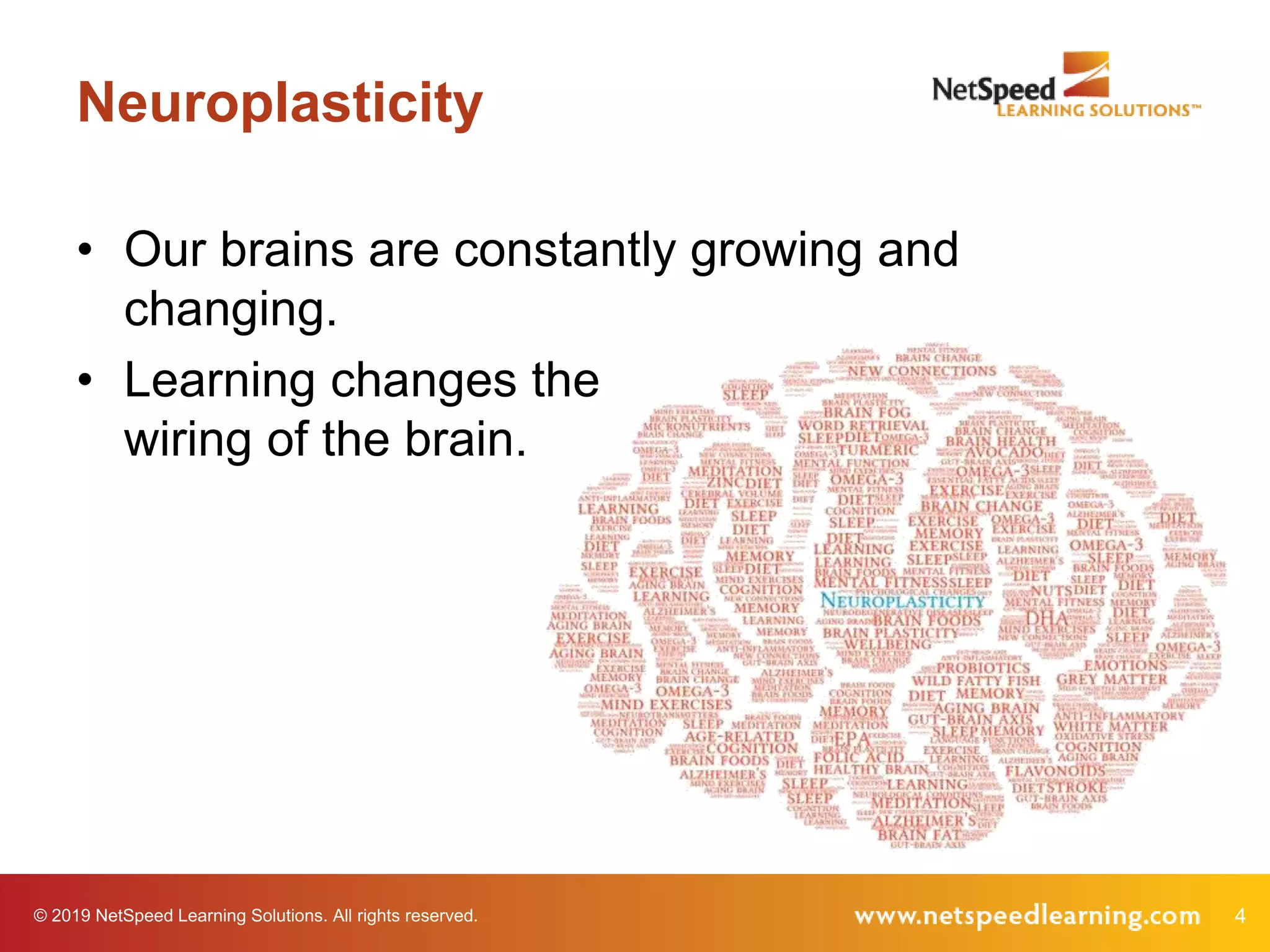
• Our brains are constantly growing and
changing.
• Learning changes the
wiring of the brain.
© 2019 NetSpeed Learning Solutions. All rights reserved. 5
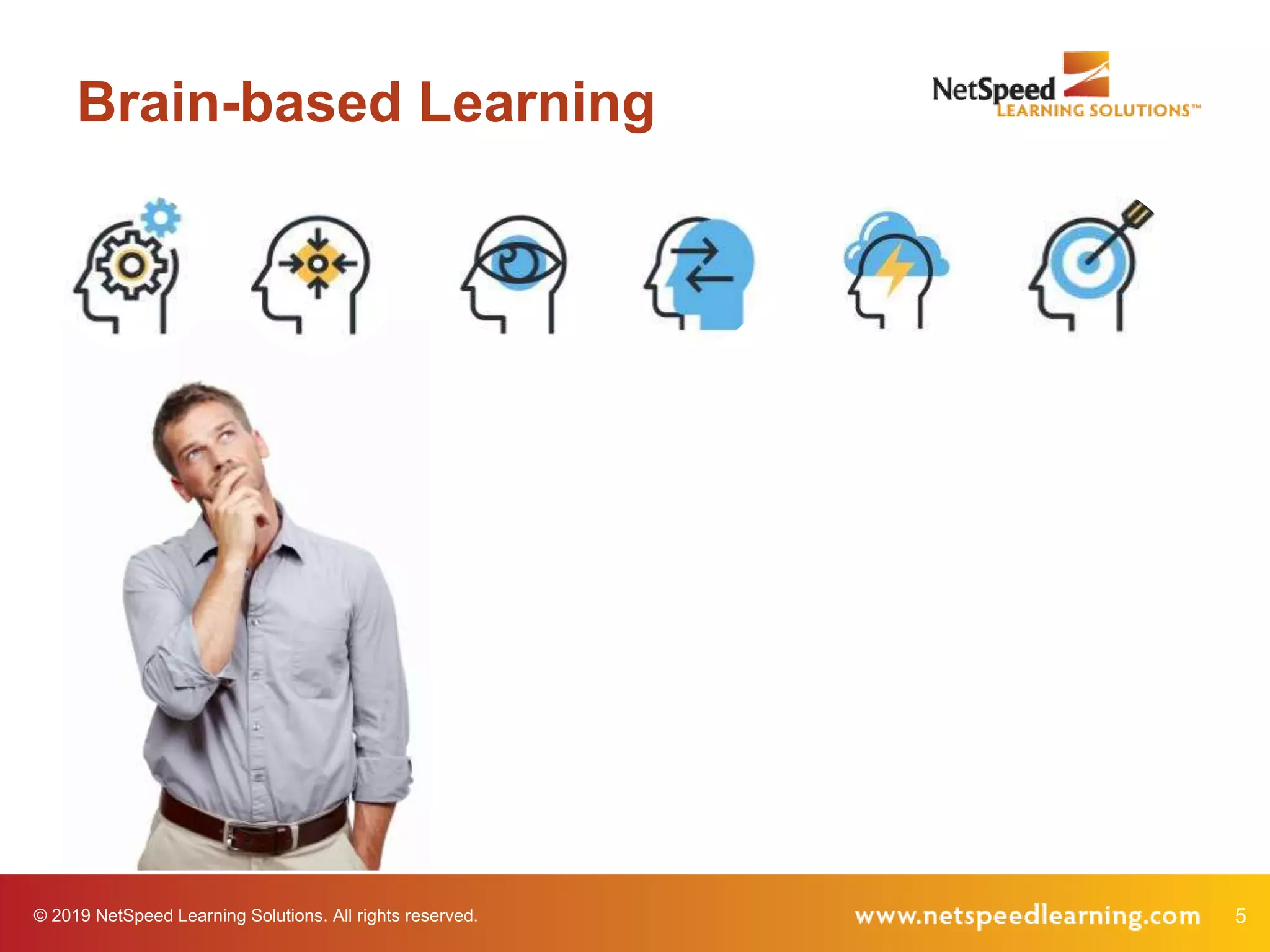
Brain-based Learning
© 2019 NetSpeed Learning Solutions. All rights reserved. 6
Brain-based Learning
Active engagement = active brains
© 2019 NetSpeed Learning Solutions. All rights reserved. 7
Brain-based Guideline #1
Active engagement
=
active brains
© 2019 NetSpeed Learning Solutions. All rights reserved. 8
Rate your Engagement
How would you rate your ability to actively
engage your learners in the virtual classroom?
© 2019 NetSpeed Learning Solutions. All rights reserved. 9
Example
© 2019 NetSpeed Learning Solutions. All rights reserved. 10
Example
© 2019 NetSpeed Learning Solutions. All rights reserved. 11
Example
© 2019 NetSpeed Learning Solutions. All rights reserved. 12
Example
© 2019 NetSpeed Learning Solutions. All rights reserved. 13
Example
© 2019 NetSpeed Learning Solutions. All rights reserved. 14
Brain-based Learning
Active engagement = active brains
Neurons that fire together wire together
© 2019 NetSpeed Learning Solutions. All rights reserved. 15
Brain-based Guideline #2
Neurons that fire together
wire together.
© 2019 NetSpeed Learning Solutions. All rights reserved. 16
Tell Me More
Neurons that fire together wire together.
What does this brain-based guideline tell us
about the way people learn in the virtual
classroom?
© 2019 NetSpeed Learning Solutions. All rights reserved. 17
Neurons Firing Together
• Increase multi-modal sensory learning
• Create context
• Begin with what the learner
already knows
• Use stories and metaphors
© 2019 NetSpeed Learning Solutions. All rights reserved. 18
How does this story demonstrate
the brain-based guideline,
“Neurons that fire together wire together?”
Neurons Firing Together
© 2019 NetSpeed Learning Solutions. All rights reserved. 19
How does this story demonstrate the brain-based
guideline, “Neurons that fire together wire together?”
Neurons Firing Together
© 2019 NetSpeed Learning Solutions. All rights reserved. 20
Quiz
• Multi-modal sensory learning aids memory and recall.
• New information must have context.
• Learning begins with what the learner already knows.
• Moderate stress is required for learning.
• Stories and metaphors help learners make
connections.
Which element is not related to the brain-based
guideline “Neurons that fire together wire
together.”
© 2019 NetSpeed Learning Solutions. All rights reserved. 21
Brain-based Learning
Active engagement = active brains
Neurons that fire together wire together
Vision trumps all other senses
© 2019 NetSpeed Learning Solutions. All rights reserved. 22
Vision trumps all other senses.
Brain-based Guideline #3
If you understand that “Vision trumps all other
senses,” what will you do in the virtual classroom?
© 2019 NetSpeed Learning Solutions. All rights reserved. 23
This is a visual medium
© 2019 NetSpeed Learning Solutions. All rights reserved. 24
Marine Debris
• There are 5.25 trillion pieces of plastic debris in
the ocean.
• 269,000 tons of plastic float on the surface.
• 100,000 marine creatures a year die from plastic
entanglement.
• 1 million seabirds die each year
© 2019 NetSpeed Learning Solutions. All rights reserved. 25
5.25 trillion pieces of plastic debris
© 2019 NetSpeed Learning Solutions. All rights reserved. 26
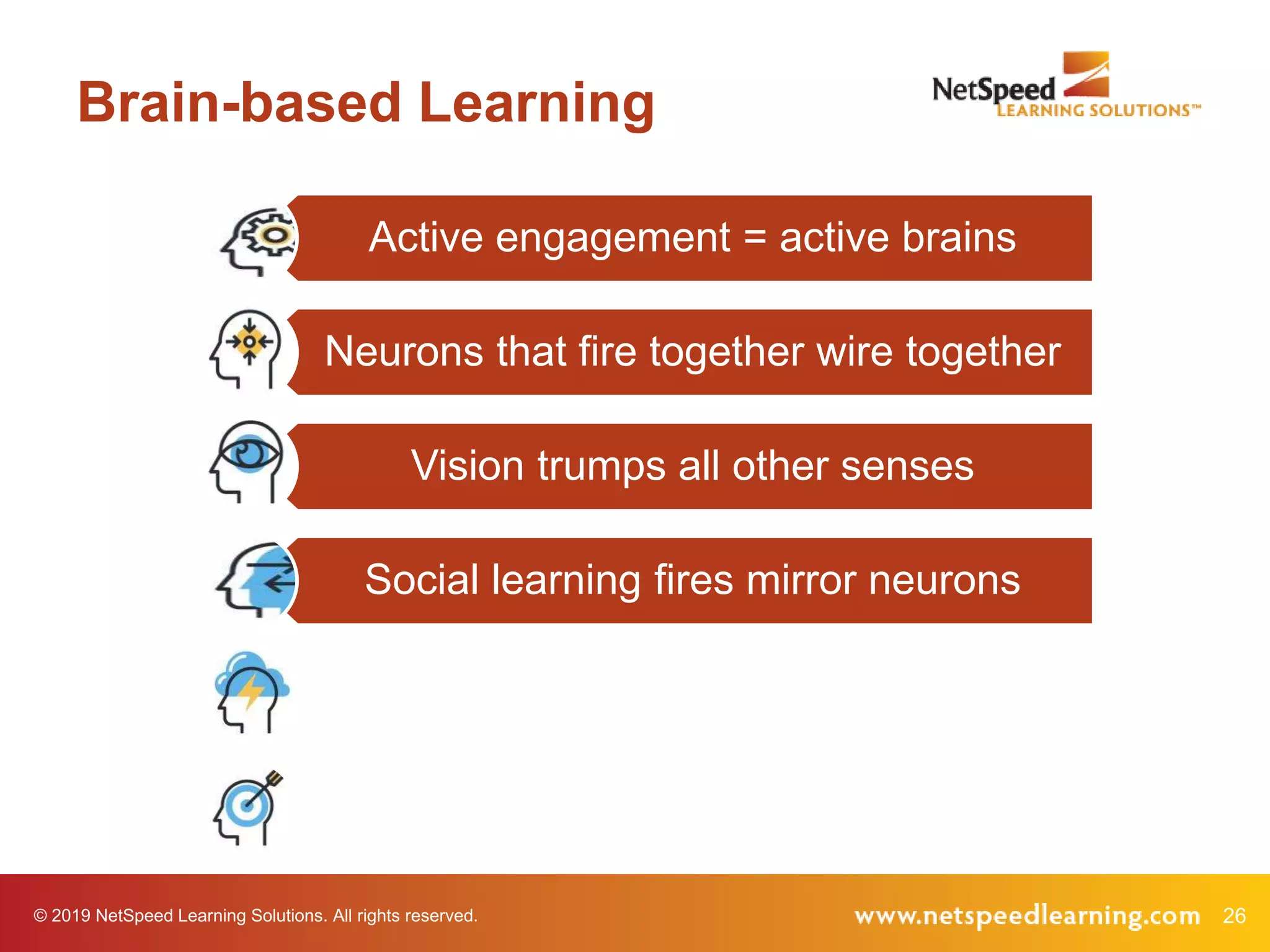
Brain-based Learning
Active engagement = active brains
Neurons that fire together wire together
Vision trumps all other senses
Social learning fires mirror neurons
© 2019 NetSpeed Learning Solutions. All rights reserved. 27
Brain-based Guideline #4
Social learning
fires mirror neurons.
© 2019 NetSpeed Learning Solutions. All rights reserved. 28
Social Learning
“People learn from one another, sometimes without even
realizing that they are doing so. With the increasing shift
from face-to-face meetings and events to virtual and
digital formats, careful thought must be given to how we
build human interaction into learning solutions.”
The Maritz Institute
© 2019 NetSpeed Learning Solutions. All rights reserved. 29
Emotions
“There can be no
knowledge without
emotion….To the
cognition of the brain
must be added the
experience of the soul.”
Arnold Bennett
© 2019 NetSpeed Learning Solutions. All rights reserved. 30
Implications
What are the implications of this brain-based
guideline (Social learning fires mirror neurons) in
the virtual classroom?
© 2019 NetSpeed Learning Solutions. All rights reserved. 31
• Stimulate emotional engagement
• Use visuals, stories, novelty and humor
• Encourage social collaboration, practice and
application
• Exhibit positive energy
and enthusiasm
• Avoid negatively
charged emotional
states
Implications
© 2019 NetSpeed Learning Solutions. All rights reserved. 32
Leadership Example
© 2019 NetSpeed Learning Solutions. All rights reserved. 33
What was your emotional response to watching
this video?
What leadership qualities
are demonstrated?
Example
© 2019 NetSpeed Learning Solutions. All rights reserved. 34
Brain-based Learning
Active engagement = active brains
Neurons that fire together wire together
Vision trumps all other senses
Social learning fires mirror neurons
No pain – No gain
© 2019 NetSpeed Learning Solutions. All rights reserved. 35
Brain-based Guideline #5
Failure precedes success.
© 2019 NetSpeed Learning Solutions. All rights reserved. 36
Goldilocks Rule
© 2019 NetSpeed Learning Solutions. All rights reserved. 37
What are the implications of this brain-based rule
in our virtual classroom designs?
No Pain. No Gain.
© 2019 NetSpeed Learning Solutions. All rights reserved. 38
Brain-based Learning
Active engagement = active brains
Neurons that fire together wire together
Vision trumps all other senses
Social learning fires mirror neurons
No pain – No gain
Practice makes permanent
© 2019 NetSpeed Learning Solutions. All rights reserved. 39
Practice makes
permanent.
Brain-based Guideline #6
© 2019 NetSpeed Learning Solutions. All rights reserved. 40
Delegating Example
© 2019 NetSpeed Learning Solutions. All rights reserved. 41
Example
© 2019 NetSpeed Learning Solutions. All rights reserved. 42
Example
© 2019 NetSpeed Learning Solutions. All rights reserved. 43
1. Review steps
2. Model or demonstrate
3. Have participants reflect
4. Apply (practice)
5. Observe and share
feedback
6. Use on the job
7. Report results to peers
Practice Makes Permanent
© 2019 NetSpeed Learning Solutions. All rights reserved. 44
Brain-based Learning
Active engagement = active brains
Neurons that fire together wire together
Vision trumps all other senses
Social learning fires mirror neurons
No pain – No gain
Practice makes permanent
© 2019 NetSpeed Learning Solutions. All rights reserved. 45
Taking Action
What Insights or Actions will you take from this
webinar today?
© 2019 NetSpeed Learning Solutions. All rights reserved. 46
Virtual Facilitator Training
• Deep dive, comprehensive course
• Focused on virtual design and delivery
• Public courses offered six times/year
• Customized for private delivery in your web
conference platform
47
Thank You!
6245 36th Ave NE, Seattle, Washington 98115

Brain-Based Learning Principles for Engagement in the Virtual Classroom

  • 1.
    © 2019 NetSpeedLearning Solutions. All rights reserved. 1 Brain-based Principles for Engagement in the Virtual Classroom March 26, 2019
  • 2.
    © 2019 NetSpeedLearning Solutions. All rights reserved. 2 Webinar Objectives • Apply six brain-based guidelines in your next web workshop • Increase novelty, contrast, meaning, and emotion in the virtual classroom • Take away an infographic to reinforce brain-based learning approaches
  • 3.
    © 2019 NetSpeedLearning Solutions. All rights reserved. 3 Purpose Poll What do you hope to gain from participating in this webinar?
  • 4.
    © 2019 NetSpeedLearning Solutions. All rights reserved. 4 Neuroplasticity • Our brains are constantly growing and changing. • Learning changes the wiring of the brain.
  • 5.
    © 2019 NetSpeedLearning Solutions. All rights reserved. 5 Brain-based Learning
  • 6.
    © 2019 NetSpeedLearning Solutions. All rights reserved. 6 Brain-based Learning Active engagement = active brains
  • 7.
    © 2019 NetSpeedLearning Solutions. All rights reserved. 7 Brain-based Guideline #1 Active engagement = active brains
  • 8.
    © 2019 NetSpeedLearning Solutions. All rights reserved. 8 Rate your Engagement How would you rate your ability to actively engage your learners in the virtual classroom?
  • 9.
    © 2019 NetSpeedLearning Solutions. All rights reserved. 9 Example
  • 10.
    © 2019 NetSpeedLearning Solutions. All rights reserved. 10 Example
  • 11.
    © 2019 NetSpeedLearning Solutions. All rights reserved. 11 Example
  • 12.
    © 2019 NetSpeedLearning Solutions. All rights reserved. 12 Example
  • 13.
    © 2019 NetSpeedLearning Solutions. All rights reserved. 13 Example
  • 14.
    © 2019 NetSpeedLearning Solutions. All rights reserved. 14 Brain-based Learning Active engagement = active brains Neurons that fire together wire together
  • 15.
    © 2019 NetSpeedLearning Solutions. All rights reserved. 15 Brain-based Guideline #2 Neurons that fire together wire together.
  • 16.
    © 2019 NetSpeedLearning Solutions. All rights reserved. 16 Tell Me More Neurons that fire together wire together. What does this brain-based guideline tell us about the way people learn in the virtual classroom?
  • 17.
    © 2019 NetSpeedLearning Solutions. All rights reserved. 17 Neurons Firing Together • Increase multi-modal sensory learning • Create context • Begin with what the learner already knows • Use stories and metaphors
  • 18.
    © 2019 NetSpeedLearning Solutions. All rights reserved. 18 How does this story demonstrate the brain-based guideline, “Neurons that fire together wire together?” Neurons Firing Together
  • 19.
    © 2019 NetSpeedLearning Solutions. All rights reserved. 19 How does this story demonstrate the brain-based guideline, “Neurons that fire together wire together?” Neurons Firing Together
  • 20.
    © 2019 NetSpeedLearning Solutions. All rights reserved. 20 Quiz • Multi-modal sensory learning aids memory and recall. • New information must have context. • Learning begins with what the learner already knows. • Moderate stress is required for learning. • Stories and metaphors help learners make connections. Which element is not related to the brain-based guideline “Neurons that fire together wire together.”
  • 21.
    © 2019 NetSpeedLearning Solutions. All rights reserved. 21 Brain-based Learning Active engagement = active brains Neurons that fire together wire together Vision trumps all other senses
  • 22.
    © 2019 NetSpeedLearning Solutions. All rights reserved. 22 Vision trumps all other senses. Brain-based Guideline #3 If you understand that “Vision trumps all other senses,” what will you do in the virtual classroom?
  • 23.
    © 2019 NetSpeedLearning Solutions. All rights reserved. 23 This is a visual medium
  • 24.
    © 2019 NetSpeedLearning Solutions. All rights reserved. 24 Marine Debris • There are 5.25 trillion pieces of plastic debris in the ocean. • 269,000 tons of plastic float on the surface. • 100,000 marine creatures a year die from plastic entanglement. • 1 million seabirds die each year
  • 25.
    © 2019 NetSpeedLearning Solutions. All rights reserved. 25 5.25 trillion pieces of plastic debris
  • 26.
    © 2019 NetSpeedLearning Solutions. All rights reserved. 26 Brain-based Learning Active engagement = active brains Neurons that fire together wire together Vision trumps all other senses Social learning fires mirror neurons
  • 27.
    © 2019 NetSpeedLearning Solutions. All rights reserved. 27 Brain-based Guideline #4 Social learning fires mirror neurons.
  • 28.
    © 2019 NetSpeedLearning Solutions. All rights reserved. 28 Social Learning “People learn from one another, sometimes without even realizing that they are doing so. With the increasing shift from face-to-face meetings and events to virtual and digital formats, careful thought must be given to how we build human interaction into learning solutions.” The Maritz Institute
  • 29.
    © 2019 NetSpeedLearning Solutions. All rights reserved. 29 Emotions “There can be no knowledge without emotion….To the cognition of the brain must be added the experience of the soul.” Arnold Bennett
  • 30.
    © 2019 NetSpeedLearning Solutions. All rights reserved. 30 Implications What are the implications of this brain-based guideline (Social learning fires mirror neurons) in the virtual classroom?
  • 31.
    © 2019 NetSpeedLearning Solutions. All rights reserved. 31 • Stimulate emotional engagement • Use visuals, stories, novelty and humor • Encourage social collaboration, practice and application • Exhibit positive energy and enthusiasm • Avoid negatively charged emotional states Implications
  • 32.
    © 2019 NetSpeedLearning Solutions. All rights reserved. 32 Leadership Example
  • 33.
    © 2019 NetSpeedLearning Solutions. All rights reserved. 33 What was your emotional response to watching this video? What leadership qualities are demonstrated? Example
  • 34.
    © 2019 NetSpeedLearning Solutions. All rights reserved. 34 Brain-based Learning Active engagement = active brains Neurons that fire together wire together Vision trumps all other senses Social learning fires mirror neurons No pain – No gain
  • 35.
    © 2019 NetSpeedLearning Solutions. All rights reserved. 35 Brain-based Guideline #5 Failure precedes success.
  • 36.
    © 2019 NetSpeedLearning Solutions. All rights reserved. 36 Goldilocks Rule
  • 37.
    © 2019 NetSpeedLearning Solutions. All rights reserved. 37 What are the implications of this brain-based rule in our virtual classroom designs? No Pain. No Gain.
  • 38.
    © 2019 NetSpeedLearning Solutions. All rights reserved. 38 Brain-based Learning Active engagement = active brains Neurons that fire together wire together Vision trumps all other senses Social learning fires mirror neurons No pain – No gain Practice makes permanent
  • 39.
    © 2019 NetSpeedLearning Solutions. All rights reserved. 39 Practice makes permanent. Brain-based Guideline #6
  • 40.
    © 2019 NetSpeedLearning Solutions. All rights reserved. 40 Delegating Example
  • 41.
    © 2019 NetSpeedLearning Solutions. All rights reserved. 41 Example
  • 42.
    © 2019 NetSpeedLearning Solutions. All rights reserved. 42 Example
  • 43.
    © 2019 NetSpeedLearning Solutions. All rights reserved. 43 1. Review steps 2. Model or demonstrate 3. Have participants reflect 4. Apply (practice) 5. Observe and share feedback 6. Use on the job 7. Report results to peers Practice Makes Permanent
  • 44.
    © 2019 NetSpeedLearning Solutions. All rights reserved. 44 Brain-based Learning Active engagement = active brains Neurons that fire together wire together Vision trumps all other senses Social learning fires mirror neurons No pain – No gain Practice makes permanent
  • 45.
    © 2019 NetSpeedLearning Solutions. All rights reserved. 45 Taking Action What Insights or Actions will you take from this webinar today?
  • 46.
    © 2019 NetSpeedLearning Solutions. All rights reserved. 46 Virtual Facilitator Training • Deep dive, comprehensive course • Focused on virtual design and delivery • Public courses offered six times/year • Customized for private delivery in your web conference platform
  • 47.
    47 Thank You! 6245 36thAve NE, Seattle, Washington 98115

Editor's Notes

  • #17 What does this brain-based guideline tell us about the way people learn in the virtual classroom? Multi-modal sensory learning aids memory New information must have context Learning begins with what the learner already knows Stories, analogies and metaphors help learners make connections All of the above
  • #18 What does this brain-based guideline tell us about the way people learn in the virtual classroom? Multi-modal sensory learning aids memory and recall. New information must have context. Learning begins with what the learner already knows Stories, analogies and metaphors help learners make connections All of the above
  • #19 This story demonstrates one aspect of the brain guideline: Neurons that Fire Together Wire Together. A teacher was trying to help her students learn to read aloud effectively. She explained that one should pause at a comma, come to a full stop at a period, and sound emphatic when an exclamation mark appeared at the end of a sentence. Despite her explanations, her students continued to race through their reading with few pauses, full stops, or emphasis. Finally, exasperated, she had them put on their coats and take their reading outside. There she had them walk while they read. She told them to pause and physically slow down when they came to a comma. They had them stop dead in their tracks when they came to a period. She had them jump up and down when they hit an exclamation point. After 15 minutes of practice, she brought the students back inside. From that day forward, they remembered to pause at commas, stop at periods, and emphasize sentences with exclamation marks.
  • #20 One more story: Two years ago, I took my two teenaged daughters to Washington, D.C. and Williamsburg. I dragged them to national monuments, national parks, museums, Civil War battlefields, and Civil War cemeteries. We visited the monument for General George Pickett, an ancestor on my mother’s side, who fought for the south in the Civil War. These are Grayce and Jessica’s feet at the site of the Lincoln Memorial where Martin Luther King, Jr. gave his famous, “I Have a Dream” speech. To say that my teenagers were reluctant tourists is an understatement. I listened to a lot of complaining. So imagine my delight when my older daughter Grayce called me this past week with excitement in her voice, “Mom, we’re studying the Civil War in American History! I’ve been to all of the places we’re talking about! There are pictures of the Lincoln Memorial in our textbook! I’ve been there! I’m reading about General Pickett! This is so cool! Now I know why you wanted us to see those monuments and battle fields! I told my teacher that my family is related to General Pickett.”
  • #21 Neurons that Fire Together Wire Together Multi-modal sensory learning aids memory and recall. New information must have context. Learning begins with what the learner already knows. Stories and metaphors help learners make connections.
  • #28 The notion of mirror neurons was first observed by scientists studying monkeys. Scientists now think that humans as babies begin to recognize social behavior within the first hour of life, trying to match gestures and mirroring facial expressions. The mirror neuron system plays a part in our ability to imitate others, speak a language, feel and show empathy, and understand the behavior of others.
  • #30 Arnold Bennett was an English playwright and novelist who wrote in the late 1800’s. Mirror neurons and emotions are strong connected. Where we once thought that the brain understood and interpreted the behavior and actions of others through logical thought, scientists now believe that we understand, not through thinking but through feeling.
  • #32 These are all ways to capture and keep attention so that people aren’t tempted to multi-task.
  • #33 Derek Redmond at the Barcelona Olympics in 1992.
  • #36 Another way to say this is “Failure precedes success.” Now the interesting thing about this brain-based guideline is that you want to support each learner’s competence, confidence, and ability to learn while at the same time creating a safe space to fail and learn from that failure.
  • #37 Not too much stress (or we trigger negative emotions and shut down learning) Not too little stress (or people get bored and start multi-tasking) But just the right amount of discomfort (so we engage interest and attention)
  • #40 Practice creates new neural pathways, eventually creating “shortcuts” to answers. The trick is that we first must practice the right things and we must receive feedback so we can adjust and improve.